• 검색 결과가 없습니다.

The Relationship between Employees' General Characteristics, Workplace Harassment, and Turnover Intent in the Deluxe Hotel

N/A
N/A
Protected

Academic year: 2021

Share "The Relationship between Employees' General Characteristics, Workplace Harassment, and Turnover Intent in the Deluxe Hotel"

Copied!
9
0
0

로드 중.... (전체 텍스트 보기)

전체 글

(1)

¶ Corresponding Author: Hye Hyun Yoon, Dept. of Culinary and Service Management, Kyung Hee University, 26 Kyungheedaero, Dongdaemoon-gu, Seoul 02447, Korea. Tel: +82-2-961-9403, Fax: +82-2-964-2537 E-mail: [email protected]

Culinary Science & Hospitality Research. 2016;22(1):117-125.

https://cshr.jams.or.kr/ ISSN  2466‐0752  (Print) ISSN  2466‐1023  (Online)

The Relationship between Employees’ General

Characteristics, Workplace Harassment, and Turnover Intent in the Deluxe Hotel

Hyo Sun Jung, Jin Lee and Hye Hyun Yoon

Dept. of Culinary and Service Management, Kyung Hee University

ABSTRACT: This study investigated workplace harassment perceived by deluxe hotel employees, exam- ined its effect on their turnover intent, and verified difference in workplace harassment perception ac- cording to demographics and job characteristics. Based on total 248 samples obtained from the empirical research, this study reviewed reliability and validity using SPSS program. The hypothesized relationships in the model were tested simultaneously by using regression analysis. The major findings are as follows.

First, the disrespectful behavior(β=.362), verbal aggression(β=.336), and physical aggression(β=.135) among workplace harassment have positive effect on turnover intent. Also, according to the result of examining differences in perception of workplace harassment in accordance with employees' demographics and job characteristics, the average values of those in their 20s and those whose working experience was five years or shorter were lowest and they were most exposed to workplace harassment. Limitations and future research directions are also discussed.

Keywords: workplace harassment, turnover intent, general characteristics, deluxe hotel

INTRODUCTION

Workplace harassment is behaviors which give mental and physical pain or aggravates the work- place environment beyond appropriate scope of tasks based on superiority within a job[1]. Such be- haviors include physical attacks such as violence and bodily harm, mental attacks such as threat, insult, and abusive language, severance from relationship such as isolation and disregard, excessive demand forcing impossible behaviors, demand ordering what is too distant from capabilities and experiences, and infiltration in individual areas excessively intervening in private matters[2]. Many companies in Korea tend to consider their employees servants regarding their customers kings but in advanced countries there are

in many cases where workplace harassment is con- sidered a social crime[3]. The reason is that insulting language in work places degrades services to cus- tomers, which decreases performance and values of companies[4]. Therefore, workplace harassment em- ployees undergo in their working situations triggers negative outcomes to workers and their organiza- tion such as excessive absence or job change[5, 6], low productivity[7], and poisonous working environ- ment[8]. Through such results, it can be inferred that in modern life work harassment at workplace may occur as a wide ranging social problem[9].

In particular deluxe hotels have military culture

where subordinates should obey superiors uncondi-

tionally[10], and in particular in the case of cooking

workers harassment and abuse are frequently occur-

(2)

ring due to working environment where they should work in silence and physical labor is needed for a long time[11,12]. It is inferred that immediate de- mand from customers should be resolved within a certain time without failure and as a result work pressure during peak hours increases and such pres- surizing working environment triggers harassment from superiors to subordinates[13,14]. However, de- spite such conditions, there is almost no research which examined workplace harassment in hotel em- ployees and research conducted on the hospitality industry has been done on very exploratory level [15]. The present study plans to measure workplace harassment by the degree perceived by employees and common opinion about harassment is that the scope of harassment should be determined by in- dividuals' interpretations because if one feels that one was harassed by somebody else, it is the very harassment[16]. Morever, 88.4% of quantitative ana- lyses[17] in research conducted thus far on bully or power harassment within a workplace conducted sur- vey based on employees' perception, which sup- ports the plan by the present study.

Such results will be able to be used as data to seek for practical measures to reduce harassment on an organizational level, not stopping at merely veri- fying workplace harassment perceived by hotel employees. The purposes of this study based on pre- vious research direction and results are as follows.

First, how is workplace harassment perceived by deluxe hotel employees? Power harassment exa- mined by dividing it into three factors-verbal ag- gression, physical aggression, and disrespectful be- haviors. Second, this study clarified how workplace harassment perceived by hotel employees affects turnover intent. Third, this study verified how work- place harassment perceived according to hotel em- ployees' demographics and job characteristics di- ffers.

BACKGROUND AND HYPOTHESES

Workplace Harassment and Turnover Intent As a study on workplace harassment and turnover intent, Ayko, Cakkab, and Hartel[5] noted that what workers experienced most among workplace harass- ment was disregard or exemption and as a result the

possibility of counterproductive behaviors was hei- ghtened. Mathisen, Einarsen, and Mykletun[18] ob- served that in a restaurant industry, workplace ha- rassment was a very prevalent behavior and dec- reased job satisfaction and increased turnover in- tent. In addition, Berthelsen, Skogstad, Lau, and Einarsen [19] as well insisted that a representative case of workplace harassment was exclusion from work and those who experienced workplace harass- ment had a high possibility of leaving their job and Deery, Walsh, and Guest[20] also noted that work- place harassment increased nurses' exhaustion and turnover intent. Bentley, Catley, Cooper-Thomas, Gardner, O’ Driscoll, Dale, and Trenberth[15] as well observed that those who suffered from workplace harassment had higher stress levels than those who did not and had higher intent to leave their organization. Glasø and Notelaers[21] found that workplace harassment related to employees' job de- creased their satisfaction and commitment and in- creased their intent to leave their organization.

Maclntosh[22] noted that 70% of women who expe- rienced workplace harassment quit their job and Sims and Sun[4] suggested that harassment occur- ring within a workplace decreased employees' sat- isfaction and enthusiasm and increased their turn- over intent. On The basis the following hypothesis was offered:

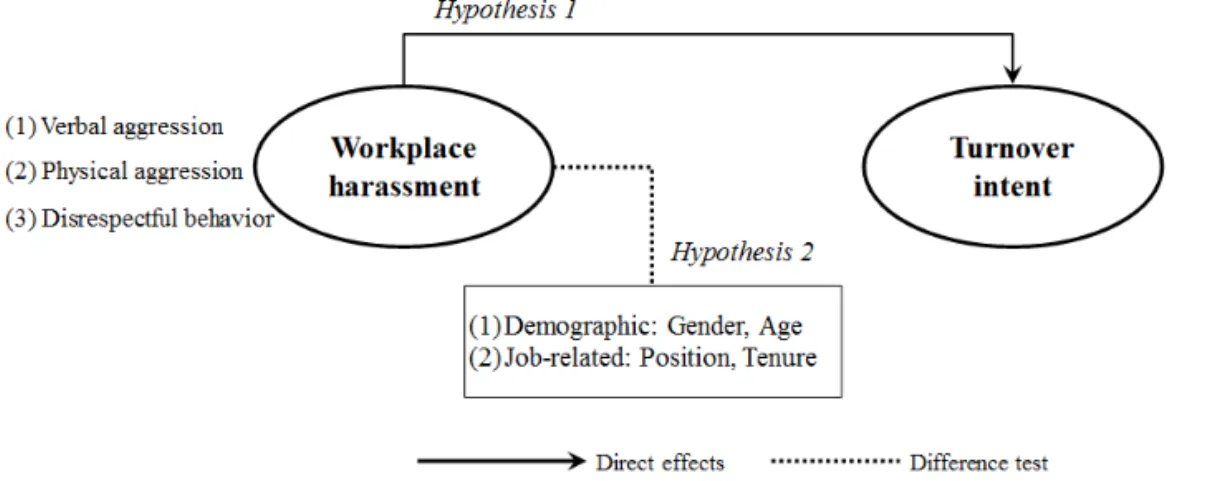
Hypothesis 1: Employees’ perceived workplace harassment(verbal aggression

a

, physical ag- gression

b

, and disrespectful behavior

c

) has a positive effect on employees’ turnover intent.

Workplace Harassment and General Characteris- tics among Hotel Employees

Research which examined relationship between

employees' demographics and job characteristics and

workplace harassment is as follows. As for gender,

McMahon[23] asserted the number of the cases

where male superiors harassed female subordinates

was largest and in the case of sexual harassment,

it was done largely by males[24]. Berdahl and Moore

[25] suggested that ethnic minority women had

more possibility to experience harassment compared

to white women and ethnic minority men and many

studies verified women more frequently recognized

(3)

Figure 1. A proposed model of the workplace and turnover intent.

they were harassed than men[26,27,28], and the rate of men's being accused due to harassment in work- place was higher than that of women's[29]. In re- search by Inness, Barling, and Turner[30] and Haines, Marchand, and Harvey[31], there was negative rela- tionship between age and workplace harassment. As for career among job related characteristics, harass- ment by superiors accounted for a majority[24] and Lopez, Hodson, and Roscigno[32] indicated that workplace harassment occurred more frequently when there was stable power in workplace. This rea- soning leads to the following hypothesis:

Hypothesis 2: Employees’ perceived workplace harassment is different between general cha- racteristics.

METHODOLOGY

Sample and Data Collection

The research hypotheses were tested with data collected through intercept surveys conducted at deluxe hotel in Seoul during June and July 2015.

Self-administered questionnaires were distributed to 350 employees of deluxe hotel. Respondents were asked voluntarily to fill out survey questionnaires and to return them directly to the survey admi- nistrator. Out of 279 collected, 248 surveys were usa- ble, giving a 71.0% response rate.

Measurement Development

The measures for all items in this study were

drawn from previous study. Work harassment were measured by 12 items on a 7-point scale(1: strongly disagree to 7: strongly agree), based on Rospenda, Richman, and Shannon[33] and Shannon, Rospenda, and Richman[34]. GWH(Generalized workplace hara- ssment) is awell-established workplace harassment measure encompassing 3 different harassments: (1) verbal aggression(e.g., hostile verbal exchanges cha- racterized by yelling or swearing); (2) physical ag- gression(e.g., being hit, pushed, or grabbed); and (3) disrespectful behavior(e.g., demeaning experiences such as being publicly humiliated or talked down to). Also, turnover intent were adapted by 5 items, based on Hom and Griffeth[35], Choi[36], and Jung and Yoon[37]. The items included “I will quit my job at my current organization in 1 year or less”, and

“‘I sometimes feel compelled to quit my job.” The data were analyzed with the SPSS version 22.0.

Descriptive statistics were used to describe the re- spondents’ demographic profiles, and multiple re- gression analysis was conducted to test the pro- posed research hypotheses.

RESULTS

Descriptive Statistics of Samples

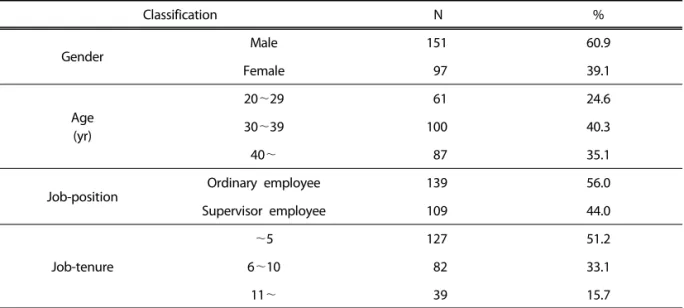
A total of 248 employees(See Table 1), 60.9% from

male and 39.1% from female. The majority of the

samples(40.3%) reported to the age group between

30~39, and the most employees(56.0%) to have

worked in ordinary employees. Also, a large number

of samples had worked in the hotel industry for 1~5

(4)

Classification N %

Gender

Male 151 60.9

Female 97 39.1

Age (yr)

20~29 61 24.6

30~39 100 40.3

40~ 87 35.1

Job-position

Ordinary employee 139 56.0

Supervisor employee 109 44.0

Job-tenure

~5 127 51.2

6~10 82 33.1

11~ 39 15.7

Table 1. General characteristics of samples (n=248)

years(51.2%), 33.1% for 6~10 years, and 15.7% for more than 10 years.

Validity and Reliability Test

Exploratory factor analysis(EFA) and reliability ana- lysis were used to judge the scale’s validity and reliability. As a result of the EFA, 4-factors explained 73.292% of the total cumulative and all the item’s factor loading, were above 0.6(See Table 2). A four- dimension solution retained in the following factor labels such as ‘verbal aggression’(factor 1, 4 items),

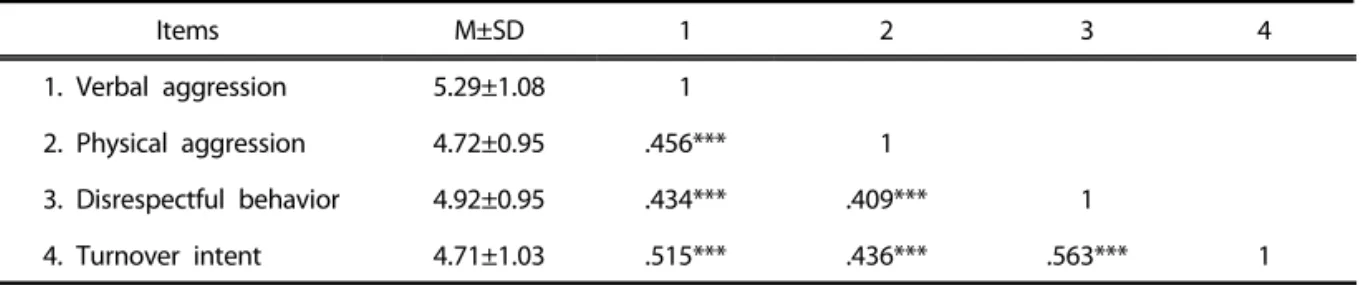
‘turnover intent’(factor 2, 4 items), ‘physical aggre- ssion’(factor 3, 4 items), and ‘disrespectful behav- ior’(factor 4, 4 items), respectively. A reliability analy- sis on the reflected an acceptable internal, con- sistency with Cronbach’s alpha at 0.900(verbal ag- gression), 0.876(physical aggression), 0.818(disre- spectful behavior), and 0.895(turnover intent). Also, Table 4 presented the correlations analysis for the factors. The factors used to assess verbal aggression, physical aggression, and disrespectful behavior were positively(+) related to the factors associated with turnover intent.

Hypothesis Test Regression Analysis

Since the main purpose of this study is to assess the direct impact of workplace harassment on turn- over intent, we used multiple regression analysis in-

stead of structural equation modeling. The regre- ssion analysis results with standardized coefficients are shown in Table 4.

Hypotheses 1 predict that workplace harassment has a positive impact on employees’ turnover intent.

Hypothesis 1

a

, which hypothesized a positive rela- tionship between verbal aggression(β=.336; t=5.995;

p<.001) among workplace harassment and turnover intent was supported. Hypotheses 1

b

, physical ag- gression(β=.135; t=2.442; p<.001) had a significantly positive association with turnover intent. Also, as proposed by Hl

c

, disrespectful behavior(β=.362; t=

6.625; p<.001) had a significantly positive effect on turnover intent. Overall workplace harassment di- mensions show significantly positive impact on em- ployees’ turnover intent. This showed the result that is consistent with previous studies[19,20,4], which verified positive causality with workplace harass- ment and turnover intent. Therefore hypothesis 1 was supported.

Difference Analysis

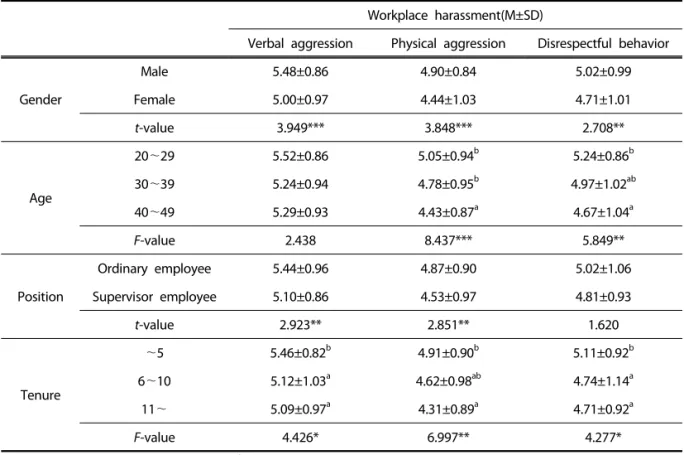
Table 5 shows the result of examining differences

in work harassment according to demographics and

job characteristics of employees. Regarding gender,

the average value of males was relatively higher

than that of females in all workplace harassment fac-

tors and there was significant difference in verbal

aggression(p<0.01), physical aggression(p<0.001), and

disrespectful behaviors(p<0.01). As for age, the aver-

(5)

Items Communalities Factor loading Cronbach’s alpha

F1 F2 F3 F4

WH

1

.799 .858 .148 .177 .100

.900

WH

2

.757 .806 .144 .239 .171

WH

3

.725 .791 .255 .138 .119

WH

4

.738 .775 .282 .146 .192

WH

5

.731 .332 .142 .773 .061

.876

WH

6

.755 .304 .143 .769 .226

WH

7

.819 .183 .161 .844 .216

WH

8

.706 .022 .255 .779 .184

WH

9

.684 .042 .208 .281 .748

.818

WH

10

.767 .368 .080 .138 .779

WH

11

.749 .024 .305 .157 .794

WH

12

.769 .358 .228 .124 .758

TI

1

.755 .378 .705 .222 .258

.895

TI

2

.720 .332 .711 .145 .289

TI

3

.705 .006 .818 .132 .136

TI

4

.689 .442 .650 .201 .174

TI

5

.693 .205 .689 .191 .164

Eigen value 7.802 1.769 1.586 1.303

% of variance 45.896 10.404 9.329 7.664

Note: Cumulative=73.292%; WH=workplace harassment; TI=turnover intent.

Table 2. Exploratory factor analysis

Items M±SD 1 2 3 4

1. Verbal aggression 5.29±1.08 1

2. Physical aggression 4.72±0.95 .456*** 1

3. Disrespectful behavior 4.92±0.95 .434*** .409*** 1

4. Turnover intent 4.71±1.03 .515*** .436*** .563*** 1

Note: *** p<.001(2-tailed).

Table 3. Correlation analysis

age value of those in their 20s was higher than those in their 30s and 40s and the average value of physical aggression and disrespectful behavior was higher in those in their 20s than those in their

40s. This was consistent with the result of study by

Inness, Barling, and Turner[30] and Haines, Mar-

chand, and Harvey[31] that the younger, the more

frequently one was afflicted by workplace harass-

(6)

Workplace harassment(M±SD)

Verbal aggression Physical aggression Disrespectful behavior

Gender

Male 5.48±0.86 4.90±0.84 5.02±0.99

Female 5.00±0.97 4.44±1.03 4.71±1.01

t-value 3.949*** 3.848*** 2.708**

Age

20~29 5.52±0.86 5.05±0.94

b

5.24±0.86

b

30~39 5.24±0.94 4.78±0.95

b

4.97±1.02

ab

40~49 5.29±0.93 4.43±0.87

a

4.67±1.04

a

F-value 2.438 8.437*** 5.849**

Position

Ordinary employee 5.44±0.96 4.87±0.90 5.02±1.06

Supervisor employee 5.10±0.86 4.53±0.97 4.81±0.93

t-value 2.923** 2.851** 1.620

Tenure

~5 5.46±0.82

b

4.91±0.90

b

5.11±0.92

b

6~10 5.12±1.03

a

4.62±0.98

ab

4.74±1.14

a

11~ 5.09±0.97

a

4.31±0.89

a

4.71±0.92

a

F-value 4.426* 6.997** 4.277*

Note: * p<.05, ** p<0.01, *** p<.001;

ab

Duncan’s multiple test.

Table 5. Difference analysis

Items β S.E. t-value

Constant - - .759

Verbal aggression .336 .062 5.995***

Physical aggression .135 .060 2.442*

Disrespectful behavior .362 .056 .6.625***

F-statistic 66.331***

R

2

.442

Note: * p<.05; *** p<.001.

Table 4. Regression analysis

ment. Regarding position, the average value of ordi- nary workers was higher than that of managers and there was significant difference in verbal aggression and physical aggression. With regard to tenure, there was significant difference in all factors like age.

The average value of those whose working experi- ence was 5 years or shorter was higher than those whose working experience was six years or longer,

which was similar to the result of research by Way-

ne[24], and Lopez et al[32] that harassment by supe-

riors was much. Resultantly, males, those in their

20s, employees, those whose working experience

was five years or shorter had the highest average

value in their degree of perception of harassment

within workplace. Based on this result, the hypothe-

sis 2 that there was significant difference in employ-

(7)

ees' degree of perceiving workplace harassment ac- cording to employees’ demographics and job cha- racteristics was supported.

CONCLUSION AND LIMITATION

This study examined workplace harassment per- ceived by deluxe hotel employees, examined its ef- fect on their turnover intent, and verified difference in workplace harassment perception according to demographics and job characteristics.

The major findings are as follows. First, the dis- respectful behavior(β=.362), verbal aggression(β=.336), and physical aggression(β=.135) among workplace harassment have positive effect on turnover intent.

Through this, it was found that the more employees perceived workplace harassment, the more their turnover intent was and the influence of disre- spectful behaviors was greatest on hotel employees' turnover intent. Second, according to the result of examining differences in perception of workplace harassment in accordance with employees' demo- graphics and job characteristics, the average values of those in their 20s and those whose working expe- rience was five years or shorter were lowest and they were most exposed to workplace harassment.

The academic meaning of this study was to ex- pand understanding of workplace harassment occurr- ing in deluxe hotel's working situation which has not been discussed much thus far. Moreover, the con- cept of harassment discussed thus far was dealt with in terms of sexual harassment and a majority of re- search was on ordinary businesses. Concentration on the more or less sensative topic of sexual harass- ment resulted in lack of research on the topic of har- assment prevalent in workplace. This study was able to emphasize that the understanding scope of the concept needed expansion into harassment by pow- er generated within an organization. In addition, this research was able to create an opportunity to raise the word power harassment and in this respect, this study is judged to be a chance to prompt additional research by discussing power harassment occurring in a job situation over a hotel organization as a whole. Moreover, this study will be able to provide specific suggestive points in seeking for policy re- sponses on a hotel level. In particular, in Japan, su-

perior types of power harassment are presented, employees' coping methods by each type are sought for, and how they are power harassed and the coping methods by each power harassment are depicted in detail so that employees may cope with such situations wisely. This study showed that ho- tel employees most perceived verbal harassment (5.29±1.08) among workplace harassment and re- sponded that they experienced turnover intent be- cause of disrespectful behaviors. It is judged that language purification education should be conduc- ted on employees on an organizational level, coach- ing and counseling programs should be activated with employees exposed to workplace harassment as subjects and management of workplace harass- ment should be systemically made. In addition, by presenting that open and respectful mutual commu- nications and appropriate encouragement through interaction with superiors are the most effective strategies for successful harassment management this study will be able to play an important role in effectively controlling workplace harassment on an organizational level.

This study is not free from limitations. First, result from the targeted employees were limited to Seoul in South Korea, which means that the results of the current study may not be generalizable to other geographic areas of South Korea or hotels world- wide. Second, it should be pointed out that the cur- rent study employed self-reported data. Third, this study did set limits of final dependent variable only to turnover intent. Future studies may want to adopt objective measures of job performance(e.g., satisfaction and commitment) and include more var- iables that explain performance.

ACKNOWLEDGEMENTS

This work was supported by the Ministry of Education of the Republic of Korea and the National Research Foundation of Korea (NRF-2015S1A5A2A- 01011977).

REFERENCES

[1] Rospenda KM, Richman JA (2004). Harassment

and discrimination. In: Barling J, Kelloway EK,

(8)

Frone MR, editors. Handbook of Work Stress. Th- ousand Oaks, CA: Sage Publications. 149-188.

[2] Einarsen S (2000). Harassment and bullying at work: a review of the Scandinavian approach.

Aggression and Violent Behavior 5(4):379-401.

[3] Low SZ (2012). Workplace harassment and coun- terproductive work behavior: A daily diary in- vestigation. California State University Master Th- eory 1-85.

[4] Sims RL, Sun P (2012). Witnessing workplace bul- lying and the Chinese manufacturing employee.

Journal of Managerial Psychology 27:9-26.

[5] Ayoko OB, Cakkab VJ, Hartel CE (2003). Work- place conflict, bullying, and counterproductive behaviors. International Journal of Organizational Analysis 11:283-301.

[6] Giebels E, Janssen O (2005). Conflict stress and reduced well-being at work: the buffering effect of third-party help. European Journal of Work and Organizational Psychology 14(2):137-155.

[7] Chen Y, Tjosvold D, Su Fang S (2005). Working with foreign managers: conflict management for effective leader relationships in China. Internatio- nal Journal of Conflict Management 16(3):265-286.

[8] Jonason PK, Slomski S, Partyka J (2012). The dark triad at work: how toxic employees get their way.

Personality and Individual Differences 52(3):449- 453.

[9] Nielsen MB, Matthiesen SB, Einarsen S (2010). The impact of methodological moderators on preva- lence rates of workplace bullying: A meta-analy- sis. Journal of Occupational and Organizational Psychology 83(4):955-979.

[10] Na YS, Cho SH, Lee OJ (2011). Effect of emo- tional labor and emotional dissonance on burn- out and turnover intention of hotel and food- service culinary employees; Focusing on the cu- linary-related service. Korean Journal of Culinary Research 17(3):104-116.

[11] Bloisi W, Hoel H (2008). Abusive work practices and bullying among chefs: a review of the literature. International Journal of Hospitality Ma- nagement 27:649-656.

[12] Kim YJ, Park YM, Yoon HH (2013). The effects of culinary food & beverage employees’ stress coping style on job satisfaction and customer orientation. Korean Journal of Culinary Research

19(3):156-172.

[13] Pratten JD, O’Leary B (2007). Addressing the cause of chef shortages in the UK. Journal of European Industrial Training 31(1):68-78.

[14] Na TG, Jeon IH (2010). The effects of workplace bullying on job satisfaction and turnover in- tention of kitchen employee in family restau- rant. Korean Journal of Culinary Research 16(5):

37-49.

[15] Bentley TA, Catley B, Cooper-Thomas H, Gardner D, O’Driscoll MP, Dale A, Trenberth L (2012).

Perceptions of workplace bullying in the New Zealand travel industry: prevalence and mana- gement strategies. Tourism Management 33(2):

351-360.

[16] Claybourn M (2011). Relationships between mo- ral disengagement, work characteristics and work- place harassment. Journal of Business Ethics 100:

283-301.

[17] Neall AM, Tuckey MR (2014). A methodological review of research on the antecedents and con- sequences of workplace harassment. Journal of Occupational and Organizational Psychology 87:

225-257.

[18] Mathisen GE, Einarsen S, Mykletun R (2008). The occurrences and correlates of bullying and ha- rassment in the restaurant sector. Scandinavian Journal of Psychology 49:59-68.

[19] Berthelsen M, Skogstad A, Lau B, Einarsen S (2011). Do they stay or do they go? a longitu- dinal study of intentions to leave and exclusion from working life among targets of workplace bullying. International Journal of Manpower 32:

178-193.

[20] Deery S, Walsh J, Guest D (2011). Workplace ag- gression: the effects of harassment on job burn- out and turnover intentions. Work Employment and Society 25(4):742-759.

[21] Glasø L, Notelaers G (2012). Workplace bullying, emotions, and outcomes. Violence and Victims 27:360-377.

[22] MacIntosh J (2012). Workplace bullying influen- ces women's engagement in the workforce.

Issues in Mental Health Nursing 33:762-768.

[23] McMahon L (2000). Bullying and harassment in

the workplace. International Journal of Contem-

porary Hospitality Management 12(6):384-387.

(9)

[24] Wayne JH (2000). Disentangling the power ba- ses of sexual harassment: comparing gender, age, and position power. Journal of Vocational Behavior 57:301-325.

[25] Berdahl JL, Moore C (2006). Workplace harass- ment: double jeopardy for minority women. Jo- urnal of Applied Psychology 91:426-436.

[26] Einarsen S, Skogstad A (1996). Bullying at work:

epidemiological findings in public and private organizations. European Journal of Work and Organizational Psychology 5(2):185-201.

[27] Worsfold P, McCann C (2000). Supervised work experience and sexual harassment. International Journal of Contemporary Hospitality Management 12(4):249-255.

[28] Vartia M, Hyyti J (2002). Gender differences in workplace bullying among prison officers. Euro- pean Journal of Work and Organizational Psy- chology 11:113-126.

[29] Claybourn M, Spinner B, Malcom K (2014). Work- place harassment: a test of definitional criteria derived from an analysis of research definitions and Canadian social definitions. International Journal of Law and Psychiatry 37(6):589-600.

[30] Inness M, Barling J, Turner N (2005). Understand- ing supervisor-targeted aggression: a within- person, between jobs design. Journal of Occupa- tional Health Psychology 90:731-739.

[31] Haines VY, Marchand A, Harvey S (2006). Cro- ssover of workplace aggression experiences in dual-earner couples. Journal of Occupational Heal- th Psychology 11:305-314.

[32] Lopez SH, Hodson R, Roscigno VJ (2009). Power, status, and abuse at work: general and sexual harassment compared. Sociological Quarterly 50:

3-27.

[33] Rospenda KM, Richman JA, Shannon CA (2006).

Patterns of workplace harassment, gender, and use of services: an update. Journal of Occupa- tional Health Psychology 11:379-393.

[34] Shannon CA, Rospenda KM, Richman JA (2007).

Workplace harassment patterning, gender, and utilization of professional services: findings from a US national study. Social Science and Medicine 64:1178-1191.

[35] Hom PW, Griffeth RW (1991). Structural equa- tions modeling a test of turnover theory: cross- sectional and longitudinal analyses. Journal of Applied Psychology 76:350-366.

[36] Choi HJ (2012). A study on core-self evaluation, service recovery performance, job satisfaction and turnover intention among hotel frontline staff. Korean Journal of Culinary Research 18(2):

118-133.

[37] Jung HS, Yoon HH (2012). The effects of culinary employees’ stress coping style on counterpro- ductive work behaviors and turnover intention in a deluxe hotel. Korean Journal of Culinary Re- search 18(3):32-45.

Received: 1 OCT, 2015

Revised: 4 JAN, 2016

Accepted: 11 JAN, 2016

수치

Figure 1. A proposed model of the workplace and turnover intent.
Table 1. General characteristics of samples (n=248)
Table 3. Correlation analysis
Table 4. Regression analysis

참조

관련 문서

This study the changes in structure and mechanical characteristics by the analysis on mechanical characteristics of the welding part and the post weld

Therefore, in this study, we investigate how workplace innovation affects workers' workplace learning and corporate performance for workers engaged in

  Investigation of turnover comes from the job itself and in this study worked in a care facility for the elderly, Caregiver Stress, Burnout comes from

Purpose: The aim of this study is to identify the relationship between knowledge and awareness of radiation department students and their intent in

For the relationship between these variables, this study analyzed the influence of parental rearing attitude on juvenile subjective well-being and examined

Altwork Station - Physically Conforming to the Needs of Humans in the Workplace

Moreover, this study examined the relationships between externalized and internalized maladaptive behaviours of adolescents on probation and analysed the

This study aims for investigating the relationship between the satisfaction based on one’s participation in physical education class and a physical self-concept