Print ISSN: 2288-4637 / Online ISSN 2288-4645 doi:10.13106/jafeb.2020.vol7.no10.073
1
First Author and Corresponding Author. Department of Management, Faculty of Economics and Business, Universitas Brawijaya, Malang, Indonesia [Postal Address: Jl. Veteran, Ketawanggede, Kec. Lowokwaru, Kota Malang, Jawa Timur 65145, Indonesia] Email: [email protected]
© Copyright: The Author(s)
This is an Open Access article distributed under the terms of the Creative Commons Attribution Non-Commercial License (https://creativecommons.org/licenses/by-nc/4.0/) which permits unrestricted non-commercial use, distribution, and reproduction in any medium, provided the original work is properly cited.
The Impact of Financial Inclusion on Economic Growth, Poverty, Income Inequality, and Financial Stability in Asia
Kusuma RATNAWATI
1Received: July 30, 2020 Revised: August 23, 2020 Accepted: September 03, 2020
Abstract
As an effort to achieve sustainable development and increase people’s welfare, financial inclusion has become the policy agenda of many countries. Therefore, the effect of financial inclusion on economic growth, poverty, income inequality, and financial stability in several countries in Asia has become the goal and this is the subject of this study. Financial inclusion is measured by 3 dimensions, namely banking penetration, access to banking services, and use of banking services. Poverty ratio below the national poverty line and the Gini coefficient are used as indicators of poverty and income inequality. Financial stability is measured by Bank Z-Score and bank nonperforming loans.
The results from the hypothesis test shows that all dimensions of financial stability simultaneously have significant influence on economic growth, poverty, income inequality, and financial stability. On the other hand, the partial impact of financial inclusion dimension on economic growth, poverty alleviation, income inequality, and financial stability in ten countries of Asia has not been optimal. The derived results of this study is required to be interpreted and considered by the Governments of each country in developing strategies for increasing financial inclusion, so that the policy to achieve sustainable development and enhancement of people’s welfare can be achieved.
Keywords: Financial Inclusion, Economic Growth, Poverty, Income Inequality, Financial Stability JEL Classification Code: O1, G2, I3
priority in many countries. Financial inclusion plays an important role in building a strong foundation of a country’s financial infrastructure, which in turn will facilitate its economic growth and development (Sharma, 2016). Policy makers in Asian countries have taken different steps to increase the access to financial service for those who are excluded from the financial sector. The government in Indonesia increases financial inclusion through the People’s Business Loans (KUR), E-Money, and microfinance service improvements. Thailand has two specialized institutions to achieve increased financial inclusion, namely the Village Fund and Bank for Agriculture and Agricultural Cooperatives (BACC). India applies several programs such as Agent Banking, Mobile Banking, and unique innovation such as Biometrical Scanning System (Asian Development Bank, 2014).
Steps to increase the access to financial services for all societies in various Asian countries has resulted in rapid expansion of financial inclusion over the past decade. The World Bank reported a very rapid increase in financial inclusion in several Asian countries. The financial inclusion index increased significantly in almost all countries in Asia,
1. Introduction
Financial inclusion has become a topic in the global policy agenda since early 2000. Many countries use financial inclusion as an effort to achieve more equitable economic growth (Collard, 2010). The United Nation (UN) set financial inclusion as one of the main goals in the Millennium Development Goals (MDG) to achieve sustainable development and improve the world welfare that is based on human rights and equality to encourage social, economic, and environmental development.
According to Pearce (2011), the importance of financial
inclusion is now widely recognized, even become a policy
such as in Malaysia which reached 80.7 in 2014, which is a increase of 14.5 percent from 2011; while in India and Indonesia it increased by 2 times in 2014 compared to 2011 (World Bank, 2015) (see Figure 1).
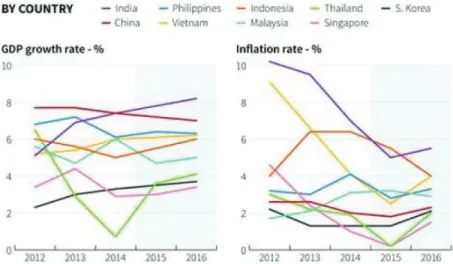
The main objective of financial inclusion programs carried out by countries in Asia is to encourage inclusive growth through reducing poverty, increasing development, income distribution, and financial system stability (Bank Indonesia, 2014). However, the rapid increase of financial inclusion in Asia in 2014 was not accompanied by an increase in economic growth; even some countries experienced an economic slowdown. The data of economic growth in Asia reported by the Asian Development Bank in Figure 1 shows the Gross Domestic Product (GDP) growth rate of several countries experienced a sharp decline in 2014.
In Figure 1, it can be seen that Thailand, Singapore, Indonesia, the Philippines, and several other countries experienced a decline in GDP growth rates as well as income inequality in 2014. Based on the data from the World Bank (2016) as presented in Figure 2(a), income inequality in the last few decades has increased in several Asian countries. This shows that the main objective of financial inclusion which theoretically can increase the economic growth and reduce income inequality is not in accordance with the phenomenon in Asia. On the other hand, poverty rates in several Asian countries have decreased significantly, as Figure 2(b) shows a drastic reduction in the ratio of poor population in Asia.
Thus, the increase of financial inclusion in Asia in the last few decades is accompanied by a reduction in poverty levels, which is consistent with the aims of financial inclusion (see Figure 2).
Figure 1: GDP Growth Rates in Several Countries in Asia Source: Asian Development Bank
a. Income Inequality b. Ratio of Poor Population
Figure 2: Income Inequality and Poverty of Several Asian Countries
Source: World Bank, 2016
This phenomenon shows that there is a gap between the theoretical purposes of financial inclusion with the real circumstances in Asia. Several studies have proven strong positive relationship between financial inclusion and economic growth (Kendall et al., 2010; Ghosh, 2011; Sarma
& Pais, 2011; Mihasonirina & Kangni, 2011; Masoud &
Hardaker, 2012; Demirguc-Kunt & Klapper, 2012; Sharma, 2016; Pradhan et al., 2016; Kim, Yu, & Hassan, 2018; Gul et al., (2018); Raza et al., 2019), while Naceur and Ghazouani (2007) and Khan (2011) shows that financial inclusion has a negative influence on economic growth.
Other studies also examine the relationship between financial inclusion, poverty, and income inequality in various countries with diverse methods and findings. Beck et al. (2007), Brune et al. (2011), Dixit and Ghosh (2013), Le and Nguyen (2020), and Sanjaya (2014) stated that financial inclusion can reduce poverty and income inequality.
Park and Mercado (2015), Schmied and Marr (2016), and Boukhatem (2016) also found empirical evidence of a negative relationship between financial inclusion, poverty, and income inequality. On the contrary, Dhrifi (2013), Seven and Coskun (2016), and Neaime and Gaysse (2018) found that financial inclusion does not have a significant influence on poverty and income inequality.
Likewise, there are different findings on the relationship between financial inclusion and financial stability. Hanning and Jansen (2010), Prasad (2010), Morgan and Pontines (2014), Dienillah and Anggraeni (2016), Ozili (2018), Neaime and Gaysse (2018), and Ahamed and Mallick (2019) found that financial inclusion positively influences financial stability. Sanusi (2011) argues that there is no economy that can achieve financial stability, economic sustainability, and inclusive growth without achieving a high level of financial inclusion. Different results on the impact of financial inclusion and financial system stability were obtained by Khan (2011) and Mehrotra and Yetman (2015) who stated that financial inclusion negatively influenced financial stability. In addition, Dupas et al. (2012) added that the increase in banking services did not cause an increase in financial stability because it was not followed by a decrease in borrowing costs for the lower middle class as well as an increase in service quality, and lack of trust.
The phenomenon of the increase of a quite rapid financial inclusion in Asia that is not accompanied by increased economic growth and reduction of income inequality, as well as inconsistent research findings and the lack of comprehensive research that examines the impact of financial inclusion on economic growth, poverty, income inequality, and financial stability becomes the main basis for the author to examine the influence of financial inclusion toward economic growth, poverty, income inequality, and financial stability in Asia. The results of this study will help policy makers to design and implement programs that will
expand access to financial services, which lead to increased economic growth, poverty reduction, income distribution, and financial stability, which in turn will be able to help achieve sustainable development.
2. Literature Review
2.1. Financial Inclusion and Economic Growth Economic growth is an achievement through a process supported by various sectors in the economy, one of which is the financial sector. There are four roles of the financial sector that are beneficial for the economy, namely: (1) being able to reduce risk; (2) mobilize savings; (3) reduce transaction and information costs; and (4) encourage specialization (Levine, 2005). Furthermore, Fabya (2011) added that the financial sector is able to provide borrowers various financial instruments with high quality and low risk, which ultimately will accelerate economic growth.
Several studies have examined the relationship between financial inclusion and economic growth. Kendall et al.
(2010) and Ghosh (2011) evaluate the role of financial access in economic growth with the data from Indian sub- national level which proves the positive impact of access to financial services and use of financial services on economic growth in India. Mihasonirina and Kangni (2011) also found the significance of financial inclusion and communication technology toward economic growth. Martinez et al. (2011) argued that access to finance is an important policy tool used by governments and policy makers to stimulate economic growth. By making finance available and affordable for all economic agents, it will affect the growth of economic activities that will increase the output. Sarma and Pais (2011) found empirical evidence of a relationship between financial inclusion and economic growth using data from 49 countries. Falahaty and Hook (2013) showed that financial development is a significant determinant of economic growth. This finding shows that improving the function of the banking sector is very crucial to spur economic growth.
Law, Azman-Saini, and Hui (2014) emphasized that a well- developed financial system is essential for economic growth.
Furthermore, Sarma (2016) continued the study by analyzing the causality relationship between various dimensions of financial inclusion and economic growth, which proves that there is a two-way causality relationship between access to banking services and economic growth. Recently, Pradhan et al. (2016), Kim et al. (2018), and Raza et al. (2019) proved that there is a significant positive relationship between financial inclusion and economic growth.
On the contrary, Naceur and Ghazounai (2007)
examined the relationship between financial development
and economic growth for 11 countries in the Middle East
and North Africa and found that bank development has a
negative influence on economic growth. Khan (2011) also showed that financial inclusion has a negative influence on economic growth. Financial inclusion can lower loan standards because financial institutions are trying to reach the lower community by lowering loan terms, but it can also increase the risk of a bank’s reputation, as several countries lower the standard of establishing financial institutions for rural areas.
2.2 Financial Inclusion, Poverty, and Income Inequality
Financial inclusion can lift the financial condition and standard of living of poor and reduce income inequality (Beck et al, 2007). According to Brune et al. (2011), saving allows families to increase their capacity to absorb financial shocks, smooth consumption, accumulate assets, and invest in health and education. Access to financial services has the potential to remove the poor from the cycle of poverty through a culture of saving and creating efficient and low- cost payment mechanisms (Dixit & Ghosh, 2013). Sanjaya (2014) obtained results that financial inclusion through micro credit programs can improve social and economic status of the poor. Park and Mercado (2015) found empirical evidence of a negative relationship between financial inclusion, poverty, and income inequality. Boukhatem (2016) investigated the contribution of financial development level on poverty reduction in 67 low and middle income countries during 1988-2012 and found that the increase of financial development directly influences poverty reduction.
Dhrifi (2013) obtained different findings that financial development encourages economic growth and reduces poverty in middle and high income countries, while in low- income countries, the financial system does not have positive influence on economic growth. On the other hand, Nguyen et al. (2020) conducted research in Vietnam and found that economic growth positively contributes to poverty reduction. Seven and Coskun (2016) stated that although financial development encourages economic growth, it does not necessarily benefit low-income people in developing countries, as they found that financial inclusion does not play an important role in poverty reduction. The latest research conducted by Neaime and Gaysse (2018) found that financial inclusion does not have significant influence toward poverty.
2.2. Financial Inclusion and Financial Stability Financial inclusion can have both positive and negative influences on financial stability. The positive influence includes diversification of bank assets, increasing stability of deposit base, and increased monetary policy transmission,
while the negative influence includes a decrease in loan standards, bank reputation risk, and inadequate regulations.
Hannig and Jansen (2010) argued that financial inclusion also has the potential to improve financial stability, because poor people’s access to formal financial institutions’ savings can increase household capacity to manage financial vulnerabilities caused by the adverse effects of the crisis, diversify the funding base from financial institution that can reduce shocks when global crisis occur, increases economic resilience by accelerating growth, facilitate diversification, and reduce poverty. Prasad (2010) added that at the state level, financial inclusion can increase efficiency in financial intermediation through domestic savings and increase in investment to encourage financial stability. Aduda and Kulanda (2012) examined financial inclusion and financial stability in Kenya, and found that financial inclusion is a perquisite for economic growth and development because various financial programs have an impact on Kenya’s financial stability. Morgan and Pontines (2014) stated that an increase in availing by SMEs will increase financial stability. According to Dienillah and Anggraeni (2016), the increase of financial inclusion, banking assets, GDP per capita, and portfolio investment can be a good strategy to improve financial stability. Neaime and Gaysse (2018), Ahmed and Mallick (2019), and Pham and Doan (2020) stated that the increase of financial inclusion positively contributes to financial stability.
Khan (2011) and Dupas et al. (2012) obtained different results regarding the relationship between financial inclusion and financial stability. Financial inclusion has a negative influence on financial stability, as it can reduce loan standards because financial institutions try to reach the lower-income groups by lowering loan terms (Khan, 2011). Dupas et al. (2012) found that an increase in banking services in Kenya does not lead to an increase in financial stability because it is not followed by a decrease in borrowing costs for the lower-middle-class, increase in service quality, and because there is a lack of trust.
Financial inclusion achieved through rapid loan growth or fund intermediation that is not accompanied by proper regulation can negatively influence financial stability (Mehrotra & Yetman, 2015). Based on the literature review, the hypothesis proposed in this study is:
H1. Financial Inclusion (banking penetration, access to banking services, and use of banking services) significantly influences Economic Growth in Asia.
H2. Financial Inclusion (banking penetration, access to banking services, and use of banking services) significantly influences Poverty in Asia.
H3. Financial Inclusion (banking penetration, access to
banking services, and use of banking services) significantly
influences Income Inequality in Asia.
H4a. Financial Inclusion (banking penetration, access to banking services, and use of banking services) significantly influences Financial Stability (bank non-performing loans to total gross loans) in Asia.
H4b. Financial Inclusion (banking penetration, access to banking services, and use of banking services) significantly influences Financial Stability (Bank Z-Score) in Asia.
3. Research Method
The object of this study is 10 developing countries in Asia: Afghanistan, Bangladesh, Brunei Darussalam, India, Indonesia, Malaysia, Pakistan, Philippines, Singapore, and Thailand, which are selected on the basis of the Financial Inclusion Index published by the International Monetary Fund (IMF). The research period is based on the year after the crisis to the availability of the latest data, namely 2009-2018.
The independent variable of this study is Financial Inclusion (X), which consists of banking penetration (X
1), indicated by population who has bank account; access to banking services (X
2), indicated by number of bank office and ATMs spread across an area; and use of banking services (X
3), indicated by amount of deposits and loans extended. The dependent variable used is economic growth (Y
1), indicated by GDP per capita growth; poverty (Y
2), indicated by the ratio of poverty numbers below the national poverty line (% of total population); income inequality (Y3), indicated by Gini coefficient; and financial stability (Z), indicated by bank Z-score and bank nonperforming loans to total gross loans. The data used in this study is annual secondary data collected from the World Bank, International Monetary Fund (IMF) database, and others.
Hypothesis testing is done using a dynamic data panel model of Generalized Method of Moments (GMM), following Rioja and Valev (2004), Beck et al. (2007a, b) and Neaime and Gaysse, (2018). To measure the strength of the relationship between financial inclusion and income inequality/poverty, researchers used the inflation rate control variable following Ravallion and Datt (1999), Easterly and Fischer (2001), Dollar and Kray (2002), and Neaime and Gaysse (2018). The equation for the dynamic panel data model to measure the influence of financial inclusion toward economic growth, poverty, and income inequality is as follows:
1 1 1 1
P N L
,
it i j it j jit k kit it
j j k
Z α ϕ Z
−γ X β Y ε
= = =
= + ∑ + ∑ + ∑ +
Note:
i = Cross-country units (country) t = Period of time t (years)
X = Proxy for financial inclusion variable
Y = Independent economic variable vector (inflation) Z = Proxy for variable of economic growth, poverty,
and income inequality αi = Unobserved fixed effect
εit = The error rate that distributed independently Furthermore, to see how banking penetration, access to banking services, and use of banking services can improve financial stability, this equation is proposed:
1 1
STAB α + c ε
= =
= ∑N + ∑L +
+
i ij ij ik ik i
j k