• 검색 결과가 없습니다.

Changes in the Respiratory Function of Stroke Patients on the Ground and Immersed under Water

N/A
N/A
Protected

Academic year: 2021

Share "Changes in the Respiratory Function of Stroke Patients on the Ground and Immersed under Water"

Copied!
7
0
0

로드 중.... (전체 텍스트 보기)

전체 글

(1)

Original Article Open Access

지상과 수중에서 뇌졸중 환자의 호흡기능 변화

김주승⋅박민철 1†

1)

양산부산대학교병원 물리치료실, 1 부산가톨릭대학교 물리치료학과

Changes in the Respiratory Function of Stroke Patients on the Ground and Immersed under Water

Ju-Seung Kim⋅Min-Chull Park 1†

Department of Physical Therapy, Pusan National University Yangsan Hospital

1 Department of Physical Therapy, Catholic University of Pusan

Received: September 6, 2018 / Revised: October 23, 2018 / Accepted: October 23, 2018

ⓒ 2018 Journal of Korea Proprioceptive Neuromuscular Facilitation Association

This is an Open Access article distributed under the terms of the Creative Commons Attribution Non-Commercial License (http://creativecommons.org/licenses/by-nc/3.0) which permits unrestricted non-commercial use, distribution, and reproduction in any medium, provided the original work is properly cited.

| Abstract |

Purpose: The purpose of this study was to investigate whether the respiratory function of patients with stroke was different on the ground and under water.

Methods: We recruited 14 adults who had experienced a stroke (12 male, 2 female) for our study. We measured forced vital capacity, forced expiratory volume at one second, maximum inspiratory pressure, and maximum expiratory pressure when the participants breathed on the ground and under water. On the ground, the participants were safely supported using a table and chair and were measured in a standing posture. For measuring under water, the participants were immersed in water in a standing position to clavicle height. The participants were measured while standing, and the assistant supported them when they needed help. The collected data were analyzed by a paired t-test.

Results: Forced vital capacity and forced expiratory volume at one second were significantly lower in water than on the ground when breathing at maximum. Maximum inspiratory pressure was not significantly different when standing on the ground or in water, but maximum expiratory pressure was significantly higher in water than on the ground.

Conclusion: It has been confirmed that the hydrostatic pressure affecting stroke patients immersed in water affects the forced expiratory volume at one second while reducing the forced vital capacity and increasing the maximum expiratory pressure.

Key Words: Stroke, Lung capacity, Hydrostatic pressure

†Corresponding Author : Min-Chull Park ([email protected])

(2)

Ⅰ. 서론

뇌졸중은 뇌의 손상과 연관되어 신진대사, 심장호 흡계통, 근골격계 등에 2차적인 합병증을 동반하기도 한다(Kumar et al., 2010; Roth et al., 2001). 이 중에서 호흡 기능 장애는 호흡과 삼킴 작용을 조절하는 능력 에 문제를 일으킬 수 있어 환자의 삶에 부정적인 영향 을 미칠 수 있다(Brack et al., 2002; Gross et al., 2009).

또한 호흡 기능의 저하는 환자의 지구력을 감소시키 고 이는 환자가 이동할 수 있는 시간과 거리를 감소시 켜 기능적인 손실을 가져온다(Pitta et al., 2005).

뇌졸중 환자들은 편측 체간의 제한된 움직임으로 인해 자세와 움직임 조절에 문제가 발생함과 더불어 배와 가슴벽의 활동이 감소되어 폐활량과 호흡기능의 약화를 초래하기도 한다(Pollock et al., 2013). 정상인과 뇌졸중 환자에게서 호흡기능의 차이를 본 연구를 살 펴보면 Ezeugwu 등(2013)은 동일한 연령대의 뇌졸중 환자와 정상 성인의 노력성폐활량(forced vital capacity, FVC), 1 초간 노력성호기량(forced expiratory volume at one second, FEV1), 최대호기량(peak expiratory flow)을 비교하였을 때 뇌졸중 환자에게서 유의한 감소를 보 였다고 하였다.

뇌졸중 환자의 재활 운동프로그램 구성은 전통적 인 운동치료에 더해 수중운동치료, 게임, 로봇, 가상현 실을 접목하는 방식으로 다양화 되고 있다(Fonseca et al., 2017; Iatridou et al., 2018; Veerbeek et al., 2017).

수중운동치료에 관련된 연구를 살펴보면 Noh 등 (2008)은 뇌졸중 환자에게 수중운동치료를 8주간 적 용하였을 때 지상에서 훈련한 군에 비해 버그균형척 도의 점수와 체중 이동 능력의 유의한 증가를 보았다 고 하였고 Zhu 등(2016)은 4주 동안의 수중운동치료를 통해 뇌졸중 환자의 버그균형척도, 기능적 뻗기 검사, time up and go test의 점수가 유의하게 향상되었다고 하였다.

신체가 물에 침수되면 물의 압력에 의해 호흡기능 의 변화를 가져오게 된다. 선행 연구에서 정상인의 경우 폐활량과 1초간 노력성호기량, 최대흡기압

(maximum inspiratory pressure, MIP)은 지상보다 수중 에서 유의하게 낮게 측정된다고 하였다(Andrade et al., 2014). 또한 Yamashina 등(2016)은 정상 남성이 빗장뼈 높이까지 물에 침수되었을 때 폐활량, 호기예비량 (expiratory reserce volume) 이 감소되었다고 하였다.

그러나 수중재활 프로그램이 널리 적용되고 있는 뇌졸중 환자의 수중에서 호흡 기능 변화에 대한 연구 는 부족한 실정이다. 이에 본 연구에서는 뇌졸중 환자 를 대상으로 지상에서와 수중에서의 호흡기능 변화를 확인하여 수압이 호흡기능에 미치는 영향과 수압을 이용한 호흡 저항운동의 적용 가능성을 알아보고자 하였다.

Ⅱ. 연구 방법 1. 연구 대상자 및 실험 절차

2017 년 7월부터 8월까지 양산소재 P대학교 병원에 서 치료를 받고 있는 14명의 뇌졸중 환자들이 연구의 목적과 방법을 자세하게 설명 듣고 동의서를 작성한 후 자발적으로 실험에 참여하였다. 본 연구는 부산가 톨릭대학교 생명윤리심의 위원회의 승인을 받았다 (CUP-16019). 본 연구의 대상자들은 뇌졸중 발병 전에 호흡기계 질환으로 인해 단순방사선 검사 상 폐 병변 이 없었고, 평가 당시 폐렴 등의 호흡기 질환이 없었으 며 선천적 가슴우리의 변형이나 갈비뼈 골절 등 근골 격계 질환의 동반 손상이 없었다. 또한 한국판 간이 정신상태검사(Korean version of mini-mental status examination)상 24점 이상으로 인지기능에 문제가 없 는 자로 뇌자기 공명영상 또는 뇌전산화 단층촬영으 로 뇌졸중이 확인되었고 발병한지 6개월 이상인 만성 뇌졸중 환자를 대상으로 하였다.

대상자는 장비의 사용법에 대한 충분한 설명을 듣

고 훈련을 통해 측정 방법을 인지한 후 실험을 시작하

였다. 지상과 수중에서 측정 순서는 무작위 순으로

나누었고 1일 간격으로 측정하였다. 지상에서는 테이

(3)

Participants (n=14) gender (male/female) Paretic side (right/left)

Diagnosis (infarction/hemorrhage) Age (years)

Time since onset (months)

12/2 9/5 4/10 54.36 37.21 Table 1. General characteristics of subject 블과 의자를 사용하여 대상자를 안전하게 서게 한 다

음 측정하였고 수중에서는 1.2~1.5m 깊이의 풀에서 대상자의 빗장뼈까지 물에 침수되는 지점을 찾아 선 자세에서 노력성폐활량, 1초간 노력성호기량, 최대흡 기압, 최대호기압을 측정하였다. 만약 환자가 선 자세 에서 불안감을 느낀다고 하면 보조자의 도움으로 바 로 설 수 있게 하였다. 실험이 진행되는 동안 호흡과 관련된 특별한 훈련을 받지 않게 하였다. 물의 온도는 32 도를 유지하였고 반복 측정에 의한 피로를 줄이기 위해서 측정 간 휴식 시간은 3분으로 하였다.

2. 연구 도구 및 측정 방법

노력성폐활량은 호기 시 최대한 빠르게 강제로 내 쉬었을 때 측정된 공기의 양을 나타내고 1초간 노력성 호기량은 1초간 최대한 빠르게 내쉰 호기량을 뜻한다.

환자가 스스로 흡입할 수 있는 최대용량의 공기를 들 여 마시게 한 후 최대한 내쉬게 하였고 폐활량측정기 (Pony FX, COSMED, Italy)를 이용하여 선 자세에서 노력성폐활량과 1초간 노력성호기량을 측정하였다.

측정 전 측정 방법과 장비의 사용법에 대한 충분한 교육을 하였고 3번 시행하여 얻은 수치 중 최대값을 사용하였다.

최대흡기압은 일반적으로 흡기근의 근력을 나타내 고 횡격막의 압력을 반영한다. 최대호기압(maximum expiratory pressure, MEP) 은 강제적 호기 시 발생하는 가장 높은 압력으로서 배근육의 압력을 뜻한다. 최대 흡기압 및 호기압은 정적 압력 측정기(Pony FX, COSMED, Italy)를 이용하여 측정하였다. 선 자세에서 코를 막고 마우스피스를 통해 총폐용적(total lung capacity) 에 최대한 가깝게 흡기 하게한 후 힘껏 호기 할 때 최대호기압을 측정하였고 폐잔류량(residual volume)에 최대한 가깝게 호기한 후 힘껏 흡기할 때 최대흡기압을 측정하였다. 압력이 최소한 1초 이상 지속되어야 측정이 되도록 하며 각각 3회 측정하여 최대값을 사용하였다.

3. 자료 분석

본 연구에서 수집된 자료는 SPSS 21.0버전을 사용 하여 통계처리 하였다. 값은 평균과 표준편차로 기록 하였고 정규성을 만족하여 대응 t-검정(paired t-test)으 로 지상과 수중에서의 변화를 확인하였다. 유의 수준 은 0.05로 설정하였다.

Ⅲ. 연구 결과 1. 연구 대상자의 일반적인 특성

본 연구에 참가한 대상자들은 14명의(남 12명, 여 2 명) 뇌졸중 환자로 평균연령은 54.36세, 오른쪽 편마 비 9명, 왼쪽 편마비 5명, 뇌경색 4명, 뇌출혈 10명, 발병 후 기간은 37.21달이었다(table 1).

2. 폐활량 및 최대호기압, 흡기압의 변화

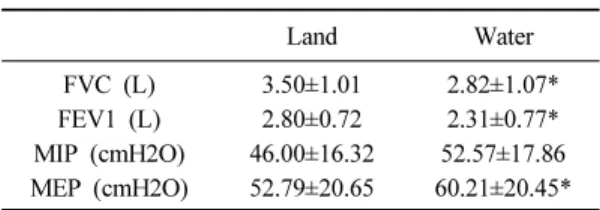
노력성폐활량과 1초간 노력성 호기량은 지상에 비해 수중에서 유의하게 낮았다. 최대흡기압은 지상과 수중 에서 유의한 차이를 볼 수 없었고 최대호기압은 지상에 비해 수중에서 유의하게 높았다(p>0.05)(table 2).

Ⅳ. 고찰

뇌졸중으로 인해 환자들은 근력, 균형, 보행 능력의

감소가 나타나고 이로 인해 움직임과 일상생활에 제

(4)

Land Water FVC (L)

FEV1 (L) MIP (cmH2O) MEP (cmH2O)

3.50±1.01 2.80±0.72 46.00±16.32 52.79±20.65

2.82±1.07*

2.31±0.77*

52.57±17.86 60.21±20.45*

Mean±SD

FVC: forced vital capacity

FEV1: forced expiratory volume at one second MIP: maximum inspiratory pressure

MEP: maximum expiratory pressure

Table 2. Comparison of respiratory function land and water

한을 받게 된다. 수중운동치료는 뇌졸중으로 인한 후 유증을 감소시키기 위한 하나의 방법으로서 여러 연 구들에서 그 효과가 증명되고 있다. Chan 등(2017)은 수중에서 수직적인 움직임을 할 때 부력의 도움으로 하지의 무게를 덜고 움직임을 촉진시켜 낙상에 대한 두려움을 줄이고 쉽게 운동할 수 있다고 하였고 Chu 등(2004)은 만성 뇌졸중 환자에게 8주간 수중에서의 운동을 적용하였을 때 마비측 하지의 근력을 증가시 키고 보행 속도를 향상시킨다고 하였다. 또한 Jung 등(2014)은 뇌졸중 환자가 지상에서 보다 수중에서 보행훈련을 할 때 에너지 소비가 감소되어 조금 더 오래 걷는 연습이 가능하다고 하였다. 이러한 효과에 더불어 정수압이 가해지는 수중 환경에서 호흡 재활 의 가능성을 알아보고자 본 연구에서는 풀 내에서 뇌 졸중 환자의 호흡 능력 변화를 측정하였다.

본 연구에서는 뇌졸중 환자를 대상으로 폐활량의 지표인 노력성폐활량과 1초간 노력성호기량을 지상 과 수중에서 측정하였는데 수중에서 폐활량이 더욱 낮은 결과를 보였다. Becker (2009) 에 따르면 수압은 수심 1피트 당 22.4mmHg의 압력이 작용하는데 4피트 깊이에서의 수압은 탄력 스타킹의 대략 2배 정도의 압력을 하지에 가할 수 있다고 하였다. 또한 Yamashina 등(2016)은 정수압이 가슴벽에 대한 압력을 증가시켜 정상성인의 가슴둘레를 줄이며 복부에 가해지는 압력 을 증가시켜 가로막의 높이를 증가시킨다고 하였고 Frangolias 와 Rhodes (1995)는 정수압이 정상인의 폐활

량, 총폐용량, 폐탄성을 감소시킬 수 있다고 하였다.

따라서 본 연구에서도 정수압이 작용하는 수중에서 뇌졸중 환자의 노력성폐활량과 1초간 노력성호기량 이 감소된 것으로 생각된다.

최대흡기압력과 호기압력의 검사는 효율적으로 흡 기근과 호기근의 근력을 직접적으로 측정할 수 있는 방법으로 호흡근육의 약화를 보여주는 유용한 지표이 다. 뇌졸중 환자들은 건강한 대상자에 비해 최대흡기 압과 최대호기압이 낮고(Teixeira-Salmela et al., 2005) 마비측 흉부의 움직임이 줄어들며(Lanini et al., 2003) 폐활량과 전체 폐용량의 감소(Fugl-Meyer et al., 1983) 를 보인다. 기침을 하기 어려울 정도의 호흡근 기능의 저하와 흉곽 압력의 감소는 기도 내 분비물을 제거할 만큼의 최대 기침유량을 만들어 내지 못하여(Bach et al., 1993) 뇌졸중 환자의 잦은 흡인을 유발할 수도 있다 (Hammond et al., 2009). 본 연구에서 흡기 압력에는 유의한 차이가 없으나 호기 압력에 차이가 나타나는 것은 물에 의한 압력이 최대 호기에 작용하는 근육들 을 보조한 결과라 여겨진다. 강하고 깊은 노력성 호기 시에는 배곧은근, 배가로근, 배빗근, 속갈비사이근등 이 수축을 하게 된다. 배근육들과 속갈비사이근은 하 부 흉곽을 내부로 당겨 복부의 부피를 줄이고 흉곽의 용적을 감소시킨다. 또한 갈비뼈를 내하방으로 이동시 켜 복압의 상승과 가로막의 상승으로 호기를 촉진시킨 다. 수중에서 가해지는 정수압은 이러한 복압의 상승과 갈비뼈의 압박 작용을 보조하게 되어 수중에서 최대호 기압의 증가를 볼 수 있었을 것이다. Yamashina 등 (2016) 은 정상인의 침수 이후 최대흡기압의 감소가 일 어나는데 이는 5분 이후에는 회복 되었다고 하였다.

흡기의 주동근인 횡격막은 지근섬유가 55%로 많이 함유되어 있어서(Polla et al., 2004) 지구력과 피로에 저항력이 좋기 때문에 침수 후 일정시간 이후에는 최 대흡기압을 회복하는 모습을 볼 수 있었다고 하였는 데 본 연구에서는 대상자들이 입수한 이후 최대흡기 압을 측정한 시간이 다양하여 Yamashina 등(2016)의 연구와 같이 차이를 볼 수 없었던 것으로 사료된다.

Kim (2012)과 Lim 등(2011)에 따르면 탄력밴드 저항

(5)

을 흉곽에 적용하여 호흡 운동을 하였을 때 호흡기능 이 개선되고 폐활량이 증가되었다고 보고하였다. 본 연구의 결과에 비추어 볼 때 뇌졸중 환자가 빗장뼈 높이까지 물에 침수되어 있을 때는 체간에 가해지는 정수압으로 폐활량이 감소되므로 지속적인 저항을 이 겨내고 호흡을 해야 한다. 따라서 뇌졸중 환자를 물에 침수시킨 상태에서 정수압을 저항으로 적용한 호흡훈 련을 시도해 볼 수 있을 것이다. Andrade 등(2014)은 지상과 수중에서 정상인의 폐활량을 비교하였는데 흉 곽에 정수압이 가해지는 빗장뼈 높이에서는 노력성폐 활량과 1초간 노력성호기량이 감소되었으나 칼돌기 (xiphoid process)와 골반까지 침수되는 깊이에서는 노 력성폐활량과 1초간 노력성호기량에서 지상에서와 차이를 볼 수 없었다고 하였다. 수중에서 정수압으로 인해 폐활량이 감소되어 피로를 유발할 위험을 줄이 기 위해서는 환자가 침수해 있는 수심을 조절하여 호 흡훈련 및 운동을 적용하여야 할 것이다. 이처럼 폐활 량의 감소로 인한 피로 유발의 가능성을 적절하게 통 제한다면 뇌졸중 환자에게 적용되는 수중운동치료 시 수압을 이용한 호흡 훈련을 함께 적용해 볼 수 있을 것이라 사료된다.

본 연구에서는 참가한 대상자의 수가 14명으로 적 고 남성 환자의 비율이 높았다. 또한 평균 37개월 이상 인 만성 뇌졸중 환자를 대상으로 하여 모든 뇌졸중 환자에게 일반화하기에는 제한점이 있다. 추후 연구 에서는 더 많은 대상자를 참여시키고 물에 침수하는 깊이를 다양화 하여 지상에서와 수중에서 호흡기능 변화를 비교하는 연구가 필요하다고 생각된다.

Ⅴ. 결론

뇌졸중 환자 14명을 대상으로 지상과 수중의 환경 이 폐활량, 최대흡기량, 최대호기량에 미치는 영향을 알아보고자 하였다. 지상에서 보다 수중에서의 폐활 량이 낮았고 최대 호기량은 지상에서 보다 수중에서 높은 것을 확인하였다. 따라서 뇌졸중 환자가 수중

환경에서 운동 및 호흡 훈련을 할 때에는 정수압으로 인한 폐활량의 감소와 운동 강도를 고려하여 적용할 것을 제안 한다.

Acknowledgments

This research is supported by Catholic University of Pusan in 2016.

References

Andrade AD, Júnior JC, Lins de Barros Melo TL, et al. Influence of different levels of immersion in water on the pulmonary function and respiratory muscle pressure in healthy individuals: observational study. Physiotherapy Research International. 2014;19(3): 140-146.

Bach JR, Smith WH, Michaels J, et al. Airway secretion clearance by mechanical exsufflation for post-poliomyelitis ventilator-assisted individuals. Archives of physical medicine and rehabilitation. 1993;74(2):170-177.

Becker BE. Aquatic therapy: scientific foundations and clinical rehabilitation applications. physical medicine and rehabilitation. 2009;1(9):859-872.

Brack T, Jubran A, Tobin MJ. Dyspnea and decreased variability of breathing in patients with restrictive lung disease.

American Journal of Respiratory and Critical care Medicine. 2002;165(9):1260-1264.

Chan K, Phadke CP, Stremler D, et al. The effect of water-based exercises on balance in persons post-stroke: a randomized controlled trial. Topics in Stroke Rehabilitation. 2017;24(4):228-235.

Chu KS, Eng JJ, Dawson AS, et al. Water-based exercise

for cardiovascular fitness in people with chronic

stroke: a randomized controlled trial1. Archives of

Physical Medicine and Rehabilitation. 2004;85(6):

(6)

870-874.

Ezeugwu VE, Olaogun M, Mbada CE, et al. Comparative lung function performance of stroke survivors and age ‐matched and sex‐matched controls. Physiotherapy Research International. 2013;18(4):212-219.

Fonseca EP, Silva NMR, Pinto EB. Therapeutic effect of virtual reality on post-stroke patients: randomized clinical trial. Journal of Stroke and Cerebrovascular Diseases.

2017;26(1):94-100.

Frangolias DD, Rhodes EC. Maximal and ventilatory threshold responses to treadmill and water immersion running.

Medicine and Science in Sports and Exercise.

1995;27(7):1007-13.

Fugl-Meyer AR, Linderholm H, Wilson AF. Restrictive ventilatory dysfunction in stroke: its relation to locomotor function. Scandinavian Journal of rehabilitation Medicine Supplement. 1983;9:118-124.

Gross RD, Atwood Jr CW, Ross SB, et al. The coordination of breathing and swallowing in chronic obstructive pulmonary disease. American Journal of Respiratory and Critical Care Medicine. 2009;179(7):559-565.

Hammond CAS, Goldstein LB, Horner RD, et al. Predicting aspiration in patients with ischemic stroke: comparison of clinical signs and aerodynamic measures of voluntary cough. Chest. 2009;135(3):769-777.

Iatridou G, Pelidou HS, Varvarousis D, et al. The effectiveness of hydrokinesiotherapy on postural balance of hemiplegic patients after stroke: a systematic review and meta-analysis. Clinical Rehabilitation. 2018;

32(5):583-593.

Jung T, Ozaki Y, Lai B, et al. Comparison of energy expenditure between aquatic and overground treadmill walking in people post‐stroke. Physiotherapy Research International. 2014;19(1):55-64.

Kim JH, Park HK, Jeon SY, et al. Initial effect of an elastic chest band during inspiratory exercise on chest function improvement in people with limited rib

mobility: a randomized controlled pilot trial.

Physiotherapy Research International. 2012;17(4):

208-213.

Kumar S, Selim MH, Caplan LR. Medical complications after stroke. The Lancet Neurology. 2010;9(1):105-118.

Lanini B, Bianchi R, Romagnoli I, et al. Chest wall kinematics in patients with hemiplegia. American Journal of Respiratory and Critical Care Medicine. 2003;168(1):

109-113.

Lim SW, Seo KC. The effect of treadmill training with elastic bands on the chest expansion and pulmonary functions of young adults. Journal of International Academy of Physical Therapy Research. 2011;2(2):301-307.

Noh DK., Lim JY, Shin HI, et al. The effect of aquatic therapy on postural balance and muscle strength in stroke survivors—a randomized controlled pilot trial.

Clinical Rehabilitation. 2008;22(10-11):966-976.

Pitta F, Troosters T, Spruit MA, et al. Characteristics of physical activities in daily life in chronic obstructive pulmonary disease. American Journal of Respiratory and Critical Care Medicine. 2005;171(9):972-977.

Polla B, d’Antona G, Bottinelli R, et al. Respiratory muscle fibres: specialisation and plasticity. Thorax. 2004;

59(9):808-817.

Pollock RD, Rafferty GF, Moxham J, et al. Respiratory muscle strength and training in stroke and neurology: a systematic review. International Journal of Stroke.

2013;8(2):124-130.

Roth EJ, Lovell L, Harvey RL, et al. Incidence of and risk factors for medical complications during stroke rehabilitation. Stroke. 2001;32(2):523-529.

Teixeira-Salmela LF, Parreira VF, Britto RR, et al. Respiratory pressures and thoracoabdominal motion in community- dwelling chronic stroke survivors. Archives of physical medicine and rehabilitation. 2005;86(10): 1974-1978.

Veerbeek JM, Langbroek-Amersfoort AC, Van Wegen EE,

et al. Effects of robot-assisted therapy for the upper

(7)

limb after stroke: a systematic review and meta- analysis. Neurorehabilitation and Neural Repair.

2017;31(2):107-121.

Yamashina Y, Yokoyama H, Naghavi N, et al. Forced respiration during the deeper water immersion causes the greater inspiratory muscle fatigue in healthy young men.

Journal of Physical Therapy Science. 2016;28(2):

412-418.

Zhu Z, Cui L, Yin M, et al. Hydrotherapy vs. conventional land-based exercise for improving walking and balance after stroke: a randomized controlled trial.

Clinical Rehabilitation. 2016;30(6):587-593.

수치

Table 2. Comparison of respiratory function land and  water 한을 받게 된다. 수중운동치료는 뇌졸중으로 인한 후 유증을 감소시키기 위한 하나의 방법으로서 여러 연 구들에서 그 효과가 증명되고 있다

참조

관련 문서

§ Due to the late start of construction and frequent design changes during construction, the completion of the project has been one year delayed. of the project has been

On the artificial waterway that stretches on in the middle of the park, various water leisure sports activities are taking place, such as water taxi available at the West

다양한 번역 작품과 번역에 관한 책을 읽는 것은 단순히 다른 시대와 언어, 문화의 교류를 넘어 지구촌이 서로 이해하고 하나가

The index is calculated with the latest 5-year auction data of 400 selected Classic, Modern, and Contemporary Chinese painting artists from major auction houses..

The key issue is whether HTS can be defined as the 6th generation of violent extremism. That is, whether it will first safely settle as a locally embedded group

A frame size error in a frame that could alter the state of the entire connection MUST be treated as a connection error (Section 5.4.1); this includes any frame carrying a

1 John Owen, Justification by Faith Alone, in The Works of John Owen, ed. John Bolt, trans. Scott Clark, "Do This and Live: Christ's Active Obedience as the

Prevention of coronary and stroke events with atorvastatin in hypertensive patients who have average or lower-than-average cholesterol concentrations, in