서 론
보편적으로 아침 식사는 중요하다고 알려져 있으나1)
2017
년 국민 건강통계에 따르면 우리나라 아침 결식률은 남자29
.5
%, 여자25
.7
% 으로 증가하는 추세이다.2)인슐린 저항성은 정상적 인슐린에 대한 반응이 감소된 것으로 제
2
형 당뇨병의 원인으로 알려져 있으며 대사증후군과 심혈관질환의 관련인자로 인식되고 있으며3-6) 세포 내 신호전달체계의 변화를 유 발하여 죽상경화반을 진행시킨다.7,8) 죽상경화증은 심혈관질환의 직 접적 원인으로 전세계적으로 그 중요성이 증가하고 있다.9)Received September 10, 2019 Revised April 22, 2020 Accepted April 29, 2020
Corresponding author Jae Yong Shim Tel: +82-2-2228-2333, Fax: +82-2-362-2473 E-mail: [email protected]
ORCID: http://orcid.org/0000-0002-9561-9230
Copyright © 2020 The Korean Academy of Family Medicine
This is an open-access article distributed under the terms of the Creative Commons At- tribution Non-Commercial License (http://creativecommons.org/licenses/by-nc/4.0) which permits unrestricted noncommercial use, distribution, and reproduction in any medium, provided the original work is properly cited.
Original Article
https://doi.org/10.21215/kjfp.2020.10.3.200 eISSN 2233-9116
Korean J Fam Pract. 2020;10(3):200-207
Korean Journal of Family Practice
KJFP
당뇨병이 없는 한국 40 –79세 성인에서 아침 식사 결식 여부와 인슐린 저항성 및 심혈관계 질환 발생 위험도와의 연관성
이현희, 강유선, 윤경채, 송유현, 심재용*
연세대학교 의과대학 세브란스병원 가정의학교실
Association between Breakfast Skipping and Homeostasis Model Assessment of Insulin Resistance and the Atherosclerotic Cardiovascular Disease Risk in Non-Diabetic Korean Adults Aged 40–79 Years
Hyunhee Lee, Yousun Kang, Kyungchai Yoon, Youhyun Song, Jae Yong Shim*
Department of Family Medicine, Severance Hospital, Yonsei University College of Medicine, Seoul, Korea
Background: It is reported that the decline in breakfast consumption is associated with diabetes, metabolic disease, and cardiovascular disease. This study analyzed the association between skipping breakfast and the homeostasis model assessment of insulin resistance (HOMA-IR) and atherosclerotic cardiovascular disease (ASCVD) risk among non-diabetic Korean adults aged 40–79 years who did not take medication for hypertension or dyslipidemia.
Methods: This study included 1,001 adults from the Sixth Korea National Health and Nutrition Examination Survey in 2015. Participants were classified into two groups based on those who skipped breakfast and those who ate breakfast. Analysis of covariance was performed to compare the average value of HOMA-IR between the two groups. Logistic regression analysis was used to evaluate the relationship between skipping breakfast and HOMA-IR and ASCVD risk. All analyses were performed after adjusting for covariates.
Results: There was no significant association between the group that skipped breakfast and HOMA-IR or ASCVD risk. However, the odds ratio of ASCVD risk was 3-fold higher in male in the skipping breakfast group that skipped breakfast than in those that ate breakfast.
Conclusion: Previous studies that suggested there was an association between skipping breakfast and ASCVD risk may have been biased as they included individuals taking medication, and thus, this could have led to incorrect results. Therefore, further studies on the association between breakfast consumption and ASCVD risk should consider practical factors that can affect eating habits, such as regular medication use in their analysis.
Keywords: Breakfast; Insulin Resistance; Atherosclerosis; Cardiovascular Diseases
이현희 외. 아침 식사 결식에 따른 인슐린저항성과 심혈관계질환 발생 위험도 Korean Journal of Family Practice
KJFP
또한 심혈관질환은 주요 사망원인 중 하나로10)
2013
년 미국심장 학회(American College of Cardiology
,ACC
)와 미국심장협회(American Heart Association
,AHA
)는 혈중 콜레스테롤을 조절하여 동맥경화 성 심혈관질환 위험을 감소하기 위해 콜레스테롤 가이드라인을 제 시하였으며11) 동맥경화증에 의한 위험도를 평가 방법으로Pooled Cohort risk assessment equations
인Atherosclerotic Cardiovascular Disease
(ASCVD
)risk estimator
를 제시하였다. 이에 따라10
년내 심혈 관질환 위험도(ASCVD risk
)를 평가하였으며 스타틴 약물요법을 권 고하였다.아침 결식은 비만 유병률 증가, 체질량지수(
body mass index
,BMI
), 콜레스테롤 및 혈압 증가, 대사 증후군 및 만성질환 증가와도 관련이 있는 것으로 보고되었다.12) 또한 아침 결식은24
시간 평균 혈당을 증 가시키고13) 식후 혈당 상승 및 인슐린 감수성에 영향을 주며14) 당뇨 병 전 단계 및 당뇨 진단율 상승과도 관계가 있는 것으로 알려져 있 다.15)국내 연구에서 아침 식사와 건강행태, 대사증후군 위험요인 및 당뇨병 전 단계, 공복혈당장애 발생 및 심혈관질환 위험도와의 연관 성에 대한 연구들은 있었으나 만성질환자의 경우 복약을 위해 아침 식사를 할 가능성을 고려하지 못하여 실제보다 아침 결식과 심혈관 질환 위험의 연관성이 왜곡되어 평가되었을 가능성이 있다. 이에 본 연구는 국민건강영양조사 자료를 사용하여 고혈압 및 이상지질혈 증 복약군을 제외한 비당뇨 성인을 대상으로 인슐린 저항성을 나타 내는 지표 중 하나인
homeostasis model assessment of insulin resistance
(HOMA-IR
)와ASCVD risk estimator
를 이용하여 아침 결식과 인슐 린 저항성 및 심혈관질환 발생 위험도와의 연관성을 살펴보고자 한 다.방 법
1. 연구 대상
본 연구는 국민건강영양조사 제
6
기3
차년도(2015
) 자료를 가중치 를 적용하여 사용하였다. 총 응답자 수는7
,380
명으로ASCVD risk
의 산출이 가능한 만40–79
세에 해당하는4
,123
명 중 임산부, 공복혈 당126 mg
/dL
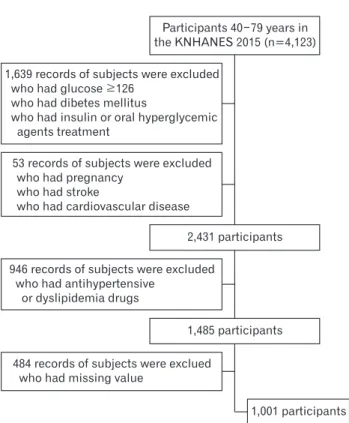
이상이거나 의사로부터 당뇨병 진단을 받았거나 혈당 강하제 복용 또는 인슐린 투여 중인 자, 뇌졸중, 심근경색증, 협심증 이 있는 사람, 혈압조절제 또는 이상지질혈증 약을 복용하고 있는 사람을 제외하였다. 제외 기준을 적용한 후 대상자는1
,485
명으로 이 중 점심 또는 저녁 식사를 주5
회 미만 섭취하는 군을 제외한1
,286
명이 연구에 포함되었다. 연구변수에 결측값이 있는 경우는 배 제하였으며 최종적으로1
,001
명을 대상자로 하였으며 여성은617
명,남성은
384
명이었다. 연구대상자1
,001
명은 우리나라 인구수 대비 산출된 가중치를 적용하면 총7
,606
,349
명에 해당한다(Figure 1
).2. 영양 조사
식습관은 식생활 조사의 최근
1
년 동안,1
주 동안 아침 식사, 점심 식사, 저녁 식사 빈도 항목을 이용하였다. 본 연구에서는 아침 식사 를 주5–7
회 이상 섭취한 대상자를 섭취군으로 하였으며 주1–4
회 섭취 및 아침 식사를 거의 하지 않는 대상자는 결식군으로 분류하 였다. 영양소 섭취량은 개인별24
시간 회상법으로 조사한1
일 총 식 사 섭취량 중 에너지, 탄수화물, 지방, 단백질의 섭취량으로 구하였 다.3. 인슐린 저항성
인슐린 저항성을 평가하는 방법은
HOMA-IR
16)을 이용하였으며 계산식은 다음과 같다.17) 본 연구에서는 선행 연구 결과를 바탕으로HOMA-IR
값이2
.5
이상이면 인슐린 저항성이 있는 것으로 본다.18)H OMA-IR=
[fasting insulin
(μIU
/mL
)×fasting blood glucose
(mg
/dL
)]
/405
Original Article
Korean Journal of Family Practice
Figure 1. Flowchart showing the selection of study subjects.
KNHANES, Korea National Health and Nutrition Examination Survey.
53 records of subjects were excluded who had pregnancy
who had stroke
who had cardiovascular disease
Participants 40 79 years in the KNHANES 2015 (n=4,123)
1,001 participants 2,431 participants
1,485 participants 946 records of subjects were excluded
who had antihypertensive or dyslipidemia drugs
484 records of subjects were exclued who had missing value
1,639 records of subjects were excluded who had glucose 126
who had dibetes mellitus
who had insulin or oral hyperglycemic agents treatment
Hyunhee Lee, et al. Association between Breakfast Skipping and HOMA-IR and ASCVD Risk
Korean Journal of Family Practice
KJFP
4. 심혈관질환 위험도(ASCVD risk)
미국심장학회(
ACC
)/미국심장협회(AHA
)에서 제시한Pooled Cohort risk assessment equations
을 이용하여10
년내 심혈관질환 발생 위험도(10-year-ASCVD risk
)를 계산하였다. 성별, 연령, 인종, 총 콜레 스테롤, 고밀도지단백 콜레스테롤, 수축기 혈압, 고혈압 치료 여부, 당뇨병 여부, 흡연 여부를 고려하여 계산하였으며 이전에 심혈관질 환이 없는40–79
세의 성인을 대상으로 하였다.10
년내 심혈관질환 위험도는 심근경색, 관상 동맥 질환으로 인한 사망과 뇌졸중을 포 함한 동맥경화성질환이10
년내 발생할 위험도를 백분율로 나타낸 것으로 심혈관질환 및 당뇨병이 없고 저밀도 지단백 콜레스테롤이70–189 mg
/dL
에 해당하는 사람들 중 위험도가7
.5
% 이상이면 일차 예방으로 스타틴 약물요법을 권고11)하고 있다. 이에 본 연구에서는10
년내 심혈관질환 위험도가7
.5
% 미만은 저위험군으로,7
.5
% 이상 인 경우 고위험군으로 분류하여 비교하였다.5. 연구 자료
국민건강영양조사에서 건강설문조사의 성별, 연령, 경제활동, 소 득, 교육, 신체활동, 스트레스 인지, 체중 변화, 음주 및 흡연 여부 자 료를 이용하였으며 검진조사의 체질량지수(
BMI
), 허리 둘레 측정값 (waist circumference
), 혈압 및 혈액 검사 결과와 영양조사의 식품섭 취빈도 조사 자료를 사용하였다.건강설문조사 항목 중 경제활동을 하는 인구를 취업자로, 실업자 또는 비경제활동 인구에 해당하는 경우를 비경제활동 인구로 구분 하였으며 소득은 가구 소득 사분위수에 따라 하, 중하, 중상, 상의 네 개 군으로 구분하였다. 교육수준은 초등학교 졸업 이하, 중학교 졸업, 고등학교 졸업, 대학교 졸업 이상의 네 개 군으로 구분하였다.
신체활동은 일주일에 중강도 신체활동을
2
시간30
분 이상 또는 고 강도 신체활동을1
시간15
분 이상 또는 중강도와 고강도 신체활동 을 섞어서 각 활동에 상당하는 시간을 실천하는 군을 유산소 신체 활동 실천군으로, 중강도 또는 고강도 활동을 실천하지 않는 군을 비실천군으로 분류하였다. 일상생활 중에 스트레스를 ‘대단히 많 이’ 또는 ‘많이’ 느끼는 편이라고 응답한 사람을 스트레스 인지율이 높은 군으로 ‘조금’ 또는 ‘거의 느끼지 않는다’ 라고 응답한 사람을 인지율이 낮은 군으로 분류하였다.1
년간 체중 변화 여부에 따라 변 화 없음, 체중 증가, 체중 감소로 구분하였으며 흡연 상태는 현재 흡 연 여부에 따라 흡연군과 비흡연군으로 구분하였다. 음주 습관은 최근1
년간 월1
잔 이상 음주하는 사람을 음주군으로1
년간 월1
잔 미만 음주 및 평생 비음주인 사람을 비음주군으로 분류하였다.신체계측은 표준화 장비와 측정방법을 이용하였으며, 체질량지 수는 측정한 체중(
kg
)을 신장(m
)의 제곱으로 나눈 값(kg
/m
2)으로산출하였다. 수축기 및 이완기 혈압은 표준화 측정 방법을 사용하 여 환자가 앉은 자세로
5
분 간격으로3
회 측정하여2
번째와3
번째 측정한 혈압의 평균값을 각각 최종 수축기 및 이완기 혈압으로 정의 하여 이 결과값을 사용하였다. 혈액 검사는 최소8
시간 이상 금식을 한 후 아침에 채혈하였고 공복혈당, 총콜레스테롤, 중성지방,high density lipoprotein
콜레스테롤은Hitachi Automatic Analyzer 7600
(Hitachi
,Tokyo
,Japan
) 기구를 사용하여enzyme method
를 이용하였 고 당화혈색소(hemoglobin A1c
) 검사는HLC-723G7
(Tosoh
,Tokyo
,Japan
)를 사용하여high performance liquid chromatography
방법으로Table 1. General and lifestyle characteristics by breakfast consumption Variable Skipping breakfast
P-value
Yes No
All 228 (25.0) 773 (75.0)
Age (y) 48.40±0.46 53.30±0.36 <0.001
Sex 0.801
Male 83 (45.6) 301 (46.7)
Female 145 (54.4) 472 (53.3)
Household income level 0.373
Low 21 (7.3) 108 (11.3)
Mid-low 47 (20.0) 181 (21.4)
Mid-high 73 (33.1) 212 (28.8)
High 87 (39.6) 272 (38.5)
Educational level 0.004
≤Elementary school 20 (5.8) 163 (16.4)
Middle school 29 (13.2) 110 (12.8)
High school 91 (39.3) 258 (34.5)
≥College 88 (41.7) 242 (36.3)
Economic activity 0.107
Yes 165 (75.7) 501 (69.8)
No 63 (24.3) 272 (30.2)
Smoking <0.001
Yes 53 (29.9) 82 (13.4)
No 175 (70.1) 691 (86.6)
Drinking 0.003
Yes 127 (62.8) 349 (49.6)
No 101 (37.2) 424 (50.4)
Physical activity 0.430
Yes 110 (47.8) 366 (51.1)
No 118 (52.2) 407 (48.9)
Hypertension 0.057
Yes 8 (3.4) 17 (1.7)
No 220 (96.6) 756 (98.3)
Change of body weight 0.002
No 129 (57.1) 550 (70.0)
Decreased 29 (12.6) 88 (11.4)
Increased 70 (30.3) 135 (18.5)
High stress 0.136
Yes 63 (28.3) 157 (22.7)
No 165 (71.7) 616 (77.3)
Values are presented as unweighted number (weighted %) or mean±standard error.
P-values are from Rao–Scott χ2 test or ANOVA.
이현희 외. 아침 식사 결식에 따른 인슐린저항성과 심혈관계질환 발생 위험도 Korean Journal of Family Practice
KJFP
분석하였다. 인슐린은
1470 WIZARD gamma-counter
(PerkinElmer
/Finland
) 기구를 이용하여immunoradiometric assay
방법으로 분석하 였다.6. 통계 분석
분석 프로그램은
IBM SPSS Statistics ver
.23
.0
(IBM Co
.,Armonk
,NY
,USA
)을 사용하였고 통계적 유의성 기준은P<0
.05
로 검증하였 으며 복합표본 설계에 맞는 방법으로 분석을 실시하였으며 통계처 리 내용은 다음과 같다.첫째, 대상자 특성을 확인하기 위해 아침 결식에 따른 범주형 변 수의 빈도와 가중 백분율을 제시하고
Rao–Scott
보정을 적용한 카이 제곱 검정(chi-square test
)을 실시하였으며, 연속형 변수의 평균과 표 준오차를 제시하고 분산분석(ANOVA
)을 실시하였다.둘째, 한국 성인 남녀의 아침 결식에 따른 두 군의
HOMA-IR
의 평균값을 알아보고자 분산분석(ANOVA
) 및 공분산분석(ANCOVA
) 을 실시하였다. 아침 결식과 인슐린 저항성의 관련성을 확인하기 위 해 로지스틱 회귀분석(logistic regression
)을 실시하고, 상대 위험도로 서 오즈비(odds ratio
) 및95
% 신뢰구간을 산출하였다. 공분산분석 및 로지스틱 회귀분석은 대상자 특성 변수(연령, 성별, 체질량지수, 신체활동, 경제수준, 경제활동 여부, 교육 수준, 스트레스 인지, 흡 연 상태, 음주 습관, 에너지 섭취량, 단백질 섭취량, 탄수화물 섭취 량, 지방 섭취량)를 보정하였다.셋째, 아침 결식과
10
년내 심혈관질환 위험도(10-year-ASCVD risk
) 의 관련성을 알아보고자 로지스틱 회귀분석을 실시하고, 오즈비 및95
% 신뢰구간을 산출하였다. 아침 결식과 인슐린 저항성의 관련성 분석에서 사용한 대상자 특성 변수를 이용하여 보정하였다.결 과
1. 아침 결식에 따른 연구대상자의 일반 특성
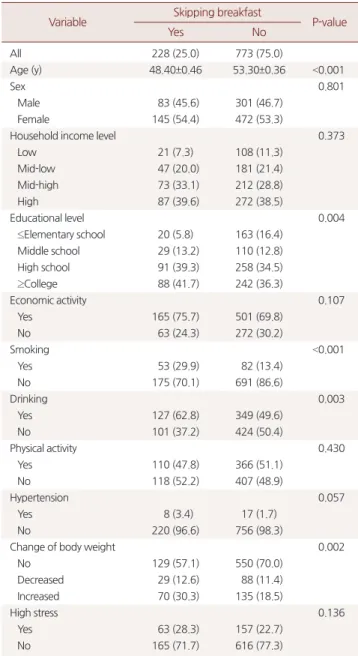
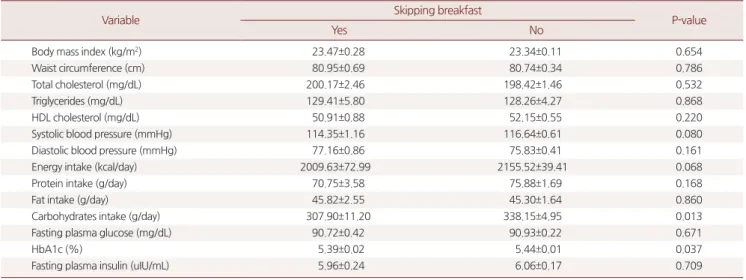
아침 결식에 따른 두 군의 일반적 특성을 비교하여 보았다(
Table 1
,2
). 평균 연령은 아침 식사 섭취군이53
.3
세, 결식군은48
.4
세으로 아침 결식군의 평균 연령이 낮았다. 교육 수준이 높을수록 결식 빈 도가 큰 결과를 보였으며 흡연 그룹에서 아침 결식 비율이 높았다.또한 음주가 잦은 그룹에서 아침 결식 빈도가 높았으며
1
년간 체중 이 증가한 그룹에서 아침 결식 비율이 높은 것으로 나타났다. 탄수 화물 섭취량과 당화혈색소 역시 아침 섭취군에서 유의미하게 높았 다.2. 아침 결식과 인슐린 저항성과의 관계
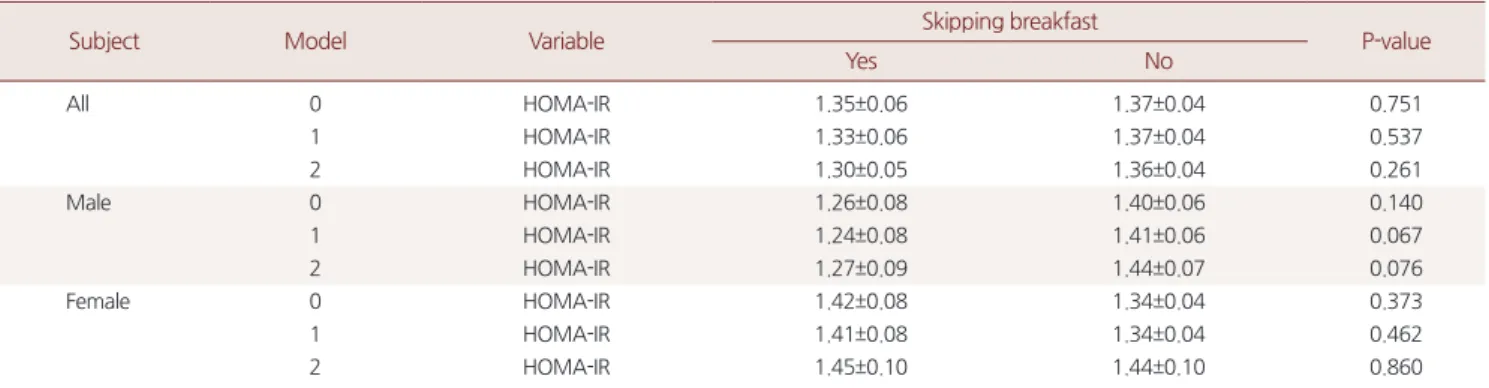
HOMA-IR
의 평균값은 전체 인구 및 남성에서 아침 섭취군이 결식군에 비해 높았고 여성에서는 결식군의
HOMA-IR
평균값이 높았 으나 그 차이의 통계적 유의성은 없었다(Table 3
). 아침 결식과 인슐 린 저항성과의 관련성 분석에서도 통계적 유의성은 없었다(Table 4
).3. 아침 결식과 심혈관질환 위험도의 관계
보정 변수 적용 후 전체 인구와 여성에서 아침 결식과 심혈관질환 위험도는 통계적 유의성이 없었으나 남성에서 아침 결식과 심혈관
Table 2. Anthropometric, blood biochemical and nutritional indices by breakfast consumption
Variable Skipping breakfast
P-value
Yes No
Body mass index (kg/m2) 23.47±0.28 23.34±0.11 0.654
Waist circumference (cm) 80.95±0.69 80.74±0.34 0.786
Total cholesterol (mg/dL) 200.17±2.46 198.42±1.46 0.532
Triglycerides (mg/dL) 129.41±5.80 128.26±4.27 0.868
HDL cholesterol (mg/dL) 50.91±0.88 52.15±0.55 0.220
Systolic blood pressure (mmHg) 114.35±1.16 116.64±0.61 0.080
Diastolic blood pressure (mmHg) 77.16±0.86 75.83±0.41 0.161
Energy intake (kcal/day) 2009.63±72.99 2155.52±39.41 0.068
Protein intake (g/day) 70.75±3.58 75.88±1.69 0.168
Fat intake (g/day) 45.82±2.55 45.30±1.64 0.860
Carbohydrates intake (g/day) 307.90±11.20 338.15±4.95 0.013
Fasting plasma glucose (mg/dL) 90.72±0.42 90.93±0.22 0.671
HbA1c (%) 5.39±0.02 5.44±0.01 0.037
Fasting plasma insulin (uIU/mL) 5.96±0.24 6.06±0.17 0.709
Values are presented as mean±standard error.
HDL, high density lipoprotein; HbA1c, hemoglobin A1c.
P-values are from Rao–Scott χ2 test or ANOVA.
Hyunhee Lee, et al. Association between Breakfast Skipping and HOMA-IR and ASCVD Risk
Korean Journal of Family Practice
KJFP
질환 위험도는 오즈비
3
.054
배로 통계적으로 유의미하게 높았다. 반 면 혈압조절제 또는 이상지질혈증 약을 복용하는 군을 포함한 경우 전체 인구 및 남성, 여성 모두에서 통계적 유의성이 없었다(Table 5
).고 찰
본 연구는 국민건강영양조사를 이용하여 한국의 비당뇨 성인
40–79
세를 대상으로 아침 결식과 인슐린 저항성 및 심혈관질환 발생 위험도의 관련성을 알아보기 위한 단면연구이다.
아침 결식에 따른 대상자 특성 분석에서 결식군의 평균 연령이 낮 고, 교육 수준이 높을수록, 음주 및 흡연 빈도가 높을수록 아침 결 식 빈도가 유의미하게 높았다. 이는 비결식이 규칙적 생활 습관과 연관이 있다고 생각되며, 타 연구와 유사한 결과이다.19,20) 당화혈색 소 역시 아침 식사군에서 유의미하게 높은 결과를 보였으며 이는 식사군에서 혈중 포도당 수치 평균과 평균 연령이 결식군과 비교하
여 높은 것과 관련이 있는 것으로 생각된다.
또한 본 연구에서는 아침 결식군에서
1
년간 체중 증가군의 비율 이 유의미하게 높았다. 그러나 결식군의 체질량지수, 허리둘레, 총 콜레스테롤, 중성지방 평균은 높은 반면 일일 총 에너지 섭취량, 단 백질과 탄수화물 섭취량 평균은 낮아 비만군이 체중관리를 위해 아침 결식을 했을 가능성이 있으며 국민건강영양조사 자료에서는 아침 식사의 종류 및 양에 대한 정보를 얻을 수 없어 아침 결식과 체중 증가의 인과관계는 설명에 제한이 있다.더불어 아침 결식과 인슐린 저항성 및 심혈관질환 위험도 간의 통계적 유의성은 없었다. 반면 남성의 경우 아침 결식군의 심혈관질 환 위험도가 유의미하게 증가하였다. 이 같은 결과는 최근 국가건강 영양조사를 대상으로 시행한 단면연구에서 아침 결식을 자주 할수 록
ASCVD
위험도가 높다는 분석 결과와 대조된다.21) 또한 아침 결 식은 식후 인슐린 감수성 저하와 관련이 있고14) 전곡류가 풍부한 아 침 식사는 인슐린 저항성과 역의 상관관계가 있으며22) 청소년 대상 Table 3. Comparison of average value HOMA-IR among groups by breakfast consumptionSubject Model Variable Skipping breakfast
P-value
Yes No
All 0 HOMA-IR 1.35±0.06 1.37±0.04 0.751
1 HOMA-IR 1.33±0.06 1.37±0.04 0.537
2 HOMA-IR 1.30±0.05 1.36±0.04 0.261
Male 0 HOMA-IR 1.26±0.08 1.40±0.06 0.140
1 HOMA-IR 1.24±0.08 1.41±0.06 0.067
2 HOMA-IR 1.27±0.09 1.44±0.07 0.076
Female 0 HOMA-IR 1.42±0.08 1.34±0.04 0.373
1 HOMA-IR 1.41±0.08 1.34±0.04 0.462
2 HOMA-IR 1.45±0.10 1.44±0.10 0.860
Values are presented as mean±standard error.
HOMA-IR, homeostasis model assessment of insulin resistance.
Model 1: adjusted for age, sex (except male and female group). Model 2: Model 1+household income level, education level, economic activity, stress, smoking, drink- ing, physical activity, body mass index, energy intake, protein intake, carbohydrates intake, fat intake.
P-values are from ANOVA (unadjusted) or ANCOVA (adjusted).
Table 4. Relationship between breakfast consumption and insulin resistance
Subject Model Predictor HOMA-IR ≥2.5
P-value Odds ratio (95% confidence inverval)
All 0 Skipping 1.083 (0.643–1.824) 0.765
1 Skipping 1.083 (0.624–1.879) 0.776
2 Skipping 1.045 (0.541–2.019) 0.895
Male 0 Skipping 0.478 (0.196–1.169) 0.105
1 Skipping 0.473 (0.196–1.143) 0.096
2 Skipping 0.347 (0.065–1.865) 0.217
Female 0 Skipping 1.758 (0.879–3.516) 0.110
1 Skipping 1.779 (0.857–3.695) 0.122
2 Skipping 1.509 (0.715–3.188) 0.280
HOMA-IR, homeostasis model assessment of insulin resistance.
HOMA-IR ≥2.5: insulin resistance group, <2.5: normal group. Model 1: adjusted for age, sex (except male and female group). Model 2: Model 1+household income level, education level, economic activity, stress, smoking, drinking, physical activity, body mass index, energy intake, protein intake, carbohydrates intake, fat intake.
이현희 외. 아침 식사 결식에 따른 인슐린저항성과 심혈관계질환 발생 위험도 Korean Journal of Family Practice
KJFP
연구에서 아침 식사로 지방, 당류, 과자류를 많이 섭취할수록 인슐 린 저항성이 증가하였던 연구 결과와도 상반된다.23) 그러나 여성을 대상으로 한 타연구에서 아침 결식과
HOMA-IR
의 통계적 유의성이 없었으며,24) 한국인 대상 국내 연구에서도 아침 식사군이 결식군에 비해 중성지방 증가 위험도가 높은 반면25) 아침 결식이 대사증후군 의 위험도를 증가와 관련이 있다26)는 연구 결과가 있어 일치된 결과 를 보여주지 못했다.연구 결과가 불일치 하는 이유 중 하나는 대부분이 단면 연구인 점과 더불어 임상 실제의 특성을 충분히 고려하지 못하고 대상자 선정이 되었기 때문이라고 생각한다. 국내의 경우 복약 순응도를 높 이기 위해 식사와 복약을 묶어서 식전 또는 식후 복용으로 권장하 는 경우가 많으며 환자들은 불규칙한 아침 식습관을 가졌음에도 복 약을 위해 아침 식사를 할 가능성이 있다. 이런 특성을 고려하지 않 고 아침 결식과 심혈관질환 사이 상관성을 연구하는 것은 왜곡된 분석 결과가 발생할 수 있다. 그러므로 심혈관질환과 관련 있는 고 혈압, 이상지질혈증으로27,28) 복약 중인 환자를 제외한 뒤 분석을 진 행한 본 연구는 실제적인 요소를 고려하여 아침 결식과 인슐린 저 항성 및 심혈관질환 위험도의 연관성을 확인했다는 점과 향후 연구 에 있어 좀 더 면밀하게 임상적 특성과 환자군 특성을 고려해야 한 다는 점에서 의미가 있다.
본 연구의 제한점은 다음과 같다. 첫째, 국민건강영양자료의 자료 수집이나 설문지 기입 과정에서 정보의 부정확성 및 회상 오류가 발 생할 수 있다는 점이다. 둘째,
HOMA-IR
의 타당성 여부이다.HOMA-IR
법은 간단하면서도 인슐린 저항성과 관련 있는 지표들과양의 상관관계를 보여 보편적으로 사용되지만17) 한국인은 당뇨 발 병 기전이 인슐린 분비능 저하가 먼저 일어나는 특성이 있고29) 성별, 나이, 인종별로 공복 인슐린 농도 차이가 커서 기준치를 설정하는
데 제한이 있다.30) 셋째, 미국심장학회(
ACC
)/미국심장협회(AHA
)에 서 제시한10
년 내 심혈관질환 발생 위험도는 북미 지역의 백인과 흑 인을 대상으로 예측한 값으로 국내 성인에게 적합한가이다. 넷째, 단면연구로 남성군의 아침 결식과 심혈관계질환 위험도 간의 유의 미한 상관관계가 있으나 인과관계를 알 수 없다는 점이다.그러나 본 연구는 심혈관질환 위험도가 높은
40–79
세 성인에서 복약 습관과 같이 아침 식습관에 영향을 미칠 수 있는 요소를 배제 후 아침 결식과 인슐린 저항성 및 심혈관질환 위험도의 관련성을 평 가하여 연구설계 시 실제적 요소를 고려할 필요성이 있음을 보여주 었다. 향후 식습관에 영향을 미칠 수 있는 요소에 대한 분석과 임상 실제를 고려한 대상군 선정이 선행된 연구가 필요할 것으로 생각된 다.요 약
연구배경: 아침 결식은 당뇨, 대사증후군 및 심혈관질환과 관련이 있으며 인슐린 저항성은 심혈관질환의 위험인자로 인식되고 있다.
본 연구는 혈압 조절제 및 이상지질혈증 약 복용군을 제외한 비당 뇨 성인
40–79
세를 대상으로 아침 결식과HOMA-IR
및 심혈관질환 위험도의 연관성을 살펴보았다.방법: 제
6
기 국민건강영양조사(2015
년)를 이용하여1
,001
명(남성384
명, 여성617
명)을 연구 대상으로 선정하였다. 아침 식사 횟수에 따라 아침 결식군과 섭취군으로 분류하였고 두 군의homeostasis model assessment of insulin resistance
(HOMA-IR
)의 평균값과 차이를 확인하기 위해 공분산분석을 실시하였다. 아침 결식과 인슐린 저항 성 및 심혈관질환 위험도와 관련성을 분석하기 위해 각각 복합표본 로지스틱 회귀분석을 통해 교차비를 구하였다. 각 분석은 연령, 성 Table 5. Relationship between breakfast consumption and ASCVD riskSubject Model Predictor 10-year-ASCVD risk (≥7.5%) including medication group 10-year-ASCVD risk ASCVD risk (≥7.5%)
OR (95% CI) P-value OR (95% CI) P-value
All 0 Skipping 0.486 (0.357–0.660) <0.001 0.638 (0.410–0.993) 0.047
1 Skipping 1.712 (0.915–3.202) 0.092 2.777 (1.093–7.057) 0.032
2 Skipping 1.194 (0.538–2.653) 0.662 2.227 (0.751–6.604) 0.148
Male 0 Skipping 0.512 (0.338–0.775) 0.002 0.747 (0.416–1.342) 0.328
1 Skipping 1.657 (0.815–3.369) 0.163 2.860 (1.019–8.026) 0.046
2 Skipping 1.248 (0.509–3.058) 0.628 3.054 (1.051–8.873) 0.040
Female 0 Skipping 1.248 (0.509–3.058) <0.001 0.345 (0.133–0.898) 0.029
1 Skipping 1.646 (0.665–4.078) 0.281 1.505 (0.484–4.685) 0.479
2 Skipping 1.032 (0.338–3.155) 0.956 6.588 (0.593–73.198) 0.125
ASCVD, atherosclerotic cardiovascular disease; OR, odds ratio; CI, confidence interval.
ASCVD risk: 10-year ASCVD risk was measured using the pooled cohort equation, 10-year risk <7.5%: normal group, ≥7.5%: high-risk group. Medication group: par- ticipants who took antihypertensive or dyslipidemia drugs. Model 1: adjusted for age, sex (except male and female group). Model 2: Model 1+household income level, education level, economic activity, stress, smoking, drinking, physical activity, body mass index, energy intake, protein intake, carbohydrates intake, fat intake.
Hyunhee Lee, et al. Association between Breakfast Skipping and HOMA-IR and ASCVD Risk
Korean Journal of Family Practice
KJFP
별, 체질량지수, 신체활동, 경제수준, 경제활동 여부, 교육 수준, 스 트레스 인지, 흡연상태, 음주습관, 에너지 섭취량, 단백질 섭취량, 탄수화물 섭취량, 지방 섭취량을 보정하였다.
결과: 분석 결과 아침 결식과 인슐린 저항성 및 아침 결식과 심혈관 질환 위험도는 유의미한 연관성이 없었다. 반면 남성군은 아침 결식 군의 심혈관질환 위험도가 유의미하게 증가하였다.
결론: 본 연구의 결과는 복약을 위해 아침 결식자가 아침 식사를 할 가능성이 있으며 이런 요소가 아침 결식과 관련된 분석에서 왜곡된 결과를 야기할 수 있음을 의미한다. 따라서 향후 연구에서 좀 더 임 상 현실과 환자 특성을 고려한 대상군 선정이 필요할 것으로 생각된 다.
중심단어: 아침식사; 인슐린 저항성; 죽상동맥경화증; 심혈관계 질환 CONFLICT OF INTEREST
No potential conflict of interest relevant to this article was reported
. ORCIDHyunhee Lee
,https
://orcid
.org
/0000-0001-8900-3678 Yousun Kang
,https
://orcid
.org
/0000-0001-7050-574X Kyungchai Yoon
,https
://orcid
.org
/0000-0001-8956-7975 Youhyun Song
,https
://orcid
.org
/0000-0001-5621-2107 Jae Yong Shim
,https
://orcid
.org
/0000-0002-9561-9230
REFERENCES
1. O'Neil CE, Byrd-Bredbenner C, Hayes D, Jana L, Klinger SE, Stephenson- Martin S. The role of breakfast in health: definition and criteria for a quality breakfast. J Acad Nutr Diet 2014; 114(12 Suppl): S8-26.
2. Ministry of Health and Welfare, Korea Centers for Disease Control and Prevention. Korea Health Statistics 2017: Korea National Health and Nutri- tion Examination Survey (KNHANES VII-2) [Internet]. Cheongju: Korea Centers for Disease Control and Prevention; 2018 [cited 2019 July 29].
Available from: https://knhanes.cdc.go.kr/knhanes/sub04/sub04_03.
do?classType=7.
3. McKeigue PM, Shah B, Marmot MG. Relation of central obesity and insulin resistance with high diabetes prevalence and cardiovascular risk in South Asians. Lancet 1991; 337: 382-6.
4. Lee JM. Insulin resistance in children and adolescents. Rev Endocr Metab Disord 2006; 7: 141-7.
5. Seidell JC. Obesity, insulin resistance and diabetes--a worldwide epidemic.
Br J Nutr 2000; 83 Suppl 1: S5-8.
6. Isomaa B, Almgren P, Tuomi T, Forsén B, Lahti K, Nissén M, et al. Cardiovas- cular morbidity and mortality associated with the metabolic syndrome. Di- abetes Care 2001; 24: 683-9.
7. Freeman BA, Crapo JD. Biology of disease: free radicals and tissue injury.
Lab Invest 1982; 47: 412-26.
8. Kawamura M, Heinecke JW, Chait A. Pathophysiological concentrations of glucose promote oxidative modification of low density lipoprotein by a su- peroxide-dependent pathway. J Clin Invest 1994; 94: 771-8.
9. Fuster V, Gotto AM Jr. Risk reduction. Circulation 2000; 102(20 Suppl 4):
IV94-102.
10. Vital Statistics Division, Statistics Korea, Shin HY, Lee JY, Kim JE, Lee S, Youn H, et al. Cause-of-death statistics in 2016 in the Republic of Korea. J Korean Med Assoc 2018; 61: 573-84.
11. Stone NJ, Robinson JG, Lichtenstein AH, Bairey Merz CN, Blum CB, Eckel RH, et al. 2013 ACC/AHA guideline on the treatment of blood cholesterol to reduce atherosclerotic cardiovascular risk in adults: a report of the Amer- ican College of Cardiology/American Heart Association Task Force on Practice Guidelines. J Am Coll Cardiol 2014; 63(25 Pt B): 2889-934.
12. St-Onge MP, Ard J, Baskin ML, Chiuve SE, Johnson HM, Kris-Etherton P, et al. Meal timing and frequency: implications for cardiovascular disease pre- vention: a scientific statement from the American Heart Association. Circu- lation 2017; 135: e96-121.
13. Kobayashi F, Ogata H, Omi N, Nagasaka S, Yamaguchi S, Hibi M, et al. Effect of breakfast skipping on diurnal variation of energy metabolism and blood glucose. Obes Res Clin Pract 2014; 8: e201-98.
14. Farshchi HR, Taylor MA, Macdonald IA. Deleterious effects of omitting breakfast on insulin sensitivity and fasting lipid profiles in healthy lean women. Am J Clin Nutr 2005; 81: 388-96.
15. Mekary RA, Giovannucci E, Willett WC, van Dam RM, Hu FB. Eating pat- terns and type 2 diabetes risk in men: breakfast omission, eating frequency, and snacking. Am J Clin Nutr 2012; 95: 1182-9.
16. Wallace TM, Matthews DR. The assessment of insulin resistance in man.
Diabet Med 2002; 19: 527-34.
17. Matthews DR, Hosker JP, Rudenski AS, Naylor BA, Treacher DF, Turner RC.
Homeostasis model assessment: insulin resistance and beta-cell function from fasting plasma glucose and insulin concentrations in man. Diabetolo- gia 1985; 28: 412-9.
18. Yamada C, Mitsuhashi T, Hiratsuka N, Inabe F, Araida N, Takahashi E. Opti- mal reference interval for homeostasis model assessment of insulin resis- tance in a Japanese population. J Diabetes Investig 2011; 2: 373-6.
19. Jeong SR, Shim KW, Lee HS, Lee SW, Byun AR, Cho SH, et al. Lifestyle and nutritional state according to breakfast frequency level of Korean adults: us- ing 2014 Korea National and Nutrition Examination Survey. Korean J Fam Pract 2018; 8: 364-71.
20. Yoon HS, Cho YC. A study on the preventive attitudes and health behavior of life-style related diseases in college students. J Koran Soc Health Educ Promot 2005; 22: 229-44.
21. Lee HJ, Jang J, Lee SA, Choi DW, Park EC. Association between breakfast frequency and atherosclerotic cardiovascular disease risk: a cross-sectional study of KNHANES data, 2014-2016. Int J Environ Res Public Health 2019;
16: E1853.
22. Lutsey PL, Jacobs DR Jr, Kori S, Mayer-Davis E, Shea S, Steffen LM, et al.
Whole grain intake and its cross-sectional association with obesity, insulin
이현희 외. 아침 식사 결식에 따른 인슐린저항성과 심혈관계질환 발생 위험도 Korean Journal of Family Practice
KJFP
resistance, inflammation, diabetes and subclinical CVD: the MESA Study.
Br J Nutr 2007; 98: 397-405.
23. Karatzi K, Moschonis G, Barouti AA, Lionis C, Chrousos GP, Manios Y. Di- etary patterns and breakfast consumption in relation to insulin resistance in children. The Healthy Growth Study. Public Health Nutr 2014; 17: 2790-7.
24. Witbracht M, Keim NL, Forester S, Widaman A, Laugero K. Female break- fast skippers display a disrupted cortisol rhythm and elevated blood pres- sure. Physiol Behav 2015; 140: 215-21.
25. Min C, Noh H, Kang YS, Sim HJ, Baik HW, Song WO, et al. Skipping break- fast is associated with diet quality and metabolic syndrome risk factors of adults. Nutr Res Pract 2011; 5: 455-63.
26. Chung SJ, Lee Y, Lee S, Choi K. Breakfast skipping and breakfast type are as- sociated with daily nutrient intakes and metabolic syndrome in Korean adults. Nutr Res Pract 2015; 9: 288-95.
27. Rapsomaniki E, Timmis A, George J, Pujades-Rodriguez M, Shah AD, De-
naxas S, et al. Blood pressure and incidence of twelve cardiovascular diseas- es: lifetime risks, healthy life-years lost, and age-specific associations in 1·25 million people. Lancet 2014; 383: 1899-911.
28. Grundy SM, Cleeman JI, Merz CN, Brewer HB Jr, Clark LT, Hunninghake DB, et al. Implications of recent clinical trials for the National Cholesterol Education Program Adult Treatment Panel III Guidelines. J Am Coll Cardi- ol 2004; 44: 720-32.
29. Ohn JH, Kwak SH, Cho YM, Lim S, Jang HC, Park KS, et al. 10-year trajecto- ry of β-cell function and insulin sensitivity in the development of type 2 di- abetes: a community-based prospective cohort study. Lancet Diabetes En- docrinol 2016; 4: 27-34.
30. Kuroe A, Fukushima M, Usami M, Ikeda M, Nakai Y, Taniguchi A, et al. Im- paired beta-cell function and insulin sensitivity in Japanese subjects with normal glucose tolerance. Diabetes Res Clin Pract 2003; 59: 71-7.