Cut-off Values and Clinical Utility of Surrogate
Markers for Insulin Resistance and Beta-Cell Function to Identify Metabolic Syndrome and Its Components among Southern Indian Adults
Chiranjeevi Kumar Endukuru
1, Girwar Singh Gaur
1,*, Dhanalakshmi Yerrabelli
1, Jayaprakash Sahoo
2, Balasubramaniyan Vairappan
3Departments of
1Physiology,
2Endocrinology, and
3Biochemistry, Jawaharlal Institute of Postgraduate Medical Education and Research, Puducherry, India
Background: Insulin resistance (IR) is a collective clinical entity that exacerbates metabolic syndrome (MetS).
As the gold-standard test to quantify IR involves intravenous insulin loading and repeated blood glucose moni- toring, many indices have been developed for IR assessment for convenience. This study tested the ideal cut-off values and clinical utility of IR indices in identifying MetS.
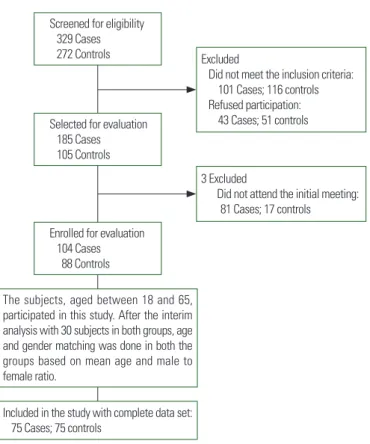
Methods: We recruited 150 subjects, 75 MetS patients and 75 healthy controls, then obtained written informed consent to participate in this study. We collected fasting blood samples for glucose and lipid profiles and calcu- lated nineteen indices of IR and insulin secretion using validated formulae. We determined the precision of these IR indices using the area under the curve (AUC) in a receiver operating characteristic analysis.
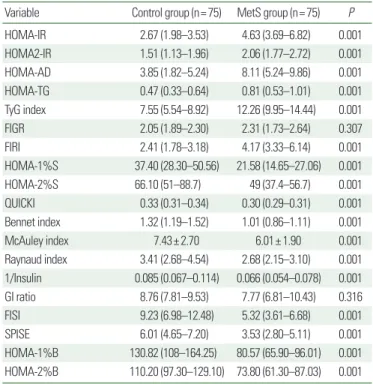
Results: Subjects with MetS have significantly higher IR coupled with lower insulin sensitivity and beta-cell function than controls. Among the surrogate markers of IR tested, the homeostatic model assessment of insulin resistance (HOMA-IR), HOMA-adiponectin (HOMA-AD), triglyceride-glucose (TyG) index, HOMA-1%S (insulin sensitivity), quantitative insulin sensitivity check index (QUICKI), McAuley index, single-point insulin sensitivity estimator (SPISE), and HOMA-2%B (beta-cell function) showed the highest AUC values for detecting MetS.
Conclusion: Our study results suggest that the ideal cut-off and AUC values identified for HOMA-IR, HOMA-AD, the TyG index, HOMA-1%S, QUICKI, the McAuley index, SPISE, and HOMA-2%B offer a clinical approach to the early detection and risk stratification for MetS among people in southern India.
Key words: Beta-cell function, Homeostatic model assessment of insulin resistance, Insulin sensitivity, Homeo- static model assessment-adiponectin, McAuley index, Single-point insulin sensitivity estimator
Received June 25, 2020 Reviewed July 27, 2020 Accepted September 16, 2020
* Corresponding author Girwar Singh Gaur
https://orcid.org/0000-0002-6593-5187 Department of Physiology, Jawaharlal Institute of Postgraduate Medical Education and Research, Puducherry 605006, India Tel: +91-9994470395 Fax: +91-0413-2272066 E-mail: [email protected]
INTRODUCTION
During the past decade, technological breakthroughs in health- care and medical technologies have substantially improved the di- agnostic approaches to and treatment options for cardiovascular disease (CVD). Nonetheless, CVD is the primary cause of morbid- ity and mortality globally.
1Impaired glucose tolerance, atherogenic
dyslipidemia, hypertension (HTN), and central or abdominal obe- sity are well-known CVD risk factors. Metabolic syndrome (MetS) is the collection of all the CVD risk factors related to vascular and metabolic dysfunctions that precede overt CVD and type 2 diabe- tes mellitus (T2DM).
2The association of MetS and its compo- nents with CVD risk is complicated and multifactorial. It ranges from developing resistance to insulin, aggravated glycemic and lipid
Copyright © 2020 Korean Society for the Study of Obesity
This is an Open Access article distributed under the terms of the Creative Commons Attribution Non-Commercial License (https://creativecommons.org/licenses/by-nc/4.0/) which permits unrestricted non-commercial use, distribution, and reproduction in any medium, provided the original work is properly cited.
2017-03-16 https://crossmark-cdn.crossref.org/widget/v2.0/logos/CROSSMARK_Color_square.svg