INTRODUCTION
The cellular and subcellular targets and the mechanisms of action of estrogen and progesterone in human skin pig- mentation are largely unknown. Only a few studies have examined the actions of estrogen and progesterone on the epidermal microenvironment. Most of the actions of female sex hormones appear to be exerted via their specific receptors on target cells and intracellular receptors that function as li- gand-activated transcription factors, regulating the synthe- sis of specific RNAs and proteins. Human progesterone receptors (PR) have been identified in normal keratinocytes (1).
High estrogen levels in the serum have been reported to be associated with an increase in skin pigmentation (2). How- ever, it is unclear whether the sex hormones play a significant role in the proliferatiom of cultured human melanocytes and their tyrosinase activity.
The issue of melanocytic expression via estrogen receptors (ER) has been quite controversial (3, 4). Although many researchers have shown the ability of melanocyte to bind to the hormones, such as estrogen and progesterone, using a hormone-binding assay, true hormone receptors have not
been molecularly identified in human melanocytes (5, 6).
The present study used immunocytochemistry and reverse transcriptase polymerase-chain reaction (RT-PCR) to deter- mine the ER and PR status in cultured melanocytes and the effects of estrogen and progesterone in human pigmentation in vitro in an attempt to elucidate the mechanism of the pregnancy-induced pigmentation, melasma.
MATERIALS AND METHODS Melanocyte culture
Normal human melanocytes were derived from the adult foreskin as previously described (7) and maintained in a growth medium consisting of MCDB-153, 4% heat-inacti- vated fetal bovine serum (FBS) (Gibco BRL, Grand Island, NY, U.S.A.), 10-7 M -melanocyte stimulating hormone ( -MSH) (Sigma Chemical Co., St. Louis, MO, U.S.A.), 8 nM 12-O-tetradecanoyl phorbol 13-acetate (TPA) (Sigma Chemical Co., St. Louis, MO, U.S.A.), 0.6 ng/mL human recombinant basic fibroblast growth factor (FGF) (Cal- biochem, San Diego, CA, U.S.A.), 5 g/mL insulin (Sigma
Sungbin Im, Eun-So Lee, Wankee Kim*, Whayoung On, Jaehyun Kim, Miok Lee, Won Hyoung Kang
Departments of Dermatology and Institute* for Medical Science, Ajou University School of Medicine, Suwon, Korea
Received : 12 July 2001 Accepted : 25 September 2001
Address for correspondence Won Hyoung Kang, M.D.
Department of Dermatology, Ajou University School of Medicine, 5 Wonchon-dong, Paldal-gu, Suwon 442-721, Korea
Tel : +82.31-219-5190, Fax : +82.31-219-5189 E-mail : [email protected]
*S.I., E-S.L., and W.H.K. were supported by grant of the Graduate School of Medicine, 1997, Ajou University, and were partially supported by grant (HMP-98-M-2-0021) of the 1998 Good Health R&D Project, Ministry of Health and Welfare, Republic of Korea.
58
Donor Specific Response of Estrogen and Progesterone on Cultured Human Melanocytes
The mechanisms of estrogen and progesterone in human cutaneous pigmenta- tion are largely unknown. The molecular identification of estrogen receptor (ER) and progesterone receptor (PR) in the human melanocytes is of great importance to understand the mechanisms. We performed immunocytochemistry analysis and demonstrated that ER and PR were expressed in the cytoplasms and nuclei of human melanocytes. Reverse transcriptase-polymerase chain reaction (RT- PCR) and sequence analysis confirmed the expression of ER and PR at the transcriptional level. Despite of the presence of ER and PR, the physiological and pregnant levels of estrogen and progesterone showed inconsistent effects on the proliferation and tyrosinase activity of cultured human melanocytes. These results suggest that human melanocytes express ER and PR, which have a donor- specific action in human pigmentation. Further studies are needed to elucidate the induction mechanism and functions of these receptors, and the role of estro- gen and progesterone in melanocytes.
Key Words : Progesterone; Estrogens; Receptors, Progesterone; Melanocytes
Chemical Co., St. Louis, MO, U.S.A.), 1 g/mL -toco- pherol (Sigma Chemical Co., St. Louis, MO, U.S.A.), and 1% penicillin-streptomycin (10,000 units/mL and 10,000 g/
mL, respectively) (Sigma Chemical Co., St. Louis, MO, U.S.A.).
All the subjects were Korean with Fitzpatrick skin type between III-VI. In all experiments for the expression of ER and PR, the melanocytes were maintained in culture MCDB 153 with chelexed FBS (Hyclone, Logan, UT, U.S.A.) and lacking -MSH for 3 days prior to beginning. Conventional FBS were reported to have estrogen.
Immunocytochemistry of ER and PR
Melanocytes grown on Lab-Tek chambers were fixed in 4%
paraformaldehyde for 30 min at room temperature, and per- meated in methanol followed by 0.1% Triton X-100 to achieve a nuclear permeance. Slides were placed in methanol contain- ing 0.3% hydrogen peroxidase for 10 min and the tissue non- specific activity was blocked by normal goat serum for 10 min. Then they were incubated with mouse monoclonal primary antibody against recombinant protein correspond- ing to the full-length estrogen receptors (Novocastra, Clare- mont Palace, U.K.) overnight at 0℃ at 1:40 dilution. Bio- tinylated antibody both against mouse and rabbit (DAKO, Carpinteria, CA, U.S.A.), was applied for 20 min. Subse- quently, the slides were incubated with streptavidin peroxi- dase (DAKO, Carpinteria, CA, U.S.A.), for 20 min at room temperature. The substrate chromogen 3-amino-9-ethyl- carbazole (AEC) (Biomeda Corp., Foster city, CA, U.S.A.), was applied for approximately 20 min. The sections were counterstained with Mayer hematoxylin (Merck, Darmstadt, Germany), and mounted with universal mount. Negative controls were made by applying phosphate-buffered saline (PBS) instead of the primary antibody. They consistently yielded the negative results. MCF-7 cell line grown on the LabTek chamber were used as a positive control (8).
Reverse Transcriptase-Polymerase Chain Reaction
Total RNA was extracted from cells by using a silica gel- based membrane (RNeasy total RNA kits; QIAGEN, Chat- sworth, CA, U.S.A.) and incubated for 15 min at room tem- perature with 1 U RNase-free DNase I (Gibco BRL, Grand Island, NY, U.S.A.), to remove contaminating genomic DNA.
Following inactivation of DNase I with ethylenediamine teraacetic acid (EDTA), the samples were heated and 3 g of total RNA was reverse-transcribed using Oligo-dT and Superscript II RNase H reverse-transcriptase (Gibco BRL, Grand Island, NY, U.S.A.). One tenth of RT product was mixed with 22 mM Tris-HCl (pH 8.4), 55 mM KCl, 165 mM MgCl2, 0.2 mM each of dATP, dCTP, dGTP, and dTTP, 22 U recombinant Taq DNA polymerase (PCR SuperMix system; Gibco BRL, Grand Island, NY, U.S.A.), and 0.5 M
each of the sense and anti-sense primer pairs. The following deoxyoligonucleotides were used as specific primers for the PCR. Human PR (9), sense 5′-TGGCTAAAGTGGTGCA TGAT-3′, anti-sense 5′-GTTTCACCATCCCTGCCAAT-3;
human ER (10), sense 5′-GCACCCTGAAGTCTCTGG AA-3′, anti-sense 5′-TGGCTAAAGTGGTGCATGAT-3′; GAPDH, sense 5′-GGTCGGAGTCAACGCATTTG-3′, anti-sense 5′-ATGAGCCCCAGCCTTCTCCAT-3′. After heating the mixtures at 94℃for 2 min, the PCR reaction was performed for 35 cycles [30 sec at 94℃, 30 sec at 65℃ (PR and GAPDH) or 55℃ (ER), and 2 min at 72℃]. PCR products were visualized with ethidium bromide staining (Promega, Madison, WI, U.S.A.).
DNA Sequencing
Amplified PCR products were electrophoresed on a 2%
agarose gel. The cDNA fragments were eluted from the agarose gel slices by a QIAquick gel extraction kit (QIA- GEN, Chatsworth, CA, U.S.A.). Single strand DNA tem- plate was purified by a Big Dye Terminator cycle sequenc- ing kit (Perkin-Elmer, Norwalk, CT, U.S.A.). Sequencing reactions were performed using the dideoxy chain-termina- tion method and analyzed, using an ABI 733 sequencer (Perkin-Elmer, Norwalk, CT, U.S.A.).
Skin organ culture
Normal skin of the breast cancer patients during the mas- tectomy were used for organ culture. All the skin samples were used immediately after the excision. Subcutaneous fat was removed and discs were taken from the skin samples with a 4-mm punch biopsy. Each skin sample was placed on a millicelles (1.2 m pore size, Millipore, Bedford, MA, U.S.A.) and then inserted on a 24-well culture plate in such a way that the medium was only in contact with the dermal side of the sample so that the epidermis remained constantly exposed to the air. Each piece was maintained in a DMEM medium lacking phenol-red (Gibco BRL, Grand Island, NY, U.S.A.) and containing 10% Chelexed FBS (Hyclone, Logan, UT, U.S.A.). Phenol-red and conventional FBS were reported to have an estrogenic stimulatory effect. Treatment with estrogen and progesterone (1 and 100 nM each) and medium change were performed every other day for 6 days.
At 6th day, the cultures were fixed in 4% buffered formalde- hyde and embedded in paraffin. Routine hematoxylin and eosin stain and Fontana-Masson stain were done on each sample.
Determination of melanocyte proliferation and tyrosi- nase activity after treatment with estrogen and pro- gesterone
To investigate the effects of estrogen and progesterone on
the melanocyte proliferation and tyrosinase activity, cells were plated at a density of 1.5×10⁶cells/60-mm dish. The culture medium was replenished, and a fresh treatment (1, 100 nM estrogen and progesterone) was done every other day for a total of 6 days. At the end of each experiment, melano- cytes from each individual dish were harvested and counted using a Coulter counter (Coulter Electronics, Hialcah, FL, U.S.A.). During the final 24 hr of the experiment, (3, 5-3H) L-tyrosine (specific activity, 52 mCi/mmol; Dupont NEN, Boston, MA, U.S.A.), at a concentration of 0.7 Ci/ mL (total of 2.1 Ci/3 mL/flask) was added to the culture medium.
The conditioned medium from each well was then saved to determine tyrosinase activity. The tyrosine hydroxylase activi- ty was determined in situ by a modification of the Pomer-
antz charcoal absorption method as previously described (11).
This assay is based on the measurement of the amount of 3H2O released into the culture medium as [3H]tyrosine is converted to L-dihydroxyphenylalanine (L-DOPA) by tyro- sinase.
RESULTS
Expression of ER and PR in the cultured melanocytes
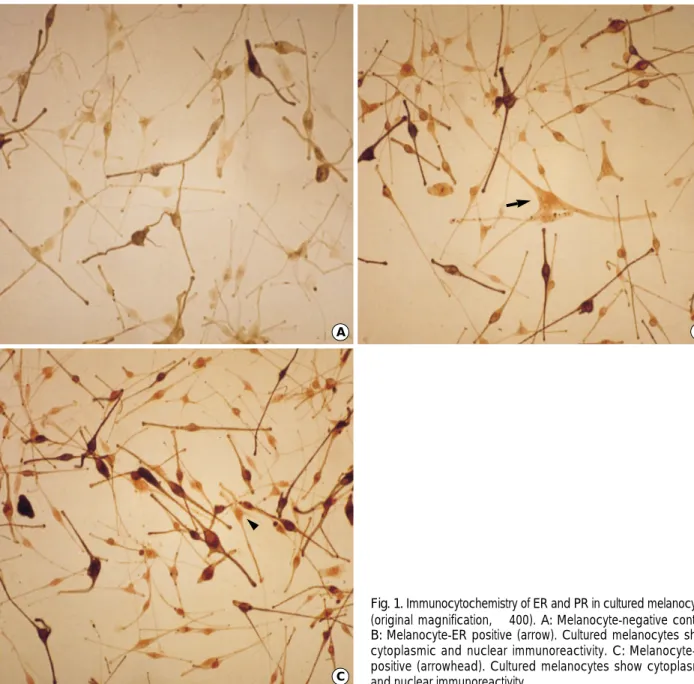
Melanocytes grown on slides were analyzed by immunos- taining using the same human ER and PR antibodies. The human adult melanocytes expressed ER and PR in the cyto-
C
A B
Fig. 1. Immunocytochemistry of ER and PR in cultured melanocytes (original magnification, ×400). A:Melanocyte-negative control.
B:Melanocyte-ER positive (arrow). Cultured melanocytes show cytoplasmic and nuclear immunoreactivity. C:Melanocyte-PR positive (arrowhead). Cultured melanocytes show cytoplasmic and nuclear immunoreactivity.
plasm and nucleus (Fig. 1). The human breast cancer cell line MCF-7 shows positive ER and PR immunoreactivity
in the nucleus (data not shown) (12, 13).
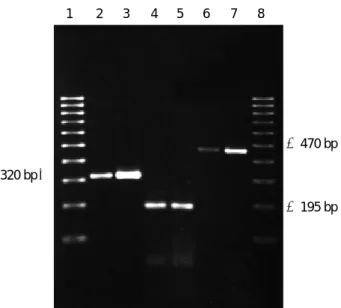
To confirm that the ER and PR immunoreactivity was originated from the encoded proteins, we subsequently exam- ined the ER and PR transcripts by PCR. The predicted 195 bp and 470 bp PCR products of PR and ER, respectively, were found in MCF-7 and human adult melanocytes (Fig.
2). Neonatal melanocytes expressed the same immunoreactiv- ity and mRNA transcripts of ER and PR (data not shown).
Sequencing analysis of the RT-PCR products of ER and PR showed 99.9% homology with the reported human ER and PR sequences (data not shown). These results confirmed that mRNA coding for ER and PR is transcribed and translated in human melanocytes, providing a strong evidence that human melanocytes are the target for the estrogen and pro- gesterone action.
Effect of estrogen and progesterone on pigmentation in skin samples grown in organ culture
To investigate the influence of estrogen and progesterone on pigmentation, skin organ culture was used as a model system more closely resembling in vivo circumstances than those of the melanocyte monolayer culture. Because the steroid hormones are capable of penetrating the skin easily as com- pared with the peptide hormones, the skin explants were first immersed in the media and estrogen and progesterone were treated for 6 days. During the culture, the overall in
Fig. 2. RT-PCR profiles of cultured human melanocyte. RT-PCR of MCF-7 and human melanocytes yielded the predicted 195 bp PCR product for PR and 470 bp for ER at mRNA level. Lane 1, molecular size marker, Lane 2, GAPDH (MCF-7), Lane 3, GAPDH (melanocyte), Lane 4, ER ( MCF-7), Lane 5, ER (melanocyte), Lane 6, PR (MCF-7), Lane 7, PR (melanocyte), Lane 8, molecular size marker.
1 2 3 4 5 6 7 8
320 bp→
←470 bp
←195 bp
A B
Fig. 3. Effect of estrogen and progesterone on pigmentation in skin samples grown in organ culture. Estrogen and progesterone at a physiologic concentration (1 nM) and concentration in pregnancy (100 nM) did not show any significant epidermal changes including the thickness and rete ridge pattern. The concentrations also did not affect the epibolic outgrowth. In 2 samples out of 5, estrogen at 1 nM and 100 nM concentration increased the basal pigmentation as compared with the control. However, progesterone either at 1 nM or at 100 nM concentration did not increase the melanin content in the epidermis in all samples. A:control, B:estrogen at 100 nM concentra- tion increased the basal pigmentation (Fontana-Masson stain, original magnification, ×400).
vivo cell morphology of keratinocytes was maintained for a period of 6 days. Although a slight dermoepidermal separa- tion was noted in some experiment, the explants were quite satisfactory for testing. Epidermal cells of the explant prolif- erated and migrated to form a new epidermis (epibolus) that completely surround the explant within 6 days. Estrogen and progesterone either at a physiologic concentration (1 nM) or at a concentration in pregnancy (100 nM) did not show any significant epidermal changes including the thickness and rete ridge pattern. The concentrations did not affect the epi- bolic outgrowth, either. In 2 samples out of 5, estrogen at 1 nM and 100 nM concentration both increased the basal pig- mentation as compared with the control (Fig. 3). However, progesterone either at 1 nM or at 100 nM concentration did not increase the melanin content in the epidermis in all sam- ples.
Melanogenic and mitogenic effects of estrogen and progesterone on human melanocytes
Because conventional FBS and phenol red in MCDB media have a mild estrogenic effect, we first maintained the cultured melanocytes in phenol red-free DMEM with chelexed serum that was deprived of estrogen by charcoal. In this condition, melanocytes started to float on day 4 and we could not main- tain the melanocytes more than 6 days. We next compared the effect of estrogen and progesterone on melanocytes in MCDB with phenol red and chelexed serum vs regular serum, and observed no difference. Thus the subsequent experiments were done using MCDB with chelaxed serum.
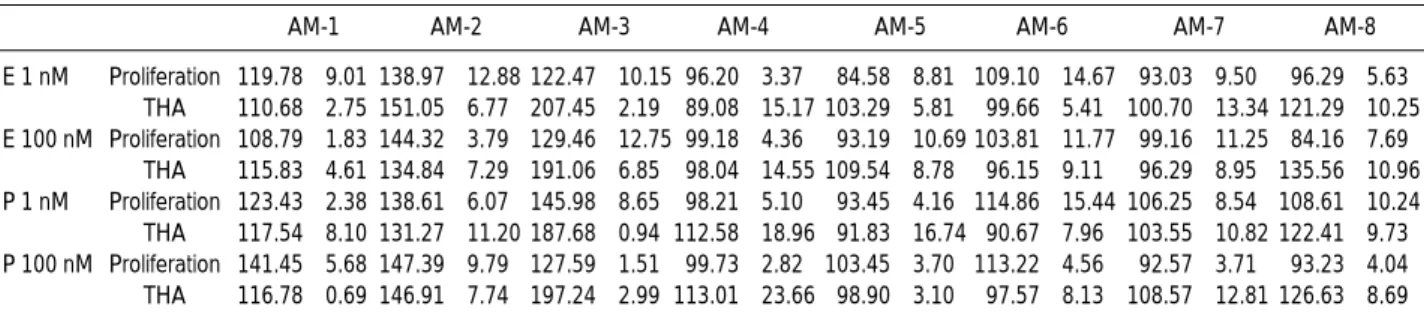
Melanocytes from 8 donors treated with 1 and 100 nM estrogen and progesterone for 6 days showed a donor-specif- ic response (Table 1). The number of melanocytes and tyro- sine hydroxylase activity increased in melanocytes from 3
% control
control E 1 nM E 100 nM P 1 nM P100 nM 180
160 140 120 100 80 60 40 20
0 A
AM-2
Porliferation
THA % control
control E 1 nM E 100 nM P 1 nM P 100 nM 140
120
100
80
60
40
20
0 B
AM-6
Porliferation THA
Fig. 4.Effect of estrogen and progesterone on the proliferation and tyrosinase activity of human melanocytes. A: The number of melanocytes and tyrosine hydroxylase activity both increased in melanocytes from AM-2 donor in response to 1 and 100 nanomolar concentrations of estrogen and progesterone. B:Neither proliferation nor tyrosinase activity showed any changes due to estrogen and progsterone treatment in AM-6 donor.
AM-1 AM-2 AM-3 AM-4 AM-5 AM-6 AM-7 AM-8
E 1 nM Proliferation 119.78±9.01 138.97±12.88 122.47±10.15 96.20±3.37 84.58±8.81 109.10±14.67 93.03±9.50 96.29±5.63 THA 110.68±2.75 151.05±6.77 207.45±2.19 89.08±15.17 103.29±5.81 99.66±5.41 100.70±13.34 121.29±10.25 E 100 nM Proliferation 108.79±1.83 144.32±3.79 129.46±12.75 99.18±4.36 93.19±10.69 103.81±11.77 99.16±11.25 84.16±7.69
THA 115.83±4.61 134.84±7.29 191.06±6.85 98.04±14.55 109.54±8.78 96.15±9.11 96.29±8.95 135.56±10.96 P 1 nM Proliferation 123.43±2.38 138.61±6.07 145.98±8.65 98.21±5.10 93.45±4.16 114.86±15.44 106.25±8.54 108.61±10.24 THA 117.54±8.10 131.27±11.20 187.68±0.94 112.58±18.96 91.83±16.74 90.67±7.96 103.55±10.82 122.41±9.73 P 100 nM Proliferation 141.45±5.68 147.39±9.79 127.59±1.51 99.73±2.82 103.45±3.70 113.22±4.56 92.57±3.71 93.23±4.04 THA 116.78±0.69 146.91±7.74 197.24±2.99 113.01±23.66 98.90±3.10 97.57±8.13 108.57±12.81 126.63±8.69 Table 1.Melanogenic and mitogenic effects of estrogen and progesterone on cultured human melanocytes (% of untreated control)
Cells were plated at 1.5×10⁶cells/60-mm dish, and triplicate dishes were included in each of the control and experimental groups. Fresh growth medium with 1 nM and 100 nM concentrations of estrogen (E) and progesterone (P) each was added to each dish every other day for a total of 6 days. For proliferation, melanocytes from each individual dish were harvested at the end of experiment and counted using a Coulter counter, and % of control was calculated. In the same experiment, tyrosine hydroxylase activity was assayed on day 6. On day 5, each dish was incubated with a medium containing [3H] tyrosine for 24 hr. The conditioned medium from each dish was then collected and assayed for tyrosine hydroxylase activity.
For THA, tyrosine hydroxylase activity was expressed as DPM/107cells and % of untreated control was calculated. This experiment was repeated three times, which yielded similar results. The values indicated are the means and SD of % of control in each experiment performed in triplicate.
Melanocytes treated for 6 days with 1 and 100 nM estrogen and progesterone in 8 different donors showed a donor-specific response.
adult foreskin donors in response to 1 and 100 nM estrogen and progesterone, respectively (Fig. 4A). In one donor, only the tyrosinase activity increased. In the remaining 4 donors, neither proliferation nor tyrosinase activity of melanocytes showed any significant changes due to estrogen and proges- terone (Fig. 4B). Interestingly, the dose response to 1 and 100 nanomolar concentrations of either hormone did not show any significant differences. -MSH treatment, used for a positive control, was proved to be both mitogenic and melanogenic in melanocytes. However when -MSH was treated concomitantly with estrogen and progesterone, no additive response was observed, and no difference was noted between neonatal and adult melanocytes (data not shown).
DISCUSSION
Since many dermatoses are related to a female predisposi- tion and pregnancy, it is feasible that the female sex hormone may influence the skin directly. Estrogen appears to increase the vascularization of the skin and suppress the sebaceous gland activity. Also estrogen increases the pigment cell activity (14).
Skin pigmentation in vivo is determined by genetic, envi- ronmental, local, and endocrine factors, which influence both melanin synthesis within each melanocyte and the distribu- tion of melanin throughout the epidermis. Melasma, a com- mon acquired brownish pigmentation occurring exclusively in the sun-exposed areas on the face, is exacerbated by preg- nancy and oral contraceptives (15-20). Sato reported a signifi- cantly high level of progesterone in the serum of Japanese patients with melasma (2). On the other hand, Perez et al.
reported the increased serum levels of LH alone, and lower levels of serum estradiol in patients with melasma than in normal controls (21). We, therefore, assumed that the ovarian hormones such as estrogen and progesterone may be involved in the pathogenesis of melasma, i.e., indirect influence of ovarian hormones on the melanocytes in vivo remains to be clarified.
The issue of melanocytic expression via ER has been quite controversial. Investigators found that tyrosinase can mimic the tight binding of 3H-estradiol, giving 3H-labeled prod- ucts. In this way tyrosinase oxidation of 3H-estradiol led to spurious positive results in early biochemical assays of estro- gen binding. Although the true estradiol binding could not be distinguished from tyrosinase activity with the dextran- coated charcoal assay, the use of immunocytochemistry and RT-PCR obviated this problem.
In this study we provide the first direct evidence that human melanoytes show ER and PR immunoreactivity. ER and PR belong to a superfamily of ligand-induced transacti- vators that exerts their regulatory activity on discrete genes through DNA binding at individual hormone-responsive elements. Understanding the molecular characterization of
ER and PR is of particular importance in assessing the hor- monal dependence of target cells. The significance of ER and PR in the melanocytes is an area of considerable interest. To clarify the existence of ER and PR, we analyzed the expression of ER and PR in cultured melanocytes and designed an exper- iment to evaluate the role of estrogen and progesterone on human pigmentation using an in vitro culture system. Our data provides the evidence for the presence of ER and PR in cultured melanocytes by immunocytochemistry, RT-PCR, and sequencing.
Recent studies have demonstrated the effects of estrogen and progesterone on human melanocytes. However, it is unclear whether the effects were directly exerted by the sex hormones or by tyrosinase activity.
Ranson et al., for the first time, reported that the incuba- tion of neonatal melanocytes with beta-estradiol (10-10-10-9 M) for 24 hr resulted in a dose-dependent stimulation of the tyrosinase activity (22). The increased melanogenesis was accompanied by reduced cell number and enhanced melanin extrusion into the medium. They are also aware that, most studies on the melanocytes have extrapolating any of the results to the adult situation.
On the contrary, Jee et al. reported that the treatment of 17 -estradiol (10-12to 10-9M) for 10 days significantly showed the increased neonatal melanocyte number, and for 1 day exhibited the decreased tyrosinase activity and melanin con- tent (6). However, they suggested that the tyrosinase activi- ty and melanin content were expressed on per cell bases. It is suggested that the proliferating activity stimulated by estra- diol was greater than that by the tyrosinase activity and the melanin producing activity.
Recent data from the adult melanocytes of Japanese male foreskin showed that estradiol in the concentration range of 0.01 to 1.0 g/mL and 1 g/mL progesterone significantly increased the amount of TRP-1, and no significant effect on DOPA oxidase activity was detected after estradiol and pro- gesterone treatment (23). Estradiol and progesterone also increased the area, the dendrites and the perimeter per cell.
Kippenberger et al. applied the reverse transcriptase-com- petitive multiplex PCR to normal human melanocytes, and reported that 20 M treatment of diethylstilbestrol and estra- diol for 48 hr lead to an increase of about 1.5 to 2.5 fold of tyrosinase and TRP-2 transcripts (24). The authors reported for the first time that the sex steroids cause an increase of melanogenic enzyme transcripts in normal human mela- nocytes. An increase in the tyrosinase activity could provoke the switch from pheomelanogenesis to eumelanogenesis.
Activation of tyrosinase by estradiol might be an alternative to a direct receptor-mediated mechanism for the growth inhibitory effect observed in vivo and in vitro.
In this study, in spite of the presence of receptor for estro- gen and progesterone, they had a donor-specific effect on proliferation of melanocytes. There are several plausible explanations for this lack of effect on melanocyte growth in
vitro. The first is that certain prone melanocytes only can respond to estrogen and progesterone with a stimulation of growth. The genetic predisposition and ultraviolet exposure may be prerequisite or costimulating factors. Alternative explanations for the lack of either a stimulatory response to estrogen and progesterone in vitro include the limited amount of receptor present, a requirement for an estrogen- or pro- gesterone-induced autocrine or paracrine growth factor- mediated growth. The dilution of such factors in culture has been proposed to account for the observed absence of estro- gen- or progesterone-stimulated cell growth in the breast tumor cells that otherwise respond to estrogen and proges- terone in vivo by increased tumor growth.
We provide the first direct evidence that human cultured melanoytes contain ER and PR immunoreactivity. Human melanocytes uniformly expressed ER and PR in their cyto- plasm and nucleus. ER and PR mRNA were present in cul- tured melanocytes. In spite of the presence of receptor for estrogen and progesterone, estrogen and progesterone had a donor-specific effect on proliferation of melanocytes and tyrosine hydroxylase activity.
REFERENCES
1. Im S, Lee E-S, Kim W, Song J, Kim J, Lee M, Kang WH. Expression of progesterone receptor in human keratinocytes. J Korean Med Sci 2000; 15: 647-54.
2. Sato N. Endocrine environment in adult females with chloasma. Jpn J Dermatol 1987; 97: 937-43.
3. Hodgins MB, Spike RC, Mackie RM, McLean AB. An immunohisto- chemical study of androgen, oestrogen and progesterone receptors in the vulva and vagina. Br J Obstet Gynaecol 1998; 105: 216-22.
4. Jee SH, Lee SY, Chiu HC, Chang CC, Chen TJ. Effect of estrogen and estrogen receptor in normal human melanocytes. Biochem Bio- phys Res Commun 1994; 199: 1407-12.
5. McCarty KS Jr, Wortman J, Stowers S, Lubahn DB, McCarty KS Sr, Seigler HF. Sex steroid receptor analysis in human melanoma.
Cancer 1980; 46: 1463-70.
6. Ellis DL, Wheeland RG, Solomon H. Estrogen and progesterone receptors in melanocytic lesions. Arch Dermatol 1985; 121: 1282-5.
7. Kim NS, Cho JH, Kang WH. Behavioral differences between donor site-matched adult and neonatal melanocytes in culture. Arch Der- matol Res 2000; 292: 233-9.
8. Cho H, Aronica SM, Katzenellenbogen BS. Regulation of proges- terone receptor gene expression in MCF-7 breast cancer cells: a comparison of the effects of cyclic adenosine 3′, 5′-monophosphate,
estradiol, insulin-like growth factor-I, and serum factor. Endocrinol- ogy 1994; 134: 658-64.
9. Ingamells S, Campbell IG, Anthony FW, Thomas EJ. Endometrial progesterone receptor expression during the human menstrual cycle.
J Reprod Fertil 1996; 106: 33-8.
10. Sabbah M, Kang KI, Tora L, Redeuilh G. Oestrogen receptor facili- tates the formation of preinitiation complex assembly: involvement of the general transcription factor TFIIB. Biochem J 1998; 336: 639-46.
11. Pomerantz SH. L-tyrosine-3, 5-3H assay for tyrosinase development in skin of newborn hamsters. Science 1969 16; 164: 838-9.
12. Greene GL, Gilna P, Waterfield M, Baker A, Hort Y, Shine J.
Sequence and expression of human estrogen receptor complementary DNA. Science 1986; 231: 1150-4.
13. Misrahi M, Atger M, d’Auriol L, Loosfelt H, Meriel C, Fridlansky F, Guiochon-Mantel A, Galibert F, Milgrom E. Complete amino acid sequence of the human progesterone receptor deduced from cloned cDNA. Biochem Biophys Res Commun 1987; 143: 740-8.
14. Shahrad P, Marks R. A pharmacological effect of oestrone on human epidermis. Br J Dermatol 1977; 97: 383-6.
15. Newcomer VD, Lindbert MC, Stenbert TH. A melanosis of the face
“( chloasma”). Arch Dermatol 1961; 83: 284-97.
16. Sanchez NP, Pathak MA, Sato S, Fitzpatrick TB, Sanchez JL, Mihm MC Jr. Melasma: A clinical, light microscopic, ultrastructural, and immunofluorescence study. J Am Acad Dermatol 1981; 4: 698-710.
17. Grimes PE. Melasma: etiologic and therapeutic considerations. Arch Dermatol 1995; 131: 1453-7.
18. Resnick S. Melasma induced by oral contraceptive drugs. JAMA 1967; 199: 95-9.
19. Nordlund JJ, Boissy RE, Hearing VJ, King RA, Ortonne JP, editors.
Pigmentary system: physiology and pathophysiology. New York:
Oxford University Press; 1997.
20. Pathak MA, Riley FC, Fitzpatrick TB. Melanogenesis in human skin following exposure to long-wave ultraviolet and visible light. J Invest Dermatol 1962; 39: 435-43.
21. Perez M, Sanchez JL, Aguilo F. Endocrinologic profile of patients with idiopathic melasma. J Invest Dermatol 1983; 81: 543-5.
22. Ranson M, Posen S, Mason RS. Human melanocytes as a target tis- sue for hormones: in vitro studies with 1 alpha-25, dihydroxyvitamin D3, alpha-melanocyte stimulating hormone, and beta-estradiol. J Invest Dermatol 1988; 91: 593-8.
23. Maeda K, Naganuma M, Fukuda M, Matsunaga J, Tomita Y. Effect of pituitary and ovarian hormones on human melanocyte in vitro.
Pigment Cell Res 1996; 9: 204-12.
24. Kippenberger S, Loitsch S, Solano F, Bernd A, Kaufmann R. Quan- tification of tyrosinase, TRP-1, and TRP-2 transcripts in human melanocytes by reverse transcriptase-competitive multiplex PCR- regulation by steroid hormones. J Invest Dermatol 1998; 110: 364-7.