Printed in the Republic of Korea DOI 10.5012/jkcs.2011.55.3.364
0.25 M 황산 용액 상에서의 Imatinib Mesylate에 의한 연강철 부식 억제
K. N. Mohana*, S. S. Shivakumar, and A. M. Badiea
Department of Studies in Chemistry, University of Mysore, Manasagangotri, Mysore 570 006, India (접수 2011. 1. 3; 수정 2011. 1. 13; 게재확정 2011. 3. 10)
Inhibition of Mild Steel Corrosion in 0.25 M Sulphuric Acid Solution by Imatinib Mesylate
K. N. Mohana*, S. S. Shivakumar, and A. M. Badiea
Department of Studies in Chemistry, University of Mysore, Manasagangotri, Mysore 570 006, India.
*E-mail: [email protected]
(Received January 3, 2011; Revised January 13, 2011; Accepted March 10, 2011)
요 약. 다양한 억제제의 농도, 온도, 유속에서 중량 분석과 변전위 분극법을 이용하여 0.25 M 황산 용액상에 있는 연강 철에 대한 imatinib mesylate (IMT)의 부식 억제를 연구하였다. 억제제의 농도가 증가함에 따라 억제 효과가 증가한다는 결 과를 얻었다. 연강철 표면 위의 흡착 과정은 Langmuir 흡착 등온선을 따른다. 얻어진 흡착 깁스 자유 에너지의 값은 연강 철 위의 IMT의 흡착 과정이 화학흡착이라는 것을 보여준다. 열역학 변수들이 계산되고, 논의되었다. IMT의 HOMO와
LUMO의 전자궤도 밀도 분포는 억제 메커니즘을 논의하는데 이용되었다. FT-IR 분광학과 SEM 이미지는 필름에 흡착된
표면을 분석하기 위해 사용되었다.
주제어: 연강철, Imatinib mesylate, 황산 매질, 분극, 흡착
ABSTRACT. The corrosion inhibition of imatinib mesylate (IMT) on mild steel in 0.25 M sulphuric acid has been studied using gravimetric and potentiodynamic polarization techniques at various concentrations of inhibitor, temperature and fluid velocities. The results obtained showed that, inhibition efficiency (% IE) increases with increasing concentration of the inhib- itor. The adsorption process on mild steel surface follows Langmuir adsorption isotherm. The values of Gibbs free energies of adsorption obtained suggest that, the adsorption process of IMT on mild steel is chemisorption. Thermodynamic parameters were evaluated and discussed. The electron orbital density distribution of HOMO and LUMO of IMT was used to discuss the inhibition mechanism. FT-IR spectroscopy and SEM images were used to analyze the surface adsorbed film.
Keywords: Mild steel, Imatinib mesylate, Sulphuric acid medium, Polarization, Adsorption
INTRODUCTION
The investigation of corrosion of mild steel is always a subject of high theoretical as well as practical interest.
Mild steel is widely used in industries due to its good mechanical property. Sulphuric acid is most frequently used for the removal of undesirable scale and rust in metal finishing industries, heat exchangers, cleaning of boilers and pickling of iron and steel.1-4 Corrosion inhibitors are often used to inhibit corrosion of apparatus caused by acid medium in many industrial operations.5 Most of the well known acid inhibitors are organic compounds such as those containing nitrogen, sulphur, oxygen atoms and aro- matic rings.6-12 These substances in general are effective through adsorption on the metal surface. Compounds con- taining both nitrogen and sulphur groups generally give
rise to satisfactory inhibition efficiency in the case of iron corrosion in acid medium.13-15 The efficiency of these inhibitors depends on chemical composition and structure of the inhibitors and on the state of the metallic surface.16,17 A few investigations have been reported on the use of drugs as corrosion inhibitors. Rhodanine azosulpha drugs have been reported to be corrosion inhibitors for the cor- rosion of 304 stainless steel in HCl medium.18 They showed good corrosion inhibition by parallel adsorption on the surface of steel due to the presence of more than one active centre in the inhibitor. Some antibacterial drugs viz., ampi- cillin (AMP), cloxacillin, flucloxacillin and amoxicillin have been studied as inhibitors for the corrosion.19 The cor- rosion inhibition of the mild steel in HCl medium by four sulpha drugs viz., sulfaguanidine, sulfamethazine, sul- famethoxazole and sulfadiazine was reported using both
weight loss and galvanostatic polarization.20
Accordingly, the aim of present work is to study the inhibitive performance of imatinib mesylate (IMT Cancer drug) on the corrosion of mild steel in 0.25 M sulphuric acid using gravimetric measurements and potentiody- namic polarization studies. Thermodynamic parameters such as adsorption heat, adsorption entropy and adsorp- tion free energy were obtained from the experimental data of the inhibition process at different temperatures, and pre-exponential factor at various inhibitor concentrations were calculated. The effect of activation energy on the corrosion rate of mild steel was discussed. The adsorbed film containing the investigated compound has been iden- tified by FT-IR spectroscopy and SEM analysis. The inhi- bition mechanism has been discussed based on the electron orbital density distribution of HOMO and LUMO of IMT molecule.
EXPERIMENTAL
Materials
The experiments were performed with mild steel hav- ing the chemical composition (weight %), C 0.090, Mn 1.373, P 0.016, Si 0.322, Cr 0.062, S 0.025 and the reminder iron. Imatinib mesylate (IMT) was procured from Intermed Labs, Bangalore, India. The chemical structure of IMT is shown in Fig. 1. A stock solution of IMT (10 mM) was prepared by weighing an appropriate amount of it and dis- solved in 1 liter of 0.25 M H2SO4, and series of concen- trations (1 mM - 5 mM) were prepared from this stock solution. Approximately 1 M H2SO4 solution was pre- pared by diluting the appropriate volume of the concen- trated acid (AR grade) with double distilled water. The concentration of the acid was checked by titrating an appropriately diluted portion with standard solution of sodium hydroxide which was titrated in turn against stan- dard solution of oxalic acid. From this stock concentrated solution, exactly 0.25 M H2SO4 solution was prepared by dilution with double distilled water which was used throughout the experiment.
Weight Loss Method
The reaction basin used in this method was a graduated
glass vessel having a total capacity of 500 ml. 250 ml of the test solution was employed in each experiment. The test specimens were cut into 1×1×0.3 cm. They were mechanically polished with different grades of emery papers, degreased in acetone, rinsed with double distilled water and finally dried between two filter papers and weighed. Finally, they were kept in a desicator for 1 h until use. The temperature of the environment was maintained by thermostatically controlled water bath with accuracy of
± 0.2 C0 (Weiber limited, Chennai, India). By using rotat- ing disk method, the rotational speed of the specimen was set at desired speed by using speed regulator motor (Eltek Ltd, Mumbai, India). The one face of the specimen was exposed to solution and remaining faces were embedded with epoxy resin. After 6 h of immersion, three test pieces were taken out from the test solution, rinsed with double distilled water, dried as before and weighed again. The average weight loss for each set of three samples was taken. The weight loss was recorded to the nearest 0.0001 gram by using an analytical balance (Sartorius, precision
± 0.1 mg). The corrosion rates (CR) of mild steel were cal- culated at various rotational speeds (1800-2200 rpm) from mass loss using equation (1):
(1)
where W is the weight loss (mg), t is the immersion time (h), A is the surface area of the specimen in (cm2) and CR is expressed in mg cm-2 h-1.
The inhibition efficiency (% IE) and degree of surface coverage (θ) were calculated using the following equa- tion:
(2)
(3)
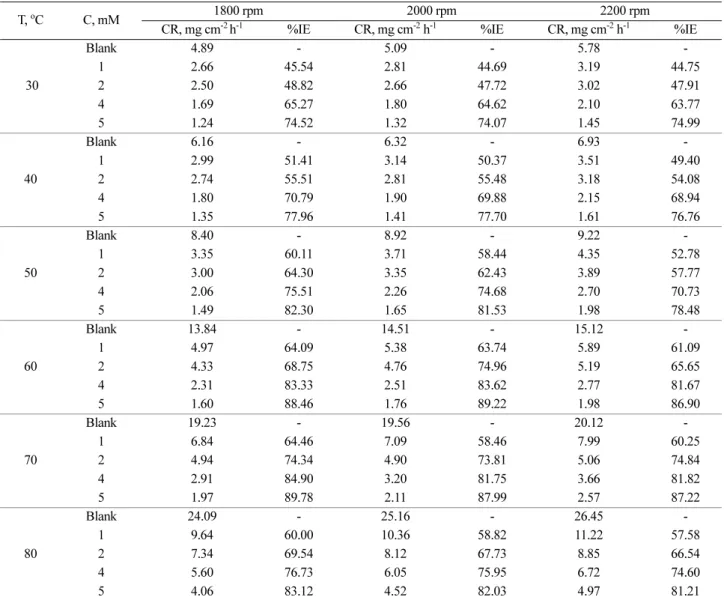
where (CR)p and (CR)a are the corrosion rate in the pres- ence and absence of the inhibitor, respectively. The values of CR and % IE are given in Table 1.
Potentiodynamic Polarization Method
The electrochemical experiments were carried out in a three-electrode electrochemical cylindrical Pyrex glass cell with a platinum counter electrode and saturated calomel electrode (SCE) as reference. The working electrode had the form of a square cut from mild steel sheet. The square with an exposed area of 1 cm2 which was then held in a shaft and rotated by motor driven shaft of ¼ hp. The
CR w
A t× ---
⎝ ⎠
⎛ ⎞
=
Θ 1 (CR)p
(CR)a
--- –
=
%IE 1 (CR)p
(CR)a
--- 100×
⎝ – ⎠
⎛ ⎞
=
Fig. 1. Chemical structure of IMT.
exposed area was polished with different grades of emery papers in the normal way starting from coarser to finer, followed by degreasing in acetone and finally washing with double distilled water, just before insertion in the electrolytic cell. A constant quantity of the test solution (100 ml) was taken in the polarization cell. A time inter- val of about 30 minutes was given for the system to attain a steady state and the open circuit potential (OCP) was noted. Both cathodic and anodic polarization curves were recorded potentiodynamically by changing the electrode potential between - 700 and + 500 mV from open circuit potential (OCP) at the scan rate of 0.4 mV s-1, using poten- tiostat model Solatron 1286.
Inhibition efficiency was calculated from the electro- chemical measurements by the following equation:
(4)
where (Icor)a and (Icor)p are the corrosion current density in the absence and presence of inhibitor, respectively. The corrosion potential (Ecor) and corrosion current density (Icor) were calculated by extrapolation of anodic and cathodic Tafel slopes.
SEM analysis
Samples for SEM experiments are mild steel sheets (1 cm × 1 cm × 0.2 cm). After 6 h of immersion, the surface features of the steel specimens exposed to acid as well as inhibited acid were examined with the help of scanning electron microscope (model JSM-5800).
%IE (Icor)a–(Icor)p
Icor ( )a
--- 100×
=
Table 1. CR and %IE obtained from weight loss measurements of mild steel in sulphuric acid medium containing various concentrations of IMT at different temperatures and rotational speed
T, oC C, mM 1800 rpm 2000 rpm 2200 rpm
CR, mg cm-2 h-1 %IE CR, mg cm-2 h-1 %IE CR, mg cm-2 h-1 %IE
30
Blank 4.89 - 5.09 - 5.78 -
1 2.66 45.54 2.81 44.69 3.19 44.75
2 2.50 48.82 2.66 47.72 3.02 47.91
4 1.69 65.27 1.80 64.62 2.10 63.77
5 1.24 74.52 1.32 74.07 1.45 74.99
40
Blank 6.16 - 6.32 - 6.93 -
1 2.99 51.41 3.14 50.37 3.51 49.40
2 2.74 55.51 2.81 55.48 3.18 54.08
4 1.80 70.79 1.90 69.88 2.15 68.94
5 1.35 77.96 1.41 77.70 1.61 76.76
50
Blank 8.40 - 8.92 - 9.22 -
1 3.35 60.11 3.71 58.44 4.35 52.78
2 3.00 64.30 3.35 62.43 3.89 57.77
4 2.06 75.51 2.26 74.68 2.70 70.73
5 1.49 82.30 1.65 81.53 1.98 78.48
60
Blank 13.84 - 14.51 - 15.12 -
1 4.97 64.09 5.38 63.74 5.89 61.09
2 4.33 68.75 4.76 74.96 5.19 65.65
4 2.31 83.33 2.51 83.62 2.77 81.67
5 1.60 88.46 1.76 89.22 1.98 86.90
70
Blank 19.23 - 19.56 - 20.12 -
1 6.84 64.46 7.09 58.46 7.99 60.25
2 4.94 74.34 4.90 73.81 5.06 74.84
4 2.91 84.90 3.20 81.75 3.66 81.82
5 1.97 89.78 2.11 87.99 2.57 87.22
80
Blank 24.09 - 25.16 - 26.45 -
1 9.64 60.00 10.36 58.82 11.22 57.58
2 7.34 69.54 8.12 67.73 8.85 66.54
4 5.60 76.73 6.05 75.95 6.72 74.60
5 4.06 83.12 4.52 82.03 4.97 81.21
IR spectroscopy
The surface products deposited on the test specimens after 6 h of exposure at room temperature in the inhibited acid were analyzed by FTIR (JASCO FT-IR Spectrome- ter, model 4100) using KBr discs.
RESULTS AND DISCUSSION
Adsorption Isotherm
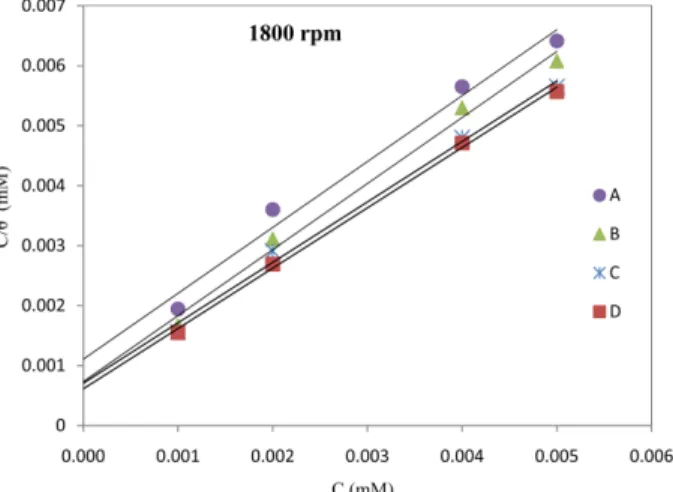
The dependence of the degree of surface coverage (θ) as function of concentration (C) of the inhibitor was tested graphically by fitting it to various isotherms to find the best isotherm which describes this study. Langmuir adsorption isotherm was found to be the best description for IMT on mild steel. According to this isotherm, θ is related to the inhibitor concentration, C and adsorption equilibrium constant Kads, via21:
(5)
The plot of C/θ versus Cgave a straight line (Fig. 2) with a slope of around unity confirming that the adsorp- tion of IMT on mild steel surface in sulphuric acid obeys the Langmuir adsorption isotherm. According to Lang- muir adsorption isotherm there is no interaction between the adsorbed inhibitor molecules, and the energy of adsorption is independent on the degree of surface cov- erage (θ). Langmuir isotherm assumes that the solid sur- face contains a fixed number of adsorption sites and each site occupies one adsorbed species. The equilibrium adsorp- tion constant, Kads is related to the standard Gibb’s free energy of adsorption (∆G0ads) with the following equa- tion:
(6)
where 55.5 is the concentration of water in solution (mol L-1), R is the universal gas constant and T is the absolute temperature. The enthalpy and entropy of adsorption (∆H0ads and ∆S0ads) can be calculated using the equations (7) and (8).
lnKads= ln (7)
lnKads= ln (8)
Using Eq. (8), the values of ∆H0ads and ∆S0ads were eval- uated from the slope and intercept of the plot of ln Kads
versus 1/T (Fig. 3). The values of ∆G0ads, ∆H0ads and ∆S0ads
are listed in Table 2. It shows that, the increase in Kads with increasing temperature indicates increase in the extent of adsorption with temperature.22 The negative values of
∆G0ads ensure the spontaneity of the adsorption process and stability of the adsorbed layer on the metal surface.23 Generally, the values of ∆G0ads around - 20 kJ mol-1 or lower are consistent with the electrostatic interaction between the charged molecules and the charged metal (physisorption), while those around - 40 kJ mol-1 or higher indicate charge sharing or transfer from organic molecule to vacant 3d orbital of the metal to form co-ordinate type of bond (chemisorption).24-25 In the present study, ∆G0ads
values are more negative than -20 kJ mol-1 suggest that, the adsorption process of IMT on mild steel surface is typ- ical chemisorption.26 The value of ∆H0ads is another cri- terion to confirm the mode of adsorption. Generally, an exothermic adsorption process signifies either physisorp- C
----θ 1 Kads ---+C
=
Kads 1
55.5---exp ∆Gads 0
---RT –
=
1 55.5---
⎝ ⎠
⎛ ⎞ ∆Gads0 ---RT –
1
55.5--- ∆Hads0 ---RT – ∆Sads0
---R +
Fig. 2. Langmuir’s adsorption isotherm plots for the adsorption of IMT in 0.25 M H2SO4 on the surface of mild steel at A-313 K, B-323 K, C-333 K and D-343 K at 1800 rpm.
Fig. 3. Plot of lnKads versus 1/T for IMT on mild steel in 0.25 M H2SO4 acid at 1800 rpm.
tion or chemisorption or mixture of both while an endot- hermic process is signifies chemisorption.27 In the present case, the calculated value of ∆H0ads is 9.41 kJ mol-1 indi- cating chemisorption of IMT on metal surface. In fact, it is well known that adsorption is an exothermic phenome- non accompanied by a decrease in entropy.28 In aqueous solution, the adsorption of organic molecule is generally accompanied with desorption of water molecules. The adsorption of an organic adsorbate at the metal/solution interface is considered a ‘‘substitutional adsorption’’ phe- nomenon.29 Therefore, the positive values of ∆H0ads and
∆S0ads related to ‘‘substitutional adsorption”.
The values of ∆H0ads and ∆S0ads can also be calculated by using following equation:
(9)
Using Eq. (9), the plot of ∆G0ads versus T gives a straight line with a slope of -∆S0ads and intercept of ∆H0ads. The values obtained are well correlated with those obtained from Eq. (8).
Effect of Temperature
To assess the effect of temperature on corrosion and cor- rosion inhibition process, gravimetric experiments were performed at different temperatures (30-80oC) in the absence and in the presence of various concentrations of the inhibitor during 6 h of immersion and at various rota- tional speeds (1800-2100 rpm) of the specimen. The results are presented in Table 1. From the Fig. 4 it is shown that, the CR increases with increasing the temperature in the absence of the inhibitor. However, this increase seems slightly in presence of the IMT. The relationship between the corrosion rate (CR) of mild steel and temperature (T) can be expressed by the Arrhenius equation:
(10)
where Ea* is the activation energy, k is the pre-exponential constant, R is the universal gas constant and T is the abso- lute temperature. Using Eq. (10), and from a plot of the log
CR versus 1/T (Fig. 5), the values of Ea* and k at various concentrations of IMT were computed from slopes and inter- cepts, respectively and the values are given in Table 3.
The lower value of Ea* at higher inhibitor concentration was due to the slow rate of inhibitor adsorption.30 Putilova31 has reported that these types of inhibitors are effective at higher temperatures. Ampicillin (AMP), a beta-lactam antibiotic was studied as corrosion inhibitor for mild steel in 0.1 M H2SO4, 32 its inhibition efficiency decreases with increase in temperature. The inhibition efficiency of IMT
∆Gads
0 ∆Hads
0 T∆Sads
– 0
=
CR k exp Ea* RT---
⎝– ⎠
⎛ ⎞
=
Table 2. Thermodynamic parameters for adsorption of IMT on mild steel in 0.25 M sulphuric acid at different temperatures and 1800 rpm T, K R2 Kads, L mol-1 ∆G0ads, kJ mol-1 ∆H0ads, kJ mol-1 ∆S0ads, J mol-1 K-1
313 0.982 909.1 -28.18 9.41 a 120.27 a
323 0.990 1086.9 -29.56 9.39 b 120 b
343 0.993 1111.1 -30.54
353 0.998 1282.1 -31.86
avalues obtained from Eq. (8) bvalues obtained from Eq. (9)
Fig. 4. Variation of CR of mild steel as a function of temperature and concentration of IMT at 1800 rpm.
Fig. 5. Plot of log CR versus 1/T for the corrosion of mild steel in 0.25 M H2SO4 containing various concentrations of IMT at 1800 rpm.
increases with temperature, because the addition of IMT to the acid solution decreases the activation energy. The reduction of the activation energy in the presence of IMT may be attributed to the chemisorption of the IMT on metal surface.33-34 The increase of %IE with temperature is explained with the change in the adsorption character.
In the present case physisorption has been observed at a lower temperature and transforms into chemisorption at higher temperature.35 The adsorbed inhibitor molecules block significantly some of the active sites on the steel surface, which is energetically inhomogeneous. The inhib- itor adsorbs at the active sites of the metal surface have the lowest Ea* and other active sites of higher Ea*will take part in the subsequent corrosion process.36 The values of enthalpy and entropy of activation can be calculated from the alternative form of Arrhenius equation as follows:
(11)
Where h is Planks constant, N is Avogadro’s number, ∆Sa*
is the entropy of activation, ∆Ha*is the enthalpy of acti- vation. Plots of log (CR/T) versus 1/T gave straight lines (Fig. 6) with a slope of (-∆Ha*/ 2.303R) and an intercept of [log (R/Nh) + ∆Sa*/2.303R] from which the values of
∆Ha*and ∆Sa* were calculated and are listed in Table 3.
The ∆Ha*values obtained from the slope of Eq. (8) and those values calculated from the equation, ∆Ha*= Ea*- RT are in good agreement with each other. The positive val- ues of ∆Ha* both in the absence and presence of inhibitor reflect the endothermic nature of mild steel dissolution process.37 The negative values of ∆Sa* obtained indicate that the activated complex in the rate determining step represents an association rather than dissociation, means that decrease in the disorder of the system due to the adsorption of inhibitor molecule on to the metal surface.38-40
Effect of Rotational Speed
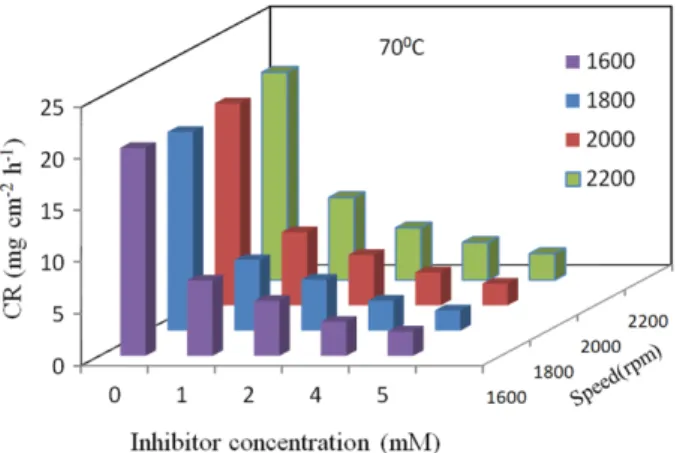
The corrosion measurements were carried out at dif- ferent rotational speed of the specimen (1800-2000 rpm).
From Fig. 7, it is clear that the %IE is maximum at 70 oC, 1800 rpm and at 5 mM IMT. Further, %IE increases with increasing rotational speed at all temperatures up to 1800 rpm however beyond 1800 rpm %IE decreases at all con- centrations. Therefore, an optimum velocity is necessary for uniform distribution of an inhibitor.
Electrochemical Measurements
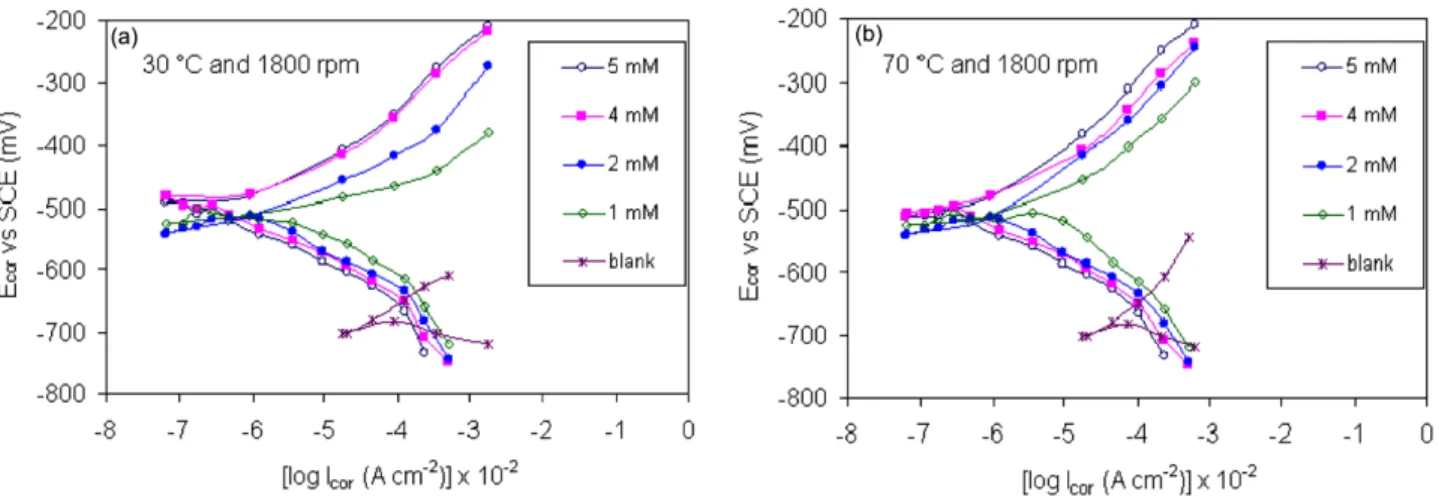
Potentiodynamic polarization curves obtained for the mild steel in 0.25 M sulphuric acid at various concentra- tions of IMT ranging from 1 mM to 5 mM are shown in CR RT
Nh---exp ∆Sa
*
---R
⎝ ⎠
⎛ ⎞exp ∆– Ha* ---R
⎝ ⎠
⎛ ⎞
=
Fig. 6. Alternative Arrhenius plots for mild steel dissolution in 0.25 M H2SO4 the absence and presence of different concentra- tions of IMT at 1800 rpm.
Fig. 7. Variation of CR of mild steel as a function of rotational speed and concentration of IMT at 70oC.
Table 3. Values of activation parameters for mild steel in 0.25 M sulphuric acid medium in the absence and presence of IMT at 1800 rpm C, mM Ea, kJ mol-1 k, mg cm-2 h-1 ∆Ha, kJ mol-1 ∆Ha = Ea-RT, kJ mol-1 ∆Sa, J mol-1 K-1
blank 30.52 814704.28 27.84 28.00 -140.73
1mM 20.53 8090.95 17.79 17.92 -179.09
2mM 15.64 1122.01 12.88 12.95 -195.52
4mM 11.38 144.21 8.64 8.60 -212.91
5mM 9.25 46.88 6.52 6.40 -221.91
Figs. 8a and 8b. It can be observed that the addition of IMT at all the studied concentrations decreased the anodic and cathodic current densities, and resulted in significant decline in the Icorr. This indicates that IMT shifted to smaller Icorr values in both anodic and cathodic branches of the curves, thus, acting as a mixed-type inhibitor,41 and the decrease is more pronounced with the increase in the inhibitor concentration at both temperatures. By compar- ing polarization curves in the absence and in the presence of various concentrations of IMT, it is observed that, increase in concentration of the inhibitor shift the corro- sion potential (Ecorr) in the positive direction and reduces both anodic and cathodic process.38,42
Molecule Structure and Inhibition Mechanism The adsorption of IMT molecule in sulphuric acid may be due to the interaction between iron atom and cyclic molecular π orbital. The incompletely filled 3d orbital of iron could bond with highest occupied molecular orbital (HOMO)43 of the IMT molecule, while the filled 4s orbital of the former could interact with the lowest unoccupied molecular orbital (LUMO) of the latter. This type of inter- action has been explained in other documents.44-45 The electron density distributions of HOMO and LUMO of IMT are shown in Figs. 9a and 9b. From this it can be seen that the larger HOMO (Fig. 9a) electron density at amide group and benzene ring are more feasible to interact with 3d orbital of iron, while the pyrimidine ring is having larger LUMO (Fig. 9b) electron density and could take priority of interaction with completely filled 4s orbital of iron. Both interactions lead to strong binding between iron and IMT and it evidence the negative value of ∆G0ads, and it increases with concentration. Another important factor
is that, IMT having approximate planar structure with larger molecular weight than usual inhibitors and this allows the molecule to have more functional groups which are in favor of corrosion inhibition.
FT-IR Analysis
The FT-IR analysis of IMT before and after reaction with iron was carried out between 400 and 4,000 cm-1 and the spectra are shown in Figs. 10a and10b, respectively.
The peak around 3000-3050 cm-1 was assigned to C-H stretching, C=O and N-H stretching frequencies are shown at 1659 cm-1 and 3435 cm-1, respectively. On com- Fig. 8. (a) Polarization curves for mild steel in 0.25 M H2SO4 containing different concentrations of IMT at 1800 rpm and 30oC (scan rate = 0.42 mV s-1), (b). Polarization curves for mild steel in 0.25M H2SO4 containing different concentrations of IMT at 1800 rpm and 70oC (scan rate = 0.42 mV s-1).
Fig. 9. The Structure of molecular orbital plots of IMT: (a) HOMO orbital density (b) LUMO orbital density.
paring the spectrum of pure IMT with the spectrum of adsorbed IMT molecule over iron, it is observed that shift- ing of C=O stretching frequency from 1659 to 1629 cm-1 and disappearance of N-H stretching frequency indicat- ing that there is interaction between the surface of mild steel and IMT.46
Morphological Investigation
The protective layer that formed on the metal surface was characterized by SEM analysis. Morphologies of mild steel in the absence and presence of optimum con- centration of IMT at 70oCare shown in Figs. 11a - 11c. It can be seen from Fig. 11a that the mild steel samples before immersion seem smooth. Inspection of Fig. 11b reveals that the mild steel surface after immersion in unin- hibited 0.25 M sulphuric acid for 6 h shows an aggressive attack of the corroding medium on the steel surface. The corrosion products appeared very uneven and lepidoteral- like morphology, and the surface layer is rather rough. In contrast, in the presence of IMT there is an adsorbed film on the metal surface (Fig. 11c).
CONCLUSIONS
1. Results obtained from the experimental data shows IMT as effective inhibitor for the corrosion of carbon steel in 0.25 M H2SO4.
2. The adsorption of IMT was found to obey the Lang- muir adsorption isotherm.
3. The corrosion rate in the presence and in the absence of inhibitor decreased with increasing rotational speed up to 1800 rpm and then it began to increasing. The adsorbed film containing the investigated compound was identified by SEM analysis and FT-IR spectroscopy.
4. The lower values of activation energy in the presence of IMT than those in its absence, and the higher values of Gibbs free energy indicated that the adsorption of IMT on mild steel in 0.25 M sulphuric acid is chemisorption.
REFERENCES
1. Dubey, A. K.; Singh, G. Port. Electrochim. Acta. 2007, 25, 249.
Fig. 10. (a) as FT-IR spectrum of pure IMT before its reaction with iron at optimum conditions, (b) FT-IR spectrum of IMT after reaction with iron at optimum conditions.
Fig. 11. SEM images of Mild steel in 0.25 M H2SO4 after 6 h immersion at 70oC and at 1800 rpm (a) Before immersion (polished) (b) without inhibitor (c) with 5 mM IMT.
2. Benali, O.; Larabi, L.; Mekelleche, S. M.; Harek, Y. J.
Mater. Sci. 2006, 41, 7064.
3. Leila, H.; Balkheir, H.; Abdelouahad, A.; Sghir El, K.;
Rachid, T. Acta. Chim. Slov. 2007, 54, 419.
4. Abd El Rehim, S. S.; Ibrahim Magdy, A. M.; Khalid, K.
F. Matter. Chem. Phys. 2001, 70, 268.
5. Skyes, J. M. Br. Corros. J. 1990, 25, 175.
6. Shyamalay, M.; Arulanantham, A. J. Mater. Sci. Technol.
2009, 25, 5.
7. Benabdellah, M.; Rhomari, M.; Raada, A.; Dafali, A.; Senhaji, O.;Hammouti, B.; Aouniti, A.; Robin, J. J. Chem. Eng.
Comm. 2007, 194, 1328.
8. Xianghong, L.; Deng, C.; Hui, F.; Guannan, M. Corros.
Sci. 2008, 50, 3599.
9. Vishwanathan, S.; Haldar, N. Corros. Sci. 2008, 50, 2999.
10. Ali, S. A.; Al-Muallem, H. A.; Saeed, M. T.; Rahman, S.
U. Corros. Sci. 2008, 50, 3070.
11. Siddiqi, W. A.; Chaubey, V. M. Port. Electrochim. Acta.
2008, 26, 221.
12. Peng, Z.; Cheng, Z.; Lei, H.; Lihong, N.; Fushi, Z. Corros.
Sci. 2008, 50, 2166.
13. Prabhu, R. A.; Venkatesha, T. V.; Shanbhag, A.V. J. Iran.
Chem. 2009, 6, 353.
14. Prabhu, R. A.; Venkatesha, T. V.; Shanbhag, A.V.; Praveen, B. M.; Kulkarni, G. M.; Kalkhambkar, R. G. Matter.
Chem. Phys. 2008, 108, 283.
15. Haifeng, Y.; Yiping, S.; Jiahua, J.; Wei, S.; Xuan, Z.; Yan- yan, Y.; Zongrang, Z. Corros. Sci. 2008, 50, 3160.
16. Yildirim, A.; Cetin, M. Corros. Sci. 2008, 50, 155.
17. Halperin, A.; Tirelli, M.; Lodge, T. P. Adv. Polym. Sci.
1992, 100, 31.
18. Abdallah, M. Corros. Sci. 2002, 44, 717.
19. Abdallah, M. Corros. Sci. 2004, 46, 1981.
20. El-Naggar, M. M. Corros. Sci. 2007, 49, 2226.
21. Lebrini, M.; Lagrenee, M.; Vezin, H. Traisnel, M.; Ben- tiss, F. Corros. Sci. 2007, 49, 2254.
22. Tang, L.; Mu, G.; Liu, G. Corros. Sci. 2003, 45, 2251.
23. Varsalovic, L.; Kliskic, M.; Radosevic, J.; Gudic, S. J.
Appl. Electrochem. 2007, 37, 325.
24. Wei hua, L.; Qiao, H.; Sheng, T. Z.; Chang, L. P.; Bao, R.
H. J. Appl. Electrochem. 2008, 38, 289.
25. Bouklah, M.; Hammouti, B.; Lagrenee, M.; Bentiss, F.
Corros. Sci. 2006, 48, 2470.
26. Bayoumi, F. M.; Ghanem, W. A. Matter. Lett. 2005, 59, 3806.
27. Mohameed, A.; Amin. J. Appl. Electrochem. 2006, 36, 215.
28. Li, X.; Deng, S.; Fu, H.; Mu, G. Corros. Sci. 2009, 51, 620.
29. Aljourani, J.; Raeissi, K.; Golozar, M. A. Corros. Sci.
2009, 51, 1836.
30. Hoar, T. P.; Holliday, R. D. J. Appl. Chem. 1953, 3, 502.
31. Putilova, I. N.; Balzin, S. A.; Branik, U. P. Metallic cor- rosion inhibitor; Pergamon Press: 1960, p.3.
32. Nnabuk O. E.; Eno, E. E.; Udo J. I. J. Appl.Electrochem.
2010, 40, 445.
33. Szauer, T.; Brandt, A. Electrochim. Acta. 1981, 26, 1209.
34. Sankarapapavinasam, S.; Pushpanaden, F.; Ahmed, M. F.
Corros. Sci. 1991, 32, 193.
35. Ivanov, E. S. Inhibitors for Metal Corrosion in Acid Media, Metallurgy, Moscow, 1986.
36. Popova, A. Corros. Sci. 2007, 49, 2144.
37. Abdallah, M.; Heal, E. A.; Fouda, A. S. Corros. Sci. 2006, 48, 1639.
38. Abd El Rehim, S. S.; Refaey, S. A. M.; Taha, F.; Saleh, M. B.; Ahmed, R. A. J. Appl. Electrochem. 2001, 31, 429.
39. Yurt, A.; Balaban, A.; Kandemir, S. U.; Bereket, G.; Erk, B. Mater. Chem. Phys. 2004, 85, 420.
40. Tang, L.; Li, X.; Si, Y.; Mu, G.; Liu, G. Mater. Chem.
Phys. 2006, 95, 26.
41. Gao, B. J.; Zhang, X.; Sheng, Y. L. Mater. Chem. Phys.
2008, 108, 375.
42. Yurt, A.; Bereket, G.; Kivrak, A.; Balban, A.; Erk, B. J.
Appl. Electrochem. 2005, 35, 1025.
43. Gabriella, L. G.; Gabor, M.; Bela, L.; Gyorgy, J. Corros.
Sci. 2003, 45, 1685.
44. Bouklah, M.; Hammouti, B.; Aouniti, A.; Benhadda, T.
Prog. Org. Coat. 2004, 49, 225.
45. El Azhar, M.; Menari, B.; Traisnel, M.; Bentiss, F.; Lagrenee, M. Corros. Sci. 2003, 43, 2229.
46. Robinson, S. D.; Uttleys, M. F. J. Chem. Soc. 1973, 12, 1912.