Printed in the Republic of Korea
- -
The Inhibition of C-steel Corrosion in H
3PO
4Solution by Some Furfural Hydrazone Derivatives
A. S. Fouda*, G. E. Badr, and M. N. El-Haddad
Department of Chemistry, Faculty of Science, El-Mansoura University, El-Mansoura-35516, Egypt (2008. 1. 16 접수)
The Inhibition of C-steel Corrosion in H
3PO
4Solution by Some Furfural Hydrazone Derivatives
A. S. Fouda*, G. E. Badr, and M. N. El-Haddad
Department of Chemistry, Faculty of Science, El-Mansoura University, El-Mansoura-35516, Egypt (Received January 16, 2008)
요 약. 3 M H3SO4(M: 몰농도) 용액에서 탄소강의 부식방지제로 Furfural hydrazone 유도체의 효과를 질량손실법 및 정전류극성법을 사용해 연구하였다. 이들 유도체 존재하에서 탄소강의 부식속도가 급격히 감소함을 관찰하였다. 이
연구로부터 부식방지효율은 부식방지제 농도가 증가함에 따라 증가하였고 I−와 SCN−을 첨가하면 부식방지효율은 더욱
증가되었다. 질량손실법을 사용해 5×10⁻⁶ M의 유도체가 있을 때와 없을 때 30-60oC 사이에서 탄소강 부식에 미치는 온도 효과를 보았다. 부식과정에 대한 활성화에너지(Ea*)와 다른 열역학적 변수들을 계산하였고 이들에 대해 논의하였다.
정전류극성법을 통해 유도체들이 혼합형 방지제로 작용함을 알았고 외부전류를 흘려주었을 때 음극은 더욱 분극되었다.
3 M H3SO4용액에서 탄소강 표면에 이들 유도체들의 흡착은 Frumkin의 흡착등온을 따랐다. 이들 유도체들의 화학구조 를 통해 부식방지 메커니즘을 설명하였다.
주제어: H3PO4, 부식, 탄소강, Furfural Hydrazone 유도체들
ABSTRACT. The effect of some furfural hydrazone derivatives (I -V) as corrosion inhibitors for C-steel in 3M H3PO4 solution in which M indicates mol/l has been studied using weight-loss and galvanostatic polarization techniques. A sig- nificant decrease in the corrosion rate of C-steel was observed in the presence of the investigated compounds. This study revealed that, the inhibition efficiency increases with increasing the inhibitor concentration, and the addition of iodide and thiocynate ions enhances it to a considerable extent. The effect of temperature on the corrosion behavior of C-steel was studied in the range from 30-60oC with and without 5×10⁻⁶ M investigated compounds using weight-loss method.
Apparent activation corrosion energy (Ea*) and other thermodynamic parameters for the corrosion process were cal- culated and discussed. The polarization measurements show that the investigated compounds act as mixed-type inhib- itors, but the cathode is more polarized when an external current was applied. The adsorption of these compounds on the surface of C-steel in 3 M H3PO4 obeys Frumkin’s adsorption isotherm. The mechanism of inhibition was discussed in the light of the chemical structure of the investigated compounds.
Keywords: H3PO4, Corrosion, C-steel, Furfural Hydrazone Derivatives
INTRODUCTION
The corrosion inhibition of C-steel becomes inter- est because C-steel is widely applicable in industry
and domestic life and it is widely used as a con- structional material in many industries due to its excellent mechanical properties and low cost.
The corrosion inhibition of iron and its alloys by
H3PO4에서 탄소강의 부식 125
different organic inhibitors in acidic solutions has been studied by several authors.1-12
A little work appears to have been done on the corrosion inhibition of steel alloys in H3PO4. Some quaternary ammonium compounds were prepared from cycloaliphatic amines and have been tested as corrosion inhibitors for mild steel in 50% H3PO4.13 2-mercaptopyrimidine is effective for the corrosion inhibition of low C-steel over a wide concentration range of aqueous H3PO4 solutions.14 The effect of some aromatic hydrazone derivatives as corrosion inhibi- tors for C- steel in 1M H3PO415 has been studied.
In the present paper the corrosion inhibition of C-steel in H3PO4 solution by some furfural hydra- zone derivatives using weight-loss and galvano- static polarization technique was studied. The effect of addition of iodide and thiocynate ions on the inhibition efficiency was tested. Moreover, the effect of temperature on the corrosion rate was studied to calculate the thermodynamic parameters related to the corrosion process.
EXPERIMENTAL Materials
The experiments were performed with C-steel hav- ing the chemical compositions (weight %), C 0.2, Mn 0.35, P 0.24, Si 0.003 and Fe is the remainder.
The molecular structures of the investigated fur- fural hydrazone derivatives are shown below and were chosen because they are available, easily pre- pared and non toxic.
Hydrazone derivatives derived from furfural were prepared16 by mixing equimolecular amounts of the
respective aldehyde and hydrazide in absolute etha- nol. The mixture was refluxed on water bath for 2-6 hours and the solution was evaporated to about its half volume, left to cool until white, yellowish or orange crystals were separated out. These were fil- tered off, recrytalized from ethanol and finally dried in vacuum desiccator over anhydrous calcium chlo- ride. Their structures were characterized by NMR, IR spectroscopy and element analyses before use.
100 ml stock solutions (10-3 M) of compounds (I-V) were prepared by dissolving an accurately weighed quantity of each material in an appropriate volume of absolute ethanol, and then the required concen- trations (1×10⁻⁶ M to 11×10-6 M) were prepared by dilution with double distilled water.
Approximately 5M H3PO4 solution was prepared by diluting the appropriate volume of the concen- trated chemically pure acid (BDH grade), with dou- ble distilled water. The concentration of the acid was checked by titrating an appropriately diluted portion with standard solution of sodium hydrox- ide, which was titrated in turn against standard solu- tion of oxalic acid. From this stock concentrated solution, exactly 3M H3PO4 solutions were pre- pared by dilution with double distilled water which was used throughout all experiments for the prepa- ration of solutions.
Two different techniques have been employed for studying the corrosion inhibition of C-steel by hydrazone derivatives, these are:
a) Chemical technique (Weight loss method).
b) Electrochemical technique (Galvanostatic polar- ization method).
Chemical Technique (Weight loss method) The reaction basin used in this method was a graduated glass vessel 6 cm inner diameter having a total volume of 250 ml. 100 ml of the test solution were employed in each experiment. The test pieces were cut into 2×2×0.2 cm. They were mechani- cally polished with emery paper (a coarse paper was used initially and then progressively finer grades were employed), degreased in acetone,17 rinsed with double distilled water and finally dried between two filter papers and weighed. The test pieces were sus-
pended by suitable glass hooks at the edge of the basin, and under the surface of the test solution by about 1 cm. After specified periods of time, three test pieces were taken out from the test solution, rinsed with double distilled water, dried as before and weighed again. The average weight loss at a certain time for each set of three samples was taken. The weight loss was recorded to the nearest 0.0001 gram.
Electrochemical Technique (Galvanostatic polar- ization method)
The electrochemical experiments were carried out in a three-electrode electrochemical cylindrical Pyrex glass cell with a platinum counter electrode and saturated calomel electrode (SCE) as refer- ence. The working electrode had the form of a disc cut from C-steel sheet. The disc with an exposed area of 1 cm2 was used and was weld from one side to a copper wire for electric connec- tion and embedded in a glass tube of just larger diameter than the sample. Epoxy resin was used to stick the sample to the glass tube.18 The exposed area was polished with different grades of emery papers in the normal way starting from coarser to finer, followed by degreasing in acetone and finally washing with double distilled water, just before insertion in the electrolytic cell.
A constant quantity of the test solution (100 ml) was taken in the polarization cell. A time interval of about 30 minutes was given for the system to attain a steady state and the open circuit potential (OCP) was noted. Both cathodic and anodic polarization curves were recorded galvanostatically using an Amel Galvanostat (Model-549) and digital Multim- eters (Fluke-73) were used for accurate measure- ments of potential and current density. Solutions were not deaerated to make the conditions identical to weight loss measurements. All the experiments were carried out at 30±1oC by using ultra circulat- ing thermostat.
RESULTS AND DISCUSSION Weight-Loss Measurements
The Corrosion Inhibition Behavior- Weight-loss
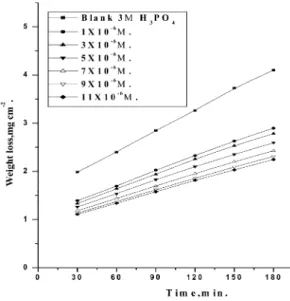
of C-steel was determined at various time intervals in absence and presence of different concentrations of furfural hydrazone derivatives (I-V). The obtained weight loss-time curves are represented in Fig. 1 for inhibitor (I), the most effective one. Similar curves were obtained for other inhibitors (not shown).
As shown from this Figure, by increasing the concentration of compound (1), the weight loss of C-steel samples is decreased. This means that the presence of this compound retards the corrosion of C-steel in 3 M H3PO4 or in other words, this com- pound acts as inhibitor.
The linear variation of weight loss with time in uninhibited and inhibited 3 M H3PO4 indicates the absence of insoluble surface films during corro- sion. In the absence of any surface films, the inhib- itors are first adsorbed onto the metal surface and thereafter impede corrosion either by merely block- ing the reaction sites (anodic and cathodic) or by altering the mechanism of the anodic and cathodic partial processes.
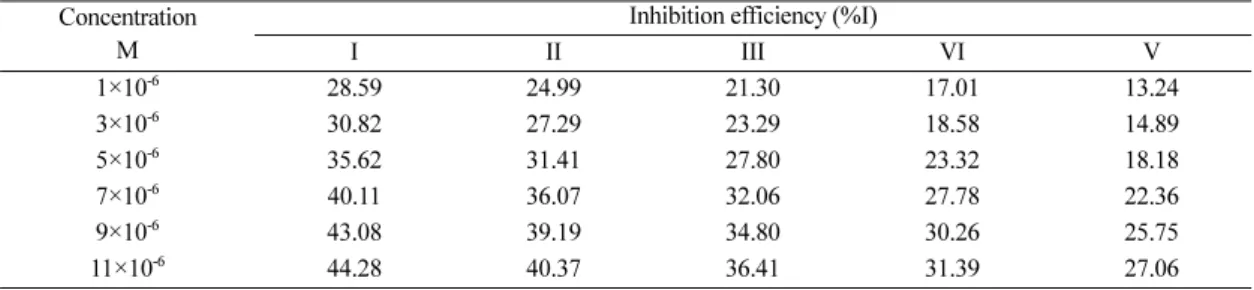
The percentage inhibition efficiencies (%I) of the investigated furfural hydrazone derivatives were determined using the equation (1):
Fig. 1. Weight loss-time curves for C-steel dissolution in 3 M H3PO4 in absence and presence of different concentrations of compound (1) at 30oC.
H3PO4에서 탄소강의 부식 127
%I=[(W1–W2)/W1]×100 (1) where W1 and W2 are the corrosion rate of C-steel in the absence and presence the investigated fur- fural hydrazone derivatives, respectively at given time period and temperature. From the calculated values of the % inhibition efficiency (%I) given in Table 1 at 30oC, the order of decreased inhibition efficiencies of the investigated furfural hydrazone derivatives is: I > II > III > IV > V.
Synergistic effect
The corrosion behavior of C-steel in 3M H3PO4 solution in the presence of 1×10⁻⁴ M potassium iodide and potassium thiocyanate at different con- centrations of inhibitors (I-V) was studied. The % inhibition efficiencies were increased in the pres- ence of these anions than in its absence .In case of KI the % inhibition efficiency in presence of I- and SCN- ions are presented in Table 2. From these results, it is observed that (%I) is enhanced due to synergistic effects.19 The synergistic effect of these anions (I–and SCN–) has been observed.20 The data in Table 2 indicate that this co-operative effect
decreased in order I-> SCN- suggesting a possible role by the I- and SCN- which also decrease in the order I- (0.135 nm)> SCN- (0.095 nm). The strong chemisorption of (I- and SCN-) anions on the metal surface are responsible for the synergistic effect of iodide and thiocyanate anions in combination with cation of the inhibitor. The cation is then adsorbed by columbic attraction on the metal surface where iodide and thiocyanate anions are already adsorbed by chemisorption. Stabilization of adsorbed iodide and thiocyanate anions with cations leads to a greater surface coverage and therefore greater inhi- bition. One can conclude that the addition of iodide and thiocyanate ions enhances the inhibition effi- ciency to a considerable extent, due to the increase of the surface coverage in the presence of iodide and thiocyanate ions. The order of investigated compounds remains unchanged, as before. From the previous results it is known that KI could be considered as one of the effective anions for syner- gistic action within the investigated inhibitors.
Effect of Temperature on Corrosion Process The effect of temperature on corrosion of C-steel Table 1. Inhibition Efficiency (%I) of C-Steel Dissolution After 120 Minutes Immersion in 3 M H3PO4 in Presence of Different Con- centrations of Furfural Hydrazone Compounds at 30oC.
Concentration M
Inhibition efficiency (%I)
I II III VI V
1×10⁻⁶ 28.59 24.99 21.30 17.01 13.24
3×10⁻⁶ 30.82 27.29 23.29 18.58 14.89
5×10⁻⁶ 35.62 31.41 27.80 23.32 18.18
7×10⁻⁶ 40.11 36.07 32.06 27.78 22.36
9×10⁻⁶ 43.08 39.19 34.80 30.26 25.75
11×10-6 44.28 40.37 36.41 31.39 27.06
Table 2. Inhibition Efficiency (%I) of C-Steel Dissolution After 120 Minutes Immersion in 3 M H3PO4 in Presence of 1×10⁻⁴ M KI
& KSCN at Different Concentrations of Furfural Hydrazone Derivatives at 30 °C.
Concentration (M)
Inhibition efficiency (%I)
I II III VI V
1×10⁻⁶ 66.9(62.0) 62.3(55.5) 58.0(48.5) 46.3(32.8) 37.1(23.9)
3×10⁻⁶ 69.6(65.3) 65.6(59.5) 61.0(52.2) 48.1(35.0) 40.2(28.5)
5×10⁻⁶ 74.2(69.0) 69.3(63.4) 65.2(55.2) 51.8(38.7) 44.2(31.6)
7×10⁻⁶ 77.3(72.4) 72.1(67.5) 69.3(58.6) 54.0(42.0) 47.2(36.5)
9×10⁻⁶ 80.2(76.4) 75.2(71.5) 72.4(62.6) 57.4(45.4) 50.6(40.2)
11×10-6 82.6(79.5) 78.2(74.5) 74.3(66.3) 59.8(47.9) 53.7(43.3)
%I values in presence of 1×10⁻⁴ M KSCN are given in parenthesis.
in 3 M H3PO4 solution in absence and presence of different concentrations of inhibitors (I-V) at differ- ent temperatures ranging from 30oC to 60oC was investigated.
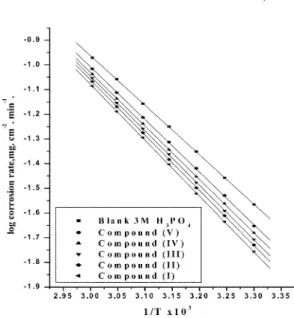
Arrhenius plot, equation (2), of logarithm of the corrosion rate (log W) with the reciprocal of abso- lute temperature (1/T) in absence and presence of 5×10⁻⁶ M inhibitors (I-V) was shown graphically in Fig. 2.
W = k exp (Ea*/RT) (2) where k is the Arrhenius preexponential constant.
and R is the universal gas constant.
From the slopes of the plots, the respective appar- ent activation corrosion energy (Ea*) was calculated and tabulated in Table 3. The results show that, the
values of apparent activation corrosion energy (Ea*) increases in the same order of increasing inhibition efficiency of the inhibitors. It is also indicated that the whole process is controlled by surface reaction, since the energy of activation of the corrosion pro- cess is over 20 kJ mol-1.20
From the results of the effect of temperature, it was observed that the inhibition efficiency increases with increasing the inhibitor concentration at one hand, and decreases with the rise of temperature on the other hand. This means that these derivatives are adsorbed physically on C-steel surface.
From transition state theory21
Wcorr=RT/N h exp (ΔS*/R) exp (-ΔH*/RT) (3) Where h is Planck’s constant, N is Avogadro’s number, we can calculate the ΔH* & ΔS* from plot- ting log (k/T) vs. (1/T), equation (3). Straight lines were obtained as shown in Fig. 3 for C-steel disso- lution in 3 M H3PO4 in absence and presence of 5×10⁻⁶M of inhibitors (I-V). The order of inhibition efficiency of the investigated derivatives as gath- ered from the increase in Ea* and ΔH* and the decrease in ΔS*, values remains unchanged and fol- lows the order : I >II > III > IV > V.
The enthalpy change of activation (ΔH*) ranged from 35 to 38 kJ mol-1, and the entropy change of activation (ΔS*) ranged from -157 to -144 Jmol-1K-1, for corrosion of C-steel in 3 M H3PO4 solution in absence and presence of 5×10⁻⁶M of each additive.
From the results obtained, it is clear that the pres- ence of investigated derivatives increased the acti- vation energy values and consequently decreased the corrosion rate of the C-steel. Moreover, activa- Fig. 2. log k -1/T curves for C-steel dissolution in 3 M H3PO4
in absence and presence of 5×10⁻⁶ M furfural hydrazone derivatives.
Table 3. Activation Parameters of the Dissolution of C-Steel in 3 M H3PO4 in the Absence and Presence of 5×10⁻⁶ M of Furfural Hydrazone Derivatives.
Inhibitor Activation parameters
Ea*, kJ mol-1 ΔH*, kJ mol-1 -ΔS*, J mol-1K-1
Blank ( Free acid ) 38.3 35.7 157.0
(I) 43.3 40.7 144.4
(II) 42.7 40.1 145.8
(III) 42.2 39.6 147.2
(IV) 41.4 38.7 149.3
(V) 40.7 38.2 156.6
H3PO4에서 탄소강의 부식 129
tion energy increased by increasing the concentra- tion of the inhibitors. These results indicate that these investigated derivatives are acting as inhibi- tors by increasing the activation energy of C-steel dissolution and by making a barrier to mass and charge transfer due to their adsorption on C-steel surface. The values of ΔS* in absence and presence of the investigated derivatives are negative; this indicates that the activated complex is the rate determining step representing an association rather than dissociation step.22 This means that the acti- vated molecules are in higher ordered state than that at the initial state.
Adsorption Isotherms
The variation of surface coverage determined by weight loss measurements, θ, with the logarithm of the inhibitor concentration, log C, is represented in Fig. 4. These curves are of S- shape obeying the Frumkin’s adsorption isotherm23 and are in good agreement with the Frumkin’s equation (4). As shown from this Figure, one can conclude that the degree of surface coverage increases as the concen- tration of the inhibitor increases and hence, the inhi- bition efficiency increases.
Frumkin’s equation is:
[θ/1-θ] exp (-2aθ)=K C (4)
where (a) is a molecular interaction parameter depending on the molecular interaction in the adsorption layer and on the degree of heterogeneity of the surface, C is the molar concentration of inhibitor, K is the equilibrium constant of the adsorption reaction.
Galvanostatic Polarization Technique
Fig. 5 shows the galvanostatic polarization curves Fig. 3. log k/T–1/T curves for C-steel dissolution in 3 M
H3PO4 in absence and presence of 5×10⁻⁶ M furfural hydrazone derivatives.
Fig. 4. θ-log C curves for C-steel dissolution in 3 M H3PO4 in presence of furfural hydrazone derivatives.
Fig 5. Galvanostatic polarization curves for C- steel in 3 M H3PO4 in absence and presence of different concentrations of inhibitor (I) at 30oC.
for C-steel dissolution in 3 MH3PO4 in absence and presence of different concentrations of inhibitor (I) at 30oC. Similar curves were obtained for other inhibitors (not shown).
The numerical values of the variation of corro- sion current density (icorr), corrosion potential (Ecorr.), Tafel slopes (βa and βc ), and percentage of inhibi- tion efficiency (%I) degree of surface coverage (θ) with the concentrations of different furfural hydra- zone derivatives are given in Table 4. In the case of polarization method, the relation determines the inhibition efficiency (%I) is:
%I = [1–(icorr/iocorr)]×100 (5) Where icorr and iocorr are the inhibited and uninhibited corrosion current densities, respectively, determined by extrapolation of cathodic and anodic Tafel lines.
The results indicate that:
1. The cathodic and anodic curves obtained exhibit Tafel-type behavior. Addition of furfural hydra- zone derivatives increased both the cathodic and anodic overpotentials and the presence of furfural hydrazone derivatives in solution inhibits both the hydrogen evolution and the anodic dissolution pro- cesses i.e. they are mixed-type inhibitors.
2. The corrosion current density (icorr.) decreases with increasing the concentration of furfural hydra- zone derivatives which indicates that these deriva- tives act as inhibitors, and the degree of inhibition efficiency depends on the concentration and type of inhibitors present.
3. The slopes of the anodic and the cathodic Tafel
lines (βa and βc) were slightly changed on increas- ing the concentration of the tested derivatives. This indicates that there is no change of the mechanism of corrosion in presence and absence of inhibitors.
4. The order of inhibition efficiency of all inhibi- tors at different concentrations, as given by polar- ization measurements are listed in Table 4, and is in the order of:
I >II > III > IV > V.
5. The results obtained from weight-loss mea- surements are in good agreement with that obtained in polarization measurements.
Chemical Structure of the Inhibitors and Cor- rosion Inhibition
Inhibition of corrosion of C-steel in 3M H3PO4 by the investigated furfural hydrazone derivatives as determined from weight loss and polarization mea- surements was found to depend on the concentra- tion and the nature of the inhibitor.
The observed corrosion data in the presence of the selected furfural hydrazone derivatives showed in the following:
i) The corrosion rate and corrosion current den- sity decrease with increasing the concentration of the inhibitors.
ii) The linear variation of weight loss with time.
iii) The parallel shift in Tafel lines to higher potential regions.
iv) The decrease in % inhibition efficiency (%I) with increasing the temperature.
This indicates that the corrosion inhibition occurs by adsorption of the inhibitor at the electrode / solu- tion interface. The nature of inhibitor interaction on Table 4. Effect of Inhibitor (I) Concentrations on the Corrosion Potential (Ecorr.), Corrosion Current Density (icorr.), Tafel Slopes (βc and βa), Degree of Surface Coverage (θ) and Percentage Inhibition (%I ) or C- Steel in 3 M H3PO4 at 30oC.
Conccentration, M
-Ecorr.
(mV)
icorr.
µA cm-2
βc
mV dec.-1
βa
mV dec.-1 θ % I
Blank 531 384 152 157 - -
1×10⁻⁶ 533 279 159 169 0.266 26.56
3×10⁻⁶ 533 272 163 172 0.292 29.20
5×10⁻⁶ 538 267 166 175 0.349 34.90
7×10⁻⁶ 540 260 170 181 0.388 38.80
9×10⁻⁶ 541 255 173 186 0.412 41.20
11×10-6 544 249 185 188 0.431 43.10
H3PO4에서 탄소강의 부식 131
metal surface during corrosion inhibition has been known from its adsorption characteristics. How- ever, inhibition efficiency (%I) of the investigated derivatives depends on many factors which include the number of adsorption sites in the molecule and their charge density, molecular size, stability of these derivatives in acidic solution, mode of adsorp- tion and formation of metallic complexes.
It was found that, the order of decreasing inhibi- tion efficiency (%I) of the tested compounds in 3 M H3PO4 for C-steel is:
I > II > III > IV > V
Mode of adsorption of furfural hydrazone deriva- tives on the surface of C-steel is shown below and clearly indicates the adsorption centers. As shown from this presentation, the compound (V) is the least efficient inhibitor in this series because of the presence of only one active adsorption center (one O-atom), but the other used investigated com- pounds have two active adsorption centers (one N-atom and one O- atom).
Variation in structure of inhibitors molecules (I- IV) takes place through the substituent attached to the carbonyl group. So, the inhibition efficiency will depends on this part of the molecule. This order of decreased inhibition efficiency (%I) of the additives can be accounted for in terms of increase the length of the chain 24within the given homolo- gous series (I-IV). Compounds (I-IV) have two adsorption active centers. Compound I has two branched -CH3 groups which increase the electron density on the molecule, compound II has one -CH3 group therefore it comes after compound I in %I.
Compound III comes after compound II because it has no -CH3 group. Compound IV comes after compound III because it has -CN group which is a reducing group (decrease the electron density on the molecule).Compound V has one active adsorp- tion center, so it is the least effective one.
The order of inhibition efficiency (%I) of fur fural hydrazone derivatives derived from weight loss method is further supported by galvanostatic measurement. The observed agreement among these independent techniques prove the validity of the results obtained and supports the explanation
given for the effect of chemical structure on the inhibition action of these investigated compounds.
In our Lab we use some aromatic furfural hydra- zone derivatives15 as corrosion inhibitors for C-steel in 1M H3PO4 at the same concentrations, the % inhibition was found to be 10-46% which is less than % inhibition in our case. This may be due to, the aromatic moiety does not lie flat on the C-steel surface so, less surface coverage obtained and hence less % inhibition.
CONCLUSIONS
1. Furfural hydrazone derivatives are fairly effi- cient inhibitors for C-steel dissolution in 3M H3PO4. 2. Percentage inhibition efficiency (% I) are increased in the presence of 1×10⁻⁴ M KI, and KSCN due to the synergistic effect.
3. Efficiency of these investigated compounds decreased with the rise of temperature.
4. These investigated compounds show an adsorp- tion on C-steel surface according to Frumkin iso- therm.
5. Polarization measurements show that these investigated furfural hydrazone derivatives act as a mixed inhibitors without modifying the mecha- nism of hydrogen evolution.
REFERENCES
1. Soror, T. Y.; El-Ziady. M. A. Mate. Chem. Phys. 2002, 77, 697.
2. Migahed, M. A.; Mohamed , H. M.; Al-Sabagh, A. M.
Mater. Chem. Phys. 2003, 80(1), 169.
3. Fouda, A. S.; Mostafa, H. A., El-Taib, F.; Elewady, G.
Y. Corros. Sci., 2004, 47, 1988.
4. Ashassi-Sorkhabi, H.; Ghalebsaz-Jeddi, N. Mater.
Chem. Phys. 2005, 92, 480.
5. Qiu, L.-G.; Xie, A.-J.; Shen, Y.-H. Mater. Chem. Phys.
2005, 91, 269.
6. Ait Chikh, Z.; Chebabe, D.; Dermaj, A.; Hajjaji, N.;
Srhiri, A.; M. Montemor, F. M.; Ferreira, G. S.; Bastos, A. C. Corros. Sci., 2005, 47, 447.
7. Abd El-Maksoud, S. A.; Fouda, A. S. Mater. Chem. Phys.
2005, 93, 84.
8. Olivares, O.; Likhanova, N. V.; Gómez, B.; Navarrete, J.; Llanos-Serrano, M. E.; Arce, E.; Hallen, J. M. Appl.
Surf. Sci., 2006, 252, 2894.
9. Ashassi-Sorkhabi, H.; Ghalebsaz-Jeddi, N.; Hashemza- deh, F.; Jahani, H. Electrochim. Acta 2006, 51, 3848.
10. Amin, M. A.; Abd El-Rehim, Sayed S.; El-Sherbiniy, E. E. F.; Bayoumi, Rady S. Electrochim. Acta 2007, 52, 3588.
11. Chauhan, L. R.; Gunasekaran, G. Corros. Sci., 2007, 49, 1143.
12. Lebrini, M.; Lagrenée, M.; Vezin, H.; Traisnel, M.;
Bentiss, F. Corros. Sci. 2007, 49, 2254.
13. Fouda, A. S. Monat Chem., 1986, 117, 159.
14. Wang, L. Corros. Sci. 2001, 43(9), 1637.
15. Fouda, A. S.; Al-Sarawy, A. A.; Radwan, M. S. Ann.
Chim., 2006, 96(1-2), 85.
16. Hassanin, M. M.; M. Sc. Thesis, Mansoura University, Egypt, 1990.
17. Fouda, A. S.; El-Kaabi, S. S.; Mohamed, A. K. Corros.
Prev. & Control, 1990, 164.
18. Otieno-Alego, V.; Hope, G. A.; Flitt, H. J.; Cash, G. A.;
Schweinsberg, D. P. Corros. Sci., 1992, 33, 1719.
19. Cahskan, N.; Bilgic, S. Appl. Surf. Sci., 2000, 153, 128.
20. Al-Neami, K. K.; Mohamed, A. K.; Kenawy, I. M.;
Fouda, A. S. Monat. Chem., 1995, 126, 369.
21. Haladky, K.; Collow, L.; Dawson, J. Br. Corros. J., 1980, 15, 20.
22. Abd El-Rehim, S. S.; Ibrahim, M. A. M.; Khaled, K. F.
J. Appl. Electrochem., 1999, 29, 593.
23. Frumkin, A. N. J. Phys. Chem., 1925, 116, 466.
24. Mohamed, A. K.; Ibrahim, K. M.; Moussa, M. N. H.
Bull. Soc. Chim. Fr., 1991, 128, 496.