1. Introduction
Intense corrosion problems of mild steel especially in the acid medium owing to the extensive use of HCl sol- ution cleaning, acid pickling, oil-wet cleaning, and acid descaling processes of mild steel surfaces is the common form of corrosion and directly impacts its cost and safety [1-6]. Therefore, studying suitable inhibitors in order to control the corrosion of mild steel in HCl solutions and decrease acid consumption, have attracted many inves- tigators in recent years [7-11]. Using organic compounds as a corrosion inhibitor is a popular and frequent method for prevention and corrosion control [12-17]. The existing studies indicated that organic materials as inhibitors act through adsorption and the block of the active corrosion sites between the inhibitors and the metal surface [18-22].
The heterocyclic systems including electronegative ele- ments (such as P, S, N, and O) and π electrons due to donating electrons for facilitating inhibitors adsorption
over mild steel surface have been widely studied in acidic solutions [23-30]. Nowadays, Schiff base compounds con- sidered as corrosion inhibitors have attracted more atten- tion thanks to several advantages such as sensitivity, ex- cellent selectivity, and high stability. These unique proper- ties make Schiff base compound a promising material in different applications such as inorganic, biological, and analytical chemistry rather than that of corresponding al- dehydes and amines [31-36].
Seifzadeh co-workers [37] studied the inhibition effect of the 5-CM-Salophen inhibitor on mild steel corrosion in hydrochloric acid solutions via electrochemical techniques. They found that IE significantly increased to 96.25% for 10 mg/L of inhibition concentration. The cor- rosion inhibition of some inhibitor compounds base on diphenolic, namely, 1,3-bis[2-(2-hydroxy benzylidenami- no) phenoxy] propane (P1), 1,3-bis[2-(5-chloro-2-hydrox- ybenzyliden amino) phenoxy] propane(P2), and 1,3-bis[2- (5-bromo-2-hydroxybenzylidenamino) phenoxy] propane (P3) for mild steel in 1 M HCl solution were reported by Yurt co-workers [38] using electrochemical methods.
The obtained results indicated that the IE of these in-
Experimental Investigation and Quantum Chemical Calculations of Some (Chlorophenyl Isoxazol-5-yl) Methanol Derivatives as Inhibitors for Corrosion
of Mild Steel in 1 M HCl Solution
Rogayeh Sadeghzadeh1, Ladan Ejlali1, Moosa Es’haghi1,†, Hadi Basharnavaz2, and Kambiz Seyyedi1
1Department of Chemistry, Tabriz Branch, Islamic Azad University, Tabriz, Iran
2Department of Chemistry, Faculty of Science, University of Mohaghegh Ardabili, P.O. Box 179, Ardabil, Iran (Received June 07, 2019; Revised September 14, 2019; Accepted September 16, 2019)
In this study, two novel Schiff base compounds including (3-(4-Chlorophenyl isoxazole-5-yl) methanol and (3-(2,4 dichlorophenol isoxazole-5-yl) methanol as corrosion inhibitors for mild steel in 1 M hydrochloric acid solution were investigated by potentiodynamic polarization, electrochemical impedance spectroscopy (EIS), and density functional theory (DFT) computations. The results showed that the corrosion inhibition efficiency (IE) is remarkably enhanced with the growing concentration of the Schiff base inhibitors. The results from Tafel polarization and EIS methods showed that IE decreases with gradual increments of temperature.
This process can be attributed to the displacement of the adsorption/desorption balance and hence to the diminution of the level of a surface coating. Also, the adsorption of two inhibitors over mild steel followed the Langmuir adsorption isotherm. Too, the results of the scanning electron microscope (SEM) images showed that the Schiff base inhibitors form an excellent protective film over mild steel and verified the results by electrochemical techniques. Additionally, the results from the experimental and those from DFT computations are in excellent accordance.
Keywords: Corrosion inhibitor, Mild steel surface, Hydrochloric acid solution, Electrochemical techniques, Density functional theory
†Corresponding author: [email protected]
hibitors obeys the order P1(IE=85.14%) > P3(IE=73.5%)
> P2(IE=68.55%), which is due to the substitution of chlorine and bromine elements on the aromatic ring of inhibitor compounds. In the similar work, Kumaravel et al. [39] studied the IE of the prepared unsymmetrical Schiff base compound, namely, (2Z,4E)-4-((2-(((E)-1- phenylethylidene) amino) propyl) imino) pent-2-en-2-ol using in 0.5M H2SO4 and 1M HCl solutions. The results revealed that Schiff base compound as an inhibitor is the best inhibitor with IE of approximately 92% at the pres- ence of 600 mg/L additive concentration.
In the literature, studies concerning the inhibition of mild steel corrosion using Schiff base compounds in- dicated that IE significantly increased to addictive these compounds on a variety of substrate. Additionally, from these studies, it was known that there are no reports based on Schiff base (3-(4-Chlorophenyl isoxazole-5-yl) meth- anol (compound I) and (3-(2,4dichlorophenol iso- xazole-5-yl) methanol (compound II) in order to introduce suitable materials for use in inhibitors for corrosion of mild steel surface.
In this work, the corrosion inhibition influence of in- hibitor compound I and II on mild steel corrosion in 1M HCl solution were investigated using two various electro- chemical techniques. Furthermore, the communication be- tween the structure of Schiff base materials and the IE were carried out using quantum chemical computations based on density functional theory (DFT) as a powerful tool for the determination of various quantum chemical parameters including, orbital energies, band gap energy (Eg), and dipole moments [40-45].
2. Experimental
2.1. Materials
2.1.1. Preparation of Schiff base inhibitors
The optimized structures of the utilized inhibitor com- pounds are displayed in Fig. 1. These inhibitors were prepared
via the condensation reaction of an equimolar benzaldox- imesnamely: 4-chlorobenzaldoxime, 2,4-chlorobenzaldoxime and N-chlorosuccinimide, according to reference [46]. It should be noted that the anhydrous dichloromethane was used as a solvent. Their action blend was stirred at 25 ◦C for 1h and then, dropwise propargyl alcohol (20 mmol) followed by trimethylamine was added to the obtained liquid. The obtained product was refluxed and stirred for 6h. After that, it was cooled to 25 ◦C and washed with pure water and dried with sodium carbonate. The synthesis of the final Schiff base compounds was confirmed using FT-IR and 1H NMR techniques.
(3-(4-Chlorophenyl isoxazole-5-yl) methanol: FT-IR (KBr,cm-1): 3294 (O-H), 2928 (C-H), 1488, 1598, 1657 (C=C,C=N); 1H NMR(CDCl3, 400MHZ, ppm): 4.78(s, 2H, CH2), 6.51(s, 1H, isoxazole-H), 7.26-7.67(m, 4H, ArH), 8.08(bs, 1H, OH)
(3-(2,4 dichlorophenolisoxazole-5-yl) methanol: FT-IR (KBr,cm-1): 3400(O-H), 3100-3120(C-H), 2960-3050 (-CH), 1450, 1530, 1550, 1600(C=C,C=N); 1H NMR (CDCl3, 400MHz, ppm): 2.54(bs,OH), 4.84(S, CH, CH2), 6.71 (s, 1H, isoxazole-H),7.23-7.77(m, 3H, ArH) 2.1.2. Mild steel substrates
The investigated mild steel samples were commercial MS bars. The mild steel samples with a size of 1 cm
× 1 cm × 1 cm were mounted with polyester resin (with an exposed area of 1 cm2) utilizing MS strip as a working electrode for potentiodynamic polarization and EIS methods.
2.2. Methods
2.2. Electrochemical techniques
Potentiodynamic polarization and EIS measurements were carried out by a AUTOLAB potentiostat-galvano- stat/Nova software using a conventional electrochemical cell of three electrodes, including of a working electrode (mild steel sample with 1cm2 surface area), an Ag/AgCl Fig. 1 Chemical structure of prepared Schiff base compounds.
saturated calomel electrode (SCE), and a Pt sheet as coun- ter electrode (CE) was performed for Tafel polarization and EIS measurements. Polarization data were obtained with a scan rate of 2 mVs-1 in the maximum overvoltage 200 mV. Impedance data were carried out in the frequency range of 1‒10 MHz at the open circuit potential using exerting 10 mV sine wave AC voltage. All electro- chemical tests were performed at 25 ◦C under environ- mental pressure utilizing 100 mL of corrosive solution.
The impedance and Tafel polarization results were carried out for the sample sat various temperature and concen-
tration of Schiff base inhibitors.
2.3. SEM analysis
To investigation surface morphology of the samples af- ter 2h immersion in HCl solution without inhibitor and with 600 ppm of inhibitor, SEM images were carried out using SEM (LEO, VP 1430) model.
2.4. Density functional theory calculations
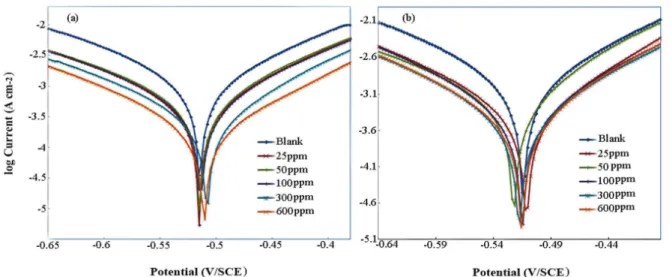
All computations were performed by the Gaussian 09 code. All geometry structures were carried out using the DFT computations at the B3LYP/6-311G**(d, p) basis Fig. 2 Tafel polarization plots for mild steel in 1 M HCl solution in the absence (blank) and presence of different concentrations of Schiff base (a) compound I and (b) compound ІІ at temperature of 303.3 ◦K.
Table 1 Corrosion parameters for the mild steel at different concentrations of the inhibitors in 1M HCl solution in temperature of 303.3ᵒK bypotentiodynamic polarization method
concentration
Compound І
Blank 10.68 64.81 60.60 342.92 527.25 -
25ppm 70.79 65.98 68.86 237.74 525.27 84.91
50ppm 74.84 76.46 88.26 206.72 524.26 85.72
100ppm 78.46 53.94 47.12 152.59 516.21 86.38
300ppm 106.40 86.49 116.47 139.22 509.88 89.96
600ppm 163.15 100.34 102.50 134.97 502.88 93.45
Compound ІІ
25ppm 51.87 84.96 140.21 252.13 525.34 79.41
50ppm 78.86 69.47 76.36 210.33 521.24 86.45
100ppm 82.57 85.27 88.45 178.36 515.26 87.06
300ppm 95.04 85.71 101.78 152.62 511.92 88.76
600ppm 98.79 75.75 100.39 139.92 515.49 89.18
set. The important quantum parameters such as lowest un- occupied molecular orbital energy (ELUMO), highest occu- pied molecular orbital energy (EHOMO), Eg, and μD have been computed and discussed.
3. Results and discussion
3.1. Polarization measurement
Potentiodynamic polarization plots for mild steel in 1 M HCl solution without and with different concentrations of Schiff base compound І and ІІ at 303.3 K temperatures are displayed in Fig. 2. The electrochemical parameters such as corrosion potential (Ecorr), anodic and cathodic Tafel slope (βa and βc), corrosion current density (Icorr), polarization resistance (Rp), and percentage inhibition effi- ciency (IE%) were computed by applying the ex- trapolation technique for the Tafel polarization plots and summarized in Table 1. It should be noted that IE% was obtained as the following relation (1):
(1)
where I°corr and Icorr are the corrosion current density in the uninhibited acid and inhibited acid, respectively.
The Rp was calculated from the βa and βc for the anodic and cathodic branches by Stern–Geary equation dis- played in relation (2):
(2)
The results of Tafel polarization curves revealed that
with the addition of the inhibitors, the icorr for anodic and cathodic reactions was reduced and, hence, prevents the corrosion of the mild steel in 1 M hydrochloric acid solution. No considerable variation in the amounts of cor- rosion potential is seen except the shift in amounts to the positive direction in the attendance of the inhibitor com- pound compared with the blank, which may be observed to show control on the anodic and cathodic reactions and therefore they act as mixed-type inhibitor. From Table 1, it was found that the amounts of icorr significantly diminish with an increment in the inhibitor concentration. It should be noted that the decrease in the values of icorr is owing to the blocking of the active centers present over mild steel surface. Based on the obtained results, it can be con- cluded that the IE remarkably increases with an enhance- ment in the Schiff base compound concentration.
3.2. EIS
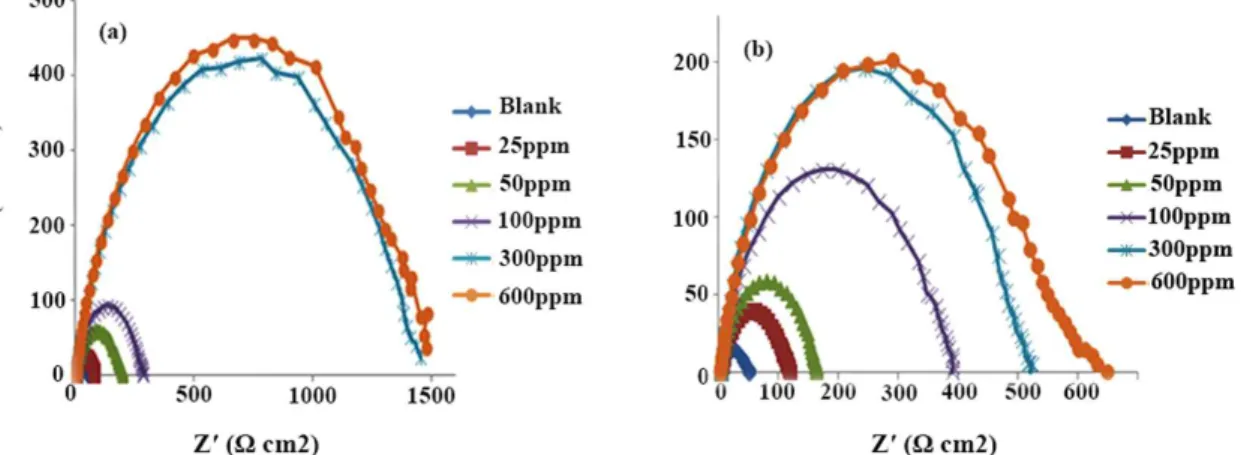
The Nyquist curves for mild steel in 1M hydrochloric acid solution absence (blank) and the presence of different concentrations of the Schiff base material І and ІІ at 303.3 K temperatures are displayed in Fig. 3. From this figure, it can be seen that the Nyquist plot of mild steel in the absence and presence of several concentrations of the Schiff base compounds a little depressed semicircular shape, which indicates that corrosion of mild steel in 1 M HCl solution is essentially controlled using an electron transfer process. Furthermore, the Nyquist curves are iden- tified using one capacitive loop and also the diameter of the loop enhances with growing inhibitor concentration, which is in excellent accordance with the other report [49].
The deflection from the ideal format which is shown as a depressed semicircle at the center under the real axis is given to the frequency scattering of impedance owing
Fig. 3 Nyquist plots of EIS measurements of the mild steel in uninhibited 1 M HCl solution and with various concentrations of Schiff base (a) compound Iand (b) compound ІІ at temperature of 303.3◦K.
to the lack of smoothness of the mild steel and adsorption of the different inhibitors [50]. As a result, pure dou- ble-layer capacitors can be described very well in such circumstances using a transfer function with constant phase elements (CPE) and the impedance is demonstrated by relation (3):
(3)
In equation Yo is a constant with dimensions of (in Ω
-1Sncm-2), ω is the angular frequency given in radians per second, j is the fictitious number and is equal to the square root of -1, and the coefficient n represents the deviated degree of the capacitance of the double layer from ideal and ranges from 0 to 1, For n = 1 a capacitance withC
= Q and for n = -1 an inductance with = Q-1, for n = 0, ZCPE illustrates a resistance withR = Q-1.
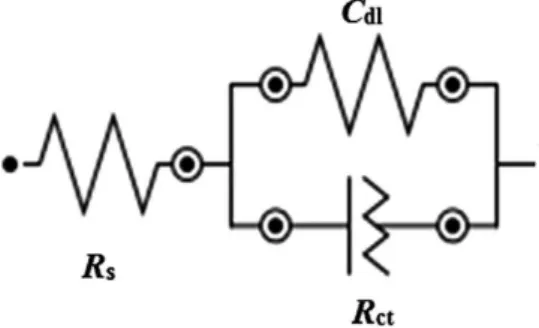
The Nyquist curve was fitted using a simple Randle’s equivalent circuit, presented in Fig 4, including the sol- ution resistance (Rs), double layer capacitance (Cdl), and
the charge transfer resistance (Rct). The double-layer ca- pacitance can be computed from the amounts of Yo and n by the following relation (4) [51].
(4)
A decline can be observed in the magnitude of Cdl with growing the concentration of inhibitor compounds, which indicates increasing the thickness of electric double-layer with the creation of an inhibitor layer over mild steel sur- face in hydrochloric acid solution. The inhibition effi- ciency gained by the EIS measurements was computed by the following relation in which Rct and Rct° are the charge transfer resistances in uninhibited and inhibited sol- ution, respectively.
(5)
It should be noted that the Nyquist plots were fitted using a simple Randle’s equivalent circuit and the ob- tained results are summarized in Table 2. As can be ob- served in this Table, the Rp and CPE(dl) amount increase and decrease as the concentration of inhibitors enhance, respectively. Enhance in the diameter of the capacitive loop manifests the formation of a protective layer on the mild steel surface, which provides higher resistance versus electron transfer reactions happening at the metal-electro- lyte interface zone. Besides, diminish in CPE(dl) with the increasing concentration of inhibitor can be attributed to adsorption of inhibitors over the mild metal surface by substituting pre-adsorbed H2O molecules, lower electrical Fig. 4 The proposed equivalent circuit model for the investigated
system.
Table 2 Impedance parameters for the corrosion of mild steel in 1 M HClsolution in the absence and presence of different concentrations of compound I and II at temperature of 303.3 °K
concentration Rs CPE(dl)(µF/cm2) n Rp IE%
Compound І
Blank 2.79 130.0 0.87 41.7 -
25ppm 3.08 84.1 0.86 70.8 39.78
50ppm 3.24 78.3 0.82 173.0 74.75
100ppm 3.18 73.0 0.82 253.5 82.66
300ppm 3.64 44.2 0.80 1490.0 97.02
600ppm 3.31 38.5 0.81 1506.0 97.05
Compound ІІ
25ppm 2.78 78.9 0.85 103.4 58.09
50ppm 3.58 66.5 0.86 156.7 72.24
100ppm 3.55 63.2 0.87 401.4 89.01
300ppm 3.28 61.0 0.86 528.8 91.63
600ppm 3.82 56.0 0.84 608.3 92.73
permittivity of adsorbed inhibitors compared to H2O mole- cules, as well as the enhanced thickness of the protective layer. Based on the impedance data results, it is clear that the IE considerably enhance with the growing inhibitor concentrations, which shows the increase of surface resist- ance by the inhibitor compounds and the growing in- hibition of mild steel corrosion. It should be noted that the values obtained for inhibition efficiency from different teachings including potentiodynamic polarization and im- pedance are in excellent agreement.
3.3. Effect of temperature
In order to investigate the effect of temperature over corrosion of mild steel and its inhibition, we computed Tafel polarization and EIS experiments in the without and with of Schiff base compounds in the temperature range of 303.3–343.3 K and the results of these calculations demonstrated that by growing the temperature from 303.3
to 343.3 K, the IE% for 600 ppm of compound І decreases from 93.45 to 76.14% and from 97.05 to 80.31% in Tafel polarization and EIS experiments, respectively. The di- minution in the IE% with enhance in the temperatures is owing to the shift of the adsorption/desorption balance towards the inhibitor’s desorption and in this way the di- minution of the degree of surface coverage. The IE com- puted from the EIS method, indicate a similar trend as those obtained from the potentiodynamic polarization method [47,48]. Furthermore, from Nyquist curves in the temperature range of 303.3–343.3 K, it was found that the size of the semicircles diminished with increasing of temperature. This process is an indicator of rising corro- sion rate of the samples with temperature in the blank and inhibitor-containing corrosive solutions.
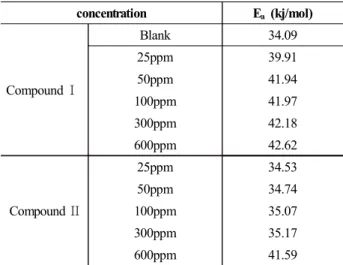
Furthermore, it should be noted that the activation en- ergy (Ea) performs a key role in understanding the mecha- nism of action of Schiff base inhibitors. In order to calcu- late the Ea of the corrosion process in the presence and absence of Schiff base inhibitors, using Arrhenius equa- tion (6):
(6)
where Ea representing the activation energy of the cor- rosion process, is the gas constant, absolute temperature, the Arrhenius constant and the corrosion current density.
The Ea amounts can be determined from the slopes of Arrhenius plots (logicorr vs. 1/T). Therefore, the value of Ea could be obtained by calculating the linear slope (
)
of equation (6) (see Fig. 5) and are summarized in Table 3. The calculated values for linear regression coefficients are close to unity, indicating that the corrosion of mild Table 3 Activation energy (Ea) of two Schiff base compounds
concentration Ea (kj/mol)
Compound І
Blank 34.09
25ppm 39.91
50ppm 41.94
100ppm 41.97
300ppm 42.18
600ppm 42.62
Compound ІІ
25ppm 34.53
50ppm 34.74
100ppm 35.07
300ppm 35.17
600ppm 41.59
Fig. 5 Arrhenius slopes calculated from corrosion current density for mild steel at different concentration of inhibitors in:(a) compoundI and (b) compound II.
steel in HCl solution can be explained using the kinetic model. The Ea values in the presence of Schiff base in- hibitors are higher than that of the blank HCl solution.
Enhancement in the Ea amounts along with higher in- hibition efficiencies with growing inhibitor concentration can be attributed to the strong adsorption of Schiff base inhibitors.
3.4. Adsorption isotherms
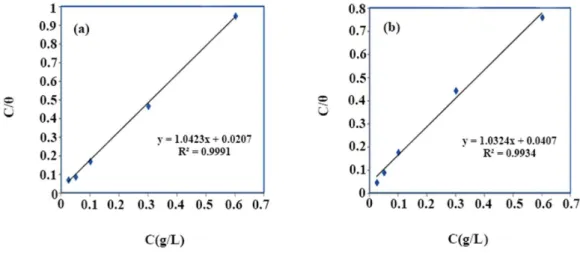
In an attempt to investigate the thermodynamics in- cluded during adsorption of inhibitors on mild steel sur- face in 1 M HCl solution, we have fitted the experiential data points through several adsorption isotherms involving the Frumkin, Temkin, Langmuir, and Freundlich isotherms. The most suitable isotherm was chosen among isotherm models, with using regression coefficient R2 (see Table 4).
As a result, the most suitable model was Langmuir iso- therm which was fit with experiential data, with all linear R2 very near oneness. In other words, it proves that the adsorption process of compound I and II on the mild steel in 1M hydrochloric acid solution is according to Langmuir isotherm containing physical and chemical adsorption.
(7)
exp
∆
(8)
where Kads is the balance constant for the adsorption-de- sorption process and Cinh is the inhibitor concentration,
θ is the surface coverage owing to inhibitor adsorption, and △G°ads is the standard free energy of the adsorption equations. From equation 7, a plot of (C/θ) versus C pro- duced direct lines with intercept log Kads (see Fig. 6). The results of this figure indicated that adsorption of inhibitor compound І and ІІ on mild steel surface at 303.3 K obey Langmuir adsorption isotherm. It should be noted that ad- sorption of Schiff base inhibitors in all of the temperature obeyed Langmuir adsorption isotherm.
The results of a literature review indicated that the if the value of △G°ads is about -20 kJ/mol, the inhibitors adsorption process on the metal surface is physisorption, which includes electrostatic interactions between the Schiff base compounds and the surface of metals, while its amount of -40 kJ/mol or more is determined as chem- isorption owing to electron transfer between the adsorbent surface and adsorbate. In this investigation, the amounts of △G°ads for the compound I and compound II at 303.3 K, vary from -23.983 and -25.689 kJ mol-1, respectively, offering both chemisorption and physisorption mechanism (including mixed mode). It should be noted that the ad- sorption of Schiff base compounds at all of the temper- atures on the mild steel surface involves both chemicals as well as physical interactions. In chemisorption mecha- nism, the electron transfer between π-electrons of Schiff base compounds and d-orbitals of mild steel are forming coordination bonds. Furthermore, physisorption mecha- nism owing to electrostatic interaction between Schiff base compounds and mild steel surface.
3.5. SEM
The SEM images for polished and corroded mild steel Table 4 Thermodynamic parameters for adsorption of compound І and ІІ on mild steel in 1 M HCl solution at different temperatures from the Langmuir adsorption isotherm
Compound І
Temperature(ᵒK) Intercept Slope Kads △G°ads(kj/mol) R2 303.3 0.00407 1.2324 245.700 -23.983 0.993 313.3 0.00401 1.2352 249.376 -24.817 0.991 323.3 0.00146 1.4022 684.462 -28.318 0.992 343.3 0.00134 2.0470 746.268 -29.437 0.941
Compound ІІ
303.3 0.00207 1.5424 483.091 -25.689 0.999 313.3 0.00156 1.9290 641.025 -27.274 0.993 323.3 0.00045 2.1724 2222.22 -31.485 0.993 343.3 0.00036 3.9698 777.77 -33.072 0.986
in 1 M hydrochloric acid solution without (blank) and with of 600 ppm concentrations of Schiff base compound І and ІІ at 303.3 K after 2h of immersion are illustrated in Fig. 7a-c. From this figure, it can be observed that the blank sample surface is very rough, cracks and pits can be seen at the surface thanks to severe corrosion,
whereas the surface of the samples with 600 ppm of Schiff base compounds are smooth because of formation of pro- tective inhibitor film which decreases corrosion of these samples.
Fig. 6 Langmuir isotherm for adsorption of Schiff base (a) compoundI and (b) compound IIat 303.3 ◦K on the mild steel surface.
(a) (b)
(c)
Fig. 7 SEM micrographs of the surface of the mild steel after 2 hours of immersion in 1 M HCl solution (a) blank HCl, (b) compound I, and (c) compound II.
3.6. Quantum chemical study
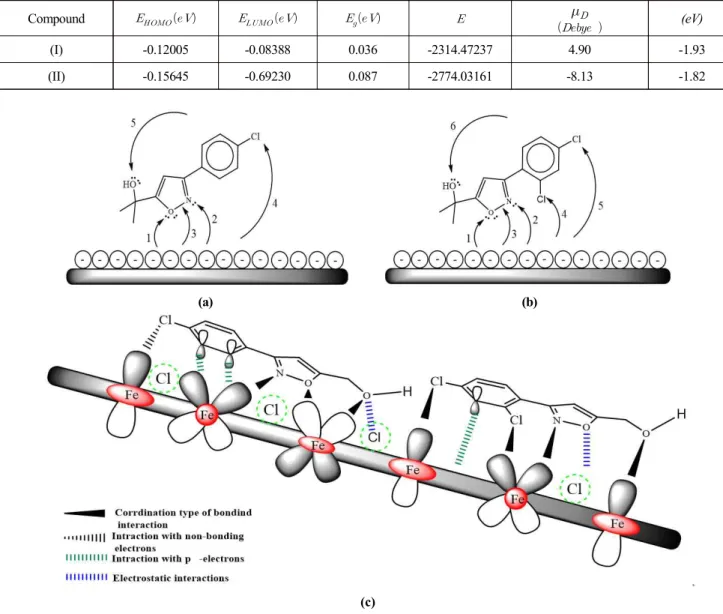
DFT calculations were performed to release donor–ac- ceptor interactions between the Schiff base compounds and metallic surface. The optimized structure and adsorp- tion energy (Eads) of Schiff base compound І and ІІ are represented in Table 5a and b. The Eads for adsorption of Schiff base compounds over the mild steel surface were computed from the following equation:
(9)
where EMS surface-Schiff base, ESchiff base, and EMS surface are
the total energy of Schiff base compounds adsorbed on mild steel surface, Schiff base compounds, and mild steel surface, respectively. Therefore, a negative adsorption en- ergy value reveals the adsorption is energetically favor- able, while a positive Eads value shows an unstable system.
From these tables, it can be observed that the Eads of in- hibitor compound І and ІІ on the mild steel surface are -1.93 and -1.82 eV, respectively. According to the ob- tained results, the adsorption of Schiff base inhibitors on position 2 of the mild steel surface is higher than that of other positions. This process can be attributed to the covalent bond between mild steel surface and electron pairs of N atom in Schiff base compounds (see Fig. 8a
Table 5a Optimised geometrical configurations all positions of compound I with corresponding energies
Position Structure Eads(Hartree) Eads(eV)
pure -1051.023739 -
1 -2314.409346 -0.225
2 -2314.47237 -1.93
3 -2314.465400 -1.74
4 -2314.407010 -1.90
5 -2314.423442 -0.598
and 8b). Based on these results, it can be concluded that the interaction between mild steel surface and Schiff base compound І is stronger than that of compound ІІ, which is in good accordance with the experimental results.
Results for calculated parameters such as ELUMO, EHUMO, Eg = ELUMO - EHUMO (band gap energy), µD are presented in Table 6. It should be noted that a high EHUMO indicates intrinsic electron-donating tendency to an electron accept- or, while a high ELUMO shows intrinsic electron receiving tendency of a molecule. On the other hand, fewer values
of the band gap energy will cause an excellent IE, as the energy in order to remove a charge from the HOMO will be very low. Additionally, the results of DFT calculations indicated that the band gap energy of Schiff base com- pound І and ІІ obey the order: compound II > compound I. From the above discussion, it can be deduced that the compound I has lower band gap energy value compared to compound IІ, which confirms that the IE of compound I is greater than that of compound IІ.
Table 5b Optimised geometrical configurations all positions of compound II with corresponding energies
Position Structure Eads(Hartree) Eads(eV)
pure -1510.587164 -
1 -2773.993522 -0.789
2 -2774.031618 -1.82
4 -2773.903359 -1.66
5 -2773.919597 -1.19
6 -2773.970250 -0.157
4. Mechanism of inhibition
The inhibitory action in most cases is by the adsorption of inhibitors over the mild metal surface. The adsorption process is related to the chemical behavior such as struc- ture and presence of donor atoms in the inhibitor molecule (such as S, N, and O elements). The adsorption of inhibitor molecules over the metal surface can be done by several modes including chemisorption and physisorption. The ad- sorption process depends on various important factors such as molecular size, the number of active sites, geome- try, the electron of surface, the type of interaction between inhibitors and metal surface, distributed electronic charge
of inhibitor molecules as well as kind of electrolyte.
According to these parameters, it can be deduced that the inhibitors were adsorbed over mild steel surface in HCl solution through physically and chemically mechanism.
According to gravimetric and electrochemical results and surface analysis, the graphical design of various adsorp- tion positions of inhibitors over mild steel interface is rep- resented in Fig. 8c. There could be different possible mechanisms for the adsorption of Schiff base inhibitors on mild steel surface namely: 1) electrostatic interactions between the protonated Schiff base compounds and the pre-adsorbed Cl- ions; 2) interaction between unshared va- lence electron pairs of heteroatoms (N and O) and vacant Table 6 Quantum chemical parameters of used Schiff bases obtained from B3LYP/6-311G** (d, p) method
Compound
(eV)
(I) -0.12005 -0.08388 0.036 -2314.47237 4.90 -1.93
(II) -0.15645 -0.69230 0.087 -2774.03161 -8.13 -1.82
(a)
(b)
(a) (b)
(c)
(c)
Fig. 8 Schematic graphical illustration of different types of interactions proposed for the adsorption of Schiff base inhibitors on mild steel in 1M HCl solution.
d-orbital of Fe atoms, or donor-acceptor interactions be- tween the vacant d-orbital of Fe atoms and π-electrons of aromatic ring. Therefore, Cl- ions from the HCl solution would probably absorb over positively charged surface of the mild steel and change the electron on the mild steel from positive to negative; this process is followed by ad- sorption of cationic inhibitor on the negatively charged mild steel surface through electrostatic interaction and therefore supporting the physical adsorption mechanism.
Besides the physical adsorption mechanism, Schiff base compounds could be chemically adsorbed over mild steel surface through creating a coordinate bond in between the electrons of hetero-atoms and vacant d-orbitals of Fe atoms.
5. Conclusions
In the present work, two novel Schiff base compounds including (3-(4-Chlorophenyl isoxazole-5-yl) methanol and (3-(2,4 dichlorophenol isoxazole-5-yl) methanol as a corrosion inhibitors for mild steel in 1M hydrochloric acid solution were investigated by potentiodynamic polar- ization, electrochemical impedance spectroscopy (EIS), and density functional theory (DFT) computations. The obtained results displayed that the corrosion inhibition ef- ficiency (IE) remarkably enhances with the growing con- centration of the inhibitors. On the other hand, the results revealed that the IE remarkably increased to 97.05% for 600 ppm of Schiff base (3-(4-Chlorophenyl iso- xazole-5-yl) methanol concentration. Hence, this Schiff base compound is as a corrosion inhibitor for mild steel in HCl solution, in comparison with that of the other compounds. The results from Tafel polarization and EIS methods showed that IE decreases with gradual incre- ments of temperature. This process can be attributed to the displacement of the adsorption/desorption balance and hence to the diminution of the level of the surface coating.
Furthermore, the adsorption of two inhibitors over mild steel followed the Langmuir adsorption isotherm.
Furthermore, the results of SEM images displayed that the Schiff base inhibitors form an excellent protective film over mild steel and verified the obtained result by electro- chemical techniques. Additionally, the results obtained from experimental and those from DFT computations are in excellent accordance. Conclusively, we should noted that the practical and economic view point, an extensive and in-depth research is required to shift these achieve- ments of laboratory investigations to an industrial scale.
Acknowledgment
We gratefully acknowledge financial support from the Research Council of Tabriz Branch of
Islamic Azad University.
References
1. N. Eddy and E. E. Ebenso, Pigment & Resin Technology, 39, 77 (2010).
2. D. S. Chauhan, K. R. Ansari, A. A Sorour, M. A Quraishi, H. Lgaz, and R. Salghi, International Journal of Biological Macromolecules, 107, 1747 (2018).
3. Q. B. Zhang and Y. X. Hua, Electrochim. Acta, 54, 1881 (2009).
4. M. Lagrenee, B. Mernari, M. Bouanis. M. Traisnel, and F. Bentiss, Corros. Sci., 44, 573 (2002).
5. P. P. Kumari, P. Shetty, and S. A. Rao, Arab. J. Chem., 10, 653 (2017).
6. I. Ahamad and M. A. Quraishi, Corros. Sci., 51, 2006 (2009).
7. B. E. Rani and B. B. Basu, Int. J. Corros., 12, 1 (2012).
8. C. Verma, M. A. Quraishi, and A. Singh, J. Taibah Univ.
Sci., 10, 718 (2016).
9. D. Daoud, T. Douadi, H. Hamani, S. Chafaa, and M.
Al-Noaimi, Corros. Sci., 94, 21 (2015).
10. K. R. Ansari, D. K. Yadav, E. E. Ebenso, and M. A.
Quraishi, Int. J. Electrochem. Sci., 7, 4780 (2012).
11. H. B. Fan, C. Y. Fu, H. L.Wang, X. P. Guo, and J. S.
Zheng, Brit. Corros. J., 37, 122 (2002).
12. S. Safak, B. Duran, A. Yurt, and G. Turkoglu, Corros.
Sci., 54, 251 (2012).
13. A. Fiala, A. Chibani, A. Darchen, A. Boulkamh, and K.
Djebbar, Appl. Surf. Sci., 253, 9347 (2007).
14. I. B. Obot, N. O. Obi-Egbedi, and N. W. Odozi, Corros.
Sci., 52, 923 (2010).
15. A. Pandey, B. Singh, C. Verma, and E. E. Ebenso, RSC Advances, 7, 47148 (2017).
16. A. Chetouani, B. Hammouti, T. Benhadda, and M. Daoudi, Appl. Surf. Sci., 249, 375 (2005).
17. S. A. El-Maksoud, Electrochim. Acta, 49, 4205 (2004).
18. D. Ben Hmamou, M. R. Aouad, R. Salghi, A. Zarrouk, M. Assouag, O. Benali, M. Messali, H. Zarrok, and B.
Hammouti, J. Chem. Pharmaceut. Res., 4, 3489 (2012).
19. L. Larabi, O. Benali, and Y. Harek, Mater. Lett., 61, 3287 (2007).
20. A. Y. Musa, A. A. Kadhum, A. B. Mohamad, and M.
S. Takriff, Corros. Sci., 52, 3331 (2010).
21. O. Benali, L. Larabi, S. M. Mekelleche, and Y. Harek, J. Mater. Sci., 41, 7064 (2006).
22. H. Zarrok, A. Zarrouk, R. Salghi, M. Assouag, B.
Hammouti, H. Oudda, S. Boukhris, S. S. Al Deyab, and I. Warad, Der Pharmacia Letter, 5, 43 (2013).
23. K. C. Emregul, E. Duzgun, and O. Atako, Corros. Sci., 48, 3243 (2006).
24. H. Ju, Z. P. Kai, and Y. Li, Corros. Sci., 50, 865 (2008).
25. K. C. Emregul, R. Kurtaran, and O. Atakol, Corros. Sci.,
45, 2803 (2003).
26. K. F. Khaled, K. Babi, and N. Hackerman, J. Appl.
Electrochem., 34, 697 (2004).
27. G. Bereket, C. Ogretir, and A. Yurt, J. Mol. Struct.
Theochem., 571, 139 (2001).
28. S. A. El-Rehim, M. A. Ibrahim, and K. F. Khaled, J. Appl.
Electrochem., 29, 593 (1999).
29. L. M. Rodriguez-Valdez, W. Villamisar, M. Casales, J.
G. Gonzalez-Rodriguez, A. Martinez-Villafane, L. Martinez, and D. Glossman-Mitnik, Corros. Sci., 48, 4053 (2006).
30. F. Bentiss, M. Bouanis, B. Mernari, M. Traisnel, H. Vezin, and M. Lagrenee, Appl. Surf. Sci., 253, 3696 (2007).
31. M. A. Ashraf, K. Mahmood, A. Wajid, M. J. Maah, and I. Yusoff, Int. Conf. Chem. Chem. Proc., 10, 1 (2011).
32. A. Paul, K. J. Thomas, V. P. Raphael, and K. S. Shaju, ISRN Corrosion, 2012, Article ID 425878 (2012).
33. H. Ashassi-Sorkhabi, B. Shaabani, and D. Seifzadeh, Appl.
Surf. Sci., 239, 154 (2005).
34. M. Hosseini, S. F. Mertens, M. Ghorbani, and M. R.
Arshadi, Mater. Chem. Phys., 78, 800 (2003).
35. K. C. Emregul and O. Atakol, Mater. Chem. Phys., 83, 373 (2004).
36. G. Ceyhan, M. Tumer, M. Kose, V. McKee, and S. Akar, J. Lumin., 132, 2917 (2012).
37. D. Seifzadeh, V. Valizadeh-Pashabeigh, and A. Bezaatpour, Chem. Eng. Commun., 203, 1279 (2016).
38. A. Yurt, B. Duran, and H. Dal, Arab. J. Chem., 7, 732 (2014).
39. K. Mallaiya, R. Subramaniam, S. S. Srikandan, S. Gowri, N. Rajasekaran, and A. Selvaraj, Electrochim. Acta, 56, 3857 (2011).
40. G. Gece, Corros. Sci., 50, 2981 (2008).
41. M. A. Quraishi and R. Sardar, Mater. chem. phys., 78, 425 (2003).
42. L. Tang, X. Li, L. Li, G. Mu, and G. Liu. Surf. Coat.
Technol., 201, 384 (2006).
43. H. Hamani, T. Douadi, D. Daoud, M. Al-Noaimi, R. A.
Rikkouh, and S. Chafaa, J. Electroanal. Chem., 801, 425 38 (2017).
44. R. G. Parr, D. P. Craig, and I. G. Ross, J. Chem. Phys., 18, 1561 (1950).
45. M. Messali, M. Larouj, H. Lgaz, N. Rezki, F. F. Al-Blewi, M. R. Aouad, A. Chaouiki, R. Salghi, and I. M. Chung, J. Mol. Struct., 1168, 39 (2018).
46. L. D. Tang, D.T. Zhang, F. G. Sun, G. Y. Duan, and J. W. Wang, Acta Crystallogr. E, 62, 1298 (2006).
47. M. S. Morad and A. K. El-Dean, Corros. Sci., 48, 3398 (2006).
48. S. Zehra, M. Mobin, J. Aslam, and M. Parveen, J. Adhesion Sci. Technol., 32, 317 (2018).
49. A. Popova, Corros. Sci., 49, 2144 (2007).
50. D. K. Yadav, B. Maiti, and M. A. Quraishi, Corros. Sci., 52, 3586 (2010).
51. S. E. Manahan, Enbironmental chemistry, 10th ed., pp.
1 - 752, Taylor & Francis, OX (2017).