Electrochemical Noise Analysis on the General Corrosion of Mild steel in Hydrochloric Acid Solution
Do-Soo Seo1, Kwang-Hak Lee, and Heung-Sik Kim2
1Korea Heat Surface Treatment Reseach Association 1111-11 nesam-ri juchon-myun kimhae-city kyungnam, Korea
2School of Materials Science and Engineering, University of Ulsan 680-749 San 29, Mugeo 2-Dong, Nam-Ku, Ulsan Korea
The polarization resistance of mild steel in 0.5M hydrochloric acid has been evaluated by using impedance (Z) and linear polarization (LPR) techniques and compared to the noise resistance obtained from electrochemical noise data. The degree of localization of this general corrosion has also been discussed by evaluating localization index and power spectral density. Polarization resistance obtained by LPR technique (28Ω) was higher than that obtained by impedance technique (15Ω). Noise resistance (11Ω) was much lower than polarization resistance measured by both of above techniques. Higher polarization resistance obtained by LPR technique is generally caused by passivation effect in the presence of scales or deposits which can introduce an increased resistance as can low conductivity electrolytes. The reason why noise resistance is lower than polarization resistance is the effect of background noise detected by using three platinum electrodes cell in 0.5M hydrochloric acid. Slope(-β) of power spectral density (PSD) obtained from analysis of noise data (-β = 3.3) was much higher than 2 which indicates mild steel corroded uniformly. Localization index (LI) calculated from statistical analysis (LI=0.08) is much lower than 1 which indicates that mild steel did not corroded locally. However, LI value is still higher than 1x 10⁻³ and this indicates that mild steel corroded locally in microscopic point of view.
Keywords : electrochemical noise, potential and current noise, uniform corrosion, electrochemical noise resistance (Rn), impedance(Z), polarization resistance (Rp), localization index (LI), power spectral density (PSD)
†Corresponding author: [email protected]
1. Introduction
The foundations of electrochemical noise technology lie in original work undertaken by Iverson,1) who studied tran- sient voltage changes produced in corroding metals and alloys using fairly rudimentary instrumentation, and who subsequently published in 1968.
Blanc et al2),3) undertook some fundamental electro- chemical noise studies of anodic dissolution and electro deposition processes. During this time the practical aspects of electrochemical noise were also revisited in some work carried out at UMIST on cavitation and pitting attack. This latter work led to the original electrochemical noise patent application by Hladky4) which dates back to January 1981.
The voltage measurement was then used to provide an indication of the corrosion of the material under test.. The potential difference between the two electrodes is a voltage noise signal, which fluctuates at rather low frequency.
In parallel with the studies of potential noise, work was being undertaken to understand the phenomenon of cou- pling current and associated current noise signals arising from the galvanic coupling of nominally identical ma- terials. Ultimately this led to a further patent application in 1986 by Eden et al,5) which described a method and apparatus for the detection of localized corrosion using current noise measurements.
Also outlined in this patent is the concept of electro- chemical noise resistance or impedance which may be de- rived by comparing the potential and current noise signals.
The concept of noise impedance was further developed leading to a patent filed in 1991 which described a method and apparatus for producing electrochemical impedance spectra using the spontaneous electrochemical potential and current noise signals.
Specific problems studied have included general corro- sion, localized corrosion, stress corrosion cracking, coat- ings degradation, and erosion corrosion.
In recent years the focus for the application of the tech-
nology has been towards mitigation of corrosion damage in plant by continuous monitoring and feedback of corro- sion related information to plant operators to enable re- medial or corrective action to be taken to reduce the corro- sion related accidents.
However, background noise normally detected in elec- trochemical reactions have been failed to notice up to now whether it influence the corrosion rate in general corrosion or crack propagation rate in stress corrosion cracking.
Thus, the polarization resistance of mild steel in hydro- chloric acid has been evaluated by using impedance and linear polarization techniques and compared to the noise resistance obtained from noise data.
The degree of localization of this general corrosion has also been discussed by evaluating localization index and power spectral density.
2. Background and data analysis
Electrochemical Noise(EN) in corrosion6),7) and electro- chemical studies were first reported in the early 1960s and 1970s. The research on electrochemical processes has been evaluated and presented in a comprehensive theoretical treatment by Rangarajan and Serclathan,8),9) but they did not consider corrosion processes. It is only since the corro- sion publications of the late 1970s and 1980s that there has been an increasing interest in the subject.
This is partially because the availability of digital equip- ment makes the measurement and recording of noise data a relatively easy task. Equally important is the recognition that EN interpretation provides scientific answers in corro- sion research and practical problems in corrosion engi- neering.
Most workers who have made DC polarization or elec- trochemical impedance measurements have noticed the ap- parent "chatter" on chart recordings or "scatter" in low-fre- quency impedance data. Such random signals, often as- cribed to instrumentation noise, are now recognized as re- sulting from distinctive phenomena that are of significant importance in corrosion.
Note that low - frequency electrochemical corrosion da- ta that do not conform to the Krammers-Kronig analysis are stochastic and probably a result of localized corrosion.
There are also sufficient reviews,10) scientific publica- tions11),12) and information on practical applications13),14) available in the literature on EN, including presentations at this symposia, to provide a formalization that will aid future scientific debate and development of the subject.
Linear polarization resistance, LPR Rp, is a DC method used for measurement of uniform corrosion rate as defined by ASTM G59. The technique assesses the electrode po-
tential versus current relationship close to the corrosion potential. This is achieved by monitoring the external cur- rent flow between two nominally identical electrodes held at a known potential difference. The difference is kept small, typically 10 mV, and the change of potential relative to the change of current gives the polarization resistance Rp. The corrosion current, Icorr, is then given by the simple relationship;
Icorr = B/ Rp (1)
Where B is a polarization constant defined by gas con- stant(R), temperature(T), valence of corroding metal(Z) and Faraday constant(F);
B = RT/ZF (2)
However, B is dependent on the type of metal or alloy used for the electrode probe and on the environment.
The LPR method is used extensively for prediction of general or uniform corrosion rates but has limited value in the presence of scales or deposits, which can introduce an increased resistance as can low conductivity electro- lytes. Thus, this technique is insensitive to the evaluation of general corrosion rates of metals and alloys.
Polarization resistance, Rp, can also be obtained by us- ing AC electrochemical impedance spectroscopy (EIS) technique. Rp is calculated from AC impedance value (Z) by subtracting electrolyte resistance, Rs.
Electrochemical noise (EN) spectra can be converted to corrosion rates by calculating the noise resistance, Rn, and inserting it into the Stern-Geary equation in place of Rp. Rn is calculated according to the following equation;
Rn = σV / σI
Where
σV ; standard deviation of the potential noise and σI ; standard deviation of the current noise
Localized corrosion processes, pitting and SCC in par- ticular, are characterized by current or potential transients which may be observed in the time record data. Pit ini- tiation, SCC phenomena etc. have characteristics which can help to distinguish between them. Localization index (LI) and power spectral density(PSD) obtained by stat- istical analysis of time record data can also be used in distinguishing between localized corrosion and uniform corrosion.
The localization index (LI), which is defined as the ratio of the standard deviation and the root mean square (rms)
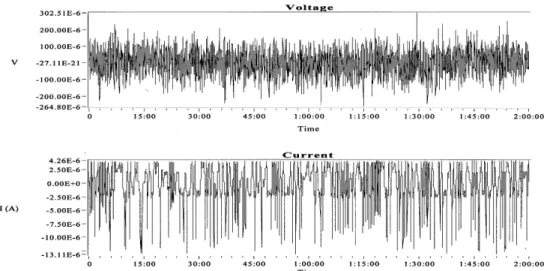
Fig. 1. Electrochemical Potential and Current noise recorded for low carbon steel in 0.5M HCl solution.
of current fluctuation in time record data can have values between 0 (uniform corrosion) and 1(local corrosion).
Experimental data for mild steel in sodium chloride (NaCl) have produced LI values close to 0, while the LI for a Ti alloy in Ringer's solution was found to be close to 1.15) The slope of power spectral density (-β) on frequency domain can also be used to distinguish between local cor- rosion and uniform corrosion. Uniform corrosion is preva- lent if β > 2 and alloy is corroded locally if β < 2.
3. Experiment sepup
Electrochemical noise analysis (ENA) is unique among all electrochemical techniques used in corrosion research because no external power signal needs to be applied for the collection of experimental data. In general, a zero re- sistance ammeter (ZRA) and one or two voltmeters under computer control are sufficient. Potential and current noise data has been collected from identical three mild steel plate electrodes in 0.5M hydrochloric acid aqueous solution at ambient temperature by using "Gamry ESA 400" instru- ment.
Linear polarization resistance (LPR) and electrochemi- cal impedance (Z) has been measured by using same in- strument as used in ENA with applying DC and AC power signals respectively.
Electrochemical noise data can be obtained in a conven- tional manner using potentiostatic and galvanostatic tech- niques. The current time records or potential time records are then analyzed to provide information on the corrosion process. Such measurements can be useful in research in- vestigations since only one measured parameter varies with time.
4. Conclusions
The major sources of noise observed in electrochemistry and corrosion can be ascribed to macroscopic random (stochastic) phenomena. Active dissolution of iron and steel in acidic solutions is controlled by the hydrogen evo- lution process.
The noise signals obtained under galvanostatic and po- tentiostatic control have been interpreted in terms of a sto- chastic process determined by bubble formation, growth and detachment. Electrochemical background noise data detected by using three identical platinum electrodes in 0.5M HCl solution is shown in Fig. 1. These potential and current noises are considered to decrease the noise resistance of electrochemical noise data detected from cor- roding mild steel in 0.5M HCl solution.
The form of potential and current noise signal when occurred uniform corrosion was not shown the phenomena of transient and fluctuation it was show typical sine curve.
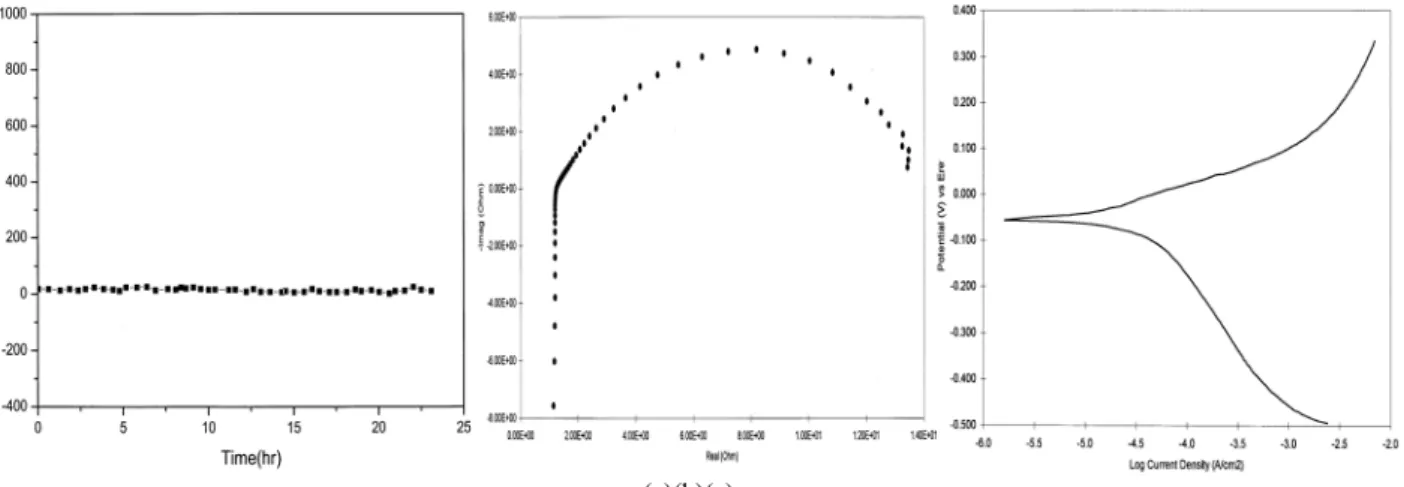
Statistical analysis of low carbon steel after uniform cor- rosion shown in Fig. 2, 3 and Table 1.
The polarization resistance of mild steel in 0.5M hydro- chloric acid has been evaluated by using impedance (Z) and linear polarization (LPR) techniques and compared to the electrochemical noise resistance obtained from electro- chemical noise data.
The degree of localization of this general corrosion has also been discussed by evaluating localization index and power spectral density. Polarization resistance obtained by LPR technique (28Ω) was higher than that obtained by impedance technique (15Ω). Noise resistance (11Ω) was much lower than polarization resistance measured by both of above techniques.
(a)(b)(c)
Fig. 2. Statistical analysis of low carbon steel after uniform corrosion. (a) Noise Resistance(Rn) (b) Impedance(Z) (c) Polarization Resistance(Rp)
(a)
(b)
Fig. 3. Statistical analysis of low carbon steel after uniform corrosion (a) Localization Index(LI) (b) Power Spectra Density (PSD)
Higher polarization resistance obtained by LPR techni- que is generally caused by passivation effect in the pres-
Table 1. Statistical analysis of low carbon steel after uniform corrosion.
Rn Z Rp LI PSD
1 11.9 16.2 32.5 0.08 3.31
2 11.0 14.1 24.3 0.07 3.28
3 9.1 15.2 27.7 0.085 3.24
Aver. 10.7 15.2 28.2 0.08 3.28
ence of scales or deposits which can introduce an increased resistance as can low conductivity electrolytes. The reason why noise resistance is lower than polarization resistance is the effect of background noise detected by using three platinum electrodes cell in 0.5M hydrochloric acid.
Slope(-β) of power spectral density (PSD) obtained from analysis of noise data (-β = 3.3) was much higher than 2 which indicates mild steel corroded uniformly.
Localization index (LI) calculated from statistical analysis (LI=0.08) is much lower than 1 which indicates that mild steel did not corroded locally.
However, LI value is still higher than 1 x 10⁻³ and this indicates that mild steel corroded locally in microscopic point of view.
References
1. W. P. Iverson, J. Electrochem. Soc., 115, 617 (1968).
2. G. Blanc, C. Gabrielli, and M. Keddam, Electrochimica Acta, 20, 687 (1975).
3. G. Blanc, C. Gabrielli, and R. Wiart, Electrochimica Acta, 23, 337 (1978).
4. K. Hladky, European Patent 084404A3, USA Patent 455709, Canadian Patent 418938, (1981).
5. D. A. Eden, J. L. Dawson, and D. G. John, UK Patent App. 861158, (May 1986), US Patent 5139627.
6. T. Hagyard and J. R. Williams, Transactions of the Faraday Society, 57, 2288 (1961).
7. W. P. Iverson, Electrochemical Society, 115, 617 (1968).
8. M. Seralathan and S. K. Rangarajan, Journal of Electroanalytical Chemistry, 208, 13 (1986).
9. M. Seralathan and S. K. Rangarajan, Journal of Electroanalytical Chemistry, 208, 29 (1986).
10. D. A. Eden, A. N. Rothwell, and J. L. Dawson, Corrosion /91, Paper 444, National Association of Corrosion Engineers, Houston (1991).
11. G. T. Burnstein, P. C. Pistorius, and S. P. Mattin, Corrosion Science, 35, 57 (1993).
12. P. C. Searson, Ph. D. thesis, University of Manchester, 1982.
13. M. A. Winsters, P. S. N. Stokers, P. O. Zuniga, and D. J. Schlottenmeier, Corrosion Science (1993).
14. M. Moon and B. S. Skerry, Polymer Preprints, 35, 303 (1994).
15. F. Mansfeld and Z. Sun, Corrosion, Vol. 55, (1999).