Printed in the Republic of Korea
http://dx.doi.org/10.5012/jkcs.2013.57.2.264
Extract of Camellia sinensis as Green Inhibitor for the Corrosion of Mild Steel in Aqueous Solution
Abd El-Aziz S. Fouda*, Dina Mekkia†, and Abeer H. Badr†
Department of Chemistry, Faculty of Science, El-Mansoura University, El-Mansoura- 35516, Egypt.
*E-mail: [email protected]
†Water and wastewater company, Dakahlia, Egypt (Received January 17, 2013; Accepted February 19, 2013)
ABSTRACT. Corrosion inhibition of mild steel used in water station in 35 ppm aluminum sulfate and 10 ppm chloride solu- tion by Camellia sinensis leaves extract was studied using weight loss, potentiodynamic polarization and electrochemical impedance spectroscopy techniques at 30oC. Results show that the inhibition efficiency increases with increasing concentra- tion of the extract and decreases with increasing temperature. Inhibitive effect was afforded by adsorption of the extract’s components which was found to accord with Langmuir adsorption isotherm. Inhibition mechanism is deduced from the tem- perature dependence of the inhibition efficiency and was further corroborated by the values of activation parameters obtained from the experimental data.
Key words: Corrosion inhibition, Mild steel, Aluminum sulfate, Chloride solution, Camellia sinensis extract
INTRODUCTION
Industrial processes such as acid pickling, acid cleaning and etching often involve contact between mild steel and acidic media (in our case NaCl and Al2(SO4)3), which implied that the use of inhibitors is necessary.1−3 Most cor- rosion inhibitors are either synthesized from cheap raw materials or are chosen from organic compounds contain- ing electronegative functional groups and π-electrons in triple or conjugated double bonds. The presence of aro- matic rings and heteroatoms are the major adsorption cen- ters for these inhibitors.4−6 Despite the broad spectrum of organic compounds available as corrosion inhibitors, the successful utilization of most corrosion inhibitors has been hindered by their toxic nature.7 Green corrosion inhib- itors have the advantages of, biodegradable, inexpensive, non-toxic and eco-friendly. These advantages have pro- voked numerous and intensive searches on the use of nat- urally occurring substances or their extracts for the inhibition of the corrosion of metals.8−37
It has been published that the inhibitory actions of plant extracts are due to the presence of some organic com- pounds such as saponins, tannin, alkaloid, steroids, gly- cosides and amino acids.37 Most of these compounds have centers for π-electrons and functional groups (such as –C=C–, –OR, –OH, –COOH, –NR2, –NH2 and –SR), which provide electrons that facilitate the adsorption of the inhibitor on the metal surface. Also, the presence of het-
ero atoms such as P, O and S enhances the adsorption of the inhibitor on the metal surface. Amino acids in the plant extracts play an important role in the inhibition mecha- nism.38−47 Tea leaves contain many compounds, such as polysaccharides, volatile oils, vitamins, minerals, purines, alkaloids (e.g. caffeine) and polyphenols (catechins and flavonoids).
This work reports the results obtained in the evaluation of the corrosion inhibitive effectiveness of the tea extract on the corrosion of mild steel immersed in 35 ppm alu- minum sulfate and 10 ppm NaCl solution at ambient tem- perature.
EXPERIMENTAL PROCEDURE Materials and Solutions
Materials used for the study were mild steel sheet (Talkha water plant) of composition (wt%) 0.13 C, 0.029 Si, 0.018 S, 0.0067 P, 0.397 Mn, 0.025 Ni, 0.0076 Cr, 0.0020 Mo, 0.0010 V, 0.036 Cu, 0.0010 Sn, 0.0057 Co, 0.126 Al, 0.023 Zn, 0.0020 Mg, 0.0046 Nb, and 0.0025 Bi, the rest Fe. The sheet was mechanically pressed and cut into cou- pons, each of dimensions, 20×18×1 mm. They were then ground with silicon carbide abrasive papers, polished, cleaned thoroughly, rinsed in ultrasonic cleaner, dried and kept in desiccator for further weight- loss tests. The weight loss was determined by weighting the cleaned samples before and after hanging the sample into 100 ml of cor-
rosive solution in the absence and presence of various concentrations of the extract. After the time elapsed the coupons were washed with double distilled water and eth- anol and weighed again.
For the electrochemical tests, mild steel with dimension of 10×10 mm, welded with Cu-wire for electrical con- nection and was mounted in epoxy resin, to expose geo- metrical surface areas of 1 cm2. Prior to these measurements, the exposed surface was pretreated in the same manner as for weight loss experiments. All reagents [NaCl, Al2 (SO4)3] used for the study were Analar grade and double distilled water was used for their preparation.
Extract of Camellia Sinensis
The Camellia Sinensis extract was obtained directly from the tea bags of Lipton green tea. Stock solutions of the inhibitor extract were prepared by boiling 1.5 grams of dried tea bags in 250 ml of double distilled water for 30 min. The extract was left all night, then filtered and com- pleted to 1000 ml with double distilled water. Both the freshly prepared extract and that aged in a refrigerator for one month gave almost the same results.
The Corrosive Media
Stock solutions of 100 ppm NaCl were prepared by dis- solving 0.12 gram of NaCl in 1000 ml of double distilled.
Stock solutions of 1000 ppm aluminum sulfate were pre- pared by dissolving 1 gm of aluminum sulfate in 1000 ml double distilled water. The required concentrations were obtained by dilution.
Electrochemical Measurements
The electrochemical measurements were conducted using a conventional three electrode cell, using Pt sheet (2
×2 cm) as counter electrode and a saturated calomel elec- trode (SCE) as reference electrode and mild steel as working electrode. A Potentiostat/Galvanostat/ZRA (Gamry PCI
300/4) was used in all electrochemical measurements. All potential values referred to SCE. The experiments were performed in 100 ml volume cell. The potentials were scanned at a scan rate 1 mV sec−1. Impedance measure- ments were carried out using AC signals of amplitude 10 mV peak to peak at the open circuit potential in the frequency range 100 kHz to 10 mHz. After immersion of specimen, prior to the test measurements, a stabilization period of 30 min was observed, which was sufficient for open circuit potential value (Eocp) to attain a stable value.
RESULTS AND DISCUSSION Weight-Loss Method
Fig. 1 shows the weight loss-time curves for the corrosion of mild steel in 35 ppm aluminum sulfate and 10 ppm chloride solutions in the absence and presence of Camel- lia sinensis at 30oC. From the experimental data of the Fig. 1. Weight loss-time curves for the corrosion of mild steel in 35 ppm aluminum sulfate and 10 ppm Chloride solution in the absence and presence of Camellia Sinensis at 30oC.
Table 1. Effect of Camellia sinensis extract concentrations on weight loss (mg cm−2) and inhibition efficiency (%P) of mild steel in 35 ppm aluminum sulfate and 10 ppm chloride solution at different temperatures
Conc. ppm 30 ºC 40 ºC 50oC
Weight loss mg cm−2 % P Weight loss mg cm−2 %P Weight loss mg cm−2 %P
Blank 0.87 − 1.05 − 1.300 −
100 0.36 58.6 0.83 20.9 1.100 15.4
200 0.30 65.5 0.61 42.0 0.840 35.4
300 0.19 78.2 0.60 42.8 0.770 40.8
400 0.12 86.2 0.45 57.1 0.701 46.0
600 0.10 88.4 0.37 64.8 0.560 56.9
700 0.09 89.7 0.22 79.1 0.420 67.7
weight loss measurements, the protection efficiency (% P) was calculated from Eq. (1):
% P = 100[1–W2/W1] (1)
where W1 and W2 are the weight losses in absence and presence of extract, respectively. All the experiments were performed at 30−50oC. Values of % P of Camellia sin- ensis extract are summarized in Table 1. The % P increases with increasing inhibitor concentration. This behavior can be attributed to the increase of the surface coverage due to the adsorption of extract components on the mild steel sur- face. The results confirmed the very good effect of the Camellia sinensis extract on the corrosion inhibition of mild steel in aluminum sulfate and sodium chloride solu- tions as corrosive media.
The optimum concentration required to achieve an effi- ciency of 90% was found to be 700 ppm.
Effect of Temperature
The effect of temperature on the corrosion parameters of mild steel with the addition of Camellia sinensis extract was studied using weight loss technique. A major advan- tage of this method is its relative simplicity and avail- ability. The data of corrosion behavior of mild steel in 10 ppm sodium chloride and 35 ppm aluminum sulfate solu- tion containing different concentrations of Camellia sin- ensis extract for 21 hours in temperature range 30−50oC were presented in Table 1. Inspection of this Table reveals that the corrosion rate of mild steel increases with increased temperature. On the other hand, the inhibition efficiency
of Camellia sinensis extract decreased (Fig. 2). This sug- gests that possible desorption of the adsorbed inhibitor molecules from the metal surface at higher temperatures.
Such behavior shows that the additives were physically adsorbed on the metal surface. Arrhenius-type dependence is observed between corrosion rate and temperature as in Eq. (2):
k = Ae(−E*a/RT) (2)
where k is the corrosion rate, E*a is the apparent activation energy, R is the universal gas constant, T is the absolute temperature, and A is the frequency factor. Fig. 3 depicts Arrhenius plot (log k against the reciprocal of temperature (1/T)) for mild steel in 10 ppm sodium chloride and 35 ppm aluminum sulfate solution in the absence and pres- ence of different extract concentrations. Straight lines of high correlation coefficients were obtained.
The values of activation energy, Ea* were 16.4, 62.9 kJ mol−1 for the blank and in the presence of Camellia sin- ensis extract, respectively. The increase in the activation energy is directly proportional to the extract concentra- tion, indicating that the energy barrier for corrosion pro- cess is also increased.48
An alternative formulation of Arrhenius equation is:49 k = RT/Nh exp (∆S*/R) exp (−∆H*/RT) (3) where h is the Planck’s constant and N is the Avogadro’s number. Fig. 4 shows a plot of log k/T as a function of 1/T for mild steel. Straight lines were obtained with a slope of
−∆H*/R and an intercept of ln R/Nh + ∆S*/R from which the values of ∆H* and ∆S* were calculated for the blank and Camellia sinensis extract. The values of the activation enthalpy, ∆H* were 5.9 and 26.1 kJ mol−1 and the values of Fig. 2. The effect of inhibitor dose and temperature on the inhi-
bition efficiency of Camellia Sinensis.
Fig. 3. Arrhenius plots for the corrosion rate of steel in 35 ppm aluminum sulfate and 10 ppm chlorine solution with and without the extract of Camellia Sinensis extract at different temperatures.
the activation entropy, ∆S* were −2, −259 J mol−1K−1 for the blank and extract, respectively. It known that values of
∆H* lower than 41.9 kJ mol−1 indicative of physical adsorp- tion.50 Since, the absolute values of ∆H* obtained in this study was lower than 41.9 kJ mol−1, this indicative of phy- sisorption.
The increase in the activation enthalpy (∆H*) in pres- ence of the inhibitors means that the addition of the Camellia sinensis extract to the acid solution increases the height of the energy barrier of the corrosion reaction to an extent depends on the concentration of the present extract.
The adsorption of extract molecules on the metal surface leads to a lower number of hydrogen atoms adsorbed on it;
this will cause a decrease in hydrogen evolution rate rather than the rate of metal dissolution, because of the blocking of the surface of the metal by the extract molecules.
Adsorption Isotherm
The efficiency of an organic compound as a successful inhibitor is mainly dependent on its ability to get adsorbed on the metal surface, which consists of the replacement of water molecules at the corroding interface. If it is assumed that the metals are corroding uniformly, then the corrosion rate in the absence of inhibitor is representative of the total number of corroding sites. To ascertain the nature of adsorp- tion, the surface coverage values for Camellia sinensis extract at 30−50oC were theoretically fitted into different adsorption isotherm models and correlation coefficients were used to determine best fit which was obtained with Temkin, and El Awady isotherms for mild steel.
Temkin’s isotherm:
aθ = ln KadsC (4)
where a is the heterogeneity factor, ‘C’ is the concentra- tion of the extract, θ, is the degree of surface coverage, and Kads is the adsorption equilibrium constant, which is related to the standard free energy of adsorption (∆Goads) by the equation:
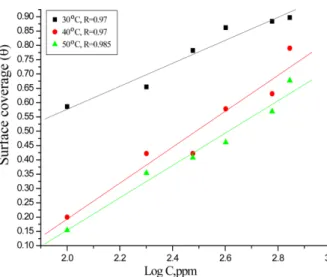
Kads= (1/55.5) exp (∆Goads/RT) (5) where 55.5 is the concentration of water in mol/l at metal / solution interface. The plot of surface coverage (θ) as a function of logarithm of Camellia sinensis extract con- centration is shown in Fig. 5. From the plot, straight lines were obtained for Camellia sinensis extract indicating that the experimental data fit well into Temkin adsorption iso- therm. The Temkin isotherm characterizes the chemisorp- tions of uncharged molecules on a heterogeneous surface.50 Though the calculated values of molecular interaction parameter ‘a’ and adsorption equilibrium constant obtained from Temkin’s plot indicate that all values of ‘a’ are positive in all cases (showing that there is attraction forces between the adsorbed molecules.50 The values of Kads decrease with increasing temperature, suggesting that the inhibitor is physically adsorbed on the mild steel surface. Generally, Kads denotes the strength between adsorbate and adsor- bent. The ∆Gºads values were calculated from this plot were negative this mean spontaneous adsorption of the extract molecules on the surface of the mild steel. The surface coverage values obtained from the weight loss measure- ments were also fitted into the adsorption isotherm of the Fig. 4. Log (k/T) versus 1/T for mild steel in 35 ppm aluminum
sulfate and 10 ppm chloride solution as blank and with Camellia Sinensis extract at different temperatures.
Fig. 5. Temkin adsorption isotherms for Camellia Sinensis extract at different temperatures for mild steel immersed on 35 ppm alu- minum sulfate and 10 ppm chloride solution.
thermodynamic-kinetic model of El-Awady et al.50 which is given by:
log Kads + y log C = log [θ/1−θ] (6) where 1/y is the number of inhibitor molecules occupying one active site (or the number of water molecules replaced by one molecule of Camellia sinensis extract). Curve fit- ting of the data to the thermodynamic-kinetic model is shown in Fig. 6. The calculated values of y are 0.9, 0.52, 0.64, at 30, 40 and 50oC; respectively. y is the number of active site, since its value is less than one. This means that, on adsorption, the inhibitor molecule displace more than one water molecule adsorbed on the surface. The heat of adsorption (∆Hºads) can be calculated according to the Vant Hoff’s Eq. (7):
log Kads= (−∆Hoads/2.303 RT) + constant (7) In order to calculate heat of adsorption (∆Hºads), log Kads was plotted against 1000/T (Fig. 7). A straight line was obtained; its slope is equal to ∆Hoads/2.303R. Since, the absolute values of ∆Hºads obtained in this study was lower than 100 kJ mol−1, this indicative of physisorption, and this support the above mechanism of adsorption. The neg- ative value of ∆Hoads (−86.5 kJ mol−1) in the presence of the extract reflects the exothermic nature of mild steel dis- solution process. It is clear that the activation enthalpies vary in the same manner as the activation energies, sup- porting the proposed inhibition mechanism. According to the basic Eq. (8):
∆Goads=∆Hoads– T∆Soads (8) The entropy of adsorption, ∆Soads was calculated. Large
and negative values of entropies imply that the activated complex in the rate determining step represents an asso- ciation rather than dissociation step, meaning that a decrease in disordering takes place on going from reactant to the activated complex. Similar observations have been reported in the literature.49
Tafel Polarization
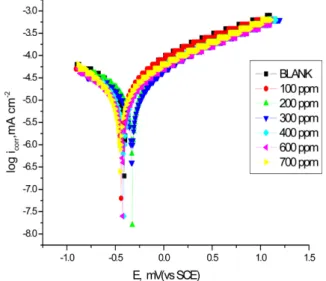
The Tafel plots for mild steel in 10 ppm sodium chlo- ride and 35 ppm aluminum sulfate solution with and with- out Camellia Sinensis extract are presented in Fig. 8.
Corrosion current densities were obtained from polariza- tion curves by linear extrapolation of anodic and cathodic branches of Tafel slopes at point 50 mV more positive and Fig. 6. Kinetic thermodynamic model isotherm for Camellia Sin-
ensis extract at different temperatures for mild steel immersed on 35 ppm aluminum sulfate and 10 ppm chloride solution.
Fig. 7. Log Kads vs 1/T for the corrosion of mild steel in the pres- ence of extract.
Fig. 8. Tafel polarization curves of mild steel corrosion with and without different concentrations of Camellia Sinensis extract at 30 ºC.
more negative than the corrosion potential values (Ecorr).
The protection efficiency (% P) was calculated from the following Eq. (9):
% P = 100 [1–(icorr(inh)/icorr)] (9) where icorr is the corrosion current density in the absence of inhibitor and the icorr(inh) is the corrosion current density in the presence of inhibitor.
The electrochemical parameters such as: corrosion poten- tial (Ecorr), corrosion current density (icorr), anodic Tafel constant (ba) and cathodic Tafel constant (bc) are given in Table 3. From the Fig. 8 and Table 3 we see, when the con- centration of Camellia sinensis extract was increased, the corrosion current density gradually decreased and the pro- tection efficiency increased. The nearly steady values of (Ecorr) indicate that Camellia sinensis extract might have predominantly acted as mixed inhibitor to retard both the rates of hydrogen ion reduction and anodic dissolution of mild steel. Also addition of Camellia sinensis extract enhances both cathodic and anodic polarization and decreases the corresponding partial anodic and cathodic current den- sity. Addition of Camellia sinensis extract has no signif- icant effect on the values of anodic and cathodic Tafel slopes (ba, bc). Therefore, the addition of this inhibitor is simple site blocking of the electrode surface and decreas- ing the surface area available for corrosion reaction.50 Therefore the presence of various concentrations of Camellia sinensis extract does not alter the corrosion mechanism.
The experimental findings of Tafel curves were in good agreement with the corrosion weight loss data.
Mechanism of Inhibition
Green tea was chosen as an inhibitant because it has been analyzed to have higher concentrations of tannin, alka- loids and polyphenols than other green inhibitors and having less environmentally damaging effects than most other contaminants.
This different complex chemical composition in tea act as reducing agents used to slow the electrochemical process in corrosion. Tea contains tannin which had been known23,24,51,52
to be an effective corrosion inhibitor. Tannins are a group of chemicals usually with large molecular weights and diverse structures. Monomeric flavanols, the major compo- nents in green tea, are precursors of condensed tannins.53 Tea polyphenols also have high complexation affinity to metals, alkaloids, and biologic macromolecules such as lipids, carbohydrates, proteins, and nucleic acids.53 The Table 2. Adsorption parameters for the corrosion of mild steel in
steel in 35 ppm aluminum sulfate and 10 ppm chloride solution at different temperatures
Temp. ºC Kads, M−1 −∆Goads, kJ mol−1
∆Hºads
kJ mol−1
∆Sºads
J mol−1 K−1
30 0.166 13.3 86.5 44.3
40 0.060 20.6 86.5 66.0
50 0.018 21.5 86.5 66.7
Table 3. Corrosion parameters in the presence and absence of Camellia Sinensis extract obtained from polarization measurements Conc. ppm −Ecorr mV
vs SCE
icorr
µA cm2
ba
V dec−1
bc
V dec−1 C.R. mmy−1 Rp×10−3
Ω cm2 % P
Blank 406 124.3 1.78 8.78 1.44 6.20 −
100 442 106.2 1.73 11.36 1.23 7.10 14.6
200 325 83.0 1.56 7.18 0.96 8.16 33.2
300 330 68.7 1.48 1.41 0.79 9.39 44.7
400 413 50.6 1.41 3.42 0.58 8.69 59.2
600 426 31.5 1.22 1.67 0.36 9.71 74.7
700 452 29.2 1.13 1.12 0.33 8.45 76.5
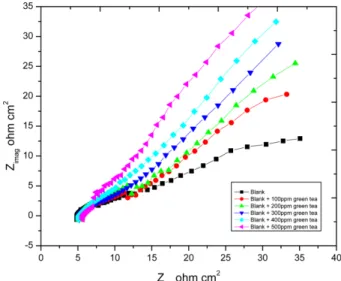
Fig. 9. Nyquist plot of mild steel in 35 ppm aluminum sulfate and 10 ppm chloride solution with and without different con- centrations of Camellia Sinensis extract at 30 ºC.
high complexation affinity to metals in particular could be responsible for the effective metallic corrosion inhibition performance. The mode of adsorption (physisorption and chemisorption) observed could be attributed to the fact that Camellia sinensis extract contains many different chem- ical compounds which some can adsorbed chemically and others adsorbed physically. One of the main criticisms of the use of plant extracts as corrosion inhibitors is the inabil- ity to pinpoint the major active component that is respon- sible for the corrosion inhibition effect owing to complex chemical composition of the crude extract. Eddy and Ebenso7 stated that saponins, alkaloids, lipids and some vitamins are major constituents of plants that enhance the inhibi- tion potentials of plant extracts. Therefore, the inhibition efficiency of ethanol extracts of Phyllanthus amarus is due to the formation of multi-molecular layer of adsorption between iron in mild steel and some of these phytochemicals.
CONCLUSIONS
From the present study, it is found that Camellia sin- ensis extract can be used as inhibitor for mild steel in alu- minum sulfate and sodium chloride solution. While the green inhibitor molecules most supposedly act by being adsorbed on mild steel surface, the overall inhibition is provided by a synergistic effect. It has been found that the inhibitive action of Camellia sinensis extract is basically controlled by temperature and the concentration of the inhibitor. A probable sequel to the present study would be to perform in-depth chemical and analytical investigations using techniques like NMR or IR spectroscopy together with electrochemical studies so as to depict which are the active components of the Camellia sinensis extract involved in the corrosion inhibition reaction, and also elucidate the corrosion inhibition mechanism.
Acknowledgments. The publication cost of this article was supported by the Korean Chemical Society. And the publication cost of this paper was supported by the Korean Chemical Society.
REFERENCES 1. Abdallah, M. Corros. Sci. 2002, 44, 717.
2. Abdallah, M. Port. Electrochim. Acta 2004, 22, 161.
3. Abdallah, M. Corros. Sci. 2004, 46, 1981.
4. Agrawal, Y. K.; Talati, J. D.; Shah, M. D.; Desai, M. N.;
Shah, N. K. Corros. Sci. 2003, 46, 633.
5. Arora, P.; Kumar, S.; Sharma, M. K.; Mathur, S. P. E. J.
Chem. 2007, 4(4), 450.
6. Awad, M. I. J. Appl. Electrochem. 2006, 36, 1163.
7. Eddy, N. O.; Ebenso, E. E. African J. Pure Appl. Chem.
2008, 12(6), 1.
8. Adel-Gaber, A. M.; Abd El-Nabey, B. A.; Sidahmed, I.
M.; El-Zayady, Saadawy A. M. Corros. Sci. 2006, 48(9), 2765.
9. Davis, G. D. A.; Von Fraunhofer, J. A. Tobacco, Mat. Perf.
2003, 42(2), 56.
10. Eddy, N. O. Port. Electrochim. Acta 2009, 27(5), 579.
11. El-Etre, A. Y. Corros. Sci. 2003, 45, 2485.
12. Ebenso, E. E.; Eddy, N. O.; Odiongenyi, A. O. Afri. J.
Pure Appl. Chem. 2008, 4(11), 107.
13. Ebenso, E. E.; Ekpe, U. J.; Ibok, U. J. Discov. Innov.
1998, 10, 52.
14. Ebenso, E. E.; Ibok, U. J.; Ekpe, U. J.; Umoren, S.; Jack- son, E.; Abiola, O. K.; Oforka, N. C.; Martinez, S. Trans.
SAEST, 2004, 39(4), 117.
15. Eddy, N. O. Int. J. Phys. Sci. 2009, 4(3), 1.
16. Eddy, N. O.; Ebenso, E. E. African J. Pure Appl. Chem.
2008, 2(6), 1.
17. Eddy, N. O.; Odoemelam, S. A. Resin Pigm. Technol. 2009, 38(2), 111.
18. Eddy, N. O.; Odoemelam, S. A.; Odiongenyi, A. O. J. Appl.
Electrochem. 2009, 39(6), 849.
19. Ekpe, U. J.; Ebenso, E. E.; Ibok, U. J.; African, J. W. Sci.
Assoc. 1994, 37, 13.
20. Ebenso, E. E.; Ekpe, U. J.; African, W. J. Biol. Appl.
Chem. 1996, 41, 21.
21. El-Etre, A. Y. Appl. Surf. Sci. 2006, 252, 8521.
22. Kliskic, M.; Radoservic, J.; Gudic, S.; Katalinic, V. J.
Appl. Electrochem. 2000, 30, 823.
23. Loto, C. A. Corros. Prev. Cont. 2003, 50(1), 43.
24. Loto, C. A.; Mohammed, A. I.; Loto, R. O. Corros. Prev.
Cont. 2003, 50(3), 107.
25. El-Etre, A. Y.; Abdallah, M. Corros. Sci. 2000, 42, 731.
26. Odiongenyi, A. O.; Odoemelam, S. A.; Eddy, N. O. Port.
Electrochim. Acta 2009, 27(1), 33.
27. Oguzie, E. E. Pigm. Resin Technol. 2005, 34(6), 321.
28. Oguzie, E. E. Mater Chem. Phys. 2006, 99(2-3), 441.
29. Okafor, P. C.; Ebenso, E. E. Pigm. Resin Technol. 2007, 36(3), 134.
30. Rajendran, S.; Ganga, S. V.; Arockiaselvi, J.; Amalraj, A.
J. Bull. Electrochem. 2005, 21(8), 367.
31. Ramesh, S. P.; Vinod Kumar, K. P.; Sethuraman, M. G.
Bull. Electrochem. 2001, 17(3), 141.
32. Rehan, H. H. Materialwissenschaft Werksofftechnik 2003, 34(2), 232.
33. Sethuran, M. G.; Raja, P. B. Pigment Resin Technol. 2005, 34(6), 327.
34. Umoren, S. A.; Obot, I. B.; Ebenso, E. E.; Okafor, P. C.;
Ogbobe, O.; Oguzie, E. E. Anti-Corros. Meth. Mater. 2006, 53(5), 277.
35. Umoren, S. A.; Ebenso, E. E. Pigm. Resin Technol. 2008, 37(3), 173.
36. Soror, T. Y. J. Mater. Sci. Technol. 2004, 20(4), 463.
37. Eddy, N. O.; Odoemelam, S. A.; Odiongenyi, A. O. Green Chem. Lett. Rev. 2009, 2(2), 111.
38. Quraishi, M. A.; Ahamad, I.; Singh, A. K.; Shukla, S. K.;
Lal, B.; Singh, V. Mater. Chem. Phys. 2008, 112, 1035.
39. Zerfaoui, M.; Ouddac, H.; Hammouti, B.; Kertit, S.; Ben- kaddourb, M. Prog. Org. Coat. 2004, 5, 134.
40. Moretti, G.; Guidi, F.; Grion, G. Corros. Sci. 2004, 46, 87.
41. Kiani, M. A.; Mousavi, M. F.; Ghasemi, S.; Shamsipur, M.; Kazemi, S. H. Corros. Sci. 2008, 50, 1035.
42. Silva, A. B.; Agostinho, S. M. L.; Barcia, O. E.; Cordeiro, G. G. O.; D’Elia, E. Corros. Sci. 2006, 48, 3668.
43. Gao, G.; Liang, C. Electrochim. Acta 2007, 52, 4554.
44. Yurt, A.; Bereket, G.; Ogretir, C. J. Mol. Struct. THEOCHEM 2005, 725, 215.
45. Ghasemi, Z.; Tizpar, A. Appl. Surf. Sci. 2006, 252, 3667.
46. Barouni, K.; Bazzi, L.; Salghi, R.; Mihit, M.; Hammouti, B.; Albourine, A.; El Issami, S. Mater. Lett. 2008, 62, 3325.
47. Spah, M.; Spah, D. C.; Deshwal, B.; Lee, S.; Chae, Y.;
Park, J. W. Corros. Sci. 2009, 51, 1293.
48. Popova, A.; Sokolova, E.; Raicheva, S.; Christov, M. Cor- ros. Sci. 2003, 45, 33.
49. Fouda, A. S.; Al-Sarawy, A. A.; Ahmed, F. S.; El-Abbasy H. M. Corros. Sci., 2009, 51, 485.
50. Umoren, S. A.; Eduok, U. M.; Solomon, M. M.; Udoh, A.
P. Arabian Journal of Chemistry 2011, doi:10.1016.
51. Loto, C. A.; Mohammed, A. I. Corrosion Prevention &
Control J. 2005, 47, 50.
52. Loto, C. A. J. Mater. Environ. Sci. 2011, 2(4), 335.
53. Chung, S.; Yang, Zhi-Yuan Wang. The Chemistry of Tea,
“The Tea Man”, (1996), www.Teatalk.com/science/chemistry.
htm, 2011; www.jmaterenvironsci.com.