- CONTENTS -
Ⅰ. INTRODUCTION
Ⅱ. MATERIALS AND METHODS
Ⅲ. RESULTS
Ⅳ. DISCUSSION REFERENCES KOREAN ABSTRACT
Ⅰ. INTRODUCTION
Sex determination of pure and mixed blood samples and stains was performed by amplification of the X-specific and Y-specific alphoid sequences by Polymerase chain reaction (PCR). Sex determination by PCR can be a valuable tool not only after selective lysis of mixed stains, but also in the analysis of pure stains. Since in many forensic cases persons of both sexes are involved, a rapid and simple sex determination assay may give valuable information on the origin of the stain by identifying the sex of an unknown person involved in the crime
2,3).
Since restriction fragment length polymorphisms (RFLP) analysis was introduced in the mid 1980's, DNA analysis was used for forensic scientific field.
* This study was supported in part by research funds from Chosun University, 1999.
Although RFLP-based DNA analysis offers a high degree of discrimination, it shows demerits such as need of high molecular weight of DNA, complicated procedures and the difficulty of DNA typing of degraded sample
2,3,4,5). These problems were solved by advent of PCR method. In recent years, the development of PCR method greatly simplified the determination of genetic marker and offers a potential alternative to overcome limit of the RFLP analysis
2,3,4). It also makes possible to analyze an infinitesimal quantity of DNA.
Sex determination of DNA samples has been performed by amplification of sex chromosomal genes, such as Y chromosomal repetitive DYZ1 sequence in the distal Y chromosome long arm, centromeric α-satellite repeats of X and Y chromosomes, and the X-Y homologous amelogenin gene
4,5). At first, sex determination by PCR method is used to exclude the likelihood of a sex-linked disorder. Especially several genes including sex determining region Y (SRY) gene are DNA marker for sex identification in a range of mammals
2,4,5,6). The SRY gene is just one of a family of genes related by the High Mobility group (HMG) box.
These genes have come to be known as SOX (SRY related HMG box) genes
1,6,7,8,9,10). The SOX9 gene
Usefulness of SOX9 and SRY Gene on Sex Determination in Human Teeth
Nam-Ju Ko, D.D.S., Jong-Mo Ahn, D.D.S., M.S.D., Chang-Lyuk Yoon, D.D.S., M.S.D., Ph.D.
Department of Oral Medicine and Forensic Odontology, Institute of Forensic Odontology
College of Dentistry, Chosun University
was first noted at sites of chondrogenesis in mouse embryo
19,26,27,28,29,30,34). In human, heterozygous defects in the SOX9 gene have been associated with the bone dysmorphology syndrome campomelic dysplasia (CD)
10,11,12,15,17,22,23,34).
Unlike the situation in SRY, the SOX9 gene shows a very high degree of sequence conservation throughout the protein between species
13,18). In sex determination, the SOX9 gene would be expected to activate an entirely different gene or set of genes
1,33). The sex determining cascade is better thought of as a combinatorial network rather than a linear pathway. CD can be caused by translocations involving breakpoints spread through more than 800kb upstream from SOX9
6,7,8,9,10). Mutation analyses of patients with campomelic dysplasia, a bone dysmorphology and XY sex reversal syndrome, indicate that the SRY-related gene SOX9 is involved in both skeletal development and sex determination
7,11,12). In the mouse, high levels of SOX9 mRNA was found in male(XY) but not female (XX) genital ridges, and were localized to the sex cords of the developing testis
7,16). The SOX9 and SRY gene have known for testis determining factor in mammals. SOX9 gene is just one of a family of genes related by the HMG box.
And it roles as sex determination and XY sex reverse
8,9). It was doubted whether the SOX9 gene is used for sex determination. Otherwise, it was found that sex determination using the SRY gene was possible in male only. But there was not observed in female.
The purpose of this study is to evaluate the usefulness of sex determination by detection of the SOX9 and SRY gene in the human teeth.
Ⅱ. MATERIALS AND METHODS 1. Subjects
The pulp tissues (5 males, 5 females) and dentinal tissues (5 males, 5 females) from human teeth were selected for this study.
2. DNA extraction
Gingiva, blood component, dental calculus, nicotine, pigments and cementum of the teeth surface were removed using high speed dental bur.
The teeth were rinsed with distilled water and sectioned along the vertical axis and seperated with surgical chisel. The pulp tissue was placed in 1.5㎖
eppendorf tube. The remained dentinal tissues were crushed with a hammer until resulting fragments were 0.1mm or less in diameter. This dentin was placed in 1.5mL eppendorf tube and was dispensed 400㎕ distilled water. DNA was isolated from pulp and dentin according to a conventional DNA extraction method including an overnight at 55℃ in nucleolysis buffer (0.5% S.D.S, 10mM Tris-Cl, 0.1M EDTA, pH 8.0) and 20㎕ proteinase K. Each sample was spin at 10,000 rpm in a centrifuge for 10 minutes to further purify the DNA and discarded the infranatant. DNA precipitated by added 5M NaCl and 100% ethanol. After washed in 70%
ethanol and dried, followed overnight at 37℃ for 24 hours, and dissolved in 200㎕ of distilled water.
3. SOX9 gene detection.
The PCR mixture contained follows ; 50㎕ reaction containing 100-200ng/㎕ template DNA, buffer (100mM Tris-HCl (pH 9.0), 500mM KCl, 1.0%
Triton), 1.5mM MgCl
2, 20pmole/㎕ SOX9 specific primers INT5 + Q (5'-GTCTGCACAGCCCTTGT- TG-3' and 5'-TCAGGTCAGCCTTGCCCGGC-3'), R + S (5'-CAACGAGTTTGACCAGTACCT-3' and 5'-TGGGACTGGCCCGGCTCGCTG-3') according to Kwok et al
8), 250㎛ dNTPs and 2.5unit of Taq DNA polymerase. The PCR for R + S was performed under condition of 94℃ for 1 min, 1 cycles; 94℃ for 30 sec, 62℃ for 30 sec, 72℃ for 1 min, 40 cycles; 72℃
for 5 min, 1 cycles and the PCR for INT5+Q was performed under condition of 94℃ for 1 min, 1 cycles;
94℃ for 30 sec, 65℃ for 30 sec, 72℃ for 1 min, 35
cycles; 72℃ for 5 min, 1 cycles in PCR thermocycler
(Minicycler
TM, MJ research Ins, Watertown, MA,
U.S.A). The PCR products (10㎕) were loaded onto
agarose gel, Electrophoresis was carried out at 100V, 30 min, 1X TBE buffer (Tris base, Boric acid, 0.5M EDTA). The gel was subsequently stained with ethidium bromide (0.5㎍/㎖).
4. SRY gene detection
The PCR mixtures contained follows ; SRY specific primers(5'- GAT CAG CAA GCA GCT GGG ATA CCA GTG-3' and 5'- CTG TAG CGG TCC CGT TGC TGC GGT G-3') according to Koopman et al
35). The PCR was performed under condition of 95℃ for 4 min, 1 cycles; 94℃ for 60 sec, 65℃ for 60 sec, 72℃ for 2 min, 40 cycles; 72℃ for 10 min, 1 cycles in PCR thermocycler. The PCR products (8㎕) was loaded onto 12% natural polyacrylamide gel, 1mm thickness using vertical electrophoresis unit (Mighty smallⅡ, Hoffer Scientific Ins, Sanfransisco, California, U.S.A.).
Electrophoresis was carried out at 100V, 3 hours, TBE buffer (90mM Tris-Borate, 2mM EDTA). The gel was subsequently stained with ethidium bromide (0.5㎍/㎖).
1 2 3 4 5 6 7 8 9 10 11 12
Fig 1. Results of detection of the SOX9 gene specific primer Int5+Q from the human teeth
Lane 1, 12 : blank Lane 2, 11 : size marker Lane 3, 4, 5 : male pulp teeth Lane 6, 7, 8 : female dentin teeth Lane 9 : male blood control Lane 10 : female blood control
Ⅲ. RESULTS 1. Detection of the SOX9 gene
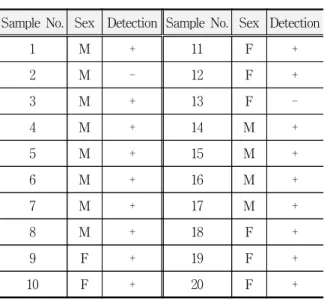
Male and female samples have distinct bands. It was observed 9 cases out of 10 in male (all, in pulp and dentin, respectively), and observed 9 cases out of 10 in female (Table 1).
Ⅳ. DISCUSSION
This study examined capability of sex determination used SOX9 gene on human sample (the blood, pulp and dentin). Analysis of the complete coding region and of the 3rd exon of SOX9 led to establishing SOX9 as the gene for sex determination
8,9). The genes involved in early sex differentiation. At least 14 genes coding for proteins with more than 60%
similarity to the HMG box of SRY have been designated SOX genes
13,18,21,24). Male sexual develop- ment may be a sequence of testis determination, gonadal differentiation, and germ cell differentiation.
Male gonads are formed also in the absence of germ
1 2 3 4 5 6 7 8 9
Fig 2. Results of detection of the SOX9 gene product and SRY gene specific primer R+S from the human teeth
Lane 1 : blank Lane 2, 9 : size marker Lane 3, 4, 5 : male pulp teeth Lane 6, 7, 8 : female dentin teeth
Table 1. Results of detection of the SOX9 gene from the pulp and dentinal tissues on the human teeth
Sample No. Sex Detection Sample No. Sex Detection
1 M + 11 F +
2 M - 12 F +
3 M + 13 F -
4 M + 14 M +
5 M + 15 M +
6 M + 16 M +
7 M + 17 M +
8 M + 18 F +
9 F + 19 F +
10 F + 20 F +
+ : A distinct band was observed - : No specific band was observed
cells, and therefore germ cells are involved neither in sex determination nor in gonadal differentiation
38). In an autosomal sex reversal syndrome, campomelic dysplasia, a number of patients with various reciprocal chromosome translocations have been observed who have one breakpoint in common in the chromosome region 17q24.3-25.1
1,7,8,9,10). A member of the SOX gene family, SOX9, has been found to be localized in this breakpoint region and inactivating mutations identified in SOX9 demonstrated that this gene is responsible for both campomelic dysplasia and sex reversal. SRY is just one of a family of genes related by the HMG box.
These genes haves come to be known as Sox genes.
SOX genes have been found in a wide variety of species representing insects, amphibians, ascidians reptiles, birds, fishes and mammals
16,18,19). The structure of SOX9 is that of a typical transcription factor with discrete DNA binding and trans-activation domains
6,10,13,18,32). The HMG box region of SOX9 has been shown to bind to the sequences AACAAT and AACAAG, typical of SRY and other SOX proteins
1,13,18,20). The importance of
DNA binding for SOX9 function is reflected by the presence of mutations affecting the SOX9 HMG box in sex-reversed CD patients. In the mouse, high levels of SOX9 mRNA was found in male (XY) but not female (XX) genital ridges, and was localized to the sex cords of the developing testis. The timing and cell-type specificity of SOX9 expression suggests that SOX9 may be directly regulated by SRY. SOX9 expression was maintained in the mouse testis during fetal and adult life, but no expression was seen at any stage by in situ hybridation in the developing ovary
7).
A human autosomal XY sex reversal locus, SRA1, associated with the skeletal malformation syndrome campomelic dysplasia (CMPD1), has been placed at distal 17q
7,8). SOX9 encodes a putative transcription factor structurally related to the testis-determining factor SRY and is expressed in many adult tissues. SRY encodes a protein with an 80 amino acid motif known as the high mobility group (HMG) domain, found in a large number of proven or suspected transcription factors with DNA binding properties
8,37,38), including a subgroup of proteins encoded by genes termed SOX/Sox genes by virtue of their sequence similarity to the SRY HMG box
36,37,38).
Author could not find the report to utilize the SOX9 gene from human teeth. In this study, author tried to change amplification condition as decreased annealing temperature, increased SOX9 primer concentration and number of thermal cycling. And SOX9 gene was detected in all of the two group.
This study presents an alternative hypothesis that
SRY functions indirectly, by interacting with
related genes SOX3 (from which SRY evolved) and
SOX9 (which appears to be intimately involved in
vertebrate gonad differentiation)
25). Specifically, it
was suggested that SOX3 inhibits SOX9 function in
females, but in males, SRY inhibits SOX3 and
permits SOX9 to enact its testis-determining
role
21,25). This hypothesis makes testable predictions
of the phenotypes of XX and XY individuals with
deficiencies or overproduction of any of the three
genes, and is able to account for the difficult cases
of XX (SRY-) males and transdifferentiation in the absence of the SRY gene
19).
It was originally supposed that SRY acts directly to activate other genes in the testis-determining pathway. At the protein level, SRY are under less selective pressure to remain conserved than SOX9, and, therefore, diverge more across species than does SOX9. These are consistent with evolutionary stratification of the mammalian sex determination pathway, analogous to that for sex chromosome
38). Therefore, in future the research will be estimated the possibility that detection of SOX9 mRNA and SOX9 protein from the teeth is useful for sex determination.
REFERENCES
1. Koopman P., Sry and Sox9: mammalian testis- determining genes. Cell Mol Life Sci. 55(6-7):839-56, 1999.
2. Akane, A., Seki, S., Shiono, H. et al : Sex determination of forensic samples by dual PCR amplification of an X-Y homologous gene. Forensic science international, 52:143-148, 1992.
3. Akane, A., Shiono, H., Matsubara. K. et al : Purification of forensic specimens for the polymerase chain reaction(PCR) analysis. J. of forensic science, 38(3):691-701, 1993.
4. Goodfellow, P.N. : Mapping the Y chromosome.
Development, supplement 39, 1987.
5. Gubbay, J., Collignon, J., Koopman, P. A. et al : A gene mapping to the sex-determining region of the mouse Y chromosome is a member of a novel family of embryonically expressed genes. Nature, 346:240- 244, 1990.
6. Sudbeck P, Schmitz ML, Baeuerle PA, Scherer G., Sex reversal by loss of the C-terminal transactivation domain of human SOX9. Nat Genet. 13(2):230-2, 1996.
7. Kent J, Wheatley SC, Andrews JE, Sinclair AH, Koopman P., A male-specific role for Sox9 in vertebrate sex determination. Development 122(9):
2813-22, 1996.
8. Foster JW, Dominguez-Steglich MA, Cuioli S, Kowk G, Weller PA, Stevanovic M, Weissenbach J, Mansour S, Young ID, Goodfellow PN, et al., Campomelic dysplasia and autosomal sex reversal caused by mutations in an SRY-related gene. Nature
372(6506):525-30, 1994.
9. Wagner T, Wirth J, Meyer J, Zabel B, Held M, Zimmer J, Pasantes J, Bricarelli FD, Keutel J, Hustert E, et al., Autosomal sex reversal and campomelic dysplasia are caused by mutations in and around the SRY-related gene SOX9. Cell 79(6):1111-20, 1994.
10. Meyer J, Sudbeck P, Held M, Wagner t, Schmitz ML, Bricarelli FD, Eggermont E, Friedrich U, Haas OA, Kobelt A, Lerou JG, Van Maldergem L, Michel E, Mitulla B, Pfeiffer RA, Schinzel A, Schmidt H, Scherer G., Mutational analysis of the SOX9 gene in campomelic dysplasia and autosomal sex reversal:
lack of genotype/phenotype correlations. Hum Mol Genet. 6(1):91-8, 1997.
11. Cameron FJ, Hageman RM, Cooke-Yarborough C, Kwok C, Goodwin LL, Sillence DO, Sinclair AH. A novel germ line mutation in SOX9 causes familial campomelic dysplasia and sex reversal. Hum Mol Genet. 5(10):1625-30, 1996.
12. Kwok C, Weller PA, Guioli S, Foster JW, Mansour S, Zuffardi O, Punnett HH, Dominguez-Steglich MA, Brook JD, Young ID, et al. Mutations in SOX9, the gene responsible for Campomelic dysplasia and autosomal sex reversal. Am J Hum Genet.
57(5):1028-36, 1995.
13. Sudbeck P, Scherer G. Two independent nuclear localization signals are present in the DNA-binding hign-mobility group domains of SRY and SOX9. J biol Chem. 272(44):27848-52, 1997.
14. Wright E, Hargrave MR, Christiansen J, Cooper L, Kun J, Evans T, Gangadharan U, Greenfield A, Koopman P., The Sry-related gene Sox9 is expressed during chondrogenesis in mouse embryos. Nat Genet.
9(1):15-20, 1995.
15. Hageman RM, Cameron FJ, Sinclair AH. Mutation analysis of the SOX9 gene in a patient with campo- melic dysplasia. Hum Mutat. Supp 1:S112-3, 1998.
16. Uchida K, Koopman P, Mita A, Wakana S, Wright E, Kikkawa Y, Yonekawa H, Moriwaki K, Shiroishi T., Exclusion of Sox9 as a candidate for the mouse mutant tail-short. Mamm Genome 7(7):481-5, 1996.
17. Wunderle VM, Critcher R, Hastie N, Goodfellow PN, Schedl A., Deletion of long-range regulatory elements upstream of SOX9 causes campomelic dysplasia. Proc Natl Acad Sci USA. 95(18): 10649-54, 1998.
18. Mertin S, McDowall SG, Harley VR. The DNA- binding specificity of SOX9 and other SOX proteins.
Nucleic Acids Res. 27(5): 1359-64, 1999.
19. Morais da Silva S, Hacker A, Harley V, Goodfellow P, Swain A, Lovell-Badge R., Sox9 expression during gonadal development implies a conserved role for the gene in testis differentiation in mammals and birds.
Nat Genet. 14(1):62-8, 1996.
20. Zhou G, Lefebvre V, Zhang Z, Eberspaecher H, de Crombrugghe B., Three high mobility group-like sequences within a 48-base pair enhancer of the Col2al gene are required for cartilage-specific expression in vivo. J Biol Chem. 273(24):14989-97, 1998.
21. Kamachi Y, Cheah KS, Kondoh H. Mechanism of regulatory target selection by the SOX high-mobility -group domain proteins as revealed by comparison of SOX1/2/3 and SOX9. Mol Cell Biol. 19(1):107-20, 1999.
22. McDowall S, Argentaro A, Ranganathan S, Weller P, Mertin S, Mansour S, tolmie J, Harley V., Functional and structural studies of wild type SOX9 and mutations cuasing campomelic dysplasia. J Biol Chem. 274(34):24023-30, 1999 .
23. Olney PN, Kean LS, Graham D, Elsas LJ, May KM., Campomelic syndrome and deletion of SOX9. Am J Med Genet. 84(1):20-4, 1999.
24. Ng LJ, Wheatley S, Muscat GE, Conway-Campbell J, Bowles J, Wright E, Bell DM, Tam PP, Cheah KS, Koopman P., SOX9 binds DNA, activates transcri- ption, and coexpresses with type Ⅱ collagen during chondrogenesis in the mouse., Dev Biol. 183(1):
108-21, 1997.
25. Pask AJ, Harry JL, Renfree MB, Marshall Graves JA., Absence of SOX3 in the developing marsupial gonad is not consistent with a conserved role in mammalian sex determination. Genesis. 27(4):145-52, 2000 26. Bell DM, Leung KK, Wheatley SC, NgLJ, Zhou S,
Ling KW, Sham MH, Koopman P, Tam PP, Cheah KS., SOX9 directly regulates the type-Ⅱ collagen gene. Nat Genet. 16(2):174-8, 1977.
27. Lefebvre V, Hunag W, Harley VR, Goodfellow PN, de Crombrugghe B., SOX9 is a potent activator of the chondrocyte-specific enhancer of the pro alpha(Ⅱ) collagen gene. Mol Cell Biol. 17(4):23 36-46, 1977.
28. Zhao Q, Eberspaecher H, Lefebvre V, De Crom- brugghe B.,Parallel expression of Sox9 and Col2al in cells undergoing chondrogenesis. Dev Dyn. 209(4):377 -86, 1997.
29. Bi W, Deng JM, Zhang Z, Behringer RR, de Crom- brugghe B., Sox9 is required for cartilage formation.
Nat Genet. 22(1):85-9, 1999.
30. Ng LJ, Wheatley S, Muscat GE, Conway-Campbell J, Bowles J, Wright E, Bell DM, Tam PP, Cheah KS, Koopman P., SOX9 binds DNA, activates transcription, and coexpresses with type Ⅱ collagen during chondrogenesis in the mouse. Dev Biol. ; 183(1): 108-21, 1977.
31. Xie WF, Zhang X, Sakano S, Lefebvre V, Sandell LJ., Trans-activation of the mouse cartilage-derived retinoic acid-sensitive protein gene by Sox9. J Bone Miner Res. 14(5):757-63, 1999.
32. Healy C, Uwanogho D, Sharpe PT., Regulation and role of Sox9 in cartilage formation. Dev Dyn.
215(1):69-78, 1999.
33. Lefebvre V, Li P, de Crombrugghe B., A new long form of Sox5(L-Sox5), Sox6 and Sox9 are coexpressed in chondrogenesis and cooperatively activate the type Ⅱ collagen gene. EMBOJ. 17(19):
5718-33, 1998.
34. Kulyk WM, Frnklin JL, Hoffman LM., Sox9 expression during chondrogenesis in micromass cultures of embryonic limb mesenchyme., Exp Cell Res. 255(2):327-32, 2000.
35. Koopman, P., Gubbay, J., Vivian, N., Goodfellow, P., Lovell- Badge, R. : Male devcelopment of chromoso- mally female mice transgenic for Sry. Nature, 351(9):117-121, 1991.
36. Stock, David W., Buchanan, Anne V., Zhiyong Zhao, and Kenneth M. Weiss. : Numerous members of the Sox family of HMG Box- Containing genes are expressed in developing mouse teeth. Genomics.
37:234-237,1996
37. Sabine Mertin, McDowall, Sharon G., Harley, VincentR., : The DNA-binding specificity of SOX9 and other SOX proteins. Nucleic Acids Research.
27(5):1359-1364, 1998
38. Michael Wegner.: From head to toes: the multiple facets of Sox proteins. Nucleic Acids Research.
27(6):1409-1420, 1998.