Copyright ⓒ the Korean Society for Transplantation, 2014
신장이식 후 발목-상완 지수의 변화
전남대학교병원 외과학교실
김대중ㆍ박오현ㆍ조정선ㆍ이호균ㆍ정상영ㆍ최수진나
Alteration of Ankle-Brachial Index after Kidney Transplantation
Dae Jung Kim, M.D., Oh Hyun Park, M.D., Jeong Seon Jo, M.D., Ho Kyun Lee, M.D., Sang Young Chung, M.D. and Soo Jin Na Choi, M.D.
Department of Surgery, Chonnam National University Medical School, Gwangju, Korea
Background: A steno-occlusive disease of the iliac artery can mimic renal vascular hypertension, and is an important cause of renal dysfunction in renal transplant recipients. We assessed the alternation of postanastomotic arterial blood flow of lower ex- tremities by ankle-brachila index (ABI).
Methods: We analyzed 50 patients who underwent kidney transplantation between March, 2010 and November, 2012 at Chonnam National University Hospital. This study was performed prospectively and case selection by renal transplantation patients who got first operation on right iliac fossa. All operational procedures were end to side anastomosis of the external iliac artery to the renal artery. We measured and compared the preoperative and postoperative (1 week, 6 months, 1 year) ABI. We analyzed the diameter of the recipient external iliac artery and renal artery of the transplanted kidney.
Results: Among 50 patients, 34 were male (68%) and 16 were female (32%). The mean age of recipients was 44.37±11.42 years.
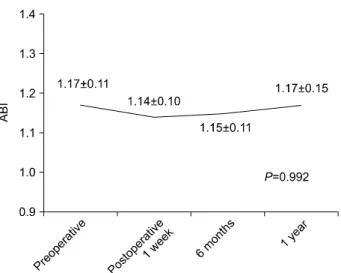
The mean preoperative ABI at the right lower extremity was 1.17±0.11, postoperative 1 week, 6 months, and 1 year was 1.14±0.10, 1.15±0.11, 1.17±0.15, respectively. Alternation of preoperative ABI and postoperative 1 week, 6 months, and 1 year was P =0.331, P =0.864, and P =0.992, respectively.
Conclusions: Alternation of ABI on the ipsilateral lower extremity was not significant in renal transplanted recipients. We recom- mend a long-term study with more cases.
Key Words: Kidney transplantation, Ankle brachial index, External iliac artery 중심 단어: 신장이식, 발목-상완 지수, 외장골동맥
Received August 26, 2014 Revised November 20, 2014 Accepted November 20, 2014 Corresponding author: Soo Jin Na Choi
Department of Surgery, Chonnam National University Medical School, 42 Jebong-ro, Dong-gu, Gwangju 501-757, Korea Tel: 82-62-220-6456, Fax: 82-62-227-1635
E-mail: [email protected]
Original Article
서 론
신장이식은 이식신의 신동맥과 수혜자의 외장골동맥이
나 내장골동맥의 혈관을 연결하여 동맥혈류의 우회 (diversion)를 유발한다(1,2). 동맥혈의 우회술은 말단 장기 나 하지의 혈류량을 개선할 수 있다(3). 이식 후 이식신의 신동맥 협착 및 문합 부위의 외장골동맥의 협착은 드물게 보고되고 있다(4,5). 하지만 이식신의 동맥혈류 우회에 의한 하지의 혈역학적 변화에 대한 연구는 드문 실정이다. 혈역학 적 변화는 간편하며 비침습적인 방법인 발목-상완 지수 (ankle-brachial index, ABI)로 평가할 수 있다(6,7). 본 연구에 서는 신장이식 전후의 ABI 변화를 추적 관찰하여 신장이식 후 외장골동맥의 혈류 우회가 동측 외장골동맥 하방의 혈역
J Korean Soc Transplant 2014;28:200-203 http://dx.doi.org/10.4285/jkstn.2014.28.4.200
201
Dae Jung Kim, et al: ABI after Kidney Transplantation
Table 1. Clinical characteristics of patients (n=50)
Characteristic Value
Sex Male Female Age (yr) <19 20∼29 30∼39 40∼49 50∼59 >60 Related disease Hypertension Diabetes Hyperlipidemia
Diameter of recipient EIA (mm) Diameter of donor RA (mm) eGFR (postoperative 1 yr) (mL/min)
34 (68) 16 (32) 2 (4) 4 (8) 9 (18) 18 (36) 14 (28) 3 (6) 26 (52) 13 (26) 17 (34) 9.7±1.2 (8.2∼12.2)
5.1±0.8 (4.0∼6.3) 75.0±15.9 Data are presented as number (%) or mean±SD (range).
Abbreviations: EIA, external iliac artery; RA, renal artery; eGFR, estimated glomerular filtration rate.
Fig. 1. Comparisons of preoperative and postoperative ankle-brachial index (ABI) at right lower extremity.
학적 변화에 영향을 미치는지 알아보고자 하였다.
대상 및 방법
2010년 3월부터 2012년 11월까지 신장이식 수술을 받은 50명의 신장이식 환자들을 대상으로 연구를 시행하였다.
환자의 성별, 연령, 기저질환 등에 따라 분류하였고, 수술 전과 수술 후 1주일, 6개월, 1년째 좌우측 ABI 변화 양상을 분석하였다. 신장이식 수혜자의 외장골동맥 직경은 복부 전산화단층촬영을 통해 측정하였으며, 이식신의 신동맥 직 경은 수술 중에 직접 측정하였다. 이식신의 신동맥은 모든 수혜자에서 우측 외장골동맥에 단측문합하였다. 술 후 환 자의 신기능은 Modification of Diet in Renal Disease 공식 (추정사구체여과율, estimated glomerular filtration rate, eGFR=186×sCr
−1.154×연령
−0.203×0.742 여성인 경우)을 사용하여 eGFR을 계산하였다. ABI 측정은 편안하게 누운 자세에서 동일한 장비(VasoGuard, VIASYS Healthcare, Madison, WI, USA)로 측정하였다. 혈압은 양측 상완동맥 (brachial artery)과 양쪽 후경골동맥(posterior tibial artery), 발등동맥(dorsalis pedia artery)에서 각각 측정하였으며, ABI는 양측 상완 중 높은 수축기 혈압과 양측 발목 각각의 가장 높은 수축기 혈압의 비로 정의하였다. 측정결과 0.9≤
ABI≤1.2를 정상범주로, 0.9 미만인 경우 하지동맥 질환이
있는 것으로 보았다(6,7). 통계분석을 위해 SPSS ver. 18.0 (IBM Co., Armonk, NY, USA)을 이용하여 대응표본 검정 을 하였으며
P-value가 0.05 이하인 경우 통계적으로 유의 한 것으로 판정하였다.
결 과
1. 환자군의 특성
50명의 신장이식 환자들 중에 남자가 34명(68%), 여자 가 16명(32%)이었다. 30세 미만이 6명(12%), 30세 이상 60 세 미만이 41명(82%), 60세 이상은 3명(6%)이었으며, 평 균 나이는 44.37±11.42세(범위, 18∼64)였다. 동반 질환 으로는 고혈압이 26명(52%)으로 가장 많았으며, 고지혈증 17명(34%), 당뇨는 13명(26%)순 이었다. 대상 환자들의 말기신부전의 원인질환으로는 사구체신염 20명, 당뇨 12 명, 고혈압 12명, 원인불명 6명이었고, 투석기간은 평균 75.58개월(범위, 0∼228)이었다. 이식신 신동맥의 평균 직 경은 5.1±0.8 mm (범위, 4.0∼6.3)이었으며, 수혜자의 외 장골동맥 평균 직경은 9.7±1.2 mm (범위, 8.2∼12.2)이었 다. 수술 후 1년째 추정 사구체 여과율은 75.0±15.9 mL/min이었다(Table 1).
2. 수술 전후 ABI 비교
수술 전 우측 하지의 ABI 평균은 1.17±0.11이었으며, 수술 1주일 후, 6개월 후, 수술 1년 후 1.14±0.10 (
P=0.331), 1.15±0.11 (
P=0.864), 1.17±0.15 (
P=0.353)이었다(Fig. 1).
수술 전 좌측 하지의 ABI 평균은 1.13±0.11이었으며, 수술
202
J Korean Soc TransplantㆍDecember 2014ㆍVolume 28ㆍIssue 4
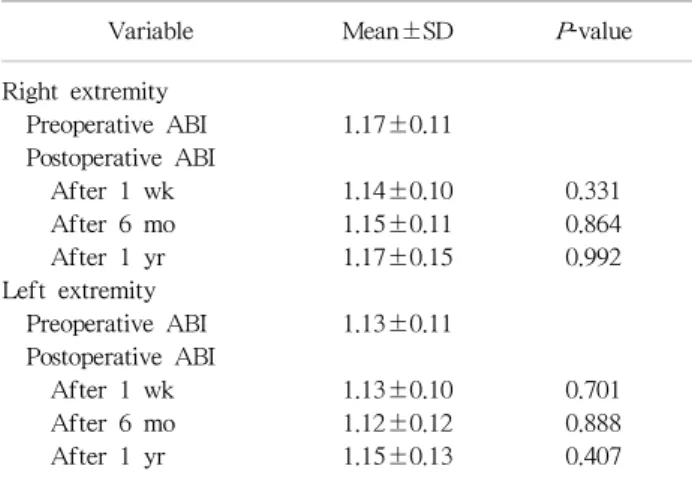
Table 2. Comparisons of preoperative and postoperative ABI of both lower extremity
Variable Mean±SD P -value
Right extremity Preoperative ABI Postoperative ABI After 1 wk After 6 mo After 1 yr Left extremity Preoperative ABI Postoperative ABI After 1 wk After 6 mo After 1 yr
1.17±0.11 1.14±0.10 1.15±0.11 1.17±0.15 1.13±0.11 1.13±0.10 1.12±0.12 1.15±0.13
0.331 0.864 0.992
0.701 0.888 0.407 Abbreviation: ABI, ankle-brachial index.
1주일, 6개월, 1년 후 1.13±0.10 (
P=0.701), 1.12±0.12 (
P=0.888), 1.15±0.13 (
P=0.407)이었다. 양측 모두에서 ABI 가 0.9 미만으로 떨어진 환자는 없었다(Table 2).
고 찰
신장이식은 말기신부전 환자에서 가장 유용한 치료법 으로 알려졌으며, 이식신 및 수혜자의 생존율은 점차 높아 지는 추세이다(8,9). 이식신의 생존율은 수혜자의 생존율 과 밀접한 관계에 있기 때문에, 이식신의 생존율을 높이기 위하여 거부반응, 면역억제제, 감염, 고혈압, 당뇨, 악성종 양 등에 대한 다양한 연구들이 보고되고 있다(10,11). 수술 시 혈관문합 기법으로는 이식신의 신동맥과 수혜자의 외 장골동맥의 단측문합 수술법이 가장 많이 사용되고 있다 (1,2). 이러한 수술법이 예후가 좋다고 알려져 있으나 외장 골동맥 하방의 혈역학적 변화에 영향을 주는지에 대한 보 고는 드물다. 따라서 본 저자들은 외장골동맥의 신장이식 후 혈역학적 변화양상을 연구하기 위하여 비교적 짧은 시 간에 간단하게 혈관상태를 측정할 수 있는 ABI를 이용하 였다.
ABI는 말초동맥 질환(peripheral arterial disease)의 비침 습적인 선별검사(screening test)로써 환자의 혈관상태는 간접적으로 평가하는데 비교적 정확하여 비침습적이고 경 제적이어서 매우 유용하게 사용된다. 그러나 혈관의 석회 화가 진행될 경우 ABI 값이 혈관의 상태에 비해 지나치게 높게 측정될 수 있다(12). 따라서 동맥 경화가 조기에 가속 화되어 동맥중간막 석회화(medial arterial calcifitation)를 유발하여 말초동맥 질환으로 진행할 가능성이 높은 만성
신부전 환자에서 ABI 수치는 정확한 혈관 상태를 반영하 지 못할 수 있다(13). 이에 대한 오차를 줄이기 위해 본 연구에서는 수술 전 ABI가 0.9 미만이거나 1.4 이상 되는 환자는 제외시켰다.
신장이식 후 거부반응 없이 신기능이 잘 유지되는 환자 군을 선별하여 수술 후 1년까지 양측 하지의 ABI를 신이 식 전과 비교분석 하였고, 그 결과 의미 있는 변화를 관찰 할 수 없었다.
이러한 결과를 볼 때, 신장이식 시 이식신의 신동맥과 수혜자의 외장골동맥의 혈관 문합이 문합된 혈관 하방의 혈역학적 변화를 유발하지 않는 안정적인 수술법이라 판 단된다.
Nishioka 등(14)은 수혜자가 원래 가지고 있던 기질적인 동맥경화는 수술 1년 이후에도 특별한 차이를 보이지 않 는다고 보고 하였다. 또한 Covic 등(15)의 연구에서는 신 장이식 전 수혜자의 혈액 투석 및 고혈압이나 당뇨 등의 기저 질환들로 인하여 동맥경화가 진행되어 하지의 말초 동맥 질환을 유발할 수 있고, 시간이 경과함에 따라 말초 동맥 질환의 진행이 빠르게 되는데, 성공적인 신장이식 수 술 이후에는 투석이 종료되고, 고혈압이 조절이 되기 때문 에 동맥경화의 위험 인자들이 감소하게 된다는 보고를 하 였다.
본 연구에서 동맥경화의 영향이 비교적 없는 수술 1주 일 후 ABI에서 특별한 변화를 보이지 않는 것으로 볼 때 신동맥과 외장골동맥의 문합법이 수술 직후의 혈류 변화 에 영향을 주지 않는다고 생각할 수 있었다. 하지만 연구 에 참여한 환자군의 수가 50예로 적었으며, 추적 관찰 기 간이 1년으로 짧아 단기간 동안 ABI 변화를 보이지 않을 수 있다는 제한점이 있었다. 또한 ABI는 하지동맥의 협착 이 50% 이상의 협착의 경우 90%의 민감도와 98%의 특이 도를 보여 폐쇄성 혈관 질환에 대한 유용한 진단법이기는 하나 50% 이하의 경한 동맥협착에 대하여서는 그 민감도 와 특이도가 떨어져 정확한 혈관 상태를 파악하는 데는 한 계가 있다(16).
좀 더 명확한 결과를 얻기 위해서는 더 많은 환자군과
장기간의 추적 관찰이 필요할 것으로 사료된다. 또한 신장
이식 환자에서 신장기능 회복으로 인하여 동맥경화의 위
험요인들이 상쇄될 수 있기 때문에 투석 환자들과의 비교
분석을 통하여 이러한 위험인자들의 변화에 대한 연구도
필요할 것으로 보인다.
203
Dae Jung Kim, et al: ABI after Kidney Transplantation
결 론
신장이식 수술 이후 1년간의 연구에서 이식신의 신동맥 을 수혜자의 외장골동맥에 단측문합 시 이로 인한 외장골 동맥의 혈류 우회가 수혜자 하지의 혈역학적 변화에 영향 을 미치지 않는 것으로 보인다. 좀 더 신뢰 있는 결과를 알아보기 위해서는 장기적인 연구 및 연령이나 동맥경화 등에 따른 혈역학적 변화에 대한 고려가 필요할 것으로 생 각된다.
REFERENCES