79
서 론
이식 전 B형 간염 표면항원 양성인 신수여자의 이식 후 자연경과는 아직 충분히 규명되지 않았으나 분명한 것은 장기간에 걸친 면역억제제의 사용으로 인한 간염 바이러스 의 증식과 동반되는 간기능 부전이 이식 후 수여자의 이환 율과 사망률을 증가시킨다는 사실이다.(1) 그러나 다행스러 운 것은 말기 신부전 환자에서 B형 간염 바이러스의 감염 빈도는 B형 간염 백신 및 재조합 적혈구 생성인자의 사용 으로 과거보다 감소하고 있다.(2,3) 문헌에 의하면 B형 간염 수여자의 이식 후 생존율은 계속해서 투석을 받는 말기 신 부전 환자에 비해 우수하지만,(4) 신기능이 정상인 환자군 에 비하면 간질환 관련 사망률이 높다고 한다.(5,6) 그러나 최근 들어 라미부딘(Lamivudine)의 적극적인 사용으로 B형 간염 바이러스의 증식이 억제되고, 이에 따라 환자의 생존 율이 높아지리라는 기대를 하고 있다. 본 연구에서는 이식 전 B형 간염 표면항원 양성 환자의 신장이식 후 성적을 후Clinical Outcome of Renal Transplantation in
Patients with Positive Pretransplant Hepatitis B
Surface Antigen
Hyung Joon Ahn, M.D.
1, Myoung Soo Kim, M.D.
1,2, Soon
Il Kim, M.D.
1,2, Jong Hoon Lee, M.D.
2, Man Ki Ju,
M.D.
1,
Yu Seun Kim, M.D.
1,2, Kyung Ock Jeon, R.N.
1and Hyun
Jung Kim, R.N.
11
Department of Transplantation Surgery, Severance Hospital
Transplantation Center and
2The Research Institute for
Trans-plantation, Yonsei University College of Medicine, Seoul, Korea
Purpose: The natural history of renal transplant recipients
with positive HBs Ag is still unclear and unpredictable. Liver-
related morbidity and mortality after long-term
immunosup-pression need clinical challenges. We retrospectively
investi-gated the clinical outcome of pre-transplant HBs Ag positive
renal recipients in a single transplant center located in
ende-mic area. Methods: After excluding post-transplant de novo
HBV infected, and peri-transplant anti-hepatitis C virus
posi-tive recipients, the clinical outcome of 1,816 recipients was
examined by the nature of pre-transplant HBs Ag positivity.
Results: Pre-transplant HBs Ag positivity was documented
in 61 recipients (M/F=47/14). During mean follow up of 71.61
±54.14 months, 24 recipients died (6 by infection, 12 by
hepatic failure, 2 by hepatocellular carcinoma, 2 by other
malignancies, 1 by suicide, 1 by gastrointestinal bleeding).
In 14 recipients (58.3%), death was related to
liver-associ-ated reasons. The 10-year patient survival rates in HBs Ag
negative and positive groups were 90.0% and 62.6%,
respectively (P<0.0001). The 10-year graft survival rates in
HBs Ag negative and positive groups were 82.0% and
55.6%, respectively (P<0.0001). When pre-transplant HBV
DNA viral load by PCR was positive or when the level of
post-transplant HBV-DNA viral load flared up, we started
lamivudine therapy since 1997. Seventeen recipients
recei-ved daily 100 mg lamivudine. The mean duration of patients
survival with (n=17) and without (n=44) lamivudine therapy
was 104.3±45.6 and 59.0±51.2 months, respectively (P=
0.003). The 10-year patient survival rates in patients with
and without lamivudine therapy were 80.7% and 55.4%,
re-spectively (P=0.0698). Conclusion: Overall patient and graft
survival in patients with positive pre-transplant HBs Ag was
lower than negative recipients. Although, statistically not
sig-nificant, lamivudine therapy showed a marginally positive
im-pact on the survival of patients with pre-transplant positive
HBs Ag.
(J Korean Soc Transplant 2006;20:79-83
)ꠏꠏꠏꠏꠏꠏꠏꠏꠏꠏꠏꠏꠏꠏꠏꠏꠏꠏꠏꠏꠏꠏꠏꠏꠏꠏꠏꠏꠏꠏꠏꠏꠏꠏꠏꠏꠏꠏꠏꠏꠏꠏꠏꠏꠏꠏꠏꠏꠏꠏꠏꠏꠏ
Key Words: Pre-transplant HBs antigen, Renal
transplanta-tion, Lamivudine
중심 단어: 이식 전 B형 간염, 신장이식, 라미부딘
책임저자:김유선, 서울시 서대문구 신촌동 134번지 연세대학교 의과대학 외과학교실, 120-752 Tel: 02-2228-2115, Fax: 02-313-8289 E-mail: [email protected] 본 논문은 2005년도 연세대학교 의과대학 장기이식연구소의 연 구비 지원으로 이루어졌음.이식 전 B형 간염 표면항원 양성인 환자에서 시행한 신장이식 후
임상 경과
1세브란스병원 장기이식센터 및
2연세대학교 의과대학 장기이식연구소
안형준
1․김명수
1,2․김순일
1,2․이종훈
2․주만기
1․김유선
1,2․전경옥
1․김현정
1향적으로 분석하고 라미부딘 사용여부에 따른 이식 성적에 대하여 조사하고자 하였다.
방 법
1979년 4월부터 2003년 12월까지 세브란스병원 장기이식 센터에서 시행한 신장이식 환자 2,284예 중에서 이식수술 후 B형 간염 감염, 수술 전후 항 C 형 간염항체 양성인 경우 를 제외한 1,816예의 임상 기록을 후향적으로 조사하였다. 수술 후 면역억제제는 1984년 이전에는 스테로이드와 aza-thioprine을 사용하였으며 그 이후에는 calcineurin 억제제와 스테로이드 그리고 azathioprine을 사용하였으며 1997년 이 후에는 azathioprine을 mycophenolic acid로 대체하여 사용하 였다. 수술 후 간기능 검사는 기본적으로 1년마다 시행하였 으며, 라미부딘은 1997년부터 이식 전 HBV-DNA-PCR 양성 인 경우와 이식 후 HBV-DNA 역가의 상승이 있는 경우에 사용하였다. 통계분석은 SPSS 12.0을 사용하였으며, B형 간 염 표면항원 양성군과 음성군의 비교에는 카이검정 및 t 검 정을, 생존율 분석에는 Kaplan-Meier 법을 사용하였다.결 과
1) 임상적 특징 조사 대상군 1,816예 중에서 이식 전 B형 간염 표면항원 양성은 61예였으며(남/여=47/14), 평균 추적관찰 기간은 71.6±54.1개월, 평균 연령은 34.8±9.5세였다. 추적기간 중 24명이 사망하였으며(감염 6명, 간기능 부전 12명, 간세포 암 2명, 위암 1명, 자궁경부암 1명, 위장관 출혈 1명, 자살Fig. 1. (A) Patient survival rates in patients with pre-transplant HBs Ag positive and negative group, (B) Graft survival rates in patients
with pre-transplant HBs Ag positive and negative group.
Table 1. Characteristics of study population
ꠚꠚꠚꠚꠚꠚꠚꠚꠚꠚꠚꠚꠚꠚꠚꠚꠚꠚꠚꠚꠚꠚꠚꠚꠚꠚꠚꠚꠚꠚꠚꠚꠚꠚꠚꠚꠚꠚꠚꠚꠚꠚꠚꠚꠚꠚꠚꠚꠚꠚꠚꠚꠚꠚꠚꠚꠚꠚꠚꠚꠚꠚꠚꠚꠚꠚꠚꠚꠚꠚꠚꠚꠚꠚꠚꠚꠚꠚꠚꠚꠚꠚꠚꠚꠚꠚꠚꠚꠚꠚꠚꠚꠚꠚꠚꠚꠚꠚꠚꠚꠚꠚꠚꠚꠚꠚꠚꠚꠚꠚꠚꠚꠚꠚꠚ Pre-transplant hepatitis B surface antigen status
ꠏꠏꠏꠏꠏꠏꠏꠏꠏꠏꠏꠏꠏꠏꠏꠏꠏꠏꠏꠏꠏꠏꠏꠏꠏꠏꠏꠏꠏꠏꠏꠏꠏꠏꠏꠏꠏꠏꠏꠏꠏꠏꠏꠏꠏꠏꠏꠏꠏꠏꠏꠏꠏꠏꠏꠏꠏꠏꠏꠏꠏꠏꠏꠏꠏꠏꠏꠏꠏꠏꠏꠏꠏꠏꠏꠏꠏꠏꠏꠏꠏꠏꠏꠏꠏ Negative group (n=1,755) Positive group (n=61) P-value ꠏꠏꠏꠏꠏꠏꠏꠏꠏꠏꠏꠏꠏꠏꠏꠏꠏꠏꠏꠏꠏꠏꠏꠏꠏꠏꠏꠏꠏꠏꠏꠏꠏꠏꠏꠏꠏꠏꠏꠏꠏꠏꠏꠏꠏꠏꠏꠏꠏꠏꠏꠏꠏꠏꠏꠏꠏꠏꠏꠏꠏꠏꠏꠏꠏꠏꠏꠏꠏꠏꠏꠏꠏꠏꠏꠏꠏꠏꠏꠏꠏꠏꠏꠏꠏꠏꠏꠏꠏꠏꠏꠏꠏꠏꠏꠏꠏꠏꠏꠏꠏꠏꠏꠏꠏꠏꠏꠏꠏꠏꠏꠏꠏꠏꠏ
Age 36.8±11.7 34.8±9.5 N.S. Sex (M/F) 1,179/576 (67.2%/32.8%) 47/14 (77%/23%) N.S.
Hepatic failure 0 12
Graft status (function/loss) 1,314/441 (74.9%/25.1%) 19/42 (31.1%/68.9%) <0.05 Patients status (live/death) 1,592/163 (90.7%/9.3%) 37/24 (60.7%/39.3%) <0.05 LRD/LURD/cadaveric 905/797/53 (51.6%/45.4%/3.0%) 36/25/0 (59.0%/41.0%) N.S. Acute rejection (no/yes) 1,182/575 (67.2%/32.8%) 44/17 (72.1%/27.9%) N.S. Graft survival duration (months) 100.2±54.5 71.6±54.1 <0.05 Patient survival duration (months) 100.6±54.5 71.6±54.1 <0.05 ꠏꠏꠏꠏꠏꠏꠏꠏꠏꠏꠏꠏꠏꠏꠏꠏꠏꠏꠏꠏꠏꠏꠏꠏꠏꠏꠏꠏꠏꠏꠏꠏꠏꠏꠏꠏꠏꠏꠏꠏꠏꠏꠏꠏꠏꠏꠏꠏꠏꠏꠏꠏꠏꠏꠏꠏꠏꠏꠏꠏꠏꠏꠏꠏꠏꠏꠏꠏꠏꠏꠏꠏꠏꠏꠏꠏꠏꠏꠏꠏꠏꠏꠏꠏꠏꠏꠏꠏꠏꠏꠏꠏꠏꠏꠏꠏꠏꠏꠏꠏꠏꠏꠏꠏꠏꠏꠏꠏꠏꠏꠏꠏꠏꠏꠏ N.S. = not significant; LRD = living related donor; LURD = living unrelated donor.
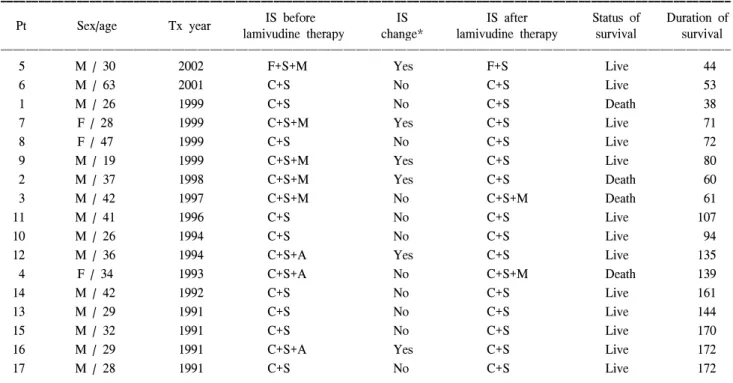
1명), 사망원인 중 14명(58.3%)이 간질환 관련 사망이었다. 이식 후 1년 이내 조기 사망한 경우는 총 8명이었으며, 조기 사망의 원인으로는 감염 3명, 간기능 부전 4명, 위장관 출혈 1명이었다. 단변량 분석을 통해 B형 간염 표면항원 음성군 과 양성군을 비교해 보면 이식신 생존기간 및 환자 생존기 간에서 의미있는 차이를 보였으며, 이식신 부전 및 환자의 사망 유무에서도 의미있는 차이를 보였다(Table 1). 2) 수여자 및 이식신 생존율 이식 전 B형 간염 표면항원 양성군과 음성군의 10년 환 자 생존율은 각각 62.6%, 90.0%로 의미있는 차이를 보였다 (Fig. 1A)(P<0.0001). 각 군의 10년 이식신 생존율의 비교에 서도 각각 55.6%, 82.0%로 의미있는 차이를 보였다(Fig. 1B) (P<0.0001). 3) 라미부딘 사용 효과 본원의 경우 1997년부터 이식 전 HBV-DNA-PCR이 양성 인 경우와 이식 후 HBV-DNA의 급격한 상승이 있는 경우 라미부딘을 사용하였다. 이식 후 HBV DNA 역가의 상승은 18명에서 관찰되었으며, 그 중 5명은 이식 전 HBV-DNA 음 성이었고, 2명은 이식 전 HBV-DNA 양성이었으며 그 외 11 명에서는 이식 전에 DNA 검사를 시행하지 않았다. 한 명을 제외한 17명에서 라미부딘 100 mg/일을 복용하였다. HBV- DNA 역가 상승 시 라미부딘을 사용하면서 면역억제제 조 절을 하였다(Table 2). 라미부딘을 사용한 17명 중 8명에서 항 대사성 면역억제제를 사용하고 있었으며, 이 중 6명에서 항 대사성 면역억제제의 사용을 중단하였다(mycophenolic acid (MPA) 중단 5명, azathioprine 중단 1명). 생존 기간의 평 균 비교 분석에서 라미부딘 사용군(n=17)과 미사용군(n=44) 은 각각 104.3±45.6개월, 59.0±51.2개월로 의미 있는 차이 를 보였다(P=0.003). 라미부딘 사용군과 미사용군의 10년 환 자 생존율은 각각 80.7%와 55.4%였다(Fig. 2)(P= 0.0698).
Table 2. Change of immunosuppression when HBV-DNA titer flared up
ꠚꠚꠚꠚꠚꠚꠚꠚꠚꠚꠚꠚꠚꠚꠚꠚꠚꠚꠚꠚꠚꠚꠚꠚꠚꠚꠚꠚꠚꠚꠚꠚꠚꠚꠚꠚꠚꠚꠚꠚꠚꠚꠚꠚꠚꠚꠚꠚꠚꠚꠚꠚꠚꠚꠚꠚꠚꠚꠚꠚꠚꠚꠚꠚꠚꠚꠚꠚꠚꠚꠚꠚꠚꠚꠚꠚꠚꠚꠚꠚꠚꠚꠚꠚꠚꠚꠚꠚꠚꠚꠚꠚꠚꠚꠚꠚꠚꠚꠚꠚꠚꠚꠚꠚꠚꠚꠚꠚꠚꠚꠚꠚꠚꠚꠚ IS before IS IS after Status of Duration of Pt Sex/age Tx year
lamivudine therapy change* lamivudine therapy survival survival ꠏꠏꠏꠏꠏꠏꠏꠏꠏꠏꠏꠏꠏꠏꠏꠏꠏꠏꠏꠏꠏꠏꠏꠏꠏꠏꠏꠏꠏꠏꠏꠏꠏꠏꠏꠏꠏꠏꠏꠏꠏꠏꠏꠏꠏꠏꠏꠏꠏꠏꠏꠏꠏꠏꠏꠏꠏꠏꠏꠏꠏꠏꠏꠏꠏꠏꠏꠏꠏꠏꠏꠏꠏꠏꠏꠏꠏꠏꠏꠏꠏꠏꠏꠏꠏꠏꠏꠏꠏꠏꠏꠏꠏꠏꠏꠏꠏꠏꠏꠏꠏꠏꠏꠏꠏꠏꠏꠏꠏꠏꠏꠏꠏꠏꠏ 5 M / 30 2002 F+S+M Yes F+S Live 44 6 M / 63 2001 C+S No C+S Live 53 1 M / 26 1999 C+S No C+S Death 38 7 F / 28 1999 C+S+M Yes C+S Live 71 8 F / 47 1999 C+S No C+S Live 72 9 M / 19 1999 C+S+M Yes C+S Live 80 2 M / 37 1998 C+S+M Yes C+S Death 60 3 M / 42 1997 C+S+M No C+S+M Death 61 11 M / 41 1996 C+S No C+S Live 107 10 M / 26 1994 C+S No C+S Live 94 12 M / 36 1994 C+S+A Yes C+S Live 135 4 F / 34 1993 C+S+A No C+S+M Death 139 14 M / 42 1992 C+S No C+S Live 161 13 M / 29 1991 C+S No C+S Live 144 15 M / 32 1991 C+S No C+S Live 170 16 M / 29 1991 C+S+A Yes C+S Live 172 17 M / 28 1991 C+S No C+S Live 172 ꠏꠏꠏꠏꠏꠏꠏꠏꠏꠏꠏꠏꠏꠏꠏꠏꠏꠏꠏꠏꠏꠏꠏꠏꠏꠏꠏꠏꠏꠏꠏꠏꠏꠏꠏꠏꠏꠏꠏꠏꠏꠏꠏꠏꠏꠏꠏꠏꠏꠏꠏꠏꠏꠏꠏꠏꠏꠏꠏꠏꠏꠏꠏꠏꠏꠏꠏꠏꠏꠏꠏꠏꠏꠏꠏꠏꠏꠏꠏꠏꠏꠏꠏꠏꠏꠏꠏꠏꠏꠏꠏꠏꠏꠏꠏꠏꠏꠏꠏꠏꠏꠏꠏꠏꠏꠏꠏꠏꠏꠏꠏꠏꠏꠏꠏ Tx = transplantation, IS = immunosuppression (C: cyclosporine, S: steroids, M: mycophenolic acid, F: tacrolimus, A: azathioprine). *When HBV-DNA titer flared up.
Fig. 2. Patient survival rates in patients with or without lamivudine
고 찰
신장이식 후 B형 간염 환자에서 장기간에 걸친 면역억제 제 사용에 의한 간기능의 악화는 임상적으로 매우 중요한 문제라 할 수 있다. 과거의 문헌을 살펴보면, B형 간염 수여 자의 심각한 이환율 및 사망률을 고려해 볼 때 이러한 조건 은 상대적인 신장이식의 금기로 여겨져 왔다.(7) 본 연구에 서도 B형 간염 표면항원 양성인 수여자는 음성인 경우보다 낮은 10년 환자 생존율을 보였으며(62.62% vs. 90.01%), 이는 여러 문헌의 보고와 일치하는 소견이다.(8-10) Fabrizi 등(11) 은 여러 문헌의 메타 분석(meta-analysis)을 통해 신이식 수여 자의 B형 간염 바이러스 표면 항원 양성이 사망률(relative risk=2.49, 95% confidence interval: 1.64∼3.78)과 이식신 생존 율(relative risk=1.44, 95% confidence interval: 1.02∼2.04)에 영 향을 미치는 의미있는 독립적인 위험인자라고 보고하였다. B형 간염 수여자의 예후에 관한 초기 문헌을 보면, B형 간 염 음성군보다 예후가 불량하거나 비슷하다는 상반되는 보 고들이 있었으나,(12-17) 이는 B형 간염의 경과가 서서히 진 행되기 때문으로, 초기 문헌들은 주로 단기간인 5년 생존율 을 조사했기 때문으로 생각된다. B형 간염의 치료제로 사 용되는 라미부딘은 간효소의 안정화 및 B형 간염 바이러스 증식을 억제하는 효과가 있으며, 최근들어 라미부딘을 사 용함으로, 많은 문헌에서 신장이식 후 생존율의 향상을 보 고하고있다.(18-20) 본 연구에서 라미부딘 사용군과 미사용 군의 10년 환자 생존율은 각각 80.7%와 55.4%으로 비록 통 계학적으로는 의미가 없으나(P=0.0698), 긍정적인 효과의 경향은 보이고, 라미부딘 사용군에서 평균 생존 기간이 104.3±45.6개월로 미사용군 59.0±51.2개월보다 의미있게 연장되었다. 본 연구의 단점으로는 HBV-DNA 검사가 일상 적으로 이루어지지 않던 시기에 이식을 받은 환자에게서 라미부딘의 투여가 B형 간염이 상당히 진행된 후에 투여되 었을 가능성이 있다는 것이다. 이런 점을 고려하더라도 본 연구에서 라미부딘의 사용은 B형 간염 환자의 이식 후 환 자생존율에 긍정적인 효과가 있음을 확인할 수 있었다. Chan 등(20)은 라미부딘의 선행(preemptive)사용을 통해 B 형 간염 양성군에서도 음성군과 유사한 환자 생존율을 보 고하였고, 신장이식 후 가능한 빨리 라미부딘을 사용하는 것이 환자 생존율을 향상시킨다고 결론지었다. 박 등(21)은 B형 간염 표면항원 양성인 신장이식 수여자 17예에서 라미 부딘을 사용한 결과 HBV-DNA 역가의 감소와 간효소의 정 상화에 효과적이라고 보고하였다.결 론
B형 간염 표면항원 양성인 환자에서 신장이식 후 환자 생존율 및 이식신 생존율은 음성군에 비해 열등한 결과를 보였다. 그러나 라미부딘을 사용한 환자군에서 평균 생존 기간이 미사용군보다 의미있게 연장되어 라미부딘의 사용 이 신이식 환자의 생존율을 향상시킬 수 있을 것이라 생각 한다. 따라서 B형 간염 표면항원 양성인 환자에서 신장이 식은 금기가 아니며, 이식 전부터 라미부딘을 사용하고 이 식 후에도 계속 사용함으로써 신장이식의 결과를 향상시킬 수 있을 것이라 생각한다.참 고 문 헌
1) Degos F, Lugassy C, Degott C, Debure A, Carnot F, Theirs V, Tiollais P, Kreis H, Brechot C. Hepatitis B virus and he-patitis B-related viral infection in renal transplant recipients. A prospective study of 90 patients. Gastroenterology 1988;94: 151-6.
2) Crosnier J. Hepatitis B in haemodialysis: vaccination against HBS antigen. Proc Eur Dial Transplant Assoc 1981;18:231-40. 3) Casati S, Campise M, Ponticelli C. Correction of anaemia with recombinant human erythropoietin despite low serum ferritin. Nephrol Dial Transplant 1991;6:452-4.
4) Harnett JD, Zeldis JB, Parfrey PS, Kennedy M, Sircar R, Ste-inmann TI, Guttmann RD. Hepatitis B disease in dialysis and transplant patients. Further epidemiologic and serologic stu-dies. Transplantation 1987;44:369-76.
5) Perrillo RP. Hepatitis B and renal transplantation: securing the sword of damocles. Hepatology 2002;36:1041-5.
6) Fabrizi F, Martin P, Ponticelli C. Hepatitis B virus and renal transplantation. Nephron 2002;90:241-51.
7) Pirson Y, Alexandre GP, Ypersele C. Long-term effect of HBs antigenemia on patient survival after renal transplantation. N Engl J Med 1977;296:194-6.
8) Mathurin P, Mouquet C, Poynard T, Sylla C, Benalia H, Fretz C, Thibault V, Cadranel JF, Bernard B, Opolon P, Coriat P, Bitker MO. Impact of hepatitis B and C virus on kidney transplantation outcome. Hepatology 1999;29:257-63. 9) Morales JM, Dominguez-Gil B, Sanz-Guajardo D, Fernandez
J, Escuin F. The influence of hepatitis B and hepatitis C virus infection in the recipient on late renal allograft failure. Nephrol Dial Transplant 2004;19(Suppl 3):iii72-6.
10) Breitenfeldt MK, Rasenack J, Berthold H, Olschewski M, Schroff J, Strey C, Grotz WH. Impact of hepatitis B and C on graft loss and mortality of patients after kidney trans-plantation. Clin Transplant 2002;16:130-6.
11) Fabrizi F, Martin P, Dixit V, Kanwal F, Dulai G. HBsAg seropositive status and survival after renal transplantation: meta-analysis of observational studies. Am J Transplant 2005; 5:2913-21.
12) Parfrey PS, Forbes RD, Hutchinson TA, Beaudoin JG, Dauphi-nee WD, Hollomby DJ, Guttmann RD. The clinical and path-ological course of hepatitis B liver disease in renal transplant recipients. Transplantation 1984;37:461-6.
13) Rao KV, Kasiske BL, Anderson WR. Variability in the mor-phological spectrum and clinical outcome of chronic liver disease in hepatitis B-positive and B-negative renal transplant recipients. Transplantation 1991;51:391-6.
14) Kim YS, Kim SI, Suh JS, Chon CY, Park K. Renal transplan-tation is not contraindicated in hepatitis B surface antigen posi-tive patients. Transplant Proc 1992;24:1541-2.
15) Tang S, Lo CM, Chan TM, Lai KN. Early detection of hepato-cellular carcinoma in hepatitis-B-positive renal transplant reci-pients. J Surg Oncol 1999;72:99-101.
16) Grekas D, Dioudis C, Mandraveli K, Alivanis P, Alexiou S, Derveniotis V, Hatzibaloglou A, Tourkantonis A. Renal trans-plantation in asymptomatic carriers of hepatitis B surface an-tigen. Nephron 1995;69:267-72.
17) Pol S, Debure A, Degott C, Carnot F, Legendre C, Brechot C, Kreis H. Chronic hepatitis in kidney allograft recipients. Lancet 1990;335(8694):878-80.
18) Fabrizi F, Dulai G, Dixit V, Bunnapradist S, Martin P. La-mivudine for the treatment of hepatitis B virus-related liver di-sease after renal transplantation: meta-analysis of clinical tri-als. Transplantation 2004;77:859-64.
19) Thabut D, Thibault V, Bernard-Chabert B, Mouquet C, Di Martino V, Le Calvez S, Opolon P, Benhamou Y, Bitker MO, Poynard T. Long-term therapy with lamivudine in renal trans-plant recipients with chronic hepatitis B. Eur J Gastroenterol Hepatol 2004;16:1367-73.
20) Chan TM, Fang GX, Tang CS, Cheng IK, Lai KN, Ho SK. Preemptive lamivudine therapy based on HBV DNA level in HBsAg-positive kidney allograft recipients. Hepatology 2002; 36:1246-52.
21) Park SK, Yang WS, Lee YS, Jung HH, Chang JW, Choi HJ, Han DJ, Park JS. Outcome of renal transplantation in hepatitis B surface antigen-positive patients after introduction of lami-vudine. Nephrol Dial Transplant 2001;16:2222-8.