Reference Values for the Revised Anti-Müllerian Hormone Generation II Assay: Infertile Population-based Study
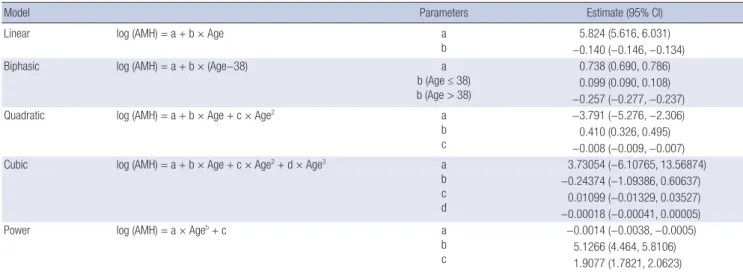
Anti-Müllerian hormone (AMH) is now accepted as an important clinical marker of ovarian reserve and is increasingly measured as an initial evaluation at infertility clinics. The aim of this study was to establish reference values for the revised second generation (Gen II) assay using population-based data. In this population-based cohort study, AMH data from unselected infertile women aged 25–45 years from June 2013 to June 2014 (n = 15,801) were collected. The AMH values were measured using the revised Gen II assay. We established and validated 5 AMH-age regression models. Based on the optimal AMH-age model, reference values and centile charts were obtained. The quadratic model (log AMH = 0.410 × age−0.008 × age2−3.791) was the most appropriate for describing the age-dependent decrease in AMH measured using the revised Gen II assay. This is the largest population-based study to establish age-specific reference values of AMH using the revised Gen II assay. These reference values may provide more specific information regarding the ovarian reserve estimation of infertile women.
Keywords: AMH; AMH Generation II Assay; Ovarian Reserve; Reference Values Joong Yeup Lee,1 Soyeon Ahn,2
Jung Ryeol Lee,3 Byung Chul Jee,3 Chung Hyon Kim,1 Soyeon Seo,4 Chang Suk Suh,5 and Seok Hyun Kim5
1Hamchoon Women’s Clinic, Seoul, Korea;
2Medical Research Collaborating Center, Seoul National University Bundang Hospital, Seongnam, Korea; 3Department of Obstetrics and Gynecology, Seoul National University Bundang Hospital, Seongnam, Korea; 4Samkwang Medical Laboratories, Seoul, Korea; 5Department of Obstetrics and Gynecology, Seoul National University College of Medicine, Seoul, Korea
Received: 19 September 2016 Accepted: 30 January 2017 Address for Correspondence:
Seok Hyun Kim, MD, PhD
Department of Obstetrics and Gynecology, Seoul National University College of Medicine, 103 Daehak-ro, Jongno-gu, Seoul 03080, Korea
E-mail: [email protected]
Funding: This research was supported by the Korea Health Care Technology R & D Project, Ministry of Health and Welfare, Korea (grant No. A120043).
https://doi.org/10.3346/jkms.2017.32.5.825 • J Korean Med Sci 2017; 32: 825-829
INTRODUCTION
The percentage of women delaying childbearing continues to increase, and demand for an accurate assessment of ovarian reserve has grown. Reproductive aging varies markedly among women. Anti-Müllerian hormone (AMH) is recognized as a re- liable predictor of ovarian response in assisted reproduction and is a good indicator of ovarian reserve in other clinical set- tings (1). To demonstrate the value of AMH as a biomarker, a reliable and commercially available assay is essential (2). The original second generation (Gen II) AMH assay was developed by modification of the Immunotec (IOT) and Diagnostic Sys- tems Laboratory (DSL) assay. The Gen II assay uses the same antibody from the DSL system, but adopted calibration against the standard from the IOT system (3). Recent publications re- ported a discrepancy in AMH values obtained using the origi- nal Gen II assay compared to those with the IOT assay (4), as well as a significant decrease in values compared to those with the DSL assay (5-7). Beckman-Coulter released a field safety notice stating that all kit lots (≤ 326,119) were affected by com- plement interference, which caused a time-dependent 70% re- duction in the AMH value, and they revised their assay meth-
odology (i.e., premixing the sample with a buffer before plating) (8). This technical issue is of critical importance, and it may have hampered the clinical use of the AMH.
Reference values do not have a meaning per se unless they are referred to in a particular context, which is usually a physio- logical one; thus, those values represent a specific population (9). Reference values and centile charts for AMH could serve as a tool for clinicians and patients when assessing ovarian reserve at a given age, which would assist in decision-making and se- lecting treatment options. The samples for reference value stud- ies must be collected under conditions representative of those used in clinical practice (10). We previously reported on age- specific AMH values measured using the IOT assay in a cohort of 16,972 infertility women, and we confirmed that the quadrat- ic model is the most appropriate for describing the AMH-age relationship (11). Since the revised Gen II assay is a substitution for the IOT and original Gen II assay, new age-specific AMH val- ues are urgently needed.
The aim of this study was to establish age-specific reference values and centile chart for the revised Gen II assay. To achieve this objective, we studied mass anonymized AMH data, which were obtained in the same laboratory during routine clinical use.
Obstetrics & Gynecology
MATERIALS AND METHODS Study cohort
We recruited AMH data obtained from unselected infertile wom- en aged 25 to 45 years old between June 2013 and June 2014. Se- rum AMH measurements using the revised Gen II assay were performed at Samkwang Medical Laboratories. AMH samples were collected from many infertility centers in Korea for ovarian reserve estimation. Only data on the patients’ age, hospital, race/
ethnicity, and AMH levels were available from the laboratory’s registry. To collect data specifically for the purpose of develop- ing the reference values for infertile women, we included wom- en aged 25–45 years for infertility work-up in the analysis to re- duce selection bias, and we excluded non-Korean women to rule out the influence of ethnicity (11). If there were multiple AMH values from the same patient, each woman was included only once, and the first AMH value was chosen for analysis. The study cohort was randomly divided into training or validation data groups to establish and validate the optimal AMH-age model.
The revised Gen II assay and analysis
All the AMH measurements were performed according to the manufacturers’ protocols by the same experienced staff. The Gen II kit (A79765; Beckman-Coulter, Brea, CA, USA) was used with the revised instructions (IFU-REF A92268D), which include a predilution step of the specimen with assay buffer. In the orig- inal instructions, calibrator, control, or serum and assay buffer were added sequentially to the microplate. In the revised instruc- tions, calibrator, control, or serum and assay buffer are premixed, and then added to the microplate. The assay has a measuring range from 0.08–22.50 ng/mL. AMH values ≤ 0.08 were cen- sored at a value of 0.08 ng/mL. The intra- and inter-assay coef- ficient of variation (CV) were 5.4% and 5.6%, respectively.
Statistical analysis
The total samples from the study cohort were pooled and ran- domly divided into a training or validation set. A set of 5 tenta- tive regression models were applied to the training set, where the logarithm of AMH was used as a response variable in each model, and the age in years was a predictor (12). The same re- gression models were fitted in the validation set to ascertain the model performance. To evaluate goodness of fit, summary sta- tistics for the sum of the absolute residuals (differences between the log [AMH] values and those predicted), R2 statistic (propor- tion of the total variation of outcomes explained by the model), and Akaike information criterion (AIC) (a relative estimate of the information lost with a given model) were considered (7,11).
The 95% confidence intervals (CIs) were produced from 1,000 bootstrap residual data sets, which were generated from ran- dom sampling with replacement from the observed residual data set. A likelihood ratio test was used when comparing the nested models. The partial F test was used to decide whether adding an additional explanatory term to the regression mod- els would be statistically significant.
Based on the optimal AMH-age model, centile chart of the serum AMH was plotted in the 5th, 10th, 25th, 50th, 75th, 90th, and 95th percentiles of the predicted AMH values against age.
All analyses were performed using R for Windows, version 2.11.1 (R Foundation for Statistical Computing, Vienna, Austria).
Table 1. Characteristics of the study cohort
Cohort Age, yr AMH, ng/mL
Total No. of subjects 15,801
Mean 34.6 4.40
SD 4.1 3.97
Median 34.1 3.40
Upper quartile 37.3 1.62
Lower quartile 31.8 5.97
AMH = anti-Müllerian hormone, SD = standard deviation.
Table 2. AMH-age regression models for the revised Gen II assay
Model Parameters Estimate (95% CI)
Linear log (AMH) = a + b × Age a
b 5.824 (5.616, 6.031)
−0.140 (−0.146, −0.134)
Biphasic log (AMH) = a + b × (Age−38) a
b (Age ≤ 38) b (Age > 38)
0.738 (0.690, 0.786) 0.099 (0.090, 0.108)
−0.257 (−0.277, −0.237)
Quadratic log (AMH) = a + b × Age + c × Age2 a
b c
−3.791 (−5.276, −2.306) 0.410 (0.326, 0.495)
−0.008 (−0.009, −0.007)
Cubic log (AMH) = a + b × Age + c × Age2 + d × Age3 a
b c d
3.73054 (−6.10765, 13.56874)
−0.24374 (−1.09386, 0.60637) 0.01099 (−0.01329, 0.03527)
−0.00018 (−0.00041, 0.00005)
Power log (AMH) = a × Ageb + c a
b c
−0.0014 (−0.0038, −0.0005) 5.1266 (4.464, 5.8106) 1.9077 (1.7821, 2.0623) AMH = anti-Müllerian hormone, Gen II = second generation, CI = confidence interval.
Ethics statement
This study was approved by the Institutional Review Board of the Hamchoon Women’s Clinic (IRB No. 79507-201503-EC-001).
The requirement for informed consent was waived by the board.
RESULTS
Table 1 shows the baseline demographic characteristics of the study cohort, which was randomly divided into a training or val- idation set. The P value from the Wilcoxon-Mann-Whitney test showed no significant differences in age and the AMH values between the training and validation set (P = 0.332 and 0.421, respectively). In the training set, 5 regression models were fit- ted, and the parameters for each model were estimated (Table 2). Table 3 presents summary statistics for the sum of the abso- lute residuals, R2, and AIC in the validation set. The linear mod- el had the largest sum of absolute residuals and the lowest R2. Despite a small difference in the goodness of fit among the non-
linear models, the quadratic, cubic, and power models had the lower sum of absolute residuals and AIC. To determine which model would best fit the data, additional statistical analyses were performed. According to the partial F test (Table 4), a quadratic and cubic model provided a significantly better fit than a linear model. There was no significant difference between the quadrat- ic and cubic models. When 2 models fit the data equally well, a simpler model was preferred because of the ease of interpreta- tion. Thus, we chose the quadratic model over the cubic model.
Finally, the quadratic and power models appeared to provide the best fit to our data. For the sake of general usability and ac- cessibility, we chose the quadratic model as the most appropri- ate clinical model for describing the association between AMH and age.
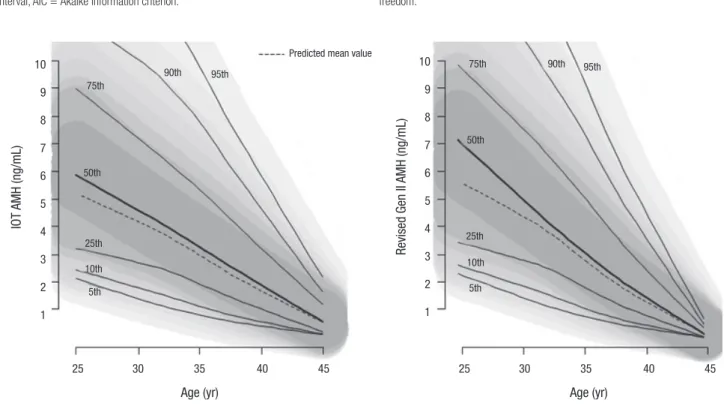
Fig. 1 shows centile charts of the predicted AMH values against the age acquired by the IOT assay and by the revised Gen II as-
Fig. 1. Centile charts for the predicted AMH values acquired by the IOT and revised Gen II assays.
AMH = anti-Müllerian hormone, IOT = Immunotec, Gen II = second generation.
Predicted mean value
IOT AMH (ng/mL)
Age (yr)
25 30 35 40 45 10
9 8 7 6 5 4 3 2 1
90th 95th 75th
50th
25th 10th 5th
Revised Gen II AMH (ng/mL)
Age (yr)
25 30 35 40 45 10
9 8 7 6 5 4 3 2 1
90th 95th 75th
50th
25th 10th 5th Table 3. Summary of the goodness of fit for AMH-age regression models in the vali-
dation dataset
Model R2 (95% CI) Sum of absolute residuals (95% CI) AIC Linear 0.22 (0.19, 0.26) 6,375.91 (6,249.67, 6,492.11) 23,828 Biphasic 0.25 (0.21, 0.28) 6,297.76 (6,173.46, 6,419.51) 23,682 Quadratic 0.25 (0.21, 0.28) 6,300.39 (6,171.43, 6,433.02) 23,668 Cubic 0.25 (0.21, 0.28) 6,295.61 (6,170.16, 6,420.72) 23,667 Power 0.25 (0.21, 0.28) 6,294.67 (6,173.02, 6,431.25) 23,665 A 95% CI was determined using bootstrapping methods.
AMH = anti-Müllerian hormone, R2= coefficient of determination, CI = confidence interval, AIC = Akaike information criterion.
Table 4. The partial F test for comparing the model with and without an additional anal- ysis of variance
Parameters Res.Df RSS Df
Sum of squared
residuals F value P value for F test Linear vs.
quadratic 7,898 9,156.9 164.21 < 0.001
7,897 8,878.9 1 192.13
Linear vs. cubic 7,898 9,156.9 83.266 < 0.001 7,896 8,861.1 2 194.820
Quadratic vs.
cubic 7,897 8,878.9 2.2982 0.129
7,896 8,861.1 1 2.6886
Res.Df = residual degree of freedom, RSS = residual sum of square, Df = degree of freedom.
say; both were based on the most suitable quadratic models.
There is a little difference between the shapes of 2 centile charts;
the centile charts of the revised Gen II assay had a wider sepa- ration in the younger age group and a narrower separation in the older age group. The observed, not predicted, age-specific AMH values measured using the revised Gen II assay in 15,801 infertility patients and corresponding percentiles are summa- rized in Table 5.
DISCUSSION
Discrepancy in AMH values measured using different kits is a major concern that hampers their application in the reproduc- tive field. Our study aimed to establish age-specific reference values for the revised Gen II assay with population-based data.
With the introduction of the revised Gen II assay, it is neces- sary to establish new cut-off values and age-specific reference values of AMH. The manufacturer alleged that the existing ref- erence established with the IOT assay can be applied when in- terpreting the AMH values with the original Gen II without any problems theoretically. However, adapting clinical cut-off val- ues from the IOT assay to the original Gen II without verification was not recommended because of a different antibody pair. This is actually correct, considering the aforementioned AMH dis- crepancy. We derived reference values for AMH in a large pop- ulation-based infertility cohort aged 25–45 years. There are 2 approaches for establishing age-specific AMH reference values.
One way is to construct percentile values from observed popu-
lation data (Table 5), and the other way is using predicted AMH values based on the best model fitted to the population data (Fig.
1). Raw centiles can be calculated from appropriate data, but the perturbations will unlikely reflect the underlying AMH de- crease with age at the population level. Therefore, it is reason- able to use statistical methods to derive a series of smoothed curves showing how the centiles of AMH change when plotted against age (13). We previously reported that the quadratic mod- el optimally described AMH-age relation in an analysis of 16,972 women with AMH measurements obtained using the IOT as- say (11). The current study also demonstrated that the quadrat- ic model was best fit for describing the AMH-age relation irre- spective of the types of AMH assay.
A limitation of this study was that the centile charts were con- structed to provide reference values of AMH for infertile wom- en, not for a normal population. Because of our large databases, reference values for the infertile population could be extrapo- lated to the general population with some assumptions. How- ever, it is necessary to confirm and validate the reference values obtained by using a more scientifically sound a priori selection of the general population (9).
Although a low ovarian reserve does not mean decreased fer- tility potential, it is clear that a low AMH value is associated with a worse outcome during assisted conception. Consequently, many clinicians will advise patients with a low AMH value not to delay commencing family planning or to consider a rapid in vitro fertilization conversion as an infertility treatment.
To the best of our knowledge, this is the largest population- Table 5. The observed, age-specific AMH values measured using the revised Gen II assay
Age, yr No. Percentiles
5th 10th 25th 50th 75th 90th 95th
25 53 0.080 2.342 4.360 6.000 8.070 13.512 15.442
26 137 1.806 2.232 3.800 5.830 10.70 14.600 19.204
27 186 1.440 2.355 3.462 6.200 9.217 15.905 19.940
28 387 1.293 1.950 3.550 5.890 9.250 13.832 18.536
29 602 1.111 1.781 3.042 5.510 8.703 12.623 16.779
30 964 1.013 1.843 3.210 5.105 8.140 11.927 16.296
31 1,164 0.965 1.510 2.720 4.750 7.562 11.517 15.145
32 1,812 0.820 1.391 2.610 4.400 7.160 10.458 12.970
33 1,472 0.550 1.201 2.460 4.170 6.613 10.093 12.725
34 1,792 0.546 1.072 2.150 3.760 6.005 9.206 11.901
35 1,313 0.356 0.832 1.820 3.560 5.780 8.778 10.828
36 1,206 0.290 0.740 1.632 3.090 5.005 8.025 10.905
37 914 0.150 0.550 1.310 2.630 4.448 6.964 8.870
38 885 0.100 0.474 1.220 2.500 4.290 6.226 7.582
39 661 0.080 0.290 0.880 1.950 3.570 5.580 7.290
40 695 0.080 0.110 0.715 1.710 3.330 5.376 6.953
41 467 0.080 0.080 0.480 1.210 2.290 3.970 5.274
42 416 0.080 0.080 0.228 0.870 2.120 3.760 4.787
43 324 0.080 0.080 0.098 0.715 1.605 2.797 3.604
44 264 0.080 0.080 0.080 0.640 1.320 2.301 2.975
45 87 0.080 0.080 0.080 0.120 0.610 1.262 2.100
AMH = anti-Müllerian hormone, Gen II = second generation.
based study to establish age-specific reference values of AMH using the revised Gen II assay. Further studies of larger general population are consistently required to verify the reference AMH values.
ACKNOWLEDGMENT
We wish to acknowledge Doyeong Hwang and Ki Chul Kim from the Hamchoon Women’s Clinic for their valuable comments re- garding our manuscript.
DISCLOSURE
The authors have no potential conflicts of interest to disclose.
AUTHOR CONTRIBUTION
Conceptualization: Lee JY, Lee JR. Data curation: Kim CH, Seo S. Formal analysis: Lee JY, Ahn S, Lee JR. Funding acquisition:
Kim SH. Investigation: Ahn S, Jee BC. Writing - original draft: Lee JY, Kim SH. Writing - review & editing: Suh CS.
ORCID
Joong Yeup Lee http://orcid.org/0000-0002-1536-3811 Soyeon Ahn http://orcid.org/0000-0003-3440-2027 Jung Ryeol Lee http://orcid.org/0000-0003-3743-2934 Byung Chul Jee http://orcid.org/0000-0003-2289-6090 Chung Hyon Kim http://orcid.org/0000-0001-7643-2975 Soyeon Seo http://orcid.org/0000-0001-8216-6562 Chang Suk Suh http://orcid.org/0000-0003-1835-7350 Seok Hyun Kim http://orcid.org/0000-0003-0649-3224 REFERENCES
1. Dewailly D, Andersen CY, Balen A, Broekmans F, Dilaver N, Fanchin R, Griesinger G, Kelsey TW, La Marca A, Lambalk C, et al. The physiology and clinical utility of anti-Müllerian hormone in women. Hum Reprod Update 2014; 20: 370-85.
2. Puntmann VO. How-to guide on biomarkers: biomarker definitions, vali- dation and applications with examples from cardiovascular disease. Post-
grad Med J 2009; 85: 538-45.
3. Kumar A, Kalra B, Patel A, McDavid L, Roudebush WE. Development of a second generation anti-Müllerian hormone (AMH) ELISA. J Immunol Methods 2010; 362: 51-9.
4. Li HW, Ng EH, Wong BP, Anderson RA, Ho PC, Yeung WS. Correlation between three assay systems for anti-Müllerian hormone (AMH) deter- mination. J Assist Reprod Genet 2012; 29: 1443-6.
5. Rustamov O, Smith A, Roberts SA, Yates AP, Fitzgerald C, Krishnan M, Nar- do LG, Pemberton PW. Anti-Müllerian hormone: poor assay reproduc- ibility in a large cohort of subjects suggests sample instability. Hum Re- prod 2012; 27: 3085-91.
6. Han X, McShane M, Sahertian R, White C, Ledger W. Pre-mixing serum samples with assay buffer is a prerequisite for reproducible anti-Mülleri- an hormone measurement using the Beckman Coulter Gen II assay. Hum Reprod 2014; 29: 1042-8.
7. Nelson SM, Iliodromiti S, Fleming R, Anderson R, McConnachie A, Mes- sow CM. Reference range for the antimüllerian hormone Generation II assay: a population study of 10,984 women, with comparison to the es- tablished diagnostics systems laboratory nomogram. Fertil Steril 2014;
101: 523-9.
8. Medicines and Healthcare products Regulatory Agency (GB). Urgent field safety notice—FSN 20434-3 AMH Gen II ELISA (REF A79765), 2 July 2013 [Internet]. Available at http://webarchive.nationalarchives.gov.uk/2014 1205150130/http://mhra.gov.uk/home/groups/fsn/documents/fieldsafe- tynotice/con297532.pdf [accessed on 15 June 2014].
9. Ceriotti F, Hinzmann R, Panteghini M. Reference intervals: the way for- ward. Ann Clin Biochem 2009; 46: 8-17.
10. Solberg HE, PetitClerc C. International Federation of Clinical Chemistry (IFCC), Scientific Committee, Clinical Section, Expert Panel on Theory of Reference Values. Approved recommendation (1988) on the theory of reference values. Part 3. Preparation of individuals and collection of speci- mens for the production of reference values. J Clin Chem Clin Biochem 1988; 26: 593-8.
11. Lee JY, Jee BC, Lee JR, Kim CH, Park T, Yeon BR, Seo SY, Lee WD, Suh CS, Kim SH. Age-related distributions of anti-Müllerian hormone level and anti-Müllerian hormone models. Acta Obstet Gynecol Scand 2012; 91:
970-5.
12. Silverwood RJ, Cole TJ. Statistical methods for constructing gestational age-related reference intervals and centile charts for fetal size. Ultrasound Obstet Gynecol 2007; 29: 6-13.
13. Bonellie S, Chalmers J, Gray R, Greer I, Jarvis S, Williams C. Centile charts for birthweight for gestational age for Scottish singleton births. BMC Preg- nancy Childbirth 2008; 8: 5-15.