• 검색 결과가 없습니다.

IEG 환경지질연구정보센터

N/A
N/A
Protected

Academic year: 2021

Share "IEG 환경지질연구정보센터"

Copied!
5
0
0

로드 중.... (전체 텍스트 보기)

전체 글

(1)

Application of SSM/I data to monitor the sec ice extent in the Arctic

Yan-Jun Wang*, Yuei-An Liou

Center for Space and Remote Sensing Research, National Central University, Taiwan 32001

*Corresponding author E-mail: bingopipe @hotmail.com

ABSTRACT

Arctic sea ice is very sensitive to climate change. It is able to modify the absorption of solar radiance of the earth, and restrict the exchanges of heat, momentum, and chemical constituents between the atmosphere and the ocean. From the past 30-year record, Arctic sea ice area appears to be in a decreasing trend, dropped to the lowest in 2007. Although a slight recovery in the past 2 years, an overall decreasing trend is obvious. This study is intended to assess and analyze the temporal variation of Arctic sea ice area based on estimate derived by Special Sensor Microwave/Imager (SSM / I) imageries.

Keywords:Arctic sea ice extent、Brightness temperature、SSM/I

1. INTRODUCTION

Arctic sea ice is the large cold of source for global climate work, both volatile and sensitive to climate change, has a significant impact on global atmospheric and ocean circulation. According to the records of National Snow and Ice Data Center (NSIDC), the extent of sea ice in the Arctic has decreased by about 3% per decade since 1979. Although seawater is a poor conductor of the heat, and a barrier of heat exchanges between the atmosphere and the ocean, the amount of exchanges are very different on sea and ice surface. In winter, the heat provided by thick sea ice into the atmosphere is at most 2-3 watt/m 2 , while clear sea surface provided more than 300 watt/m 2 (Chang, 2010).

Therefore, the melting and thinning of the sea ice will directly affect the “heat contribution quantity” of the ocean and the atmosphere.

As sea and ice/snow surface albedo are different, the extent of summer sea ice directly impact the solar

radiation absorbed by earth. The snow surface albedo is as high as about 80-90%, while the sea surface albedo is only about 5-9%. Sea ice is able to reflect solar radiation back into space, but seawater absorbs most of the solar radiation to melt sea ice and to heat the atmosphere.

Arctic warming is attributed to ice melting and atmospheric warming feedback (Screen et al., 2010). In addition, the effects of the rapid melting sea ice are much smaller than the effects of the atmospheric warming.

1.1BACKGROUND

Using satellite images is a very important method to study changes in Arctic sea ice. Microwave remote sensing is divided into active and passive, and the ability of microwave instruments to collect data through cloud cover and polar darkness makes them well suited to global monitoring of sea ice extent and dynamics.

Passive microwave provides near-surface temperature.

(2)

In this study, the SSM/ I microwave radiometer onboard DMSP satellite (from 1987) imageries are used, where the DMSP’s first satellite is code-named F8, then F10, F11, F12, F13, F14, F15 were subsequently launched. SSM/ I carries passive microwave radiometers, with the main purpose to understand and observe marine state, sea surface wind speed, snow cover, and atmospheric profile state. In fact, data of the Polar Regions as well as real-time weather information, global rainfall, water vapor, and surface wind speed data are all provided by SSM/ I, which contains a total of seven channels at 19.3, 22.2, 37.0, and 85.5 GHz, with 47 degrees backward scan of the ground. Among the operating frequencies, only the 22.2GHz has vertical channel, while the others have both vertical and horizontal polarization channels. The advantage of microwave is the ability to penetrate through clouds and acquires observations during night time, but the drawback is that poor resolution sometimes is unable to provide detailed information. Table 1 shows the resolution and spectral bands of SSM/ I.

Table 1. Spectral band resolution of SSM/I (Wang et al., 2000)

Frequency Spectral bands

Observation Time

3 dB Footprint Size Along-track Cross-track

19.35 Ghz

Vertical polarization

Horizontal polarization

7.95 ms

7.95 ms

69 km

50 km

43 km

40 km

22.35 Ghz Vertical polarization

37.0 Ghz Vertical polarization

Horizontal polarization

7.95 ms 37 km 28 km 29 km

85.5 Ghz Vertical polarization

Horizontal polarization

3.89 ms 15 km 13 km

2. THEORY

2.1 RADIATIVE TRANSFER EQUATION

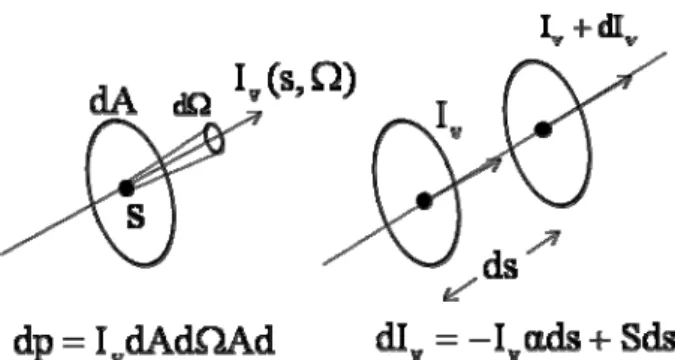
SSM/I measured radiance emitted from the object of interest, which can be used to derive the brightness temperature based on radiative transfer theory. I v

represents the intensity of radiation field, energy propagating through the medium of each point, per unit area, frequency, and solid angle of energy, as shown in Fig. 1 in terms of received radiation in differential equation.

Fig. 1. Radiance transmission schematic diagram (Wang et al., 2000)

In addition to showing that a distance S loss of part of

energy, it points out the contribution of a source volume,

and adds up the first and the second to a total. Then it

assumes that atmosphere of water vapor, cloud water,

rain occurred in the troposphere regions is

thermodynamic equilibrium. According to the principle

of Kirchhoff and ignore the scattering effect, replace it

with the dissipation coefficient of absorption. Next is the

original equation.

(3)

I κ S dS

dI

e v

v = − + (1)

where S = source function

κ e = dissipation factor

Function S can be expressed as (2)

( ) T

B κ

S = a v (2)

where B v (T) = Planck function κ a = absorption coefficient

By solving (1), it usually gets to the radiation transfer (3), used on microwave remote sensing.

( ) ν T e ( ) T ( ) s e ( ) κ ds

T b = b 0 τ s

0

∫ 0 s

0

τ s a

(3)

where T b = brightness temperature

T b0 = Cosmic background temperature 2.7K

The contributions of cosmic background radiation after the atmospheric attenuation is shown, plus the c o n t r i b u t i o n s a l o n g p a t h f r o m 0 t o S 0 . B y calculating T b one can show the range of sea ice.

2.2 ANALYSIS METHOD

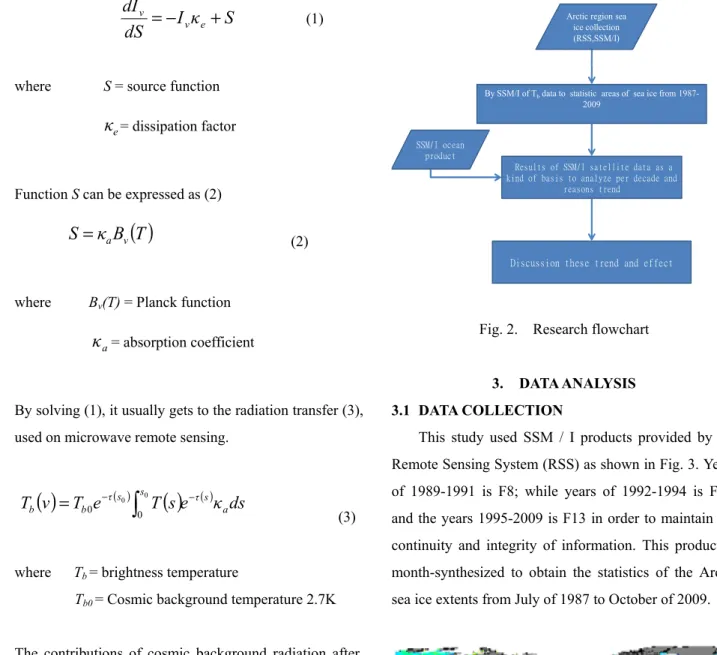
The research process is shown in Fig. 2, which is the collection of the 1989 - 2008 ocean product of SSM/I satellite data that analyzed the Arctic Sea ice variations of extent. It is a per ten-year investigation with the discussion about trends and impacts on subjects of the melting and increasing dilemmas.

By SSM/I of T

b

data to statistic areas of sea ice from 1987- 2009

Discussion these trend and effect Arctic region sea

ice collection (RSS,SSM/I)

SSM/I ocean product

Results of SSM/I satellite data as a kind of basis to analyze per decade and

reasons trend

Fig. 2. Research flowchart

3. DATA ANALYSIS 3.1 DATA COLLECTION

This study used SSM / I products provided by the Remote Sensing System (RSS) as shown in Fig. 3. Years of 1989-1991 is F8; while years of 1992-1994 is F10, and the years 1995-2009 is F13 in order to maintain the continuity and integrity of information. This product is month-synthesized to obtain the statistics of the Arctic sea ice extents from July of 1987 to October of 2009.

Fig. 3. Arctic sea ice area

where 0 to 255=valid geophysical data 251=missing wind speed due to rain 252=sea ice

253=SSM/I observation exist,but bad 254=no SSM/I observations

255=land mass

(4)

3.2 DATA ANALYSIS

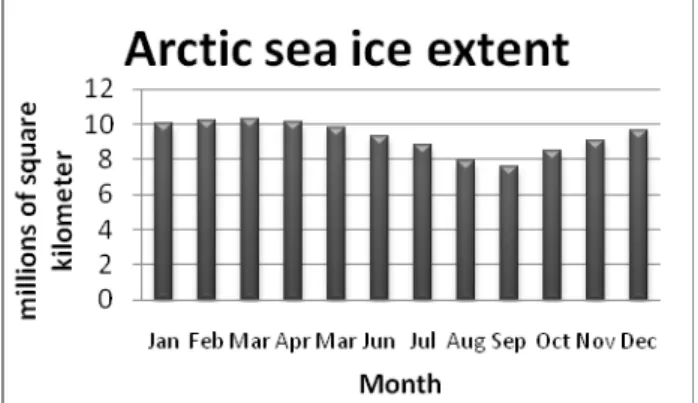
This research needs to define a standard to analyze the data. First is the way to determine whether the scope of surface is selected as the sea ice. Usually the melting point of ice is 273.15K. Because sea ice is saline, it freezes at a temperature that is less than 273.15 K (the freezing point of fresh water). Therefore 271.5 K is set as the cutoff temperature between water and ice. When SSM/I brightness temperature calculation is equal to this value, it is set as the sea ice. Adds up the area of all months from 1989-2008 as shown in Fig. 4, the trend of sea ice extent is the lowest in September and the highest in March. The Arctic is divided into hot and cold seasons, with the cold season from January to March, October to December, while the hot season from April to September.

Fig. 4. Sum of Arctic sea ice areas in months

Data collected for the past 20 years are analyzed to examine whether extent of Arctic sea ice is at a decreasing trend associated with melting, due the impact of global warming. The method is based on statistics of the total area of every 10-year, compare to the previous 10-year and hinder 10-year and the extent of changes reduced by approximately 2.5%. Fig. 5 shows the changes in the trend that the hinder sea ice extent is lower than the previous ones. Therefore, there is indeed an impact of climate warming on the Arctic sea ice.

In addition, the comparison between cold and hot seasons in the 20-year period states the melting and

increasing of sea ice. In Fig. 6 and Fig. 7, the trend of hot and cold season is broadly consistent with changes in the curve. In the cold season comparison 1999-2008 is 2.7%

less than that of 1989-1998, whereas it is about 3.4%

lesser in the hot season comparison. Thus, it is to infer the phenomenon of climate warming on the Arctic in the hot season would be, in fact, exacerbated the impact on the melting of ice.

Fig. 5. Comparison between 1989-1998 and 1999-2008 trend

Fig. 6. Comparison between 1989-1998 and 1999-2008 trend of cold season

Fig. 7. Comparison between 1989-1998 and 1999-2008

trend of hot season

(5)

4. CONCLUSIONS

This research point of view is that the extent of Arctic sea ice declines every year. Although a slight recovery after the year 2008, the overall downward trend is the same. The extent trend of change is more gentle in previous 10-year of cold season, but a big variations in the hinder 10-year, which represents dramatic changes in Arctic climate. The hot season extent of hinder 10-yaer is less than the previous ones. This leads to the ability to understand the time of the ice in the hot season albedo feedback mechanism (Polyakov et al., 2004) is more intense; and causing more area of melting that of the cold season.

5. REFERENCES

K. Y. Vinnikov, A. Robock, R. J. Stouffer, J. E. Walsh, C. L. Parkinson,D. J. Cavalieri, J. F. B. Mitchell, D.

Garrett, and V. F. Zakharov, “Global warming and Northern Hemisphere sea ice extent,” Science, vol.

286.pp.1934-1937, 1999.

C. L. Parkinson and D. J. Cavalieri, “A 21 year record of Arctic sea-ice extents and their regional, seasonal and monthly variability and trends,” Ann. Glaciol., vol. 34, pp.441-446, 2002.

J. A. Screen and I. Simmonds, “The central role of diminishing sea ice in recent Arctic temperature amplification,” Nature, Vol. 464, pp.1334-1337, 2010.

H. J.Zwally, J.C. Comiso, C. L. Parkinson,W. J.

Campbell, F. D. Carsey,and P. Gloersen, “Antarctic sea ice, 1973–1976: Satellite passive-microwave observations,” GPO, Washington, DC, NASA SP-459, 1983.

J. C. Comiso, “Satellite-observed variability and trend in sea-ice extent,surface temperature, albedo and clouds in the Arctic,” Ann. Glaciol., vol.33, pp. 457–473, 2001.

J.-S. Chang, 2010. Xinhuanews: Arctic sea ice melting faster over expected. Retrieved September 3, 2010, from the World Wide Web:

http://news.sciencenet.cn/htmlnews/2010/8/236270.shtm

6. ACKNOWLEDGEMENTS

The authors would like to thank the Remote Sensing

Systems and National Aeronautics and Space

Administration for providing research data to make this

study completed.

수치

Fig. 1.    Radiance transmission schematic diagram  (Wang et al., 2000)
Fig. 3. Arctic sea ice area
Fig. 5.   Comparison between 1989-1998 and 1999-2008  trend

참조

관련 문서

2재화 2요소 헥셔-올린 모형에서는 어느 한 경제에서 어느 한 요소의 양이 증가하면, 그 요소를 집약적으로 사용하는 산업의 생산량은 증가하고 다른

Ross: As my lawfully wedded wife, in sickness and in health, until

다양한 번역 작품과 번역에 관한 책을 읽는 것은 단순히 다른 시대와 언어, 문화의 교류를 넘어 지구촌이 서로 이해하고 하나가

The index is calculated with the latest 5-year auction data of 400 selected Classic, Modern, and Contemporary Chinese painting artists from major auction houses..

“Climate Change Could Mean More Terrorism in the Future”, UNODC, https://www.unodc.org/nigeria/en/climate-change-could-mean-more-terrorism-in-the-future.html (ac-

A frame size error in a frame that could alter the state of the entire connection MUST be treated as a connection error (Section 5.4.1); this includes any frame carrying a

remarks at Prosecuting Attorneys Association of Michigan annual conference, Michigan Alliance Against Hate Crimes training, Michigan Human Trafficking conference, Kentwood

1 John Owen, Justification by Faith Alone, in The Works of John Owen, ed. John Bolt, trans. Scott Clark, "Do This and Live: Christ's Active Obedience as the