Using Mobile Phones in EFL Classes
1)Tae-Soo Sung*, Kab-Yong Park**, Chi-Woon Joo***
Abstract
This article is to investigate the possibility that project-based classes introducing mobile phones can replace the monotony of traditional classes led by teachers as well as they can encourage students to take active part in the classes to some extent. The students in groups choose a genre for their own video projects (e.g., movie, drama, news, documentary, and commercial) and produce the video contents using a mobile phone for presentation made at the end of a semester. In the sense that the students are allowed to do video-based mobile phone projects, they can work independently outside of class, where time and space are more flexible and students are free from the anxiety of speaking or acting in front of an audience. A mobile phone project consists of around five stages done both in and outside of the classroom. All of these stages can be graded independently, including genre selection, drafting of scripts, peer review and revision, rehearsals, and presentation of the video. Feedback is given to students. After the presentation, students filled out a survey questionnaire sheet devised to analyze students’ responses toward preferences and level of difficulty of the project activity. Finally, proposals are made for introduction of a better mobile phone-based project classes.
▸Keyword: Intensive courses, Regular courses, e-learning
I. Introduction
Teachers of English as a foreign language (EFL) who want to develop successful lessons face numerous challenges, including large class sizes and inadequate instructional materials and technological support. Another problem is unmotivated students who refuse to participate in class activities. According to Harmer (2007), uncooperative and unmotivated students are a serious problem and can easily disrupt the instructional process.
Often, routine activities structured around whole class lectures and drills can contribute to the lack of motivation, especially when the students are children or adolescents. As many teachers know, project-based tasks alleviate this problem by allowing students to use their
imagination and creativity and actively express themselves in a variety of interesting and enjoyable tasks.
A project-based task focused on students’ interests also helps transfer the limited facilities of the classroom setting to the real word, where students are freer to use individual learning styles and make personal choices. This article discusses how teachers can have their students use mobile phone technology which is not typically considered an educational tool to produce video projects and thus boost their communicative use of English.
The purpose of this study is to reflect on and understand the position of mobile learning in project-based English classes. In order to realize this
∙First Author: Tae-Soo Sung, Corresponding Author: Chi-Woon Joo
*Tae-Soo Sung ([email protected]), Dept. of English, Nam Seoul University
**Kab-Yong Park ([email protected]), Dept. of English, Nam Seoul University
***Chi-Woon Joo ([email protected]), Dept. of Hotel Management, Inha Technical College
∙Received: 2017. 03. 07, Revised: 2017. 04. 12, Accepted: 2017. 06. 20.
objective, the following paper has been organized as follows: after a brief introduction, the next section deals with a review of previous literature followed by a section on the methodology of the paper. Next, the results and findings of the study are presented and finally the concluding remarks will be given.
II. The importance of communicative competence
An analysis of English language teaching (ELT) methodology reveals that achieving communicative competence in a second language involves not only knowing the grammatical rules of a language but also knowing when, where, and with whom to use the language in a contextually appropriate way (Ellis 1994; Hymes 1971; Richards 1985). This requires more than mere knowledge of English grammar and vocabulary; it requires skill in how to use English in communicative situations.
For example, a person with communicative competence will know how to do things in English such as making a purchase, asking for directions, persuading someone, and expressing personal feelings and will also know how to manage formal (speaking to an elder) and informal (speaking to a peer) language styles. According to Brown (1994), communicative language teaching (CLT) allows learners to practice English as it is actually used in a speech community and equips them with the language skills they will need when they leave the classroom for the real world. As teachers search for solutions to large class sizes and unmotivated students, they should consider projects that match the principles of CLT. In contrast to teaching a structural syllabus with a preponderance of grammar and vocabulary drills, project work lets students collaborate on tasks that demand authentic, relevant, and real-life communicative interactions. In turn, this type of authentic communication helps students to acquire communicative competence in a second language, much as a person learns his or her first language (Richards and Rodgers 2001).
2.1. Barriers to communicative tasks
The principles of CLT are not always easy to put into practice. For instance, large class sizes tend to favor
receptive activities involving reading and listening because they are less demanding and time-consuming for the teacher than productive activities involving speaking and writing in pairs or groups. The result is teacher-centered instruction that does not provide students with critical unrehearsed language practice and individual attention. The combination of grammar-based instruction, limited oral interaction of students in class, and inadequate opportunities to speak English outside of class with foreigners or to travel abroad does not support the development of communicative competence. Another barrier to CLT is the fact that students may feel too shy or embarrassed to speak in class or perform in front of an audience, especially in English. This type of performance anxiety, and other feelings students have in the language learning process, have long been an important consideration in ELT (Dörnyei 2005; Harmer 2007; Krashen 1982). To make matters worse, students’
reluctance to engage in communicative activities may be exacerbated by cultural differences. Since the communicative approach is of Western origin, it is best suited for the interactive classrooms of Western cultures, where communicative activities are more common (Harmer 2001). In cultures where the teacher-centered classroom is still the norm, learners may not respond willingly to communicative activities (Richards 1985).
Teachers will surely be disappointed if they expect CLT to be easy in a country like Turkey, where it is a virtue for students to listen to older people and not to speak before asked as a sign of respect.
2.2. Producing drama activities with mobile phones To overcome barriers, teachers must be creative in seeking methods to make their classrooms more communicative. One method I use is to take advantage of students’ interest in the latest mobile phone technology by designing a project-based video task. This task, which combines drama, technology, and CLT, motivates students because they enjoy recording with their mobile phones, and when they do so in a group they receive approval, cooperation, and support from their peers, which is an important factor in their adolescent psychology (Harmer 2001; Senemoğlu 2005). There is agreement in ELT literature about the motivating effect of dramatization (Arditto 2006; Gill 1996; Hyacinth 1990; Miccoli 2003). It breaks the monotony of traditional class teaching and is enjoyable and stimulating. A drama project is an excellent
way to get students to use different communicative functions in English, including description, narration, identification, debate, and decision-making (Millrood 2001). Drama also integrates the four language skills, as students must write English scripts, engage in peer correction, and design and produce the video in English.
In addition to fulfilling the objectives of CLT, developing and recording a dramatic performance with a mobile phone can also address problems such as large class sizes, bad behavior, and performance anxiety.
As noted above, anxiety interferes with second language acquisition (Krashen 1982). Project-based learning overcomes students’ anxiety about class participation because it deals with interesting, real-world topics. Nevertheless, drama and role play may still cause embarrassment, and not every learner finds it easy to perform in front of an audience, especially in a second language. One way to gradually make shy students more assertive and participatory is to not require them to stand up and act in front of the whole class. With a mobile phone project, hesitant and uncommunicative students have the option of creating their film in a non-threatening home or neighborhood environment where they feel comfortable. With this experience and the help of rehearsals, students can get accustomed to speaking or acting in front of an audience. Those students who are still embarrassed to be in front of the camera can take more responsibility for writing the scripts and dialogues and gradually take on minor roles until they feel more comfortable. Another way a mobile phone drama project reduces anxiety is by offering numerous choices for students with different interests and abilities. Several research studies examine the interaction between language learning and individual differences (Armstrong 2000; Dörnyei 2005; Ellis 1994; Harmer 2007; Robinson 2002). Instructors must create suitable settings and appropriate methods and materials to fit the different cognitive or affective needs of students, and this is a strong rationale for considering individual differences in aptitude, attitude, motivation, and learning styles. For example, while an extroverted student might participate enthusiastically in group work and play the leading role in a film, an introverted student might perform best by working independently at home using toys or puppets for the roles, rather than appearing personally in the film.
III. Ideas for mobile phone video projects
Students can consider a wide range of topics to produce a drama project with their mobile phones. To begin, they can get ideas from many popular programs on television, including talk shows, game shows, news specials, and parodies. Following are four ideas for projects that can be expanded or reduced to adapt to the requirements of semester length, class size, language level, and age group.
Project 1: movie and drama
To make a short film, students will have to decide whether to base it on fact or fiction. After composing a script for the different scenes, assigning roles, and rehearsing their parts, they record the performance. Since this category offers students a large spectrum of genre options, such as drama, action, horror, and comedy, it is highly likely that they will find something of interest.
Project 2. news and documentary
A documentary offers numerous topic choices suitable to different age groups. Students can plan out how they are going to narrate and record details about something of real-life interest, such as their family life, their neighborhood, their pet, their school, or their friends.
Project 3. commercials
Students can make a commercial by adapting an idea from an existing commercial or by making up one of their own. In the commercial they persuade the audience to buy something such as a new beverage they have invented by talking about the selling points and advantages of the drink. They write the text in English, rehearse it, and then act out the commercial while filming the production with a mobile phone.
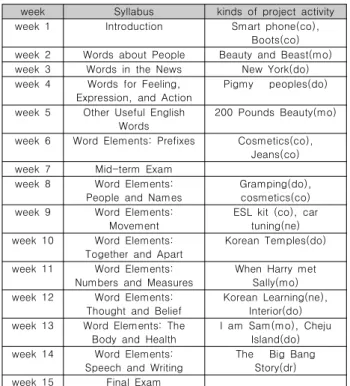
English classes were aimed at improving the learner's four language skills and students were required to first create a script to develop a variety of skills such as grammar, writing, reading, and pronunciation, This class takes three hours a week, of which the textbook is The World of Words (Richek, 2000). The second-class is arranged for presentation, and the third class includes preparation of qualification test such as TOEIC. The syllabus of this class is as follows.
week Syllabus kinds of project activity week 1 Introduction Smart phone(co),
Boots(co) week 2 Words about People Beauty and Beast(mo) week 3 Words in the News New York(do) week 4 Words for Feeling,
Expression, and Action
Pigmy peoples(do)
week 5 Other Useful English Words
200 Pounds Beauty(mo)
week 6 Word Elements: Prefixes Cosmetics(co), Jeans(co) week 7 Mid-term Exam
week 8 Word Elements:
People and Names
Gramping(do), cosmetics(co) week 9 Word Elements:
Movement
ESL kit (co), car tuning(ne) week 10 Word Elements:
Together and Apart
Korean Temples(do)
week 11 Word Elements:
Numbers and Measures
When Harry met Sally(mo) week 12 Word Elements:
Thought and Belief
Korean Learning(ne), Interior(do) week 13 Word Elements: The
Body and Health
I am Sam(mo), Cheju Island(do) week 14 Word Elements:
Speech and Writing
The Big Bang Story(dr) week 15 Final Exam
co(commercial);do(documentary); ne(news); mo(movie);
dr(drama) Table 1. Syllabus
1. Research subjects
The subjects of this study consisted of 40 learners who took Practical English classes, all of whom are 2nd grade in the English Department. At the beginning of the semester, the class is announced as a project-based class using mobile phones and students are divided into nineteen teams. Each team consists of two or three people. There are 12 students (4groups: 5 students / 3 students / 2 students / 2 students) in the film / drama production. 16 students (8 groups: 2 students / 2 students / 2 students / 2 students / 2 students / 2 students / 2 students / 2 students) take part in news/ documentary production. 12 students (5 groups: 6 students / 2 students / 2 students / 2 students/ 2 students) participate in commercial production.
Students who responded to the questionnaire at the beginning of the survey showed 60% confidence in conversation, 67% in listening, 79% in reading, and 63%
in vocabulary showed confidence that they were above intermediate. According to the analysis of the need for conversational skills, about 4% of students responded that they could express their own opinions using words or phrases rather than sentences, and 70% were able to fully convey their opinions on subjects related to familiar situations And the remaining 18% were able to communicate, and only the remaining 8% could
communicate in most of the given situations. According to the analysis of needs related to reading and vocabulary, 78% of the students answered that there is not much difficulty in translating and understanding the fingerprints if only the dictionary is available. 6% of the students said that most of the words are dependent on the dictionary and that even after finding the meaning of individual words in the dictionary, they have difficulty understanding the contents of the newspaper or magazine.
2. Data Collection and Analysis
We surveyed students who participated in one semester class, and examined the improvement in conversation / writing, listening, reading, and pronunciation according to the type of project they participated in. Improvement assessment means that students improve their self-confidence after completing their own one semester class. The results of this study are as follows. All of these steps must be evaluated independently, and drafting, editing, rehearsal, etc., belong to this independent phase. Evaluation and feedback on the final result can be made using the following evaluation table. The evaluation table of <Table 2> is evaluated as four out of four based on the four criteria, and the sum of the four items is evaluated from four points to sixteen.
criterion Excellent(4) Good(3) not bad(2) bad(1) Script quality
acting ability perfection participation
Table 2. Assessment of video projects
In addition to providing meaningful and real-world language experience, Skehan (1998) lists two other important elements of project-based tasks: (1) students work towards a goal, and (2) the activity is evaluated by its outcome. A mobile phone project consists of several stages done both in and outside of class. All of these stages can be graded independently, including the drafting of scripts, peer review and revision, and rehearsals of the film. To give feedback and evaluation of the final outcome, teachers and students can use a video assessment instrument like the rubric in Table 1, which lists six criteria and allows for a maximum score of 16 points.
A mobile phone drama project can also be assessed through the Internet by uploading the videos to a website,
preferably an official site under Ministry of Education, and having students, teachers, parents, and academicians evaluate and rank them. Then, at the end of the school year, the best works for each drama category can be selected and given awards by the Ministry of Education.
Some of the drama productions may also compete in national or international competitions. With a video project, students produce something tangible that they can keep in their portfolios or personal albums to show their parents, friends, or perhaps their grandchildren.
Moreover, students will see themselves actually speaking English. All of these factors will come together to give them a sense of accomplishment.
IV. Findings
This study analyzes the survey results of how much, after the group presentations and footage of the term project assignments are submitted, they get students interested in the class and how the class content project classes has influence on the confidence of the learners.
And it also examines the results of the project of whether it affects the outcome of language practice activities, such as TOEIC.
The following <Table 3> represents the students' responses to the challenges after the end of the project classes. And 92.5% of the students, in relation to the course content and their class activities, show their interest to more than average, and, moreover, a positive reaction is 7.5% higher than the reaction of 'average'.
This shows that students themselves have a greater interest in voluntary and creative classroom activities compared to the traditional teacher - centered instruction.
Preference movie/
drama
news/
documentary
commercial frequency
Exciting 7 5 8 20
(50%) Nothing
Special
4 9 4 17
(42.5%) Not
Exciting
1 2 0 3
(7.5%)
Total 12
(30%)
16 (40%)
12 (30%)
40 (100%) χ²(4,40)=4.5891, p=0.332
Table 3. Students’preference for project activity
With regard to project, the chi squared test was
performed to investigate whether there are preferential differences among movies, news, and advertisement.
However, the difference between the three types did not appear significantly (p = 0.332), which means that a certain preferential selection did not arise based on each project. In other words, students were said to show a similar preference among the chosen topics. <Table 4>,
<Table 5>, <Table 6>, and <Table 7> are the reactions in which students showed to what extent improvement of the linguistic four skills and mobile project assignments are correlated.
preference movie/
drama
news/
documentary
commercial frequency
difficult 6 10 8 24(60%)
usual 6 4 4 14(35%)
easy 0 2 0 2(5%)
total 12(30%) 16(40%) 12(30%) 40
(100%) χ²(4,40)=4.5437,, p=0.337
Table 4. Project-based preference for writing ability
<Table 4> reflects the effort that the students made in the course of collecting and analyzing data in order to make the script of the video productions and in the process of writing English script in the end. To determine the content and to make them consistent with the themes required for group activities obliged students to have difficulties in reading a variety of materials and completing English scripts tailored for their content types.
95% of students responded 'hard' and 'average' and only 5%, 'easy'. This means that students are not still exposed to the project classes than anticipated. Like <Table 3>
showed, the chi-squared test results did not appear discriminatory, depending on whether the reaction results of each project are 'easy' or 'difficult' (p = 0.337).
Preference movie/
drama
news/
documentary
commercial frequency
difficult 0 1 2 4 (10%)
usual 3 5 1 9 (22.5%)
easy 9 10 9 27
(67.5%)
total 12
(30%)
16 (40%)
12 (30%)
40 (100%) χ²(4,40)=1.7143, p=0.7881
Table 5. Project-based preference for reading ability
The results of <Table 4> contrasted with those of
<Table 5>, which shows that students did not have great hardships reading and understanding the various data before completing the script. 70 percent of the students
replying 'easy' shows a big contrast to 5% replying 'easy' demonstrated in <Table 4>. As above, the chi-squared test did not show a difference between the project selections and preferences (p = 0.387).
Preference movie/
drama
news/
documentary
commercial frequency
difficult 0 0 1 1 (0.25%)
usual 8 8 7 23
(57.5%)
easy 4 8 4 16 (40%)
total 12
(30%)
16 (40%)
12 (30%)
40 (100%) χ²(4,40)=3.3333, p=0.503
Table 6. Project-based preference for speaking / pronunciation ability
<Table 6> with respect to English pronunciation appeared similar to <Table 5> regarding reading ability, in that both showed a similar percentage response about 'easy' and 'difficult'. In both tables, 'easy' is 0.25% and 'difficult' is 40%, respectively. 57.5% responded 'usual' and this figure showed that students had a bit of difficulty with English pronunciation, regardless of English writing and English reading skills. Students complained of difficulties with stress, pace, and clarity in pronouncing English words and sentence, when they conveyed the contents from movies, dramas, documentaries and news.
For commercials, however, many respondents, as a whole, responded 'usual'. It did not show a statistically significant difference in the preference selection based on project type (p = 0.503).
preference movie/
drama
news/
documentary
commercial frequency
difficult 4 5 2 11
(27.5%)
usual 5 8 8 21
(52.5%)
easy 3 3 2 8 (20%)
total 12
(30%)
16 (40%)
12 (30%)
40 (100%) χ²(4,40)=1.7176, p=0.787
Table 7. Project-based preference for listening ability
<Table 7> shows that students feel to which degree their listening skill develops according to each type of project tasks. 80% percent of the students said that they had more-than-average difficulty collecting data and listening to the project content. It is estimated that this difficulty arose from the indication that they were to submit a complete and accurate caption of reference materials during the project preparation. As preferential
differences shown in other linguistic skills, their preferences for listening appeared to be similar in all the project types (p = 0.787).
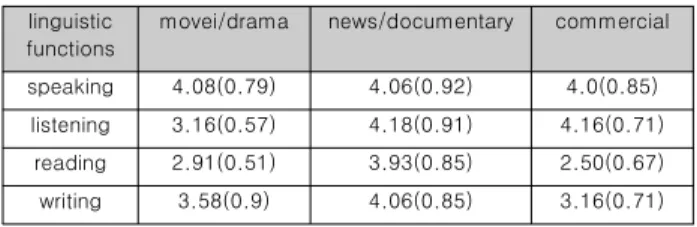
<Table 8> exhibits the students' reponses about the question of how much influence the project tasks (movies / dramas, news, documentaries, and commercials) that they had selected had on the students' improvement of speaking, listening, reading, and writing. If they feel that there is no improvement at all, they are asked to mark 'point zero' and if they are sure of a significant improvement, they are expected to mark 'point 5'. On the basis of their preferences, the standard deviation and the average were presented.
linguistic functions
movei/drama news/documentary commercial
speaking 4.08(0.79) 4.06(0.92) 4.0(0.85) listening 3.16(0.57) 4.18(0.91) 4.16(0.71) reading 2.91(0.51) 3.93(0.85) 2.50(0.67) writing 3.58(0.9) 4.06(0.85) 3.16(0.71) Table 8. Improvement of language skills (Average/ SD)
After finishing the project tasks, the students were asked about an enhanced level of four linguistic skills.
For speaking skill enhancement, students generally gave high scores to all the project types - film 4.1 points, news / documentary 4.1 points, and commercials 4.0 points. For listen skill, they scored a relatively low mark of 3.8 points to movie / drama, but as high scores 4.2 and 4.2 to news / documentary and commercials, respectively, as those shown in speak skill. Asked about whether reading skill and writing skill were enhanced, they gave comparatively low marks. For reading skill, film was 2.9 points and commercial was 2.5 points, whereas news / documentary showed a high figure of 4.0 points. For writing skill, film was marked 3.6 points, and commercial was marked a relatively low score of 3.2, but news / documentary showed a relatively high score of 4.1.
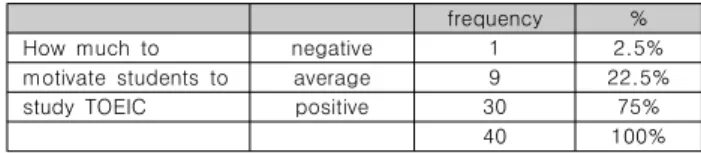
Following the second class session, the third class session dealt with TOEIC listening speaking, and reading exercises. The survey results of whether project tasks cause the interest induction in TOEIC said that 39 students (95.5%) gave a positive assessment above the average and only one student (2.5%) answered negatively. More Important, 30 learners (75%) responded positively, and more than the majority thought to be motivated by the project tasks.
frequency %
How much to negative 1 2.5%
motivate students to average 9 22.5%
study TOEIC positive 30 75%
40 100%
Table 9. Interest in Toeic test caused by project activities
The table below showed that significantly improved scores on the TOEIC scores were significantly improved after the project classes. Of course, do not see that improvements in students' TOEIC scores might not be entirely due to the project classes. This is because in addition to 'Practical English' course, English theoretic subjects as well as several practical English subjects.
Mean SD
Pre-test Score 398.38 154.158
Post-test score 494.50 174.767
Table 10. Score Difference between pre-test and post-test
In order to confirm tht the project classes affected improvement of TOEIC scores, a couple of TOEIC tests were taken as pre-test and post-test, respectively, before and after the semester. The average score of post-TOEIC test was 96.3 higher than that of pre-TOEIC test. At the significance level of 0.01 paired t test results showed statistically significant results (t (39) = 6.86, p <0.001).
V. Conclusion
The above data prove that the TOEIC scores of the intensive course students and the permanent course students were almost the same over the years, when the students took the pretest before each course started.
However, it is clear that the better results among the intensive course students were not coincident. The differences between the intensive courses and the permanent courses depend on how intensively the instructors manage their classes, using some more appropriate materials and applying the multi-level system which distributed the students to the tailored classes.
We believe in the benefits of intensive English programs. Indeed, the intensive programs are a good alternative for students who want to improve their English skills, especially in Korea where students are not provided with many opportunities to practice the language. However, many intensive English programs do
not include all the skills (reading, listening, speaking, and writing) in their syllabus. Still, we should consider intensive English programs as a great alternative for students to improve their English skills because they get more classes of English per cycle and because students are more motivated to use only English in these classes.
Intensive English programs should be more promoted since there is a need for improving student's level of English. When students participate in intensive programs to improve their English, they receive authentic and constant input. In consequence, they absorb the new material since they have to frequently reinvest and reuse it. Moreover, the possibility to improve their skills is increased considering the fact that students are constantly working and manipulating the language. They also can have a positive experience from the intensive program because of the fact that they are getting more comfortable with the language and that they are more aware of their progress in English.
REFERENCES
[1] Arditto, N. 2006. “Educational conference: Using drama in the EFL classroom.” London: British Council.
ww.britishcouncil.org/elt-conference-06-paper-using_
drama-nelsonarditto.doc.
[2] Armstrong T. 2000. Multiple intelligences in the classroom. 2nd ed. Alexandria, VA: Association for Supervision and Curriculum Development.
[3] Brown, H. D. 1994. Principles of language learning and teaching. 3rd ed. Englewood Cliffs, NJ: Prentice Hall.
[4] Dörnyei, Z. 2005. The psychology of the language learner: Individual differences in second language acquisition. Mahwah, NJ: Lawrence Erlbaum.
[5] Ellis, R. 1994. The study of second language acquisi - tion. Oxford: Oxford University Press.
[6] Gill, C. S. 1996. “Using drama techniques to encourage oral interaction,” The English Teacher 25 (October): 72 –86. www.melta.org.my/ ET/1996/main6.html.
[7] Harmer, J. 2001. The practice of English language teaching. 3rd ed. Harlow, England: Longman.
[8] Hyacinth, G. 1990. “Using drama techniques in language teaching,” Washington, DC: Education Resources Information Center. ERIC Database ED366197.
[9] Hymes, D. H. 1971. On communicative competence.
Philadelphia: University of Pennsylvania Press.
[10] Krashen, S. D. 1982. Principles and practice in second language acquisition. Oxford: Pergamon.
[11] Miccoli, L. 2003. “English through drama for oral skills development.” ELT Journal 57 (2): 122–29.
[12] Millrood, R. 2001. Modular course in ELT methodology.
Moscow: Drofa.
[13] Richards, J. 1985. “Conversational competence through role play activities.” RELC Journal l6 (1): 82–100.
[14] Robinson, P. 2002, ed. Individual differences and instructed language learning. Amsterdam: John Benjamins.
[15] Royka, J. G. 2002. “Overcoming the fear of using drama in English language teaching.” Internet TESL Journal 8 (6). http://iteslj.org/Articles/ Royka-Drama.html.
[16] Senemoğlu, N. 2005. Development and learning.
Ankara, Turkey: Gaza Kitapevi.
[17] Skehan. 1998. “Task-based instruction.” Annual review of applied linguistics 18: 268–86.
[18] Sung, Tae-Soo, “On Intensive E-learning Toeic Course,” Journal of the Korea Society of Computer and Information. Vol.18, No. 12, pp. 217-223, Dec.
2013.
Authors
Tae-Soo Sung received the B.A., M.A., and Ph.D. degrees in English Linguistics and Literature from Hankuk University of Foreign Studies, Korea, in 1985, 1989, and 1995, respectively. Dr. Sung joined the faculty of the Department of English at Namseoul University, Cheonan, Korea. He is currently a Professor in the Department of English, Nam Seoul University. He is interested in syntax, english education, mobile teaching/learning and semantics.
Kabyong Park received his B.A. degree in English from Hankuk University of Foreign Studies in 1984, and M.A. and Ph.D. degrees in Linguistics from University of North Carolina at Chapel Hill, in 1986 and 1992, respectively.
Dr. Park joined the faculty of Department of English at Nam Seoul University located in Cheonan, Korea, in 1994. He is currently a Professor in the Department of Global Studies at Namseoul University. He is interested in morphology, syntax, mobile teaching/learning, english education and translation.
Chi-Woon Joo received the B.A., M.A., and Ph.D. degrees in English Linguistics and literature from Hankuk University of Foreign Studies, Korea, in 1988, 1990, 2001, respectively. Dr. Joo originally joined the faculty of the Department of Tourism at Inha Technical College in 2002. He is currently a Professor in the Department of Hotel Management, Inha Technical College. His research interests include syntax, english education, mobile teaching/learning and semantics.