단 보
울릉도 항구의 해양환경에 따른 해양미생물의 분포 변화
강용호* ・ 안민경 영남대학교 생명공학부
Phylogenetic diversity of marine bacteria dependent on the port environment around the Ulleng Island
Yongho Khang* and Minkyung Ahn
School of Biotechnology, Yeungnam University, Gyeongsan 712-749, Republic of Korea
(Received August 25, 2015; Accepted September 24, 2015)
ABSTRACT: Pyrosequencing of 16S rDNA tags was used to obtain the bacterial diversity and community structure in the uncultured seawaters as well as in the cultured seawaters, which were collected from the 7 ports (Cheonbu, Hyunpo, Taeha, Namyang, Sadong, Dodong, and Jeodong) and 1 seashore (Guam) around the Ulleng island, Korea.
Alphaproteobacteria were the most abundant group in the clean seawaters such as seawaters of Taeha and Sadong ports.
Gammaproteobacteria proportion increased depending upon the wastewater amounts mixed with the seawaters such as seawaters of Namyang, Dodong, and Jeodong ports. The genuses of Alteromonas (from samples of Cheonbu, Taeha, Guam, Namyang, Sadong), Shewanella (from sample of Jeodong), and Vibrio (from samples of Hyunpo and Dodong) were dominant group in each of the cultured seawaters incubated in marine broth (Difoco). The results suggest that the incoming wastewaters to the port seawaters contribute to the dynamic change of the marine bacterial community around the Ulleng island.
Key words: bacterial community, port seawaters, pyrosequencing, Ulleng island, wastewater
*For correspondence. E-mail: [email protected];
Tel.: +82-53-810-3051; Fax: +82-53-810-4663
울릉도는 경상북도 포항에서 217 km 떨어져 있으며 동해의 깊은 바다 한가운데에 위치한 고립된 섬이며 자연경관이 수려 하여 주요 관광지로 개발되고 있다. 울릉도에는 약 일만 명 정 도의 주민들이 73 km2 면적에서 살고 있으며, 섬 주변의 해안 에는 어선들이 이용하는 지방어항(천부항, 태하항)과 국가어 항(현포항, 남양항, 사동항, 저동항), 그리고 관광객들이 이용 하는 페리항(도동항)이 개발되어 있다. 울릉도로 가는 교통 수 단이 편리해지고 독도에 대한 국민적인 관심이 고조되면서 매 년 수많은 관광객들이 울릉도를 방문하고 있다. 울릉도를 찾 는 관광객 수가 증가하면 생활쓰레기나 생활하수 등으로 울릉 도의 청정한 해안이 오염될 가능성이 높기 때문에 해양환경 관리를 위한 특별한 노력이 필요하다.
육지 근해의 해수 오염은 바다로 방출되는 생활하수나 산 업폐수(Chandía and Salamanca, 2012; Araújo et al., 2014;
Khang, 2014), 농축산업의 부산물로 발생하는 바이오매스 (Lambert et al., 2009), 원유 성분인 polycyclic aromatic hydro- carbons (Montevecchi et al., 2012; Sinaei and Mashinchian, 2014), 플라스틱류를 포함하는 생활쓰레기(Van Cauwenberghe et al., 2013; Cózar et al., 2014), 어선들이 버린 폐그물(Arthur et al., 2014) 등이 원인이 되고 있다. 해수로 유입된 환경오염 물 질들은 미생물에 의해서 분해되지만 청정한 바다에서 서식하 는 해양미생물은 육지의 토양미생물에 비하면 오염 물질을 정 화하는 능력이 크게 부족하다(Bengtsson-Palme et al., 2014).
항구에는 해안에 설치한 방파제 시설물로 인하여 생활하수나 하천수와 같은 환경 오염원들이 바다로 쉽게 유출되지 못하면 해수가 오염될 가능성이 더 높아진다(McQuaig et al., 2012;
Chae et al., 2014; Zhang et al., 2014). 육지의 생활하수나 하천 수가 해수로 유입되면 해수에서의 질소와 인의 농도가 증가하 여 미생물의 이상 증식을 유발하는 등 해양 생태계에 나쁜 영 향을 미친다(Von Glasow et al., 2013). 해수의 오염으로 인한
No Sample site Latitude Longitude 1
2 3 4 5 6 7 8
Cheonbu port (CB) Hyunpo port (HP) Taeha port (TH) Guam seawall (GA) Namyang port (NY) Sadong port (SD) Dodong port (DD) Jeodong port (JD)
37° 32' 25.8066"
37° 31' 35.5764"
37° 30' 45.9498"
37° 28' 37.1208"
37° 27' 58.3734"
37° 27' 38.8764"
37° 28' 54.5298"
37° 29' 37.8018"
130° 52' 21.1872"
130° 49' 31.8606"
130° 47' 49.5852"
130° 48' 31.917"
130° 50' 10.485"
130° 52' 37.257"
130° 54' 30.6534"
130° 54' 37.764"
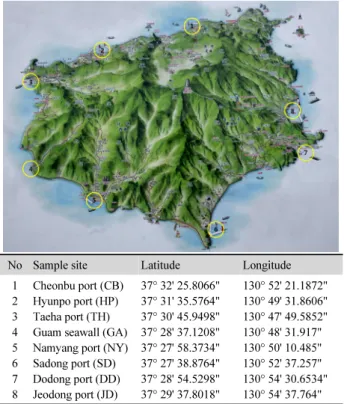
Fig. 1. Map and address of sample sites.
해양 생태계의 변화를 모니터링하기 위해서는 갈매기의 변이 나 해안에서 나타나는 분변지표 미생물의 밀도를 분석하거나 (Scott et al., 2002; Mika et al., 2007), 해저에서 채취한 조개류 (홍합, 굴, 고동, 대합, 조가비 등)의 소화기관에 축적된 As, Cd, Cu, Pb와 같은 중금속의 농도를 분석하거나(Guéguen et al., 2011; Sakellari et al., 2013; Suárez-Ulloa et al., 2013), 특정한 해역에서 해양미생물의 분포를 조사하는 방법(Edlund and Jansson, 2006; Klaus et al., 2007) 등이 활용되고 있다. 특히 해양 미생물은 해수의 온도, 염도, 용존산소, 영양물질, 오염물질의 농도 등에 민감하기 때문에 해양미생물의 분포를 조사하면 환경 변화에 따른 해양 생태계의 변화를 이해하는데 도움이 된다(Suh et al., 2015). 청정한 바다에서 서식하는 해양미생물은 대부분 Alphaproteobacteria, Gammaproteobacteria, Flavobacteria가 분 포하고 있으며(Han et al., 2014; Sjöstedt et al., 2014), 그 외 해 양환경에 따라 Actinobacteria, Betaproteobacteria, Cyano- bacteria, Deltaproteobacteria, Epsilonproteobacteria 등이 낮 은 분포율을 보이고 있다(Du et al., 2013; Jing et al., 2013;
Marietou and Bartlett, 2014; Signori et al., 2014; Tseng et al., 2015). 울릉도는 해안 주변이 깊은 바다이어서 연안의 해수는 대부분 청정하지만, 방파제 구조물이 있는 항구 안에는 생활 하수나 하천수의 유입으로 인하여 해수가 오염되고 있다. 본 연구는 울릉도에서 해수의 오염으로 인한 해양미생물의 생태 계 변화를 파악하기 위하여 항구의 표층수에서 서식하는 해양 미생물의 분포를 조사하였다.
울릉도의 해수시료는 여름철(2012년 7월 10일)에 해수의 오염도가 높을 곳으로 예상되는 페리항(도동항), 지방어항(천 부항, 태하항), 국가어항(현포항, 남양항, 사동항, 저동항) 및 구 암 방파제 해안의 표층해수를 각각 6.0 L씩 무균채수병(2 L*3, 메디랜드)에 담아서 실험실로 운반하여 냉장고(2°C)에 저장 하였다(Fig. 1). 시료로 채취한 해양표층수(4 L)는 Whatman paper 여과지로 고체 불순물을 제거한 다음, Ultrafiltration membrane (Cutoff=10,000 Da, Millipore)으로 해양미생물을 여과하고, 여과지에 모인 미생물 균체를 DNA Stool Minikit (QIAamp, Qiagen)을 사용하여 염색체 DNA를 추출하였다 (F1–F8). 또한 해수시료에 있는 해양미생물 중 실험실에서 배 양이 가능한 균주를 파악하기 위하여 해수 100 μl를 멸균한 Marine broth (Difco) 7 ml에 접종하고 27°C에서 24시간 배양 하였다. Marine broth에서 배양한 미생물들은 각각 원심분리 (4,000 rpm, 30분)로 회수한 다음, 같은 방법으로 DNA Stool Minikit (QIAamp, Qiagen)을 이용하여 염색체 DNA를 추출 하였다(C1–C8). 추출한 미생물의 genomic DNA는 16S rRNA 유전자 V1-V3 영역의 27F (5'-ATCGTACGACGAGTTTGA
TCMTGGCTCAG-3')와 518R (5'-ATCGTACGACWTTAC CGCGGCTGCTGG-3') universal primers (Suh et al., 2015)을 사용하여 Polymerase Chain Reaction (PCR)으로 16S rRNA 유전자를 증폭한 다음 454 pyrosequencing으로 염기서열을 분석하였다(Khang, 2014). PCR 산물의 pyrosequencing과 염 기서열 분석(taxonomic assignments, operational taxonomic unit, Shannon index, Simpson index)은 Macrogen(주)에서 제 공하였다. 측정한 종의 수(Operational Taxonomic Unit, OTU), 다양도지수(Shannon index), 우점도지수(Simpson index)는 각 염기서열의 97% 이상의 유사성(sequence similarity)을 기 반으로 조사하였다. 병원성 Vibrio균의 확인은 PCR Detection kit (iNtRON)로 조사하였다.
Ultramembrane filter로 여과한 해수시료(F1–F8)에서 추출 한 DNA로 분석한 세균의 16S rRNA 유전자 염기서열(평균 300 bp)은 4,822±2,433 reads (95% 신뢰구간)를 얻었고, 해수 를 marine broth로 배양한 시료(C1–C8)에서 추출한 DNA로 분석한 세균의 16S rRNA 유전자 염기서열(평균 380 bp)은 8,966±8,166 reads (95% 신뢰구간)를 얻었다.
울릉도는 섬 전체에 모두 7개의 항구가 개설되어 있다(Fig.
1). 각 항구의 해양 환경적인 특징들을 살펴보면, 북동쪽에 있 는 천부항(CB)은 방파제 시설이 수평선을 막고 있어서 ‘ㄷ’ 자 형의 닫힌 구조를 하고 있다. 현포항(HP)도 방파제 시설에 의
Fig. 2. Operational Taxonomic Unit (OTU) analysis of bacterial communities in surface seawaters (Error bars indicate 95% confidence levels).
(A) Uncultured samples
(B) Cultured samples
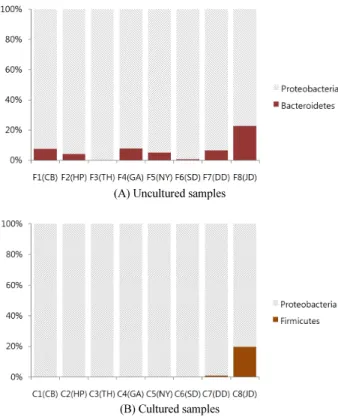
Fig. 3. Relative abundance of phylum (>1%) of total sequence tags in (A) uncultured samples and (B) cultured samples.
하여 닫힌 구조를 하고 있지만, 천부항과는 다르게 어선의 출 입로가 수평선 방향으로 열려있다. 울릉도 서쪽에 있는 태하 항(TH)은 ‘C’ 자형의 열린 구조로 수평선 방향에 방파제 구조 물이 아무것도 없어서 동해바다에 완전히 노출되었다. 따라서 태하항의 해수는 먼 동해바다의 해수와 같이 맑고 투명하여서 청정한 해수의 기준이 되는 음성 대조군으로 활용하였다. 구 암(GA) 해변은 전방에 방파제 구조물은 있으나 항구는 아니 며, 섬에서 흘러나오는 하천수가 바다의 해수와 만나는 지점 이다. 남양항(NY)은 수평선 방향으로 방파제 시설이 있어서
‘ㄷ’ 자 형태의 닫힌 구조를 하고 있으며, 항구 주변의 해안에 는 섬에서 나오는 하천수가 바다로 유입되고 있었다. 사동항 (SD)은 수평선 방향에 방파제 시설이 있는 닫힌 구조이긴 하 지만, 관광용 여객선 취항을 위하여 신축한 곳이어서 하천수 의 유입이 없는 청결한 항구이었다. 도동항(DD)은 천연적인 지형으로 인하여 수평선 방향에는 방파제 시설이 없어서 동해 바다에 노출된 항구이었다. 도동항은 관광객 수송을 위한 대 형 여객선이 출입하고 있어서 항구 주변에는 숙박업소가 밀집 되어 있으며, 섬에서 나오는 하천수가 항구로 유입되고 있었 다. 저동항(JD)은 울릉도에서 규모가 가장 큰 어항이어서 항 구내에 많은 어선들이 정박하고 있었으며, 주변 마을에서 나 오는 생활하수와 하천수가 항구로 유입되고 있었는데 수평선 방향으로 방파제 시설이 있는 닫힌 구조를 하고 있어서 항구 의 해수가 매우 혼탁하였다. 따라서 저동항의 해수는 생활하수 로 오염된 해수의 기준이 되는 양성 대조군으로 활용하였다.
울릉도에서 해수의 오염이 발생할 가능성이 높은 7곳의 항 구와 구암해변에서 채취한 해수를 조사한 결과, 해양미생물의 Operational Taxonomy Unit (OTU)이 60 이상으로 높게 나타 난 곳은 천부항, 도동항, 저동항이었다(Fig. 2). 천부항, 도동 항, 저동항에서는 다양도지수(Shannon index)도 2.0 이상으로
높아서 해수의 오염으로 다른 지역보다 다양한 미생물이 서식 하고 있다는 것을 시사하고 있다. 현포항과 태하항의 해수에 서는 다양도지수(Shannon index)는 1.5 이하로 낮고, 우점도 지수(Simpson index)는 0.5 이상으로 높아서 해수가 청정해서 소수의 미생물이 우점하고 있다는 것을 시사하고 있다. 해수 에서의 미생물 분포를 보면 Proteobacteria가 대부분이었으나 Bacteroidetes도 낮은 비율로 분포하고 있었다(Fig. 3). 생활하 수에서는 Bacteroidetes와 Firmicutes가 많이 검출된다는 점을 고려하면(Wang et al., 2014), Bacteroidetes 분포 비율이 22.6%
로 상당히 높게 나타난 저동항은 생활하수의 유입으로 인한 해수의 오염이 높은 수준에 속하고, 천부항(7.5%), 구암해변 (7.7%), 도동항(6.5%), 현포항(4.0%)과 남양항(5.0%)은 비교 적 낮은 수준이며, 태하항(0.0%)과 사동항(0.7%)은 해수의 오 염이 경미한 수준임을 시사한다. Marine broth에 채취한 해수 시료를 배양하니 Bacteroidetes는 사라지고, 대신 Firmicutes 가 저동항(19.6%)과 도동항(0.8%)에서 나타났다(Fig. 3).
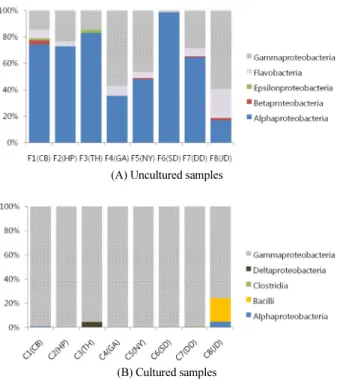
Proteobacteria 중에서는 Alphaproteobacteria와 Gamma- proteobacteria가 우점하고 있었으며, 지역에 따라서 Beta- proteobacteria와 Epsilonproteobacteria가 낮은 비율로 분포 하고 있었다(Fig. 4). Alphaproteobacteria는 유기물을 잘 분해 할 수 없으나(Joint et al., 2010), Gammaproteobacteria는 세포
(A) Uncultured samples
(B) Cultured samples
Fig. 4. Relative abundance of class (>1%) of total sequence tags in (A) uncultured samples and (B) cultured samples.
Table 1. Genus distribution (>1%) in cultured samples
Genus C1 (CB) C2 (HP) C3 (TH) C4 (GA) C5 (NY) C6 (SD) C7 (DD) C8 (JD)
Aestuariibacter 2.9%
Algicola 26.5%
Alteromonas 86.6% 92.7% 96.8% 63.8% 95.8%
Bacillus 19.7%
Balneatrix 1.5%
Enterobacter 1.0%
Geothermobacter 4.7%
Halomonas 1.0%
Marinobacter 5.3%
Melitea 1.4%
Nautella 3.1%
Nitrincola 1.1%
Oceanobacter 1.7%
Photobacterium 3.4%
Pseudomonas 1.2% 1.7%
Shewanella 1.6% 70.8%
Thalassobius 1.3%
Thalassolituus 4.6%
Vibrio 97.9% 95.5%
밖으로 amylases, proteases, lipases와 같은 효소를 분비하여 유기물을 잘 분해할 수 있다(Signori et al., 2014). 미생물의 이
런 특성으로 인해서 Alphaproteobacteria는 해수가 청정한 것 으로 나타난 태하항(82.0%)과 사동항(97.5%)에서 높게 나타 났고, Gammaproteobacteria는 하천수나 생활하수가 해수와 합쳐지는 구암해변(56.4%), 남양항(45.7%), 도동항(28.2%), 저동항(58.3%)에서 비교적 높게 나타났다(Fig. 4). 작은 분자 의 방향족 화합물을 분해할 수 있는 Betaproteobacteria (Liu and Liu, 2013)는 천부항(3.0%), 남양항(1.0%), 도동항(0.9%), 저동항(1.7%)에서 낮게 나타났다. 질산화물을 이용할 수 있는 Epsilonproteobacteria (Vetriani et al., 2014)는 천부항(1.6%) 과 태하항(2.1%)에서 낮게 나타났다.
배양이 가능한 해양미생물의 분포를 파악하기 위하여 해수 시료를 marine broth로 배양한 결과, Alphaproteobacteria는 거 의 사라지고 유기물을 이용할 능력이 있는 Gammaproteo- bacteria가 주로 배양되었다. 태하항에서는 Geothermobacter 속을 포함하는 Deltaproteobacteria (4.7%)가 검출되었고, 도 동항에서는 Clostridia (0.8%), 저동항에서는 Bacilli (19.5%) 가 검출되었다(Fig. 4). 배양한 시료(cultured samples)에서 나 타난 Gammaproteobacteria는 천부항, 태하항, 구암해변, 남양 항, 사동항에서는 Alteromonas 속이 우점으로 분포하고 있었 으나, 저동항에서는 Shewanella 속이 우점으로 분포하고 있었 다(Table 1). 현포항과 도동항에서는 uncultured samples에서 는 Vibrio 균의 분포가 각각 0.04%와 0.07%에 불과하였지만
(자료 미제시), cultured samples에서는 Vibrio 균이 95% 이상 분포하였다. Marine broth로 배양한 Vibrio 균의 유전자를 PCR로 분석한 결과 독소를 분비하는 병원성 Vibrio (V. harveyi, V. alginolyticus, V. parahaemolyticus, V. anguillarum) 세균들 을 포함하고 있음이 확인되었다(자료 미제시). 이 결과는 식중 독을 유발하는 Vibrio균의 존재 유무를 조사할 때에는 해수를 Marine broth에 배양하여 cultured bacteria의 분포를 조사하는 것이 uncultured bacteria의 분포를 조사하는 것보다 훨씬 더 효 과적임을 시사한다.
본 연구의 결과를 정리하면, 울릉도 항구의 해수에 생활하 수나 하천수 등의 유입량이 많을수록 uncultured samples에서 는 Bacteroidetes 분포가 높아지고, cultured samples에서는 Firmicutes 분포가 높아졌다. 또한 연안의 해수가 먼 바다의 해 수와 같이 청정할수록 Alphaproteobacteria 분포 비율이 높았 고, 해수에 하천수나 생활하수가 많이 혼합될수록 Gamma- proteobacteria 분포 비율이 증가하였다. 울릉도 항구에서 생 활하수나 하천수로 인하여 미생물의 다양성이 상대적으로 높 게 나타난 곳은 천부항, 도동항, 저동항이었으며, 현포항과 도 동항의 해수에서는 식중독을 유발할 수 있는 Vibrio 균이 검출 되었다. 육지 연안에 있는 해양미생물의 분포는 계절에 따라 서 변할 수 있기 때문에(Suh et al., 2015), 울릉도 항구의 해양 미생물 생태계 변화를 종합적으로 파악하기 위해서는 계절별 로 해양미생물의 분포 변화를 조사하는 것이 필요하다.
적 요
울릉도에서 7곳의 항구(천부항, 현포항, 태하항, 남양항, 사 동항, 도동항, 저동항)와 1곳의 해변(구암)에서 표층해수를 채 취하였다. 배양하지 않은 시료(uncultured samples)와 배양한 시료(cultured samples)에서 각각 미생물의 16S rDNA를 pyrosequencing하여 해양미생물의 분포를 조사하였다. 태하 항과 사동항의 해수처럼 청정한 해수에서는 Alphaproteo- bacteria 분포율이 높았고, 남양항, 도동항, 저동항의 해수처럼 생활하수나 하천수의 유입이 많은 곳에서는 Gammaproteo- bacteria 분포율이 증가하였다. Marine broth로 배양한 시료 (cultured samples)에서는 Alteromonas (천부항, 태하항, 구암 해변, 남양항, 사동항), Shewanella (저동항), Vibrio (현포항, 도동항) 속이 우점으로 분포하였다. 본 연구결과는 항구로 유 입되는 하천수나 생활하수가 해양미생물의 분포에 큰 변화를 초래한다는 것을 시사한다.
감사의 말
본 연구는 국토해양부소관(경북씨그랜트사업단) 연구개 발사업의 연구비지원에 의해 수행되었습니다.
References