Note
제주도 인근 해양퇴적물 내의 미생물 군집 구조분석
고현우 ・ 라니 선다스 ・ 황한빛 ・ 박수제*
제주대학교 생물학과
Microbial community structure analysis from Jeju marine sediment
Hyeon Woo Koh, Sundas Rani, Han-Bit Hwang, and Soo-Je Park*
Department of Biology, Jeju National University, Jeju 63243, Republic of Korea
(Received July 7, 2016; Revised August 2, 2016; Accepted August 8, 2016)
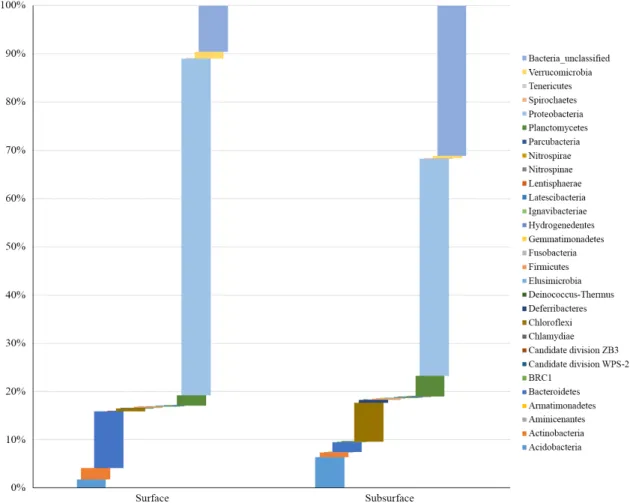
ABSTRACT: In this study, the structure and diversity of bacterial community were investigated in the surface and subsurface marine sediments using a NGS method (i.e. illumina sequencing technology). The bacterial community in the surface was distinct from that in the subsurface of marine sediment; with the exception of the phylum Proteobacteria, the relative abundance of Bacteroides phylum were higher in the surface than subsurface, whereas the sequences affiliated to the phyla Chloroflexi and Acidobacteria were relatively more copious in the subsurface than surface sediment. Moreover, interestingly, we observed that the phyla Nitrospinae and Nitrospirae contribute to nitrogen cycle in the marine sediment. This study may present the possibility for the presence of novel microorganisms as unexplored sources and provide basic information on the microbial community structure.
Key words: bacteria, community, marine sediment, next-generation sequencing
*For correspondence.
E-mail: [email protected];
Tel.: +82-64-754-3524; Fax: +82-64-756-3541
미생물은 지구상에서 인간의 삶을 포함한 모든 부분에서 필 수적인 요소이며, 생지화학적 순환을 담당하고 있다. 하지만 대부분의 미생물들은 실험실에서 배양이 어려운 한계 때문에 배양에 의존하지 않는 분자생물학적 분석이 주를 이루고 있 다(Amann et al., 1995). 차세대염기서열분석(next-generation sequencing, NGS) 기술의 발달이래, 16S ribosomal RNA (rRNA) 유전자를 활용한 미생물의 다양성 및 군집구조 분석은 기존의 clone library, T-RFLP, DGGE 등의 기법으로부터 빠르게 대 체되고 있다(Hamady et al., 2008; Caporaso et al., 2011).
해양환경은 지구 표면적의 약 70%를 차지하고 있으며, 열 수구(hydrothermal vent)를 포함하는 심해(deep-sea)와 같은 환경을 포함하고 있다. 해양미생물들은 다양한 환경에 적응하 기 위하여 독특한 물질대사와 생리적 능력을 지니고 있는 것 으로 알려져 있다. 또한, 이들 미생물의 종 풍부도와 다양성은 매우 높은 것으로 확인되고 있으며(Walsh et al., 2016), 그들 은 전지구적인 생지화학순환을 담당하고 있는 것으로 알려져 있다(Choi et al., 2016). 해양미생물의 생지화학적 순환에 기
여하는 정확한 종 다양성 및 그들이 지닌 대사과정에 대한 연 구는 활발히 이루어지고 있으나, 아직까지도 미비한 실정이 다. 특히 최근에 발효된 생물다양성협약(나고야의정서)에 따 라, 국내 서식하는 미생물들의 종 다양성 파악 및 발굴이 가속 화 되고 있다. 이에 따라, 본 연구에서는 국내의 대표적인 섬인 제주도 해양퇴적물 내의 미생물 다양성 및 군집 구조를 NGS 기법을 통하여 분석하였다.
본 실험을 위하여, 해양퇴적물은 제주 모슬포 인근(33° 13′
N, 126° 14′ E)에서 시료를 채취하였다. 퇴적물 시료는 상층부 (0–10 cm)와 하층부(10–30 cm)로 구분하여, 멸균된 50 ml conical tube에 담아, 실험전까지 -80°C에 보관하였다. 각 시료 는 Power SoilTM DNA kit (Mo Bio Laboratories)를 이용하여 제조사의 방법에 따라 genomic DNA (gDNA)를 추출하였으 며, 추출된 gDNA는 전기영동장치에 0.8% (w/v) 아가로즈 젤 을 이용하여 gDNA의 크기와 분해여부를 확인하고, DS-11 plus spectrophotometer (Denovix, Inc.)를 이용하여 농도를 확 인하였다. NGS 분석을 위하여, 미생물의 16S ribosomal RNA (16S rRNA) 유전자의 V4 영역을 PCR 증폭 및 정제하였다 (Kim et al., 2015). 정제된 PCR 산물의 NGS 수행은 Macrogen
에 의뢰하였으며, MiSeq (illumina, Inc.) 장비를 사용하였다.
NGS 결과로 얻어진 염기서열들은 Mothur (version 1.37.0) 프 로그램을 이용하여 분석하였으며, 얻어진 서열의 길이가 짧거 나 긴 것, 그리고 키메릭 서열들은 제거하였다. 또한, Ribosomal Database Project (RDP) database를 통하여 미생물 이외의 염기서열(미토콘드리아와 엽록체)들도 제거하여, 분석의 신뢰도를 향상하였다. 종(species) 수준의 분류와, operational taxonomic unit (OTU)를 포함하는 미생물의 다양성은 mother 프로그램에서 제공하는 알고리즘을 이용하여 97% 유사도를 기준으로 분석하였다(Kim et al., 2015; Koh et al., 2015).
전처리를 거친 후, 상・하층부의 해양퇴적물로부터 최종적 으로 각각, 약 13,000와 19,000여 개의 염기서열을 확보하여 분석하였으며, Good’s coverage는 평균 75%로 확인되었다.
다양성지수를 비교한 결과, 하층부의 해양퇴적물 내에 미생물 다양성, 우점도 및 풍부도가 상층보다 높음을 확인할 수 있었 다. 하지만, 다양도 분석결과(Shannon-index) 둘간의 차이(상 층, 6.98; 하층, 7.47)가 크지 않아서 보다 많은 샘플 수를 이용 하여 분석의 정확도를 높이는 것이 필요할 것으로 판단된다.
미분류균(unclassified group)으로 분류된 염기서열을 포함하 여, 409개의 종들이 29개의 문으로 분류됨을 확인하였다. 미 분류군은 다양한 환경에서 분자생물학적 분석(비배양적 분 석)을 통하여 얻어진 서열만 보고된 미생물 분류군을 칭한다 (McDonald et al., 2012).
흥미롭게도, 상층퇴적물에서 미분류균으로 분류된 염기 서열들은 약 9.6%임에 비하여 하층의 경우 31%로 이들에 대 한 정보량이 높아졌음을 확인할 수 있었다. 이러한 사실로 미 루어 볼때, 혐기적 환경으로 파악되는 하층부의 해양퇴적물 에 지금까지 분류되지 않은 미생물 분류군이 존재하고 있을 것으로 판단된다. 문(phylum) 수준에서, 상층퇴적물의 경우 Proteobacteria (69.8%)와 Bacteroides (11.8%)가 우점하는 것 에 비하여, 하층부의 경우, Proteobacteria (45.0%), Chloroflexi (8.1%), 그리고 Acidobacteria (6.4%)로 확인되었다. 해양퇴적 물내의 질소순환에 기여하는 것으로 알려져 있는 Nitrospinae 와 Nitrospirae 문도 상・하층퇴적물 모두 서식하고 있는 것으 로 확인되었다. 이러한 점을 바탕으로 대부분 모래 등으로 구 성되어 미생물의 다양성이 낮을 것으로 예측되는 제주 해양퇴 적물과는 달리 모슬포 인근 해양퇴적물은 생지화학적 물질 순 환에 기여할 것으로 판단되는 기초적 정보를 제공하나, 배양 혹은 환경유전체학적 분석을 통하여 이를 보다 정밀하게 분석 할 필요가 있다. 상층퇴적물에서 Proteobacteria 문을 제외하 고, 우점하는 문의 경우 대부분 방향족 화학물, 탄화수소류를 포함하는 난분해성 물질들을 분해하는 것으로 알려져 있는
Bacteroides 문이였다(Roling et al., 2002; Vinas et al., 2005).
게다가, 통성혐기적 호흡을 통하여 생태계 내에서 황순환 혹 은 난분해성 물질을 분해하는 특징을 지닌 것으로 확인되는 Chloroflexi 문의 경우(Yamada and Sekiguchi, 2009), 하층퇴 적물에서 8.1%로 우점하는 것으로 관찰되었다. 이러한 사실 로 미루어, 상・하층의 해양퇴적물 내에서 난분해성 유기물 분 해능이 높다고 판단된다.
Proteobacteria 문 중에서, 상 ․ 하층 퇴적물에서 모두 Alpha-, Delta-와 Gammaproteobacteria강이 우점하였으나, 상층부에서 는 Gammaproteobacteria강이 하층부에서는 Deltaproteobacteria 강이 우점하는 것으로 확인되었다. 이는 퇴적물 내의 이용 가 능한 용존산소와 관련이 있을 것으로 판단된다. 해양환경내의 Gammaproteobacteria강의 경우 주로 호기적 호흡을 통하여 에너지를 획득하는 반면에, Deltaproteobacteria강은 다양한 유・무기물을 이용하여 혐기적 호흡을 통하여 에너지를 획득 하는 미생물이(e.g. sulfate-reducing Deltaproteobacteria) 다 수 발견되고 있는 것과 연관된다고 할 수 있다(Miyatake et al., 2009; da Silva et al., 2013).
또한, 본 연구에서는 Aminicenantes, Hydrogenedentes문 및 후보문(candidate division)인 WPS-2와 ZB3을 포함하여, pyrosequencing을 통한 미생물 군집구조를 분석한 기존 연구 에서(Choi et al., 2016) 발견되지 않은 희박생물권(rare biosphere) (Lynch and Neufeld, 2015)의 미생물들도 확인되었다. 강(class) 수준에서도 pyrosequencing에 비하여 MiSeq 플랫폼을 이용 한 본 연구를 통해 보다 다양한 미생물 분류군들이 확인되었 다. 미분류군 속에 분류된 염기서열을 제외하고, 속(genus) 수 준에서는 Desulfobacteraceae 과의 미분류속에 속하는 염기 서열이 11.7%로 하층퇴적물에서는 우점하였으나, 상층퇴적 물의 경우 Gammaproteobacteria 강의 미분류 속에 속하는 것 이 23.9%로 우점하는 것으로 확인되었다. 그리고, 예상과 다르 게 Mollicutes 강을 포함하는 Tenericutes 문이 상층퇴적물에서 매우 적은 양으로 검출되었다(Brown et al., 2007). Mycoplasma 가 속하는 이 문은 세포벽이 없으며, 대부분 숙주세포에 기생하 는 병원성 미생물로 알려져 있으며, 일반적인 해양퇴적물에서 발견된다. 이들은 해양환경 내에서 산호 등과 같은 해양무척추 동물들과 연관이 있을 것으로 판단되므로(Neulinger et al., 2008, 2009; Kellogg et al., 2009), 해양퇴적물 뿐만 아니라 해 양무척추동물들 내의 미생물군집 구조 분석에 대한 추가적인 연구도 필요하다. 게다가, 최근 심해의 메탄공(deep-sea methane seep) 퇴적물로부터 Tenericutes 문과 관련된 분류군인 NB1-n 과 RF3의 유전체들로부터 분석되었다. 이 유전체는 수소화 효소(hydrogenase)와 cytochrome bd oxidase와 complex I으
Fig. 1. The abundance of the phyla in Bacteria in the marine sediments. The bacterial 16S rRNA gene sequences were assigned to each phylum using the
mothur package and a reference database of 16S rRNA genes obtained from Ribosomal Database Project.
Table 1. Estimation of sequence diversity and operational taxonomic unit (OTU) of the surface and subsurface marine sediments. Diversity was estimated
using OTUs and was defined as groups with 3% sequence dissimilarity. Diversity indices were calculated by mothur package.
Sample Analyzed reads
Observed
OTUs Shannon Shannon lci
aShannon
hci
aChao Chao
lci
Chao
hci Simpson Simpson lci
Simpson hci
Good’s coverage Surface 12,638 4,179 6.98 6.94 7.01 12,937.05 12,005.67 13,979.26 237.09 224.48 251.19 0.76 Subsurface 18,860 6,405 7.47 7.44 7.50 20,493.00 19,243.06 21,864.63 325.10 309.21 342.73 0.75
a
lci and hci are rarefied 95% low and high confidence intervals (provide by the mothur application), respectively.
로 구성된 단순한 전자전달계가 발견되었으며, Candidatus
“Izimaplamsa sp.” HR1과 HR2로 각각 명명되었다(Skennerton et al., 2016). 이러한 사실에 미루어 볼 때, Tenericutes 문에 대 한 자연환경에서의 생태학적 기능에 대한 연구는 현재까지 매 우 미비한 실정이다.
본 연구에서는 pyrosequencing을 통한 기존연구에서는 발견되지 않았던 보다 다양한 미생물 분류군들이 발견되었 다. 이는 NGS 분석을 위한 플랫폼의 차이보다는 16S rRNA 유전자 분석영역의 차이 때문인 것으로 사료된다. 비록 16S rRNA 유전자의 V3/V4와 V4/V5 영역이 454와 illumina의 플
랫폼을 사용한 in silico 분석에서 다른 영역에 비하여 높은 분 류정확도를 보이긴 하지만, 실제 실험에서는 V3/V4 영역의 편향된 증폭현상(amplification bias)이 관찰된다고 보고된 바 있다(Claesson et al., 2010). 그럼에도 불구하고, V4를 포 함하는 영역은 NGS 분석에 있어 매우 적합하다고 판단된다.
또한, Kuczynski 등(2012)은 환경시료와 인간 미생물군(human microbiome) 시료에 대해서 각각 V4 영역과 V1-V2 영역 분석 을 제안하기도 하였다. 본 연구에서도 Good’s coverage를 제 외하고, 기존의 pyrosequencing에 의하여 분석된 미생물의 다 양성지수를 비교한 결과(Table 1), 큰 차이를 볼 수 없었으나,
희박미생물(rare microorganism)과 같은 미생물 분류군의 존 재 확인에 있어 의미있는 차이를 관찰할 수 있었다.
해양퇴적물로부터 확보한 대부분의 염기서열들은 미분류 군들과 상동성을 보였으며 이것은 아직까지 해양퇴적물에 서 식하는 많은 미생물들이 배양되지 않았다는 것을 의미한다.
따라서 이러한 미생물들의 배양을 통하여, 새로운 분류군으로 분류될 수 있으며 그들의 생태학적 기능을 유추할 수 있을 것 이다. 세균과 고세균들은 rRNA 분석을 통하여 60여 개의 문들 이 보고되었으나, 이들 중 배양된 균주들이 속하는 문은 절반 정도에 지나지 않는다(Hugenholtz and Kyrpides, 2009; Rinke et al., 2013). 따라서 해양퇴적물 내에 특성이 밝혀지지 않은 미생물들이 우점한다는 점에서 새로운 토착미생물 자원으로 이용될 수 있는 가능성이 존재한다. 본 연구를 통하여, 해양퇴 적물내의 미생물 군집구조와 그 다양성을 비교・분석하였으 며, 이 결과는 해양미생물 자원 발굴에 대한 기초자료를 제공 할 수 있을 것이라 사료된다.
적 요
본 연구에서는 차세대염기서열분석 기법을 활용하여 제주 도 인근 해양퇴적물의 상층부와 하층부내의 미생물 군집구조 와 다양성을 조사하였다. 상층부와 하층부의 미생물 군집구조 는 상이하였으며, Proteobacteria 문을 제외하고, 상층부에서 는 Bacteroides 문이, 하층부에서는 Chloroflexi와 Acidobacteria 문이 각각 우점하는 것으로 확인되었다. 또한, 흥미롭게도 질 소순환에 관여하는 것으로 알려진 Nitrospinae와 Nitrospirae 문도 서식하고 있음이 관찰되었다. 본 연구를 통하여, 아직 발 굴되지 않은 새로운 미생물의 자원으로서의 가능성과 해양퇴 적물내의 기본적인 정보를 제공할 수 있을 것으로 기대한다.
감사의 말
이 논문은 2016년도 제주대학교 교원성과지원사업에 의하 여 연구되었습니다.
References