상황버섯과 발아현미상황버섯 열수추출물의 Murin Macrophage RAW 264.7 세포에서 항염증 반응 비교
정용준*·최세영*·안치선*·전윤희*·박동기**·임병우*†
*건국대학교 생명과학부 응용생화학과, **건국대학교 특성화학부 생명공학전공
Comparative Effect on Anti-Inflammatory Activity of the Phellinus linteus and Phellinus linteus Grown in Germinated Brown Rice Extracts
in Murine Macrophage RAW 264.7 Cells
Young Jun Jeoung*, Se Young Choi*, Chi Sun An*, Yun Hee Jeon*, Dong Ki Park**, and Beoung Ou Lim*†
*Dept. of Life Science, College of Biomedical & Health Science, Konkuk University, Chungju 380-701, Korea.
**Dept. of Bioscience and Biotechnology, Konkuk University, Seoul 143-701, Korea.
ABSTRACT : The present study describes the preliminary evaluation of the anti-inflammatory activities of Phellinus linteus (PL) and Phellinus linteus Grow in Germinated Brown Rice (BRPL). In order to effectively screen for anti-inflammatory agents, we first examined the extracts' inhibitory effects on the expression of pro-inflammatory cytokines activated with lipopolysaccharide. Moreover, we examined the inhibitory effects of the PL and BRPL extracts on pro-inflammatory factors such as NO, iNOS, TNF-α and IFN-γ in murine macrophage RAW 264.7 cells. NO production and iNOS expression was sig- nificantly augmented in LPS treated cell, the production of NO and iNOS was greater in the BRPL than in the PL group. In addition, protein and mRNA levels of TNF-α and IFN-γ in BRPL showed relatively more potent pro-inflammatory-activity inhibition compared to that of PL. These results suggest that BRPL may have significant effects on inflammatory factors, and may be a potential anti-inflammatory therapeutic materials.
Key Words : Phellinus linteus, Germinated brown rice, Anti-Inflammation, Nitric oxide, TNF-α, IFN-γ
서 언
상황버섯 (Phellinus linteus)의 자실체 열수 추출물은 소화기 계통의 종양세포에 저해효과가 있다고 알려지면서 (Lim et al., 2005) 많은 연구가 진행되었다. 또한 각종 암에 대한 항암활 성 및 대장암 (Li et al., 2004)과 방광암 등의 원인효소인 장 내세균 유해효소 저해효과 (Kim et al., 1998a) 등 상황버섯 의 다양한 생리활성이 보고되어 있다 (Kim et al., 2007). 상 황버섯에서 추출된 다당체가 체액성 및 세포성 면역반응을 항 진시킨다는 연구보고도 있어 민간에서 많이 사용되고 있다 (Chihara et al., 1970). 또한, 인공재배 상황버섯과 자연상황버 섯의 자실체 열수추출 다당체의 항보체 활성이 비슷하여 면역 활성 측면으로는 인공 상황버섯의 이용가능성이 있다고 보고 되였으며, 위암, 식도암, 십이지장, 결장암, 직장암 등의 소화 기계통의 암을 비롯해 간암 수술 후 화학요법을 병행할 때의 면역기능 항진에도 효과가 있는 것으로 알려져 있다. 또한 자
궁출혈 및 대하, 월경불순, 장출혈, 오장기능을 활성화시키고 해독작용을 하는 것으로 알려져 있으며, 상황버섯의 종양저지 율은 96.7%에 이르는 것으로 보고되고 있다 (Chang et al., 1993). 발아현미상황버섯은 새로운 배양·재배방법으로 발아 현미에 상황버섯 종균을 접종시켜 생산된 것으로 암세포 성장 억제 및 항종양 활성 효과에 대한 연구가 보고되고 있으며, 면역조절제로서의 역할이 기대되고 있다 (Park et al., 2007;
Ji et al., 2000).
염증반응은 생체나 조직에 물리적 작용이나 화학적 물질, 세 균 감염 등의 어떠한 기질적 변화를 가져오는 침습이 가해질 때 그 손상부위를 수복 재생하려는 기전이며 (Tizard et al., 2004), 일단 자극이 가해지면 국소적으로 염증성 성분과 같은 혈관 활성 물질이 유리되어 혈관 투과성이 증대되면서 염증을 유발한다. 그러나 지속적인 염증반응은 도리어 점막손상을 촉 진하고, 그 결과 일부에서는 암과 같은 질환을 발생 시킨다 (Willoughby, 1975). 대식세포는 선천면역뿐만 아니라 획득면
†Corresponding author: (Phone) +82-43-840-3570 (E-mail) [email protected] Received January 21, 2009 / Revised March 24, 2009 / Accepted April 11, 2009
역 등 다양한 숙주반응에 관여하여 항상성 유지에 관여하는 것으로 알려져 있으며, 염증반응 시에는 nitric oxide (NO)와 cytokine을 생산하여 감염초기에 생체방어에 중요한 역할을 한 다 (Higuchi et al., 1990). 내독소로 잘 알려진 lipopoly- saccharide (LPS)는 그람-음성균의 세포외막에 존재하며, RAW 264.7과 같은 macrophage또는 monocyte에서 TNF-α, IL-6, IL-1β 같은 pro-inflammatory cytokine들을 증가시키는 것으로 알려져 있다 (Willeaume et al., 1996; Funk et al., 1991;
Kim et al., 1998b). 이러한 염증매개 물질의 형성은 phos- pholipase A2의 활성으로 인해 arachidonic acid가 prosta- glandin으로 바뀌는 과정 및 NO형성 과정으로 이어지게 된다 (MeDaniel et al., 1996). 체내 염증과정에서는 과량의 NO 및 prostaglandin E2등의 염증인자가 inducible nitric oxide synthase 및 cyclooxygenase에 의해 형성된다 (Lim et al., 2007). 이 중 NO는 체내 방어기능, 신호전달기능, 신경독성, 혈관확장 (Ryu et al., 2003) 등의 다양한 생리 기능을 가지 고 있다 (Choi et al., 2007). 일반적인 NO의 형성은 박테리 아를 죽이거나 종양을 제거시키는 중요한 역할을 하지만, 염 증상태에서 iNOS (Yang et al., 2008)에 의해 과잉 생성된 NO는 혈관 투과성, 부종 등의 염증반응 (Stuehr et al., 1991) 을 촉진시킬 뿐만 아니라 염증매개체의 생합성을 촉진하여 염 증을 심화시키는 것으로 알려져 있다 (Lee 2007; Moncada et al., 1991).
본 연구에서는 상황버섯과 비교하여 발아현미·상황버섯을 대상으로 그 유효성분이 염증성 반응의 예방 및 치료제 개발 의 기초자료로 사용 될 수 있는지 탐색하고, 항염증 기능성 소재로서의 가능성을 규명하고자 수용성 추출물을 가지고 LPS 로 활성화된 Macrophage 유래의 RAW 264.7 세포에서 염증 성 cytokine인 TNF-α와 IFN-γ의 억제 효과와 NO의 생성억 제 효과 및 iNOS의 생성 및 활성 억제를 조사하여 발아현미 상황버섯의 기능성을 검토하고자 하였다.
재료 및 방법
1. 재료
실험에 사용된 소재인 상황버섯, 발아현미상황버섯 (Lim et
al., 2005)은 음건하고 분쇄하여 사용하였다. 리터당 각각의 성
분을 약 100 g을 넣고 85℃에서 3회 반복 열수 추출하고, 추 출액은 여과지 (Adventec Toyo 2, Japan)를 사용하여 2회 감 압 여과 하고 rotary evaporator로 농축하였다. 이를 동결건조 후 −70℃에 보관하여 사용하였다.
2. 세포 배양
대식세포 계열 (murine macrophage cell line)인 RAW 264.7 세포는 한국세포주은행 (KCLB; Seoul, Korea)으로부터
분양 받아 사용하였다. LPS는 PBS (0.45 ㎛ filted)또는 serum free DMEM medium (+penicillin-streptomicyn, +L- glutamine)을 사용하여 희석하였다. LPS에 의한 macrophage 자극은 RAW 264.7을 2일간 37℃, 5% CO2 배양기에서 배 양한 것을 사용하였으며, LPS에 의한 자극 실험 전에 6-well plate incomplate DMEM medium 또는 incomplate RPMI 1640 medium으로 2회 씻어낸 후, 세포를 6-well plate (2 × 10⁴ cells/well)에 분주한 후 LPS (1 ㎍/㎖)와 시료를 첨 가하여 24시간 동안 배양시킨 후 실험을 하였다.
3. MTT assay
RAW 264.7세포 1 × 10⁵cells/㎖ 를 96well plate 분주하고 37℃, 5% CO2 incubator에서 12시간 동안 배양하였다. 배양 한 세포에 medium을 처리하여 24시간 동안 배양한 후, phosphate buffered saline (PBS)에 녹인 5 ㎎/㎖ 의 MTT용액 50㎕를 각 well에 넣고 37℃, 5% CO2 incubator에서 4시간 동안 배양하였다. 배양 후, 배양액을 버리고 DMSO 100 ㎕ 씩 넣어 formazin을 용해한 후, microplate reader (Sunrise- basic tecan, TECAN, GrÖdig/Salzburg, Austria)로 550 ㎚ 에 서 흡광도를 측정하였다 (Lim et al., 2007).
4. Nitric oxide (NO) 생성 평가
각각의 시료의 추출물 혹은 LPS를 처리한 상층액을 nitrite 측정을 위해 100 ㎕를 96-well plate에 취하였다. 여기에 동량 의 Griess 시약을 넣어 상온의 어두운 곳에서 10분간 반응시 킨 후 microplate reader를 이용하여 UV 550 ㎚ 에서 흡광도 를 측정하였다. Nitrite의 농도는 sodium nitrite (NaNO2)를 사용하여 얻은 표준 직선과 비교하여 산출하였다.
5. Immunoblotting
배양이 끝난 세포를 수집하여 2~3회 PBS (phosphate buffered saline)로 세척 한 후 1 ㎖의 lysis buffer을 첨가하여 30분간 lysis 시킨 후 12,000 rpm에서 15분간 원심 분리하여 세포막 성분 등을 제거하였다. 단백질 농도는 BSA (bovine serum albumin)를 표준화 하여 Bio-Rad Protein Assay Kit를 사용하여 정량하였다. 20~30 ug의 lysate를 8~15% mini gel SDS-PAGE로 변성 분리하여, 이를 PVDF (polyvinylidene difluoride) membrane (BIO-RAD, Richmond, CA, USA)에 300mA로 60분간 transfer하였다. 그리고 membrane은 blocking buffer (5% nonfat dry milk in TBS-T (20 mM Tris-HCl pH7.5), 150 mM Nacl, 0.05% Tween-20) buffer 200㎖에 1 시간 동안 antibody의 비 특이적 결합 (non-specific binding) 을 억제 시키고, TBS-T로 세척하였다. iNOS, TNF-α, IFN-γ 1차 항체를 4에서 24시간 동안 배양시키고 TBS-T로 15분간 각각 4번 씻어내었다. 그 후, ECL (peroxidase, substate)
reagents를 사용하여 현상 후 분석하였다.
6. RT-PCR을 이용한 iNOS, TNF-α, IFN-γ 측정
100㎜ dish 에 1 × 10²cells/㎖ RAW 264.7 세포를 24시 간 동안 배양 후, 각각의 시료 추출물을 처리한 후 RNA를 분리하기 위해 TRIzol reagent (Invitrogen Life Technologies, USA)를 이용하여 total RNA를 분리한다. RNA의 정량은 50 배 희석한 후 UV/vis 분광광도계를 이용하여 260 ㎚에서 흡 광도를 측정하였다. RT-PCR premix (Bioneer, Seoul, Korea) 와 antisense primer (Bioneer, Seoul, Korea), RNA, DEPC 처리된 증류수를 넣어 최종부피가 50 ㎕가 되도록 한 후 RT- PCR을 수행 하였다. RT-PCR은 cDNA 합성; 42℃, 60분, predenaturation; 95℃, 5분, denaturation; 95℃, 1분, annealing;
55-65℃, 1분, elongation; 72℃, 1분을 31 cycles한 다음, postelongation bromide (EtBr; Sigma Chemical Co, St, Louis, MO, USA)가 포함된 1% agarose gel을 사용하여 75 volt에서 40분간 전기영동하여 UV에서 관찰하였다. TNF-α 의 유전자 증폭을 위하여 Forward primer: 5' GCGACGTGG AACTGGCCAGAAG-3', Reverse primer: 5'-TCCATGCCGT TGGCCAGGAGG-3'를 사용하였고 IFN-γ의 증폭을 위하여 5'- ATCTGGAGGAACTGGCAAAAGGACG-3' (Reverse)와 5'- CCTTAGGCTAGATTCTGGTGACAGC-3' (Forward)를 사용 하였고 iNOS의 증폭을 위하여 5'-CCTTGTTCAGCTACGCC TTC-3' (Reverse)와 5'-CTGAGGGCTCTGTTGAGGT-3' (For- ward)를 사용하였다.
결과 및 고찰
1. 세포 생존율
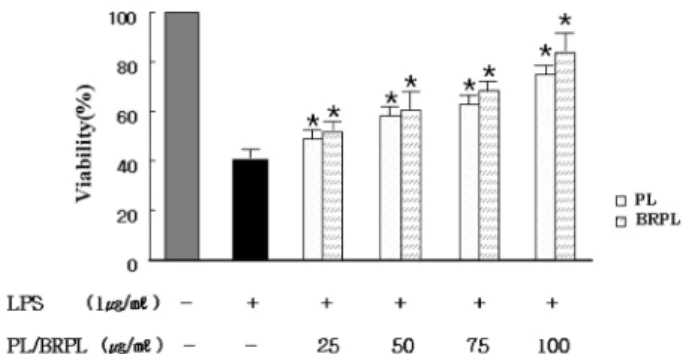
MTT를 이용하여 상황버섯과 발아현미상황버섯의 RAW 264.7 세포에 대한 세포독성을 확인하였다 (Fig. 1). 상황버섯 과 발아현미상황버섯의 수용성 추출물을 농도별로 처리하였을 때 농도 의존적으로 세포의 생존율은 증가하였다. LPS군에서 세포수가 감소하였으며, 추출물의 농도가 증가 할수록 세포의 생존율이 높아지는 것이 나타났다. 특히 상황버섯의 수용성 추 출물 보다 발아현미상활버섯의 수용성 추출물에서 높은 세포 생존율을 나타냈다.
2. Inducible nitric oxide synthase (iNOS)와 Nitric oxide (NO) 생성억제 효과
활성산소 중 하나이며, 최근 염증 유발에 중요한 역할을 하 는 것으로 알려진 (Weisz et al., 1996) NO 생성에 대한 상황 버섯과 발아현미상황버섯 추출물의 효과를 알아보았다 (Fig. 2).
그 결과 상황버섯과 발아현미상황버섯 추출물의 농도 의존적 으로 대조군인 LPS에 의해 유도된 높은 NO 생성에 대해 억
제효과를 나타내었다. 특히, 발아현미상황버섯 추출물의 경우 상황버섯보다 높은 NO 생성 억제효과를 관찰할 수 있었다.
LPS를 사용하여 iNOS의 생성을 유도한 후 상황버섯과 발 아현미·상황버섯 추출물을 100 ㎍/㎖ 농도로 처리하여 iNOS 생성에 대한 억제 정도를 단백질과 mRNA 발현양을 통해 검 토하였다 (Fig. 3). 그 결과 iNOS의 protein 생성은 추출물 처리군에서 대조군인 LPS 단독 처리군에 비해 강한 억제 효 과를 나타내었다. 본 연구 결과, NO 생성 억제 효과와 초기- 염증성 인자 (pro-inflammatory factor)생성 억제 효과가 가능 두드러지게 나타났던 발아현미상황버섯 추출물이 iNOS의 발 현량을 강하게 억제시키는 걸로 보아 NO의 생성 억제 기전은 iNOS 발현 억제를 통해 이루어진 것으로 확인된다.
iNOS는 평소에는 세포 내에 존재하지 않으나 일단 유도되 면 장시간 동안 다량의 NO를 생성하며, 생성된 NO는 병리적 인 혈관확장, 세포독성, 조직손상 등과 같은 생체에 유해한 작 Fig. 1. RAW 264.7 macrophage were incubated under various
concentration of PL and BRPL.
Viability of cells harvested at 24hr after LPS addition was determined using the MTT assay. The values are the mean ± S.D. from three independent experiments *p <
0.05, **p < 0.005 vs. LPS-treated group.
Fig. 2. Effect of PL and BRPL on nitrite oxide Production by LPS- induced RAW 264.7 macrophage.
The cells were treated with LPS alone or plus various concentrations of PL and BRPL. The production of NO was evaluated by Griess reaction. The values are the mean ± S.D. from three independent experiments *P <
0.05, **p < 0.005 vs. LPS-treated group.
용을 나타내고, 염증매개체의 생합성을 촉진하여 염증을 심화 시키는 것으로 알려져 있다 (Ryu et al., 2003; Mu et al., 2001). 또한 염증반응과 관련된 조직 손상에서 NO와 iNOS의 발현이 증가되어 있음이 보고되어 있다 (McCartney et al., 1993; Weisz et al 1996). NO는 NO 합성효소에 의해 L- arginine으로부터 생성되는 무기 유리체로 면역반응, 세포독성, 신경전달계 및 혈관이완 등 여러 가지 생물학적인 과정에 관 여하는 것으로 알려져 있으며 농도에 따라 세포 기능유지에 중요한 작용을 하기도 하고 세포독성을 일으키기도 한다.
3. Pro-inflammatory cytokine 생성 억제 효과
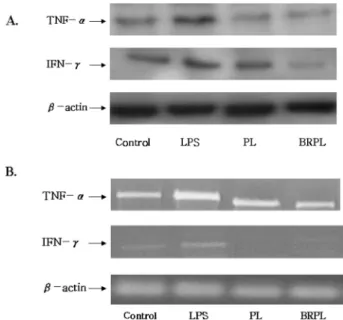
상황버섯과 발아현미·상황버섯에 대한 TNF-α와 IFN-γ의 발현 정도를 단백질과 mRNA level을 검토하였다 (Fig. 4).
LPS와 함께 처리하였을때 대조군인 LPS 단독 처리군에 비해 추출물 군에서 강한 억제 효과를 나타내었다. 특히, 발아현미 상황버섯에서 상황버섯보다 높은 억제효과를 나타내었다.
TNF-α와 같은 pro-inflammatory cytokine은 정상조직에서 발현될 뿐만 아니라 병변 과정에서 그 발현 정도가 증가되며, 암촉진 과정에서 일어나는 피부염증에 중요한 역할을 한다.
TNF-α가 인간의 염증성 피부질환과 관련이 있음은 이미 많이 보고되어 왔다 (Pociot et al., 1993). 또한 여러 염증질환과 알러지 현상에 TNF-α에 대한 항체를 처리하였을 때 증상이 완화되었다. 염증단계의 중추적 역할을 하고 있는 cytokine인 TNF-α와 IFN-γ의 발현을 저해를 통해 anti-inflammatory factor의 증가를 수반하는 병변 과정을 조절할 수 있을 가능성 이 높다.
상황버섯과 발아현미상황버섯을 이용하여 열수추출물에 대 한 항염증 효과를 검토하였다. 상황버섯과 발아현미상황버섯 의 세포생존율을 측정한 결과, LPS 단독처리군에 비해 농도 의존적으로 증가 하였다. 대식세포 RAW 264.7 세포를 이용
한 상황버섯과 발아현미상황버섯 열수추출물의 항염증활성 효 과는 LPS로 활성화시킴과 동시에 각각의 추출물을 첨가하고 24시간 경과한 후 생성된 NO의 양을 측정한 결과, 상황버섯 과 발아현미상황버섯 열수추출물 모두에서 농도의존적인 NO 생성억제효과가 확인되었다. iNOS도 immunoblotting과 RT- PCR을 통해 mRNA 발현양을 측정한 결과 농도의존적인 iNOS 생성 억제효과를 나타내었다. 또한 TNF-α와 IFN-γ cytokine과 mRNA의 발현양을 측정한 결과 LPS 단독처리군 에 비해 상황버섯보다 발아현미상황버섯 추출물 처리군에서 유의적으로 강한 억제 효과를 나타냈다. 이러한 연구 결과로 부터 발아현미에 상황버섯 종균을 접종시켜 얻어진 새로운 기 능성 소재인 발아현미·상황버섯의 항염증 연구 또는 예방과 치료에 있어서 염증 억제 성분의 분리 및 그 작용기전 연구와 기능성 식품개발의 중요한 기초연구 자료가 될 것이다.
감사의 글
본 연구는 교육과학기술부와 한국산업기술재단의 지역혁신 인력양성사업으로 수행된 연구결과임
LITERATURE CITED
Chang ST, John AB and Chju SW. (1993). In mushroom biology and mushroom products. World Scientific, Washington, D.C. 1-20.
Fig. 3. Effect of PL and BRPL on the protein and mRNA expression fo iNOS in LPS-stimulated RAW 264.7 cells.
The experiment was repeated three times with similar results.
Fig. 4. Effect of PL and BRPL on the protein and mRNA expression of TNF-α and IFN-γ in LPS-stimulated RAW 264.7 cells.
Lysates were prepared from control or stimulated cells treated for 24h with LPS (1 ㎍/㎖) alone or in combination with increasing concentrations (100 ㎍/㎖) of PL and BRPL.
Chihara G, Hamuro J, Maeda Y, Arai Y and Fukuoka F.
(1970). Fractionation and purifieation of the polysaccharide with marked antitumor activity, cspecially lentinan from Lentinus edodes. Cancer Research. 30:2776-2781.
Choi SY, Lee KC, Jeoung YJ and Lim BO. (2007). In-vitro anti- inflammatory activity of rubus coreanus Miq. on nitric oxide, interferon-, cycloxygenase-2, and tumor necrosis factor-a production in the macrophage like cell line raw 264.7 activated by lipopolysccharide. Korean Journal of Medicinal Crop Science.
15:324-329.
Funk CD, Frunk LB, Kennedy ME, Pong AS and Fitzgerald GA. (1991). Human platelet/erythroleukemia cell prostaglandin G/H synthase: cDNA cloning, expression, and gene chromosomal assignment. The Faseb Journal. 5:2304-2312.
Higuchi M, Hisgahi N, Taki H and Osawa T. (1990). Cytolytic mechanisms of activated macrophages. Tumor necrosis factor and L-arginine-dependent mechanisms act synergistically as the major cytolytic mechanisms of activated macrophages. The Journal of Immunology. 144: 1425-1431.
Ji JH, Kim MN, Chung CK and Ham SS. (2000).
Antimutagenic and cytotoxicity effects of Phellinus linteus extracts. Journal of Korena Society of Food Science and Nutrition.
29:322-328.
Kim DH, Choi, HJ and Bae EA. (1998a). Effect of artificially cultured Phellinus linteus on harmful intestinal bacterial enzymes and rat intestinal α-glucocidase. The Korean Society of Food Hyglene and Safety. 13:20-23.
Kim JY, Kim KN, Lee JA, Park SY and Yoon WJ. (2007). In vitro anti-inflammatory activity of the Artemisia fukudo extracts in murine macrophage raw 264.7 cells. Korena Journal of Food Science and Technology. 39: 464-469.
Kim SY, Park KJ and Lee WC. (1998b). Antiinflammatory and Antioxidative Effects of Morus spp. Fruit Extract. The Korean Society of Medical Crop Science. 6:204-209.
Lee YH. (2007). Effect of Phellinus Linteus grown in germinated brown rice on atopic dermatitis. The Korean Society of Cosmetology. 13:514-519.
Li G, Kim DH, Kim TD, Park BJ, Park HD, Park JI, Na MK, Kim HC, Hong ND, Lim K, Hwang BD and Yoon WH.
(2004). Protein-bound Polysaccharide from Phellinus linteus induces G2/M phase arrest and apoptosis in SW408 human colon cancer cells. Cancer Letters. 216:175-81.
Lim BO, Jeon TI, Hwang SG, Moon JH and Park DK. (2005).
Phellinus linteus grown on germinated brown rice suppresses IgE production by the modulation of Th1/Th2 balance in murine mesenteric lymph node lymphocytes. Biotechnology Letters. 27:613-7.
Lim BO, Jeong YJ, Park MH, Kim JD, Hwang SJ and Yu BP.
(2007). Immunoregulatory effects of Saengshik on DSS-induced inflammatory bowel disease in mouse model system. Journal of The Korean Society of Food Science and Nutrition. 36:32-42.
Lim BO, Park PJ, Choi WS and Kim JD. (2008). Scutellaria baicalensis modulates cytokine production, T cell population and immunoglobulin level by mesenteric lymph node lymphocytes in experimental mice with colitis. The Korean Society of Medical Crop Science. 16:100-105.
McCartney N, Allen JB, Mizel DE, Albina JE, Xie QW,
Nathan CF and Wahl SM. (1993). Suppression of arthritis by an inhibitor of nitic oxide synthase. The Journal of Experimental Medicine. 178: 749-754.
MeDaniel ML, Kwon G, Hill JR, Marshall CA and Corbett JA. (1996). Cytokines and nitric oxide in islet inflammation and diabetes. Proceedings of the Society for Experimental Biology and Medicine. 211:24-32.
Moncada S, Palmer RM and Higgs EA. (1991). Nitric oxide:
physiology, pathophysiology, and pharmacology. Pharmacological reviews. 43:109-142.
Mu MM, Chakravortty D, Sugiyama T, Koide N, Takahashi K, Mori I, Yoshida T and Yokochi T. (2001). The inhibitory action of quercetin on lipopolysaccharide-induced nitric oxide production in raw 264.7 macrophage cells. Journal of Endotoxin Research. 7:431-438
Park SJ, Kim JY, Jang YP, Cho YW, Ahn EM, Baek NI and Lee KT. (2007). Inhibition of LPS induced iNOS, COX-2 and cytokines expression by Genistein-4'-O-α-L-Rhamnopyranosyl- (1-2)-β-D-Glucopyranoside through the NF-κB inactivation in raw 264.7 cells. Korean Society of Pharmacology. 38:339-348 Piguet PF, Grau GE, Houser C and Vassalli P. (1991). Tumor necrosis factor is a critical mediators in hapten induced irritant and contact hypersensitivity reaction. The Journal of Experimental Medicine. 173:673-679.
Pociot F, Briant L and Jongeneel CV. (1993). Association of tumor necrosis factor (TNF) and class major histocompatibility complex alleles with the secretion of TNF-α and TNF-β by human mononuclear cells: a possible link to insulin-dependent diabetes mellitus. European Journal of Immunology. 23:224- 231.
Ryu JH, Ahn H, Kim JY and Kim YK. (2003). Inhibitory activity of plant extracts on nitric oxide synthesis in LPS- activated macrophage. Phytotherapy Research. 17:485-489.
Stuehr HH, Kwon NS, Weise M and Nathan C. (1991).
Purification of the cytokine-induced macrophage nitric oxide synthase: and FAD- and FMN- containing flavoprotein.
Proceedings of the National Academy of Sciences of the United States of America. 88: 7773-7777.
Tizard IR and Schubot RM (2004). Veterinary Immunology : An Introduction. W. B. Saunders Company, U.S
Weisz A, Cicatiello I and Esumi H. (1996). Regulation of the mouse inducible-type nitric oxide synthase gene promoter by interferon-gamma, bacterical lipopolysaccharide and NG- monomethy1-L-arginene. Biochemical Journal. 316:209-215.
Willoughby DA. (1975). Human arthritis applied to animal models. Towards a better therapy. Annals of the Rheumatic Diseases 34:471-478.
Willeaume V, Kruys V, Mijatovic T and Huez G. (1996). Tumor necrosis factor-alpha production induced by viruses and by lipopolysaccharides in macrophages: similarities and differences.
Journal of Inflammation. 46:1-12.
Yang JL, Jang JH, Radliakrishnan V, Kim YH and Song YS.
(2008). β-Glucan suppresses LPS-stimulated NO production through the down-regulation of iNOS expression and NF-κB transactivation in raw 264.7 macrophages. Food Science and Biotechnology. 17: 106-113.