Key Frame Assignment for Compressed Video Based on DC Image Activity
Kang-Wook Kim†, Jae-Seung Lee††, Seong-Geun Kwon†††
ABSTRACT
In this paper, we propose a new and fast method for assigning the number of key frames to each shot. At first we segment the entire video sequence into elementary content unit called shots and then the key frame allocation is performed by calculating the accumulated value of AF(activity function).
The proposed algorithm is based on the amount of content variation using DC images extracted from compressed video. By assigning the number of key frames to the shot that has the largest value of content function, one key frame is assigned at a time until you run out of given all key frames. The main advantage of our proposed method is that we do not need to use time-exhaustive computations in allocating the key frames over the shot and can perform it fully automatically.
Key words: Key Frame, DC Image, Compressed Video
※ Corresponding Author : Seong-Geun Kwon, Address : (712-701) 33 Buho-ri, Hayang-eup, Gyeongsan-si, Gyeongbuk, Korea, TEL : +82-53- 850-7158, FAX : +82-53-850-7603, E-mail : sgkwon@ kiu.ac.kr Receipt date : Apr. 29, 2011, Revision date : July 5, 2011 Approval date : July 28, 2011
†††Samsung Electronics
(E-mail: [email protected])
†††Korea Aerospace Research Institute (E-mail: [email protected])
†††Department of Electronic Engineering, Kyungil Univ.
1. INTRODUCTION
With the integration of information from various and distributed sources and emergence of digital library, browsing of multimedia information in the form of still images and videos will be an important feature of any interactive multimedia systems.
During the same time, many services such as VOD (video on demand) and pay television are provided in digital form to the consumers and a rapidly in- creasing number of interactive multimedia docu- ments, including text, audio, and video, are now available. Consequently, it is widely recognized that there is a need for intelligent management and search methods particularly for visual information in multimedia documents and digital video.
However, content-based indexing tools and al- gorithms for the effective organization and man- agement of video archives are still limited. In order to allow the user to efficiently browse, select, and retrieve a desired video part without having to deal directly with GBytes of compressed data, a com- mon first step is to segment the videos into tempo- ral shots, each representing an event or continuous sequence of actions. Next, segmented shots are used for browsing and indexing, in which only one or a few representative frames, i.e., key frames of each shot are displayed [1-5]. To extract key frames from a shot, it is important to properly de- cide on the number of key frames. This is not an easy or automatic task because the decision is sub- jective to each person. Accordingly, the question of how many key frames we extract becomes a re- search topic of importance. Most existing ap- proaches to key frame extraction [6-8], based on measuring the differences between the last selected frame and the remaining frames and extracting a subsequent key frame if the measured difference exceeds the given threshold, are typically sequen- tial processes leading to unpredictable results. In particular, since the final number of key frames for
Pref
P3
P1
wo
Block Current w1
w2 w3
ho h1
h2 h3
Po
P2
Motion Vector =
= (w0,h0) ) , (Dx Dy
) , (Dx Dy
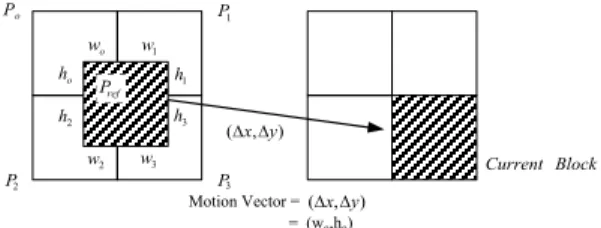
Fig. 1. Reference block ( ), motion vectors and original blocks.
an entire sequence cannot be estimated, either too large a number of key frames or too few key frames can be allocated, which is ineffective for in- dexing and browsing. This also makes it difficult to predict the capacity needed to store the extracted key frames in spite of reducing and organizing al- ready obtained key frames. In order to solve these problems, this paper proposes an objective and in- tuitively appealing algorithm for deciding on the number of key frames allocated to each shot.
In this paper, we propose a new and fast method for assigning the number of key frames to each shot of compressed video. Our algorithm operates directly on Motion JPEG or MPEG compressed video. After we segment the entire video sequence into elementary content unit called shots, the key frame allocation is performed by measuring he ac- cumulated value of activity function. This algo- rithm carries out a very simple and intuitive idea.
That is, simply give away key frames to the most needy shot, one key frame at a time until you run out of key frames to give. The degree of neediness of each shot is measured based on the content it will yield if it were to operate with its current key frame assignment. By spreading the given max- imal number of key frames along the entire vid- eo sequence, each shot of the sequence gets as- signed a fraction of the given key frames ac- cording to its share of the content relative to the total content of the sequence. The main advantage of our proposed method is that time-exhaustive computations are not needed in allocating the key frames over the shot and it is performed fully automatically. In addition, this method is not de- pendent on subjective thresholds or any manually given parameters.
In section 2, we present the concept of video segmentation using DC images and our proposed approach to key frame allocation method. Then, experimental results on various video sequences are presented in section 3, demonstrating the per- formance and validity of the proposed method.
Finally, section 4 concludes the paper.
2. KEY FRAME ASSIGNMENT USING DC IMAGE
2.1 Video Segmentation Using DC Image
DC images are spatially reduced versions of the original images. Such spatially reduced images, once extracted, can also be used for other applica- tions beyond scene change detection. They are used for efficient comparison of video shots, for automatic generation of a compact documents, and for nonlinear video browsing applications. In this section, we briefly show how DC image and DC sequence can be efficiently extracted from com- pressed videos, and illustrate why they are useful for fast and efficient video segmentation operations.
MPEG video stream is generally composed of I, P, and B type frames. A DC image is obtained from block-wise averages of 8×8 block. For the I frame of an MPEG coded video, each pixel in the DC im- age corresponds to a scaled value of the DC co- efficient of each DCT block. Thus, each DC image is reduced 64 times compared to the original image.
It is also hard to extract the DC images from P and B frames, which are coded using motion com- pensation to use temporal redundancy of video. A general situation is shown in Fig. 1. Here, is the current block of interest, ⋯ are the four original neighboring blocks from which is de- rived and the motion vector is ∆∆.
The shaded regions in ⋯ are moved by
∆∆. Our objective is to derive the DC co- efficients of . Defining the 2D DCT of an 8×8
Fig. 2. Full image at 352×240 and its DC image at 44×30.
block as, the linearity of DCT operations mean we can express the DC coefficient of
as:
(1), for some weighting coefficients . The weights
is the ratio of overlaps of the block with block , i.e.,
. In this equation, and
are the height and width of the overlap of
with . An approximation, called the first-order approximation, approximates by
(2)
When this approximation is applied to B and P frames, it gives good results in practice. More de- tails can be found in [11]. Such approximation re- quires only the motion vector information and DC values in the reference frames. Several algorithms to extract DC images from MPEG compressed vid- eo by using DCT DC coefficients in I type frame and motion compensated DCT DC coefficients in P or B type frame were already proposed [9-11].
We illustrate in Fig. 2 an original image of size 352×240 and its DC image of size 44×30.
It is demonstrated that even at this low reso- lution, global image features useful for specific class of content-based operations on MPEG com- pressed video streams are well preserved. After extracting DC images from MPEG compressed
video, we should detect cut, i.e., shot boundary to segment video into shot. For minimizing the influ- ence of non-relevant temporal variations, global frame visual features such as color and intensity histograms should be used to detect shot boundary.
In our approach we adapted the method proposed in [9] and defined an activity function AF(k) for describing the relevant difference between frames
and as:
(3)
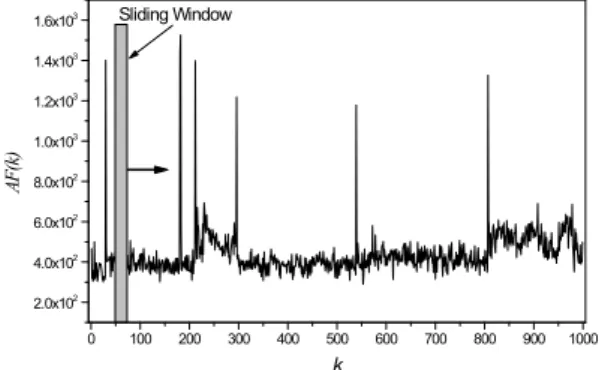
where is the frame index, and means the pixel value at position of DC image. can measure relative changes between each two con- secutive frames and its value indicates the magni- tude of such changes. We use curve to detect cut as illustrated in [9]. The method of [9] uses a sliding window to examine a few successive frame differences. We declare a scene change from frame to frame if
1) is the maximum within a sliding win- dow of size , and
2) is times of the second largest max- imum in the sliding window.
is set to be smaller than the minimum dura- tion between two scene changes. For example, set- ting for a 15 frames/s video means that there cannot be two scene changes within a second. It has been found that values of ranging form 2.0-3.0 give good result. This method would reduce false detection in cases of significant object or camera motions. Fig. 3 illustrates the plot of
versus or the clip of KBS (Korean Broadcasting System) TV news program, specific 1000 frames. From curve, we can easily know that this video sequence consists of 7 shots.
If the entire video sequence is segmented into shots by the above mentioned method, the next step is that we properly should assign the number of key frames to each shot and then distribute the
0 100 200 300 400 500 600 700 800 900 1000 2.0x10²
4.0x10² 6.0x10² 8.0x10² 1.0x10³ 1.2x10³ 1.4x10³
1.6x10³ Sliding Window
AF(k)
k
Fig. 3. Plot of versus for 1000 frames.
key frames over the shot. In the following sections, we will refer to these procedures.
2.2 Key Frame Allocation to a Shot
To represent video shots, it is necessary to properly decide the number of key frames (or rep- resentative frames) and select these key frames form each shot. Generally, it is not an easy task to determine the number of key frames automati- cally because the determination is very subjective to each person. Selecting one key frame for each shot has presented. However, a single key frame is not able to provide sufficient information about the video content of a given shot, especially for shots of long duration. Moreover, important shots of small duration may have no key frames while shots of longer duration may be represented by the multiple frames with similar content. We pro- pose a simple intuitively appealing algorithm for finding the number of key frames allocated in each shot. This algorithm may not be optimal, but it al- locates key frames to shot incrementally, one key frame at a time, in a way that yields good assignments.
The basic idea is that in each of a total of
key frames, one key frame is allocated where it will do the most good at this point. Let , called the content function, denote the content of the -th shot for the key frame allocation of key frames.
The content function of each shot is defined by
(4) , where is the accumulated value of
from the beginning up to the final summation posi- tion . can be calculated as follows:
(5), where , are the shot and frame index, respectively. If the summation of eq. (5) stretches through the entire frame within a shot, the total magnitude of temporal flow fluctuation in the shot is obtained which represents the content of the shot. In of eq. (4), is the number of frames in the shot.
Let denote the total number of key frames allocated to the-th shot after iteration , i.e., after
key frames have been allocated to the shots.
Now the request associated with the -th shot after the -th iteration of the allocation algo- rithm can be defined according to:
(6)
That is, the request after the -th key frame has been assigned is simply the content of the -th shot as regards its current key frames.
The proposed algorithm assigns key frames to shot as below.
Step 0. Initialize the key frame allocation to one, so that for each -th shot and . Set
as the initial values for request.
(The reason for is that at least one key frame must be allocated to each shot)
Step 1. Find the shot index with the maximum request.
Step 2. Set and set
for each ≠, then set
Step 3. If , increment by 1 and go to step 1. Otherwise stop.
Video sequences No. of
frames Bit rate min:sec TV news
("News.mpg") 10,000 1.3 Mbps 5:33 music video
("Music.mpg") 12,541 1.4 Mbps 6:58 sports
("Soccer.mpg") 20,000 1.3 Mbps 11:07 Table 1. Video sequences used in experiments
0 1000 2000 3000 4000 5000 6000 7000 8000 9000 10000 2.0x10²
4.0x10² 6.0x10² 8.0x10² 1.0x10³ 1.2x10³ 1.4x10³ 1.6x10³ 1.8x10³
AF(k)
k
Fig. 4. Plot of vs. for TV news sequence.
Table 2. Results of video segmentation Video
sequences No. of
frames No. of
shots ×
TV news 10,000 60 90
Music video 12,391 68 102
Sports 20,000 77 116
is the number of shots in the entire sequence.
This algorithm carries out a very simple and in- tuitive idea. That is, simply give away key frames to the most needy shot, one key frame at a time until you run out of key frames to give. The degree of neediness of each shot is measured based on the content it will yield if it were to operate with its current key frame assignment. By spreading the given maximal number of key frames along the entire video sequence, each shot of the sequence gets assigned a fraction of the given key frames according to its share of the content relative to the total content of the sequence.
3. SIMULATIONS
The proposed key frame assignment method was validated by experiment using several long video sequences, as listed in Table 1. The test se- quence was digitized at a 352×240(SIF) spatial resolution from consumer-grade video recordings of TV broadcasts and then compressed in MPEG-1 format at 30 frames/s. The sequence was also available as DC sequence, obtained from the MPEG stream with (slightly modified) frame sizes of 44× 30. The sequences include news programs, sports, and music video.
The reduced DC sequences were first extracted using the algorithm described in section 2. Next, the shot boundaries were detected using the meth- od from section 2. Fig. 4 illustrates the plot of
vs. for TV news sequence.
From the curve, the video sequence was
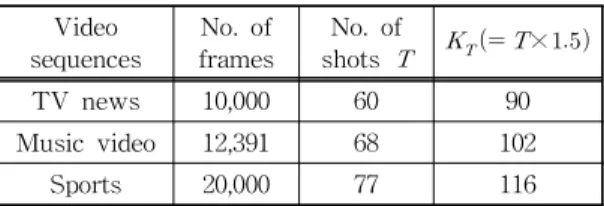
determined to consist of 60 shots. Table 2 lists the results of the video segmentation for each sequence.
After video segmentation, key frame allocation is then performed for the individual shots obtained as described in section 2.2. In the experiments, the only parameter set was the maximal number of key frames. Table 3 shows the key frame allocation re- sults obtained for the test sequences. The maximal number of key frames was set at 1.5 times the number of shots for each sequence in order to sufficiently describe the visual content of the shot.
can be adjusted by the user according to a pic- torial summary and storage capacity.
we know that several previous methods which are based on threshold [9,10] are very hard to esti- mate the total number of key frames for the entire sequence. Therefore, this method does not provide the controllability of the total key frame number according to the capacity of storage media.
Although thresholds can be updated and made shot-adaptive using statistical measures, they are essentially chosen subjectively yielding largely unpredictable results. Most likely, in a practical
Video sequences , ,
TV news (60 shots)
Shot index i 1 2 3 ⋯ 58 59 60
880 477 186 ⋯ 116 36 54
321288 276218 90656 ⋯ 37524 12146 24406
4 3 2 ⋯ 1 1 1
Music video (68 shots)
Shot index i 1 2 3 ⋯ 66 67 68
393 287 283 ⋯ 135 470 155
218148 127506 121744 ⋯ 54934 198256 58460
3 2 2 ⋯ 1 3 1
Sports (77 shots)
Shot index i 1 2 3 ⋯ 75 76 77
303 68 139 ⋯ 44 1164 67
99370 31863 64372 ⋯ 14916 364450 18634
2 1 1 ⋯ 1 4 1
Table 3. Results of proposed key frame assignment algorithm
0 5 10 15 20 25 30 35 40 45 50 55 60 1
2 3 4
no. of key frames Ki
shot index
0 5 10 15 20 25 30 35 40 45 50 55 60 0
100 200 300 400 500 600 700 800 900 1000
no. of frames
shot index
0 5 10 15 20 25 30 35 40 45 50 55 60 0.0
5.0x10⁴ 1.0x10⁵ 1.5x10⁵ 2.0x10⁵ 2.5x10⁵ 3.0x10⁵ 3.5x10⁵
Mi(Ki(0))
shot index
(a) (b) (c)
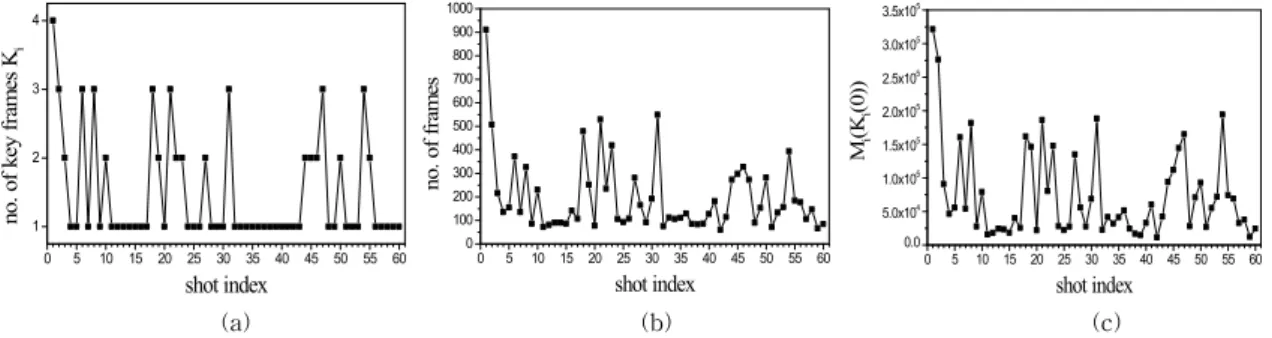
Fig. 5. Results of key frame assignment. (a) Number of key frames vs. shot index ( × , (b) Number of frames
vs. shot index, (c) Initial value of content function vs. shot index.
storage system a limit will exist on the number or rate of key frames to be stored because of storage limitations. To make matters worse, disadvantage of threshold-based method is that it needs (# of frames–# of shots–1) comparisons in order to find target for given threshold. For example, if a video sequence is composed of 10000 frames and it is segmented into 60 shots, 9939 comparisons are performed to find desired . To investigate var- iation of number of key frames for content and length of shot, we plot initial value of content func- tion, number of frames in shot, and number of key frames for shot index. In Fig. 5, the proposed algo- rithm produced a good compaction performance consistent with the duration and the content of
each shot. Fig. 5(a) illustrates the number of as- signed key frames in each shot when was set at 1.5 times the number of shots. However, can be adjusted by the user according to a pictorial summary. Figs. 5(b) and (c) illustrate the plot of the number of frames, and initial value of content function vs. shot index, respectively.
Unlike temporal video segmentation, an ob- jective performance analysis method is hard to de- fine for the assessment of a key frame assignment algorithm. Accordingly, the overall performance was evaluated by the temporal compaction ach- ieved according to the content of each shot. Fig.
5 shows that the proposed algorithm produces a good assignment performance consistent with the
content and the duration of each shot.
4. CONCLUSIONS
Recently, it is widely recognized that there is a need for intelligent management and search meth- ods particularly for visual information in multi- media documents and digital videos. Moreover, there is an essential need to automatically extract key information from images and videos for the purpose of indexing, fast and easy retrieval, and scene analysis. Therefore, key frame extraction provides a powerful tool for video content summa- rization and visualization.
In this paper, we proposed a new and simple key frame assignment algorithm applicable to various video-indexing schemes, such as content-based browsing and retrieval from video archives. The proposed algorithm can operate directly on Motion- JPEG or MPEG compressed video and is in- dependent of any subjective thresholds or manually set parameters. Experimental results confirmed the validity and usefulness of the proposed method. In addition, the proposed key frame allocation frame- work can provide a sufficient platform for many multimedia applications, efficient management of large video database, access to video archives, and the automatic creation of video clip.
REFERENCES
[ 1 ] Zeeshan Rasheed and Mubarak Shah,
“Detection and Representation of Scenes in Videos,”IEEE Trans. on Multimedia, Vol.7, No.6, pp. 1097-1105, 2005.
[ 2 ] Lijie Liu, “Combined Key-Frame Extraction and Object-Based Video Segmentation,”IEEE Trans. on Circuit and Systems for Video Technology, Vol.15, No.7, 2005.
[ 3 ] Jian-quan Ouyang, “Interactive Key Frame
Selection Model,”Journal of Visual Commun.
and Image Representation, Vol.17, Issue 6, pp. 1145-1163, 2006.
[ 4 ] Lang Congyan, “Automatic Key-Frames Ex- traction to Represent a Video,” P roceedings of IEEE ICSP '04, Vol.1, pp. 741-744, 2004.
[ 5 ] Guozhu Liu and Junming Zhao, “Key Frame Extraction from MPEG Video Stream,”
Proceedings of IEEE ISIP, pp. 423-427, 2010.
[ 6 ] Kin-Wai Sze, “A New Key Frame Represen- tation for Video Segment Retrieval,” IEEE Trans. on Circuit and Systems for Video Technology, Vol.15, Issue 9, pp. 1148-1155, 2005.
[ 7 ] Sang Hyun Kim and Rae-Hong Park, “A Novel Approach to Video Sequence Matching Using Color and Edge Features with The Modified Hausdorff Distance,”Proceedings of ISCAS, pp. II-57∼II-60, 2004.
[ 8 ] Janko Calic and Ebroul Izquierdo, “Efficient Key-Frame Extraction and Video Analysis,”
Proceedings of ITCC, pp. 28-33, 2002.
[ 9 ] B. -L Yeo and B. Liu, “Rapid Scene Analysis on Compressed Video,” IEEE Trans. on Circuit and Systems for Video Technology, Vol.5, No.6, pp. 533-544, 1995.
[10] Fangxia Shi and Xiaojun Guo, “Keyframe Extraction Based on K-meas Results to Adjacent DC Images Similarity,” Proceedings of ICSPS, pp. V1-611∼V1-613, 2010.
[11] B.L. Yeo and B. Liu, “Fast Extraction of Spatially Reduced Image Sequence from MPEG-2 Compressed Video,” IEEE Trans.
on Circuit and Systems for Video Technology, Vol.9, No.7, pp. 1100-1114, 1999.
[12] K.W. Kim and S.G. Kwon, “Shot Motion Classification Using Partial Decoding of INTRA Picture in Compressed Video,”Journal of Korea Multimedia Society, Vol.14, No.7, pp. 858-865, 2011.
Kang-Wook Kim
He received the B.S., M.S. and Ph. D. degrees in Electronics Engineering, Kyungpook National University, Korea in 1996, 1998 and 2002 respectively. He is currently a senior engineer in R&D Group, Mobile Communi- cation Division, Samsung Electronics Co.,Ltd. His re- search interests include visual communication, image processing and mobile communication.
Jae-Seung Lee
He received the B.S. and M.S degrees, Electronics Engineer- ing, Kyungpook National Uni- versity, Korea in 1999 and 2001 respectively. He is currently a engineer in Korea Aerospace Research Institute. His research interests include image processing, embeded system and realtime operating system.
Seong-Geun Kwon
He received the B.S., M.S. and Ph. D. degrees in Electronics Engineering, Kyungpook Natio- nal University, Korea in 1996, 1998, and 2002 respectively. He is currently an assistant pro- fessor of the Dept. of Electronic engineering in Kyungil University, Korea. His re- search interests include mobile broadcasting, water- marking and multimedia security.