• 검색 결과가 없습니다.

A Design of Foundation Technology for PLC-based Smart-grave(Tumulus) System

N/A
N/A
Protected

Academic year: 2021

Share "A Design of Foundation Technology for PLC-based Smart-grave(Tumulus) System"

Copied!
13
0
0

로드 중.... (전체 텍스트 보기)

전체 글

(1)

A Design of Foundation Technology for PLC-based Smart-grave(Tumulus) System

Jun-Ho Huh

, Taehoon Koh

††

, Kyungryong Seo

†††

ABSTRACT

In the Republic of Korea, there’s been a culture called ‘Hyo’ since Koryo Dynasty and this word represents the meaning of paying utmost respects to one’s own parents and ancestors whether they are alive or have passed. However, nowadays, most of people live away from their family gravesites so that they do not and cannot take care of them except on the special holidays. For this reason, people could not respond promptly to the incidents occurred at the sites as they receive notifications much later dates most of the time. Thus, in this paper, we propose a low-cost gravesite monitoring system which the users can immediately respond to the disastrous events after being informed of current situations through PLC without delay. For the performance evaluation, the lab and test bed experiments were performed on an actual ship using 200Mbps and 500Mbps products instead of performing an on-site experiment after the system has actually been constructed. The Mountain Region PLC was installed on the power lines and the result showed successful 36.14Mbps communication. Therefore, we expect that this study will contribute in time and cost reduction while constructing the internet infrastructures in mountain regions or building the Smart-graves, tumulus, and charnel houses.

Key words: PLC, Power Line Communication, Smart-grave System, Smart-tumulus System, ICT

※ Corresponding Author : Kyungryong Seo, Address:

DSLab, Pukyong National University at Daeyeon, 45, Yongso-ro, Nam-gu, Busan, Republic of Korea, TEL : +82-51-629-6262, E-mail : [email protected]

Receipt date : Sep. 1, 2015, Revision date : Sep. 16, 2015 Approval date : Sep. 18, 2015

†††

Senior Research Engineer of SUNCOM Co., Republic of Korea

(E-mail : [email protected])

†††

President of SUNCOM Co., Republic of Korea (E-mail : [email protected])

†††
Department of Computer Engineering, Pukyong National University at Daeyeon

※ This work was supported by a Research Grant of Pukyong National University (2015)

1. INTRODUCTION

In the Republic of Korea, there is a culture called

‘Hyo’, the Filial duty, since the Koryo Dynasty and it is to respect and attend one’s parents politely while they are alive and to maintain the gravesites after their parents or ancestors have passed. For instance, the nobles or the classical scholars retired from the official positions used to built a cabin nearby the grave and lived there for three years guarding it. Without distinction of being royals, middle class or commoners, they all spent several years keeping the gravesites as long as they could afford time and materials [1-11]. The reason was

that, other than royal families, the wooden coffins had been used mainly for the deceased but there was a concern that these coffins and gravesites would be swept away or lost by the land sub- sidence due to rain, typhoon or landslide, causing damages to the graves and corpses.

Such culture being passed down, Korean people

still visit the sites to perform ‘Myosa’, the ances-

tor-memorial rites, on the day of Chuseok, Korean

Thanksgiving day, ‘Soelnal’, Lunar New Year’s

day, and other regular family gathering. When they

conduct ‘Seongmyo’, respect-paying rites, or

Myosa, they usually check burial ground damages

and sinking and trim or remove weeds or tree roots

(2)

that cause damages to the gravesite, as well as making a deep bow afterwards. On the othe hand, some of those busy urbanites lay ashes of their an- cestors at the charnel house or outsource grave ti- dying and maintenance by phone or on-line. Many gravesites are mainly located in the mountain re- gions due to the costs involved and the ‘Theory of Divination’ based on the topography - which was introduced into Korea from China hundreds of years ago - such that not only because of the costs of grave maintenance but also of the time con- straints, these practices are being limited.

However, since these mountain regions often lack CCTVs, the number of grave incidents like surreptitious grave desecrations without permis- sion from the owner before starting construction works for the gold courses, ski resorts; grudge- oriented terror by driving in iron-stakes; and thefts of cultural assets from old tombs, etc. are on the rise becoming a serious social issues. Moreover, many bereaved families suffer from the damages of coffin or corpse caused by nature, wild animals or tree roots even if the coffin was made with hard materials.

Thus, we’ve designed the system proposed in this paper while preparing a piece, ‘An Encounter of Tradition, Liberal Arts, and the Present’, and will attempt to install an actual system at the one of the author’s ancestral gravesite after receiving a permission from regional Korean Electric Power Corporation (KEPCO).

2. RELATED STUDIES

2.1 Research Trends 2.1.1 Domestic Case

In the Republic of Korea, Hyung Sig Cho et al.

[12] conducted a research for the ‘Graveyard Management System Construction’ while Jin Duk Lee et al. [13] wrote the thesis ‘Development and Practicability Evaluation of GIS-Based Cemetery Information Management System'. Other related

studies include ‘Implementation of Gravestone Management System Based on Smart Phone using QR-Code’ by Young-Wook Kwon [14] and ‘Con- struction and Applicability of GIS-Based Grave Management System’ by Jin-Duk Lee et al. [15].

The idea of using QR-code on a tombstone is a relatively new concept in the Republic of Korea when compared to other countries mentioned in this study. Nevertheless, considering the number of traditional occasions in relation to memorial services and ancestral rites throughout the year, the market potential for QR-code application is yet to be realized. Especially, QR-code technology can be used for those people who cannot visit their family graves regularly. That is, millions of North Korean origins are still unable to visit their homes or gravesites in North Korea due to over half-a- century long conflict between South and North.

The QR-code technology may somehow ease their sorrow and pain by offering few virtual services such as creating virtual tombstones or family gathering images. Two major online sales markets are now offering gravesite management service or memorial service through online reservation sys- tem. Although QR-codes have not been largely utilized yet for the services they offer, it is clear that they will play an important and versatile role in near future with more sophisticated functions, considering the amount of money Korean people spend for the services currently, which is over 200 US dollars in average [10, 18].

2.1.2 Foreign Cases

Application of QR codes is becoming an effective

and efficient tool in advertisement industry where

various forms of social media are playing a vital

role. The major benefits of using QR codes is that

the users can collect more information through

these codes by just scanning them as the codes

often contain not just the graphic-based infor-

mation but also the sense-data such as sounds

and/or videos to let the readers to have better un-

(3)

derstanding of provided goods or services. The da- ta would sometimes include interactive graphics to emotionally or intellectually affect the code readers in their decision making process or behaviors. Such three-dimensional function can be observed in a safety campaign advertisement produced by the Australia’s Metro Train in Melbourne during 2012.

For the QR code used in this campaign, the pro- gram is embedded with a short animated video ti- tled ‘Dumb Ways to Die’ and it was downloadable freely without a charge. This public-aimed video was produced to promote safety awareness around the trains and made people to think twice before doing any ‘Dumb’ things that would lead to fatal consequences. This QR code application was a success, reducing around 21% in train-related deaths and the video gained five million views on YouTube. This indicates that the effectiveness of QR codes, in which three-dimensional information is contained to extend the functionality in in- formation or data provision technology. In this pa- per, we will further examine the effectiveness and applications of QR codes by investigating the ex- amples of QR code-applications in Asia, US and UK. Application of QR codes will be limited to tombstones because they are being widely used in countless sites and have different objects and effects. Our study will also investigate the effect of QR code technology on our perceptions in rela- tion to the funeral culture and the deceased [10].

Japanese funeral and graveyard management companies started to attach QR code on a tomb- stone or its adjacent objects and by 2012, the mar- ket has expanded widely using this technique. With the QR code exclusively prepared for the deceased, families and relatives can reminisce their loved ones who have passed away just scanning it with supplied device(s) on which photos, videos and in- formation are to be displayed. This supplementary form of memorial service is called ‘Kuyou no Mado’, which translates to the 'Memorial Service Window' and gives much more satisfaction by en-

abling online access [10, 19]. QR-codes are also used to make offerings, religious funeral chants, or prayers during the service. Moreover, for those who have perished during the national disaster (e.g., a great tsunami of Tohoku region in March, 2011), the Japanese government attached QR-co- des on the first 500 gravestone monuments and ev- eryone can tap into the information within [10].

The QR-codes used here also included warnings and the guidelines in the event of local disasters in both Japanese and English. The embedded mes- sage tells the readers to just keep on running till you hit top of the hill to save yourself and not to worry about the others while doing so. And, if you have succeeded and avoided the disaster, tell how high the water had reached and why only those who kept running survived [10, 20]. It is evident that the Japanese government intended to use the QR-codes not just to reminisce about the deceased but also to let people know what to do to survive in an extreme situation - the message was in- tended for the living also [10].

Not long ago, the Chinese government has

started to notice the problems in their people per-

forming funeral and ancestral rites. Despite of their

enormous land size, both the shortages of usable

burial grounds and economic losses due to annual

events of homecomings and offering rites are be-

coming serious every year. Because the Chinese

government practically owns all of the cemeteries

and relevant facilities, they now have to decide

what to do with these problems. While the vast

population of China may supply constant work-

force to their industries but on the other hand, peo-

ple's homing instinct goes beyond government

control. To keep China’s economic growth rate

steadily upward, they need more land and stable

local workforce. But at present, the burial grounds

are encroaching the lands that otherwise would

have been used for the industrial purposes. To deal

with the situation, they have implemented the

7-year term burial scheme after which the remains

(4)

of the deceased will be moved to the national mass graves or cremated if there are none of the families or relatives left to observe memorial services. The first measure taken was to assist people observe their memorial services and make offerings through internet and the QR-code technology was used partially to realize this virtual service program. This program is still in the experimental stage but it is expected that with a more sophisti- cated adjustments, it could be the solution they have been looking for. In some coastal cities like shanghai and Hong Kong, most of remains are cre- mated and the ashes and bones will be scattered on the sea. Otherwise, a small remnant of body can be kept on the land and families or relatives will be able to feel the existence of their beloved ones by checking it through internet links or the pro- gram embedded in the QR-code on collective tombstones [10, 21] or walls of the charnel house.

Families who choose such method will be sub- sidized economically and even allowed to perform religious or traditional services [10, 22] despite of government’s unfavorable attitude toward reli- gions. The QR-code-assisted virtual memorial services include making offerings, lighting candles, praying for the deceased and maintaining the grave virtually. Unlike the virtual programs used in Japan, China’s programs aim to moderate the na- tional economic stress caused by the traditional and religious memorial services during their often long national holidays. That is, they want to limit the population drift and improve land utilization capacity. To moderate people’s opposition, citizens of Beijing and Hong Kong are offered with 7-year long free online memorial service platform on which they can practice traditional Chinese memo- rial services mentioned above. This way, both the government and citizens can save costs and avoid drift of workforce. The effect of such scheme is not fully understood yet as it is not clear whether the virtual memorials would provide an adequate satisfaction to the people who are accustomed with

actual traditional and religious memorial acts for a very long period time [10].

As we have learned in the previous study, the QR-code application schemes in Asian nations are being led largely by the government sector as op- posed to the cases in the US and EU where it is a matter of individual choice. This is because most of cemeteries and relative services are provided by the private sector in Western countries as a form of business, whereas the same are offered by the central or local governments in China and China for the reason of national or public interest. Each nation’s goal is described above and our inves- tigation has revealed another interesting yet mean- ingful difference in their QR-code applications.

That is, the QR-codes used in the Western coun- tries seem to play rather emotional roles. Through those codes attached on the tombstones, families and friends would feel emotionally closer to the de- ceased and prolong the memories they shared before. Even though such experience may be an artificial one, it still gives some sort of comfort to them and they can proceed with their daily lives thinking that the deceased is within their hearts- personal and emotional desires outweigh practi- cality in terms of QR-code application purpose.

QR-Code was introduced to the UK and US markets first in 2011 and the sales expanded widely by 2012. A number of companies provided a service which embedded QR-codes into any kind of mate- rials that customers wanted. The cost was rather high forming the price range of 300 to 600 US dol- lars although the use of the programs was free.

The users can scan the QR-codes with their PC’s or smart phones to enjoy the contents. Now, some of the funeral homes offer to attach or embed QR-code on a tombstone, plaque and family’s me- morial website as an optional payable service [10].

More public parks and cemeteries have started to use this QR-code technology in their tourist programs to provide information of their facilities.

The Botley Cemetery, Oxford, UK, for example,

(5)

Fig. 1. Ship-PLC.

offers a QR-code-based system with which the visitors can access information about the war vic- tims buried in the cemetery. The information is available with any QR-code reader Apps on the smart phones (Public Service Co. UK 2012). Also, those who visit the Riverview Cemetery in Jeffer- son City, Missouri, USA can learn much about the famous figures buried there by accessing the QR- codes attached on 30+ tombstones. This QR-code- based interface provides cemetery pictures and in- teresting stories of events throughout its over 100 year-old history. The QR codes used at both sites provide rich information to visitors who want to know more about the place in a convenient and low-cost way. Without complex systems, visitors can enjoy an interactive museum-like experience leaving the cemetery landscape as it is but virtually transformed [10, 23]. As explained in the previous section, QR-code application on the tombstones is driven by the private enterprises in the UK and the US. The choice lies on the consumers who’d like to either see their loved ones again in a virtual en- vironment, or reminisce about the good memories they have had before. It’s fair to say that Asian QR-code usage seems to assume a religious form when compared to the Westerners who are usually driven by their desires. This, of course, is the result of ownership of cemeteries in each region. Often, the government-controlled cemetery operations tend to lean toward more practical uses and the users use the QR-code systems rather passively.

May be this has to do with ethnicity or educational and religious environments but more studies will be needed to cover this domain [10].

The private sector gradually started to maintain the initiative in funeral and memorial service in- dustry in both the US and the UK over the last century. The funeral homes provide all the neces- sary arrangements even when the services are to be conducted at the religious facilities and by pas- tors, monks or priests. This means that the growth and development of QR-code market and technol-

ogy totally depend on them. Also, to meet the de- mands from the consumers, funeral homes must find new ways to offer more heart-warming and memorable services. That being said, what can they do other than finding more stimulating and novel technologies? Those technologies should re- flect customer's desire of wanting to prolong memories of the deceased and get in touch with him or her even in a virtual environment. For those who believe that the dead still have a place among the living, QR-code technology and other Yet-to-Come technologies might be able to show them how to fulfill their wishes, either virtually or physically, anytime and anywhere [9-17].

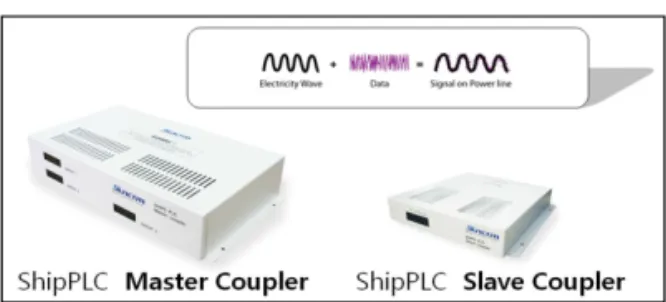
2.2 Proposed Mountain Region PLC System The mountainous regions are often damp due to the temperature differences and for this reason, de- humidifying feature is added to existing Ship-PLC system introduced by SUNCOM. At the same time, the lightning rod(s) have been installed to protect the equipment from frequent lightning strikes. We shall discuss these topics following domestic and foreign patent applications. The method of com- munication and the applicable voltage are the same with both of the existing 200Mbps and 500Mbps Ship-PLC systems marketed by SUNCOM.

2.3 Ship-PLC (Power Line Communications)

The Ship-PLC [5-9] is one of the networking

technology where data is transmitted through the

power line(s) already laid on board so that the sys-

tem enables high-speed data transfer without ad-

(6)

ditional cabling works. Fig. 1 is displaying a typical Ship-PLC system. This system can reduce both cost and time for those ships which have had pow- er lines installed throughout their ships already.

Proposed PLC system offer 200Mbps to 500Mbps data transmission speeds, ensuring a fast and effi- cient network service on the ship.

The definition of PLC: A communication techni- que which enables transmission of data or in- formation in the form of high frequency signals utilizing existing shipboard power line(s).

2.3 PLC

Power Line Communication, PLC, is a common name of a communication mode that uses power lines to transmit various forms of data and information. This technology involves transmitting data or information in a form of high-frequency signals and delivering them though power line(s).

Frequency signals can be separated from the pow- er line with the dedicated power line modems, and then transmitted to the terminal device(s). The PLC has two modes: High-speed PLC and Low- speed PLC. The former uses the frequency bands between 0.5 to 30MHz, achieving the speed of 14Mbps to 1Gbps while the latter utilizes the fre- quency bands of 10 to 450KHz, exerting the speed less than 9.6Kbps, which is mainly used to control electronic devices.

The power line communication media is origi- nally designed for power transmission rather than data transmission. For data communication, its channel characteristics are not ideal and the specif- ic negative factors are obvious noise and serious signal attenuation [7].

3. FOUNDATION TECHNOLOGY FOR PLC- BASED SMART-GRAVE (TUMULUS) SYSTEM

Power lines are usually installed across thinly populated mountain region to avoid environmental

dispute and coincidentally, that is the place where the gravesites are often created. Thus, we attempt to construct an infrastructure for the Smart Gravesite System in this region by applying SUNCOM’s Ship-PLC Network System. That is, we have designed a system that detects land sink- ing, grave desecrations and robberies by installing sensors, and that monitors out-grown weeds and pirate-plants for maintenance purpose by installing PLC-based CCTVs to notify the situation to the user via Smart Phone, with commercialization in mind.

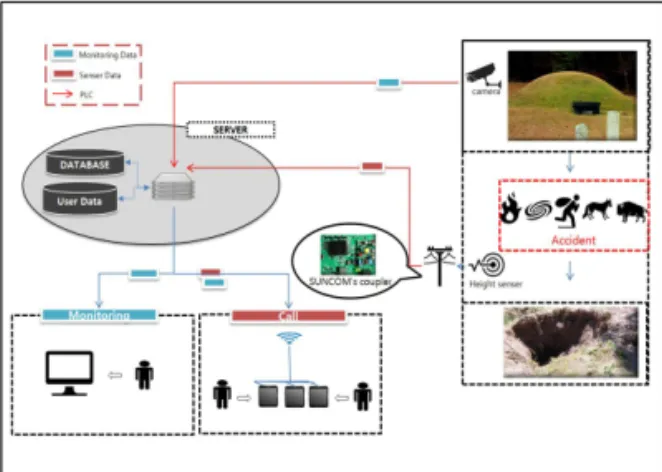
Fig. 2 is the PLC-based Smart-Grave(Tumulus) System diagram in which sensors are being in- stalled to collect data. Each component communi- cate each other through WiFi and power line(s).

The system was implemented with Java android for the use on a smart phone.

Fig. 2 PLC-based Smart-Grave System Diagram.

Our scheme to apply the PLC in the system has been devised for SUNCOM and the process is as follows. First, we plan to install existing housing on the utility pole after reconstructing the housing by adapting a master coupler within the coupler.

The slave coupler will be produced by the technical

team and put to the test for the certification. It is

impossible to install it on the high-tension power

line carrying more than 660V but is also feasible

with lesser voltages such as 440V, 220V and 110V

so that commercialization can be considered.

(7)

Fig. 6 User interface of Android-Based Application.

The schematics of the master coupler and the slave coupler are shown in following Fig. 3 and Fig. 4, respectively. Details will be disclosed in our dissertation after the patent applications have been completed.

Fig. 3 Mountain Region PLC master coupler.

Fig. 4 Mountain Region PLC slave coupler.

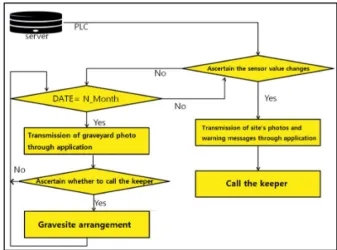
Fig. 5 shows the algorithm of the Smart-Grave (Tumulus) System and this was first implemented basically using the PLC connected with the server.

The system built with this algorithm utilizes the characteristics of sensors installed at the grave- sites such that sensor-obtained values change in the event of disasters. Our implemented system will deliver the photos or user-assigned data or in- formation once a month to check the lengths of glasses or condition of the grave throughout the year. Like any other countries, those with financial leeway willingly spend their money for the grave- sites to fulfill filial duty. We expect that once the internet platform has been built, one can not only maintain their graveyards but also monitor natural disasters such as landslides and forest fires, in ad- dition to conducting forensic activities against the crimes committed at the CCTV-blind sites in the mountain regions. Furthermore, we anticipate that

it will help the authorities to find the lost graves for those relatives and friends who have been look- ing for them. The information they can provide will be present location of the grave and even the con- dition of casket, if possible.

Fig. 5 Smart-Grave(Tumulus) System Algorithm.

Fig. 6 shows the User Interface (UI) of an Android-based application. We describe four do- mains of this interface following their functions.

[Domain 1] has the function of updating previously

stored Mac address(s) by the user. The function

of [Domain 2] is to output and update the Mac ad-

dress currently accessing. In [Domain 3], access

to the server URL, which is to check the sensor

values, is established and one's own monitoring

information can be checked. Finally, the function

in [Domain 4] is to output Mac address currently

stored. Should the Mac address stored in [Domain

(8)

Fig. 7 Lab-based performance evaluation of the Mountain Region PLC (500Mbps) proposed by SUNCOM.

4] matches the Mac address being accessed in [Domain 2], then it is determined that someone has entered the Grave. [Domain 5] takes video streams from CCTV and provide them to the user upon request. However, the contents of [Domain 5] has been implemented with UI only and therefore the prototype is not yet ready so that it is not repre- sented in this paper.

4. PERFORMANCE EVALUATION

Fig. 7 is the result of lab-based performance evaluation conducted for the proposed PLC system aimed to be deployed in the mountain regions in the future. The voltage level used for the evalua- tion was 440V and the resulting speed measure- ments under each different condition are as fol- lows:

- Approx. 40Mbps, when the distance between the PLC Master Coupler and electric wire was 50M.

- Avg. 4Mbps, when the distance between the electric wire and PLC modem was 5M.

- Ave. 4Mbps and Avg. 36.14Mbps when the distances between the PLC modem and TLC modem were 1M and 56M, respectively. Prior to commercialization, we plan to proceed with a test bed experiment actually installing the system at the graveyard of Dongjusagong branch of Yangcheon Huh family (Gimhae, Gyeongnam province) as soon as the system has is patented and the work-related appro- vals have been granted by KEPCO.

5. COMPARISON WITH OTHER SYSTEM

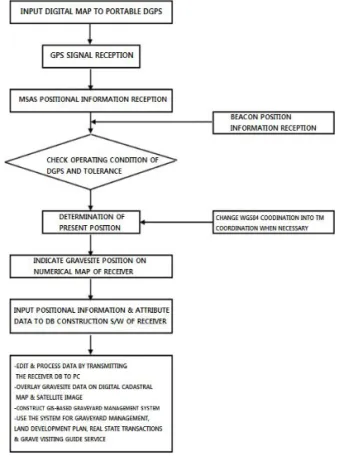
Securement of observation accuracy and highly mobile survey techniques must be preceded to effi- ciently locate gravesite positions as they are often distributed all over the forested areas. The ordinary DGPS (Differential GPS) and RTKGPS (Real- Time Kinematic GPS) currently used for the sur- veying display fine accuracy but lack efficiency because they need to carry out the control point surveying to establish a reference station, and also lack portability and mobility in the forested mountains. Thus, the enhanced design proposed in this paper aims to establish an economical GIS- based graveyard management system by enabling swift and accurate surveying using a small-sized and highly mobile portable DGPS equipment so that the survey can be conducted with only a single mobile station without setting up any reference stations Fig. 8.

Fig. 8. Flow chart of the graveyard GIS construction

using portable DGPS.

(9)

The features of portable DGPS proposed in the comparative system [12] can be described as follows. First, although this DGPS equipment does not have a cm-level accuracy, it does not require to conduct separate survey to set up a reference station like the systems that use ordinary GPS or DGPS equipments. That is, no reference station is needed at the control point. Additionally, the DGPS survey system that satisfies the required accuracy can be constructed at a moderate cost without us- ing expensive equipments.

Second, due to its high portability and mobility, the system can be very efficient for the survey works at the mountainous areas. While ordinary RTK or DGPS system includes a receiver(s), GPS antenna, wireless modem receiver and exclusive antenna, batteries and a controller forming a bulky set of equipments, the portable DGPS displays bet- ter and high mobility as it includes all features within a small, single light-weight receiver. Third, as it receives the positional information signals without a charge, no cost will be incurred. Since both the positional information of the beacons and the SBAS correction signals are being provided by the Ministry of Land, Transport and Maritime Affairs and also by the Japanese Ministry of Land, Infrastructure, Transport and Tourism respectively without any fees, only the costs related to equip- ments purchase, maintenance and consumable supplies will be borne.

Fourth, real-time mapping of the graveyard conditions and attribute input can be carried out on the spot with the DGPS coordinates using em- bedded mobile GIS software and digital map. All of these benefits contribute to the construction of cost-reduced GIS-based Graveyard Management system.

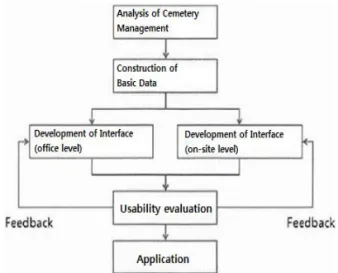
In the comparative system [13], as a preliminary study, an application development method was studied to recognize the necessity of graveyard management and to achieve easier and more con- venient management. Here, we attempted to pro-

mote user experience by developing an user-cen- tric interface using a web-based RIA technology.

Also, for the analysis of market demands, we in- vestigated cemetery-related laws, existing grave- yard management programs and the websites of the graveyard management companies. As for the system design, a database was designed with ERJStudio on the basis of pre-investigated grave- yard management programs and constructed using MySQL. Additionally, for the development of in- terface (with Flex), WMS was constructed using MapServer and connected with ‘ArcGIS API for Flex'. On-site use interface was developed on the basis of ArcPad using VBscript. Finally, we inves- tigated people’s awareness of the graveyard man- agement system by conducting a survey to reflect it upon the user-centric system development process. These works were to assist the users to use the system in their business conveniently without having to receive any special training.

Fig. 9. Development flowchart of the Graveyard Mana- gement System.

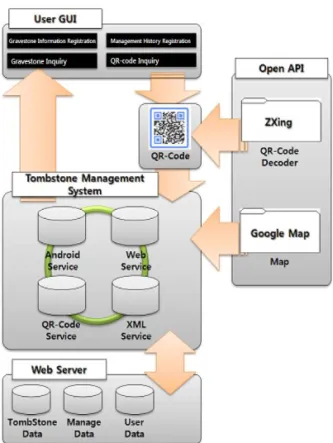
Fig. 10 is a system configuration proposed in the

comparative system [14]. Once a user recognizes

the code through QR-code decoder, the unique key

value is extracted and the registration data will be

stored using the key. The registration data includes

the user ID, key value, registration name and date,

(10)

Fig. 10 Gravestones Management System Configuration.

nameplate and positional information value of the gravesite. As for the management history registra- tion, the recent date and work title, registration name, work specifics (e.g., mowing, weeds re- moval, pest control, grass condition management and so on) will be entered for the record. The input data is then stored at the database of a server and the user can perform data inquiry, modification and delete functions with the GUI embedded in their smart phones.

In the comparative system [15], we also devel- oped a GIS-based Gravestone Management Sys- tem and were able to draw following conclusions after applying the system to the test area. First, with the system which was developed with a data- base comprised of individual graves' information, it was possible to satisfy and implement the ‘Act with Respect to the Funeral Procedures’, which de- fines the installation and management procedures.

That is, by targeting the unauthorized graves (i.e., individual or family graves not placed at the ap-

proved cemeteries), we constructed a database which the information collected from the inves- tigation conducted by the administrative system was stored and showed that this database can be utilized for the management of unattended graves or to comply with the time-limited burial approval, which enforces cremation of the corpse after a de- fined period of time, through the GIS-based grave- yard management system. Second, since this sys- tem has been constructed considering the manage- ment of the individual graveyards in the juris- dictions set by each administrative office, we were able to show that families and clans will be able to effectively manage their ancestors’ graves by constructing their own graveyard management systems separately, following the family traditions they obey. Third, by constructing a database by extracting and integrating data such as coordinates obtained from the GPS survey, GIS analysis, ca- dastral or urban planning maps, it was possible to minimize the number of separate manual inputs of relevant records. By considering all of the cadas- tral, urban planning, topographic and forest land maps, relevant attribute data, and related grave- yard installation restriction laws, it will be easier to analyze the suitability of location of the existing graveyard or the development space for the new graveyard. However, there hasn't been any at- tempts to install the IoT (Internet of Things) at the Grave site to this date, at least in the Republic of Korea.

6. CONCLUSION

In this paper, a lab-level Mountain Region PLC

System was constructed using power line(s) and

the result showed successful 36.14Mbps communi-

cation. Also, we consider that the system will be

resistant to typhoons and precipitation so that we

are planning to construct actual system in the fu-

ture work after receiving permission from the

KEPCO.

(11)

We expect that the Smart Cemetery System will reduce costs and time when constructing neces- sary infrastructure for the remote mountainous re- gions, gravesites, tumuli and charnel houses.

Described system will surely bring forth many changes in current gravesites management or cer- emonial acts. There are other areas to be studied further to supplement the system when the actual plan is in place and ready to be implemented at the mountainous region. While cost and time efficien- cies emphasized in this study may be preferable to the users, funeral companies and governments, ethnic tradition and authenticity should be consid- ered for the commercialization.

APPENDIX

In the republic of Korea, many people changed their internet providers believing that they will be served with a 100Mbps internet speed. However, the provided speed was merely around 12Mbps, much different from what has been claimed on the contract sheets they received. The term says that the data will be transmitted with a speed of 100Mbps (Mega bit per second) and this somehow makes sense. But one should be aware of a snare set in this term. That is, a technical term ‘bit’ which refers to a binary digit. The Bit is the smallest unit in describing PC’s capacity or processing power and also used to indicate the size of a file. By con- trast, users usually use the unit ‘byte'. This unit was introduced to express various information or data which cannot be expressed with bits whose expression ability is limited by 0 or 1.1 byte is equivalent to 8 bits so that 100M bits equals to 12.5 bytes.

There was no problem in expressing the ca- pacity in bits in the past but over time, such usages have decreased and they were replaced by bytes gradually. On the other hand, ‘bit’ is still used in the field of communication as a unit to measure the communication speed (bps: bits per second) since 40 years ago. It’s true that this practice caus-

es much confusion. Thus, it is considered essential that such mixed usages should be reduced by standardizing the units or at least by writing both units, to ‘express’ their gratitude to the customers.

In this paper, a speed of 500Mbps was applied for the lab test but the actual highest speed we’ve gained was 36.14Mbps to 40Mbps in average. The result was quite contrary to the expected speed of 62.5Mbps and we believe that this is due to the signal attenuation on the power line. We will try to correct the situation but yet, the problem of in- ternet disconnection will not occur in the system so that we expect that there still remains a good business opportunity.

ACKNOWLEDGEMENT

A part of the fundamental technology in this pa- per contains the Republic of Korea ‘Patent No.

10-0942020’ registered on Feb. 2010 after being submitted on April of 2008 related to the theory concerning ‘The Ship-PLC Master Coupler Under the 3-Phase 3-Line Delta Connection Environment’

by the author of this paper, SUNCOM Co., Ltd.

We wish to express our gratitude to Professor Candi K. Cann of Baylor University, United States of America for providing us with [10] research pa- per as a reference to current research trends.

REFERENCES

[ 1 ] B. Kwon, "Book of Filial Piety Family (Annual Publication)," Chungyeol King Goryeo Dyn- asty, AD.1236-1450.

[ 2 ] S. Seol, "Samgang Haengsildo," AD.1434.

[ 3 ] S.J. Shin, “Gugjo Orye,” AD.1474.

[ 4 ] B.M. Lee, “Oryun Haesildo,” AD.1797.

[ 5 ] S. Tsuzuki, M. Yoshida, Y. Yamada, K. Murai,

H. Kawasaki, S. Takaoka et. al., "Channel

Characteristic Comparison of Armored Ship-

board Cable and Unarmored one," IEEE

International Symposium on Power Line

Communications and Its Applications, pp.

(12)

7-12, 2008.

[ 6 ] S. Tsuzuki, M. Yoshida, Y. Yamada, H.

Kawasaki, K. Murai, M. Suzuki et. al., "Char- acteristics of Power-Line Channels in Cargo Ships," IEEE International Symposium on P ower Line Communications and Its Appli- cations, pp. 324-329, 2007.

[ 7 ] J.H. Huh and K.R. Seo "PLC-Based Smart grid Home Network System Design and Implementation using OPNET Simulation,"

J ournal of Multimedia and Information Sys- tems, Vol. 2, No. 1, pp. 113-120, 2014.

[ 8 ] C.Z. Ling, and A.G. Hoseini, “Greenscaping Buildings: Amplification of Vertical Greening towards Approaching Sustainable Urban Structures," J ournal of Creative Sustainable Architecture & Built Environment, Vol. 2, pp.

13-22, 2012

[ 9 ] K. Kensek and J.Y. Suk, "Daylight Factor (Overcast Sky) versus Daylight Availability (Clear Sky) in Computer-Based Daylighting Simulations," Proceeding of CSABE. pp. 3- 14, 2011.

[10] C.K. Cann, “Tombstone Technology: Death- scapes in Asia, the U.K. and the U.S,”

P roceeding of Human-Computer Interaction Series, Springer International Publishing Switzerland, pp. 101-113. 2013.

[11] H.S. Cho, H.G. Sohn, S.B. Lim, S.S. Kim, and S.M. Kim, “Construction of Cemetery Mana- gement System using Mobile DGPS,” The Korea Society For GeospatIal Information System, Vol. 16, No. 4, pp. 49-57, 2008.

[12] J.D. Lee and M.H. Kim, “Development and Practicability Evaluation of GIS-Based Cem- etery Information Management System,”

J ournal of the Korean Society of Surveying, Geodesy, Photogrammetry, and Cartography, Vol. 28, No. 2, pp. 223-231, 2010.

[13] Y.W. Kwon, S.H. Jung, and C.B. Sim, “A Implementation of Gravestone Management System Based on Smart Phone using QR-

Code,” Proceeding of Fall Conference of the Korea Institute of Electronic Communication Sciences, Vol. 5, No. 2, pp. 259-263, 2011.

[14] J.D. Lee and S.H. Lee, “Construction and Applicability of GIS-Based Grave Manage- ment System,” Journal of the Korean Asso- ciation of Geographic Information Studies, Vol. 14, No. 4, pp. 208-220, 2011.

[15] J.H. Huh and K.R. Seo, “Design and Imple- mentation of the Basic Technology for Solitary Senior Citizen's Lonely Death Moni- toring System using PLC,” Journal of Korea Multimedia Society, Vol. 18, No. 6, pp. 742- 752, 2015.

[16] J.C. Kim, T.S. Wei, J.S. Ko, H.K. Choi, M.J.

Tak, and C.Y. Kim, “A Study on Oriental Medicine Hybrid Multi-cup Electric Cupping Contents using Vacuum Pressure,” Journal of Korea Multimedia Society, Vol. 17, No. 11, pp.

1363-1373, 2014.

[17] A. Eichler, G. Gramlich, T. Kellerhals, L.

Tobler, and M. Schwikowski, “Pb Pollution from Leaded Gasoline in South America in the Context of a 2000-year Metallurgical History,”

Science Advances Research Article, The American Association for the Advancement of Science, Vol. 1, No. 2, pp. 1-8, 2015.

[18] How Chuseok is Changing, Wall Street Journal, http://blogs.wsj.com/korearealtime/2011/09/0 6/how-chuseok-is- changing (Last accessed Jan., 22, 2013).

[19] Memorial Window, Digital Life,

http://www.shifteast.com/qr-code-graves-gi ve-a-memorial-window (Last accessed Dec., 20, 2012).

[20] First Japan Tsunami Monument has QR Code Video and Advice,

http://digitaljournal.com/article/ 316636 (Last accessed Jan., 28, 2013).

[21] Wasted Space in Cemeteries Inspires Newmini-burials, China Daily,

http://usa.chinadaily.com.cn/business/ 201103/

(13)

28/content_12238547.htm (Last accessed Jan., 25, 2013).

[22] Virtual Memorial, China Daily,

http://usa.chinadaily. com.cn/life/2011-04/01/

content_12262543.htm (Last accessed Dec., 20, 2012).

[23] QR Codes Link Past with the Present in Jefferson City Cemetery, KBIA News, http://kbia.org/post/qr-codes-link-past- present-jefferson-city- cemetery (Last ac- cessed Jan., 26, 2013).

[24] J.H. Huh, “Design and Implementation of Foundation Technology for PLC-based Smart-Grave(Tumulus) System,” Proceeding of Korea Multimedia Society, Vol. 18, No. 1, pp. 275-278, 2015.

Jun-Ho Huh finished the Cooperative Marine Science and Engineering Pro- gram, Texas A&M University at Galverston, United States of America in Aug. 2006.

Received B.S. in Science Degree from Department of Major of Applied Marine Sciences [Marine Aquaculture, Ocea- nography, Marine Life Sciences (Currently Faculty of Marine Biomedical Sciences)], B.S. in Engineering Degree (Double Major) from Department of Major of Computer Engineering from Jeju National University at Ara, Jeju, Republic of Korea in Aug. 2007. And com- pletion of the Secondary School (Middle and High schools) Teacher Training Curriculum in accordance with Republic of Korea Secondary Education Act.

M.A. in Education Degree from Department of Major of Computer Science Education, Graduate School of Education, Pukyoug National University at Daeyeon, Busan, Republic of Korea in Aug. 2012. And com- pletion of the Secondary School (Middle and High schools) Teacher Training Curriculum in accordance with Republic of Korea Secondary Education Act.

Finish the Ph.D. Program in Computer Engineering, Graduate School, Pukyoug National University at Daeyeon, Busan, Republic of Korea in Aug. 2015.

He received the Best Paper Award from Korea Multimedia Society thrice (Nov. 2014, May. 2015, Nov.

2015).

Currently he is Senior Research Engineer of SUNCOM Co., Republic of Korea.

His research interests are Green IT, Smart Grid, Network Security, Curriculum of Computer, High Availability Computing.

Taehoon Koh received Diploma in School of Computer & Information, Busan Institute of Science & Technol- ogy College (Currently Busan Institute of Science and Tech- nology), Busan, Republic of Korea in Feb. 1996.

Received B.S. in Engineering Degree from Department of Major of Information and Communication, Sejong Cyber University, Seoul, Republic of Korea in Feb.

2013.

M.S. in Engineering Degree in Computer Engineering, Pukyong National University Graduate School of Industry, Busan, Republic of Korea in Aug. 2015.

Student in the Doctor Course Major of Computer Engineering, Graduate School, Pukyoug National Uni- versity at Daeyeon, Busan, Republic of Korea.

He received the Best Paper Award from Korea Multimedia Society twice (May. 2015, Nov. 2015).

Currently he is President of SUNCOM Co., Republic of Korea.

His research interests are PLC, High Speed Computer Network, Network Security, High Availability Com- puting.

Kyungryong Seo

received B.S. in Engineering Degree from Department of Major of Electrical Machinery Engineering from Pusan Natio- nal University, Busan, Republic of Korea in Feb. 1983.

M.S. in Engineering Degree in Electrical Engineering from Korea Advanced Institute of Science and Technology (KAIST), Daejeon, Repu- blic of Korea in Feb. 1990.

Received the Ph.D. Engineering Degree in Electrical Engineering from Korea Advanced Institute of Science and Technology (KAIST), Daejeon, Republic of Korea in Aug. 1995.

Currently he is a Full Professor (Tenure) of Computer Engineering Departments, Pukyong National University at Daeyeon, Busan, Republic of Korea.

His research interests are High Speed Computer Net-

work, Network Security, High Availability Computing.

수치

Fig. 1. Ship-PLC.
Fig. 2 is the PLC-based Smart-Grave(Tumulus) System diagram in which sensors are being  in-stalled to collect data
Fig. 3 Mountain Region PLC master coupler.
Fig.  7  Lab-based  performance  evaluation  of  the  Mountain Region PLC (500Mbps) proposed by  SUNCOM.
+3

참조

관련 문서

This study aims at identifying whether graduate school of Entrepreneurship is proposed as an alternative for institution enhancing the expertise of entrepreneurship education

Department of Japanese Language and Literature, Graduate School, Cheju National University. Supervised by Professor

The academic journals used at the time were ‘The Mathematical Education’ of The Korean Society of Mathematical Education, ‘Journal of Educational Research

Therefore, in order to improve student satisfaction and the quality of public education service, public education institutes should design education programs

(Vocational High Schools vs.. Source : Ministry of Education, Statistical Yearbook of Education, various year.. Source : Ministry of Education, Statistical Yearbook

Department of Electrical Technology Convergence Engineering, Graduate School of Industry Technology

After first field tests, we expect electric passenger drones or eVTOL aircraft (short for electric vertical take-off and landing) to start providing commercial mobility

1 John Owen, Justification by Faith Alone, in The Works of John Owen, ed. John Bolt, trans. Scott Clark, "Do This and Live: Christ's Active Obedience as the