서 언
1990년대 이후 국내 경제발전으로 먹을거리가 풍부해지고 서구화된 식생활 및 운동부족으로 인한 에너지 불균형으로 비 만 환자가 점차 늘고 있다. 2018년 보건복지부에서 발표한 국민 건강영양조사에 따르면 비만의 유병률은 1998년 26.0%에서 2018년 34.6%로 증가하였으며, 특히 남성은 1998년 25.1%에서 2018년 42.8%로 1998년에 비해 15%가량 증가된 것으로 비만 유 병률이 증가하는 추세로 파악되고 있다.
비만은 신체조직에 지방이 과도하게 축적된 상태를 의미하 는 것으로 고혈압, 이상지질혈증, 간기능 저하 및 제2형 당뇨병 등의 합병증 발생을 유발하며(Mokdad et al., 2001; Lavie et al., 2009; Jung and Choi, 2014), 우울감과 스트레스를 야기시
켜 사회심리적, 정신병리적 차원에서 영향을 미치게 된다(Nam and Park, 2012). 비만 예방 및 치료를 위한 근본적인 방법으로 운동과 식이요법 등이 있으나(Jeong and Bae, 2002) 생활습관 을 개선하는데 어려움이 있어 그 대안으로 약물치료를 해왔지 만 약물 효과가 없거나 부작용이 나타나는 것으로 보고되고 있 다(Schhen and Lefebvre, 1999; Peter and Williams, 2001). 최 근들어 천연물 유래 추출물의 항산화, 항염증 및 항비만 등 다양 한 생리활성에 대한 연구가 진행됨에 따라 기능성 식품소재로 서 천연물 유래 추출물을 활용한 비만 예방 및 치료제로 가능성 이 높아지고 있다(Jung et al., 2016; Jung et al., 2017; Jung et al., 2018; Kim et al., 2021; Song et al., 2016). 비만은 지방 전구세포의 분화 및 지방생성과정에 의해 지방세포 내 중성지 방(triglyceride, TG)이 축적되며, 분화된 세포 내에서 활성화 된 lipogenesis의 작용으로 인하여 지방구(Lipid droplet, LD) 가 과다 축적되어 유도된다. 따라서 지방전구세포분화를 억제
Rhodosporidium toruloides에서의 적색 파프리카 에탄올 추출물의 중성지방 억제 효과
강주원
1
, 이승제2
, 안병용3
*1
전북대학교 한약자원학과, 대학원생,
3교수,
2전라북도생물산업진흥원, 수석연구원
Inhibitory Effects of Ethanol Extract of Red Sweet Pepper (Capsicum annuum L.) on Triglyceride Biosynthesis in Rhodosporidium toruloides
Ju-Won Kang
1
Seung-Je Lee2
and Byung-Yong Ahn2
*1
Graduate School Student and
3Professor, Department of Oriental Medicine Resources, Chonbuk National University, Iksan 54596, Korea
2
Principal Researcher, Research and Development Headquaters, Jeonbuk Institute for Food-Bioindustry, Jeonju 54810, Korea
Abstract - In this study, we investigated inhibitory effect of red sweet pepper (Capsicum annuum L.) on triglyceride biosynthesis in Rhodosporidium toruloides. There was no significant difference in the total lipid content of all the experimental groups including 0.02, 0.1 and 0.5% (w/v) of red sweet pepper 70% ethanol extract treatment (RSPE).
However, the triglyceride content was significantly decreased in RSPE group campared to the control group. When the formation of lipid droplet in the oleaginous yeast was examined, a small amount of fluorescence was observed compared to the control as the concentration of RSPE increased. The number of cells and free fatty acid increased in a concentration- dependent manner. These results suggest that RSPE has an anti-obesity effect.
Key words –
Free fatty acid content, Red sweet pepper, Rhodosporidium toruloides, Triglyceride content
*교신저자: E-mail [email protected] Tel. +82-63-850-0743
ⓒ 본 학회지의 저작권은 (사)한국자원식물학회지에 있으며, 이의 무단전재나 복제를 금합니다.
Original Research Article
하는 등 지방생성기전을 조절하는 것이 비만 억제의 효과적인 치료 방법으로 알려져 있다(Cao et al., 1991; Kim, 2009; Rosen et al., 2000). 항비만 활성을 평가하기 위한 in vitro 실험으로 생쥐의 섬유모세포에서 유래된 3T3-L1 지방전구세포가 많이 사용되고 있으나 최근 연구에서는 지방유래줄기세포 및 단세포 유지 생산 미생물을 이용한 항비만 연구가 진행되고 있다(Park et al., 2019; Lee et al., 2018).
효모, 미세조류 및 곰팡이는 단세포유지 생산 미생물로 잘 알 려져 있으며, 그중 가장 널리 사용되는 미생물은 효모로 Crypto- coccus curvatus, Lipomyces starkeyi, Rhodosporidium torul- oides, Rhodotorula glutinis 등이 있다(Kim and Yoon, 2015).
특히 R. toruloides는 담자균 효모로 세포 건조 중량의 70% 이상 을 지질로 축적하여 지질 생산을 위한 유기체 모델로 활용되었 으며, 카로티노이드와 효소를 생산하여 식품, 제약 및 바이오 디젤 산업에서 활용되어 왔다(Passoth, 2017; Wiebe et al., 2012;
Zhu et al., 2012). R. toruloides가 생산하는 지질 중 대부분은 지방구로 TG, sterol esters, ether lipids를 포함하여 90% 이상 의 중성지질로 구성되어 있다(Bartz et al., 2007; Zhu et al., 2015). R. toruloides에 대한 선행 연구로는 균체 내 지질 생성량 을 증가시키기 위한 연구가 수행되었으나(Li et al., 2006;
Yaegashi et al., 2017), 본 연구에서는 선행 연구와는 반대로 균 체 내 지질 생성량을 감소시키는 효과를 확인하고자 하였다.
파프리카(Capsicum annuum L.)는 가지과에 속하는 한해살 이 식물로 6개의 아종이 있으며, 과실의 품종에 따라 적색, 황 색, 녹색 및 자주색 등 다양한 색을 가지고 있다. 우리나라에서 는 bell type의 고추를 파프리카라고 하며, 영명으로는 ‘sweet pepper’ 또는 ‘bell pepper’라고 한다(Lee, 1998). 파프리카는 비타민 A, B1 및 C가 풍부한 알칼리성 강장식품으로 알려져 있으 며, ascorbic acid, tocopherol, flavonoid, carotenoid 등 다양 한 생리활성물질을 함유하고 있다(Kim et al., 2011). 카로티노 이드 계열 중 capsanthin, β-cryptoxanthin, zeaxanthin 등은 free radical로 인한 조직의 산화적 손상을 보호하며(Bendich, 1989; Kaur and Kapoor, 2001), 특히 적색 파프리카(red sweet pepper, RSP)는 capsanthin, capsorubin 및 β-carotene 등 카 로티노이드를 함유하고 있다. capsanthin은 지방 생성 억제 효 과(Kim et al., 2017)와 혈장 HDL-cholesterol 증가 효과 (Aizawa and Inakuma, 2009)가 보고되어 있으며, capsorubin 의 항산화 효과(Maoka et al., 2001), β-carotene의 면역 기능 강화(Bendich and Shapiro, 1986)와 같은 효능들이 보고되었 다. 이외에도 적색 파프리카의 생리활성에 대한 선행 연구로 항
염(Choi et al., 2020) 및 항암 효과(Yu et al., 2006)에 대한 연 구결과가 보고되었으나 유지효모에서의 적색 파프리카 추출물 의 중성지방 억제 효과에 관한 연구는 미비한 실정이다. 따라서 본 연구는 유지효모 R. toruloides를 활용하여 적색 파프리카 추 출물의 중성지방 억제 효과를 확인하기 위하여 수행되었다.
재료 및 방법
실험재료 및 추출물 제조
본 실험의 주재료인 적색 파프리카는 2020년 7월 수확된 라이 커(Lyker) 품종을 전라북도 남원시에 소재한 운봉농협협동조합 에서 구입하여 사용하였다. 적색 파프리카는 비가식 부위인 꼭 지와 씨를 제거하여 물에 세척한 후 선반에 건조하여 45℃에서 48시간 건조한 후 믹서기로 분쇄하여 시료로 사용하였다. 적색 파프리카 열수 추출물은 분쇄한 적색 파프리카 분말에 증류수 10 배량(w/v)을 가한 후 80℃에서 3시간 동안 추출하였으며, 30%
및 70% 에탄올 추출물은 용매 10배량(w/v)을 가한 후 60℃에서 3시간 동안 추출하였다. 추출물은 여과지(Advantec NO. 2, Toyo Roshi Co. Ltd., Japan)를 이용하여 여과한 후, 회전감압 농축기(EYELA, Rikakikai Co., Japan)를 사용하여 45-50℃에 서 감압 농축한 후 동결건조하였다. 건조된 적색 파프리카 추출 물은 분말 형태로 회수하였으며, -20℃의 냉동고에 보관하면서 실험에 사용하였다.
균주배양
적색 파프리카 추출물의 중성지방 억제 효과를 알아보기 위 하여 R. toruloides를 이용하였다(Jeong, 2017). 본 실험에 사용 된 유지효모 R. toruloides (KCTC No. 17338, Type Strain)는 한국생명공학연구원 생물자원센터(Korean Collection for Type Cultures, KCTC, Korea)에서 분양받아 사용하였다. R. toruloides 는 YPD broth (Difco, USA)를 이용하여 25℃에서 180 rpm으로 72시간 동안 배양하였다.
시료 처리
시료는 YPD broth에 적색 파프리카 추출 분말을 0.02, 0.1 및 0.5% (w/v)로 첨가하여 용해시킨 후 고압멸균(121℃, 15 min)하 여 사용하였다. 제조된 배지에 유지효모 0.05% (v/v)를 접종한 후 25℃에서 180 rpm으로 72시간 동안 배양하였다. 유지효모를 배양한 시료는 배양종료 후 원심분리(4℃, 3,000 rpm, 15 min) 하여 상등액을 제거하고 50℃로 유지된 건조기에서 건조한 후
총 지질 함량 및 중성지방 함량 분석 시료로 사용하였다. 이때 양성대조구로 DL-methionine (Junsei, Japan)을 사용하였다.
총 지질 함량 분석
유지효모의 총 지질 함량을 분석하기 위하여 Sha (2013)의 방 법을 변형하여 분석하였다. 건조시킨 시료에 4 M HCl 3.2 mL를 첨가하여 혼합한 후 55℃의 water bath에서 2시간 동안 분해하 였다. 이후 chloroform : methanol 혼합액(1:1, v/v) 8 mL를 첨 가한 다음 20℃에서 250 rpm으로 3시간 동안 추출하였다. 추출 액을 원심분리(4℃, 3,000 rpm, 15 min)하여 chloroform 층을 분리한 후 감압 농축하여 총 지질 함량을 측정하였다.
중성지방 함량 분석
유지효모의 중성지방 함량은 TG-S kit (Asan Pharma- ceutical, Korea)를 사용하여 측정하였다. 효소시약을 효소시 약 용해액에 용해한 후 유리관에 3 mL씩 분주하였으며, 시료는 dimethyl sulfoxide (DMSO)로 용해하여 조제한 효소시액에 20 μL를 첨가하였다. 이후 37℃에서 10분간 반응시켜 550 ㎚에서 흡광도를 측정하였으며, 시료의 흡광도 값을 다음 식에 대입하 여 중성지방량을 계산하였다.
중성지방량(㎎/dL) = (검체의 흡광도/표준의 흡광도)×300
유지효모 내 지방구 염색
유지효모 내 지방구 형성을 확인하기 위하여 Matsunaga et al. (2009)의 방법을 이용하여 Nile red (9-diethylamino-5H- benzo[α]phenoxazine-5-one) 염색 후 형광현미경으로 관찰 하였다. YPD broth에 0.02, 0.1 및 0.5% (w/v)의 적색 파프리카 추출 분말을 첨가하여 용해시킨 후 고압멸균(121℃, 15 min)하 여 사용하였다. 유지효모 0.05% (v/v)를 접종한 후 25℃에서 180 rpm으로 72시간 동안 배양하였다. 이후, 유지효모를 배양 한 시료 100 μL에 phosphate buffered saline (PBS) 900 μL를 첨가하여 Nile red 용액(0.1 ㎎/mL in acetone) 40 μL를 첨가하 였다. 암실에서 10분간 염색한 후, excitation 515 ㎚, emission 585 ㎚ 조건의 고분해능 공초점 레이저 주사현미경(LSM 880, Zeiss, Germany)을 이용하여 염색된 지방을 관찰하였다.
세포수 측정
유지효모의 세포수 측정은 혈구계수기(hemocytometer)를 사용하여 측정하였다. YPD broth에 0.02, 0.1 및 0.5% (w/v)의
파프리카 추출 분말을 첨가하여 용해시킨 후 고압멸균(121℃, 15 min)하여 사용하였다. 유지효모 0.05% (v/v)를 접종한 후 2 5℃에서 180 rpm으로 72시간 동안 배양하였다. 이후, 유지효모 를 배양한 시료 100 μL에 PBS 900 μL를 첨가하여 시료 현탁액 10 μL를 혈구계수기에 적용하여 현미경(Primo star, Carl Zeiss, Germany)으로 세포수를 측정하였다.
유리지방산의 측정
유지효모의 유리지방산 측정은 식품공전(MFDS, 2018) 산가 측정법에 따라 실시하였다. YPD broth에 0.02, 0.1 및 0.5%
(w/v)의 파프리카 추출 분말을 첨가하여 용해시킨 후 고압멸균 (121℃, 15 min)하여 사용하였다. 유지효모 0.05% (v/v)를 접종 한 후 25℃에서 180 rpm으로 72시간 동안 배양하였다. 유지효 모를 배양한 시료 10 g을 ether : ethanol 혼합액(1:2, v/v) 100 mL를 넣고 용해하였다. 이를 1% phenolphthalein 시약을 지시 약으로 하여 2-3방울을 가한 후 엷은 홍색이 30초간 지속할 때 까지 0.1N ethanolic KOH 용액으로 적정하였다. 동시에 시료를 가하지 않은 조건에서 같은 방법으로 공실험을 실시하여 다음 의 식으로부터 산가를 산출하였다.
산가(㎎/g) = 5.611×(a-b)×F×(1/S)
a: 검체에 대한 0.1N ethanolic KOH 용액의 소비량(mL) b: 공시험에 대한 0.1N ethanolic KOH 용액의 소비량(mL) F: 0.1N ethanolic KOH 용액의 역가
S: 시료의 채취량(g)
통계 분석
각 실험결과는 3회 반복하여 결과를 도출하였으며, SPSS ver.12.0 통계 프로그램(IB-M, USA)에 의하여 평균±표준편 차(Mean±S.D.)로 계산하였다. 각 실험구 간의 통계적 유의성 검정에 따른 통계분석은 ANOVA (one-way analysis of variance test)를 실시하여 유의성이 있는 경우, Ducan’s multiple range test를 이용하여 p < 0.05 수준에서 사후 검정하였다.
결과 및 고찰
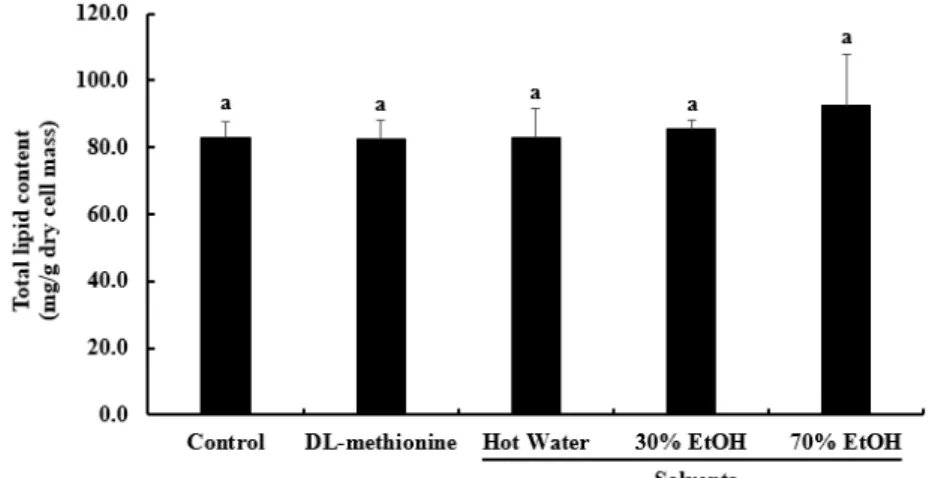
적색 파프리카 용매별 추출물의 중성지방 억제 효과 적색 파프리카 열수 추출물, 30% 및 70% 에탄올 추출물의 첨 가에 따른 유지효모의 총 지질 함량을 분석한 결과는 Fig. 1과
같다. 대조구, 양성대조구, 적색 파프리카 열수 추출물, 30% 및 70% 에탄올 추출물을 첨가한 실험구의 총 지질 함량은 각각 82.77±5.06, 82.33±5.73, 82.72±9.11, 85.39±2.96 및 92.51±
15.09 ㎎/g으로 나타났으며, 양성대조구, 적색 파프리카 열수 추출물, 30% 및 70% 에탄올 추출물을 첨가한 실험구의 총 지질 함량은 대조구에 비해 유의적인 차이를 나타내지 않았다. 적색 파프리카 열수 추출물, 30% 및 70% 에탄올 추출물의 첨가에 따 른 유지효모의 중성지방 함량을 분석한 결과는 Fig. 2와 같다.
대조구, 양성대조구, 적색 파프리카 열수 추출물, 30% 및 70%
에탄올 추출물을 첨가한 실험구의 중성지방 함량은 각각 7.43±
0.44, 6.65±0.81, 5.38±0.62, 5.29±0.22 및 5.24±0.67 ㎎/dL 으로 나타났다. 양성대조구는 대조구에 비해 유의적인 차이를 나타내지 않았으나 적색 파프리카 열수 추출물, 30% 및 70% 에 탄올 추출물을 첨가한 실험구는 대조구에 비해 유의적으로 감 소한 결과를 나타냈으며, 적색 파프리카 70% 에탄올 추출물을 첨가한 실험구에서 가장 높은 중성지방 억제 효과를 확인하였
Fig. 1. Effect of different solvent extraction of red sweet pepper on total lipid content of R. toruloides. Control, R. toruloides incubated in YPD broth without red sweet pepper extract; DL-methionine, R. toruloides incubated in YPD broth with 0.1% DL-methionine;
Hot Water, R. toruloides incubated in YPD broth with 0.1% of red sweet pepper hot water extract; 30% EtOH and 70% EtOH, R.
toruloides incubated in YPD broth with 0.1% of red sweet pepper 30% ethanol extract and red sweet pepper 70% ethanol extract, respectively. a) Means not sharing a common letter are significantly different among groups (p < 0.05).
Fig. 2. Effect of different solvent extraction of red sweet pepper on triglyceride content of R. toruloides. Control, R. toruloides incubated in YPD broth without red sweet pepper extract; DL-methionine, R. toruloides incubated in YPD broth with 0.1%
DL-methionine; Hot Water, R. toruloides incubated in YPD broth with 0.1% of red sweet pepper hot water extract; 30% EtOH and 70% EtOH, R. toruloides incubated in YPD broth with 0.1% of red sweet pepper 30% ethanol extract and red sweet pepper 70%
ethanol extract, respectively. a-b) Means not sharing a common letter are significantly different among groups (p < 0.05).
다. Park et al. (2010)은 파프리카 동결건조 분말, 물 추출물 및 에탄올 추출물을 급여한 고콜레스테롤 식이 흰쥐의 혈청 중성 지질을 비교한 결과, 파프리카 에탄올 추출물을 급여한 실험군 에서 높은 혈청 중성지질 감소 효과를 보고하였다. Lee (2017) 는 적색 파프리카 열수 추출물보다 70% 에탄올 추출물의 높은 항산화 활성을 보고하였으며, 높은 항산화 활성은 지방세포 분 화시 활성산소종의 생성을 저해하여 비만을 억제할 수 있다고 Lee et al. (2012)은 보고한 바 있다. 본 연구결과에서도 선행 연 구결과와 같은 경향의 결과를 나타냈으며, 추출용매의 극성도 가 낮을수록 높은 중성지방 억제 효과를 나타낸 결과로 보아 적 색 파프리카 추출물의 중성지방 억제 효과가 나타내는 유효성 분은 비극성인 물질로 사료된다.
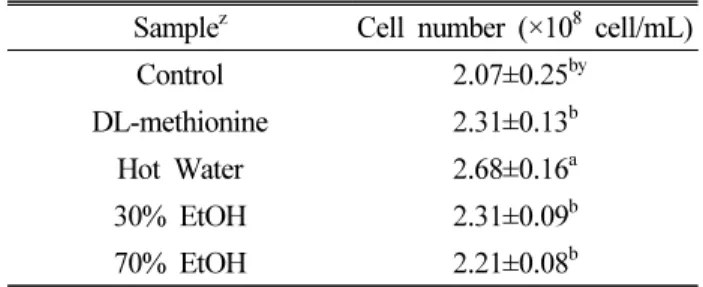
유지효모의 세포수와 중성지방 억제 효과의 상관관계를 규 명하기 위하여 세포수를 계수한 결과는 Table 1과 같다. 대조구, 양성대조구, 적색 파프리카 열수 추출물, 30% 및 70% 에탄올 추 출물을 첨가한 실험구의 세포수는 각각 2.07±0.25, 2.31±0.13, 2.68±0.16, 2.31±0.09 및 2.21±0.08×10⁸ cell/mL으로 계수 되었으며, 세포수 증가율은 대조구에 비해 각각 12, 29, 12 및 7%의 증가율을 나타냈다. 적색 파프리카 열수 추출물을 첨가한 실험구의 세포수는 대조구에 비해 유의적인 차이를 나타냈으나 양성대조구, 적색 파프리카 30% 및 70% 에탄올 추출물을 첨가 한 실험구의 세포수는 유의적인 차이를 나타내지 않았다. Kim et al. (2009)은 동충하초 균사체로 발효시킨 백련잎차의 열수
추출물과 에탄올 추출물의 총 무기질 함량을 분석한 결과, 열수 추출물이 에탄올 추출물에 비하여 높은 함량을 나타내었다. 유 지효모의 생육에 영향을 미치는 무기질은 에탄올 추출물보다 열수 추출물에 높게 함유되어 있어 본 연구결과에서도 추출용 매의 극성도가 높을수록 무기질의 함량이 높아 유지효모의 세 포수가 증가된 것으로 사료된다.
본 연구결과를 통해 적색 파프리카 열수 추출물, 30% 및 70%
에탄올 추출물 중 70% 에탄올 추출물을 첨가한 실험구에서 높 은 중성지방 억제 효과를 확인하였으며, 유지효모의 생육을 저 해하지 않는 결과로부터 적색 파프리카 70% 에탄올 추출물을 선정하였다.
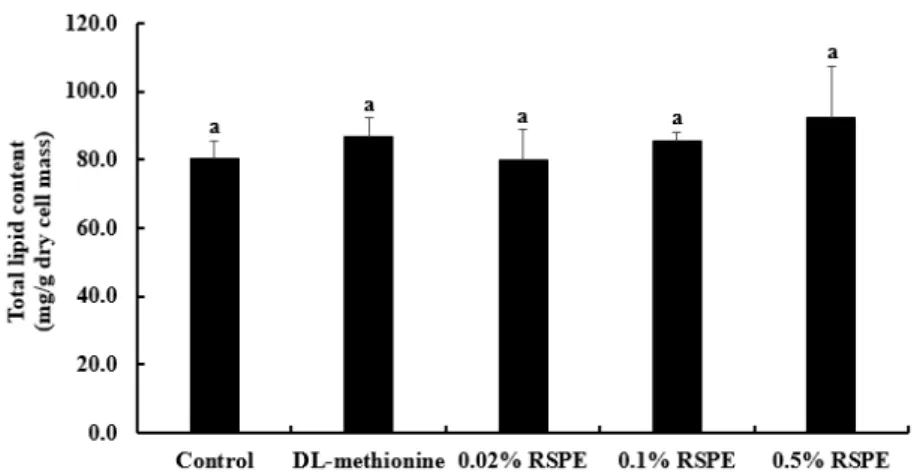
적색 파프리카 70% 에탄올 추출물의 중성지방 억제 효과 적색 파프리카 70% 에탄올 추출물의 첨가 농도에 따른 유지 효모의 총 지질 함량은 Fig. 3과 같다. 대조구, 양성대조구, 0.02, 0.1 및 0.5% 적색 파프리카 70% 에탄올 추출물을 첨가한 실험구의 총 지질 함량은 각각 80.45±2.40, 86.61±11.58, 79.82±2.80, 85.30±0.91 및 92.40±12.40 ㎎/g으로 나타났 다. 적색 파프리카 70% 에탄올 추출물의 첨가 농도에 따른 유지 효모의 중성지방 함량을 분석한 결과는 Fig. 4와 같다. 대조구, 양성대조구, 0.02, 0.1 및 0.5% 적색 파프리카 70% 에탄올 추출 물을 첨가한 실험구의 중성지방 함량은 각각 9.89±0.36, 7.58±1.11, 7.28±0.17, 6.68±0.35 및 5.23±0.67 ㎎/dL으로 나타났다. 양성대조구 및 적색 파프리카 70% 에탄올 추출물을 첨가한 실험구는 대조구에 비해 유의적인 중성지방 억제 효과 를 나타냈으며, 실험구 중 가장 낮은 농도의 0.02% 파프리카 70% 에탄올 추출물을 첨가한 실험구는 0.02% DL-methionine 을 첨가한 양성대조구보다 높은 중성지방 억제 효과를 나타냈 다. methionine은 glutathione의 구성성분으로 활성산소종 제 거 및 지질과산화물 분해제로 작용하며(Mitchell et al., 1973), Ghoshal et al. (1983)은 체내 methionine이 결핍된 경우 간장 에 중성지방을 축적하고 간 지방을 증대한다고 보고하였다. 총 지질은 중성지방, 유리지방산, 총 콜레스테롤 및 인지질과 같은 지질 성분을 총화하는 것으로(Havel and Kane, 1995), 세포는 여분의 에너지를 중성지방 형태로 저장하는데 에너지가 필요한 경우 유리지방산으로 산화되어 에너지 발생에 활용된다 (Goldstein and Brown, 1985). 본 실험결과 적색 파프리카 70%
에탄올 추출물의 첨가 농도에 따라 총 지질 함량 증가 및 중성지 방 함량 감소는 중성지방 분해시 중성지방 이외의 지질이 합성 되어 총 지질 함량이 증가한 것으로 사료된다.
Table 1. Effect of different solvent extraction of red sweet pepper on cell number of R. toruloides
Samplez Cell number (×108 cell/mL) Control 2.07±0.25by
DL-methionine 2.31±0.13b Hot Water 2.68±0.16a 30% EtOH 2.31±0.09b 70% EtOH 2.21±0.08b
zControl, R. toruloides incubated in YPD broth without red sweet pepper extract; DL-methionine, R. toruloides incubated in YPD broth with 0.1% DL-methionine; Hot Water, R. toruloides incubated in YPD broth with 0.1%
of red sweet pepper hot water extract; 30% EtOH and 70% EtOH, R. toruloides incubated in YPD broth with 0.1% of red sweet pepper 30% ethanol extract and red sweet pepper 70% ethanol extract, respectively. yMeans not sharing a common letter are significantly different among groups (p < 0.05).
유지효모 내 지방구 염색
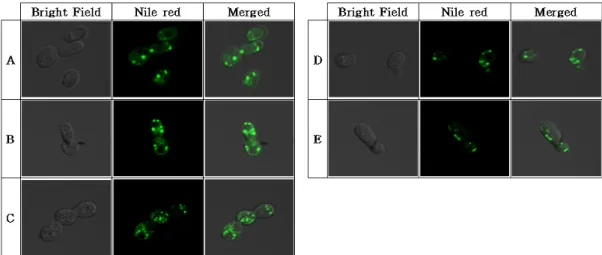
Nile red 염색은 세포 내 중성지방을 특이적으로 염색하여 중 성지방을 측정하기 위한 형광염색제로 알려져 있다(Kim et al., 2014). 대조구, 양성대조구, 0.02, 0.1 및 0.5% 적색 파프리카 70% 에탄올 추출물을 첨가한 실험구의 지방소적 형성을 관찰한 결과는 Fig. 5와 같다. 대조구에서는 다량의 형광이 관찰되어 유지효모 내 생성되는 지방소적을 확인하였으며, 적색 파프리 카 70% 에탄올 추출물의 첨가 농도가 증가함에 따라 대조구에 비해 소량의 형광이 관찰되어 유지효모 내 생성되는 지방소적 이 감소됨을 확인하였다. 본 실험결과를 통해 적색 파프리카
70% 에탄올 추출물의 첨가 농도에 따라 유지효모 내 중성지방 억제 효과를 확인하였으며, 유지효모 내 지방소적이 억제됨을 확인한 결과, 적색 파프리카 70% 에탄올 추출물이 중성지방을 억제하는데 효과적인 것으로 사료된다. 지방소적의 생성 억제 효과를 확인하기 위한 다른 연구결과로, Kim et al. (2017)은 적 색 파프리카 분말을 식이한 고지방식이 mice의 간 및 지방조직 에서 대조군에 비해 적색 파프리카를 급여한 실험군의 지방 생 성 억제 효과와 부고환 지방조직에서 지방소적의 형성이 감소 됨을 보고하였다.
Fig. 3. Effect of 70% ethanol extraction of red sweet pepper on total lipid content of R. toruloides. Control, R. toruloides incubated in YPD broth without red sweet pepper 70% ethanol extract; DL-methionine, R. toruloides incubated in YPD broth with 0.02%
DL-methionine; 0.02, 0.1 and 0.5% RSPE, R. toruloides incubated in YPD broth with 0.02, 0.1 and 0.5% red sweet pepper 70%
ethanol extract, respectively. a) Means not sharing a common letter are significantly different among groups (p < 0.05).
Fig. 4. Effect of 70% ethanol extraction of red sweet pepper on triglyceride content of R. toruloides. Control, R. toruloides incubated in YPD broth without red sweet pepper 70% ethanol extract; DL-methionine, R. toruloides incubated in YPD broth with 0.02%
DL-methionine; 0.02, 0.1 and 0.5% RSPE, R. toruloides incubated in YPD broth with 0.02, 0.1 and 0.5% red sweet pepper 70%
ethanol extract, respectively. a-c) Means not sharing a common letter are significantly different among groups (p < 0.05).
세포수 측정
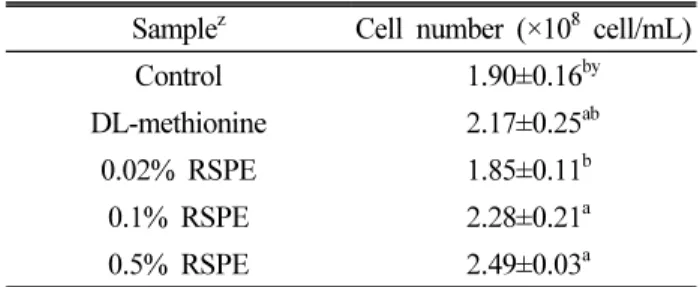
적색 파프리카 70% 에탄올 추출물의 첨가 농도에 따른 유지 효모의 세포수는 Fig. 6, Table 2와 같다. 대조구, 양성대조구, 0.02, 0.1 및 0.5% 적색 파프리카 70% 에탄올 추출물을 첨가한 실험구의 세포수는 각각 1.90±0.16, 2.17±0.25, 1.85±0.11, 2.28±0.21 및 2.49±0.03×10⁸ cell/mL으로 나타났다. 양성대
조구, 0.02, 0.1 및 0.5% 적색 파프리카 70% 에탄올 추출물을 첨가한 실험구의 세포수 증가율은 대조구에 비해 각각 14, -3, 20 및 31%의 증가율을 나타냈다. 0.02% 적색 파프리카 70% 에 탄올 추출물을 첨가한 실험구의 세포수는 대조구에 비해 유의 적인 차이가 나타나지 않았으나 0.1% 및 0.5% 적색 파프리카 70% 에탄올 추출물을 첨가한 실험구의 세포수는 대조구에 비해 Fig. 5. Effect of 70% ethanol extraction of red sweet pepper on lipid droplet of R. toruloides. A, R. toruloides in YPD broth without red sweet pepper 70% ethanol extract; B, 0.02% of DL- methionine; C, 0.02% of red sweet pepper 70% ethanol extract; D, 0.1% of red sweet pepper 70% ethanol extract; E, 0.5% of red sweet pepper 70% ethanol extract.
Fig. 6. Cell image of 70% ethanol extraction of red sweet pepper on R. toruloides. A, R. toruloides in YPD broth without red sweet pepper 70% ethanol extract; B, 0.02% of DL-methionine; C, 0.02% of red sweet pepper 70% ethanol extract; D, 0.1% of red sweet pepper 70% ethanol extract; E, 0.5% of red sweet pepper 70% ethanol extract.
유의적으로 증가하였다. 유지효모 생육에 있어서 Mg2+, Zn2+, Mn2+, Cu2+, Ca2+ 등과 같은 미량원소의 영향을 미치는데 적색 파프리카에는 이와 같은 무기질을 다량 함유하고 있어(Kim, 2011; Li et al., 2006; Tepić et al., 2008), 적색 파프리카 70%
에탄올 추출물의 첨가 농도가 증가함에 따라 유지효모의 생육 을 증가시키는 것으로 사료된다.
유리지방산의 측정
유리지방산은 세포 내 중성지방의 분해시 글리세롤과 유리 지방산으로 가수분해되어 생성된다(Frayn et al., 1995). 적색
파프리카 70% 에탄올 추출물의 중성지방 억제 효과를 알아보기 위하여 산가를 측정하여 확인하였다. 적색 파프리카 70% 에탄 올 추출물의 첨가 농도에 따른 유리지방산 함량은 Table 3과 같 다. 대조구, 양성대조구, 0.02, 0.1 및 0.5% 적색 파프리카 70%
에탄올 추출물을 첨가한 실험구의 유리지방산의 함량은 각각 2.44±0.05, 2.71±0.07, 2.46±0.16, 2.52±0.10 및 2.98±
0.14 ㎎/g으로 나타났다. 양성대조구, 0.02, 0.1 및 0.5% 적색 파프리카 70% 에탄올 추출물을 첨가한 실험구의 유리지방산 증 가율은 대조구에 비해 각각 11, 1, 3 및 22%의 증가율을 나타냈 으며, 적색 파프리카 70% 에탄올 추출물의 첨가 농도에 따라 농 도의존적으로 증가하였다. 적색 파프리카 70% 에탄올 추출물 의 첨가 농도에 따라 유지효모 내의 중성지방 함량이 감소되는 것으로 보아 중성지방이 글리세롤과 유리지방산으로 분해되어 그 결과 유리지방산의 함량이 증가한 것으로 사료된다. 중성지 방 억제 효과를 확인하기 위해 중성지방과 유리지방산의 상관 관계를 분석한 다른 연구결과로, Lee et al. (2006)은 3T3-L1 지방세포에서 마치현 추출물의 첨가 농도에 따라 지방세포 내 중성지방 함량이 유의적으로 감소하였으며, 유리지방산 및 글 리세롤 함량은 증가하였다고 보고하였다.
적 요
본 연구는 유지효모 R. toruloides를 활용하여 적색 파프리카 추출물의 중성지방 억제 효과를 확인하기 위하여 수행되었다.
대조구, 양성대조구, 0.02, 0.1 및 0.5% 적색 파프리카 70% 에탄 올 추출물을 첨가한 실험구의 총 지질 함량은 각각 80.45±
2.40, 86.61±11.58, 79.82±2.80, 85.30±0.91 및 92.40±12.40
㎎/g으로 나타났으며, 유지효모의 중성지방 함량은 각각 9.89±
0.36, 7.58±1.11, 7.28±0.17, 6.68±0.35 및 5.23±0.67 ㎎ /dL으로 나타났다. 대조구, 양성대조구, 0.02, 0.1 및 0.5% 적 색 파프리카 70% 에탄올 추출물을 첨가한 실험구의 지방소적 형성을 관찰한 결과, 적색 파프리카 70% 에탄올 추출물의 첨가 농도가 증가함에 따라 대조구에 비해 소량의 형광이 관찰되는 것으로 보아 유지효모 내 생성되는 지방소적이 감소됨을 확인 하였다. 대조구, 양성대조구, 0.02, 0.1 및 0.5% 적색 파프리카 70% 에탄올 추출물을 첨가한 실험구의 세포수는 각각 1.90±
0.16, 2.17±0.25, 1.85±0.11, 2.28±0.21 및 2.49±0.03×10⁸ cell/mL으로 나타났으며, 유리지방산의 함량은 각각 2.44±0.05, 2.71±0.07, 2.46±0.16, 2.52±0.10 및 2.98±0.14 ㎎/g으로 나타났다. 본 연구결과에서 적색 파프리카 70% 에탄올 추출물 Table 2. Effect of 70% ethanol extraction of red sweet pepper
on cell number of R. toruloides
Samplez Cell number (×108 cell/mL) Control 1.90±0.16by DL-methionine 2.17±0.25ab 0.02% RSPE 1.85±0.11b
0.1% RSPE 2.28±0.21a 0.5% RSPE 2.49±0.03a
zControl, R. toruloides incubated in YPD broth without red sweet pepper 70% ethanol extract; DL-methionine, R.
toruloides incubated in YPD broth with 0.02% DL-methionine;
0.02, 0.1 and 0.5% RSPE, R. toruloides incubated in YPD broth with 0.02, 0.1 and 0.5% red sweet pepper 70% ethanol extract, respectively. yMeans not sharing a common letter are significantly different among groups (p < 0.05).
Table 3. Effect of 70% ethanol extraction of red sweet pepper on acid value of R. toruloides
Samplez Acid value (㎎/g) Control 2.44±0.05cy DL-methionine 2.71±0.07b
0.02% RSPE 2.46±0.16c 0.1% RSPE 2.52±0.10bc 0.5% RSPE 2.98±0.14a
zControl, R. toruloides incubated in YPD broth without red sweet pepper 70% ethanol extract; DL-methionine, R. toruloides incubated in YPD broth with 0.02% DL-methionine; 0.02, 0.1 and 0.5% RSPE, R. toruloides incubated in YPD broth with 0.02, 0.1 and 0.5% red sweet pepper 70% ethanol extract, respectively. yMeans not sharing a common letter are significantly different among groups (p < 0.05).
의 첨가 농도에 따른 유지효모 내 중성지방 억제 효과, 지방소적 의 감소, 세포수 및 유리지방산의 함량이 증가한 결과를 통해 적 색 파프리카 70% 에탄올 추출물이 중성지방 억제 효과에 유의 적인 영향을 미치는 것으로 확인되었으며, 추후 활성 물질의 규 명에 관한 추가적인 연구가 필요할 것으로 사료된다.
Conflicts of Interest
The authors declare that they have no conflict of interest.
References