청고추, 쇠비름, 표고버섯의 물 추출물 및 당침액의 항산화 활성 및 α -Glucosidase Inhibition 활성 비교
이성미1,*․강윤환2,*․김대중2․김경곤1․임준구2․김태우2․최 면1,2,†
1강원대학교 생명건강공학과, 2강원대학교 강원웰빙특산물산업화지역혁신센터
Comparison of Antioxidant and α-Glucosidase Inhibition Activities among Water Extracts and Sugar Immersion Extracts of Green Pepper, Purslane and Shiitake
Sung Mee Lee1,*, Yun Hwan Kang2,*, Dae Jung Kim2, Kyoung Kon Kim1, Jun Gu Lim2, Tae Woo Kim2 and Myeon Choe1,2,†
1Dept. of Bio-Health Technology, Kangwon National University, Gangwon 200-701, Korea
2Well-being Bioproducts RIC, Kangwon National University, Gangwon 200-701, Korea
Abstract
This study was conducted in order to compare the biological activities of water extracts and sugar immersion extracts of green pepper (Capsicum annuum L.), purslane (Portulaca oleracea L.) and shiitake (Lentinula edodes (Berk.) Pegler) by measuring total polyphenol and flavonoid contents, antioxidant activities and inhibitory effects on α-amylase and α-glucosidase.
The contents of total polyphenols and flavonoids were higher in water extracts than in sugar immersion extracts. The anti- oxidative activities of water and sugar immersion extracts were measured using the 1,1-diphenyl-2-picrylhydrazyl (DPPH) and 2,2’-azino-bis(3-ethylbenzothiazoline-6-sulfonic acid) diammonium salt (ABTS) radical scavenging activity assay and reducing power assay. All extracts scavenged radicals in a concentration-dependent manner, and water extracts showed stronger radical scavenging activity and reducing power than sugar immersion extract. However, they all exhibited lower activities than ascorbic acid. Compared to the anti-diabetic drug acarbose, which was used as a positive control, the two types of extracts exhibited low α-glucosidase inhibitory activities, although the activity of sugar immersion extracts were 2-fold higher than that of water extracts. α-Amylase inhibitory action was not observed for any of the extracts. Finally, by cytotoxicity test, we confirmed that sugar immersion extracts were safer than water extracts. These results indicate that water extracts and sugar immersion extracts of green pepper, purslane and shiitake have different advantages in terms of their antioxidant and anti- diabetic effects, respectively.
Key words: Water extract, sugar immersion extract, anti-oxidative activities, anti-diabetic effect, cytotoxicity
* These authors contributed equally to this work.
†Corresponding author : Myeon Choe, Tel : 82-33-250-8645, Fax:
82-33-250-7451, E-mail : [email protected]
서 론
최근 국내에서는 웰빙바람을 타고, 건강관리에 대한 관심 이 높아지면서 민간에서 나물류의 보관 및 추출액 제조를 위 해 사용하던 당절임 또는 당침액 제조 방법이 효소 엑기스 또는 발효 엑기스 제조법이라는 이름으로 무분별하게 성행 하고 있으며, 그 추출액의 효능에 대한 지나친 기대가 만연 해 있는 상황이다. 당절임은 채소, 과일 등을 설탕에 재워서 저장하는 가공법으로, 설탕의 농도가 높으면 재료를 강하게 탈수하여 수분을 완전히 빼내는데, 이 때문에 미생물이 번식 할 수 없게 되므로 방부 효과가 발휘되는 것이다(Ko et al
2010). 이 때 설탕의 양은 채소, 과일에 있는 수분에 대하여 포화량 이상이 필요하다(Han et al 2003). 식염 절임과는 달리 설탕 맛은 농도가 높더라도 그대로 식용할 수 있는 이점이 있고, 식품의 산화를 방지하는 작용도 있다(Han et al 2003, Yoon et al 1999). 당침액은 당절임에 의한 탈수 과정에서 채 소, 과일에서 유효 성분이 추출되어 나오면 이를 숙성하여 직접 음료로 마시거나, 음식에 양념으로 첨가하여 섭취하는 진액이다(Youn & Choi 1995, 1996). 이와 같이 효소 엑기스 또는 발효 엑기스로 알려진 설탕 추출 진액(당침액)은 그 추 출 성분이 효소 또는 발효액이 아님에도 일반인들이 이를 잘 못알고 오․남용하는 경우가 있다.
고추는 주로 향신료로만 사용되었기 때문에, 고추의 매운 맛을 내는 주성분인 capsaicin에 대한 연구가 활발하였으나, 최근 비만과 당뇨 등의 질병에 관한 연구가 시작되면서 주목
받고 있다(Chang et al 2003, Gang et al 2008, Oboh et al 2011). 고추의 주성분인 capsaicin의 효능에 대한 연구 결과, 진통, 항염증, 항비만 작용 등이 보고되었다(Kim et al 1997, Pande & Srinivasan 2012, Frydas et al 2013). 쇠비름은 한국 보다 중국에서 식용으로 애용되고 있는 다육질의 한해살이 풀이다. 오랜 세월에 걸쳐 식용의 예가 있어 많은 연구가 진 행되었으며, 다수의 연구에서 해독, 항부종, 항노화, 항산화, 항염증, 항비만 등에 관한 연구가 진행되었다(Lim & Suh 2000, Zhang et al 2009, Park et al 2011, Won & Kim 2011).
최근 쇠비름의 씨앗을 이용한 2형 당뇨 치료에 관한 연구가 보고되었다(El-Sayed MI 2011). 표고버섯은 참나무, 밤나무, 서어나무 등의 활엽수에 기생하는 담자균류 주름버섯목 느타 리과에 속하며, 한국, 일본, 중국 등 동남아시아 지역에서 주 로 자생․재배되고, 특유의 향미 성분과 약리 효과를 가지고 있어 국내에서 식용 및 약용으로 널리 이용되고 있다. 최근 의 연구에서는 항산화, 항비만, 항암, 항당뇨 등의 기능이 보 고되고 있다(Park et al 2004, Qi et al 2013, Kim et al 2013).
이에 본 연구는 고추, 쇠비름, 표고버섯을 이용하여 각각 의 물 추출물과 당침액을 제조하여 생리활성을 비교하였으 며, 이를 통해 확보된 기초 자료들은 당침액의 무분별한 남 용보다는 용도에 따라 적절한 형태로 가공하여 사용하는 것 이 목적하는 기능성을 향상시키는 방법임을 과학적인 실험 에 근거하여 제시하고자 한다.
재료 및 방법
1. 시료의 물 추출물 제조
고추, 쇠비름, 표고버섯 생물은 농업회사법인 참씨드(주)를 통해 구매하였다. 구매한 생물은 수세한 후 10배 증류수를 가 하여 60℃에서 24시간 교반하면서 추출하였다. 이를 실온에 서 방냉한 뒤, 감압농축기(EYELA SB-1000, Tokyo, Japan)로 농축하였고, 동결건조기(FD 8508, Ilshin, Korea)를 이용하여
—70℃에서 건조한 시료를 냉동보관하면서 필요한 농도로 희석하여 사용하였다.
고추(59 brix, pH 4.0), 쇠비름(48.5 brix, pH 3.8), 표고버섯 (52 brix, pH 3.9) 당침액은 참씨드(주)와 공동 연구 과제를 통해 제조하였다. 각각 소재를 설탕과 1:1의 부피 비율로 혼 합한 후 상온에서 5개월간 담금시킨 후, 여과한 액을 1년간 12∼16℃에서 숙성시켰다. 그 후 동결건조하여 분말화한 후 실험에 사용하였다.
2. 시료의 Total Polyphenol 및 Flavonoid 측정 1) Total Polyphenol 함량
Total polyphenol은 Folin-Ciocalteu's phenol을 이용한 비색 법을 응용하여 측정하였다(Kim et al 2013). 증류수에 희석시 킨 시료 0.04 mL에 증류수 0.96 mL, 50% Folin-Ciocalteu' phenol 0.1 mL를 넣고 3분간 방치시켰다. 10% Na2CO3용액 0.2 mL를 넣은 후 1시간 동안 방치 후 700 nm에서 흡광도를 측정하였다. 표준물질은 gallic acid(Sigma, St. Louis, MO, USA) 를 이용하여, 작성한 표준 곡선으로부터 total polyphenol 함량 을 계산하였다.
2) Total Flavonoid 함량
Total flavonoid는 Moreno et al(2000)의 방법을 응용하여 측정하였다. 시료 0.1 mL에 10% aluminum nitrate 0.02 mL, 1 M potassium acetate 0.02 mL와 80% ethanol 0.86 mL를 차 례로 첨가하여 혼합하고, 실온에서 40분간 방치 후 spectropho- tometer(Optizen 2120UV, Mecasys, Korea)를 사용하여 415 nm 에서 흡광도를 측정하였다. 표준물질은 Quercetin(Wako, Osaka, Japan)을 이용하여 작성한 표준 곡선으로부터 total flavonoid 함량을 계산하였다.
3. 항산화 활성 측정
1) DPPH Radical Scavenging Activity
유리 라디칼의 소거능은 2,2-diphenyl-1-picrylhydrazyl(DPPH) 을 이용하여 측정하였다(Braca et al 2001). 각 농도별 시료 0.05 mL에 DPPH 0.15 mL를 첨가하여 암조건에서 30분간 반응시킨 후 532 nm에서 흡광도를 측정하였으며, Ascorbic acid(Sigma, St. Louis, MO, USA)를 positive control로 사용하 여 비교하였다. 다음 계산식에 의거하여 라디칼 소거능을 계 산하였다.
DPPH radical scavenging activity (%) =
Control nm Sample nm
×2) ABTS Radical Scavenging Activity
7 mM 2,2'-azino-bis(3-ethylbenzthiazoline-6-sulfonic acid) diammonium(ABTS) radical을 이용한 항산화력은 ABTS+ ca- tion decolourisation assay에 의하여 측정하였다(Re et al 1999).
ABTS와 140 mM potassium peroxodisulfate를 최종 농도로 혼합하여, 실온인 암소에서 24시간 동안 방치하여 ABTS+를 형성시킨 후, 734 nm에서 흡광도 값이 0.7±0.02이 되게 etha- nol로 희석하였다. 희석된 ABTS solution 0.98 mL에 각 농도 별 시료 0.02 mL를 가하여 2.5분간 방치 후 734 nm에서 흡 광도를 측정하였다. Ascorbic acid (Sigma, St. Louis, MO, USA)
를 positive control로 사용하였으며, 다음 계산식에 의거하여 소거능을 계산하였다.
ABTS radical scavenging activity (%) =
Control nm Sample nm
×3) Reducing Power
환원력은 Kim et al(2013b)의 연구에서 서술한 방법을 변 형하여 측정하였다. 각 농도별 시료 0.25 mL에 0.2 M sodium phosphate buffer(pH 6.6) 0.25 mL, 1% potassium ferricyanide 0.25 mL를 혼합하여 50℃에서 20분 동안 반응시킨 후, 10%
trichloroacetic acid 0.25 mL를 가하였다. 이 반응액을 650 rpm 에서 10분간 원심분리한 후 상층액 0.5 mL에 증류수 0.5 mL, 1% ferric chloride 0.1 mL를 혼합 후, 700 nm에서 흡광도를 측정하였다.
4. α-Amylase 저해 활성 측정
α-Amylase 저해 활성은 starch-iodine reaction 방법을 응용 하여 측정하였다(P et al 2011). 0.1% starch 1 mL와 각 농도 별 시료 0.1 mL를 혼합한 다음, 30 Unit/mL α-amylase enzyme solution(from porcine pancreas, Sigma, St. Louis, MO, USA) 0.1 mL를 가하여 37℃에서 10분간 incubation한 다음, 1 N HCl 0.1 mL로 반응을 정지시킨다. 그 후 I2-KI solution(0.2%
I2 in 2% KI) 0.1 mL를 가하여 발색시키고, 700 nm에서 흡 광도를 측정하였다. Acarbose(Sigma, St. Louis, MO, USA)를 positive control로 사용하였으며, 다음 계산식에 의거하여 α -amylase 저해율을 계산하였다.
α-Amylase inhibition activity (%) =
Control nm Sample nm Control nm
×5. α-Glucosidase 저해 활성 측정
pNPG(4-nitrophenol-α-D-glucopyranoside)를 이용한 α-glu- cosidase 저해 활성은 Ryu et al(2010)의 방법을 응용하여 측 정하였다. 0.1 M phosphate buffer(pH 6.8)에 용해한 2.5 mM 4-nitrophenol-α-D-glucopyranoside 0.05 mL에 각 농도별 시료 0.025 mL를 혼합한 후 0.2 Unit/mL α-glucosidase enzyme solution(from Saccharomyces cerevisiae, Sigma, St. Louis, MO, USA) 0.025 mL를 가하여 37℃에서 20분간 incubation한 다 음, 0.1M NaOH 0.05 mL로 반응을 정지시킨 후 405 nm에서 흡광도를 측정하였다. Acarbose(Sigma, St. Louis, MO, USA) 를 positive control로 사용하였으며, 다음 계산식에 의거하여 α-glucosidase 저해율을 계산하였다.
α-Glucosidase inhibition activity (%) =
Control nm Sample nm Control nm
× 6. 세포 독성 측정
실험에 사용된 간조직 세포는 HepG2(human hepatoma cell line)로써 한국생명공학연구원 미생물자원센터(KCTC, Dae- jeon, Korea)에서 구입하였다. HepG2 세포는 10% fetal bovine serum(FBS, Welgene, Daegu, Korea)과 100 U/mL penicillin, 100 ug/mL streptomycin(Welgene, Daegu, Korea)이 첨가된 minimum essential medium(MEM, Welgene, Korea)에서 37℃, 5% CO2조건에서 배양하였다. 세포 독성은 cell counting kit- 8(CCK-8, Kumamoto, Japan)을 이용하여 측정하였다. 96 well plate에 1×10⁴ cells/well의 농도로 24시간 동안 세포 배양한 후, 각 시료를 농도별로 24시간 동안 처리한 다음 각 well에 10 uL의 CCK-8 reagent를 첨가하였다. 3시간 동안 반응시킨 후 ELISA microplate reader(EL808, BioTek, Winooski, VT, USA)를 사용하여 450 nm에서 흡광도를 측정하였다.
7. 통계 처리
실험에서 얻어진 결과의 통계적 유의성은 SPSS(statistical package for social sciences, Version 10.0, Chicago, USA) program을 이용하여 평균±표준편차로 표시하였고, One-way ANOVA test 후에 Duncan’s multiple range test에 의해 p<
0.05 수준에서 각 실험군 간의 유의성을 검증하였다.
결과 및 고찰
1. Total Polyphenol 및 Total Flavonoid 함량 측정 총 폴리페놀과 플라보노이드는 식물 유래 추출물의 다양한 기능 및 항산화 활성을 나타내는 물질로써 그 함량을 측정한 결과, 물 추출물보다 당침액에서 크게 감소된 것을 확인할 수 있었다(Table 1). 청고추의 경우, 추출물에서 31 mg/g의 폴리페놀이 확인되었으며, 이는 Kim et al(2012)의 결과보다 약 2∼3배 가량 낮은 함량이며, Capsicum annuum L., C. annuum var. grossum, C. annuum var. abbreviatum, C. annuum var.
accuminatum 처럼 고추의 종류나 생산지 및 추출 방법의 차
이에 의해 나타나는 현상으로 생각된다. 청고추 당침액에서 는 폴리페놀 함량이 3.5 mg/g으로 확인되었으며, 이는 Gang et al(2008)의 연구 결과와 유사한 값이다. 고추의 종과 추출 방법에 차이가 있다고 하더라도 본 실험에서 물 추출물보다 당침액의 폴리페놀 함량이 약 88% 감소한 것을 확인할 수 있 었다. 플라보노이드 또한 물 추출물에서 8.95 mg/g이 확인되 었으며, 이는 Kim et al(2012)의 연구 결과보다 약간 감소한 함량이며, 생산지 및 추출 방법의 차이에 의한 감소라 생각
Table 2. IC50 value of wild herb (pepper, purslane, shiitake) water extracts and sugar immersion extracts for DPPH, ABTS and reducing power
Sample IC50 (mg/mL)
DPPH ABTS Reducing power
Ascorbic acid 0.04±0.011) 0.15±0.01 0.12±0.00
Green papper
Water extract 12.21±0.01 2.68±0.04 7.25±0.37
Sugar immersion extract 58.36±1.38* 48.79±1.03* 59.90±1.08*
Purslane
Water extract 2.03±0.13 2.73±0.10 2.90±0.15
Sugar immersion extract 33.26±1.48* 44.63±0.45* 52.07±1.41*
Shiitake
Water extract 6.47±0.37 5.29±0.65 6.10±0.16
Sugar immersion extract 57.17±1.80* 61.77±3.28* 32.52±3.00*
As standard compounds ascorbic acid was used for measurement of antioxidant activity.
1) Values are mean±standard deviation of triplicate determination.
* Superscripts indicate significant differences (P<0.05) as compared to water extract and sugar immersion extract by one-way ANOVA test.
Table 1. Content of total polyphenol and total flavonoid of wild herb(pepper, purslane, shiitake) water extracts and sugar immersion extracts
Sample Total polyphenol (mg/g)
Total flavonold (mg/g)
Green pepper
Water extract 31.00±1.68 8.95±0.03 Sugar immersion
extract 3.50±0.03*1) 1.46±0.20*
Purslane
Water extract 29.81±0.96 16.54±0.37 Sugar immersion
extract 2.50±0.02* 0.30±0.03*
Shiitake
Water extract 17.28±1.44 7.15±0.07 Sugar immersion
extract 2.80±0.04* 2.48±0.28* As standard compounds galic acid and quercetin were used for measurement of polyphenol and flavonoid.
1) Values are mean±standard deviation of triplicate determina- tion.
* Superscripts indicate significant differences (P<0.05) as com- pared to water extract and sugar immersion extract by one- way ANOVA test.
된다. 그리고 당침액의 플라보노이드 함량은 1.46 mg/g으로 물 추출물보다 83% 감소한 것을 확인할 수 있었다. 쇠비름 과 표고버섯에서도 청고추와 유사한 결과를 확인할 수 있었 다. 쇠비름의 물 추출물에서는 29.81 mg/g의 폴리페놀 함량 이 확인되어 Park et al(2011)의 연구 결과와 유사한 결과를
얻었지만, 당침액의 경우 2.5 mg/g으로 90% 이상 감소한 것 이 확인되었으며, 플라보노이드 또한 16.54 mg/g에서 0.3 mg/g으로 급격히 감소한 것을 확인할 수 있었다. 표고버섯의 폴리페놀 함량은 물 추출물에서 17.28 mg/g으로 확인되었지 만, 당침액에서는 2.8 mg/g으로 80% 이상 감소하였으며, 플 로보노이드 함량도 물 추출물 7.15 mg/g에서 당침액 2.48 mg/g으로 약 65% 감소한 것을 확인하였다. 즉, 추출물 속에 함유된 폴리페놀 및 플라보노이드의 함량 측정 결과, 당침을 통한 추출물 내의 폴리페놀 및 플라보노이드 성분 함량이 급 격히 감소한 것이 관찰되었다.
2. 항산화 활성 측정
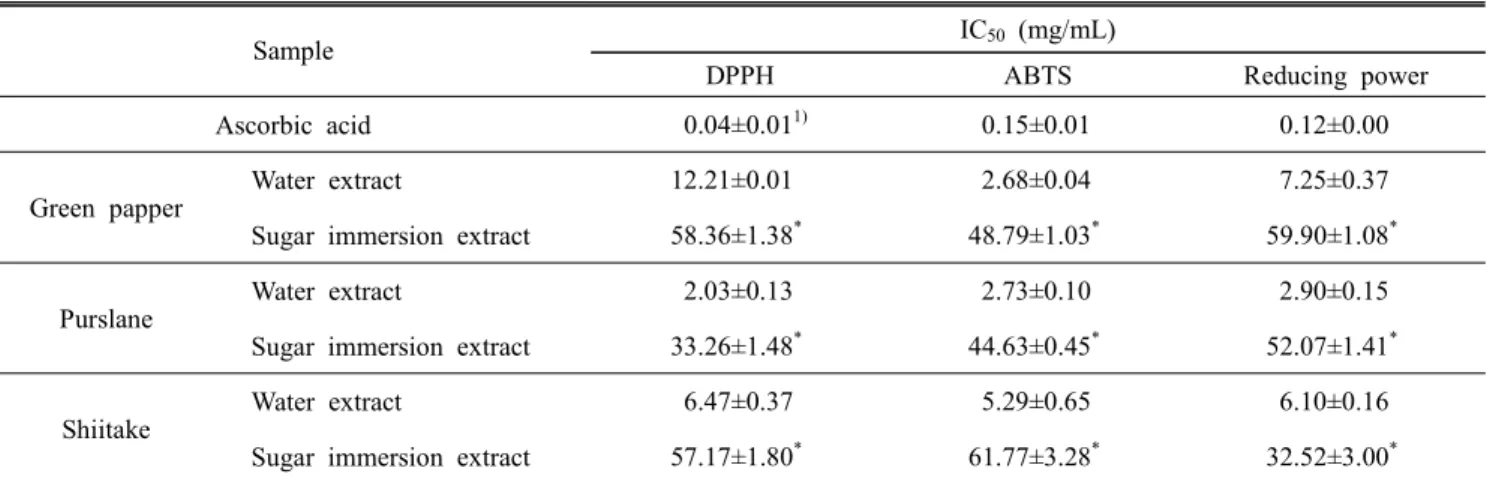
항산화 활성은 생체 내 생성된 활성 산소종(reactive oxy- gen species, ROS)을 제거하는 반응으로써 활성 산소에 의한 염증, 노화 등의 반응을 억제 및 완화시키는 효과를 나타낸 다(Saeidnia & Abdollahi 2013). 본 실험에서 DPPH, ABTS 및 reducing power를 측정한 결과, 청고추, 쇠비름 및 표고버 섯의 물 추출물보다 당침액에서 크게 감소한 것을 확인할 수 있었다(Table 2). 각 항산화 활성 측정법에 따라 half maxi- mal inhibitory concentration(IC50)을 계산한 결과, 청고추의 DPPH는 물 추출물 12.21 mg/mL로 Kim et al(2012)의 결과 보다 3배 가량 낮게 관찰되었지만, 이는 추출 방법에 따른 차이로 판단되며, 당침액에서는 58.36 mg/mL로 당침을 통한 추출물의 항산화 활성이 감소한 것을 확인할 수 있었다. ABTS 는 물 추출물 2.68 mg/mL로 Kim et al(2012)의 결과보다 약 3배 높게 관찰되었지만, 이 또한 추출 방법에 따른 차이라 판단되며, 당침액에서는 48.79 mg/ mL로 당침 추출물의 항
산화활성이 감소하는 것을 확인할 수 있었다. Reducing power 역시 물 추출물 7.25 mg/mL, 당침액 59.90 mg/mL로 당침 추출물의 항산화 활성이 감소하였다. 쇠비름 추출물의 IC50 값에서도 DPPH는 물 추출물 2.03 mg/mL에서 당침액 33.26 mg/mL로, ABTS는 2.73 mg/mL에서 44.63 mg/mL로 reducing power는 2.90 mg/mL에서 52.07 mg/mL로 항산화 활성이 감소하였으며, 표고버섯 또한 DPPH는 6.47 mg/mL에 서 57.17 mg/mL로, ABTS는 5.29 mg/mL에서 61.77 mg/mL 로, reducing power는 6.10 mg/mL에서 32.52 mg/mL로 IC50
값이 증가하여 항산화 활성이 감소하는 것으로 확인되었다.
이런 당침액의 항산화 활성 감소 결과는 총 폴리페놀 및 플 라보노이드 함량 측정과 함께 당침액 건조 분말의 상당량이 설탕 및 그 분해물이기 때문에 분말의 단위그램당 활성 측정 결과, 낮은 함량 및 활성이 나타나는 것이라 판단된다.
3. α-Amylase 억제 활성 측정
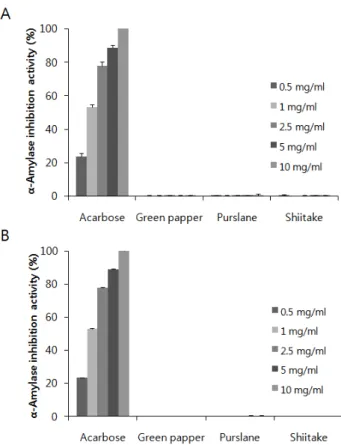
α-Amylase는 녹말 등의 α-1,4 glucan을 임의로 절단하여 가수분해하는 효소로 알려져 있다. 그러나 기존 당뇨치료제 인 acarbose의 과다한 α-amylase 억제 활성으로 인해 복부 팽 만, 설사 및 소화 장애 등의 부작용이 발생한다(Choi et al 2008, Barrett & Udani 2011). 본 실험에서 탄수화물 주요 소 화 효소인 α-amylase 억제 활성을 측정한 결과, positive control 로 사용된 acarbose의 강력한 α-amylase 억제 활성은 관찰되 었으나, 청고추, 쇠비름 및 표고버섯의 물 추출물 및 당침액 에서는 α-amylase 억제 활성이 1% 이하로 관찰되어 억제 활 성이 거의 나타나지 않는 것으로 확인되었다(Fig. 1).
4. α-Glucosidase 억제 활성 측정
α-Glucosidase는 α-amylase와 함께 소장 내 탄수화물 소화 의 주요 효소이다. α-Glucosidase inhibitor는 소장의 brush bor- der에 존재하는 이당류 분해 효소를 가역적으로 억제하여 장 에서의 탄수화물 흡수를 지연시켜 식후 혈당 상승을 저해한 다(Hanefeld M 1998). 특히 α-glucosidase inhibitor 작용기전 은 인슐린 분비를 통하지 않고, 소장에서의 탄수화물 소화 및 흡수를 저해함으로써 기존 약물들이 갖고 있는 저혈당 현상, 간독성 유발, 베타세포 기능 저하 등의 부작용을 최소화 할 수 있다(Hanefeld M 1998, Choi et al 2008). 본 실험에서는 청고추, 쇠비름, 표고버섯의 물 추출물과 당침액 제조에 사 용되는 정제당(설탕) 및 당침액의 α-glucosidase 억제 활성을 측정하였다. 그 결과, α-glucosidase inhibitor 의약품으로 판 매되는 acarbose의 활성에는 미치지 못하지만, 청고추, 쇠비 름, 표고버섯 물 추출물과 정제당의 α-glucosidase 억제 활성 보다 당침액의 억제 활성이 농도 의존적으로 증가하는 것을 확인할 수 있었다. 5 mg/mL 농도에서부터 3종의 당침액 모
Fig. 1. α-Amylase inhibitory activity of wild herbs(green pepper, purslane, shiitake) water extracts(A) and sugar im- mersion extracts(B).
α-Amylase inhibitory activity assay was performed using a range of concentrations(incubation time, 20 min).
Acarbose was used as positive control.
Results are presented as Mean±S.D. of three independent expe- riments.
두에서 유의한 수준의 α-glucosidase 억제 활성을 나타나기 시 작했으며, 10 mg/mL 농도에서 청고추의 물 추출물은 14.38
%에서 당침액 34.48%로, 쇠비름은 물 추출물 6.38%에서 당 침액 31.82%로, 표고버섯은 물 추출물 1.81%에서 당침액 26.55
%로 증가하였으며, 정제당은 9.49%로 억제 활성이 관찰되었 다(Fig 2A). Oboh et al(2011)과 Kwon et al(2007)이 발표한 고추의 α-glucosidase 억제 활성 결과와 차이가 있는 것은 고 추의 종류와 생산지 및 추출법에서 차이가 있기 때문으로 판 단되며, 쇠비름과 표고버섯은 아직 α-glucosidase 억제 활성 에 대한 보고가 거의 발표되지 않아 비교가 어려운 상태다.
α-Glucosidase 억제 활성이 관찰된 청고추, 쇠비름, 표고버섯 의 당침액을 이용하여 시간별 α-glucosidase 억제 활성을 측 정한 결과, 시간 경과에 따라 억제 활성이 증가하는 것을 확 인할 수 있었다(Fig 2B). α-Glucosidase 억제 활성이 당침 방 법에 의해 제조된 추출물에서 농도 의존적으로 증가하는 실 험 결과를 통해 당뇨 등의 대사성 질환으로 인해 설탕 및 탄
Fig. 2. α-Glucosidase inhibitory activity of wild herb(pe- pper, purslane, shiitake) water extracts and sugar immersion extracts.
A : α-Glucosidase inhibitory activity assay according to concen- tration dependent manner(incubation time, 20 min).
B : α-Glucosidase inhibitory activity of sugar immersion extracts (pepper, purslane, shiitake) on time dependent manner.
Acarbose was used as positive control.
Results are presented as Mean ± S.D. of three independent expe- riments.
$, #, * p<0.05 as compared to the extract group.
수화물의 단맛에 대한 과도한 절제로 인해 고통 받는 환자의 어려움을 일정 부분 완화할 수 있는 식품 소재의 개발이 가 능할 것으로 판단된다.
5. 세포 독성
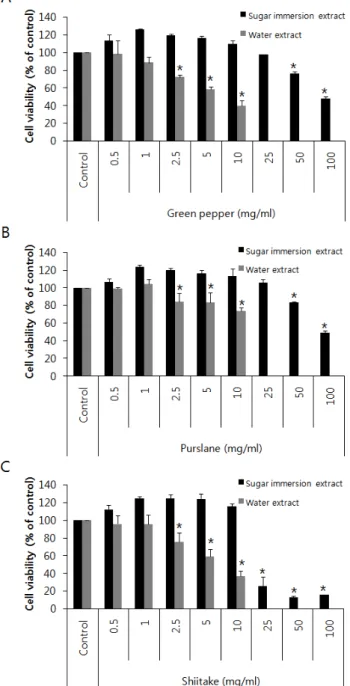
청고추, 쇠비름, 표고버섯 물 추출물 및 당침액의 세포 독 성을 HepG2 cell을 이용하여 확인하였다(Fig 3). 그 결과, 물 추출물은 각각 1 mg/mL에서 유의한 수준의 세포 독성이 관
찰되지 않았지만, 그 이상의 농도에서 독성이 관찰되었다.
그리고 각각의 당침액을 이용하여 세포 독성을 관찰한 결과, 10 mg/mL까지 독성이 관찰되지 않았으며, 그 이상의 농도에
Fig. 3. Concentration-dependent effects of wild herb(pe- pper, purslane, shiitake) water extracts and sugar immersion extracts on HepG2 cell growth.
A : Cytotoxicity of green pepper extracts.
B : Cytotoxicity of purslane extracts.
C : Cytotoxicity of shiitake extracts.
Cell viability was analyzed using the CCK-8 assay kit.
Each bar is the mean±standard deviation from three independent experiment.
* Indicate significant differences(P<0.05) by ANOVA test.
서 일부 독성이 나타나기 시작하였다. HepG2 cell을 이용한 세포 독성 시험 결과, 물 추출물보다 당침액의 독성이 약 1/10 낮은 것으로 확인되었다. 이 결과를 바탕으로 당침을 통해 추출한 용액의 독성이 물 추출물보다 완화됨을 확인할 수 있 었다.
요 약
본 연구에서는 최근 건강 관리를 위해 다양하게 상용되고 있는 당침액의 오․남용을 막기 위해 과학적으로 물 추출물 과 당침액의 특성을 규명하고자 하였다. 그 결과, 일반 물 추 출물과 비교하였을 때 당침액의 총 폴리페놀 및 플라보노이 드 함량이 크게 감소하는 것을 확인하였으며, 그에 따라 항 산화 활성 또한 감소한 것을 확인할 수 있었다. 이는 물 추출 물과 비교하여 당침액의 건조 분말에는 설탕 또는 그 분해물 들이 많은 부분을 차지하기 때문이라 판단된다. 그러나 혈당 강하 효능의 target 효소로 연구되고 있는 α-amylase 및 α-glu- cosidase의 활성을 측정한 결과, 청고추, 쇠비름, 표고버섯의 물 추출물과 당침액은 α-amylase 억제 활성을 나타내지 않았 지만, α-glucosidase 억제 활성은 의약품인 acarbose에는 미치 지 못하였으나, 물 추출물에 비해 당침액이 농도 의존적으로 높은 억제 활성을 나타내었다. 또한 세포 독성을 HepG2 cell 에서 확인한 결과, 물 추출물과 비교하여 당침액의 독성이 약 1/10 감소한 것을 확인할 수 있었다. 이와 같은 결과는 민 간에서의 믿음처럼 당침액이 물 추출물과 비교하였을 때 모 든 부분에서 우수한 기능을 가진다고 할 수 없으며, 활용할 용도에 따라 소재를 물 추출하거나 당침액을 제조하는 등의 가공 과정을 거치는 것이 목표한 기능을 효과적으로 확보하 는 방법임을 의미한다. 따라서 민간에서 맹목적으로 믿는 당 침액의 효능에 대한 과학적인 연구 접근법은 당침액의 적절 한 사용 목적과 방법을 설정하는 기초 자료로 활용이 가능할 것이다.
감사의 글
본 결과물은 교육부의 재원으로 한국연구재단의 지원을 받아 수행된 산학협력 선도대학 육성사업(바-11), 강원웰빙 특산물산업화지역혁신센터(B0009702) 및 강원대학교 생명 공학연구소(320130015)의 일부 지원으로 수행한 연구 결과 로 이에 감사드립니다.
문 헌
Barrett ML, Udani JK (2011) A proprietary alpha-amylase in- hibitor from white bean (Phaseolus vulgaris): a review of
clinical studies on weight loss and glycemic control. Nutr J 10: 24.
Braca A, De Tommasi N, Di Bari L, Pizza C, Politi M, Mo- relli I (2001) Antioxidant principles from Bauhinia tarapo- tensis. J Nat Prod 64: 892-895.
Chang UJ, Kim DG, Kim JM, Suh HJ, Oh SH (2003) Weight reduction effect of extract of fermented red pepper on female college students. J Korean Soc Food Sci Nutr 32:
479-484.
Choi HJ, Jeong YK, Kang DO, Joo WH (2008) Inhibitory effect of four solvent fractions of Alnus firma on α-amylase and α-glucosidase. J Life Sci 18: 1005-1010.
El-Sayed MI (2011) Effects of Portulaca oleracea L. seeds in treatment of type-2 diabetes mellitus patients as adjunctive and alternative therapy. J Ethnopharmacol 137: 643-651.
Frydas S, Varvara G, Murmura G, Saggini A, Caraffa A, Anti- nolfi P, Tete' S, Tripodi D, Conti F, Cianchetti E, Toniato E, Rosati M, Speranza L, Pantalone A, Saggini R, Di To- mmaso LM, Theoharides TC, Conti P, Pandolfi F (2013) Impact of capsaicin on mast cell inflammation. Int J Im- munopathol Pharmacol 26: 597-600.
Gang HM, Park HS, Kwon KR, Rhim TJ (2008) A study on the comparison of antioxidant effects between hot pepper extract and capsaicin. J Pharmacopuncture 11: 109-118.
Han JY, Hwang SH, Youn KS, Kim NW, Shin SR (2003) Optimization for the sugaring process of yam for snack food using response surface methodology. Korean J Food preserv 10: 320-325.
Hanefeld M (1998) The role of acarbose in the treatment of non-insulin-dependent diabetes mellitus. J Diabetes Com- plications 12: 228-237.
Kim HS, You JH, Jo YC, Lee YJ, Park IB, Park JW, Jung MA, Kim YS, Kim SO (2013) Inhibitory effects of Lenti- nus edodes and rice with Lentinus edodes mycelium on diabetes and obesity. J Korean Soc Food Sci Nutr 42: 175- 181.
Kim HJ, Hong CO, Nam MH, Ha YM, Lee KW (2012) Anti- oxidant and physiological activities of Capsicum annuum ethanol extracts. J Korean Soc Food Sci Nutr 41: 727-732.
Kim HK, Bae EJ, Shin MS, Son MH, Kim SH, Kim WB, Yang J, Kong JY (1997) Analgesic effects of DA-5018, a new capsaicin derivative, after subcutaneous injection and topi- cal application. J Appl Pharmacol 5: 117-124.
Kim KK, Kang YH, Kim DJ, Kim TW, Choe M (2013)
Comparison of antioxidant, α-glucosidase inhibition and antiinflammatory activities of the leaf and root extracts of Smilax china L. J Nutr Health 46: 315-323.
Ko YJ, Lee HH, Kim EJ, Kim HH, Son YH, Kim JY, Kang SD, An JH, Lee WS, Ryu CH (2010) A study on the stan- dardization of sugar-preserved Prunus mume manufactured in Ha-Dong. J Life Sci 20: 424-429.
Kwon YI, Apostolidis E, Shetty K (2007) Evaluation of pe- pper (Capsicum annuum) for management of diabetes and hypertension. J Food Biochem 31: 370-385.
Lim JP, Suh ES (2000) Hepatoprotective, diuretic and anti- inflammatory activities of the extract from Portulaca ole- racea Linne. Korean J Medicinal Crop Sci 8: 189-193.
Moreno MI, Isla MI, Sampietro AR, Vattuone MA (2000) Com- parison of the free radical-scavenging activity of propolis from several regions of Argentina. J Ethnopharmacol 71:
109-114.
Oboh G, Ademiluyi AO, Faloye YM (2011) Effect of combi- nation on the antioxidant and inhibitory properties of tro- pical pepper varieties against α-amylase and α-glucosidase activities in vitro. J Med Food 14: 1152-1158.
P S, Zinjarde SS, Bhargava SY, Kumar AR (2011) Potent α -amylase inhibitory activity of Indian Ayurvedic medicinal plants. BMC Complement Altern Med 11: 5.
Pande S, Srinivasan K (2012) Potentiation of hypolipidemic and weight-reducing influence of dietary tender cluster bean (Cyamopsis tetragonoloba) when combined with capsaicin in high-fat-fed rats. J Agric Food Chem 60: 8155-8162.
Park JM, Lee SH, Kim JO, Park HJ, Park JB, Sin JI (2004) In vitro and in vivo effects of Lentinus edodes on tumor growth in a human papillomavirus 16 oncogenes-transfor- med animal tumor model -Apoptosis-mediated tumor cell growth inhibition-. Korean J Food Sci Technol 36: 141- 146.
Park SH, Kim DK, Bae JH (2011) The antioxidant effect of Portulaca oleracea extracts and its antimicrobial activity on Helicobacter pylori. Korean J Food & Nutr 24: 306-
311.
Qi Y, Zhao X, Lim YI, Park KY (2013) Antioxidant and anti- cancer effects of edible and medicinal mushrooms. J Korean Soc Food Sci Nutr 42: 655-662.
Re R, Pellegrini N, Proteggente A, Pannala A, Yang M, Rice- Evans C (1999) Antioxidant activity applying an improved ABTS radical cation decolorization assay. Free Radic Biol Med 26: 1231-1237.
Ryu HW, Lee BW, Curtis-Long MJ, Jung S, Ryu YB, Lee WS, Park KH (2010) Polyphenols from Broussonetia papy- rifera displaying potent alpha-glucosidase inhibition. J Agric Food Chem 58: 202-208.
Saeidnia S, Abdollahi M (2013) Toxicological and pharmaco- logical concerns on oxidative stress and related diseases.
Toxicol Appl Pharmacol 273: 442-455.
Won HR, Kim SH (2011) Antihyperlipidemic effect of diet containing Portulaca oleracea L. ethanol extract in high fat diet-induced obese mice. J Korean Soc Food Sci Nutr 40:
538-543.
Yoon KY, Kim MH, Lee KH, Shin SR, Kim KS (1999) De- velopment and quality of dried cherry-tomatoes. J Korean Soc Food Sci Nutr 28: 1283-1287.
Youn KS, Choi YH (1995) Mass transfer characteristics in the osmotic dehydration process of carrots. Korean J Food Sci Technol 27: 387-393.
Youn KS, Choi YH (1996) Mass transfer characteristics during the osmotic dehydration process of apple. J Korean Soc Food Sci Nutr 25: 824-830.
Zhang R, Lee H, Yoon Y, Kim S, Kim H, Li SH, An S (2009) The melanin inhibition, anti-aging and anti-infla- mmation effects of Portulaca oleracea extracts on cells.
KSBB 24: 397-402.
접 수:
최종수정:
채 택:
2013년 12월 12일 2014년 2월 5일 2014년 2월 28일