고추 친환경 재배를 위한 Chitosan 처리 효과
문영훈*·이진호1†·안병구·최인영·정성수
전라북도농업기술원, 1전북대학교 생물환경화학과
Effects of Chitosan on Red Pepper (Capsicum annuum L.) Cultivation for Eco-friendly Agriculture
Young-Hun Moon*, Jin-Ho Lee1†, Byung-Koo Ahn, In-Young Choi, and Seong-Soo Cheong Jeollabuk-do Agricultural Research and Extension Services, Iksan 570-704, Korea,
1Department of Bioenvironmental Chemistry, Chonbuk National University, Korea
The present study evaluated the effect of chitosan on the changes of soil chemical properties, soil microbial population, and yield of red pepper (Capsicum annuum L.) for eco-friendly agriculture in an upland field. We utilized four treatment groups, control, foliar spray, soil drench, and foliar spray + soil drench with chitosan, and analyzed these variations throughout the seven, fourteen, and twenty one days interval. The pH values, organic matter, and available phosphate in the upland soil at the harvesting stage decreased in the chitosan treatment. The populations of bacteria, actinomyces, and fungi in the upland field were increased in plots treated with chitosan. The chlorophyll content of leaves was no significant differences between the control and the chitosan treatments, while calcium content of leaves was significantly higher in the chitosan treatments than in the control. In addition, the nitrogen content of leaves was no significant differences between the foliar spray and the soil drench. The yield of red pepper was significantly higher in the control (383 kg 10a-1) than the chitosan treatments and the yield of soil drench with chitosan reached up to 95% of control.
Key words: Chitosan, Red pepper, Soil chemical property, Microbial population
접수 : 2012. 7. 20 수리 : 2012. 8. 16
†공동 제1저자
*연락저자 : Phone: +82632906082 E-mail: [email protected]
서 언
소득과 지식수준이 향상되면서 식품과 환경의 안전성에 대한 국민적 관심이 높아져 친환경 농산물의 생산과 수요가 증가하고 있다. 우리나라의 중요한 양념채소인 고추는 원예 작물 중에서 생산액이 가장 많다 (Shin et al., 2006). 하지 만 최근에는 잦은 강우로 인한 탄저병이 조기에 발병하여 생산량이 점차 감소하는 추세이다. 한국농촌경제연구원에 따르면 재배면적과 생산량은 2008년 54,885 ha와 385,763 Mg ha-1 수준에서 2009년 50,521 ha, 350,436 Mg ha-1로 감소하였다. 재배면적과 생산량 유지를 위해 비가림 재배와 조기수확에 관심을 두고 있다. 고추는 연작이 이루어지면서 동일한 비료, 퇴비 및 친환경자재가 과도하게 투입되어 토 양 양분의 불균형이 초래되고 있다 (Park et al., 2009; Yang et al., 2011).
친환경농가에서 활용하고 있는 chitosan은 생리활성물질 로서 게나 새우 같은 갑각류 껍질의 자연분해산물이다.
Chitosan은 인체에 무해할 뿐만 아니라 초산과 같은 약산에 용해되며 피막을 형성할 수 있는 생분해성 천연고분자 물질 이다 (Hirano and Nagao, 1989; Park, et al., 2001). 또한, 식물의 생장촉진, 토양전염성 식물병원균에 대한 항균활성 등이 있으며, 토양환경 개선제로 이용되고 있다 (El Ghaouthm et al., 1991; Kendra and Hadwiger, 1984). 이와 같이 chitosan 처리에 의해 생장이 촉진되는 것은 chitin과 chitosan을 식 물세포 조직과 접촉시키는 것만으로도 chitonase의 유도생성 이 촉진되고 phytopalexxin과 같은 식물의 자기방어 기구가 발달되기 때문으로 보고 있다 (Kim, 1998; Yoo et al., 1999).
따라서 본 연구는 친환경 고추재배를 위한 친환경자재로 써 chitosan 사용방법에 따라 토양환경 개선과 고추수량 등 에 미치는 영향을 조사하였다.
재료 및 방법
재료 및 처리방법 친환경 고추재배에 chitosan의 이용 효과를 검토하기 위해 사용한 고추품종은 마니따 (농우바이 오)를 대상으로 전북 익산시 농업기술원내의 배수가 양호한 원곡양토에서 수행하였다. 밭토양의 화학성은 pH 6.7, EC
Table 1. Properties of chitosan used in this experiment.
pH T-N P K Ca Mg B Fe Mn Zn
--- % ---
3.3 0.004 ND† 0.787 0.052 ND 0.027 0.055 ND ND
†ND, Not Detected.
1.7 dS m-1, 유기물함량 22 g kg-1, 유효인산 527 mg kg-1, 치환성 K+, Ca2+, Mg2+는 각각 0.61, 6.7, 2.1 cmolc kg-1 수 준으로 고추재배에 적합한 수준이었다. 재배는 표준영농교 본 (RDA, 1986)에 준하여 재배하였고, chitosan은 수용성 분말제제를 사용하였다. Chitosan의 화학적 특성은 Table 1 과 같이 pH는 3.3으로서 강산성을 나타냈고, K 0.787%, Ca 0.052%, B 0.027%, Fe 0.055%가 함유되어 있었으며 P, Mg, Mn, Zn 등은 검출되지 않았다.
Chitosan이 육묘생산에 미치는 효과를 검정하기 위해 250, 500, 1,000, 2,000배액에 고추 종자를 각각 5, 10, 20, 30시간 침지하여 pot에 파종하였다. 육묘생산 시험에서 선 발된 개체를 이용하여 5월 8일에 정식하였다. 재식거리는 70×40 ㎝로 하였으며, 토양검정을 통해 19-13.8-21.8 ㎏ 10a-1 (N-P2O5-K2O)를 시비하였고 퇴비는 2,000 ㎏ 10a-1 을 시용하였다. Chitosan 처리방법은 엽면살포, 토양관주, 옆면살포+토양관주의 3처리로 하였고, 처리횟수는 정식 후 7일 간격으로 총 29회, 정식 후 14일 간격으로 총 8회, 정식 후 21일 간격으로 총 5회 등 3수준으로 처리하였으며 chitosan 무처리를 대조구로 비교하였다.
생육조사 및 분석방법 고추 생육 및 수량조사는 농업 과학기술 연구조사분석기준 (RDA, 2003)에 의해서 조사하 였으며, 토양과 식물체 무기성분 및 토양미생물 분석은 농 촌진흥청 토양화학분석법 (2000)에 준하여 분석을 하였다.
분석에 사용된 토양은 고추 정식전과 수확기에 채취하여 풍 건하고 2 mm체를 통과한 것을 분석에 사용하였다. 토양 pH 및 EC는 토양과 증류수를 1 : 5의 비율로 희석하여 초자 전극법과 전기전도도법으로 각각 분석하였고, 유기물은 Tyurin법, 유효인산은 Lancaster법, 치환성 양이온은 1 N NH4OAc 침출액으로 침출한 여액을 유도결합플라즈마분광 광도계 (GBC, Interga XL)로 측정하였다.
식물체 분석은 시료를 열풍건조기에서 60~80℃로 72시 간 건조한 후 분쇄한 시료를 H2SO4-H2O2 혼합액으로 분해 하여 T-N는 kjeldahl 분해・증류장치 (FOSS, Kjeltec Auto Distillation)를 사용하여 측정하였고, 인산은 ammonium vandate법에 의한 비색정량, 무기물은 습식분해액을 증류 수로 희석하여 유도결합플라즈마분광광도계로 측정하였다.
토양미생물의 밀도조사는 희석평판법으로 선택배지를 사 용하여, 세균은 yeast extract glucose agar배지, 방선균은
starch casein agar배지, 사상균은 rose-bengal agar 배지를 사용하였다. 엽록소 함량 측정은 chlorophyll meter (SPAD- 502, Minolta, Japan)를 이용하여 조사하였으며, 분석한 자 료의 통계적인 분석은 SPSS (19.0K)를 사용하여 Duncan 검 정을 실시하였다.
결과 및 고찰
발아 및 묘소질 Chitosan이 육묘생산에 미치는 효과 를 조사하기 위하여 고추종자를 chitosan 농도에 따라 침지 시간을 달리하여 조사한 결과는 Table 2에서 보는 바와 같 다. Chitosan 농도가 낮을수록, 침지시간이 짧을수록 발아 율은 높았으나, chitosan을 처리하지 않은 대조구의 발아율 인 99.4% 보다 모두 낮아 chitosan을 처리함으로써 발아율 이 떨어짐을 알 수 있었다. 정식기에 조사한 묘소질 (초장, 전중량, 엽수, 경장, 경경, 근중)에서도 발아율과 같은 결과 보였다. chitosan을 처리하지 않은 무처리에서 묘소질이 가 장 우수하여 본 시험에는 chitosan 무처리 묘를 정식하였다.
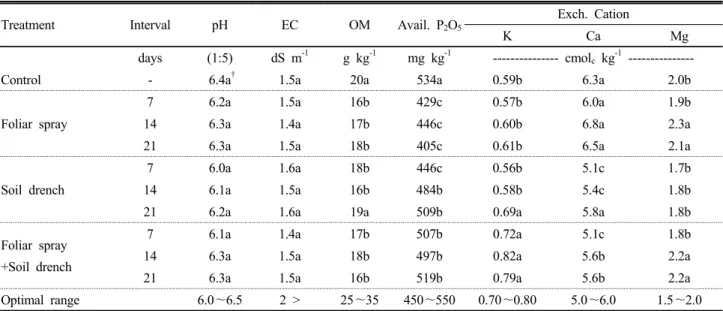
토양화학성 Chitosan 처리 방법에 따라 고추정식전과 수확기 토양특성에 미치는 영향을 조사한 결과 Table 3과 같았다. 정식전 토양 조건은 유기물과 치환성 K+ 함량이 고 추재배 적정범위 보다 낮았고, 나머지는 적정범위였다. 고 추 수확기에 조사한 토양 pH는 정식 전에 비해 모든 처리에 서 감소하였고, chitosan을 7일 간격으로 토양관주한 경우 감소폭이 가장 컸다. 유기물함량은 모든 처리구에서 정식전 보다 감소하였고, 유효인산함량은 대조구의 경우 정식전 보 다 증가하였지만, chitosan 처리방법에 상관없이 모든 처리 구에서 정식전보다 감소하는 경향을 보였다. 특히 엽면시비 를 실시한 처리구에서 토양인산 잔류량이 가장 낮아 chitosan 이 토양중 인산 유효화에 영향을 미치는 것으로 판단된다.
치환성 K+은 엽면시비구는 대조구와 비숫한 수준을 보였 고, 혼합처리하면 오히려 정식전 보다 증가하였다. 사용간 격이 길어 질수록 토양중 잔류량은 증가하는 것으로 나타났 다. 토양관주처리를 하면 치환성 Ca2+은 5.1~5.8 cmolc
kg-1수준으로 정식전보다 13.4~23.9% 감소하는 것으로 나 타났다. 치환성 Mg2+의 경우에도 치환성 Ca2+과 같은 경향 을 보였다. Jeong et al. (2006, 2007)은 chitosan 처리 전 후 토양의 화학성 특성 변화는 없었다고 하였지만, 제시되
Table 2. Germination rate of red pepper seed and growth quality of red pepper young plant depending on the treatment of chitosan.
Dilution rate
Immersion time
Germination rate
Plant No. of
leaves
Stem Root weight
Height Weight Length Diameter
hr % cm g cm mm g
0 0 99.4a 25.0 22.8 17.3a 21.0a 3.8a 6.3a
250
5 10 20 30
92.3c† 91.4c 91.4c 90.5c
24.2a 24.0a 23.3a 23.5a
21.1b 20.5b 20.3b 19.2b
17.5a 17.6a 17.4a 17.2a
20.1a 19.6a 18.6a 18.5a
3.8a 3.7a 3.8a 3.6a
6.1a 6.0a 6.1a 5.9a
500
5 10 20 30
92.9c 92.9c 92.3c 90.5c
24.1a 24.2a 23.9a 24.0a
22.2a 21.8b 21.9b 21.3b
17.7a 17.8a 17.5a 17.6a
19.6a 20.0a 19.2a 18.8a
3.8a 3.7a 3.6a 3.7a
6.2a 6.2a 6.1a 6.0a
1,000
5 10 20 30
93.7bc 92.8c 92.1c 91.0c
24.9a 24.8a 24.0a 24.2a
22.5a 22.1a 22.2a 21.6a
17.8a 17.6a 17.6a 17.5a
20.8a 20.6a 19.7a 19.9a
3.8a 3.8a 3.6a 3.7a
6.4a 6.4a 6.3a 6.1a
2,000
5 10 20 30
97.6b 96.7b 96.2b 94.1bc
25.3a 25.2a 24.6a 24.7a
23.2a 22.5a 22.3a 21.8a
18.0a 17.8a 17.5a 17.5a
21.2a 21.0a 20.4a 20.5a
3.8a 3.8a 3.8a 3.7a
6.5a 6.3a 6.2a 6.2a
†Numbers followed by the same letter with a column are not significantly different (Duncan test, p < 0.05).
Table 3. Changes of soil chemical properties in red pepper (Capsicum annuum L.) field as affected by chitosan.
Treatment Interval pH EC OM Avail. P2O5
Exch. Cation
K Ca Mg
days (1:5) dS m-1 g kg-1 mg kg-1 --- cmolc kg-1 ---
Control - 6.4a† 1.5a 20a 534a 0.59b 6.3a 2.0b
Foliar spray
7 6.2a 1.5a 16b 429c 0.57b 6.0a 1.9b
14 6.3a 1.4a 17b 446c 0.60b 6.8a 2.3a
21 6.3a 1.5a 18b 405c 0.61b 6.5a 2.1a
Soil drench
7 6.0a 1.6a 18b 446c 0.56b 5.1c 1.7b
14 6.1a 1.5a 16b 484b 0.58b 5.4c 1.8b
21 6.2a 1.6a 19a 509b 0.69a 5.8a 1.8b
Foliar spray +Soil drench
7 6.1a 1.4a 17b 507b 0.72a 5.1c 1.8b
14 6.3a 1.5a 18b 497b 0.82a 5.6b 2.2a
21 6.3a 1.5a 16b 519b 0.79a 5.6b 2.2a
Optimal range 6.0~6.5 2 > 25~35 450~550 0.70~0.80 5.0~6.0 1.5~2.0
†Numbers followed by the same letter with a column are not significantly different (Duncan test, p < 0.05).
어 있는 데이터를 보면 유효인산, 유기물, 치환성 K+, Mg2+
등에서 차이가 있었다.
토양미생물 밀도 변화 토양중 미생물 밀도 변화는 Table 4에서 보는 바와 같이 chitosan 처리 횟수가 많을수 록 세균 및 방선균의 밀도가 높아져 상대적으로 유해미생물 에 대한 유용미생물의 확보가 유리하여 고추 생육조건에 양 호하게 작용한 것으로 판단되며, B/F와 A/F 값은 토양관주
7일 간격 처리구에서 가장 높았다. 토양미생물은 유기물 분해자로서 무기성분의 산화와 환원에 미치는 영향이 크며 (Kim, 1994), 최근 농업분야에서 활발하게 이용하고 있다.
Lee and Jang (2000)은 chitosan 처리로 토양중의 방선 균 활동이 증가되고 사상균의 활동이 일시적으로 억제되었 다고 하였으며, Uhm et al. (2002)도 비슷한 결과를 보였 다. Jeong et al. (2007)은 chitosan을 가지와 잎상추에 엽 면시비한 경우 세균수는 증가하였지만 방선균, 사상균, 트
Table 4. Changes in population of soil microorganisms depending on the treatment methods of chitosan at the red pepper (Capsicum annuum L.) fields.
Treatment Interval Bacteria
×107
Actinomycetes
×106
Fungi
×105 B/F A/F
days --- cfu g-1, dry soil ---
Control - 2.22a† 2.13a 1.29a 172 16.5
Foliar spray
7 2.30a 2.22a 1.19b 193 18.7
14 2.27a 2.18a 1.20b 189 18.2
21 2.24a 2.13a 1.24a 181 17.2
Soil drench
7 2.34a 2.25a 1.04b 225 21.6
14 2.30a 2.21a 1.17b 197 18.2
21 2.26a 2.17a 1.19b 190 18.2
Foliar spray+
Soil drench
7 2.36a 2.27a 1.15b 205 19.7
14 2.32a 2.24a 1.29a 180 18.0
21 2.27a 2.20a 1.22a 186 18.0
†Numbers followed by the same letter with a column are not significantly different (Duncan test, p < 0.05).
Table 5. Changes in chlorophyll contents of red pepper (Capsicum annuum L.) foliage treated with chitosan.
Investigation time Interval Chlorophyll content
Foliar spray Soil drench Foliar spray+ Soil drench DAP† days --- SPAD ---
45
control 7 14 21
56.1a‡ 57.3a 58.1a 56.8a
56.4a 57.3a 58.7a 57.5a
56.2a 58.6a 57.2a 55.8a
87
control 7 14 21
50.8b 72.7a 73.7a 71.3a
51.3b 68.7a 70.3a 68.2a
50.9b 68.2a 67.8a 69.8a
†DAP, days after planting.
‡Numbers followed by the same letter with a column are not significantly different (Duncan test, p < 0.05).
리코데마수는 처리량에 따른 경향은 없었다고 하였다.
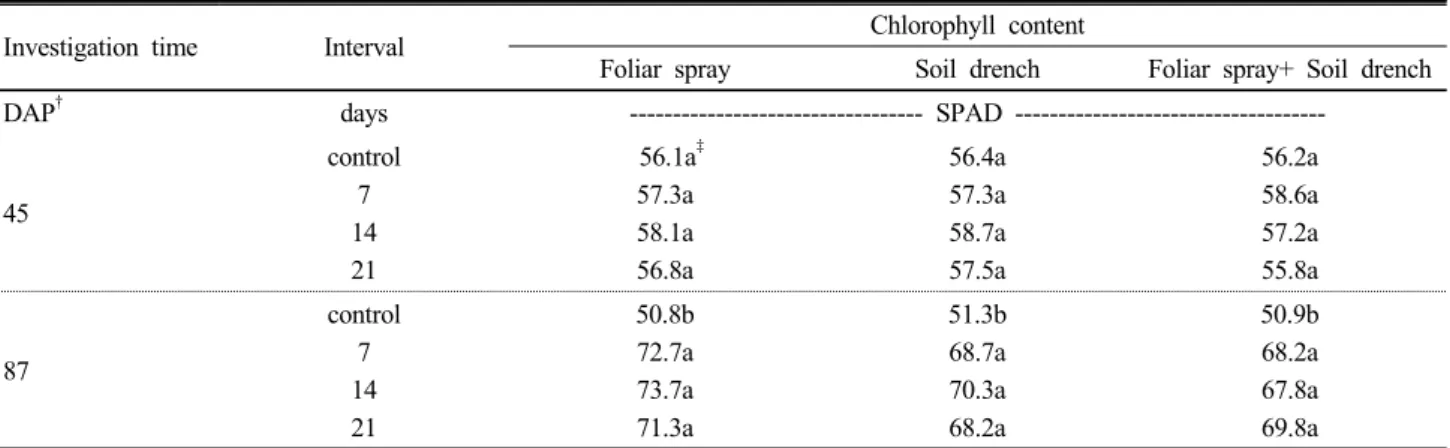
엽록소 함량 변화 Chitosan 처리에 의한 고추의 chlorophyll 함량을 정식 후 45일과 87일에 조사한 결과는 Table 5와 같 다. 정식 후 두 차례 조사에서 chitosan 처리방법과 시기에 따라 45일 경우에는 창가 없었지만, 87일 조사에서는 모든 처리구에서 대조구보다 chlorophyll 함량이 높았다. 이는 chitosan이 고추 정식후 87일까지는 토양 중 양분흡수를 활 발하게 함으로써 생육에 영향을 미치는 것으로 나타났으며, Uhm et al. (2002)의 결과와도 같은 경향을 보였다.
식물체 무기성분 함량 Chitosan 처리방법 및 처리간 격에 따른 고추 잎의 무기성분 함량에 미치는 영향을 조사 한 결과 Table 6과 같다. 고추 잎의 N는 엽면시비 14일, 토 양관주 21일, 혼합처리 14일과 21일 간격에서 대조구와 같
은 수준을 보였고, 엽면시비를 21일 간격으로 처리했을 때 4.11%로 가장 많았다. P는 처리간에 차이가 없었고, Ca은 chitosan을 처리했을 때 대체로 대조구보다 높았고, 엽면시 비와 토양관주를 혼합으로 7일과 14일 간격으로 처리했을 때 2.35~2.41%로 가장 높았고, 21일 간격으로 엽면시비나 토양관주를 했을 경우 대조구와 같은 수준으로 가장 낮았 다. Mg은 엽면시비 14일, 혼합처리 7일과 14일 경우 1.09~
1.12%로 가장 많았고, K는 7일 간격으로 토양관주가 이루어 질 경우 3.14~3.18%로 가장 많았고, 21일 간격으로 엽면시 비나 토양관주를 할 경우 가장 낮았다. Uhm et al. (2002) 도 chitosan 처리시 고추 잎의 Ca과 K 함량이 증가하였고, 처리횟수가 많을수록 증가한다고 하였다.
생육 및 수량특성 정식 후 87일 조사한 고추 생육상 황은 Table 7에서 보는 바와 같이 토양관주 처리에서 초장
Table 6. Contents of inorganic elements in red pepper (Capsicum annuum L.) leaves as affected by chitosan.
Treatment Interval T-N P Ca Mg K
Control
days --- % ---
- 4.27a† 0.07a 1.78d 0.95c 2.33b
Foliar spray
7 4.16b 0.07a 2.24b 0.98c 3.14a
14 4.24a 0.08a 2.18b 1.09a 2.34b
21 4.11c 0.06a 1.84d 1.04b 2.15c
Soil drench
7 4.14b 0.07a 2.15b 1.05b 2.56b
14 4.21b 0.06a 2.04c 0.97c 2.35b
21 4.26a 0.07a 1.81d 0.98c 2.18c
Foliar spray+
Soil drench
7 4.18b 0.06a 2.41a 1.10a 3.18a
14 4.32a 0.07a 2.35a 1.12a 2.87b
21 4.25a 0.08a 2.05c 1.01c 2.37b
†Numbers followed by the same letter with a column are not significantly different (Duncan test, p < 0.05).
Table 7. Effects of chitosan on the growth of red pepper (Capsicum annuum L.).
Treatment Interval Plant
height
Stem Diameter
Fruit
Length Diameter
days cm mm cm mm
Control - 107b† 14.2 11.3b 17.2a
Foliar spray
7 105b 14.1b 11.6a 16.9a
14 107b 14.4b 11.7a 17.3a
21 106b 14.1b 11.9a 17.8a
Soil drench
7 110a 15.1a 11.3b 17.3a
14 109a 14.8a 10.8b 16.9a
21 110a 15.0a 10.9b 17.3a
Foliar spray + Soil drench
7 106b 14.2b 10.9b 17.0a
14 107b 14.0b 11.4b 17.2a
21 107b 14.1b 11.4b 17.1a
†Numbers followed by the same letter with a column are not significantly different (Duncan test, p < 0.05).
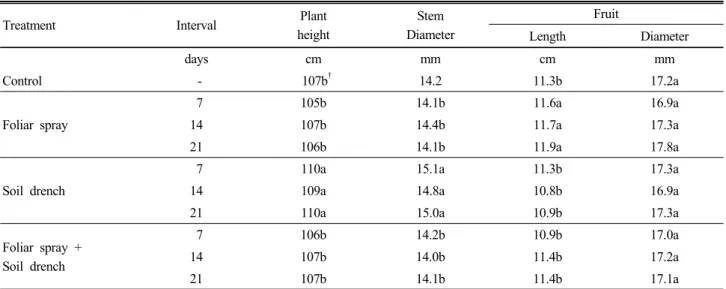
109~110 cm, 경경 14.8~15.1 mm으로 가장 크고, 대조구, 엽면시비, 혼합처리구는 처리간격에 관계없이 통계적인 차 이가 없었다. 과장은 엽면시비를 할 경우 11.6~11.9 cm로 가장 길었고, 나머지 처리구는 모두 같은 수준을 보였고, 과 경은 처리간에 차이가 없었다.
Jeong et al. (2007)도 chitosan 처리에 따라 가지의 초 장, 엽장 경경, 생체중 등이 대조구보다 통게적으로 높았다 고 하였다. Sterrett et al. (1990)은 묘의 생육 기간 동안 근 권에 안정된 수분 공급을 함으로써 수분 스트레스를 최소화 하는 것이 생육을 촉진 시킬 수 있는 방법이라고 하였는데 본 연구에서도 토양관주시 초장과 경경에 유리하게 작용한 것으로 보아 chitosan을 토양관주로 공급할 경우 뿌리의 수 분흡수 스트레스를 최소화할 수 있다고 본다.
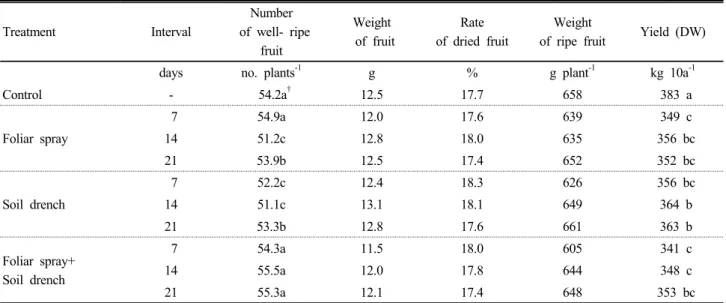
고추수량 특성을 조사하기 위해 4차례 수확한 결과를 통 합하여 Table 8에 표시하였다. 주당 숙과수는 7일 간격으로 엽면시비를 하거나 엽면시비와 토양관주를 혼합처리할 경
우 가장 많았고, 과중, 건과율, 주당 숙과중은 통계적인 차 이는 없었지만 토양관주에서 양호한 것으로 나타났다. 건고 추 생산량은 대조구에서 383 kg 10a-1으로 가장 많았고, chitosan을 토양관주 처리하였을 때 대조구의 93.0~95.0%
수준인 356~364 kg 10a-1으로 chitosan 처리구 중에서 가 장 많았다. 한편 혼합처리를 했을 때는 대조구의 89.0~
92.2% 수준으로 가장 낮았다.
처리간격간 비교에서 주당 숙과수는 엽면살포+토양관주 14일 간격에서, 과중은 토양관주구의 14일 간격, 건과율은 모든 처리구의 7일 간격, 주당 숙과중은 21일 간격에서 가 장 우수하였지만, 건과중은 토양관주 14일 간격에서 364 kg/10a으로 가장 많은 수량을 얻어 chitosan을 고추에 사용 할 경우 토양관주 14일 간격으로 처리해야 효과가 있는 것 으로 보인다. 한편 대조구에 비해 수량이 5% 정도 감소한 것은 친환경재배를 실시하면서 합성농약에 의한 병해충 방 제를 하지 않았기 때문인 것으로 판단된다. Uhm et al.
Table 8. Effects of chitosan on the yield and fruit characteristics of pepper.
Treatment Interval
Number of well- ripe
fruit
Weight of fruit
Rate of dried fruit
Weight
of ripe fruit Yield (DW)
days no. plants-1 g % g plant-1 kg 10a-1
Control - 54.2a† 12.5 17.7 658 383 a
Foliar spray
7 54.9a 12.0 17.6 639 349 c
14 51.2c 12.8 18.0 635 356 bc
21 53.9b 12.5 17.4 652 352 bc
Soil drench
7 52.2c 12.4 18.3 626 356 bc
14 51.1c 13.1 18.1 649 364 b
21 53.3b 12.8 17.6 661 363 b
Foliar spray+
Soil drench
7 54.3a 11.5 18.0 605 341 c
14 55.5a 12.0 17.8 644 348 c
21 55.3a 12.1 17.4 648 353 bc
†Numbers followed by the same letter with a column are not significantly different (Duncan test, p < 0.05).
(2002)의 결과에서도 관행에 비해 수량은 감소하였다고 하 였다.
화학합성 농약을 사용하지 않고도 토양관주를 14일 간격 으로 실시했을 때 관행처리구에 비해 5% 정도 수량차이를 보일 수 있는 것인 방선균의 증식 촉진에 의한 토양미생물 상이 호전되고, 작물의 양분이용이 유리하게 작용하여 과중 등의 과실 특성에 효과를 보인 것으로 판단된다. 따라서 chitosan 처리에 의한 친환경농산물이 일반농산물보다 가격 적인 차별성이 보장된다면 관행수준 이상의 소득향상이 있 을 것이다.
요 약
Chitosan이 친환경 고추재배를 위한 친환경자재로써 토 양환경개선과 고추수량 등에 미치는 효과를 조사하기 위해 엽면시비, 토양관주, 두 가지를 혼합처리 하였다. 침지시간 에 따른 발아율은 무처리에서 99.4%였고, chitosan 농도가 낮을수록 침지시간이 짧을수록 발아율은 높았지만 대조구 보다는 낮았다. 수확기에 조사한 토양화학성분은 chitosan 처리방법에 관계없이 정식전 보다 모두 감소하였다. Chitosan 처리횟수가 증가할수록 토양중 세균과 방선균 밀도는 증가 하였고, chlorophyll 함량은 대조구보다 많았다. 고추 잎의 P 함량은 차이가 없었지만, N는 14일 간격으로 엽면시비를 하거나 21일 간격으로 토양관주를 했을 때 무처리 수준과 같았고, Ca, Mg, K는 7일 간격으로 혼합처리시 높은 경향 을 보였으며, 토양관주를 했을 때 생육상태는 가장 우수하 였지만, 수량은 대조구에서 383 kg 10a-1 수준으로 가장 많 았고, 토양관주 처리에서 대조구의 93.0~95.0% 수준을 보 였다.
인 용 문 헌
El Ghaouthm, A., J. Arul, R. Ponnampalam, and M. Boulet.
1991. Chitosan coating effect on storability and quality of fresh strawberries. J. Food Sci. 56:1618-1620.
Hirano, S. and N. Nagao. 1989. Effects of chitosan, pectic acid, lysozyme and chitinase on the growth of several phyto- pathogens. Agrci. Bio. Chem. 53:3065-3066.
Jeong, S.J., J.S. Oh, W.Y. Seok, J.H. Kim, D.H. Kim, and W.B. Chung. 2006. The effect of chitosan, wood vinegar and EM on microorganisms in soil and early growth of tomato. Korean J. Org. Agri. 14:433-443.
Jeong, S.J., J.S. Oh, W.Y. Seok, M.Y. Cho, and J.B. Seo.
2007. The effect of chitosan and wood vinegar treatment on the growth of eggplant and leaf lettuce. Korean J. Org. Agri.
15:437-452.
Kendra, D.F. and I.A. Hadwiger. 1984. Characterization if the smallest chitosan oligomer that is maximally antifungal to Fusarium solani and elicits oisatin formation in Pisum sativum. Experiment. Mycol. 8:276-281.
Kim, H.G. 1994. Situation of Koran organic farming and research of its development. Research Report of Agricultural Science Institute. pp.85-92.
Kim, S.G. 1998. Use of chitin and chitosan in field of agriculture. Korean Res. J. Chitin-Chitosan. 3(4):327-342.
Lee, Y. and B.C. Jang. 2000. Identification and use of activated substance derived from the commercialized environmental friendly agro-materials on plant growth. Agro-Environment Research 2000. NIAST, RDA. pp.337-345.
NIAST (National Institute of Agricultural Science and Technology). 2000. Method of soil and plant analysis.
NIAST, RDA, Korea.
Park, J.M., I.B. Lee, Y.I. Kang, and K.S. Hwang. 2009.
Effects of mineral and organic fertilizations on yield of hot pepper and changes in chemical properties of upland soil.
Kor. J. Hort. Sci. Technol. 27(1):24-29.
Park, Y.B., K.N. Yang, and K.T. Kim. 2001. Effect of chitosan treatment on gorwth and yield of fall-planted potato (Solanum tuberosum) Dejima in Jeju lsland. J.
Bio-Environ. Cont. 10(4):251-257.
RDA (Rural Development Administration). 1986. Red pepper culture. RDA. Suwon. Korea.
RDA. 2003. Standard methods for agricultural experiments.
RDA. Suwon. Korea.
Shin, Y.A., J.S. Lee, Y.C. Um, and S.H. Park. 2006. Effects of seed spacing and depth and planting date on yield of once-over harvested hot pepper (Capsicum annuum L.) planted by direct seeding. Kor. J. Hort. Sci. Technol.
24:8-12.
Sterrett, S.B., B.B. Ross, and C.P. Savage, Jr. 1990. Establish- ment and yield of asparagus as influenced by planting and irrigation method. J. Amer. Soc. Hort. Sci. 115 : 29~33.
Uhm, M.J., H.C. Park, Y.H. Moon, K.C. Kim, and S.G. Han.
2002. Effect of chitsan and wood vinergar on the growth and nutrient absorption of red pepper (Capsicum annum L.) J. Bio-Environ. Control. 11(2):67-73.
Yang, S.K., Y.W. Seo, Y.S. Kim, S.K. Kim, K.H. Lim, K.J.
Choi, J.H. Lee, and W.J. Jung. 2011. Changes of pepper yield and chemical properties of soil in the application of different green manure crops and no-tillage organic cultivation.
Korean J. Org. Agri. 19(2):215-228.
Yoo, Y.K., H.J. Park, S.W. Kang, and H.K. Kim. 1999. Effect of chitosan and sucrose on the cut rose ‘Cardinal’. Korean J.
Hort. Sci. Tech. 17(4):482-485.