• 검색 결과가 없습니다.

Epidemiological and Clinical Characteristics of Elderly Fall Patients Visit to the Emergency Department: A Comparison by Gender

N/A
N/A
Protected

Academic year: 2021

Share "Epidemiological and Clinical Characteristics of Elderly Fall Patients Visit to the Emergency Department: A Comparison by Gender"

Copied!
8
0
0

로드 중.... (전체 텍스트 보기)

전체 글

(1)

Received: July 6, 2018 Revised: September 28, 2018 Accepted: October 1, 2018 Trauma and InJury

Correspondence to Sun Pyo Kim, M.D.

Department of Emergency Medicine, Chosun University Hospital, College of Medicine, Chosun University, 365 Pilmun-daero, Dong-gu, Gwangju 61453, Korea

Tel: +82-62-220-3285 Fax: +82-62-224-3501 E-mail: [email protected]

Epidemiological and Clinical

Characteristics of Elderly fall Patients Visit to the Emergency department:

a Comparison by Gender

Jun Kew Kim, M.D.

1

, Sun Pyo Kim, M.D.

1

, Sun Hyu Kim, M.D.

2

,

Gyu Chong Cho, M.D.

3

, Min Joung Kim, M.D.

4

, Ji Sook Lee, M.D.

5

, Chul Han, M.D.

6

1

Department of Emergency Medicine, Chosun University Hospital, College of Medicine, Chosun University, Gwangju, Korea

2

Department of Emergency Medicine, University of Ulsan College of Medicine, Ulsan, Korea

3

Department of Emergency Medicine, School of Medicine, Hallym University, Seoul, Korea

4

Department of Emergency Medicine, Yonsei University College of Medicine, Seoul, Korea

5

Department of Emergency Medicine, Ajou University School of Medicine, Suwon, Korea

6
Department of Emergency Medicine, Ewha Womans University School of Medicine, Seoul, Korea

Purpose: This study was to analyze clinical and epidemiological characteristics of elderly patients who were admitted to the emergency department (ED) due to falls by separating male and female.

methods: We retrospectively analyzed the fall patients aged 65 years or older from the data of the in-depth surveillance study of injured patients visit to the ED under the su- pervision of the Korea Centers for Disease Control and Prevention (KCDC) from 2011 to 2016 by separating male and female.

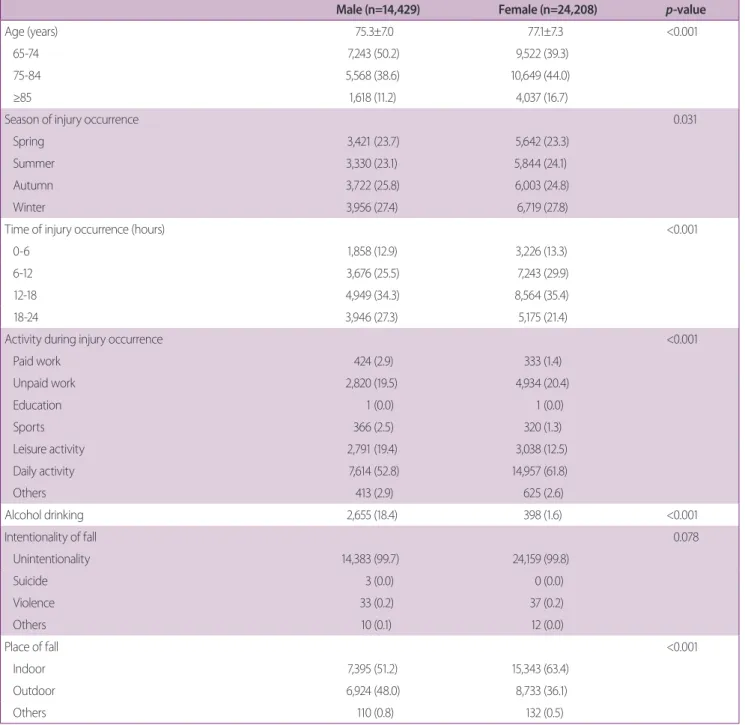
results: A total of 361,588 elderly fall patients were analyzed and, among them, 14,429 (37.3%) were males and 24,208 (62.7%) were females. Male and female showed similar frequency of damage happening season. However, they showed falling accident mostly on winter. The time of injury occurrence is mostly from 12:00 to 18:00 with 4,949 (34.3%) male and 8,564 (35.4%) female. Most falls occurred in daily activities, accounting for 7,614 (52.8%) in males and 14,957 (61.8%) in females, respectively. Unintentional dam- age accounted for the most part and 7,395 (51.2%) of male and 15,343 (63.4%) of female were injured indoors. Head and neck were the most common site of injuring, with 8,392 (58.2%) in males and 7,851 (32.4%) in females. According to ED examination outcomes, most of the patients were discharged, while the majority of the hospitalized patients were admitted to the general patient room.

Conclusions: The elderly falls occurred mostly from 12:00 to 18:00, during winter and to elderly women. Also, they happened unintentionally indoors in everyday life, mostly.

Proved clinical, epidemiological characteristics from this research will be used as useful indicator at validity research of development of prevent program of falling accident for elderly people.

Keywords: Elderly; Falls; Emergency; Injuries

(2)

INTRODUCTION

Fall refers to various situations that, unlike drops from a height difference, suddenly collapses or fail and being hurt regardless of their will. Although it can occur in all ages, the incidence rate in elderly people is especially high. The injury caused by trauma can leave a permanent sequela to the elderly [1]. Falling accident happens commonly in our life and it doesn’t cause serious damage or injury. Howev- er, the fear, limitation of walking, losing confidency that elder people feel can cause lots of disability [2,3]. In Ko- rea, there are many studies on patients who suffered falls and admitted in hospitals, while few studies on analyzing falling-related factors by separating male and female have been done [1,3]. This study was to analyze clinical and ep- idemiological characteristics of elderly patients who were admitted to the ED due to falls by separating male and female.

METHODS

Population

This study retrospectively analyzed data from in-depth surveillance study of patients with injured patients in the ED under the control of the KCDC. In-depth surveillance of patients with injured patients in the ED has been start- ed since 2006, and 23 hospitals are currently participating in the surveillance. The data on emergency patients are collected and prospectively constructed to make data registry. This study analyzed data for 6 years from 2011 to 2016. The authors classified the patients who entered the fall in the common category and entered the fall as the deep category among 65 years and older by male and female. And the authors analyzed the data, we excluded insufficient or inaccurate data about the contents that the researcher want to analyse.

Data collection

Patients’ gender and age, season, time of injury, means of visit, acting status, drinking status, result of examina- tion, result of hospitalization, intentionality of injury, and place of occurrence were selected as variables. The elderly patients were classified as 65 years and older and

they were subdivided by 65-74, 75-84, and ≥85 years. The patient’s condition was collected at the season and time of injury occurrence and the vital sign, consciousness status, damaged area at emergency room, and whether emergency operation was done were collected. When an- alyzing fall patients, we selected ground condition, type of ground and slope, jaw, lighting, brightness and concomi- tant disease among environmental factors. This study was approved by Chosun University Hospital Institutional Review Board (IRB No. 2018-08-026).

Statistical analysis

Statistical analysis was performed using SPSS version 20.0 (IBM Corp., New York, NY, USA). In order to test whether gender differences were significant, continuous variables were compared by Student’s t-test. Categorical variables were compared by chi-squared test but Fisher’s exact test was used when frequency value was below 5.

p-value (importance level, α) of less than 0.05 was consid- ered statistically significant.

RESULTS

A total of 1,538,260 patients were enrolled in the in-depth examination of patients with an injured patients in the ED from 2011 to 2016, of which 361,588 suffered falls in common items. Among the patients over 65 years, if the data recording of analysis requirements of this study is insufficient, we excluded insufficient or inaccurate data about the contents that the researcher want to analyse.

Therefore, total 38,637 patients were analyzed in this

study. Fourteen thousand four hundred twenty-nine

(37.3%) of the males and 24,208 (62.7%) of the females

were analyzed. According to the gender of the patients,

the mean age was 75.3±7.0 for males and 77.1±7.3 for

females. Among the women patients over 65 years, 75-

84 accounted for the largest proportion (44.0%), and for

men patients over 65 years, 65-74 accounted for the high-

est percentage (50.2%). When comparing season, winter

is most frequent with 3,956 (27.4%) of males and 6,719

(27.8%) of females. The time of injury occurrence was

mostly from 12:00 to 18:00 with 4,949 (34.3%) in males

and 8,564 (35.4%) in females. In case of injured activities,

(3)

the majority of falls was in daily activities in both male and female. In the case of drinking status, male was 2,655 (18.4%), significantly more than female with 398 (1.6%).

The intention of injuries was most common in uninten- tionality, and 14,383 (99.7%) of males and 24,159 (99.8%) of females were indoor condition when damage occurred

(Table 1).

Most patients used an ambulance when they visit ED.

Major injured sites were head and neck in both male with 8,392 (58.2%) and female with 7,851 (32.4%). The next results were slightly different by the lower extremity with 2,187 (15.2%) in male and hip with 6,286 (26.0%) and

Table 1. Comparison of general characteristics of elderly fall patients

Male (n=14,429) Female (n=24,208) p-value

Age (years) 75.3±7.0 77.1±7.3 <0.001

65-74 7,243 (50.2) 9,522 (39.3)

75-84 5,568 (38.6) 10,649 (44.0)

≥85 1,618 (11.2) 4,037 (16.7)

Season of injury occurrence 0.031

Spring 3,421 (23.7) 5,642 (23.3)

Summer 3,330 (23.1) 5,844 (24.1)

Autumn 3,722 (25.8) 6,003 (24.8)

Winter 3,956 (27.4) 6,719 (27.8)

Time of injury occurrence (hours) <0.001

0-6 1,858 (12.9) 3,226 (13.3)

6-12 3,676 (25.5) 7,243 (29.9)

12-18 4,949 (34.3) 8,564 (35.4)

18-24 3,946 (27.3) 5,175 (21.4)

Activity during injury occurrence <0.001

Paid work 424 (2.9) 333 (1.4)

Unpaid work 2,820 (19.5) 4,934 (20.4)

Education 1 (0.0) 1 (0.0)

Sports 366 (2.5) 320 (1.3)

Leisure activity 2,791 (19.4) 3,038 (12.5)

Daily activity 7,614 (52.8) 14,957 (61.8)

Others 413 (2.9) 625 (2.6)

Alcohol drinking 2,655 (18.4) 398 (1.6) <0.001

Intentionality of fall 0.078

Unintentionality 14,383 (99.7) 24,159 (99.8)

Suicide 3 (0.0) 0 (0.0)

Violence 33 (0.2) 37 (0.2)

Others 10 (0.1) 12 (0.0)

Place of fall <0.001

Indoor 7,395 (51.2) 15,343 (63.4)

Outdoor 6,924 (48.0) 8,733 (36.1)

Others 110 (0.8) 132 (0.5)

Values are presented as number (%) or mean±standard deviation.

(4)

upper extremity with 4,305 (17.8%) in female. According to ED examination outcomes, most of the patients were discharged, while the majority of the hospitalized patients were admitted to the general patient room. Emergency surgery account for 5,039 (22.0%) of total treatment among female falls patients and 2,089 (16.4%) of total treatment among male falls patients. In the post-admis- sion results, the number of patients who were discharged from the hospital was occupied a large proportion, but the patients who died were also examined by 244 (5.6%) in male and 226 (2.5%) in female (Table 2).

In the in-depth analysis data of six hospitals, only com- plete analysis data of this study were analyzed in patients with ‘fall’. Among them, the data showed most fall in the normal ground condition and the concrete ground type was 1,466 (80.5%) of male and 2,336 (75.9%) of female.

When environmental factors were analyzed, both male and female falls in place with no inclination, no jaws and place of illumination but those results have no significant value. In the simple comparison of the presence of con- comitant disease, patients with no concomitant disease were more than those with concomitant disease (Table 3).

DISCUSSION

In Korea, the life expectancy of the elderly has increased and the elderly population has increased dramatically with the improvement of national health and medical ser- vices following the economic development and improve- ment of medical technology. In 2006, the elderly popula- tion aged 65 or older accounted for 9.5%, 14.3% in 2018, and in 2026 it is expected to exceed 20.8% and become an aged society [4]. In the statistics of death of patients, accidents account for 9.5% of all deaths in Korea, and fall accidents rank third after traffic accident and suicide [5].

Although there are many studies on the elderly trauma patients due to the increase of the elderly population, the proportion of trauma patients, especially fallen patients, is increasing in Korea [2,6]. In the United States, more than one-third of the elderly over 65 years experience falls at least once a year, and more than 50% of the elderly over 80 years are reported to have experienced falls [7,8]. In Korea and elsewhere, there are many analysis of elderly

fall patients. Fall experience rates of the elder are higher in female than in male and fractures due to falls occur twice as often in female while deaths due to falls occur more frequently in male than female [3,9]. In this study, the incidence of falls in women was higher than that in men, and no significant difference was found in the analysis factors. This is a result of the fact that the average life span of women is longer than that of men.

Of course, the reason for the elderly falls is due to the deterioration of the body function. Falls are caused by physical health problems such as diminished activity, side effects or interactions of drug use, alcohol consumption and behavioral problems, environmental factors [10,11].

In general, falls are caused by environmental factors such as slippery floor or uneven ground, and diminished ad- justing ability due to weakness of the lower extremity or dysbasia because of aging, muscle weakness, orthostatic hypotension and dizziness [1,11].

In previous studies, there are many studies that have been reported that falls occur mostly in winter [1,6,7]. In this study, similar results were obtained in four seasons while slightly frequent in winter, and this suggests that the fall is due to slippery floors as the weather gets colder and seasonal fallout, which may lead to decreased concentra- tion, leads to an increase in the incidence of falls.

Falling in the elderly is an important social problem

that causes various serious injuries such as fracture, brain

damage, and even death. Approximately 30% of elderly

people aged 65 or older living in homes experience falls

each year [8]. Twenty to thirty percent of the elderly suf-

fering from falls experience severe injuries such as hip

fracture and head injury, which limits their mobility and

independence and the duration of treatment is prolonged,

resulting in secondary complications and even death

[6,12,13]. So, the physical and mental suffering of the pa-

tients and their family is serious and the economic loss is

great. In the elderly, death from falls is 10 times of other

age, hospitalization rate due to falls is close to eight times

of other ages, and besides death due to falls, complication

and inconvenience caused by long hospitalization result

in severe noticeable decrease in quality of life [14,15]. The

deaths from falls occurred in about 2% of patients aged

60 or older and the most common cause of death was

cerebral hemorrhage (40.3%) followed by hip and thigh

(5)

Table 2. Comparisons of emergency department medical outcomes of elderly fall patients

Male (n=14,429) Female (n=24,208) p-value

Blood pressure (mmHg) <0.001

Systolic pressure 140.1±25.5 145.8±26.2 <0.001

Diastolic pressure 79.1±13.5 80.2±13.6 <0.001

Pulse rate (per minute) 80.6±14.2 80.3±13.3 0.037

Respiratory rate (per minute) 19.1±1.9 19.1±1.8 1.000

Body temperature (°C) 36.5±0.9 36.6±4.2 0.005

Consciousness at emergency room <0.001

Alert 13,730 (95.2) 23,641 (97.6)

Verbal response 452 (3.1) 402 (1.7)

Pain 183 (1.3) 126 (0.5)

Unresponsiveness 64 (0.4) 39 (0.2)

Mode of arrival (%) <0.001

Ambulance 8,013 (55.5) 12,276 (50.7)

Private car 6,095 (42.2) 11,396 (47.1)

On foot 267 (1.9) 458 (1.9)

Others 54 (0.4) 78 (0.3)

Major injury region <0.001

Head and neck 8,392 (58.2) 7,851 (32.4)

Thorax 795 (5.5) 1,470 (6.1)

Abdomen 847 (5.9) 2,373 (9.8)

Upper extremity 1,387 (9.6) 4,305 (17.8)

Lower extremity 2,187 (15.2) 1,923 (7.9)

Hip 821 (5.6) 6,286 (26.0)

Disposition at emergency room <0.001

Discharge 8,846 (61.3) 13,136 (54.2)

DAMA 477 (3.3) 591 (2.4)

Admission (ICU) 806 (5.6) 643 (2.7)

Admission (general ward) 3,533 (24.5) 8,366 ( 34.6)

Transfer 739 (5.1) 1,449 (6.0)

Death 28 (0.2) 23 (0.1)

Result of adimission 4,339 9,009 <0.001

Discharge 3,406 (78.5) 7,633 (84.8)

Self-discharge 48 (1.1) 76 (0.8)

Transfer 641 (14.8) 1,074 (11.9)

Death 244 (5.6) 226 (2.5)

Emergency operation 2,089 (16.4) 5,039 (22.0) <0.001

Values are presented as number (%) or mean±standard deviation.

DAMA: discharge against medical advice, ICU: intensive care unit.

(6)

damage (23.3%), back bone or pelvic injury (10.9%).

There was more cerebral hemorrhage in elderly male, and hip fractures in elderly female [16,17]. Of the injured parts due to fall in the elderly over 65 years of age, the lower extremity damage has decreased since 2004 and the upper extremity, head and neck damage tend to increase [6]. In this study, head and neck injuries were the most common in male and female, followed by lower extremity injuries in male and hip injuries in female. Also, we are considering lots of mortality rates because there were lots of male’s head damage on damaged parts and also there were lots of intensive care unit hospitalization patients.

Preventing is the top priority for elderly fall patients because the life of the patient can be threatened by the complications resulting from the deterioration of many

underlying diseases and the fast loss of muscle mass com- pared to young people. To prevent falls, it is important to know the preventable risk factors of falls and to eliminate them and it is necessary to educate people who are ex- posed to risk factors or in risk, and to investigate the pos- sibility of falls [18,19]. Also, exercise programs should be provided according to age and gender by evaluating gait, balance, or muscle strength to prevent falls [20]. While it is impossible to prevent all injuries from falls, efforts to reduce the frequency and severity of falls in the risk group should be continued. Elderly fall and fall injuries will be reduced when information on where the fall occurs, the time, and the consequences of the damage are surveyed.

Although there are many fall prevention programs for the elderly, applying it to all elderly people regardless of Table 3. Comparisons of characteristics of elderly fall patients in the in-depth analysis items of 6 hospitals

Male Female p-value

Ground condition 1,777 3,019 <0.001

Normal 1,519 (85.5) 2,421 (80.2)

Water 194 (10.9) 458 (15.2)

Ice 34 (1.9) 90 (3.0)

Snow 25 (1.4) 43 (1.4)

Others 5 (0.3) 7 (0.2)

Ground type 1,820 3,079 <0.001

Concrete 1,466 (80.5) 2,336 (75.9)

Soil 95 (5.2) 129 (4.2)

Others 259 (14.3) 614 (19.9)

Environmental factor

Slope 2,172 3,595 0.102

None 1,822 (83.9) 3,073 (85.5)

Exist 350 (16.1) 522 (14.5)

Jaws 2,182 3,618 0.548

None 1,797 (82.4) 2,957 (81.7)

Exist 385 (17.6) 661 (18.3)

Illumination 2,210 3,683 0.444

None 491 (22.2) 787 (21.4)

Exist 1,719 (77.8) 2,896 (78.6)

Concomitant disease 1,817 3,132 <0.001

Yes 624 (34.3) 1,392 (44.4)

No 1,193 (65.7) 1,740 (55.6)

Values are presented as number (%).

(7)

method and gender may not be effective [21,22]. In the United States, elderly fall is an impairment which has sig- nificance on preventive activity so it collects effective fall prevention program and introduces an evidence-based specific community prevention program to all people. In order to present a more effective exercise program to the elderly, it is necessary to increase not only the physical strength factor but also ability to maintain the balance to the unexpected stimulus by training one’s body core. And it is also important to know how to cope when a fall oc- curs [20,23].

The limitations of this study are retrospective studies that collected records of various hospitals based on the ED so it is possible that they are reported less than actual falls because they are data of fall patients among injured patients rather than fall only. And the authors could not provide a representative index for Korea because they ex- cluded patients who showed a little more than the numer- ical value to the comparative analysis. Further continuing research is needed to develop specific preventive measures by sharing the results with the development and analysis of systematic, objective and prospective data collection methods for the elderly fall patients.

CONCLUSION

We examined the epidemiological features of the elderly fall patients who visited the ED of the several hospitals for 6 years. The elderly falls occurred mostly from 12:00 to 18:00, during winter and to elderly women. And it happened unintentionally indoors in everyday life, most- ly. Proved clinical, epidemiological characteristics from this research will be used as useful indicator at validity research of development of prevent program of falling accident for elderly people.

ACKNOWLEDGEMENTS

This research was supported by a fund by Research of Ko- rea Centers for Disease Control and Prevention.

REFERENCES

1. Kim JM, Lee MS. Risk factors for falls in the elderly population in Korea: an analysis of the third Korea national health and nu- trition examination survey data. Korean J Health Edu Promot 2007;24:22-39.

2. Jung HY, Kim SH, Lee SC, Kim S, Cho GC, Kim MJ, et al. Relat- ing factors to severe injury from outdoor falls in older people.

Geriatr Gerontol Int 2018;18:80-7.

3. Kim JM, Lee MS, Song HJ. An analysis of risk factors for falls in the elderly by gender. Korean J Health Edu Promot 2008;25:1- 18.

4. Korea National Statistical Office. 2018 elderly people statistics [Internet]. Daejeon: KOrean Statistical Information Service (KOSIS) 2018 [cited 2018 Sep 28]. Available from: http://kosis.

kr/index/index.do.

5. Korea National Statistical Office. 2017 cause of death statistics [Internet]. Daejeon: KOrean Statistical Information Service (KOSIS) 2017 [cited 2018 Sep 28]. Available from: http://kosis.

kr/index/index.do.

6. Korea Centers for Disease Control and Prevention (KCDC).

Epidemiologic characteristics of injured elderly inpatients in Korea: the results of the Korea National Hospital discharge sur- vey, 2004-2013 [Internet]. Cheongju: Korea Centers for Disease Control and Prevention 2017 [cited 2018 Jun 21]. Available from: http://www.cdc.go.kr.

7. Bergen G, Stevens MR, Burns ER. Falls and fall injuries among adults aged ≥65 years - United States, 2014. MMWR Morb Mortal Wkly Rep 2016:65;993-8.

8. Centers for Disease Control and Prevention (CDC). Fatalities and injuries from falls among older adults--United States, 1993-2003 and 2001-2005. MMWR Morb Mortal Wkly Rep 2006;55:1221-4.

9. Duckham RL, Procter-Gray E, Hannan MT, Leveille SG, Lipsitz LA, Li W. Sex differences in circumstances and consequences of outdoor and indoor falls in older adults in the MOBILIZE Bos- ton cohort study. BMC Geriatr 2013;13:133.

10. Kim SH. Risk factors for severe injury following indoor and outdoor falls in geriatric patients. Arch Gerontol Geriatr 2016;62:75-82.

11. Korea Centers for Disease Control and Prevention (KCDC).

Epidemiological characteristics of injured inpatients in Korea,

2015 [Internet]. Cheongju: Korea Centers for Disease Control

and Prevention 2015 [cited 2018 Jun 25]. Available from: http://

(8)

www.cdc.go.kr.

12. Stevens JA, Rudd RA. Circumstances and contributing causes of fall deaths among persons aged 65 and older: United States, 2010. J Am Geriatr Soc 2014;62:470-5.

13. Evans D, Pester J, Vera L, Jeanmonod D, Jeanmonod R. Elderly fall patients triaged to the trauma bay: age, injury patterns, and mortality risk. Am J Emerg Med 2015;33:1635-8.

14. Maresh J, Guse C, Layde P. National trends and coding patterns in fall-related mortality among the elderly in the United States.

J Public Health Policy 2012;33:202-14.

15. Chippendale T, Gentile PA, James MK, Melnic G. Indoor and outdoor falls among older adult trauma patients: a comparison of patient characteristics, associated factors and outcomes. Geri- atr Gerontol Int 2017;17:905-12.

16. Burns E, Kakara R. Deaths from falls among persons aged ≥65 years - United States, 2007-2016. MMWR Morb Mortal Wkly Rep 2018;67:509-14.

17. Korea Centers for Disease Control and Prevention (KCDC).

Type of damage of fall injury 2010 [Internet]. Cheongju: Korea Centers for Disease Control and Prevention 2010 [cited 2018

Jun 21]. Available from: http://www.cdc.go.kr.

18. Tinetti ME. Clinical practice. Preventing falls in elderly persons.

N Engl J Med 2003;348:42-9.

19. Dellinger A. Older adult falls: effective approaches to preven- tion. Curr Trauma Rep 2017;3:118-23.

20. Shier V, Trieu E, Ganz DA. Implementing exercise programs to prevent falls: systematic descriptive review. Inj Epidemiol 2016;3:16.

21. Taylor-Piliae RE, Peterson R, Mohler MJ. Clinical and com- munity strategies to prevent falls and fall-related injuries among community-dwelling older adults. Nurs Clin North Am 2017;52:489-97.

22. Pfortmueller CA, Lindner G, Exadaktylos AK. Reducing fall risk in the elderly: risk factors and fall prevention, a systematic review. Minerva Med. 2014;105:275-81.

23. Guirguis-Blake JM, Michael YL, Perdue LA, Coppola EL, Beil

TL. Interventions to prevent falls in older adults: updated evi-

dence report and systematic review for the US Preventive Ser-

vices Task Force. JAMA 2018;319:1705-16.

수치

Table 1. Comparison of general characteristics of elderly fall patients
Table 2. Comparisons of emergency department medical outcomes of elderly fall patients

참조

관련 문서

Modern Physics for Scientists and Engineers International Edition,

If both these adjustments are considered, the resulting approach is called a bootstrap-BC a -method (bias- corrected-accelerated). A description of this approach

③ A student who attended Korean course at KNU Korean Language Program and holds TOPIK Level 3 or a student who completed Korean course Level 4 at the KNU Korean Language

· 50% exemption from tuition fee Ⅱ for the student with a TOPIK score of level 3 or higher or completion of level 4 or higher class of the Korean language program at the

웹 표준을 지원하는 플랫폼에서 큰 수정없이 실행 가능함 패키징을 통해 다양한 기기를 위한 앱을 작성할 수 있음 네이티브 앱과

_____ culture appears to be attractive (도시의) to the

The index is calculated with the latest 5-year auction data of 400 selected Classic, Modern, and Contemporary Chinese painting artists from major auction houses..

The “Asset Allocation” portfolio assumes the following weights: 25% in the S&amp;P 500, 10% in the Russell 2000, 15% in the MSCI EAFE, 5% in the MSCI EME, 25% in the