322
Copyright © 2015 The Korean Society of Fisheries and Aquatic Science pISSN:0374-8111, eISSN:2287-8815
서 론
조피볼락
(Sebastes schlegeli)
은국내에서넙치다음두번째 로 많이양식 생산되는 육식성해산어종으로 국내어류양식 총생산량의약33%
인23,033
톤을차지한다(Statistics Korea,
2013).
조피볼락을포함한대부분의어류양식에서배합사료의효율적이며체계적인공급방법은매우중요한요소로작용한 다
(Azzayedi et al., 2000).
어류양식경영에있어서배합사료 의비용은총양식경영비의50-60%
를차지함으로써양식경영의수익성에가장밀접한영향을미치는요인이다
(Cho et al.,
2006).
이러한이유로배합사료의체계적인공급방법과공급량에관한연구들이지속적으로이루어지고있다
(Myeong et al., 1997; Lee et al., 2013a; Kim et al., 2010).
최근국내양식산업 에서도배합사료의체계적인공급방법과공급량및공급횟수에관한연구의필요성이대두되면서조피볼락을대상으로한 일련의연구결과들이보고되고있다
(Oh et al., 2013; Lee et al., 2013a, 2013b).
사료의과잉공급은사료의유실뿐만아니라,
어체내사료의비효율적인이용으로인한사료허실을초래하 여경제적인손실과수질오염원을증가시키게된다(Kim et al.,
2012).
또한,
배합사료를만복공급형태로과잉공급하면사료계수가올라가고복수증
,
탈장등과같은질병발생의원인이되 기도한다(Biswas et al., 2006).
이와반대로사료를부족하게 공급하면어류의최대성장에필요한영양소요구량을충족시 키지못하여어류의성장저하를초래하게된다(Tsevis et al., 1992; Azzaydi et al., 2000).
수온은어류의성장과발육을결정짓는중요한요인으로어류 의섭식욕구에직접적인영향을준다
(Choi et al., 2002).
수온 이낮아지면어류체내의소화효소활성및대사율이감소하게저수온, 적수온, 고수온에서
미성어기 조피볼락(Sebastes schlegeli)의 배합사료 적정 공급률
김민기·이초롱·김유정·오대한·이봉주
1·김성삼
1·이경준*
제주대학교 해양생명과학, 1국립수산과학원 사료연구센터
Optimal Feeding Rates of Subadult Korean Rockfish Sebastes schlegeli Fed a Commercial Diet at Different Water Temperatures
Min-Gi Kim, Cho-Rong Lee, You-Jeong Kim, Dae-Han Oh, Bong-Joo Lee
1
, Sung-Sam Kim1
and Kyeong-Jun Lee*Department of Marine Life Sciences, Jeju National University, Jeju 690-756, Korea
1
Aquafeed Research Center, National Fisheries Research and Development Institute, Pohang 791-923, Korea
Three feeding trials were conducted to investigate the optimal feeding rates of subadult Korean rockfish Sebastes schlegeli at low, optimal and high water temperatures. In Exp-I, triplicate groups of fish (248 g) were fed a commer- cial diet (CD) with five different feeding rates of 0.1%, 0.2%, 0.4%, 0.6% and 0.8% body weight per day for 10 weeks at the low temperature (11.6-15.2°C). In Exp-II, fish (129 g) were fed the same CD with five different feeding rates of 0.4%, 0.8%, 1.2%, 1.6% and 2.0% body weight per day for 10 weeks at the optimal temperature (16.0-18.8°C).
In Exp-III, fish (85.7 g) were fed the same CD with five different feeding rates of 0.4%, 0.8%, 1.2%, 1.6% and 2.0%
body weight per day for 12 weeks at the high temperature (21.0-28.5°C). The optimal feeding rates in the low, opti- mal, and high water temperatures were estimated to be 0.56%, 0.93% and 1.17% body weight per day, respectively, for subadult Korean rockfish.
Key words: Sebastes schlegeli , Optimum feeding rate, Korean rockfish, Water temperature, Sub-adult fish
This is an Open Access article distributed under the terms of the Creative Commons Attribution Non-Commercial Licens (http://creativecommons.org/licenses/by-nc/3.0/)which permits unrestricted non-commercial use, distribution, and reproduction in any medium, provided the original work is properly cited.
http://dx.doi.org/10.5657/KFAS.2015.0322 Korean J Fish Aquat Sci 48(3) 322-328, June 2015
Received 6 April 2015; Revised 5 June 2015; Accepted 22 June 2015
*Corresponding author: Tel: +82. 64. 756. 3423 Fax: +82. 64. 756. 3493
E-mail address: [email protected]
되어
(Fauconneau et al., 1983)
사료섭취량이적어지며,
수온이 상승하여적정수온에이르게되면활동성증가에따른대사율 이증가하여사료섭취율도증가하게된다는것은이미잘알려진사실이다
(NRC, 2011).
하지만적정수온보다높은고수온에서는스트레스가증가하게되어먹이섭식활동이저하될수 있으며
,
수온이과도하게상승할경우에는어류의면역력이급 속히떨어지게되어폐사율이높아지게된다(Choi et al., 2011).
따라서수온변화에따른사료의적절한공급률을확립하는것 이어류양식에있어서가장중요한요소가된다
.
어류의사료 섭취량은사육수온에주로영향을받는다고이미잘알려져있 다(Brett, 1979; Hidalgo et al., 1987).
사육수온과사료공급량 이조피볼락의성장과사료효율에미치는영향에대해이전에 연구된바가있으나(Myeong et al., 1997; Mizanur and Bai, 2014),
제한적인수온범위와성장단계
(
치어-
육성어)
를대상으 로한연구만이이루어졌으며,
미성어기에대한연구는미흡한 실정이다.
따라서본연구는미성어기(85-250 g)
조피볼락을대 상으로저수온기,
적수온기및고수온기에있어서의적정사료 공급률을설정하기위해수행되었다.
재료 및 방법
실험어 및 사육관리
실험어는경상남도거제에위치한조피볼락양어장에서구입 하여제주대학교해양과학연구소로 운송되었다
.
운송된어류 를실험환경에적응시키기위해시판되는조피볼락용배합사료(
수협사료5
호, 11
호)
를공급하면서약3
주간순치하였다. 실험사료 및 실험설계
실험
1 (Exp-I)
은조피볼락미성어의저수온기배합사료공급량평가에관한실험으로초기평균체중
248±1 g
의조피볼락을사용하여
15
개350 L
원형수조에각30
마리씩무작위로배 치하였다.
실험사료구는총5
개로어체중을기준으로공급량을 달리하여0.1%, 0.2%, 0.4%, 0.6%
그리고0.8%
가되도록설 정되었으며,
각사료구당3
반복으로사육실험이진행되었다.
실험사료로는시판조피볼락용배합사료(
수협사료11
호;
수분7.8%,
조단백질48.1%,
조지방13.5%,
조회분12.7%)
를사용 하였다.
사육실험은조피볼락저수온기자연수온(11.6-15.2℃)
에서총10
주간실시되었다(2-4
월).
실험
2 (Exp-II)
는조피볼락미성어의적수온기배합사료공급량평가에관한실험으로초기평균체중
129±1 g
의조피볼락을
15
개150 L
원형FRP
수조에33
마리씩무작위로배치하 였다.
실험사료구는총5
개로각각공급량을달리하여어체중 기준으로0.4%, 0.8%, 1.2%, 1.6%
그리고2.0%
가되도록설 정되었으며,
실험사료구당3
반복으로진행되었다.
실험사료 는실험1
에서와마찬가지로상업용조피볼락배합사료(
수협 사료6
호;
수분7.6%,
조단백질49.5%,
조지방13.1%,
조회분15.3%)
를사용하였다.
사육실험은10
주간진행되었으며,
사육 수온은조피볼락의적수온기인자연수온(16.0-18.8℃)
하에서 실시되었다(11-12
월).
실험
3 (Exp-III)
은조피볼락미성어의고수온기배합사료공급량평가에관한실험으로
85.7±0.3 g
의조피볼락을이용하여실시되었다
.
실험어는150 L
원형FRP
수조15
개에각33
마 리씩무작위로배치되었다.
실험사료구는총5
개로각각공급 량을달리하여어체중기준으로0.4%, 0.8%, 1.2%, 1.6%
그리 고2.0%
가되도록설정하였으며,
사료구당3
반복으로진행되 었다.
실험사료는상업용조피볼락배합사료(
수협사료5
호;
수 분7.6%,
조단백질49.5%,
조지방13.1%,
조회분15.3%)
를사 용하였다.
사육실험은총12
주간으로고수온기자연수온(21.0- 28.5℃)
하에서실시되었다(7-9
월).
위의수온별세가지사육실험은원형유수식수조시스템에 서실시되었으며사육수는모래여과해수를사용하여실험
1
과 실험2
는2-3 L/min,
실험3
은1-2 L/min
의유수량을유지하면 서실시되었다.
각실험수조에충분한용존산소유지를위하 여에어스톤을설치하였으며,
광주기는형광등을이용하여약12L:12D
조건으로유지되었다.
실험사료는1
일2
회(08:30 h,
18:00 h)
로각실험별실험사료공급량에준하여공급하였다.
어체측정
어체측정은매
2
주마다실시하였으며,
성장률을측정하기위 하여24
시간절식시킨후수조별전체어체중을측정하였다.
어체중측정후최종평균무게(Final body weight, FBW),
일간 성장률(Specific growth rate, SGR),
사료전환효율(Feed con- version ratio, FCR),
단백질이용효율(Protein efficiency ratio, PER),
사료섭취량(Feed intake, FI)
그리고생존율(Survival)
을조사하였으며,
매2
주단위로어체중공급량을조절하였다. 일반성분분석
실험사료의일반성분분석은
AOAC (1995)
방법에따라수분 은상압가열건조법(125℃, 3 h),
조회분은직접회화법(550℃, 6 h),
단백질은자동조단백질분석기(Kejltec ststem 2300, Swe- den)
로분석하였으며,
지방은Folch et al. (1957)
의방법에따 라분석되었다.
통계처리
실험사료의배치는완전확률계획법
(Completely randomized design)
을실시하였고,
성장결과는SPSS (Version 12.0)
프로그램을이용하여
One-way ANOVA
로통계분석되었다.
데이터값의유의차는
Tukey's HSD (P≤0.05)
로비교되었다.
데이터는평균값
±
표준편차(mean±SD)
로나타내었으며,
백분율데이터는
arcsine
변형값으로계산하여통계분석되었다.
결과 및 고찰
저수온기
(Exp-I)
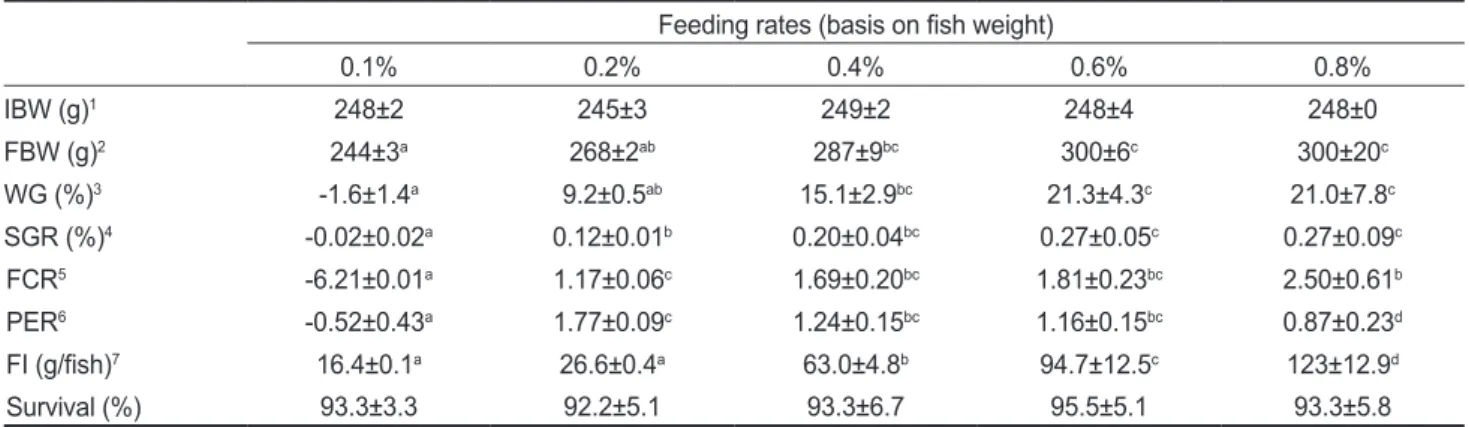
에서의 성장결과는Table 1
에 나타내었다. FBW, WG
그리고SGR
은0.6%
와0.8%
실험구가0.1%
와0.2%
실험구에비해유의적으로높았다. FCR
과PER
은0.2%
실험구가
0.8%
실험구에비해유의적으로높은효율을보였으며공급량이증가할수록낮은효율을나타내었다
.
이러한결과 는사료공급률이높아질수록에너지과잉공급으로인한단백 질효율이떨어지며(Meyer-Burgdorff et al., 1989),
사료공급률 이낮을수록어류가영양분흡수를최적화하여FCR
및PER
을높이게되는매우일반적인'
사료공급-
성장패턴'
인것으로잘 알려져있다(Zoccarato et al., 1994; Van Ham et al., 2003).
가장낮은
0.1%
사료공급량은저수온기조피볼락에있어서체중유지도하지못하는마이너스성장이유도될수있는것으로 나타났다
.
이와비슷한결과로,
저수온기에서370 g
넙치를대 상으로한사료공급실험에서는사료를공급하지않은절식구에서넙치의체중이급격히감소
(-5.7%)
되는것이보고되었다(Kim et al., 2014).
저수온기치어기넙치를대상으로한이전 의실험에서도절식구에서어체중이감소되는마이너스성장 률(-1.2%)
을보였다(Kim et al., 2011).
이러한결과는사료섭 취량이부족하여그에따른사료내영양소가실험어의성장보 다는호흡,
이온및대사산물운송등의기초대사및휴면활동(Resting activity)
과같은유지(Maintenance)
를위한에너지로 사용되었기때문으로판단된다(Kim et al., 2009).
사료에함유 된각영양소와에너지는어류의성장,
번식및건강유지에필 수적인것으로,
영양소섭취의부족에따른성장에너지의부족 현상은어류의성장을저하시키는대표적인요인이될뿐만아
니라질병을유발시킬수있는요인중의하나다
(NRC, 2011).
Weatherley and Gill (1987)
에의하면,
어류에있어서충분한 사료를섭취하지못하였을 경우체내조직의축적-
성장에너 지를소모함으로써기초대사를유지하게되고,
이러한체조직 내의저장에너지이용은곧바로성장감소로이어질뿐만아니 라,
어류의체조성및생존율에도큰영향을미칠수있다고보 고되었다.
본연구실험1
에서의생존율은모든실험구에서유의적인차이가없었다
.
타어종인넙치(281 g)
의경우저수온기
(12℃)
에서의적정사료공급률은어체중의0.32%
로보고되었다
(Kim et al., 2009).
하지만저수온에서섭식활동이더좋 은조피볼락을대상으로한본연구실험1
의결과,
미성어기(
약250 g
내외)
의적정사료공급률은약0.56%
가될것으로판 단되었다(Fig 1).
적정수온기에서이루어진실험
2
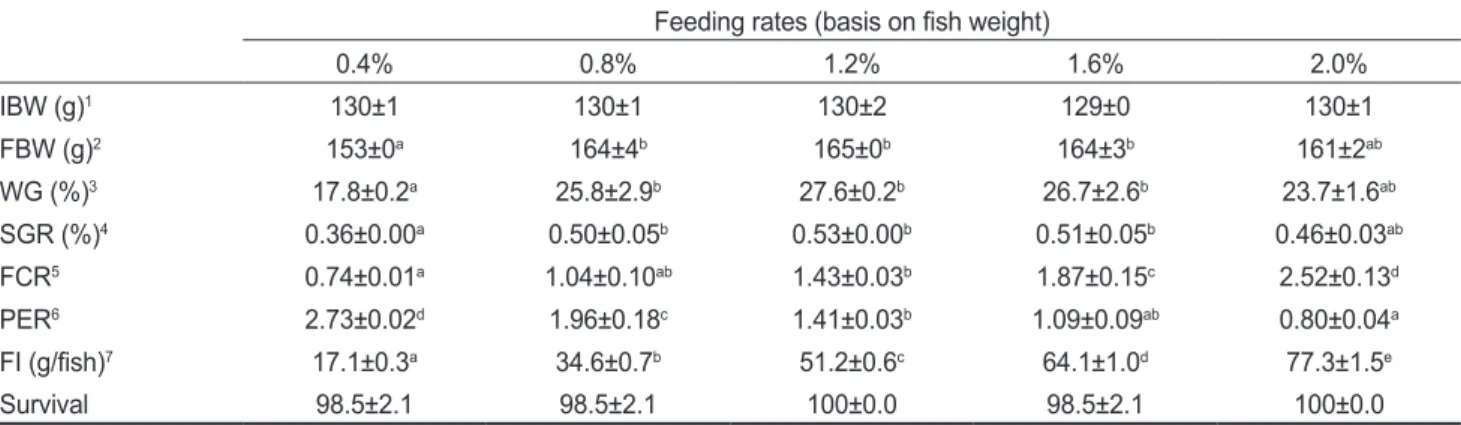
의결과는Table 2
에나타내 었다. FBW, WG, SGR
은0.8%, 1.2%, 1.6%
실험구가0.4%
실 험구에비해유의적으로높았다.
그러나0.8-2.0%
사료공급률 에서는유의적인차이가없었다. FCR
은1.2%, 1.6%, 2.0%
실험구가
0.4%
실험구에비해유의적으로낮은효율을보였다.
PER
역시상대적으로공급량이많은1.2%, 1.6%, 2.0%
실험구 가0.4%, 0.8%
실험구에비해유의적으로낮았다.
고수온기에 서이루어진실험3
의경우(Table 3), FBW, WG, SGR
은0.8%, 1.2%, 1.6%
그리고2.0%
실험구가0.4%
실험구에비해유의 적으로높게나타났다. FCR
과PER
은0.4%
와0.8%
실험구가2.0%
실험구에비해유의적으로높은효율을보였으며0.4%,
0.8%, 1.2%, 1.6%
실험구간에는유의적인차이가없었다.
Table 1. Growth performance, feed utilization and survival of Korean rockfish Sebastes schlegeli (Exp-I) fed a commercial diet with differ- ent feeding rates for 10 weeks at the low water temperature (11.6-15.2℃)
Feeding rates (basis on fish weight)
0.1% 0.2% 0.4% 0.6% 0.8%
IBW (g)1 248±2 245±3 249±2 248±4 248±0
FBW (g)2 244±3a 268±2ab 287±9bc 300±6c 300±20c
WG (%)3 -1.6±1.4a 9.2±0.5ab 15.1±2.9bc 21.3±4.3c 21.0±7.8c
SGR (%)4 -0.02±0.02a 0.12±0.01b 0.20±0.04bc 0.27±0.05c 0.27±0.09c
FCR5 -6.21±0.01a 1.17±0.06c 1.69±0.20bc 1.81±0.23bc 2.50±0.61b
PER6 -0.52±0.43a 1.77±0.09c 1.24±0.15bc 1.16±0.15bc 0.87±0.23d
FI (g/fish)7 16.4±0.1a 26.6±0.4a 63.0±4.8b 94.7±12.5c 123±12.9d
Survival (%) 93.3±3.3 92.2±5.1 93.3±6.7 95.5±5.1 93.3±5.8
Values (mean of triplicate groups) are presented as mean±SD. Values in the same row having different superscript letters are significantly different (P<0.05).
1IBW (g) = Initial body weight
2FBW (g) = Final body weight
3Weight gain (%) = (final body weight - initial body weight) / initial body weight ×100
4Specific growth rate (%) = 100×[ln (final body weight)−ln (initial body weight)] / days
5Feed conversion ratio = dry feed fed / wet weight gain
6Protein efficiency ratio = wet weight gain / total protein given
7Feed intake (g/fish) = dry feed consumed (g) / fish
실험
2
와실험3
에서도FCR
과PER
이대체로사료공급율이 증가할수록감소하는경향을보임으로써실험1
과거의유사한 경향을보였다.
이러한결과는이전에이루어진조피볼락치어 에서의배합사료적정공급률에대한연구결과와매우유사한결과이며
(Lee et al., 2013a),
타어종의연구결과에서도이와거 의유사한경향이보고되었다(Clark et al., 1990; Hung et al., 1993; Mihelakakis et al., 2002).
본실험은사료공급률이증가할수록어류의성장률또한증 Table 3. Growth performance, feed utilization and survival of Korean rockfish Sebastes schlegeli (Exp-III) fed a commercial diet with dif- ferent feeding rates for 12 weeks at the high water temperature (21.0-27.5℃)
Feeding rates (basis on fish weight)
0.4% 0.8% 1.2% 1.6% 2.0%
IBW (g)1 85.9±0.5 85.7±0.9 86.1±0.3 85.6±0.3 85.4±0.2
FBW (g)2 95.5±1.9a 112±2.6b 112±1.5b 116±4.3b 113±3.8b
WG (%)3 14.7±2.7a 31.2±4.3b 30.6±2.0b 35.1±4.4b 32.6±4.3b
SGR (%)4 0.18±0.03a 0.35±0.04b 0.34±0.02b 0.39±0.04b 0.36±0.04b
FCR5 1.27±0.22a 0.21±0.18a 1.63±0.07ab 1.66±0.21ab 2.22±0.12b
PER6 1.68±0.32a 1.75±0.28a 1.29±0.06ab 1.27±0.15ab 0.95±0.05b
FI (g/fish)7 15.8±0.6a 32.0±2.9b 43.0±1.4bc 49.5±0.7c 61.8±9.3d
Survival (%) 93.8±0.0 90.6±3.1 89.6±1.8 83.3±1.8 76.0±17.2
Values (mean of triplicate groups) are presented as mean ± SD. Values in the same row having different superscript letters are significantly different (P<0.05)
1IBW (g) = Initial body weight
2FBW (g) = Final body weight
3Weight gain (%) = (final body weight - initial body weight) / initial body weight ×100
4Specific growth rate (%) = 100×[ln (final body weight)−ln (initial body weight)] / days
5Feed conversion ratio = dry feed fed / wet weight gain
6Protein efficiency ratio = wet weight gain / total protein given
7Feed intake (g/fish) = dry feed consumed (g) / fish
Table 2. Growth performance, feed utilization and survival of Korean rockfish Sebastes schlegeli (Exp-II) fed a commercial diet with differ- ent feeding rates for 10 weeks at the optimum water temperature (16.0 - 18.8℃)
Feeding rates (basis on fish weight)
0.4% 0.8% 1.2% 1.6% 2.0%
IBW (g)1 130±1 130±1 130±2 129±0 130±1
FBW (g)2 153±0a 164±4b 165±0b 164±3b 161±2ab
WG (%)3 17.8±0.2a 25.8±2.9b 27.6±0.2b 26.7±2.6b 23.7±1.6ab
SGR (%)4 0.36±0.00a 0.50±0.05b 0.53±0.00b 0.51±0.05b 0.46±0.03ab
FCR5 0.74±0.01a 1.04±0.10ab 1.43±0.03b 1.87±0.15c 2.52±0.13d
PER6 2.73±0.02d 1.96±0.18c 1.41±0.03b 1.09±0.09ab 0.80±0.04a
FI (g/fish)7 17.1±0.3a 34.6±0.7b 51.2±0.6c 64.1±1.0d 77.3±1.5e
Survival 98.5±2.1 98.5±2.1 100±0.0 98.5±2.1 100±0.0
Values (mean of triplicate groups) are presented as mean±SD. Values in the same row having different superscript letters are significantly different (P<0.05).
1IBW (g) = Initial body weight
2FBW (g) = Final body weight
3Weight gain (%) = (final body weight - initial body weight) / initial body weight ×100
4Specific growth rate (%) = 100×[ln (final body weight) − ln (initial body weight)] / days
5Feed conversion ratio = dry feed fed / wet weight gain
6Protein efficiency ratio = wet weight gain / total protein given
7Feed intake (g/fish) = dry feed consumed (g) / fish
가하며
,
일정량이상의사료를공급하였을때성장률이더이 상차이가나지않는다는점에서미성어기넙치를이용한실험 과유사한결과를보였다(Kim et al., 2014a; Kim et al., 2014b).
이러한결과는사료효율에도영향을미쳤을것으로판단되며
,
실제로도사료공급률이증가할수록사료효율이감소하는경향 을보였다.
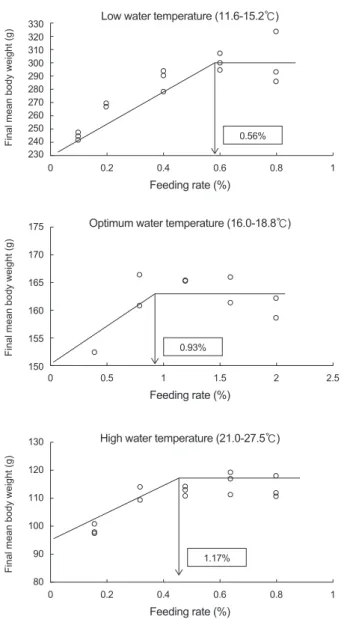
각실험에서의성장결과를바탕으로한Broken line analysis
결과는Fig. 1
에나타내었다.
분석결과,
저수온기에서의조피볼락
(248-300 g)
배합사료적정공급량은어체중의약0.56%
가되는것으로나타났으며,
적수온기에서의조피볼락(130-165 g)
배합사료적정공급량은어체중의약0.93%
그리 고고수온기에서의조피볼락(85-116 g)
배합사료적정공급량은어체중의약
1.17%
가되는것으로나타났다.
본연구의결과는치어기
(16 g)
조피볼락을대상으로저수온,
적수온및고수온기에서실험한결과인어체중의
3.41%, 3.75%
및3.34%
의 적정공급률결과와는차이를보인다(Mizanur and Bai, 2014).
이러한결과의차이는어류의성장단계에따른차이로해석할 수있다
.
사료공급률은어류의크기와사육환경에따라영향 을받게되는데사육수온은사료섭취량및대사활성에직접적 인영향을미쳐어류의성장과는밀접한관계가있다고이미알 려져있다(Kim et al., 2014a).
조피볼락의경우,
수온이높아지 게되면사료섭취량이줄어들게되어성장율이떨어지는현상(Choi et al., 2011)
이종종나타나는데,
본연구에서는고수온기 에서도적정수온에서의성장결과와유사하게나타났다(
적정 공급량기준, 0.93 vs 1.17%).
이러한결과는본연구에서사용 된실험어의크기차이에서유래된결과로분석된다.
가장이상 적인결과는사육수온(
저수온,
적수온,
고수온)
별로동일한크 기의어류를사용하여비교실험하는것이지만,
이는현실적으 로매우힘든상황이다.
가능하다면동일한크기의조피볼락을 사용하여수온변화에따른적정사료공급률결과가조만간나올 수있기를기대한다.
본연구에서는세가지수온별로조금씩다른크기의조피볼 락을사용하여실험한결과를제시하였지만향후조피볼락양 식생산을위한사육기술개발에유용하게이용될것이며
,
조피 볼락배합사료공급체계확립에매우중요한기초자료가될것 으로사료된다.
사 사
이논문은
2015
학년도제주대학교학술진흥연구비지원사업에의하여연구되었음
.
References
AOAC (Association of Official Analytical Chemists). 1995.
Official Methods of Analysis of the Association of official Analytical Chemists, 16th Edition. Association of Official Analytical Chemists, Arlington, VA, U.S.A.
Azzaydi M, Martines FJ, Zamora S, Sanchez-Valzquez and Ma- drid JA. 2000. The influence of nocturnal vs. diurnal feeding under winter conditions on growth and feed conversion of European sea bass (Dicentrarchus labrax, L.) Aquaculture 182, 329-338.
Biswas G, Jena JK, Singh SK, Patmajhi P and Muduli HK. 2006.
Effect of feeding frequency on growth, survival and feed uti- lization in mrigal, Cirrhinus mrigala, and rohu, Labeo ro- hita, during nursery rearing. Aquaculture 254, 211-218.
Brett JR. 1979. Environmental factors and growth. In: WS Joar, DJ Randall and JR Brett (Eds), Fish Physiology, Vol. Ⅷ.
Bioenergetics and growth. Academic Press, New York, U.S.A., 599-675.
330 320 310 300 290 280 270 260 250 240 230
0 0.2 0.4
Feeding rate (%) Low water temperature (11.6-15.2℃)
0.6 0.8
0.56%
1
Final mean body weight (g)
175 170 165 160 155
1500 0.5 1
Feeding rate (%)
Optimum water temperature (16.0-18.8℃)
1.5 2
0.93%
2.5
Final mean body weight (g)
130 120 110 100 90 80
0 0.2 0.4
Feeding rate (%) High water temperature (21.0-27.5℃)
0.6 0.8
1.17%
1
Final mean body weight (g)
Fig. 1. Broken line analysis of weight gain (WG, %) for optimum feeding rate in Korean rockfish Sebastes schlegeli fed a commer- cial diet with 5 different feeding rates at three different water tem- perature.
Cho SH, Lee SM, Park BH and Lee SM. 2006. Effect of feed- ing ratio on growth and body composition of juvenile olive flounder Paralichthys olivaceus fed extruded pellets during the summer season. Aquaculture 251, 78-84.
Choi YU, Rho S and Lee YD. 2002. Effect of water temperature and stocking density on growth of juvenile red drum Sciae-
nops ocellatus. J Aquaculture 15, 131-138.
Choi HS, Hub MD, Lee MK, Choi HJ and Park MA. 2001. His- topathological observation of liver in cultured black rockfish
Sebastes schlegeli. J Fish Pathol 24, 225-236.
Clark JH, Watanabe WO and Eranst DH. 1990. Effect of feed- ing rate on growth and feed conversion of Florida red tilapia reared in floating marine cages. J World Aquacult Soc 21, 16-24.
Fauconneau B, Choubert G, Blanc D, Breque J and Luquet P.
1983. Influence of environmental temperature on flow rate of foodstuffs thorough the gastrointestinal tract of rainbow trout. J Aquaculture 34, 27-39.
Folch J. Lee M and Sloane-Stanley GH. 1959. A simple method for the isolation and purification of total lipids from animal tissues. J Biol Chem 226, 497-509.
Hidalgo F, Alliot E and Thebault H, 1987. Influence of water temperature on food intake, food efficiency and gross com- position of juvenile sea bass, Dicentrarchus labrax. Aqua- culture 64, 329-338.
Hung SSO, Conte FS and Hallen EF. 1993. Effects of feeding rates on growth, body composition and nutriment metabo- lism in striped bass(Morone saxatilis) fingerlings. J Aqua- cult 112, 349-361.
Kim KD, Kim KW, Bae KM, Son MH and An CM. 2012. Ef- fects of different numbers of feeding days and feeding rate on growth of growing-out flounder Paralichthys oliva-
ceus. Korean J Fish Aquat Sci 44, 523-526. http://dx.doi.
org/10.5657/KFAS.2012.0523.
Kim KD, Nam MM, Kim KW, Lee HY, Hur SB, Kang YJ and Son MH. 2009. Effects of feeding rate and feeding frequency on growth and body composition of sub-adult flounder Paralichthys olivaceus in suboptimal water tem- perature. Korean J Fish Aquat Sci 42, 262-267. http://dx.doi.
org/10.5657/KFAS.2009.0262.
Kim KD, Nam MM, Kim KW, Kim DG and Son MH. 2010.
Effects of feeding rate and frequency on the winter growth and body composition of olive flounder, Paralichthys oli-
vaceus. Korean J Fish Aquat Sci 43, 217-222. http://dx.doi.
org/10.5657/KFAS.2010.0217.
Kim KW, Hwang NY, Son MH, Kim KD, Lee JH, Liu Y, Yun YH, Park GH, Kim SS, Lee KJ and Bai SC. 2011. Optimum feeding rates in juvenile olive flounder Paralichthys oliva-
ceus fed practical expanded pellet at low and high water
temperatures. Korean J Fish Aquat Sci 44, 345-351. http://dx.doi.org/10.5657/KFAS.2011.0345.
Kim SS, Kim KW, Kim KD, Lee BJ, Han HS and Lee KJ. 2014a.
Optimum feeding rate for sub-adult olive flounder (370 g)
Paralichthys olivaceus fed practical extruded pellets at low
water temperature (12-14℃). Korean J Fish Aquat Sci 47, 1063-1068. http://dx.doi.org/10.5657/KFAS.2014.1063.Kim SS, Kim KW, Kim KD, Lee BJ, Han HS, Kim JW, Bai SC and Lee KJ. 2014b. Optimum feeding rate for sub-adult olive flounder (384 g) Paralichthys olivaceus fed practi- cal extruded pellets at optimum water temperatures (20- 24.5℃). Korean J Fish Aquat Sci 47, 582-587. http://dx.doi.
org/10.5657/KFAS.2014.0582.
Lee JH, Kim KW, Lee BJ, Park GH, Lee JH, Yun HH and Bai SC. 2013a. Optimum feeding rate and frequency in juvenile Korean rockfish Sebastes schlegeli fed a commercial diet.
Korean J Aquat Sci 46, 753-760. http://dx.doi.org/10.5657/
KFAS.2013.0753.
Lee JH, Lee BJ, Kim KW, HAN HS, Park GH, Lee JH, Yun HH and Bai SC. 2013b. Optimum feeding frequency for ju- venile Korean rockfish Sebastes schlegeli fed a commercial diet at two different water temperatures. Korean J Aquat Sci 46, 761-768. http://dx.doi.org/10.5657/KFAS.2013.0761.
Meyer-Burgdorff KH, Osman MF and Gunther KD. 1989. En- ergy metabolism in Oreochromis niloticus. Aquaculture 79, 283-291.
Mihelakakis A, Tsolkas C and Yoshimatsu T. 2002. Optimiza- tion of feeding rate of hatchery-produced juvenile gilthead seabream Sparus aurata. J World Aquacult Soc 22, 169-175.
Mizanur RM and Bai SC. 2014. A review of optimum feeding rates and feeding frequency in Korean rockfish Sebastes
schlegeli reared at seven different water temperatures.
Fish Aquat Sci 17, 229-247. http://dx.doi.org/10.5657/
FAS.2014.0229.
Myeong JI, Pack SY and Chang YJ. 1997. Effects of water tem- perature and feeding rate on growth and feed efficiency of Korean rockfish, Sebastes schlegeli. J Aquacult 10, 311-320.
NRC (National Research Council). 2011. Nutrient requirements of fish and shrimp. The National Academy Press, Washing- ton DC, U.S.A.
Oh DH, Song JW, Kim MG, Lee BJ, Kim KW, Han HS and Lee KJ. 2013. Effect of food particle size, stocking density and feeding frequency on the growth performance of juvenile Korean rockfish Sebastes schlegelii. Korean J Fish Aquat Sci 46, 407-412. http://dx.doi.org/10.5657/KFAS.2013.0407.
Statistics Korea. 2013. Statistic database for aquaculture pro- duction. Retrieved from http://kostat.go.kr on March 21.
Tsevis N, Klaoudatos S and Conides A. 1992. Food conversion budget in sea bass Dicentracus labrax, fingerlings under two different feeding frequency patterns. Aquaculture 101, 293- Van Ham EH, Berntssen MHG, Imsland AK, Parpoura AC, 304.
Bonga SEW and Stefansson SO. 2003. The influence of temperature and ration on growth, feed conversion, body composition and nutrient retention of juvenile turbot (Scoph-
thalmus maximus). Aquaculture 217, 547-558.
Weatherley AH. and Gill HS. 1987. The biology of fish growth.
4. Protein, lipid and caloric contents. Academic press, Lon- don, U.K., 139-146.
Zoccarato IG, Benatti ML, Bianchini M, Boccignone A, Conti R, Napolitano and Palmegiano GB. 1994. Differences in performance, flesh composition and water output quality in relation to density and feeding levels in rainbow trout,