582
Copyright © 2014 The Korean Society of Fisheries and Aquatic Science pISSN:0374-8111, eISSN:2287-8815
서 론
세계양식선진국은환경친화적배합사료를사용하여지속가 능한양식업을육성하고양식시스템을자동화하는등경쟁력을 강화하고있다
.
배합사료의사용은자동공급기를통해사료를 공급할수있을뿐아니라체계적인사육관리를통해양식방법 을효율화시킬수있다.
우리나라도안전한양식수산물공급,
수산자원남획및어장환경오염방지등지속가능한양식업육성을위하여배합사료사용확대가필요한시점이다
(Kim et al., 2014).
최근제주,
여수,
신안,
거제,
울진및영덕을배합사료시 범지역으로선정하여다양한해산어류를생사료를사용하지않 고배합사료를사용하여양식하고있다.
하지만각양식어종에 대한배합사료공급프로그램이개발되지않아실제양식현장 에서는대부분만복공급을실시하고있는실정이다.
배합사료 의만복공급은사료의허실로인한수질오염및생산단가상승 을초래하며,
소화및대사장애등의문제점이발생할수있다적수온(20-24.5℃)에서 사육한 미성어기(384 g) 넙치 (Paralichthys olivaceus)의 배합사료 적정 공급률
김성삼·김강웅·김경덕·이봉주·한현섭·김재원
1·배승철
2·이경준
3*
국립수산과학원 사료연구센터, 1강원도립대학교 해양생명과학과, 2부경대학교 해양바이오신소재학과, 3제주대학교 해양생명과학과
Optimum Feeding Rate for Sub-adult Olive Flounder (384 g) Paralichthys olivaceus Fed Practical Extruded Pellets at
Optimum Water Temperatures (20-24.5°C)
Sung-Sam Kim, Kang-Woong Kim, Kyoung-Duck Kim, Bong-Joo Lee, Hyon-Sob Han, Jae-Won Kim
1
, Sungchul C. Bai2
and Kyeong-Jun Lee3
*Aquafeed Research Center, National Fisheries Research and Development Institute, Pohang 791-923, Korea
1
Department of Marine Life-Science, Gangwon Provincial college, Gangneung 210-804, Korea
2
Department of Marine Bio-Materials and Aquaculture, Pukyong National University, Busan 608-737, Korea
3
Department of Marine Life Science, Jeju National University, Jeju 690-756, Korea
We investigated the effects of feeding rate on the growth, blood components, and histology of sub-adult olive floun- der Paralichthys olivaceus . Optimum feeding rate (initial fish mean weight : 384.2±5.91 g ) was determined under the optimum water temperature. Two replicated groups of fish were fed a commercial diet at rates of 0%, 0.3%, 0.5%, and 0.7% body weight (BW) per day, and to satiation. The feeding trial was conducted using a flow-through system with ten 1.2-metric ton aquaria receiving filtered seawater at 20-24.5°C for 3 weeks. After the feeding trial, the weight gain (WG) and specific growth rate (SGR) were significantly higher in fish fed at 0.7% BW/day and those fed to satiation (0.9% BW/day) than in fish fed at other feeding rates or in the unfed fish. These parameters were negative and sig- nificantly lower in the unfed fish than in those fed the experimental diet at all feeding rates. There were no significant differences in WG and SGR among fish fed at 0.3 and 0.5% BW/day and among those fed at 0.7% BW/day and to satiation. The histological changes in the hepatopancreas, kidney, and anterior intestine of fish fed at 0, 0.5, and 0.9
% BW/day did not differ much. Broken-line regression analysis of weight gain showed that the optimum feeding rate of olive flounder weighing 384 g was 0.74% BW per day at the optimum water temperatures.
Key words: Paralichthys olivaceus , Olive flounder, Feeding rate, Optimum water temperatures, Histological changes
This is an Open Access article distributed under the terms of the Creative Commons Attribution Non-Commercial Licens (http://creativecommons.org/licenses/by-nc/3.0/)which permits unrestricted non-commercial use, distribution, and reproduction in any medium, provided the original work is properly cited.
http://dx.doi.org/10.5657/KFAS.2014.0582 Kor J Fish Aquat Sci 47(5) 582-587, October 2014
Received 13 August 2014; Revised 15 September 2014; Accepted 19 September2014
*Corresponding author: Tel: +82. 64. 754. 3423 Fax: +82. 64. 756. 3493
E-mail address: [email protected]
(Kim et al., 2014; Lee et al., 2014).
따라서향후배합사료사용 확대를위해서는각양식어종에대한성장단계별및수온별배 합사료공급량에대한공급프로그램이개발되어야할것이다.
넙치는
2013
년기준우리나라전체해산어총생산량73,108
톤중
36,944
톤이생산되어51%
를차지하는중요한양식어종이다
(Statistics Korea, 2014).
넙치의출하크기는대부분1 kg
내외였으나,
최근2 kg
이상의대형넙치의생산및출하가꾸준 히증가하고있는추세이다.
지금까지넙치에서보고된공급량 연구결과를보면대부분치어기단계(Choi et al., 2008; Kim et al., 2010; Kim et al., 2011; Kim et al., 2014)
또는여름철고수 온기및겨울철저수온기(Kim et al., 2009; Kim et al., 2010)
에이루어졌으며
, 300 g
이상의크기에서는연구가전무한실정이다
.
따라서본연구는배합사료공급프로그램개발을위한기초 연구로384 g
넙치의최적사육수온범위인20-24.5℃
수온에 서배합사료의적정공급량조사와더불어성장,
사료효율,
혈액 성분및조직성상에미치는영향을알아보기위해수행되었다.
재료 및 방법
실험사료
본실험에사용된실험사료는상업용시판넙치용배합사료 를이용하였으며
,
일반성분분석은Table 1
에나타내었다. 384 g
육성기넙치의적정사료공급량확인을위해어체무게당(g) 0%, 0.3%, 0.5%, 0.7%
및만복공급(Saturation)
으로설정하여 총5
개실험구로나누어공급하였다.
실험어 및 사육관리
사양실험에사용된실험어류는제주도내창해수산에서제주 대학교소속해양과환경연구소로운송되어
2
주동안시판배합 사료를공급하면서실험환경에적응할수있도록순치시킨후 사료공급실험에사용되었다.
예비사육후실험어류(
초기평균 무게: 384.2±5.91 g)
는총10
개의1,200 L
원형수조에각수조 당27
마리씩무작위로선택하여배치되었다.
사료공급실험은 실험구당2
반복구를두었으며,
사육수는여과해수를사용하여2-3 L/min
의유수량이공급되도록조절되었고,
모든실험수조에용존산소유지와원활한사육수순환을위하여에어스톤을
설치하였다
.
광주기는자동타이머가설치된형광등을이용하 여12L:12D
조건으로유지되었고,
전실험기간동안평균수온 은20℃
에서24.5℃
범위로자연수온에의존되었다.
실험사료 는1
일2
회(
오전08:00,
오후18:00)
에나눠서3
주동안어체중 의수준별로공급하였다.
샘플수집
사료공급실험후
,
어류의최종평균무게를측정하여증체율(weight gain),
사료효율(feed efficiency),
일간성장률(specific growth rate),
단백질전환효율(protein efficiency ratio)
및생 존율(survival)
을 계산하였다.
최종 무게측정 후,
혈액분석을 위해각수조마다4
마리씩무작위로선별하여 마취용액(MS-
222, 100 mg/L)
으로마취시켜헤파린처리가된주사기를사용하여미부동맥에서채혈한후
, hematocrit
및hemoglobin
함 량을측정하였다.
분석후,
남은혈액은ALT (alanine amino- transferase), AST (aspartate aminotransferase), total protein
및glucose
분석을위해원심분리기(Micro 17TR, Hanil Science, Korea)
를이용하여5,000 rpm
으로10
분간원심분리하여혈장 을분리하였다.
일반성분 분석
실험사료의일반성분분석은
AOAC (2000)
방법에따라수분 은상압가열건조법(125℃, 3 h),
조회분은직접회화법(550℃, 12 h)
으로측정하였고,
단백질은 자동 조단백분석기(Kejltec system 2300, Sweden)
로 분석되었으며,
지방은Folch et al.
(1959)
의방법에따라Soxhlet
추출장치(Soxhlet heater system C-SH6, Korea)
를이용하여분석되었다.
혈액분석
Hematocrit
은 헤파린이 처리된 모세혈관채혈튜브(Micro
Hematocrit Capillary Tubes)
에혈액을채운다음고무판(Wax plates)
에세운후,
혈액진단원심분리기(Micro Hematocrit VS- 12000, Vision Scientific, Korea)
에서10
분간원심분리하여값 을측정하였다.
Hemoglobin, ALT, AST, total protein
및glucose
함량은각 각의시약과반응시킨후혈액생화학분석기(Express plus sys- tem, Bayer, USA)
를이용하여분석하였다. ALT
와AST
는ki- netic, hemoglobin, total protein
및glucose
함량은end point
방 법으로분석되었다.
조직학적 관찰
넙치해부를통하여간췌장
,
신장및전장의조직학적변화를 확인하기위해각실험구당3
마리씩무작위로추출하였다.
해부 한조직을Bouin's solution
에24
시간동안고정후고정된샘플 을수세와탈수를거쳐paraffin
에포매하여4-6 µm
두께로연 속절편하여조직표본을만들었다.
제작된조직표본은Mayer's hematoxylin
과0.5% eosin (H-E)
의비교염색을실시한후광학 Table 1. Proximate analysis of the experimental diet of the oliveflounder (Paralichthys olivaceus; % of DM basis)
Proximate composition Experimental diet
Dry matter (%) 4.5
Crude protein (%, DM) 58.1
Crude lipid (%, DM) 13.2
Crude ash (%, DM) 12.5
Gross energy (MJ/kg) 17.3
Size (mm) 13.0-13.4
현미경으로관찰하였다
. 통계학적 분석
실험사료군의배치는완전확률계획법
(Completely random- ized design)
에 따라 실시하였고,
성장 및 분석결과는SPSS (Version 12.0)
프로그램을이용하여One-way ANOVA
로통 계 분석되었다.
실험데이터 값의유의차는Duncan’s mul- tiple test (P<0.05)
로비교되었다.
데이터는평균값±
표준편차(mean±SD)
로나타내었다.
백분율데이터는arcsine
변형값 으로계산하여통계분석되었다.
결과 및 고찰
미성어기넙치
(384 g)
를대상으로적수온기배합사료공급량을알아보기위한
3
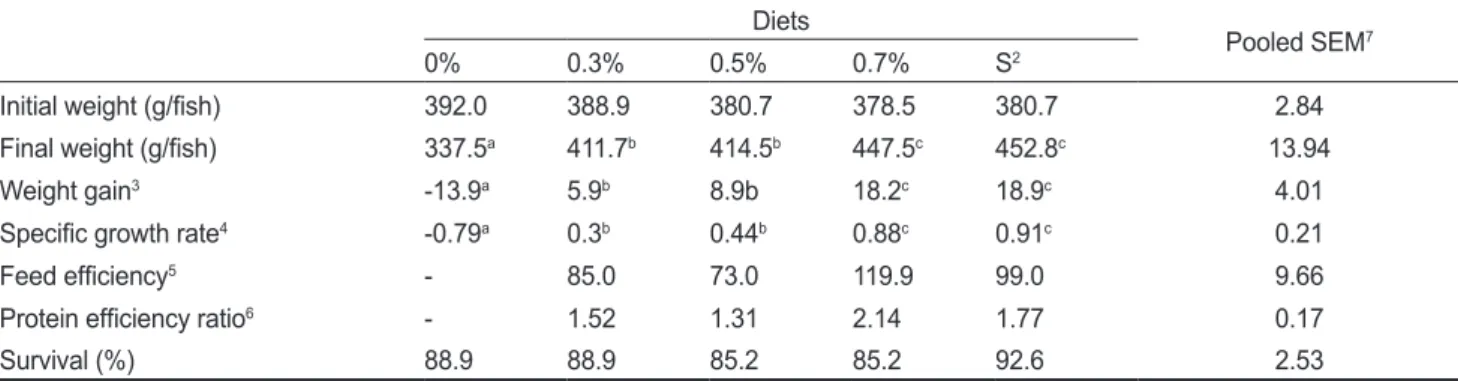
주간의성장실험결과는Table 2
에나타내었다
.
성장결과에있어서는사료를공급하지않은0%
실험구에서어체중이감소되는성장률
(-13.9%)
을보였으며,
하루에약
0.79 g
어체중이감소하였다.
증체율및일간성장률에서는사료공급량이증가함에따라증가하여
0.7%
및만복실험구에 서유의적으로가장높은성장률을보였다.
가장성장률이높은 만복실험구의경우3
주동안약72 g
성장하였다.
사료효율,
단 백질전환효율및생존율에서는모든실험구에서유의적인차이 를보이지않았다. Kim et al. (2014)
의연구에서도본연구와비슷하게
97 g
넙치를대상으로21℃
수온에서사료공급량실험을실시한결과
,
사료를공급하지않은절식실험구(0%)
에서어 체중이감소하는성장률(-12.5%)
을보였으며,
하루에약0.7 g
어체중이감소하였다.
증체율및일간성장률에있어서도사료 공급량이증가함에따라유의적으로증가하여만복실험구에서 유의적으로높은성장률을보였다.
또한Lee et al. (2014)
은넙 치(240 g)
를대상으로19-21℃
수온에서사료공급량실험을실 시하였는데사료를공급하지않은절식실험구(0%)
에서본연구결과와유사하게어체중이감소하는성장률
(-8.1%)
을보였으며
,
하루에약0.4 g
어체중이감소하였다.
증체율및일간성 장률에서도본연구결과와유사하게만복실험구에서유의적으 로높은결과를보였다.
지금까지보고된적정공급률연구결과 를보면97 g
넙치는하루에어체중의2.23%, 240 g
넙치의경 우1.09%, 317 g
넙치는0.99%
로분석되었다.
본연구의경우 성장률을기초로브로큰라인분석을통한미성어기384 g
넙치 의적정공급률은0.74%
로분석되었다.
지금까지의연구결과를 보면일반적으로사료공급량은어체크기및사육수온에따라 다르며,
어류가성장함에따라공급률은감소되는결과를보였 다(Schmittou et al., 1998; NRC, 2011).
본연구에서도이전의 연구결과와비교하였을때넙치가성장함에따라공급률은감 소되는것을알수있었다.
이와비슷한연구결과는다른어종 에서도많이보고되었다(De Silva et al., 1986; Hung and Lutes 1987; Adebayo et al., 2000; Ng et al., 2000; Mihelakakis et al., 2002).
따라서384-453 g
미성어기넙치는사료섭취가가능한범위에서 사료가허실되지않게어체중의
0.74%
를공급하는것이적절할것으로판단된다
.
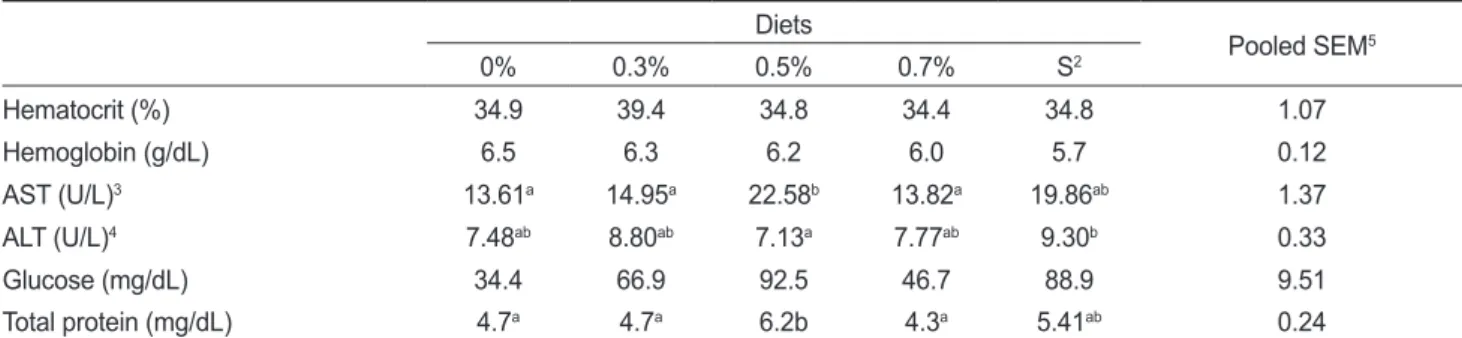
배합사료공급률이넙치의혈액성상에미치는영향을알아보 기위해조사한혈액분석결과는
Table 3
에나타내었다. Hema- tocrit, hemoglobin
및glucose
함량은모든실험구에서유의적인차이를보이지않았다
. AST
의경우0.5%
실험구에서가장높은수치를보였으나
,
만복실험구와는유의적인차이를보이지않았다
. ALT
에있어서는만복실험구가0.5%
실험구와비교하여유의적으로높은수치를보였다
. Total protein
함량은0.5%
실험구에서유의적으로높은함량을보였으며,
만복실험구와는유의적인차이를보이지않았다
.
본연구는비록3
주라 는짧은기간동안수행되었지만만복실험구에서다른실험구 와비교하여높은ALT
및AST
함량을보였다. ALT
와AST
는 일반적으로척추동물에서간의기능과상태를나타내는지표 로서사용되며일반적으로높은ALT
와AST
는간기능의손상 또는약화를의미한다(Pan et al., 2003).
따라서장기간사료를Table 2. Effects of feeding rate on the growth performance of olive flounder Paralichthys olivaceus fed the experimental diet for 3 weeks1 Diets
Pooled SEM7
0% 0.3% 0.5% 0.7% S2
Initial weight (g/fish) 392.0 388.9 380.7 378.5 380.7 2.84
Final weight (g/fish) 337.5a 411.7b 414.5b 447.5c 452.8c 13.94
Weight gain3 -13.9a 5.9b 8.9b 18.2c 18.9c 4.01
Specific growth rate4 -0.79a 0.3b 0.44b 0.88c 0.91c 0.21
Feed efficiency5 - 85.0 73.0 119.9 99.0 9.66
Protein efficiency ratio6 - 1.52 1.31 2.14 1.77 0.17
Survival (%) 88.9 88.9 85.2 85.2 92.6 2.53
1Values are means from duplicate groups of fish; values in each row with different superscripts are significantly different (P<0.05).
2S = Satiation (0.9%). 3Weight gain (%) = (final weight - initial weight) × 100 / initial weight. 4Specific growth rate (%) = (loge final wt. - loge initial wt.)/ days. 5Feed efficiency (%) = wet weight gain (g) × 100 / dry feed intake (g). 6Protein efficiency ratio = wet weight gain / protein intake. 7Pooled standard error of means: SD/√n.
만복으로공급하였을경우사료를소화하여흡수하기위한대 사과정에서간기능이약화되어정상적인영양소대사에영향 을끼칠수있을것으로본다
.
이전의연구에서도만복실험구에 서hematocrit
및hemoglobin
수치가감소되었으며(Kim et al., 2014, Oh et al., 2014), AST
의함량이유의적으로높은결과를 보였다(Kim et al., 2014).
배합사료의만복공급은성장에는효 과가있으나, 3
주라는짧은기간임에도불구하고혈액분석결과 에서좋지않은결과를보임으로서향후보다더정확한매커니 즘을파악하기위해서는장기간사육실험을통한평가가이루 어져야할것으로판단된다.
사료공급률을달리하여사육한실험어의전어체분석결과는
Table 4
에나타내었다.
전어체의수분함량에서는모든실험구에서유의적인차이를보이지않았다
.
단백질함량은만복실험 구가다른실험구와비교하여유의적으로높은값을보였으며,
지방함량은만복실험구가다른실험구와비교하여유의적으로 낮은값을보였다.
회분함량에서는절식실험구가다른실험구 와비교하여유의적으로높은값을보였다.
본연구에서는동일 한실험사료를공급하였음에도불구하고전어체의일반성분결 과가다른것은공급량을제한함으로써어체성장에필요한적 정영양소요구량을섭취하지못하였기때문으로판단된다.
따 라서배합사료의공급량이과잉또는부족하게되어전어체의일반성분에도영향을주었을것으로판단된다
.
하지만보다더 정확한매커니즘을파악하기위해서는장기간의실험을통한 증명이필요할것으로판단된다.
배합사료의 공급량이 넙치의간췌장
,
신장 및 전장의조직학적변화에미치는영향을알아보기위해
0% (
절식실험구),
0.5%
및 만복실험구(saturation)
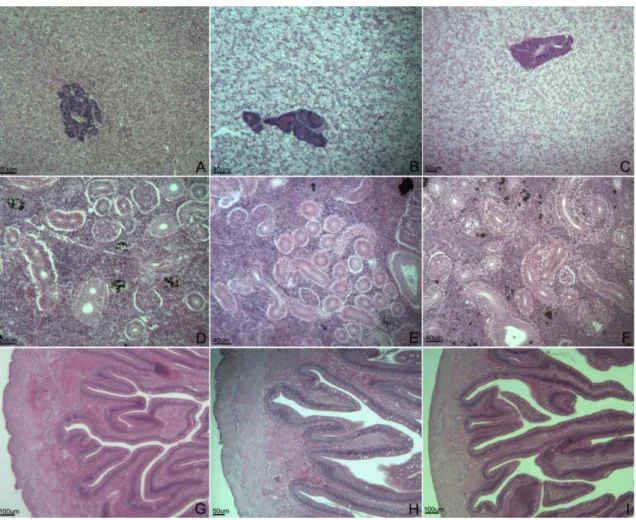
의 조직상을 조사한 결과는Fig. 1
에나타내었다. 3
주간의사육실험동안모든실험구에서복부팽창과같은병변현상은관찰되지않았다
.
모든실험구의 간췌장,
신장및전장에서정상적인조직상을보였으며차이를 보이지않았다. Kim et al. (2011)
은저수온기넙치치어를대상 으로배합사료공급률을달리하여간췌장,
신장,
전장에서조직 분석을실시한결과,
적정공급률실험구가절식실험구및만복실험구와비교하여양호한조직상을보여주었다
. Kim et al.,
(2014)
연구에서도적정수온에서넙치240 g
을대상으로공급률을달리하여조직분석을실시한결과
,
적정공급률실험구가 절식실험구및만복실험구와비교하여양호한조직상을보여 주었다.
이러한결과는어류가사료를정상적으로섭취하지못 하거나이와반대로과잉공급되어영양소의소화및흡수작용 에영향을미친것으로사료된다.
이러한결과는배합사료가과 잉또는불충분하게되면양식어류의내부소화기관에도부정 적영향을끼칠수있음을시사한다.
이와다르게본연구의조 Table 3. Effects of feeding rate on the serological characteristics of olive flounder Paralichthys olivaceus fed the experimental diet for 3 weeks1Diets
Pooled SEM5
0% 0.3% 0.5% 0.7% S2
Hematocrit (%) 34.9 39.4 34.8 34.4 34.8 1.07
Hemoglobin (g/dL) 6.5 6.3 6.2 6.0 5.7 0.12
AST (U/L)3 13.61a 14.95a 22.58b 13.82a 19.86ab 1.37
ALT (U/L)4 7.48ab 8.80ab 7.13a 7.77ab 9.30b 0.33
Glucose (mg/dL) 34.4 66.9 92.5 46.7 88.9 9.51
Total protein (mg/dL) 4.7a 4.7a 6.2b 4.3a 5.41ab 0.24
1Values are means from duplicate groups of fish; values in each row with different superscripts are significantly different (P<0.05).
2S = Satiation (0.9%). 3AST=Aspartate aminotransferase, Unit per liter (U/L) is the amount of enzyme which oxidizes one μmol/L of NADH per minute. 4ALT=Alanine aminotransferase. 5Pooled standard error of means: SD/√n.
Table 4. Effects of feeding rate on the whole-body composition of olive flounder Paralichthys olivaceus fed the experimental diet for 3 weeks (%)1
Diets
Pooled SEM3
0% 0.3% 0.5% 0.7% S2
Moisture 73.8 72.1 72.9 72.8 74.0 0.36
Crude protein 68.2a 68.4a 68.5a 68.6a 72.2b 0.52
Crude lipid 15.0b 19.1d 17.4c 19.6d 13.5a 0.79
Crude ash 15.1c 11.6ab 12.9b 11.2a 11.9ab 0.48
1Values are means from duplicate groups of fish; values in each row with different superscripts are significantly different (P<0.05).
2S = Satiation (0.9%). 3Pooled standard error of means: SD/√n.
직분석에서차이를보이지않은것은어체의크기및수온등의 차이로판단된다
.
연구결과를종합해보면
,
배합사료의공급률은미성어기넙 치의성장에영향을미치므로넙치사육시사육수온과성장단 계를고려하여적정량의사료가공급되도록관리되어야할것 이다.
또한장기간사료를공급하지않거나만복공급을했을경 우어류의건강도에부정적인영향을끼칠수있을것으로판단 된다.
최적수온인20-24.5℃
에서성장률을기초로Broken-line regression
분석을통한넙치384 g
의배합사료적정공급률은어체중당
0.74%
가적절한것으로사료된다.
향후에는장기간에걸쳐치어부터성어까지전체성장단계에걸쳐배합사료공 급률에대한효과가평가되어야할것으로판단된다
.
Fig. 2. Broken-line regression analysis of weight gain (%) ac- cording to feeding rate. Each point represents the average of two groups of fish. The optimum feeding rate for weight gain was 0.74
% body weight/day.
0.2 0.3 0.4 0.5 0.6 0.7 0.8 0.9 1.0
4 8 12 16 20
0.74
W eight gain (%)
Feeding rate (body weight/day, %)
Fig. 1. Histological changes of the hepatopancreas, kidney and anterior intestine of olive flounder Paralichthys olivaceus fed the experimen- tal diet for 3 weeks. A, D and G: 0% group (A, hepatopancreas; D, kidney; G, anterior intestine), B, E and H: 0.5% group (B, hepatopan- creas; E, kidney; H, anterior intestine), C, F and I: S (satiation, 0.9%) group (C, hepatopancreas; F, kidney; I, anterior intestine).
사 사
이연구는국립수산과학원
(
친환경실용배합사료개발및품질 관리연구, RP-2014-AQ-082)
의지원에의해연구되었습니다.
References
Adebao OT, Balogun AM and Fagbenro OA. 2000. Effects of feeding rates on growth, body composition and economic performance of juvenile clariid catfish hybrid (female Clar-
ias gariepinus × male Heterobranchus bidorsalis). J Aquac
Trop 15, 109-117.AOAC (Association of Official Analytical Chemists). 2000. Of- ficial Methods of Analysis of the Association of Official An- alytical Chemists, 17th Edition. Cunniff P, ed. Association of Official Analytical Chemists, Inc, Arlington, VA, U.S.A.
Choi SM, Kim KW, Kang YJ, Park HS and Bai SC. 2008. Opti- mum dietary lipid level and feeding rates of extruded pellets in juvenile flounder Paralichthys olivaceus during the sum- mer season. J Auqacult 21, 244-251.
De Silva SS, Gunasekera RM and Keembiyahetty C. 1986.
Optimum ration and feeding frequency in Oreochromis ni-
loticus young. In: The First Asian Fisheries Forum, Asian
Fisheries Society, Manila, Philippines. 559-564.Folch J, Lee M and Sloane–Stanley GH. 1959. A simple method for the isolation and purification of total lipids from animal tissues. J Biol Chem 226, 497-509.
Hung SSO and Lutes PB. 1987. Optimum feeding rate of hatch- ery-produced juvenile white sturgeon (Acipenser transmon-
tanus): at 20°C. Aquaculture 65, 307-317.
Kim KD, Nam MM, Kim KW, Kim DG and Son MH. 2010. Ef- fects of feeding rate and frequently on the winter growth and body composition of olive flounder, Paralichthys olivaceus.
Kor J Fish Aquat Sci 43, 217-222. http://dx.doi.org/10.5657/
kfas.2010.43.3.217.
Kim KD, Nam MM, Kim KW, Lee HY, Hur SB, Kang YJ and Son MH. 2009. Effects of feeding rate and feeding frequen- cy on growth and body composition of sub-adult flounder
Paralichthys olivaceus in suboptimal water temperature.
Kor J Fish Aquat Sci 42, 262-267. http://dx.doi.org/10.5657/
kfas.2009.42.3.262.
Kim KW, Kim SS, Kim JW, Son MH, Kim KD, Bai SC and Lee KJ. 2011. Effect of feeding rate and pellet water-soaking on growth, blood components, and histology of olive flounder
Paralichthys olivaceus. Kor J Fish Aquat Sci 44, 490-498.
http://dx.doi.org/10.5657/kfas.2011.0490.
Kim KW, Hwang NY, Son MH, Kim KD, Lee JH, Liu Y, Yun YH, Park GH, Kim SS, Lee KJ and Bai SC. 2011. Opti- mum feeding rates in juvenile olive flounder Paralichthys
olivaceus fed practical expanded pellet at low and high wa-
ter temperatures. Kor J Fish Aquat Sci 44, 345-351. http://dx.doi.org /10.5657/KFAS.2011.0345.
Kim SS, Han HS, Lee BJ, Kim JW, Bai SC and Lee KJ. 2014.
Optimum feeding rate for the sub-adult olive flounder,
Paralichthys olivaceus, fed practical extruded pellets at op-
timum water temperature. Submitted to The Israeli Journal of Aquaculture - Bamidgeh.Kim SS, Kim KW, Kim KD, Lee BJ, Han HS, Kim JW, Bai SC and Lee KJ. 2014. Optimum feeding rate in growing olive flounder Paralichthys olivaceus fed practical ex- truded pellet at optimum water temperature (21℃). J Fish Mar Sci Edu 26, 787-795. http://dx.doi.org /10.13000/
JFMSE.2014.26.4.789.
Lee JH, Kim SS, Kim KW, Kim KD, Lee BJ, Lee JH, Han HS, Kim JW, Kim SY and Lee KJ. 2014. Optimum feed- ing rate in growing olive flounder Paralichthys olivaceus fed practical expanded pellet at optimum water temperature (19-21℃). Kor J Fish Aquat Sci 47, 103-113. http://dx.doi.
org/10.5657/KFAS.2014.0103.
Mihelakakis A, Tsolkas C and Yoshimatsu T. 2002. Optimiza- tion of feeding rate for hatchery-produced juvenile gilthead sea bream, Sparus aurata. J World Aquac Soc 33, 169-175.
http://dx.doi.org/10.1111/j.1749-7345.2002.tb00491.x.
Ng WK, Lu KS, Hashim R and Ali A. 2000. Effects of feeding rate on growth, feed utilization and body composition of a tropical bagrid catfish. Aquacult Int 8, 19-29. http://dx.doi.
org/10.1023/A:1009216831360.
NRC (Nutrient Research Council). 2011. Nutrient requirements of fish and shrimp. The National Academy Press, Washing- ton DC, U.S.A., 279.
Oh DH, Kim SS, Kim KW, Kim KD, Lee BJ, Han HS, Kim JW, Okorie OE, Bai SC and Lee KJ. 2014. Optimum feeding rate for growing olive flounder (317 g) Paralichthys oliva-
ceus fed practical extruded pellets at optimum water tem-
perature (21-24℃). Kor J Fish Aquat Sci 47, 399-405. http://dx.doi.org/10.5657/KFAS.2014.0399.
Pan CH, Chien YH and Hunter B. 2003. The resistance to am- monia stress of Penaeus monodon Fabricius juvenile fed di- ets supplemented with astaxanthin. J Exp Mar Biol Ecol 297, 107-118. http://dx.doi.org/10.1016/j.jembe.2003.07.002.
Schmittou RH, Jian Z and Cramber MC. 1998. Principles and practices of 80:20 pond fish farming. American Soybean Association, St. Louis, U.S.A., 1-93.
Statistics Korea. 2014. Statistic Database for Aquaculture pro- duction. Retrieved from http://kostat.go.kr on July 02, 2014.