Insecticidal Activity of Coptis chinensis Extract Against Myzus persicae (Sulzer)
1Ji Young Jung
2⋅Hyung Chul Lee
3⋅Jae-Kyung Yang
2,†ABSTRACT
In view of the environmental and health hazards posed by synthetic insecticides, the use of plant products as botanical insecticides has gained increasing in recent years. In this study, we reported the insecticidal activ- ity of extracts isolated from Coptis chinensis. On crude extraction, among the various solvent types tested (water, 1% (w/v) of sodium hydroxide, 70% ethanol), the 70% ethanol extract showed the best insecticidal ac- tivity (36.5%). Three different fractions (n-hexane, chloroform and ethyl acetate) were obtained from crude ex- tract (70% ethanol) of the chloroform fraction and found to have noteworthy insecticidal activity (62.9%) by filter paper contact bioassay. Their chemical structures were identified as 2-methoxy-4-vinylphenol and aniline by head space-GC-MS analysis. Both compounds displayed a dose-dependent insecticidal activity of Myzus per- sicae (Sulzer). Insecticidal activity at the lowest concentration tested (500 ppm) approached 85.4% in the ani- line compared with 79.9% in the 2-methoxy-4-vinylphenol. The insecticidal activity was greater for the aniline than 2-methoxy-4-vinylphenol. It is believed that the insecticidal activity is due mainly to the presence of aniline.
Keywords : Coptis chinensis, Myzus persicae (Sulzer), extract, botanical insecticides
1 Date Received January 8, 2015, Date Accepted February 3, 2015
2 Division of Environmental Forest Science, Institute of Agriculture & Life Science, Gyeongsang National University, Jinju, 660-701, South Korea.
3 Research Center of Ecowin CO,.LTD, Daegu, 702-837, South Korea
† Corresponding author: Jae-Kyung Yang (e-mail: [email protected])
1. INTRODUCTION
The peach-potato aphid, Myzus persicae (Sulzer), is a common pest of many agronomic and vegetable crops and has a worldwide dis- tribution (Ramsey et al. 2007). This highly poly-phagous insect can cause direct injury to the plants by feeding on the leaves and extract-
ing sap or indirectly injure plants by trans- mitting viruses (Flanders et al. 1991; Tagu et al. 2008). It also secretes honeydew which at- tracts fungus causing the smutting of leaves and fruit (Gray and Gildow 2003). The growth of sooty molds also hampers photosynthesis. M.
persicae has a very high reproductive potential
and can cause substantial injury to young plants
thus causing eventual death (Petitt and Smilowitz 1982).
M. persicae populations have developed re- sistance against synthetic insecticides (Blackman and Devonshire 1978; Bauernfeind and Chapman 1985). These synthetic insecticides are the organophosphates, carbamates, pyrethroids and neonicotinoids, but only three biochemically different molecular target sites are attacked:
acetylcholinesterase (organophosphates and car- bamates), voltage-gated sodium channels (pyrethroids) and nicotinic acetylcholine re- ceptors (neonicotinoids). All chemical synthetic insecticides interfere agonistically with chol- inergic nerve transmission (Eto 1974; Casida and Quistad 1998; Ishaaya 2001; Nauen et al.
2001). Synthetic insecticides are frequently used to suppress M. persicae populations but are less effective in cooler temperatures (McLeod 1991).
Anstead et al. reported development of resist- ance in M. persicae to more insecticides than any other insect (Anstead et al. 2005). As a re- sult, it has been subjected to heavy insecticide treatment. (Martinez et al. 1999). The in- discriminate use of chemical insecticides has given rise to many well-known and serious problems, such as the risk of developing insect resistance and insecticidal residual for humans and the environment (Ahmed et al. 1981).
These problems coupled with the high cost of chemical pesticides have stimulated the search for biologically based alternatives.
Botanical insecticides, i.e., pest management products based on plant material, plant extracts, or natural products derived from plants, have
long been touted as potential alternatives to conventional synthetic insecticides. (Malik et al.
2007).
Mankind has used plant parts or extracts to control insects since ancient times. Plant de- rived products have received increased attention from scientists and more than 2000 plant spe- cies are already known to have insecticide properties (Balandrin 1985; Sukamar et al.
1991; Desneux et al. 2005; Jeon et al. 2011).
Coptis chinensis (‘Huanglian’) is found main- ly in the province of Szechwan in mainland China. It is frequently used in treating diabetes mellitus, and is particularly helpful in the treat- ment of diarrhea, acute enteritis and dysentery, delirium due to high fever, leukemia and otitis media, also known as Huang Lian (Anon 2010), and frequently found in traditional Chinese herbal formulae have been reported to exert a number of pharmacological actions including antihypertensive (Tsai et al. 2008), antibacterial (Kong et al. 2009), and antioxidative (Jung et al. 2009) and anti-inflammatory effects (Kim et al. 2010), among others. Literature reports in- dicate that C. chinensis itself exerts its anti-in- flammatory effects by down regulation of in- flammatory cytokines expression (Kim et al.
2010) and inhibition of the activator protein and
the nuclear factor-kappa B pathways (Remppis
et al. 2010). However, the insecticidal activities
of extract from the C. chinensis have not been
investigated. This study investigates the poten-
tial of extract from C. chinensis as an environ-
mentally safe measure to control the peach-po-
tato aphid, M. persicae.
2. MATERIALS and METHODS 2.1. Raw material and chemicals
Coptis chinensis was purchased from Traditional Korean Medicine Pharmacy Market in Sancheong, Korea. The C. chinensis was dried in an oven at 40 ℃ for 2 days and finely powdered using a laboratory Wiley mill. The particles that passed through a 20-mesh sieve but were retained by a 40-mesh sieve were stored in a sealed plastic bag at –72℃.
2-Methoxy-4-vinylphenol (98% purity, MW = 150.17) and aniline (99% purity, MW = 93.13) were purchased from Sigma-Aldrich (St. Louis, MO).
2.2. Extraction
Three kinds of solvents (water, 1% (w/v) of sodium hydroxide solution, 70% ethanol) were used to determine the optimum chemical sol- ution for extraction.
Extracts from C. chinensis were prepared us- ing water, 30% ethanol, 50% ethanol and 70%
ethanol as solvents. Fifty grams of marc with 100 m ℓ of solvent were mixed and shake (IS-97IR from Jeio-Tech Co., Korea) at the room temperature and 100 rpm for 2 days. The 70% ethanol was used for crude extraction. The crude extract was then concentrated on a rotary vacuum evaporator (Buchi, Switzerland) under reduced pressure at 35 ∼40℃, and freeze-dried.
The yield of each extract was calculated as fol- lows :
Extraction yield (%)
= (weight of dry extract/ weight of raw material) × 100
2.3. Fractionation of crude extract
Fractionation of the crude extract (70% etha- nol) was performed and respective fractions were obtained (Fig. 1) (Karawita et al. 2005).
The fractionation was sequentially divided into n-hexane, chloroform and ethyl acetate fractions for the chemical composition and bioassay. The different fractions were concentrated using ro- tary vacuum evaporator at 45 ℃.
2.4. GC-MS analysis
The different fractions of crude extract were analyzed by static headspace gas chromatog- raphy-mass spectrometry (headspace-GC-MS).
The headspace-GC-MS analysis was performed
with Clarus 600 gas chromatograph (Perkinelmer,
CA, USA) equipped with a static headspace
sampler (Perkinelmer, CA, USA). The different
fractions of crude extract were injected into a
column DB-5MS (30 m × 0.25 mm × 0.25 µm
film thickness; HP Agilent, USA). The injector
temperature was set at 260 ℃, and helium (1
m ℓ/min) was the carrier gas. The initial column
temperature of 35 ℃ was held for 5 min, and
then programmed at a rate of 5 ℃/min until
reaching 280 ℃ and maintained at this temper-
ature for further 10 min, next programmed again
at a rate of 10 ℃/min until reaching 300℃ and
maintained at this temperature for further 14
Fig. 1. Flow diagram of fractionation of crude extracts from C. chinensis.
min. The mass spectrometer operated in the electron impact ionization mode (70 eV), with a scan range of 50 to 300 amu. The ion source temperature was set at 230 ℃.
Identification of the constituents was per- formed on the basis of NIST library search.
The relative amounts of individual components were calculated based on the GC peak area (FID response) without using correction factors.
2.5. Bioassay
Adult alate of Myzus persicae (Sulzer), de- rived from a stock culture maintained on Nicotiana tabacum at 28 ± 1℃ in a greenhouse and a photo period of 14 : 10 (light : dark), were used for all experiments. Each treatment
contains three replications and twenty insects were used for each replication.
The different extract isolated from C. chi-
nensis and the derivatives of 2-methoxy-4-vinyl-
phenol and aniline were tested for their in-
secticidal activities against M. persicae (Sulzer)
using a filter paper contact bioassay. A dose of
500 ppm, 1,000 ppm and 2,000 ppm of each
extracts was applied to filter papers (Whatman
No. 1). After drying under a fume hood for 2
min, each filter paper was placed in the bottom
of a petri-dish (10 cm diameter × 4 cm), and
then 20 adults of each test materials were
placed in each petri-dish which was covered
with a lid. Treated insects were held at 28 ±
1 ℃, 50 - 60% relative humidity, and a 14 : 10
(light : dark) photoperiod. The insecticidal ac-
tivity was determined at 48 h after treatment.
Test insects were considered dead if appendages did not move when prodded with a fine brush.
Negative control was prepared using distilled water. 2-Methoxy-4-vinylphenol and aniline (commercial chemical) was used as a positive control with the tested insect. All treatments were replicated three times.
2.6. Statistical analysis
The insecticidal activity was transformed to arcsine square-root values for analysis of var- iance (ANOVA). Treatment means were com- pared and separated by Scheffe’s test at P >
0.05 (SAS 1990). Means (± SE) of un- transformed data are reported.
3. RESULTS and DISCUSSION 3.1. Effect of solvent on extraction
yields and insecticidal activity
Extraction is an important step for obtaining extracts with acceptable yields and strong insecticidal activity. The extraction yields and insecticidal activity of different solvent extracts were shown in Table 1. It was found that solvent types have a marked influence on the extract yield. The extract yielded 32.2, 62.7 and 60.8% in water, alkali and 70% ethanol ex- tracts, respectively and yield of extract was maximized at alkali extract. When water ex- tract, alkali extract and ethanol extract obtained from C. chinensis were laboratory assayed us-
ing filter paper contact bioassay, significant dif- ferences were observed in the toxicity to the M.
persicae used. At a dose of 1,000 ppm, the in- secticidal activity of the water extract, alkali extract and ethanol extract were 16.7%, 12.4%
and 36.5%, respectively. No insecticidal activity was obtained in the untreated controls (data not shown).
The alkali could dissolve the carbohydrate with high molecular weights. Alkaline ex- traction has attracted growing interest because they can release hemicelluloses from different fiber sources in an environmentally friendly manner. However, it was found that insecticidal substances could be dissolved in water-ethanol mixtures (Hoogenboom et al. 2007).
According to the results of extraction yields and insecticidal activity of different solvent extracts (Table 1), 70% ethanol extract (crude extract) was chosen for the subsequent fractionation.
3.2. Insecticidal activity of M. persicae treated with different solvent fractions by filter paper contact bioassay
In the current study, the toxicities of hexane fraction, chloroform fraction and ethyl acetate fraction isolated from C. chinensis were tested on M. persicae at 500, 1,000 and 2,000 ppm (Fig. 2).
The hexane fraction, chloroform fraction and
ethyl acetate fraction displayed a dose-depend-
ent response against M. persicae. The in-
Sample Yield (%) Insecticidal activity (%)b
Water extract 32.2 ± 0.1 b c 16.7 ± 1.5 b
Alkali extract d 62.7 ± 0.8 a 12.4 ± 1.5 c
Ethanol extract e 60.8 ± 0.1 a 36.5 ± 1.4 a
a Values are presented as means ± SD of three measurements
b Insecticidal activity was observed for mortality 48 h after treatment
c Values followed by different letters in the same column differ significantly at P < 0.05.
d 1% sodium hydroxide solution
e 70% ethanol
Table 1. Extract yield and insecticidal activity of different solvent extracts from C. chinensisa
0 20 40 60 80 100
500 1,000 2,000
Insecticidal activity (%)
Dose (ppm) Hexane fraction
Chloroform fraction Ethyl acetate fraction
a
a
a
b
b b
c
b
b
Fig. 2. Insecticidal activity of M. persicae (Sulzer) treated with different fractions of C. chinensis by fil- ter paper contact bioassay. Values followed by dif- ferent letters in the same column differ significantly at P < 0.05.
secticidal activity of M. persica was observed to be increased with increase in concentration 500, 1,000 and 2,000 ppm of hexane fraction, chloroform fraction and ethyl acetate fraction isolated from C. chinensis.
When the hexane fraction, chloroform frac- tion and ethyl acetate fraction of C. chinensis were examined for toxicity against M. persica, significant differences were observed. Among the different fractions, the chloroform fraction showed the highest insecticidal action.
However, weak insecticidal activities were ob-
served from the hexane and ethyl acetate fractions. Both hexane and ethyl acetate frac- tions showed a similar insecticidal activity against M. persicae at concentrations of 500 ppm (3.7 - 7.1%) and 1,000 ppm (20.3 - 22.2%).
The insecticidal activity of chloroform frac- tion was 21.7%, 39.2% and 62.9% in 500, 1,000 and 2,000 ppm respectively. It was high- ly effective in insecticidal activity of tested M.
persicae at a 2000 ppm dose of the chloroform fraction.
3.3. Chemical composition of fractions isolated from C. chinensis
The investigation of chemical component of hexane fraction, chloroform fraction and ethyl acetate fraction isolated from C. chinensis was carried out by means of headspace-GC-MS to identify the odorous target component respon- sible for characteristic odor of food flavoring products.
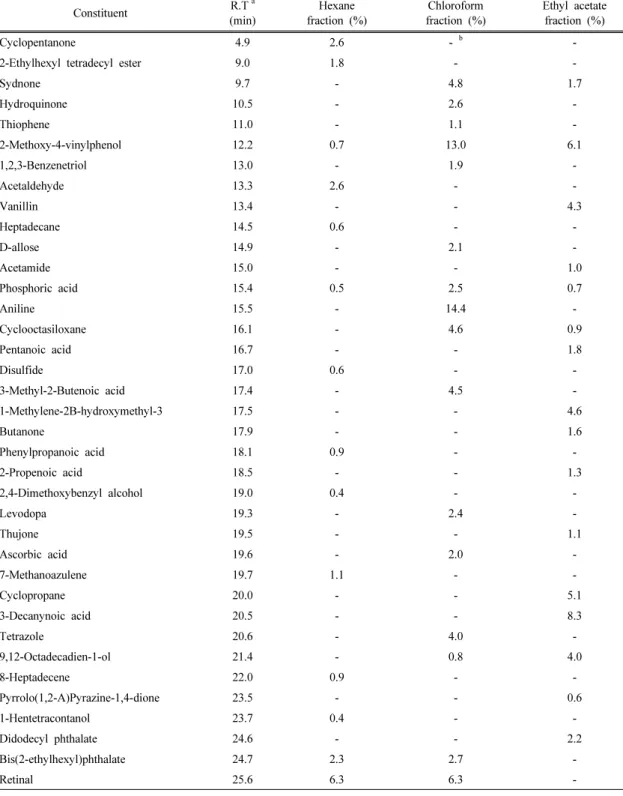
The chemical compositions of the hexane fraction, chloroform fraction and ethyl acetate fraction obtained from the crude extract of C.
chinensis presented in Table 2.
The hexane fraction on analysis showed the
Constituent R.Ta (min)
Hexane fraction (%)
Chloroform fraction (%)
Ethyl acetate fraction (%)
Cyclopentanone 4.9 2.6 - b -
2-Ethylhexyl tetradecyl ester 9.0 1.8 - -
Sydnone 9.7 - 4.8 1.7
Hydroquinone 10.5 - 2.6 -
Thiophene 11.0 - 1.1 -
2-Methoxy-4-vinylphenol 12.2 0.7 13.0 6.1
1,2,3-Benzenetriol 13.0 - 1.9 -
Acetaldehyde 13.3 2.6 - -
Vanillin 13.4 - - 4.3
Heptadecane 14.5 0.6 - -
D-allose 14.9 - 2.1 -
Acetamide 15.0 - - 1.0
Phosphoric acid 15.4 0.5 2.5 0.7
Aniline 15.5 - 14.4 -
Cyclooctasiloxane 16.1 - 4.6 0.9
Pentanoic acid 16.7 - - 1.8
Disulfide 17.0 0.6 - -
3-Methyl-2-Butenoic acid 17.4 - 4.5 -
1-Methylene-2B-hydroxymethyl-3 17.5 - - 4.6
Butanone 17.9 - - 1.6
Phenylpropanoic acid 18.1 0.9 - -
2-Propenoic acid 18.5 - - 1.3
2,4-Dimethoxybenzyl alcohol 19.0 0.4 - -
Levodopa 19.3 - 2.4 -
Thujone 19.5 - - 1.1
Ascorbic acid 19.6 - 2.0 -
7-Methanoazulene 19.7 1.1 - -
Cyclopropane 20.0 - - 5.1
3-Decanynoic acid 20.5 - - 8.3
Tetrazole 20.6 - 4.0 -
9,12-Octadecadien-1-ol 21.4 - 0.8 4.0
8-Heptadecene 22.0 0.9 - -
Pyrrolo(1,2-A)Pyrazine-1,4-dione 23.5 - - 0.6
1-Hentetracontanol 23.7 0.4 - -
Didodecyl phthalate 24.6 - - 2.2
Bis(2-ethylhexyl)phthalate 24.7 2.3 2.7 -
Retinal 25.6 6.3 6.3 -
Table 2. Chemical composition of different fractions from C. chinensis
Constituent R.Ta (min)
Hexane fraction (%)
Chloroform fraction (%)
Ethyl acetate fraction (%)
2-Butenoic acid 26.0 2.8 9.1 1.2
Desacetylanguidine 26.7 4.6 8.4 1.3
5-Methyl-z-5-docosene 26.8 0.7 - -
Tetrapentacontane 28.3 1.7 - -
Carinol 28.4 - - 2.0
Corydine 29.2 2.6 - 3.9
Cyclotrisiloxane 30.9 0.6 - 3.5
Lopan-3-ol 31.1 2.8 - -
Propenyl guaethol 31.6 - - 2.1
D-mannitol 32.2 0.9 - -
(+)-Lariciresinol 32.3 - - 2.7
Squalene 32.7 2.3 - 1.6
β-Sitosterol 33.1 4.6 - -
Farnesyl bromide 33.5 7.2 - -
β-Amyrin 33.8 9.6 - 6.4
Silicic acid 33.9 - - 1.2
Carvone 34.4 15.5 - -
Distearyl thiodipropionate 35.7 - - -
Oxoberberine 36.6 3.3 - 21.6
Acetate 38.1 9.2 - -
Methyltrissilane 38.8 2.7 - -
2-Pteridinamine 39.8 4.4 - -
a R.T : Retention time
b Not detected.
Table 2. To be Continued
presence of 31 identified components (Table 1), which account for 97.2% of the total amount.
Carvone (15.5%) was found as a major compo- nent along with β-amyrin (9.6%), acetate (9.2%), farnesyl bromide (7.2%), retinal (6.3%), and several other components in minor percentages. Moreover, chloroform fraction showed the presence of 18 identified compo- nents, which account for 87.2% of the total amount. The major component was aniline (14.4%), 2-methoxy-4-vinylphenol (13.0%),
2-butenoic acid (9.1%), desacetylanguidine (8.4%), retinal (6.3%). Ethyl acetate fraction showed the presence of 27 identified compo- nents, which account for 92.8% of the total amount. The major compounds found in the ethyl acetate fraction were oxoberberine (21.6%), 3-decanynoic acid (8.3%), 2-methoxy- 4-vinylphenol (6.1%). The chloroform fraction had highest aniline and 2-methoxy-4-vinylphenol.
These results, the insecticidal activity of C.
chinensis is mainly due to its major compound
0 20 40 60 80 100 120
500 1,000 2,000
Insecticidal activity (%)
Dose (ppm)
Aniline
25:75 (2-methoxy-4-vinylphenol : aniline) 50:50 (2-methoxy-4-vinylphenol : aniline) 75:25 (2-methoxy-4-vinylphenol : aniline) 2-methoxy-4-vinylphenol
a
a
b
d c
a a
b
d c
a
a
b c d
Fig. 3. Insecticidal activity of M. persicae (Sulzer) treated with aniline and 2-methoxy-4-vinylphenol by filter paper contact bioassay. Values followed by dif- ferent letters in the same column differ significantly at P < 0.05.
aniline and 2-methoxy-4-vinylphenol. Aniline- based derivatives were organic compounds that possess widespread chemical, agrochemical, and pharmaceutical applications (Pelucchi et al.
2006). Also, aromatic amine was characterized by numerous toxicological manifestations (Williams et al. 2000). Aniline showed strong contact toxicity.
2-Methoxy-4-vinylphenol was an aromatic substance used as a flavoring agent (Chu et al.
2011). However, no reports on insecticidal ac- tivity 2-methoxy-4-vinylphenol against insects were available so far.
3.4. Insecticidal activity of M. persicae treated with aniline and
2-methoxy-4-vinylphenol by filter paper contact bioassay
The insecticidal activities of aniline and 2-methoxy-4-vinylphenol were shown in Fig. 3.
Both aniline (85.4 - 98.1%) and 2-methoxy-4- vinylphenol (79.9 - 95.4%) showed a similar insecticidal activity against M. persicae at concentrations of 500, 1,000 and 2,000 ppm.
The insecticidal activity at the lowest concen- tration tested (500 ppm) approached 85.4% in the aniline compared with 79.9% in the 2-me- thoxy-4-vinylphenol. The insecticidal activity was decreased in all treatments with the mixing of aniline and 2-methoxy-4-vinylphenol. The different mixing ratios of aniline and 2-me- thoxy-4-vinylphenol gave decreased insecticidal activity compared to control. This may be mainly due to the increase of 2-methoxy-4-
vinylphenol. Therefore, the insecticidal activity was greater for the aniline than 2-methoxy-4- vinylphenol.
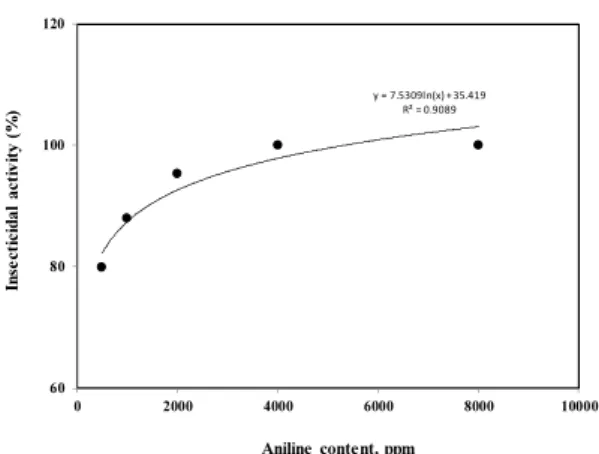
The insecticidal activity of M. persicae was shown to be linearly correlated with aniline content (correlation coefficient being 0.9089) (Fig. 4). It is believed that the insecticidal ac- tivity is due mainly to the presence of aniline (Fig. 5). Further investigations examining the synergistic effect of aniline and other minor components on the insecticidal activity of C.
chinensis are desirable.
4. CONCLUSION
In this study, the crude extract (70% ethanol)
of C. chinensis and its three fractions (hexane,
chloroform and ethyl acetate fraction) which
were separated based on polarity indexes were
examined for their insecticidal activities against
y = 7.5309ln(x) + 35.419 R² = 0.9089
60 80 100 120
0 2000 4000 6000 8000 10000
Insecticidal activity (%)
Aniline content, ppm
Fig. 4. Correlation of the insecticidal activity with aniline.
Fig. 5. Structure of aniline.
peach-potato aphid ( M. persicae). The major chemical compounds of different fraction (hexane, chloroform and ethyl acetate fraction) were identified by head space-GC-MS analysis.
The chloroform fraction showed the highest in- secticidal activity (62.9% in 2000 ppm). The major components of chloroform fraction were aniline (14.4%), 2-methoxy-4-vinylphenol (13.0%). The insecticidal activity was greater for the aniline than 2-methoxy-4-vinylphenol.
The insecticidal activity is accordingly believed to be attributable to the aniline component.
From the study, we conclude that, the extract of C. chinensis contains an array phytochem- icals in it. The chloroform fraction of C. chi-
nensis showed insecticidal providing evidence for its usage in botanical insecticides. This may provide a useful starting point for the develop- ment of botanical insecticides.
ACKNOWLEDGEMENTS
This study was carried out with the support of “Forest Science & Technology Projects (project No. S211314L010140)” provide by Korea Forest Service, Republic of Korea and Gyeongsang National University Fund for pro- fessors on sabbatical leave, 2013.
REFERENCES
Ahmed, S.M., Chander, H., Pereira, J. 1981.
Insecticidal potential and biological activity of India indigenous plants against Musca domestica.
International Pest Control Magazine 23: 170∼ 175.
Anon. 2010. Pharmacopoeia of the people’s republic of China (2010 Chinese Edition). Chemical Industry Press, Beijing, 285∼286.
Anstead, J.A., Williamson, M.S., Denholm, I. 2005.
Evidence formultiple origins of identical in- secticide resistance mutations in theaphid Myzus persicae. Insect Biochemistry and Molecular Biology 35: 249∼256.
Balandrin, M.F. 1985. Natural Plant Chemicals:
Sources of Industrial and Medicinal Materials.
Science 228: 1154∼1160.
Bauernfeind, R., Chapman, R. 1985. Nonstable para- thion and endosulfan resistance in green peach aphids (Homoptera: Aphididae). Journal of Economic Entomology 78: 516∼522.
Blackman, R., Devonshire, A. 1978. Further studies
of the genetics of thecarboxylesteraseregulatory system involved in resistance to organo- phosphorous insecticides in Myzus persicae (Sulzer). Journal of Pesticide Science 9: 517∼ 521.
Casida, J.E., Quistad, G.B. 1998. Golden age of in- secticide research: Past, present, or future?
Annual Review of Entomology 43: 1∼16.
Chu, S.S., Jiang, G.H., Liu, Z.L. 2011. Insecticidal Components from the Essential Oil of Chinese Medicinal Herb, Ligusticum chuanxiong Hort.
Journal of Chemistry 8(1): 300∼304.
Desneux, N., Fauvergue, X., Moncharmont, F., Kerhoas, L., Ballanger, Y., Kaiser, L. 2005.
Diaeretiella rapae Limits Myzus persicae Populations After Applications of Deltamethrin in Oilseed Rape. Journal of Economic Entomology 98(1): 9∼17.
Eto, M. 1974. Organophosphorus pesticides: organic and biological chemistry. Boca Raton, Florida, CRC Press.
Flanders, K., Radcliffe, E., Ragsdale, D. 1991.
Potato leafroll virus spread in relation to den- sities of green peach aphid (Homoptera:
Aphididae): Implications for management thresh- olds for Minnesota seed potatoes. Journal of Economic Entomology 84: 1028∼1036.
Gray, S.M., Gildow, F. 2003. Luteovirus-aphid interactions. Annual Reviews. Phytopathology, 41: 539∼566.
Hoogenboom, R., Schubert, U.S. 2007.
Microwave-assisted polymer synthesis: recent de- velopments in a rapidly expanding field of research. Macromolecular Rapid Communications 28(4): 368∼386.
Ishaaya, I. 2001. Biochemical processes related to in- secticide action: an overview. pp. 1-16 in Ishaaya, I. (Ed.) Biochemical sites simportant in insecticide action and resistance. Berlin,
Heidelberg, Springer Verlag.
Jeon, J.H., Kim, Y.K., Lee, S.G., Lee, S.H., Lee, H.S. 2011. Insecticidal activities of a Diospyros kaki root-isolated constituent and its derivatives against Nilaparvata lugens and Laodelphax striatellus. Journal of Asia-Pacific Entomology 14: 449∼453.
Jung, H.A., Min, B.S., Yokozawa, T., Lee, J.H., Kim, Y.S., Choi, J.S. 2009. Anti-Alzheimer and antioxidant activities of Coptidis Rhizoma alkaloids. Biological and Pharmaceutical Bulletin 32: 1433∼1438.
Karawita, R., Siriwardhana, N., Lee, K.W., Heo, M.S., Yeo, I.K., Lee, Y.D. 2005. Reactive oxy- gen species scavenging, metal chelating, re- ducing power and lipid peroxidation inhibition properties of different solvent fractions from Hizikia fusiformis. European Food Research and Technology 220(3∼4): 363∼371.
Kim, J.M., Jung, H.A., Choi, J.S., Lee, N.G. 2010.
Identification of antiinflammatory target genes of Rhizoma coptidis extract in lipopolysaccharide- stimulated RAW264.7 murine macrophage-like cells. Journal of Ethnopharmacology 130: 354∼ 362.
Kong, W.J., Zhao, Y.L., Xiao, X.H., Wang, J.B., Li, H.B., Li, Z.L., Jin, C., Liu, Y. 2009. Spectrum– effect relationships between ultra performance liquid chromatography fingerprints and anti-bac- terial activities of Rhizoma coptidis. Analytical Chimica Acta 634: 279∼285.
Malik, A., Singh, N., Satya, S. 2007. Housefly (Musca domestica): a review of control strategies for a challenging pest. Journal of Environmental Science and Health, Part B 42: 453∼469.
Martinez-Torres, D., Foster, S.P., Field, L.M., Devonshire, A.L., Williamson, M.S. 1999. A so- dium channel point mutation is associated with resistance to DDT and pyrethroid insecticides in
the peach-potato aphid, Myzus persicae (Sulzer) (Hemiptera: Aphididae). Insect Molecular Biology 8(3): 339∼346.
McLeod, P. 1991. Influence of temperature on trans-laminar and systemic toxicities of aphici- desfor green peach aphid (Homoptera:
Aphididae) suppression on spinach. Journal of Economic Entomology 84: 1558∼1561.
Nauen, R., Ebbinghaus-Kintscher, U., Elbert, A., Jeschke, P., Tietjen, K. 2001. Acetylcholine re- ceptors as sites for developing neonicotinoid insecticides. pp. 77∼105 in Ishaaya, I. (Ed.) Biochemical sites simportant in insecticide action and resistance. Berlin, Heidelberg, Springer Verlag.
Pelucchi, C., Bosetti, C., Negri, E., Malvezzi, M., LaVecchia, C. 2006. Mechanisms of disease:
The epidemiology of bladder cancer. Nature clinical practice urology 3(6): 327∼340.
Petitt, F., Smilowitz, Z. 1982. Green peach aphid feeding damage to potato in various plantgrowth stages. Journal of Economic Entomology 75: 431
∼435.
Ramsey, J., Wilson, A.C., De Vos, M., Sun, Q., Tam-borindeguy, C., Winfield, A., Malloch, G., Smith, D.M., Fenton, B., Gray, S.M., Jander, G.
2007. Genomic re-sources for Myzus persicae:
EST sequencing, SNPiden-tification, and micro- array design. BMC Genomics 8: 423.
Remppis, A., Bea, F., Greten, H.J., Buttler, A., Wang, H., Zhou, Q., Preusch, M.R., Enk, R., Ehehalt, R., Katus, H., Blessing, E. 2010.
Rhizoma Coptidis inhibits LPS-induced MCP-1/CCL2 production in murine macrophages via an AP-1 and NF kappa B dependent pathway. Mediators of Inflammation, 194896: 8.
Stewart, J., Aharoni, Y., Hartsell, P., Young, D.
1980. Acetaldehyde fumigation at reduc- edpressures to control the green peach aphid on wrapped and packed head lettuce. Journal of Economic Entomology 73: 149∼152.
Sukamar, K., Perich, M.J., Boobar, L.R. 1991.
Botanical derivatives in mosquito control: a review. Journal of the American Mosquito Control Association 7: 210∼237.
Tagu, D., Klingler, J.P., Moya, A., Simon, J. 2008.
Early progress in aphid genomics and con- sequences for plant-aphid interactions studies.
Molecular Plant Microbe Interactions 21: 701∼ 708.
Tsai, H.H., Chen, I.J., Lo, Y.C. 2008. Effects of San-Huang-Xie-Xin-Tang on U46619-induced in- crease in pulmonary arterial blood pressure.
Journal of Ethnopharmacology 117: 457∼462.
Williams, P.L., James, R.C., Roberts, S.M. 2000.
Principles of toxicology: Environmental and in- dustrial applications. 2nd Ed. Wiley, New York, N.Y.