애엽(艾葉) 에탄올 및 메탄올 추출물과 용매별 분획의 세포독성과 항산화활성
이경인*,***†·조주현**·표병식**
*동신대학교 생물자원산업화지원센터, **동신대학교 한약재산업학과, ***조선대학교 바이오신약개발학과
Cytotoxicity and Antioxidative Activity of Artemisiae Argi Folium Alcoholic Extracts and Their Fractions
Kyoung In Lee*,***†, Joo Hyun Cho** and Byoung Sik Pyo**
*Biotechnology Industrialization Center, Dongshin University, Naju 520-811, Korea.
**Deptartment of Oriental Medicine Materials, Dongshin University, Naju 520-811, Korea.
***Deptartment of Bio New Drug Development, Chosun University, Gwangju 501-759, Korea.
ABSTRACT : This experiment was carried out to obtain the cytotoxicity and antioxidative activity of Artemisiae Argi Folium. The total polyphenol contents in the ethyl acetate fraction of the ethanol extract and the methanol extract were 430.27㎎/g and 427.84 ㎎/g, respectively. In DPPH radical scavenging ability, SC50 values of the ethyl acetate fraction of the ethanol extract and the methanol extract were 32.64㎍/㎖ and 27.70 ㎍/㎖ as the same level of statistical with ascorbic acid.
In the cytotoxicity measurement by MTT assay, the chloroform and hexane fraction, and each extract were exhibited higher cytotoxicity than the other fractions. In particular, the ethyl acetate fractions appeared high activity in DPPH radical scav- enging ability were began to show cytotoxicity in 125㎍/㎖. As a result, the ethyl acetate fraction of Artemisiae Argi Folium extract was the most highly active fraction in antioxidative activity. However, for the use of extracts and fractions from Arte- misiae Argi Folium to related fields, the setting of appropriate concentration is required.
Key Words : Artemisiae Argi Folium, Cytotoxicity, Antioxidative Activity
서 언
인간과 같은 생체에서는 호흡과 에너지 생성 등 다양한 생 명유지 활동의 결과로 각종 radical을 포함한 다양한 활성산소 종 (reactive oxygen species, ROS)이 생성된다. 이러한 활성 산소종은 세포 구성 성분들인 지질이나 단백질, DNA 등을 비 가역적으로 파괴함으로써 암이나 각종 염증, 심혈관계 질환 등 의 원인으로 작용함은 물론 피부질환이나 노화의 직간접적인 원인으로 작용하게 된다 (Videla and Fermandez, 1988;
Fridovich, 1989). BHA (Butylated Hydroxy Anisole)나 BHT (Butylated Hydroxy Toluene) 등과 같은 합성항산화제가 우수 한 항산화 및 보존효과를 가진 것으로 알려져 오래 전부터 식 품이나 화장품 등에 사용되고 있으나 발암성 등 다양한 부작 용과 과량 사용에 따른 독성의 우려가 있는 것으로 보고되고 있다 (Branen, 1975; Farag et al., 1989). 이에 따라 최근에 는 합성항산화제 대신 식물 추출물과 같이 천연물에서 유래한 성분에 대한 연구와 함께 천연 성분의 사용이 다양한 제품들
에서 시도되고 있다 (Lee and Lee, 2008; Choi et al., 2009; Moreno et al., 2000).
애엽 (艾葉, Artemisiae Argi Folium)은 국화과에 속한 다 년생 초본인 황해쑥 (Artemisia argyi), 쑥 (A. princeps), 또 는 산쑥 (A. montana)의 잎 및 어린 줄기를 여름에 꽃이 피 기 전에 채취하여 건조한 것으로, 한의학이나 민간요법에서는 애엽의 항염증 활성을 기대하여 위염 등의 치료에 이용해 왔 다. 또한 항암이나 항궤양 관련 활성에 대해서도 연구되었으 며, 골 대사에 미치는 긍정적인 효과나 면역 관련 활성 등이 보고되어 있다 (Park, 2008, 2009; Lee et al., 2010). 한편, 애엽과 같은 쑥속에 포함된 사철쑥 (A. capillaris)의 경우 항 산화 및 항균 활성, 면역세포 생육증진 효과 등이 연구된 바 있었다 (Lee et al., 2004; Choi et al., 2008). 이와 같은 쑥 속의 약용식물에 대한 연구들 중 큰비쑥 (A. fukudo)을 대상 으로 항염증 활성을 연구한 경우를 제외하고는 대부분 추출물 수준에서 이루어진 것이었다 (Yoon et al., 2007). 국외의 연 구 중 쑥속의 독성과 관련된 결과에서 일부 독성과 독성을 나
†Corresponding author: (Phone) +82-61-336-3104 (E-mail) [email protected]
Received 2011 October 13 / 1st Revised 2011 November 17 / 2nd Revised 2011 November 27 / Accepted 2011 November 30
타내는 성분에 대해 보고하고 있어서 국내에서 약용으로 사용 되고 있는 애엽에 대해서도 구체적인 검증이 필요할 것으로 판단된다 (Miller et al., 1981; Qureshi et al., 1990). 또한 일반적인 약용식물 추출물의 용매 극성에 따른 분획 중 비극 성 용매층인 hexane이나 chloroform, 또는 dichloromethane 등 의 분획에서 세포독성을 나타내는 경우가 많으므로 추출물뿐 만이 아니라 분획물 수준의 세포독성 역시 확인되어야 할 것 이다 (Im and Lee, 2011; Yoon et al., 2007). 본 연구에서 는 애엽 에탄올 및 메탄올 추출물과 그 용매별 분획물의 항산 화 활성과 함께 MTT assay를 활용한 세포독성을 조사하여 애엽을 이용한 기능성 소재 개발의 기초 자료로서 활용하고자 하였다.
재료 및 방법
1. 추출 및 분획
애엽 (艾葉, Artemisiae Argi Folium) 시료 300 g을 각각 15배 용량의 94% 에탄올과 99.6% 메탄올을 추출 용매로 하 여 끓는점에서 3시간씩 3회 반복하여 환류추출을 실시하였다.
추출액은 여과와 농축 및 동결건조를 실시하여 분말화된 추출 물을 얻었으며, 이 중 일부를 증류수 1 ℓ 에 분산시킨 후 동 량의 hexane, chloroform, ethylacetate, butanol을 사용하여 순차적으로 3회 반복하여 용매분획을 실시하였다. 분획된 시 료는 여과와 농축 및 동결건조 후 추출물과 함께 4℃ 이하로 냉장보관하면서 실험에 사용하였다.
2. 세포주 배양
세포독성 실험에 사용된 Raw 264.7 세포주는 10% FBS와 1% penicillin-streptomycin을 혼합한 DMEM (Dulbecco's Modified Eagle Medium) 배지를 사용하여 37℃, 5% CO2
조건에서 배양하였다.
3. 총 polyphenol 함량 측정
Folin-Denis법을 이용하여 추출물 및 분획물의 페놀성 화합 물 함량을 측정하였다. Methanol에 1 ㎎/㎖ 농도로 용해시킨 시료액 80 ㎕와 Folin-Denis reagent 80 ㎕를 혼합하여 3분간 반응시킨 뒤 10% Na2CO3 80㎕를 혼합하여 1시간동안 암실 에서 반응시킨 후, 상등액 120 ㎕를 취하여 96-well plate에 옮겨 700 ㎚에서 흡광도를 측정하였다. 표준물질로 tannic acid 를 0~500 ㎍/㎖ 의 농도로 제조하여 시료와 동일한 방법으로 분석하여 표준 검량선을 작성하고 페놀성 화합물의 함량을 ㎎/
g tannic acid로 나타내었다.
4. DPPH radical 소거능 측정
추출물과 분획물의 항산화활성을 비교하기 위해 1,1-
diphenyl-2-picrylhydrazyl (DPPH)을 사용하여 radical 소거능 을 측정하였다 (Blois, 1958).Methanol에 농도별로 용해시킨 각 시료액 20 ㎕와 200 µM DPPH 용액 180 ㎕를 혼합하여 15분간 암실에서 반응시킨 후 517 ㎚에서 흡광도를 측정하였 다. 시료액 대신 methanol을 사용한 blank의 흡광도를 기준으 로 소거능을 산출하였으며, 50%의 DPPH radical을 소거하는 데 필요한 농도 (SC50)를 추가적으로 계산하였다. Positive control로 ascorbic acid (vitamin C)를 사용하였다.
5. MTT assay에 의한 세포독성 측정
추출물 및 분획물의 세포독성은 3-(4,5-dimethyl-2-thiazolyl)- 2,5-diphenyl-2H-tetrazolium bromide (MTT)를 이용한 방법에 의해 측정하였다 (Shin et al., 2003). 배양된 Raw 264.7 세 포를 96-well plate에 1 × 10⁴ cells/well의 농도로 분주하여 24 시간 배양하여 부착 및 안정화시킨 후, 농도별로 희석한 시료 를 처리하여 24시간 동안 배양하였다. PBS에 5 ㎎/㎖의 농도 로 용해시켜 제조한 MTT용액을 각 well에 10 ㎕ 씩 가하고, 37℃, 5% CO2 조건에서 4시간 동안 반응시켜 MTT가 환원되 도록 하였다. 배지를 제거한 후, 각 well에 100 ㎕의 DMSO 를 첨가하여 생성된 formazan 결정을 용해시켜 540 ㎚에서 흡광도를 측정하였으며, 시료액 대신 PBS를 사용한 blank의 흡광도를 기준으로 세포 생존율을 산출하였다.
6. 통계분석
모든 측정값은 3회 이상 반복 실험한 결과의 평균값과 표준 편차 (mean ± SD)로 표시하였고, 각 실험군 간의 통계학적 분 석은 windows용 SPSS 12.0 (SPSS Inc, Chicago, IL, USA)을 이용하였다. 각 군 간의 측정치 비교는 one-way analysis of variance (ANOVA)를 시행하였으며, 유의성은 신 뢰구간 p < 0.05에서 의미를 부여하였다.
결과 및 고찰
1. 추출 및 분획수율
Table 1에 나타난 추출물의 수율에 나타낸 바와 같이 ethanol과 methanol 추출물의 수율은 각각 14.18%와 14.63%
로 큰 차이를 나타내지 않았다. 용매별 분획의 수율에서 ethanol과 methanol 추출물의 aquoeus 분획이 각각 32.38%와 38.20%로 가장 높게 나타났고 다음으로 hexane 분획이 각각 17.64%와 18.69%로 나타났다. 또한 두 추출물 모두에서 ethyl acetate 분획이 각각 15.38%와 11.95%로 가장 낮은 수율을 나 타내었다. 전반적으로 용매별 분획 수율의 순위는 두 추출물 모두 동일하게 나타났으나 일반적으로 활성이 높은 것으로 알 려진 ethyl acetate와 butanol 분획의 수율에서 ethanol 추출물 이 methanol 추출물보다 높은 수율을 가지는 것으로 나타났다.
2. 총 polyphenol 함량
Polyphenol은 식물의 대표적인 2차 대사산물로 hydroxyl기 를 가지는 방향족 화합물로서 다양한 생리활성에 관여하는 것 으로 알려져 있으며, 강력한 항산화 활성을 기반으로 여러 가 지 관련 활성을 가지는 것으로 알려져 있다. 한편, polyphenol 류의 한 종류인 플라보노이드는 superoxide, hydroxy radical 과 같은 세포손상을 초래하는 free radical을 없애주는 항산화 활성을 비롯하여 항암, 항균 등 다양한 생리활성을 가지는 것 으로 알려져 있다 (Liu, 2004; Manach et al., 2005; Ryu et al., 2010). Table 2에 나타낸 polyphenol 함량 측정 결과, ethanol 추출물보다 methanol 추출물의 polyphenol 함량이 높 았으며, 용매별 분획에서는 두 추출물 모두 ethyl acetate 분획 에서 각각 430.27 ㎎/g과 427.84 ㎎/g으로 가장 높은 함량을 나타내었다. 또한 ethyl acetate 분획의 함량을 제외한 나머지
분획에서 methanol 추출물의 분획이 ethanol 추출물의 동일한 용매 분획보다 상대적으로 높은 polyphenol 함량을 가지는 것 으로 확인되었다. 이와 같은 애엽 추출물이나 ethyl acetate 분 획의 polyphenol 함량은 약용 식물 중 높은 polyphenol 함량 을 가진 것으로 알려진 벚나무 수피인 화피나 천궁 등의 함량 과 유사하거나 더 높은 수준임을 알 수 있었다 (Im and Lee, 2011; Lee et al., 2011; Oh et al., 2010).
3. DPPH radical 소거능
애엽 추출물과 분획물의 항산화활성을 비교하기 위해 실시 한 DPPH radical 소거능 측정에서 50%의 DPPH radical을 소거하는데 필요한 시료 농도를 나타내는 SC50을 산출하여 Table 3에 나타내었다. Ethanol추출물과 methanol 추출물의 용 매별 분획 중 ethyl acetate 분획의 SC50이 각각 32.6 ㎍/㎖와 Table 1. Yields of the extract and fractions from Artemisiae Argi Folium.
Extraction
solvents Extract Fractions
Hexane Chloroform Ethyl acetate Butanol Aqueous
Yields (%) Ethanol 14.18 17.64 17.07 15.38 17.53 32.38
Methanol 14.63 18.69 15.09 11.95 16.07 38.20
Table 2. Total polyphenol content of the extract and fractions from Artemisiae Argi Folium.
Extraction
solvents Extract Fractions
Hexane Chloroform Ethyl acetate Butanol Aqueous
Total polyphenol
(㎎/gTAE†)
Ethanol 151.15±6.12d 27.35±2.75i 63.18±1.45g 430.27±8.06a 144.13±2.31d 51.63±2.85h* Methanol 172.74±0.98c 52.28±3.06h 105.39±6.17e 427.84±3.40a 197.51±7.31b 93.62±5.24f
†TAE : tannic acid equivalent. *Values are mean ± SD (n = 6). Different superscript letters in the table show significant differences at p < 0.05 by one-way ANOVA.
Table 3. DPPH radical scavenging ability of the extract and fractions from Artemisiae Argi Folium.
Extraction solvents Samples SC50† (㎍/㎖) Relative‡ activity (%)
Ethanol
Extract 1,151.1 ± 5.2c* 7.72
Fractions
Hexane 1,761.2 ± 18.1i 0.66
Chloroform 1,218.5 ± 53.8g 0.96
Ethylacetate 1,532.6 ± 3.3a 35.75
Butanol 1,119.3 ± 3.7bc 9.78
Aqueous 1,499.1 ± 16.7e 2.34
Methanol
Extract 1,137.8 ± 2.9c 8.47
Fractions
Hexane 1,558.2 ± 35.5h 0.75
Chloroform 1,707.1 ± 3.4f 1.65
Ethylacetate 1,527.7 ± 3.6a 42.13
Butanol 1,598.1 ± 3.2b 11.90
Aqueous 1,385.9 ± 9.8d 3.02
Ascorbic acid 1,511.7 ± 1.0a 100.00
†SC50: concentration of each samples for scavenging 50% of DPPH radical. ‡Relative activity: ratio of SC50 value compared to positive control (ascorbic acid). Ascorbic acid was used as a positive control. *Different superscript letters in the table show significant differences at p < 0.05 by one-way ANOVA.
27.7㎍/㎖로 나타나 positive control로 사용된 ascorbic acid 의 11.7 ㎍/㎖와 유사한 수준임이 확인되었다. 추출물들의 활 성에서는 통계적으로 동일한 수준이기는 하였으나 methanol 추출물이 ethanol 추출물보다 상대적으로 높은 소거능을 가지 는 것으로 나타났으며, 모든 용매별 분획에서 methanol 추출 물의 분획이 ethanol 추출물의 동일한 용매 분획보다 높은 DPPH radical 소거능을 가지는 것으로 확인되었다. 이러한 DPPH radical 소거능은 일반적으로 polyphenol 함량과 밀접한 관련이 있다는 기존의 연구들에서 제시한 결과와 동일하게 Table 2의 polyphenol 함량과 높은 연관성을 갖는 것으로 나 타났다 (Eom et al., 2009; Oh et al., 2010; Im and Lee, 2011). 또한 positive control로 사용된 ascorbic acid의 SC50
을 100.00%로 하여 환산한 relative activity에서 methanol 추 출물과 ethanol 추출물의 ethyl acetate 분획에서 각각 42.13%
와 35.75%에 해당하는 항산화 활성을 보이는 것으로 평가할 수 있었다. 그러나 hexane이나 chloroform, aqueous 분획들의 활성은 0.66~3.02% 수준으로 현저히 낮은 소거능을 가지는 것으로 나타났다.
4. MTT assay에 의한 세포독성
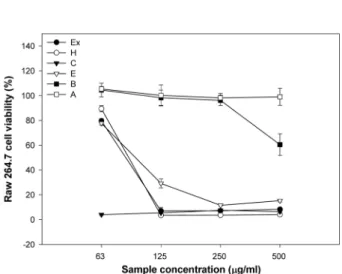
애엽 추출물과 분획물의 Raw 264.7 세포에 대한 세포독성 을 측정한 결과를 Fig. 1과 2에 나타내었다. 두 추출물 모두 에서 용매별 분획 중 chloroform 분획의 세포생존율이 실험이 실시된 가장 낮은 농도인 63 ㎍/㎖에서 4.01~4.24% 수준으로 나타남으로써 높은 세포독성이 확인되었으며, 추출물과 hexane 분획이 125 ㎍/㎖ 농도에서 3.19~7.08%의 세포생존율을 나타 냄으로써 chloroform 분획 다음으로 높은 세포독성을 가지는 것으로 나타났다. 또한 DPPH radical 소거능에서 가장 높은 활성을 보여준 ethyl acetate 분획의 세포생존율도 chloroform 과 hexane 분획보다는 높았지만 125 ㎍/㎖ 이상의 농도에서 상당한 수준의 세포독성이 있는 것으로 확인되었으며, ethanol 추출물보다는 methanol 추출물의 ethyl acetate 분획에서 상대 적으로 높은 세포독성이 나타났다. 반면, aqueous 분획은 모든 농도에서 100% 전후의 세포생존율을 나타냄으로써 세포독성 이 없는 것으로 확인되었고 butanol 분획 역시 실험이 실된 가장 높은 농도에서 53.22~60.45%의 세포생존율을 보임으로 써 우려할만한 수준의 세포독성은 가지지 않은 것으로 판단되 었다. 이와 같은 세포독성의 결과는 애엽 중에 존재하는 독성 성분들이 hexane이나 chloroform, ethyl acetate 등 상대적으 로 극성이 낮은 용매에 용해되기 쉬운 성질을 가졌다고 볼 수 있는데, 이는 인진쑥이나 사철쑥을 대상으로 실시된 세포독성 의 연구보고 결과와 유사한 결과이다 (Kim et al., 2007; Lee et al., 2004).
이상의 결과, 애엽의 methanol 추출물과 용매별 분획이 상 대적으로 높은 polyphenol 함량을 바탕으로 ethanol 추출물과
분획보다 높은 항산화 활성을 가지는 것으로 확인되었다. 한 편, 세포독성을 확인하기 위해 실시한 MTT assay 결과에서 chloroform과 hexane 분획, 그리고 각 추출물의 세포독성이 높 은 수준으로 나타났고 polyphenol 함량과 DPPH radical 소거 능에서 활성이 높게 나타난 각 추출물의 ethyl acetate 분획의 세포독성이 125 ㎍/㎖ 이상의 농도에서 나타나기 시작하는 것 을 확인하였다. 이와 같은 세포독성을 감안하여 ethyl acetate 분획의 경우 관련 분야에 적용 시 적절한 농도의 설정이 요구 되며, ethyl acetate 분획에 비해 상대적으로 활성은 낮을 수 있지만 추출물보다도 세포독성이 낮은 butanol 분획에 대해 추 가적인 활성 연구가 필요할 것으로 판단되었다.
Fig. 1. Raw 264.7 cell viabilities of the ethanol extract and fractions by MTT assay. Values are mean ± SD (n = 3).
Ex: ethanol extract, H: hexane fraction, C: chloroform fraction, E: ethyl acetate fraction, B: butanol fraction, A:
aqueous fraction.
Fig. 2. Raw 264.7 cell viabilities of the methanol extract and fractions by MTT assay. Values are mean ± SD (n = 3).
Ex: methanol extract, H: hexane fraction, C: chloroform fraction, E: ethyl acetate fraction, B: butanol fraction, A:
aqueous fraction.
LITERATURE CITED
Blois MS. (1958). Antioxidant determinations by the use of a stable free radical. Nature. 181:1199-1200.
Branen AL. (1975). Toxicological and biochemistry of butylated hydroxyanisole and butylated hydroxytoluene. Journal of the American Oil Chemists' Society. 52:59-65.
Choi SR, You DH, Kim JY, Park CB, Ryu J, Kim DH and Eun JS. (2008). Antioxidant and antimicrobial activities of Artemisia capillaris Thunberg. Korean Journal of Medicinal Crop Science. 16:112-117.
Choi SR, You DH, Kim JY, Park CB, Kim DH and Ryu J.
(2009). Antioxidant activity of methanol extracts from Cudrania tricuspidata Bureau according to harvesting parts and time. Korean Journal of Medicinal Crop Science. 17:115-120.
Eom HJ, Kim SM, Pyo BS and Lee KI. (2009). Changes of physiological activity by drying temperature in leaf of Eriobotrya japonica. Korean Journal of Pharmacognosy.
40:178-183.
Farag RS, Badei AZMA and Baroty GSA. (1989). Influence of thyme and clove essential oils in cotton seed oil oxidation.
Journal of the American Oil Chemists' Society. 66:800-806.
Fridovich I. (1989). Superoxide dismutase an adaption to paramagnetic gas. Journal of Biological Chemistry. 264:7761- 7762.
Im DY and Lee KI. (2011). Antioxidative, antibacterial activity and tyrosinase inhibitory activity of the extract and fractions from Taraxacum coreanum Nakai. Korean Journal of Medicinal Crop Science. 19:238-245.
Kim HT, Kim JW, Lim MK, Jin TW, Yeo SG, Jang KH, Oh TH and Lee KW. (2007). Cytotoxicity effect of Artemisia capillaris extracts on the cancer cells on in vitro. Journal of Veterinary Clinics. 24:367-371.
Lee HH and Lee SY. (2008). Cytotoxic and antioxidant effects of Taraxacum coreanum Nakai. and T. officinale WEB. extracts.
Korean Journal of Medicinal Crop Science. 16:79-85.
Lee KI, Yang SA, Pyo BS and Kim SM. (2011). Antibacterial activity against pathogens of acne and tyrosinase inhibitory activity of extract and fractions from bark of Prunus sargentii.
Korean Journal of Pharmacognosy. 42:155-160.
Lee MK, Choi GP, Ryu LH, Lee GY, Yu CY and Lee HY.
(2004). Enhanced immune activity and cytotoxicity of Artemisia capillaris Thunb. extracts against human cell lines.
Korean Journal of Medicinal Crop Science. 12:36-42.
Lee SM, Kim MG, Lee SY and Kang TH. (2010). Effects of Artemisia pronceps extract on bone metabolism. Journal of the
Korean Society of Food Science and Nutrition. 39:363-368.
Liu RH. (2004). Potential synergy of phytochemicals in cancer prevention : mechanism of action. The Journal of Nutrition.
134:3479S-3485S.
Manach C, Williamson G, Morand C, Scalbert A and Remesy C. (2005). Bioavailability and bioefficacy of polyphenols in humans. The American Journal of Clinical Nutrition. 81:230S- 242S.
Miller Y, Jouglard J, Steinmetz MD, Tognetii P, Joanny D and Arditti J. (1981). Toxicity of some essential plant oils. Clinical Toxicology. 8:1485-1487.
Moreno MIN, Isla MIN, Sampietro AR and Vattuone MA.
(2000). Comparison of the free radical-scavenging activity of propolis from several region of Argentina. Journal of Ethnopharmacology. 71:109-114.
Oh YJ, Seo HR, Choi YM and Jung DS. (2010). Evaluation of antioxidant activity of the extracts from the aerial parts of Cnidium officinale Makino. Korean Journal of Medicinal Crop Science. 18:373-378.
Park WS. (2008). Study on biological effect of water extract from Artemisia argi folium on mouse macropharge Raw 264.7 cells.
Korean Journal of Oriental Physiology and Pathology. 22:815- 820.
Park WS. (2009). Effect of water extract from Artemisia argi folium on mouse macropharge stimulated by LPS. Korean Journal of Herbology. 24:151-157.
Qureshi S, Ageel AM, al-Yahya MA, Tarig M, Mossa TS and Shah AH. (1990). Preliminary toxicity studies on ethanol extracts of the aerial parts of Artemisia abyssinica and A.
inculta in mice. Journal of Ethnopharmacology. 28:157-162.
Ryu MJ, Lee SY, Park Y and Yang YK. (2010). Antioxidative activities and antifungal effect against Malassezia furfur in the extracts from 6 spp. medicinal plants. Journal of Korean Society of Cosmetology. 16:120-128.
Shin KM, Park YM, Kim IT, Hong SP, Hong JP and Lee KT.
(2003). In vitro antiinflammatory activity of amygdalin in murine macrophage Raw264.7 cells. Korean Journal of Pharmacognosy. 34:223-227.
Videla LA and Fermandez V. (1988). Biochemical aspects of cellular oxidative stress. Archivos de biología y medicina experimentales. 21:85-92.
Yoon WJ, Lee JA, Kim KN, Kim JY and Park SY. (2007). In vitro anti-inflammatory activity of the Artemisia fukudo extracts in murine macrophage RAW 264.7 cells. Korean Journal of Food Science and Technology. 39:464-469.