ABSTRACT
Purpose: Ixeris strigosa (IS) is a perennial plant that commonly grows in meadows. The leaves
and roots of IS have been used in medicine as a sedative. This study evaluated the antioxidant and carbohydrate-digestive-enzyme inhibitory effects of IS to determine its potential as an essential antioxidant and glycemic inhibitor for type 2 diabetics.
Methods: The antioxidative and α-amylase and α-glucosidase inhibitory activities were
examined using the water extracts (ISW), ethanol extracts (ISE), and solvent fractions from IS. The antioxidative activities were measured using in vitro methods by measuring the 1,1-diphenyl-2-picrylhydrazyl and 2,2′-azino-bis-3-ethylbenzothiazoline-6-sulfonic acid radical scavenging activity.
Results:
Investigations of the total polyphenol, flavonoid content, in vitro antioxidant activity, and α-amylase and α-glucosidase inhibitory activities of the IS extract showed that the ISE had higher total phenolic and flavonoid contents than the ISW, as well as high antioxidant activity. The ethanolic extracts of IS (70%) had an α-amylase inhibitory activity of 78.55%.
The ethyl acetate fraction (90.56%) showed higher α-glucosidase inhibitory activity than the positive control, acarbose (83.01%).
Conclusion:
Among the ISE fractions, the ethyl acetate and butanol fractions showed the best digestive enzyme inhibitory activity. Moreover, the antioxidant activity of the extract and the carbohydrate, α-amylase, and α-glucosidase inhibitory effects showed a stronger correlation with the total phenol and flavonoid contents compared to the ISW. As a result, the antioxidant and digestive enzyme inhibitory activities of high ISE are due to the phenolic compounds, particularly the flavonoid compounds. Therefore, ethyl acetate and butanol fractions of the 70% ethanol extract are excellent anti-diabetic functional materials.
Keywords: Ixeris strigosa, antioxidant, α-amylase, α-glucosidase
Research Article
Antioxidant and anti-diabetic effects of Ixeris strigosa extract
Yun-Jeong Ji
1,*, Eun Young Lee
1,*, Ji Yeon Lee
1,2, Kyung Hye Seo
1, Dong Hwi Kim
1, Chun Geon Park
1, and Hyung Don Kim
11 Department of Herbal Crop Research, National Institute of Horticultural & Herbal Science, Eumsung 27709, Korea
2Department of Food Science and Biotechnology, Chungbuk National University, Cheongju 28644, Korea
선씀바귀 추출물의 항산화 및 항당뇨 효과
지윤정
1,*, 이은영
1,*, 이지연
1,2, 서경혜
1, 김동휘
1, 박춘근
1, 김형돈
11농촌진흥청 인삼특작부
2충북대학교 식품공학과
Received: Apr 14, 2020 Revised: May 4, 2020 Accepted: May 18, 2020 Correspondence to Hyung Don Kim
Department of Herbal Crop Research, National Institute of Horticultural & Herbal Science, 92 Bisan-ro, Eumsung 27709, Korea.
Tel: +82-43-871-5783 E-mail: [email protected]
*These authors contributed equally to this article.
© 2020 The Korean Nutrition Society This is an Open Access article distributed under the terms of the Creative Commons Attribution Non-Commercial License (http://
creativecommons.org/licenses/by-nc/3.0/) which permits unrestricted non-commercial use, distribution, and reproduction in any medium, provided the original work is properly cited.
ORCID iDs Yun-Jeong Ji
https://orcid.org/0000-0003-1182-2328 Eun Young Lee
https://orcid.org/0000-0002-8311-5991 Ji Yeon Lee
https://orcid.org/0000-0002-3622-7392 Kyung Hye Seo
https://orcid.org/0000-0002-8155-8051 Dong Hwi Kim
https://orcid.org/0000-0002-2129-7056 Chun Geon Park
https://orcid.org/0000-0003-4177-6270 Hyung Don Kim
https://orcid.org/0000-0003-0993-4347
Funding
This work was carried out with the support of “Cooperative Research Program for Agriculture Science and Technology Development (Project No. PJ01361602)” and the RDA Fellowship Program of National Institute of Horticultural and Herbal Science, Rural Development Administration, Republic of Korea.
Conflict of Interest
There are no financial or other issues that might lead to conflict of interest.
서론
최근 식생활과 생활습관 등의 변화로 각종 만성질환이 증가하고 있으며 그 중 대사성 질환인
당뇨병
(diabetes mellitus)은 전세계적으로 급증하고 있다
.국제당뇨병연맹은 현재 약
4억여
명인 당뇨병 환자가
2045년에는
7억 명에 달할 것으로 예측하고 있다
[1].우리나라 국민영양
조사결과에서 성인 만
30세 이상 당뇨병 유병률은
2001년
8.9%에서
2018년
12.9%로 매년 꾸
준히 증가하고 있다
[2].당뇨병은 그 기전에 따라 췌장에서 인슐린이 전혀 분비되지 않아서
발생한 제
1형 당뇨병과 인슐린 저항성이 증가하여 발생하는 제
2형 당뇨병으로 나뉜다
[3].당뇨병의 치료법은 인슐린을 투여하는 방법과 혈당강하제를 복용하여 혈당을 조절하는 방 법이 있다
.가장 일반적인 형태인 제
2형 당뇨병의 치료방법으로 경구혈당 강하제 복용법
은 당 분해에 관여하는 효소들을 저해하는 물질을 이용한다
[4].당의 분해에 관여하는 효
소 중에서
α-amylase와
α-glucosidase는 전분과 글리코겐 소화에 중요한 효소이며 식후 포도
당 농도를 조절하는데 중요한 역할을 한다
.일반적으로 전분은
α-amylase에 의해
maltose와
dextrin
으로 분해되며
,이후에
α-glucosidase가 포도당으로 전환시켜 혈당 수준을 높인다
[5].따라서
,제
2형 당뇨병 치료에서
α-amylase및
α-glucosidase의 억제는 식후 혈당을 완화시키
는 효과적인 방법이다
.α-amylase
및
α-glucosidase를 억제하기 위한 치료제로
acarbose, miglitol및
voglibose가 있다
.그 러나 치료제에 대한 부작용으로 복부팽만
,설사 등 위장 관련 증상이 나타나 사용이 제한되고
있다
[6].따라서 최근 다양한 소화효소 억제 효과를 가진 천연물 소재들을 탐색하고 그 생리
활성 물질들을 당뇨병의 예방과 치료에 이용하려는 연구가 다양하게 이루어지고 있다
[7,8].식물에서 유래된 페놀 화합물은 소화효소의 활성을 억제시킬 수 있는 잠재적 활성 물질이 라는 것을 선행 연구들에서 입증하였으며
,소화효소와 페놀 화합물의 결합 구조에 의해 안 정성이나 활성이 변화될 수 있다는 것이 확인되었다
[9,10].천연물질에서 추출한
quercetin, ferulic acid, chlorogenic acid, luteolin등이 소화효소 억제 효능을 가진다고 보고되었다
[11].선씀바귀
(Ixeris strigosa [IS])는 초원에 흔히 자라는 여러해살이풀로 높이는
20–40 cm이다
.씀 바귀와 비슷하게 생겼으나 위로 곧게 자라고 꽃의 색깔이 다르며
,어린잎은 식용하고 민간에
서 진정제 등의 약으로 쓰였다
[12].상대적으로 잘 알려졌으며 많은 연구가 이루어진 씀바귀
에 비해 선씀바귀에 대한 생리활성 연구는 거의 없는 실정이다
.이에 현재까지 알려진 씀바
귀 성분들의 생리활성 연구 결과를 기반으로 선씀바귀 물 추출물
(ISW)과 선씀바귀
70%에
탄올 추출물
(ISE)및 용매 분획물
(헥산
[hexane],클로로포름
[chloroform],에틸아세테이트
[ethyl acetate], n-부탄올
[water standard n-butanol])의
in vitro항산화 활성과 항당뇨 활성을 조
사하여 선씀바귀의 항당뇨 기능성 소재로의 이용 가능성을 알아보고자 하였다
.연구방법
선씀바귀추출물제조
실험에 사용된 선씀바귀 시료는
2018년 충북 음성군 인삼특작부 포장에서 수확한 것으로 지
상부를 동결건조기
(PVTFD 50R; Ilshinbio, Seoul, Korea)에서 건조하여 분말화하였다
.추출을
위해 건조된 선씀바귀 지상부
50 g을
70%에탄올과 물
(시료와 용매비율
1:10)로 실온에서
24시간 동안
3번 반복 추출하였다
.추출용액은 여과해서 농축하고 동결 건조하였다
.각 추출물 은
100 mg/mL의 농도로
dimethylsulfoxide (DMSO; Sigma-Aldrich, St. Louis, MO, USA)에 녹여 희석하여 항산화 활성 및 항당뇨 실험에 사용하였다
.선씀바귀용매분획물제조
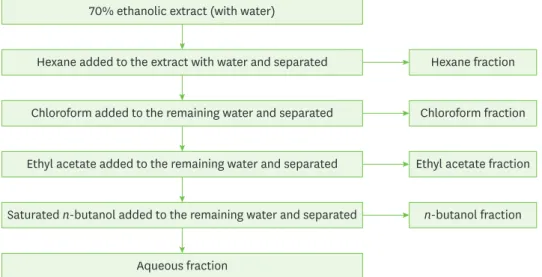
선씀바귀 추출물의 용매 분획물은
Fig. 1의순서로 순차적 용매 분획하여 제조하였다
[13].순
차적 용매 분획은
70%에탄올 추출물
2 g을 물
200 mL에 재용해한 후 분획깔데기
(separatoryfunnel)
에 넣고 헥산
,클로로포름
,에틸아세테이트
, n-부탄올의 순서로 가하여 분획하였다
.분획 후 남은 물층을 포함하여
5개의 분획물은 감압농축 후
DMSO에 재용해하여 시료로 사
용하였다
.각 용매별 수율은 에틸아세테이트
3.85%, n-부탄올
14.5%,헥산
13.5%,클로로포 름
15.7%,물
51.5%로 확인되었다
.총페놀
(total phenol compounds content)
과플라보노이드(total flavonoid compounds content)
함량측정총 페놀 함량 측정은
Folin과
Denis [14]의 방법에 따라 분석하였다
.추출물
500 µL (100 µg/mL)을
2 N Folin-Ciocalteu시약
50 µL와
3분간 혼합하였고
sodium carbonate anhydrous용액
100 µL를 넣었다
. 1시간 후
,흡광도는
multi-plate reader (Biotek, Winooski, VT, USA)를 사용하여
725 nm
에서 측정하였다
.총 플라보노이드 함량은
Pourmorad등
[15]의 염화알루미늄 비색법
을 약간 수정하여 진행하였다
.각 추출물
(100 µg/mL) 150 µL를
10%알루미늄 염화물 용액
10µL, 1 M
아세트산 칼륨 용액
10 µL및 증류수
280 µL와 혼합하였다
.혼합물을 실온에서
30분
동안 반응시키고
multi-plate reader를 사용하여
415 nm에서 흡광도를 측정하였다
.선씀바귀
Hexane fraction Chloroform fraction Ethyl acetate fraction
n-butanol fraction 70% ethanolic extract (with water)
Hexane added to the extract with water and separated Chloroform added to the remaining water and separated Ethyl acetate added to the remaining water and separated Saturated n-butanol added to the remaining water and separated
Aqueous fraction
Fig. 1. Schematic diagram for the preparation of solvent fractions from 70% ethanolic extract of Ixeris strigosa.
추출물의 총 페놀 함량은
galic acid의 용량
(mg GAE/g)으로 총 플라보노이드 함량은
catechin acid의 용량
(mg CAE/g)으로 표시하였다
.2,2 ′-azino-bis-3-ethylbenzothiazoline-6-sulfonic acid (ABTS
+)
라디칼소거측정
ABTS
라디칼 소거능은
Re등
[16]의 방법을 변형하여 측정하였다
.증류수에
7.4 mM ABTS암
모늄염과
2.6 mM칼륨과 황산염을 함유한
ABTS (Sigma Chemical Co., St. Louis, MO, USA)용 액을 준비하였다
.선씀바귀 추출물 시료
20 µL와
ABTS용액
180 µL를 섞어 실온으로 암실에 서
30분간 배양하였다
.흡광도는
734 nm에서
multi-plate reader를 사용하여 측정하였으며 대 조군으로 에탄올을 첨가하였고 양성대조군으로
ascorbic acid (AA; Sigma-Aldrich)를 사용하 여 비교
,산출하였다
.소거 효과는 다음 식에 따라 계산되었다
.반
-최대 억제 농도
(IC50)는
50%
억제를 나타내는 샘플 농도의
ABTS+라디칼 소거 활성을 결정하였다
.1,1-diphenyl-2-picrylhydrazyl (DPPH)
라디칼소거능측정DPPH
라디칼 소거능 검정 방법
[17]을 약간 변형하여 사용하였다
. 95%에탄올에
DPPH 300µM
을 함유한
DPPH용액을 제조하였다
.다음으로 시료
50 µL와
DPPH용액
200 µL를 섞어
실온에서 알루미늄 호일로 덮어 암실에서
30분간 두었다
.흡광도는
517 nm에서
multi-platereader
를 사용하여 측정하였으며 대조군에는 에탄올을 첨가하였으며
, AA를 양성대조군으
로 사용하였다
.소거 효과는 다음 식에 따라 계산되었으며
50%억제를 나타내는
IC50로 추출 물의 자유 라디칼 소거 활성을 비교하였다
.α-glucosidase
및α-amylase
의억제활성측정선씀바귀 추출물의 소화효소 활성 억제효과를 평가하기 위하여
α-glucosidase및
α-amylase활 성 비색 분석 키트
(BioVision K938, K482; BioVision, Milpitas, CA, USA)를 이용하여 측정하였 다
. α-glucosidase활성은
10 μL α-glucosidase를 각
well에 첨가하고
,분석 완충액을 총 부피
60 μL/well로 첨가하였다
. 20 μL의
α-glucosidase기질 혼합물을 각
well에 첨가하고
, 410 nm에서
1시간 동안 흡광도를 판독하였다
. α-아밀라아제 활성은 분석을 위해
, acarbose (1,000 μg/mL)를
96-well plate에 첨가하고 희석된 샘플
50 μL을 각각의
well에 첨가하고
, 50 μL의
α-amylase를 넣고 빛을 차단하여 상온에
10분간 활성화시켰다
. 50 μL의 기질 혼합물을 넣고
, 20분간 흡
광도
410 nm에서 판독하였다
.시료와 양성 대조군인
acarbose는
1,000 μg/mL의 농도로 사용
하였다
.ABTS 라디칼 소거능 (%) = �1 − 시료흡광도
대조구흡광도� × 100
전자공여능 (%) = �1 − 시료흡광도
대조구흡광도� × 100
α − glucosidase 및 α − amylase 저해율 (%) = 1 − �시료처리구의 흡광도
대조구의 흡광도 � × 100 α-glucosidase
및
α-amylase통계처리
모든 실험은
3회 반복 실시하였으며
,평균
(mean) ±표준편차
(standard deviation)로 표기하 였다
.실험결과는
SPSS package를 이용하여 분산분석 검정을 수행하였으며
,각 처리군 간의 유의성 검정은
Duncan's multiple range test로
p < 0.05수준에서 실시하였다
.상관관계 분석 은
SPSS (version 21; IBM Inc., Armonk, NY, USA)를 이용하여
Pearson's correlation coefficient로 실시하였다
.결과
수율
,
총폴리페놀및총플라보노이드함량선씀바귀 추출물의 총 페놀 함량은
gallic acid를 기준물질로
,총 플라보노이드 함량은
(+) −catechin
을 기준물질로 측정하였다
.선씀바귀에 함유되어 있는
ISW와
ISE의 총 페놀 함량은
각각
3.18 mg GAE/g, 27.46 mg GAE/g으로
ISE가
ISW보다
9배 정도 많았다
.선씀바귀 추출물의 플라보노이드 함량도 각각
0.19 mg CAE/g, 3.89 mg CAE/g로
ISE가
ISW보다
20배 정도 높게 나 타났다
(Table 1).추출방법에 따른 선씀바귀의
ISW와
ISE수율은 각각
35.4%와
34.3%로 두 용 매 간에 유의적인 차이는 없었다
.라디칼소거활성
선씀바귀 추출물의 항산화 효과를 알아보기 위하여
DPPH라디칼 소거 활성과
ABTS+라디칼
소거 활성을 비교한 결과는
Table 1과 같다
.항산화제로 잘 알려진
AA을 양성 대조군으로 하
여 분석한 결과 대조구인
AA의
DPPH IC50값은
5.91 µg/mL이었으며
, ISW와
ISE의
DPPH IC50값 은 각각
2,099 µg/mL, 96.3 µg/mL로 나타났다
(p < 0.05). ABTS+소거활성을 비교한
IC50값은 대 조구인
AA가
4.36 µg/mL, ISW는
543.3 µg/mL, ISE는
22.79 µg/mL로
ISE가
ISW보다 소거활성이 강한 것으로 나타났다
(p < 0.05).α-glucosidase
및α-amylase
저해효과선씀바귀 추출물의
α-glucosidase와
α-amylase활성저해 효과를 측정한 결과는
Table 2에서 보
는 바와 같다
.양성대조군인
acarbose 1 mg/mL과 비교하였을 때
acarbose는
99%억제효과를 보였으며
ISW 1 mg/mL는
39%억제하였고
ISE 1 mg/mL는
75%의
α-glucosidase저해 활성을
나타냈다
.선씀바귀 추출물의
α-amylase활성저해 효과 역시
ISE가
74%억제효과를 보인 반
면
ISW는
13%의 저해효과를 보였다
. ISE의 소화효소 저해 활성이
ISW보다 우수함을 확인하
고
, ISE에 있는 소화효소 저해능을 가지는 물질들의 특성을 파악하기 위해
ISE의 용매 분획물
을 제조하여 이후 실험을 진행하였다
.Table 1. Antioxidant activity of Astragalus membranaceus Ixeris strigosa extract
Sample TPC (mg GAE/g) TFC (mg CAE/g) ABTS DPPH
IC50 value (μg/mL)
Ascorbic acid 4.30 ± 0.30 5.90 ± 0.10
ISW 8.98 ± 0.00 0.53 ± 0.00 543.26 ± 12.80 2,099.30 ± 83.90
ISE 80.07 ± 0.70 11.36 ± 0.10 22.79 ± 1.30 96.63 ± 1.10
All data are presented as the means ± SD of triplicate determinations.
ISW, Ixeris strigosa water extracts; ISE, Ixeris strigosa 70% ethanol extracts; TPC, total phenol compounds content; GAE, gallic acid equivalents; TFC, total flavonoid compounds content; CAE, catechin acid equivalents;
ABTS, 2,2′-azino-bis-3-ethylbenzothiazoline-6-sulfonic acid; DPPH, 1,1-diphenyl-2-picrylhydrazyl.
ISE
계통분획물
1 mg/mL의
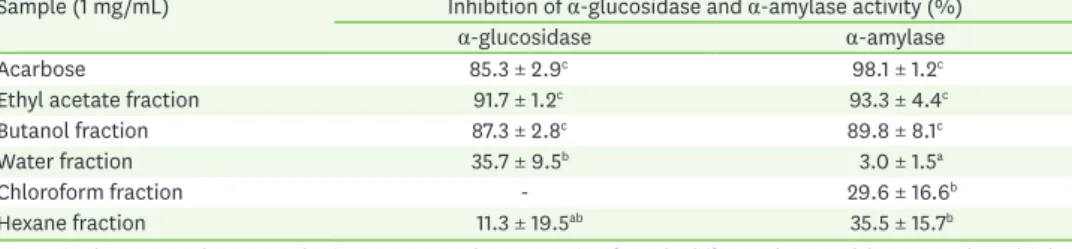
α-glucosidase저해 활성은
Table 3과 같이 나타났다
.에틸아세테 이트 분획물에서
90.56%로 가장 높았고 그 다음은 부탄올
88.67%,물
28.30%순으로 나타나 대표적인
α-glucosidase저해제인
acarbose가 나타내는 활성
(85%)보다 높게 나타났다
. ISE계 통분획물의
α-amylase저해 활성은 에틸아세테이트 분획물에서
93.31%로 가장 높았고 그 다 음은 부탄올
89.86%,헥산
35.52%,클로로포름
29.66%,물
3.02%순으로 나타났다
(Table 3).ISE
용매 분획물의 소화효소 저해 활성 실험에서 에틸아세테이트 분획물과 부탄올 분획물이 활성이 높은 것으로 보아
,선씀바귀의 페놀 화합물들이 소화효소 저해에 결정적인 역할을 하 는 것으로 판단할 수 있었다
.상관관계
선씀바귀 추출물의 폴리페놀 및 플라보노이드 함량
,항산화와
α-glucosidase저해 활성 및
α-amylase
저해 활성 간의 상관관계가 있는지를 검토해 보았다
. DPPH와
ABTS+는
IC50값으
로 상관관계를 분석하였다
.선씀바귀 추출물의 항산화 활성 및 소화효소 저해 활성 간의 상
관관계를 분석한 결과
Table 4와 같이 나타났다
.먼저 폴리페놀
1.000 (p < 0.01),플라보노이
드
−1.000 (p < 0.01)와
α-amylase −1.000 (p < 0.01)저해 활성이 가장 높은 상관관계를 나타내
었다
. α-glucosidase저해 활성과 폴리페놀과 플라보노이드 함량
, DPPH, ABTS라디칼 소거능
Table 3. Inhibitory activity of fractions from Ixeris strigosa extract on α-glucosidase and α-amylase Sample (1 mg/mL) Inhibition of α-glucosidase and α-amylase activity (%)
α-glucosidase α-amylase
Acarbose 85.3 ± 2.9c 98.1 ± 1.2c
Ethyl acetate fraction 91.7 ± 1.2c 93.3 ± 4.4c
Butanol fraction 87.3 ± 2.8c 89.8 ± 8.1c
Water fraction 35.7 ± 9.5b 3.0 ± 1.5a
Chloroform fraction - 29.6 ± 16.6b
Hexane fraction 11.3 ± 19.5ab 35.5 ± 15.7b
Means in the same column not sharing a common letter are significantly different (p < 0.05) by Duncan's multiple range test.
Table 4. Correlation among factors affecting of antioxidant components and effects
Factors1) TPC (mg GAE/g) TFC (mg CAE/g) ABTS (IC50 value) DPPH (IC50 value) α-glucosidase α-amylase
TPC (mg GAE/g) 1.000 1.000** −1.000** −0.999** 0.916* 0.916**
TFC (mg CAE/g) 1.000 −1.000** −0.999** 0.914* 0.917**
ABTS (IC50 value) 1.000 0.998** −0.908* −0.976**
DPPH (IC50 value) 1.000 −0.932** −0.975**
α-glucosidase 1.000 0.887*
α-amylase 1.000
TPC, total phenol compounds content; TFC, total flavonoid compounds content; ABTS, 2,2′-azino-bis-3-ethylbenzothiazoline-6-sulfonic acid; DPPH, 1,1-diphenyl- 2-picrylhydrazyl.
1)Total contents of phenolic acid; ABTS and DPPH was analyzed by IC50 value; Inhibition of α-glucosidase and α-amylase activity.
Significance was determined using SPSS by Pearson's correlation coefficient: *p < 0.05; **p < 0.01.
Table 2. Measurement of α-glucosidase and α-amylase inhibitory activities
Sample (1 mg/mL) Inhibition of α-glucosidase, α-amylase activity1) (%)
α-glucosidase α-amylase
Acarbose 89.6 ± 1.7b 99.0 ± 1.3c
ISW 39.2 ± 14.3a 13.5 ± 0.6a
ISE 78.1 ± 3.9b 74.5 ± 11.6b
Values are means of triplicate determinations ± SD. Means with different letters on the same column are significantly different at p < 0.05 by Duncan's multiple range test.
ISW, Ixeris strigosa water extracts; ISE, Ixeris strigosa 70% ethanol extracts.
1)α-glucosidase, α-amylase inhibition activity (%) of Ixeris strigosa extract and acarbose was measured at 1 mg/mL.
IC50
값은 각각
0.946 (p < 0.01), −0.946 (p < 0.01), 0.950 (p < 0.01), 0.950 (p < 0.01)로 높은 상관 관계를 나타내었다
.결과적으로 선씀바귀 추출물은 항산화 활성과 소화효소 저해 활성 간에 모두 높은 상관관계를 나타내었다
(p < 0.01).다시 말해
,선씀바귀의 페놀 화합물
,특히 플라 보노이드 화합물들이 항산화 및 소화효소 저해 활성이 뛰어나
, ISE가
ISW에 비해 높은 항산 화 활성 및 소화효소 저해능을 갖는데 결정적인 역할을 하는 것으로 판단된다
.고찰
당뇨병은 대사 장애로 식후 혈당 수준의 비정상적인 증가를 특징으로 한다
[18].음식 섭취 후 혈당 수준을 효과적으로 제어하기 위하여 천연 공급원으로부터 얻은
acarbose및
voglibose등이 당뇨병의 치료에 임상적으로 사용되어왔다
[19].그러나 위장관련 부작용으로 인한 약 물의 안전성 문제가 제기되고 있어 치료의 효과를 높이고 부작용이 없는 천연물을 이용한 대
안적 소재들을 찾아야 한다
[20].따라서 본 논문에서는 천연물 소재인 선씀바귀를 이용하여
항당뇨를 위한 탄수화물 소화효소 억제 효과를 검증하였다
.당뇨에 의한 합병증 발병 및 악화 요인 중 하나로 고혈당증에 의한 활성산소종
(reactive oxy-gen species)
생성이 있다
.이는 산화적 스트레스 발생에 의한 자유 라디칼
(free radical)의 과
다한 생성과 항산화 방어체계의 활성 저하가 원인이 된다
[21].식물의
2차 대사 산물인 폴리 페놀계 물질 중 플라보노이드는 가장 널리 분포되어 있는 페놀화합물로 항산화
,항균
,항염 증
,항 알레르기 및 항암 등 다양한 생물학적 효과를 나타내며
,자유 라디칼 소거와 산화방지 효과에서 천연 항산화제로 작용한다
[22].본 연구에서 선씀바귀 추출물에 함유되어 있는 총 페놀 함량은
ISE가
ISW보다
10배 정도 많았다
.선씀바귀 추출물의 플라보노이드 함량도
ISE가
ISW보다
20배 이상 높게 나타났다
.이 실험의 결과는 추출방법에 따라 총 폴리페놀 함량
과 성분에 차이가 난다는
[23]의 보고와 유사한 결과를 보였다
.선씀바귀 추출물은 씀바귀 에
탄올 추출물의 총 페놀 함량보다
20배가 높았고 플라보노이드 함량은
10배 더 높았다
[24].그
리고 흰 씀바귀 뿌리보다 총 페놀 함량이 더 높게 나타나
[25]다른 씀바귀 종류들과 비교했을
때 총 페놀 함량과 플라보노이드 함량은 높게 나타났다
.DPPH
라디칼 소거활성은 페놀화합물의 항산화 활성 지표가 되며
,자유 라디칼은 환원 능력
이 클수록 항산화 활성 및 활성 산소에 대한 소거활성을 기대할 수 있다
[26].본 연구에서 선
씀바귀 추출물의 항산화 효과를 알아보기 위하여
DPPH라디칼 소거 활성과
ABTS+라디칼 소
거 활성을 비교한 결과 양성대조군으로 사용된
AA보다는 낮은 항산화 활성이지만
ISW보다
ISE의 항산화력이
20배 이상 높은 것으로 조사되었다
. Kang등
[27], Shin과
Lee [28]는 에탄올 추출물이 물과 유기용매의 적절한 혼합에 의해 페놀성 화합물의 용출이 많고 이들 페놀 화합
물이
DPPH라디칼 소거활성을 높이는데 영향을 미친다고 하였다
.페놀성 화합물의 농도가
높을수록 자유 라디칼의 소거능이 높아지며 유기용매가 혼합되어 있는 경우 페놀성 물질의 용출이 더 용이하다는 이상의 결과들로 미루어 볼 때 본 연구에서도 페놀 화합물이
DPPH라 디칼 소거활성을 높이는데 영향을 미친 것으로 판단된다
.탄수화물 섭취 후
α-amylase및
α-glucosidase등의 소화효소 활성 억제는 혈당의 증가를 감소시
키거나 혈당 상승을 지연하는 효과가 있어
II형 당뇨병과 관련된 고혈당증의 관리에 필수 전략
으로 여겨진다
[29].선씀바귀 추출물의
α-glucosidase활성저해 효과를 측정한 결과
Fig. 2에서 와같이 양성대조군인
acarbose와 비교하였을 때
acarbose는
89%억제효과를 보였으며
ISW는
39%억제하였고
ISE는
78%의
α-glucosidase저해 활성을 나타냈다
. Jeong등
[30]의 약용식
물의 항당뇨 활성 연구에서 상엽
70%에탄올 추출물이
acarbose보다 높은
α-glucosidase저해
활성을 보여 혈당강하 물질로 기대할 수 있다고 보고한 바
,본 연구의
ISE는
acarbose보다는
낮았으나
α-glucosidase저해 활성이 우수함을 확인할 수 있었다
. Kim등
[31]은 쓴메밀 물 추
출물과
70%에탄올 추출물의
α-glucosidase활성을 측정한 결과
70%에탄올 추출물에서는 농
도 의존적으로 저해 활성이 높아지는 경향을 보였으나
,물 추출물에서는 저해 활성이 없다 고 하였는데 본 연구의 결과와 비슷한 경향이었다
. Lee등
[32]의 벌개미취 추출물의
α-gluco-sidase
저해능은 용매의 에탄올 함량이 높을수록 커지는 경향이 나타났다고 하였다
.선씀바
귀 추출물의
α- amylase활성저해 효과 역시
ISE가
75%억제효과를 보인 반면
ISW는
13%의 저 해효과를 보였다
(Fig. 3).물론
acrarbose의
99%보다는 낮았으나
ISE의
α-amylase활성저해 효
과는
acarbose와 통계적으로 유의적 차이를 보이지 않는 수준이었다
. α-amylase및
α-glucosi-dase
등의 소화효소 활성 억제효과는 추출물에 함유된 플라보노이드 함량과 관계가 있는 것
으로 보아진다
.즉
, quercetin과
luteolin이
α-glucosidase와
α-amylase를 가역적으로 느리게 결
Inhibition rate (%)
0 100
40 80
60
20
b
Acarbose EtOAC BuOH W CHCl3
ab
Hxn (1 mg/mL)
c c c
Fig. 2. Inhibitory activity of the extract and fractions from IS on α-glucosidase. The final concentration of the extract and fractions from IS and acarbose were 1.0 mg/mL. Each value is expressed as mean ± SD in triplicate experiments.
IS, Ixeris strigosa; EtOAC, ethyl acetate fraction; BuOH, butanol fraction; W, water fraction; CHCl3, chloroform fraction; Hxn, hexane fraction.
Values with different alphabets are significantly different at p < 0.05 as analyzed by Duncan's multiple range test.
Inhibition rate (%)
0 150
50 100
a
Acarbose EtOAC BuOH W CHCl3
b b
Hxn (1 mg/mL)
c c c
Fig. 3. Inhibitory activity of the extract and fractions from IS on α-amylase. The final concentration of the extract and fractions from IS and acarbose were 1.0 mg/mL. Each value is expressed as mean ± SD in triplicate experiments.
IS, Ixeris strigosa; EtOAC, ethyl acetate fraction; BuOH, butanol fraction; W, water fraction; CHCl3, chloroform fraction; Hxn, hexane fraction.
Values with different alphabets are significantly different at p < 0.05 as analyzed by Duncan's multiple range test.
합하게 하고
,비경쟁적인 저해를 하는 것으로 보고된 바 있는데
[9],선씀바귀 추출물에 함유 된 페놀성 화합물들이
α-glucosidase와
α-amylase저해 효과와 관계가 있을 것으로 판단된다
.ISW
에 비해
ISE가 소화효소 저해능이 우수하여 높은 활성 물질을 탐색하기 위하여 계통 분획
물을 제조하여 그 효과를 비교하였다
(Table 3). ISE계통분획물의
α-glucosidase저해 활성은 에틸아세테이트 분획물에서
90.56%로 가장 높았고 그 다음은 부탄올
88.67%순으로 나타나 대표적인
α-glucosidase저해제인
acarbose가 나타내는 활성
(85%)보다 높게 나타났다
. ISE계 통분획물의
α-amylase저해 활성은 에틸아세테이트 분획물에서
93.31%로 가장 높았고 그 다
음은 부탄올
89.86%순으로 나타났다
. Kim등
[33]의 오가나무 잎과 줄기의 항당뇨 활성연구
에서 줄기의 아세테이트 분획물이 가장 우수한
α-glucosidase효소 억제 효과를 나타내었다 고 보고된 바 있다
(IC50 = 155.32 ± 4.07 µg/mL). α-glucosidase활성을 억제하기 위해 사용되는 약물에는
voglibose, acarbose및
miglitol이 있다
.그러나 복부 팽창
,헛배부름
,설사 및 폐렴과 같은 부작용이 보고되어 효과적이고 안전한 억제제를 찾기 위해 많은 노력이 기울여져 왔다
[34]. α-glucosidase inhibitor
작용기전은 소장에서 이당류를 단당류로 분해하여 탄수화물 소
화 및 흡수를 저해함으로써 식후 혈당을 감소시키며
,항당뇨 기능성 천연물은 기존 약물들이 갖고 있는 저혈당 현상
,간 독성유발
,베타세포 기능 저하 등의 부작용을 최소화할 수 있는 장
점을 가지고 있다
[35]. ISE의 에틸아세테이트 분획물이 대표적인 당뇨병 치료제인
acarbose가 나타내는 억제효과보다 높게 나타남에 따라 에틸아세테이트와 부탄올 분획물을 활용한 혈당강하 기능성제품 개발의 근거가 될 것으로 판단된다
.뿐만 아니라 앞으로 이와 관련한 추가적 연구 및 구체적인 성분 분석이 이루어져야 할 것이다
.선씀바귀 추출물의 폴리페놀 및 플라보노이드 함량
,항산화와
α-glucosidase저해 활성 및
α-amylase
저해 활성 간의 상관관계가 있는지를 검토해 보았다
.그 결과 폴리페놀은 플라보
노이드
(1.00)와
α-glucosidase (0.916)및
α-amylase (0.916)저해 활성이 강한 양의 상관관계를 보였다
.플라보노이드는
α-glucosidase (0.914)및
α-amylase (0.917)저해 활성에서 강한 양의 상관관계를 나타내었다
.그 외 항산화 활성과도 높은 상관관계가 나타났다
.폴리페놀과 플 라보노이드 함량과
α-glucosidase와
α-amylase저해 활성의 상관관계가 높은 것으로 나타나
관련이 있는 것으로 보인다
. Kim등
[36]의 팔리다자주닭개비 잎 추출물 및 분획물의 항산
화 및
α-glucosidase저해 활성 연구에서도 플라보노이드 함량은
DPPH라디칼 소거활성 및
α-glucosidase
저해 활성과 양의 상관관계를 나타내었고
, Agunloye와
Oboh [9]의 플라보노이
드에 의한
α-glucosidase및
α-amylase의 억제 효과에 관한 연구 보고와
Proença등
[37]의 플라 보노이드에 의한
α-glucosidase억제효과에 관한 연구에서도 상관관계가 있는 것으로 나타 났다
.따라서 이러한 결과를 종합하여 보면
ISE의 폴리페놀
,특히 플라보노이드 함량이 높아
ISW
에 비해 항산화 및 소화효소 저해 활성이 뛰어난 성분들을 많이 함유하고 있는 것으로 판
단된다
.향후 구체적인 성분 분석과 과학적 효능 규명으로 선씀바귀 성분과 소화효소 억제 작용 기전의 유의적 관계 등에 대한 연구가 더 진행되어야 할 것이다
.요약
본 연구는 선씀바귀의 항산화 및 탄수화물 소화효소 억제 효과를 평가하여 제
2형 당뇨환자
에게 중요한 항산화제 및 혈당 상승 억제제로서의 가능성을 타진하고자 하였다
.선씀바귀 추
출물의 총 폴리페놀
,플라보노이드 함량과
in vitro항산화 활성 및 소화효소 저해 활성을 조사 한 결과
ISE가
ISW보다 총페놀과 플라보노이드 함량이 높았고 항산화 활성 및 소화효소 저
해 활성 또한 높았다
. ISE의 계통분획물 중에 에틸아세테이트 분획물과 부탄올 분획물의 소
화효소 저해 활성이 가장 우수하고
,추출물의 항산화활성과 탄수화물 소화효소 억제효과가 총 페놀 및 플라보노이드함량과 높은 상관성을 가지는 것으로 볼 때
, ISW에 비해 상대적으로 높은
ISE의 항산화 및 소화효소 저해 활성은 페놀 화합물
,특히 플라보노이드 화합물 때문임 을 알 수 있었다
.따라서
ISE와 에틸아세테이트 그리고 부탄올 분획물은 우수한 항당뇨 기능 성 소재라고 판단된다
.REFERENCES
1. International Diabetes Federation. IDF diabetes atlas, 9th edition [Internet]. Brussels: IDF; 2019 [cited 2020 Feb 11]. Available from: www.diabetesatlas.org.
2. Ministry for Health Welfare (KR). The Seventh Korea National Health and Nutrition Examination Survey.
Sejong: Ministry for Health Welfare; 2018.
3. Salimifar M, Fatehi-Hassanabad Z, Fatehi M. A review on natural products for controlling type 2 diabetes with an emphasis on their mechanisms of actions. Curr Diabetes Rev 2013; 9(5): 402-411.
PUBMED | CROSSREF
4. Derosa G, Maffioli P. α-Glucosidase inhibitors and their use in clinical practice. Arch Med Sci 2012; 8(5):
899-906.
PUBMED | CROSSREF
5. Tan Y, Chang SK, Zhang Y. Comparison of α-amylase, α-glucosidase and lipase inhibitory activity of the phenolic substances in two black legumes of different genera. Food Chem 2017; 214: 259-268.
PUBMED | CROSSREF
6. Dileep KV, Nithiyanandan K, Remya C. Binding of acarbose, an anti-diabetic drug to lysozyme: a combined structural and thermodynamic study. J Biomol Struct Dyn 2018; 36(13): 3354-3361.
PUBMED | CROSSREF
7. Shin SM, Jeong YJ, Park DW, Ko H, Kim GT, Kim EH, et al. Screening for anti-diabetic effects of prescribed Korean traditional medicines. Korean J Plant Res 2012; 25(6): 670-681.
8. Kim NS, Choi BK, Lee SH, Jang HH, Kim JB, Kim HR, et al. Effects of allium hookeri on glucose metabolism in type II diabetic mice. Korean J Pharmacogn 2015; 46(1): 78-83.
9. Agunloye OM, Oboh G. Caffeic acid and chlorogenic acid: evaluation of antioxidant effect and inhibition of key enzymes linked with hypertension. J Food Biochem 2018; 42(4): e12541.
CROSSREF
10. Wan JX, Lim G, Lee J, Sun XB, Gao DY, Si YX, et al. Inhibitory effect of phloroglucinol on α-glucosidase:
kinetics and molecular dynamics simulation integration study. Int J Biol Macromol 2019; 124(1): 771-779.
PUBMED | CROSSREF
11. Tadera K, Minami Y, Takamatsu K, Matsuoka T. Inhibition of α-glucosidase and α-amylase by flavonoids.
J Nutr Sci Vitaminol (Tokyo) 2006; 52(2): 149-153.
PUBMED | CROSSREF
12. Kim M. Antioxidant activity of ethanol extract of Ixeris chinensis [master's thesis]. Anseong: Hankyong National University; 2008.
13. Jeon SM, Lee JY, Kim HW, Lee YM, Jang HH, Hwang KA, et al. Antioxidant activity of extracts and fractions from Aster scaber. J Korean Soc Food Sci Nutr 2012; 41(9): 1197-1204.
CROSSREF
14. Folin O, Denis W. On phosphotungstic-phosphomolybdic compounds as color reagents. J Biol Chem 1912; 12: 239-243.
15. Pourmorad F, Hosseinimehr SJ, Shahabimajd N. Antioxidant activity, phenol and flavonoid contents of some selected Iranian medicinal plants. Afr J Biotechnol 2006; 5(11): 1142-1145.
16. Re R, Pellegrini N, Proteggente A, Pannala A, Yang M, Rice-Evans C. Antioxidant activity applying an improved ABTS radical cation decolorization assay. Free Radic Biol Med 1999; 26(9-10): 1231-1237.
PUBMED | CROSSREF
17. Kim JM, Kim DJ, Kim TH, Kim HS, Choe M. Anti-oxidative and anti-inflammatory effect of water extract from Perillae semen in RBL-2H3 cells. Korean J Nutr 2010; 43(4): 367-373.
CROSSREF
18. Oh IH, Yoon SJ, Kim EJ. The burden of disease in Korea. J Korean Med Assoc 2011; 54(6): 646-652.
PUBMED | CROSSREF
19. Jeong IK, Min YK, Lee MK, Chung YE, Hong SK, Chung JH, et al. Comparative study about the effects of acarbose and voglibose in type 2 diabetic patients. J Korean Diabetes Assoc 2002; 26(2): 134-145.
20. Kwon TO, Choi JW, Lee HS, Cho BO, Yin HH, Jang SI. Anti-diabetic effects of mori folium extract on high- eat diet and streptozotocin-induced type II diabetes mellitus in mice. Korean J Herbol 2015; 30(1): 1-9.
CROSSREF
21. Giacco F, Brownlee M. Oxidative stress and diabetic complications. Circ Res 2010; 107(9): 1058-1070.
PUBMED | CROSSREF
22. Blois MS. Antioxidant determination by the use of a stable free radical. Nature 1958; 181: 1199-1200.
CROSSREF
23. Scalbert A, Johnson IT, Saltmarsh M. Polyphenols: antioxidants and beyond. Am J Clin Nutr 2005; 81(1 Suppl): 215S-217S.
PUBMED | CROSSREF
24. Park SJ. Antioxidant and anti-adipogenic effects of ethanolic extracts from Ixeris dentata Nakai. Korean J Culinary Res 2014; 20(1): 133-142.
25. Hong S, Jeong D, Kim K, Hwang E. The composition of the root of Ixeris dentata var. albiflora Nakai and cell viability and DPPH radical scavenging activities of its extract. Korean J Nutr 2010; 43(2): 105-113.
CROSSREF
26. Park HJ, Kang SA, Lee JY, Cho YJ. Antioxidant activities of extracts from medicinal plants. Korean J Food Preserv 2012; 19(5): 744-750.
CROSSREF
27. Kang MH, An SM, Kim DH. Physicochemical properties of dried Saururus chinensis and the antioxidative activities of water and 70% ethanol extracts. J Nutr Health 2019; 52(4): 399-407.
CROSSREF
28. Shin SL, Lee CH. Antioxidant activities of ostrich fern by different extraction methods and solvents. J Life Sci 2011; 21(1): 56-61.
CROSSREF
29. Chipiti T, Ibrahim MA, Singh M, Islam MS. In vitro α-amylase and α-glucosidase inhibitory and cytotoxic activities of extracts from Cissus cornifolia planch parts. Pharmacogn Mag 2017; 13(2 Suppl 2): S329-S333.
PUBMED
30. Jeong HJ, Lee SG, Lee EJ, Park WD, Kim JB, Kim HJ. Antioxidant activity and anti-hyperglycemic activity of medicinal herbal extracts according to extraction methods. Korean J Food Sci Technol 2010; 42(5): 571-577.
31. Kim JE, Joo SI, Seo JH, Lee SP. Antioxidant and α-glucosidase inhibitory effect of tartary buckwheat extract obtained by the treatment of different solvents and enzymes. J Korean Soc Food Sci Nutr 2009;
38(8): 989-995.
CROSSREF
32. Lee YM, Kim IS, Kim JG, Park SH, Lim BO. Antioxidative, anti-inflammatory, and DNA damage orotective effect in cortex extracts of Eucommia ulmoides by roasting. Korean J Med Crop Sci 2019; 27(4): 259-270.
CROSSREF
33. Kim SJ, Kim JA, Kim S, Youn JU, Kim SH, Han SS, et al. Antioxidant and antidiabetic effects of leaves and stems of Acanthopanax sieboldianum (Makino) Koidz. Korean J Pharmacogn 2019; 50(2): 141-147.
34. Joshi SR, Standl E, Tong N, Shah P, Kalra S, Rathod R. Therapeutic potential of α-glucosidase inhibitors in type 2 diabetes mellitus: an evidence-based review. Expert Opin Pharmacother 2015; 16(13): 1959-1981.
PUBMED | CROSSREF
35. Choi HJ, Jeong YK, Kang DO, Joo WH. Inhibitory effects of four solvent fractions of Alnus firma on α-amylase and α-glucosidase. J Life Sci 2008; 18(7): 1005-1010.
CROSSREF
36. Kim JS, Kim KC. Antioxidant and α-glucosidase inhibitory activities of Tradescantia pallida (Rose) hunt leaf extract and fractions. Korean J Med Crop Sci 2016; 24(3): 222-227.
CROSSREF
37. Proença C, Freitas M, Ribeiro D, Oliveira EF, Sousa JL, Tomé SM, et al. α-Glucosidase inhibition by flavonoids: an in vitro and in silico structure-activity relationship study. J Enzyme Inhib Med Chem 2017;
32(1): 1216-1228.
PUBMED | CROSSREF