Insecticidal Activity of Extracts Isolated from Syzygium Aromaticum
1Ji Young Jung2⋅Jae-Kyung Yang2,†
ABSTRACT
This study separated the crude extract (70% ethanol) of and its three fractions (hexane, chloroform and ethyl acetate extracts) on the basis of polarity indexes, and examined for their insecticidal activities against aphid (Uroleucon lactucicola).
For crude extraction, the 70% ethanol extract showed the best extract yield (58.0%) and insecticidal activity (69.0%) among the various concentrations tested (water, 30% ethanol, 50% ethanol, 70% ethanol and 95% ethanol). The major chemical compounds of different fractions (hexane, chloroform and ethyl acetate extracts) were identified as eugenol by head space-GC-MS analysis. The hexane extract showed the highest eugenol content (43.7%) and insecticidal activ- ity (80.0%). The insecticidal activity is accordingly believed to be attributable to the eugenol component. This may provide a useful starting point for the development of bio-pesticides.
Keywords : insecticidal activity, Syzygium aromaticum, bio-pesticides
1 Date Received February 12, 2014, Date Accepted April 3, 2014
2 Department of Environmental Materials Science, Institute of Agriculture & Life Sciences, Gyeongsang National University, Jinju, 660-701, South Korea
† Corresponding author : Jae-Kyung Yang (e-mail: [email protected])
1. INTRODUCTION
Plant-derived extracts and their bioactive con- stituents have been suggested as alternatives to the most commonly used insecticides because many plants demonstrate insecticidal activities against in- sect pests (Kim et al. 2010; Lee et al. 2010). Plant volatile compound show wide and varied bio- activities in insect, ranging from toxicity to sublethal effects, including oviposition deterrence and anti- feedant activity and attractant and repellent actions, as well as antimicrobial, antifungal and antitumor activities. Because of this, many studies have fo- cused on essential oils, plant extracts, as new sour- ces of pest control agents (Park et al. 2000, 2011).
Natural pesticides, or pesticides derived from natural products, support both crop production and the envi- ronment by being effective in pest control, less toxic to non-target organisms and biodegradable at the same time, they may be safer than synthetic pesti- cides (Tsao et al. 2002).
Plants exhibiting aphid damage can have a variety of symptoms, such as decreased growth rates, mot- tled leaves, yellowing, stunted growth, curled leaves, browning, wilting, low yields and death. Until now, five species belong to the subgenus Uroleucon (Uromelan) have been reported in the Korea: Uroleucon (Uromelan) lactucicola, Uroleucon (Uromelan) gobo- nis, Uroleucon (Uromelan). giganteum, Uroleucon (Uromelan). amamianum, and Uroleucon (Uromelan)
Cephalonopli (Matsumura 1917; Takahashi 1930;
Takahashi 1962).
The damage of plants, and in particular commer- cial crops, has resulted in large amounts of re- sources and efforts being spent attempting to control the activities of aphids. The synthetic insecticides were useful for controlling aphid. However, their re- peated use causes resistance, residual toxicity, and environmental pollution (Senthil-Nathan et al. 2009).
There are many plant extracts and plant products that are eco-friendly and control aphids as effec- tively as chemical insecticides (Senthil-Nathan et al.
2009).
Syzygium aromaticum are native to the Maluku is- lands in Indonesia and used as a spice in cuisines all over the world. In Korea, cloves have been success- fully used for asthma and various allergic disorders by oral administration (Kim et al. 1998). The activ- ity in vitro of S. aromaticum extracts was demon- strated against pathogenic bacteria (Larhsini et al.
2001; Chaieb et al. 2007) and virus (Hussein et al.
2000). Moreover, the fungicidal activity of S. ar- omaticum was also demonstrated on several fungal species (Ranasinghe et al. 2002), fungi isolated from onychomicosis (Gayoso et al. 2005), Saccharomyces cerevisiae (Chami et al. 2005), Candida species (Chaieb et al. 2007).
There is no published report in the literature about the insecticidal activity of S. aromaticum against aphid (Uroleucon lactucicola). Therefore, the ob- jective of our study was to evaluate the bio-in- secticide potential of S. aromaticum and their major active chemical components. The present study was to evaluate insecticidal activity on aphid (Uroleucon lactucicola) of various extracts (n-hexane, chloro- form, ethyl acetate and aqueous extracts) from the S.
aromaticum.
2. MATERIALS and METHODS 2.1. Raw Material
S. aromaticum was purchased from Traditional Korean Medicine Pharmacy Market in Sancheong, Korea.
The S. aromaticum was dried in an oven at 40℃
for 2 days and finely powdered using a laboratory wiley Mill. The particles that passed through a 20-mesh sieve (850 μm) but were retained by a 40-mesh (450 μm) sieve were stored in a sealed plastic bag at -72℃.
2.2. Preparation of the Crude Extracts
The dried powder of S. aromaticum (300 g) was soaked in ethanol/water in a glass jar (2 L) at room temperature for more than 2 days and then the etha- nol-water solution was decanted and filtered (Whatman No. 2) to give a crude extract. For ex- traction, water and four different concentrations (30%, 50%, 70%, and 95% by the volume) of etha- nol were used. The crude extracts (70% ethanol) were then concentrated on a rotary vacuum evapo- rator (Buchi, Switzerland) under reduced pressure at 35∼40℃, and freeze-dried. The yield of each ex- tract was calculated as follows:
Extraction Yield (%)
= (weight of dry extract/weight of raw material) × 100
2.3. Fractionation of Crude Extracts
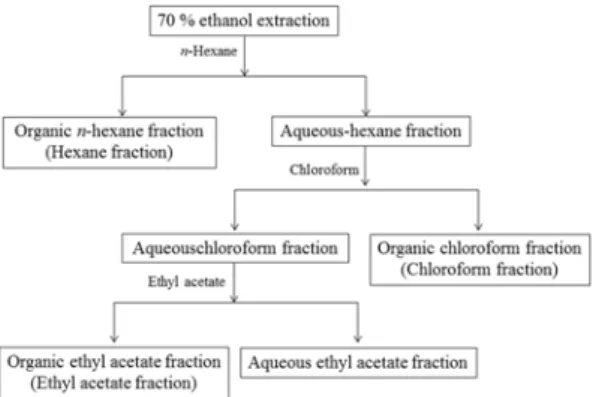
Fractionation of the crude extract (70% ethanol) was performed and respective fractions were obtained (Fig. 1) (Karawita et al. 2005). The Fractionation was sequentially divided into n-hexane, chloroform and ethyl acetate fractions for the chemical composi-
Fig. 1. Flow diagram of fractionation of S. aromaticum.
tion and bioassay. The different fractionation were concentrated using rotary vacuum evaporation at 45℃.
The different fractionations were labeled as organ- ic n-hexane fraction (hexane fractionation), organic chloroform fraction (chloroform fractionation) and organic ethyl acetate fraction (ethyl acetate fractiona- tion).
2.4. Analysis of Extracts from S. Aromaticum
The crude extract and different fractions of crude extract was analyzed (Sanz et al. 2001) by static headspace gas chromatography-mass spectrometry (headspace-GC-MS). The headspace-GC-MS analysis was performed with Clarus 600 gas chromatograph (Perkinelmer, CA, USA) equipped with a static head- space sampler (Perkinelmer, CA, USA). Ten milli- liter vials containing 2 mℓ of crude extract and dif- ferent fractions of crude extract were immediately sealed with silicone rubber Teflon caps. Each vial was equilibrated at 100℃ during 20 min in the stat- ic headspace sampler. Each vial was pressurized with carrier gas for 12 s, and 0.5 mℓ of medicinal herbs headspace sample was injected into a column DB-5MS (30 m × 0.25 mm × 0.25 μm film thick- ness; HP Agilent, USA). The injector temperature was set at 260℃, and helium (1 mℓ/min) was the
carrier gas. The initial column temperature of 35℃
was held for 5min, and then programmed at a rate of 5℃/min until reaching 280℃ and maintained at this temperature for further 10min, next programmed again at a rate of 10℃/min until reaching 300℃ and maintained at this temperature for further 14min. The mass spectrometer operated in the electron impact ionization mode (70 eV), with a scan range of 50 to 300 amu. The ion source temperature was set at 23 0℃. Identification of the constituents was performed on the basis of NIST library search. The relative amounts of individual components were calculated based on the GC peak area (FID response) without using correction factors.
2.5. Bioassay
2.5.1. Insects
Aphid (Uroleucon lactucicola) was obtained from a single strain reared for several generations on Triticumaestivum in a climatic room at 24 ± 1℃ and a photo period of 14: 10 (light: dark). The in- secticidal activity of plant extracts used was de- termined by direct contact application (Kim et al.
2003).
2.5.2. Filter Paper Contact Bioassay
The insecticidal activity was carried out for the crude extract and its various extracts against U.lactucicola. A dose of 1000 ppm of each extracts was applied to filter papers (Whatman No. 1). After drying under a fume hood for 2 min, each filter pa- per was placed in the bottom of a petri-dish (10 cm diameter × 4 cm), and then 20 adults of each test materials were placed in each petri-dish which was covered with a lid. Treated insects were held at 28 ± 1℃, 50 - 60% relative humidity, and a 16: 8 (light:
dark) photoperiod. The insecticidal activity was de- termined at 48 h after treatment. Test insects were
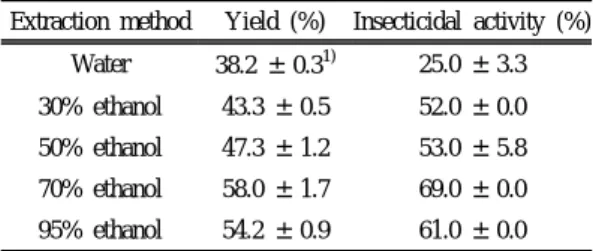
Extraction method Yield (%) Insecticidal activity (%) Water 38.2 ± 0.31) 25.0 ± 3.3 30% ethanol 43.3 ± 0.5 52.0 ± 0.0 50% ethanol 47.3 ± 1.2 53.0 ± 5.8 70% ethanol 58.0 ± 1.7 69.0 ± 0.0 95% ethanol 54.2 ± 0.9 61.0 ± 0.0
1) Values are presented as means ± SD of three measurements
Table 1. Effect of ethanol concentration on extract yield from S. aromaticum
considered dead if appendages did not move when prodded with a fine brush. Negative control was pre- pared using distilled water. Eugenol (commercial oil)was used as a positive control with the tested insect. Oils used for the determination of insecticidal activity was dissolved in Tween 80 (0.5%) and was made up as distilled water. All treatments were re- plicated three times.
2.6. Statistical Analysis
The insecticidal activity was transformed to arc- sine square-root values for analysis of variance (ANOVA). Treatment means were compared and separated by Scheffe’s test at P > 0.05 (SAS 1990).
Means (± SE) of untransformed data are reported.
3. RESULTS and DISCUSSION 3.1. Extraction Yields of Crude Extracts
Extraction is an important step for obtaining ex- tracts with acceptable yields.
The extract yield of S. aromaticum was strongly dependent on the concentration used as shown in Table 1.
The extract yield of S. aromaticum was found to be 38.2%, 43.3%, 47.3%, 58.0% and 54.2% of the starting material for the water, 30% ethanol, 50%
ethanol, 70% ethanol and 95% ethanol extracts, respectively. The yield of extract was maximized at 70% ethanol but declined considerably at higher ethanol concentrations. The insecticidal activity of the water, 30% ethanol, 50% ethanol, 70% ethanol and 95% ethanol extracts was 25.0%, 52.0%, 53.0%, 69.0%, 61.0%, respectively.
Ethanol was more effective in terms of extract yield and insecticidal activity than water, with 70%
ethanol being the most efficient extraction solvent.
These experimental results are in accordance with previous reports suggesting that a binary solvent sys- tem was superior to a mono-solvent system (water or pure ethanol) in terms of extraction yield (Chirinos et al. 2007).
Aqueous and solvent extraction is routinely used for the isolation of extractive substances from plant material. Both the extraction yield and chemical composition of extracts are strongly dependent on the extraction solvent used (Moure et al. 2001).
3.2. Chemical Composition of Crude Extracts
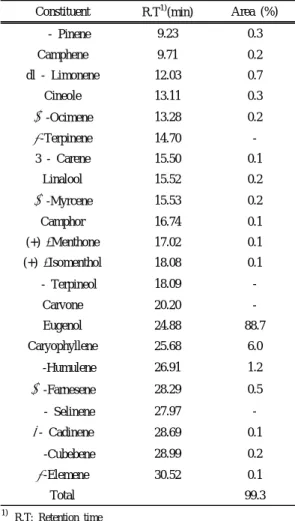
We characterized the chemical composition of crude extracts (70% ethanol extraction) of S. ar- omaticum using headspace-GC-MS. As shown in Table 2, the major chemical compounds found in ex- tracts (Table 2) were eugenol (88.7%), caryophyllene (6.0%) and α-humulene (1.2%). These data are in agreement with the results from other studies (Prashar et al. 2006). The major component of S. aromaticumis nomally considered to be eugenol, along with β-caryophyllene and lesser amounts of other compo- nents such as benzyl alcohol, however the proportions vary widely. For example, Prashar et al. (2006) found the content of eugenoland β-caryophylleneto be 78% and 13%, whereas Pawar and Thaker (2006) found that the content of eugenol was 47.64%, and
Constituent R.T1)(min) Area (%)
α- Pinene 9.23 0.3
Camphene 9.71 0.2
dl - Limonene 12.03 0.7
Cineole 13.11 0.3
β-Ocimene 13.28 0.2
γ-Terpinene 14.70 -
3 - Carene 15.50 0.1
Linalool 15.52 0.2
β-Myrcene 15.53 0.2
Camphor 16.74 0.1
(+) –Menthone 17.02 0.1
(+) –Isomenthol 18.08 0.1
α- Terpineol 18.09 -
Carvone 20.20 -
Eugenol 24.88 88.7
Caryophyllene 25.68 6.0
α-Humulene 26.91 1.2
β-Farnesene 28.29 0.5
α- Selinene 27.97 -
δ- Cadinene 28.69 0.1
α-Cubebene 28.99 0.2
γ-Elemene 30.52 0.1
Total 99.3
1) R.T: Retention time 2) Not detected.
Table 2. Chemical composition of crude extract from S. aromaticum
that of benzyl alcohol at 34.10%. Eugenol is used as an aromatic agent for food, and as a fragrance in the cosmetic industry, and it is also commonly used in dentistry for sedation of toothache, pulpitis, and den- tal hyperalgesia (Chaieb et al. 2007). Several bio- logical actions of eugenol have previously been re- ported, namely antibacterial (Shokeen et al. 2008), and antifungal (Gayoso et al. 2005) activities.
3.3. Chemical Composition of Various Extracts
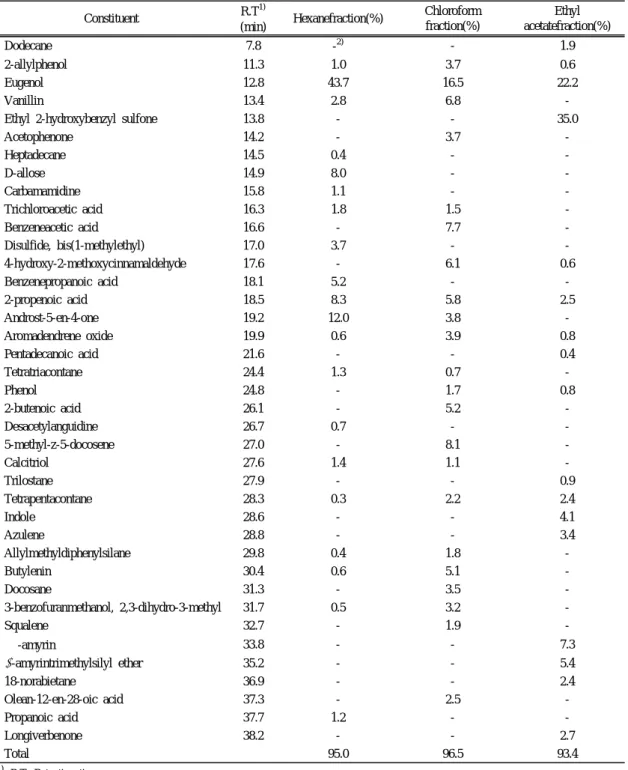
The detailed chemical compositions of the various extracts are presented in Table 3. The main chemical compounds found in the hexane fraction of S. ar- omaticum were eugenol (43.7%), androst-5-en-4-one (12.0%), 2-propenoic acid (8.3%), D-allose (8.0%), benzenepropanoic acid (5.2%), disulfide, bis (1-methylethyl) (3.7%) and vanillin (2.8%). The main compounds identified in the chloroform frac- tion were eugenol (16.5%), 5-methyl-z-5-docosene (8.1%), benzeneacetic acid (7.7%), vanillin (6.8%), 4-hydroxy-2- methoxycinnamaldehyde (6.1%), 2-prope- noic acid (5.8%) and2-butenoic acid (5.2%), whereas the major chemical compounds found in the ethyl acetate fraction were ethyl 2-hydroxybenzyl sulfone (35.0%), eugenol (22.2%), α-amyrin (7.3%), β-amyrin trimethylsilyl ether (5.4%) and indole (4.1%).
Among the various extracts, the hexane fraction had highest eugenol contents.
D-allose (Gaoet al. 2011), vanillin (Makniet al.
2011), 4-hydroxy-2-methoxycinnamaldehyde (stepan et al. 2008) and α-amyrin (Rajic et al. 2000) have been reported as active components contributing to anti-inflammatory and anti- fungal activities.
3.4. Insecticidal Activity Against U.
Lactucicola Treated with Various Extracts using a Filter Paper Contact Bioassay
The insecticidal activity of S. aromaticum differed widely among the various extracts Table 4. Among the various extracts, the hexane fraction showed the highest insecticidal activity (80%). The insecticidal activity of chloroform fraction and ethyl acetate frac- tion was 57% and 63 = %, respectively. Significant differences were observed in the insecticidal activity
Constituent R.T1)
(min) Hexanefraction(%) Chloroform fraction(%)
Ethyl acetatefraction(%)
Dodecane 7.8 -2) - 1.9
2-allylphenol 11.3 1.0 3.7 0.6
Eugenol 12.8 43.7 16.5 22.2
Vanillin 13.4 2.8 6.8 -
Ethyl 2-hydroxybenzyl sulfone 13.8 - - 35.0
Acetophenone 14.2 - 3.7 -
Heptadecane 14.5 0.4 - -
D-allose 14.9 8.0 - -
Carbamamidine 15.8 1.1 - -
Trichloroacetic acid 16.3 1.8 1.5 -
Benzeneacetic acid 16.6 - 7.7 -
Disulfide, bis(1-methylethyl) 17.0 3.7 - -
4-hydroxy-2-methoxycinnamaldehyde 17.6 - 6.1 0.6
Benzenepropanoic acid 18.1 5.2 - -
2-propenoic acid 18.5 8.3 5.8 2.5
Androst-5-en-4-one 19.2 12.0 3.8 -
Aromadendrene oxide 19.9 0.6 3.9 0.8
Pentadecanoic acid 21.6 - - 0.4
Tetratriacontane 24.4 1.3 0.7 -
Phenol 24.8 - 1.7 0.8
2-butenoic acid 26.1 - 5.2 -
Desacetylanguidine 26.7 0.7 - -
5-methyl-z-5-docosene 27.0 - 8.1 -
Calcitriol 27.6 1.4 1.1 -
Trilostane 27.9 - - 0.9
Tetrapentacontane 28.3 0.3 2.2 2.4
Indole 28.6 - - 4.1
Azulene 28.8 - - 3.4
Allylmethyldiphenylsilane 29.8 0.4 1.8 -
Butylenin 30.4 0.6 5.1 -
Docosane 31.3 - 3.5 -
3-benzofuranmethanol, 2,3-dihydro-3-methyl 31.7 0.5 3.2 -
Squalene 32.7 - 1.9 -
α-amyrin 33.8 - - 7.3
β-amyrintrimethylsilyl ether 35.2 - - 5.4
18-norabietane 36.9 - - 2.4
Olean-12-en-28-oic acid 37.3 - 2.5 -
Propanoic acid 37.7 1.2 - -
Longiverbenone 38.2 - - 2.7
Total 95.0 96.5 93.4
1) R.T: Retention time 2) Not detected.
Table 3. Chemical composition of various extracts from S. aromaticum
Extract Insecticidal activity (%)
Crude extract2) 70 ± 3.73)
Hexane extract 80 ± 5.8
Chloroform extract 57 ± 5.8
Ethyl acetate extract 63 ± 5.8
Eugenol4) 75 ± 0.0
Control5) 23 ± 3.3
1) Insecticidal activity was observed for mortality 48 h after treatment
2) 70% ethanol extract
3) Each datum represents the mean of three replicates, each set up with 20 adults.
4) Positive control:commercial oil 5) Negative control
Table 4. Insecticidal activity of crude extract and various extracts from S. aromaticum by filter paper contact bioassay1)
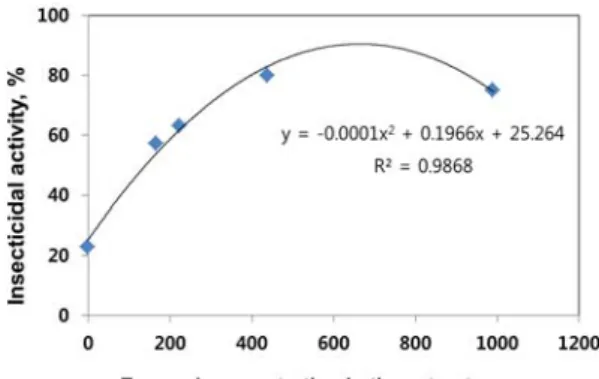
Fig. 2. Correlation of the insecticidal activity with eugenol of S. aromaticum extracts.
Fig. 3. Structures of eugenol.
of the various extract against U. lactucicola.
The activity of the hexane fraction of S. ar- omaticum was similar to that recorded for the pos- itive control (commercial oil: eugenol). Eeugenol was previously reported to be active against a range of plant pathogenic nematodes (Sangwan et al.
1990). A hexane extract of clove flower buds, which contains mainly eugenol (Guenther, 1950), was dem- onstrated to have a toxic contact effect on S. zea- mais and T. castaneum and reduced their fecundity (Ho et al. 1994). Obeng-Ofori and Reichmuth (1997) also reported that eugenol was toxic to four co- leopteran pests of stored products, namely, S. zea- mais, S. granarius, T. castaneum and P. truncatus.
3.5. The Relationship between The Eugenol Content and Insecticidal Activity of Extracts
The Fig. 2 show the correlation between the euge- nol content and insecticidal activity of the various extracts of S. aromaticum. The insecticidal activity
of extracts was shown to be linearly correlated with eugenol content (correlation coefficient being 0.9868) (Fig. 2). It is accordingly believed that the in- secticidal activity of the various extracts is due mainly to the presence of eugenol (Fig. 3). Further investigations examining the synergistic effect of eu- genol and other minor components on the in- secticidal activity of S. aromaticum are desirable.
4. CONCLUSION
In view of the environmental and health hazards posed by synthetic insecticides, the use of plant products as insecticides has gained increasing in re- cent years.
Extracts isolated from S. aromaticum are widely used and well known for their antibacterial and anti- fungal properties (Larhsini et al. 2001; Ranasinghe et al. 2002; Gayoso et al. 2005).
In this study, we reported the insecticidal activity of various extracts isolated from S. aromaticum. The chemical composition of the various extracts inves- tigated in this study was similar to those reported previously (Srivastava et al. 2005; Chaieb et al.
2007), which show that eugenolis the main compo- nent of these extracts. The results of the present study indicated that the various extracts of S. ar- omaticum possess insecticidal activity against aphids (U.lactucicola). A comparison of the insecticidal ac- tivity and composition of the extracts, lead us to conclude that the activity of S. aromaticum is mainly due to its major compound eugenol.
Our results indicate that S. aromaticum and its components could be useful as a bio-insecticide for aphid (U. lactucicola) control. For the practical use of S. aromaticum and its constituents as novel in- secticide, further study is necessary on the safety of these materials to humans, on development of for- mulations to improve the efficacy and stability and to reduce costs.
ACKNOWLEDGEMENT
This study was carried out with the support of
“Forest Science & Technology Projects (Grant No.
S211313L010140)” provide by Korea Forest Service, Republic of Korea and Gyeongsang National University Fund for professors on sabbatical leave, 2013.
REFERENCES
Chami, N., Bennis, S., Chami, F., Aboussekhra, A., Remma, A. 2005. Study of anticandidal activity of carvacrol and eugenol in vitro and in vivo.
Oral Microbiology Immunology 20: 106∼111.
Chaieb, K., Hajlaoui, H., Zmantar1, T., Kahla-Nakbi, A.B., Rouabhia, M., Mahdouani, K., Bakhrouf, A. 2007. The chemical composition and bio-
logical activity of clove essential oil, eugeniacar- yophyllata (Syzigium aromaticum L. Myrtaceae):
A Short Review. Phytotherapy Research 21: 501
∼506.
Chirinos, R., Rogez, H., Campos, D., Pedreschi, R., Larondelle, Y. 2007. Optimization of extraction conditions of antioxidant phenolic compounds from mashua (Trapaeolumtuberosum Ruíz and Pavón) tubers. Separation and Purification Technology 55(2): 217∼225.
Gao, D., Kawai, N., Tamiya, T. 2011. The anti-in- flammatory effects of d-allose contribute to at- tenuation of cerebral ischemia–reperfusion injury.
Medical Hypotheses 76(6): 911∼913.
Gayoso, C.W., Limab, E.O., Oliveirac, V.T., Pereirac, F.O., Souzac, E.L., Limac, I.O., Navarro, D.F. 2005. Sensitivity of fungi isolated from onychomycosis to Eugenia cariophyllata es- sential oil and eugenol. Fitoterapia 76(2): 247∼
249.
Guenther, E. 1950. The Essential Oils. Vol. 4. Van Nostrand Co., Inc., New York.
Ho, S.H., Cheng, L.P.L., Sim, K.Y., Tan, H.T.W.
1994. Potential of cloves (Syzygium aromaticum (L.) Merr.and Perry) as a grain protectant against Triboliumcastaneum (Herbst) and Sitophiluszeamais Motsch. Postharvest Biology and Technology 4:
179∼183.
Hussein, G., Miyashiro, H., Nakamura, N., Hattori, M., Kakiuchi, N., Shimotohno, K. 2000.
Inhibitory Effects of Sudanese Medicinal Plant Extracts on Hepatitis C Virus (HCV) Protease.
Phytotherapy Research 14: 510∼516.
Karawita, R., Siriwardhana, N., Lee, K.W., Heo, M.S., Yeo, I.K., Lee, Y.D. 2005. Reactive oxy- gen species scavenging, metal chelating, re- ducing power and lipid peroxidation inhibition properties of different solvent fractions from Hizikiafusiformis, European Food Research and
Technology, 220(3∼4): 363∼371.
Kim, H.M., Lee, E.H., Hong, S.H., Song, H.J., Shin, M.K., Kim, S.H., Shin, T.Y. 1998. Effect of Syzygium aromaticum extract on immediate hy- persensitivity in rats. Journal of Ethnopharmacology 60: 125∼131.
Kim, S.I., Roh, J.Y., Kim, D.H., Lee, H.S., Ahn, Y.J. 2003.Insecticidal activities of aromatic plant extracts and essential oils against Strophilusoryzae and Callosobruchuschinensis. Journal of Stored Products Research, 39: 293∼303.
Kim, S.I., Yoon, J.S., Jung, J.W., Hong, K.B., Ahn Y.J., Kwon, H.W. 2010. Toxicity and repellency of origanum essential oil and its components against Triboliumcastaneum (Coleopter: Tenebrionidae) adults. Journal of Asia-Pacific Entomology 13:
369∼373.
Larhsini, M., Oumoulid, L., Lazrek, H.B., Wataleb, S., Bousaid, M., Bekkouche, K., Jana, M. 2001.
Antibacterial activity of some Moroccan medici- nal plants. Phytotherapy Research 15: 250∼252.
Lee, C.H., Jeon, J.H., Lee, S.G., Lee, H.S. 2010.
Insecticidal properties of Euphorbiaceae:
Sebastianiacorniculata-derived 8-hydroxyquino- line and its derivatives against three plant hop- per species (Hemiptera: Delphacidae). Journal of the Korean society for applied biological chem- istry 53: 464∼469.
Makni, M., Chtourou, Y., Fetoui, H., Garoui, E.M., Boudawara, T., Zeghal, N. 2011. Evaluation of the antioxidant, anti-inflammatory and hep- atoprotective properties of vanillin in carbon tet- rachloride-treated rats. European Journal of Pharmacology 668: 133∼139.
Matsumura, S.1917. A list of the aphididae of Japan, with description of new species and genera. The journal of the College of Agriculture 7: 395.
Moure, A., Cruz, J.M., Franco, D., Domı́nguez, J.M., Sineiro, J., Domı́nguez, H., Núñez, M.J., Parajóa,
J.C. 2001. Natural antioxidants from residual sources. Food Chemistry, 72(2): 145∼171.
Obeng-Ofori, D., Reichmuth, C.H. 1997. Bioactivity of eugenol, a major component of essential oil of Ocimum suave (WILD.) against four species of stored-product Coleoptera. International Journal of Pest Management, 43: 89∼94.
Park, I.K., Lee, H.S., Lee, S.G., Park, J.D., Ahn, Y.J. 2000. Insecticidal and fumigant activities of Cinnamomum cassia bark-derived materials against Mechorisursulus (Coleoptera: Attelabidae).
Journal of Agricultural and Food Chemistry 48:
2528∼2531.
Park, T.S., Lee, J.Y., Jo, C., An, B.J. 2011.
Retention of biological activities of the cos- metics manufactured with green tea polyphenol and possible application of irradiation technology.
Agricultural Chemistry and Biotechnology 54:
33∼40.
Pawar, V.C., Thaker, V.S. 2006. In vitro efficacy of 75 essential oils against Aspergillus niger. Mycoses 49: 316∼323.
Prashar, A., Locke, I.C., Evans, C.S. 2006.
Cytotoxicity of clove (Syzygium aromaticum) oil and its major components to human skin cells.
Cell Proliferation, 39: 241∼248.
Rajic, A., Kweifio-Okai, G., Macrides, T., Sandeman, R.M., Chandler, D.S., Polya, G.M. 2000. Inhibition of serine proteases by anti-inflammatory triterpenoids. Planta Medica 66: 206∼210.
Ranasinghe, L., Jayawardena, B., Abeywickrama, K.
2002. Fungicidal activity of essential oils of Cinnamomumzeylanicum (L.) and Syzygiumaromaticum (L.) Merret L. M. Perry against crown rot and anthracnose pathogens isolated from banana.
Letters in Applied Microbiology 35: 208∼211.
Sangwan, N.K., Verma, B.S., Verma, K.K., Dhindsa, K.S. 1990. Nematicidal activity of some essen- tial plant oils. Pesticide Science 28: 331∼335.
Sanz, C., Ansorena, D., Bello, J., Cid, C. 2001.
Optimizing headspace temperature and time sam- pling for identification of volatile compounds in ground roasted Arabica coffee. Journal of Agricultural and Food Chemistry 49: 1364∼
1369.
Senthil-Nathan, S., Choi, M.Y., Paik, C.H., Seo, H.Y., Kalaivani, K. 2009. Toxicity andphysio- logical effects of neem pesticides applied to rice on the NilaparvatalugensStål, the brown planthopper. Ecotoxicology and Environmental Safety 72: 1707∼1713.
Shokeen, P., Anand, P., Murali, Y.K., Tandon, V.
2008. Antidiabetic activity of 50% ethanolic ex- tract of Ricinuscommunis and its purified fractions. Food and Chemical Toxicology 46(11):
3458∼3466.
Srivastava, A.K., Srivastava, S.K., Syamsundar, K.V.
2005. Bud and leaf essential oil composition of
Syzygium aromaticum from India and Madagascar.
Flavour and Fragrance Journal 20: 51∼53.
Stepana, R., Cuhra, P., Barsova, S. 2008. Comprehensive two-dimensional gas chromatography with time- of-flight mass spectrometric detection for the de- termination of anabolic steroids and related com- pounds in nutritional supplements. Food Additives and Contaminants, 25(5): 557∼565.
Takahashi, R. 1930. Some aphididae of loochoo.
Transactions of the Natural History Society of Formosa 20: 317∼327.
Takahashi, R. 1962. Key to Japanese species of Dactynotus, with descriptions of fournew species Aphididae, Homoptera. Kontyu 30: 73∼81.
Tsao, R., Romanchuk, F.E., Peterson, C.J. 2002.
Plant growth regulatory effect and insecticidal activity of extracts of tree of heaven (Ailanthus altissima L.). BioMedCentral Ecology 2: 1∼8.