40(10), 1371~1377(2011) http://dx.doi.org/10.3746/jkfn.2011.40.10.1371
남천(
Nandina domestica
) 열매 분획 추출물의 항산화 효과서수정․심규봉․김남우†
대구한의대학교 한약자원학과
Antioxidative Effects of Solvent Fractions from Nandina domestica Fruits
Soo Jung Seo, Kyu Bong Shim, and Nam Woo Kim1†
Dept. of Herbal Biotechnology, Daegu Haany University, Gyeongbuk 712-715, Korea
Abstract
This study was carried out to compare the antioxidative effects of various Nandina domestica fruits extracts.
Organic fractions, including n-hexane, chloroform, ethyl acetate, and butanol fractions, were obtained from the water and ethanol extracts of N. domestica fruits. The phenolic compound content of the EE fraction was 922.22 mg/g. The flavonoid compound content was highest in the EB fraction (282.49 mg/g). The electron-donating ability was highest (93%) in the WA and EH fractions at 0.1 mg/mL. The SOD-like activity was showed the highest in the EA fraction (56.36%), and EH and EC both showed higher than 50% activity. The nitrite-scaveng- ing ability of the EC fraction at 1.0 mg/mL under pH 1.2 conditions was 82.03%. The xanthine oxidase inhibitory activities of all the fractions, except WE, were higher than 90% at 0.5 mg/mL. The effect of tyrosinase inhibition was highest in the WE fraction (46.75%). These results show that the N. domestica fruits fractions contained high levels of polyphenol and flavonoid compounds, along with excellent antioxidative effects. This suggests that N. domestica fruits can be used as a functional material.
Key words: N. domestica, solvent fraction, antioxidative effect, electron donating, xanthine oxidase inhibition
†
Corresponding author. E-mail: [email protected]
†
Phone: 82-53-819-1438, Fax: 82-53-819-1440
서 론
다양한 환경오염 물질과 환경 호르몬, 흡연, 알코올 및 불 규칙한 식습관 등으로 생체 내 산화적 스트레스가 증가되면 서, 비만, 당뇨, 고혈압 및 심장질환 등 각종 성인병의 발생율 이 높아지고 있다. 최근 성인병의 주된 원인인 활성산소종을 억제시키기 위해 항산화제에 대한 연구가 수행되고 있으며, 특히 동양의학과 민간에서 치료 및 예방의 목적으로 사용되 고 있는 각종 생약이나 약용식물을 대상으로 천연항산화제 에 대한 연구가 활발히 이루어지고 있다(1,2). 항산화 활성을 나타내는 물질은 생체 내 활성산소에 의한 산화적 스트레스 를 감소시켜, 암, 심혈관계 질환, 염증 및 노화를 예방하고 지연시키는 물질로 작용한다. 자연계에 널리 분포하는 대표 적인 항산화 물질은 페놀성 화합물, 플라보노이드, 토코페 롤, ascorbic acid 등이 있다(3). 항산화 물질로 사용되고 있 는 butylated hydroxytolune(BHT), butylated hydroxy- anisole(BHA), propyl gallate(PG) 등과 같은 합성항산화제 는 효능과 경제성에서 천연항산화제보다 우수하나 인체에 대한 안전성이 미흡하여 사용량이 법으로 규제되어 있다.
반면 천연 항산화 물질은 안전성은 우수하나 합성항산화제 와 비교하여 효능이 낮고 추출과 정제에 많은 시간과 비용이
소모되어 이에 대한 개선이 요구되고 있다(4).
남천(
Nandina domesticaThunb)은 매자나무과(Berber- idaceae)의 상록관목으로 녹색 잎은 가을에 적색으로 변하 며, 이른 봄 다시 녹색으로 되어 조경수로 많이 식재되고 있다(5). 꽃은 흰색이고 열매는 둥글고 작으며, 10월에 적색 으로 성숙한다. 남천의 열매를 남천실(南天實)이라고도 하 며 일본에서는 만성 기침, 천식, 백일해, 매독, 자궁출혈 등의 질병치료에 사용하고 있다(6,7).
남천에 관한 연구로는 남천의 정유성분에서 1-indolizino carbazole, 2-pentanone, aziridine 등 79종류의 물질에 대한 동정과 대장균과 포도상구균을 포함한 다양한 식품 부패 미 생물에 대해 항균활성(8), 천식, 백일해, 자궁종양에 대한 억 제효과(6), α
1-adrenoceptor의 근육 자극효과(9)에 대한 연 구 등이 수행되었다. 남천의 모든 부분에서 검출된 nandinin 이라는 hydrocyanic acid(10)는 조류에서 독성을 나타낸다 고 보고되었으나, 사람에게는 무독한 것으로 알려져 있다 (11). 그리고 nantenine은 혈압 고정효과(12)를 나타내며, 최 근 연구에서 엑스타시로 알려진 환각작용을 일으키는 MDMA(3,4-methylene dioxy methamphetamine; ecstasy) 에 대한 해독효과(13)에 대해 보고된 바 있다.
본 연구는 천연유래 항산화 물질에 대한 연구의 일환으로
Fig. 1. Method of solvent fractions from fruits N. domestica Thunb. WH: n-hexane fraction of water extract, EH: n-hexane fraction of ethanol extract, WC: chloroform fraction of water ex- tract, EC: chloroform fraction of ethanol extract, WE: ethyl ace- tate fraction of water extract, EE: ethyl acetate fraction of ethanol extract, WB: butanol fraction of water extract, EB: butanol frac- tion of ethanol extract, WA: aqueous of water extract, EA: aque- ous of ethanol extract.
남천 열매의 합성항산화제의 대체 원료로서의 가능성을 알 아보기 위하여 남천 분획물에 함유된 폴리페놀과 플라보노 이드 화합물의 함량을 측정하고, 각 분획물을 일정농도로 희석하여 전자공여, superoxide dismutase(SOD) 유사활성, 아질산염 소거 및 xanthine oxidase와 tyrosinase 저해활성 을 측정하여 남천 열매의 생리활성 효능을 측정하였다.
재료 및 방법
실험재료
본 실험 재료는 2007년 10월경에 경북 경산시 일대에서 성숙된 남천(
N. domestica)의 열매를 채집하여 흐르는 물에 수회 세척하고 물기를 제거하여 6시간 음건한 후, -70
oC에서 보관하면서 추출 시료로 사용하였다.
분획물 제조
남천 열매 분획물의 생리활성 측정을 위하여 생체 1 kg 당 각각 10배의 증류수와 80% 에탄올을 가하여 80
oC와 60
oC 의 조건으로 3시간 추출한 후 여과하는 과정을 3회 반복하였 다. 모아진 증류수와 에탄올 추출물은 rotatory vacuum evaporator(Eyela 400 series, Tokyo, Japan)를 이용하여 1/10으로 농축하였으며, 이를 극성이 다른 유기용매(n-hex- ane, chloroform, ethyl acetate, butanol)를 Fig. 1과 같이 가 하여 순차적으로 분획하였다. 각 분획물은 rotatory vacuum
evaporator와 건조기를 사용하여 용매를 제거한 후 4
oC 냉장 실에 저장하면서 본 실험을 위한 시료로 사용하였다. 대조구 는 추출물 대신 천연 항산화제인 ascorbic acid(Sigma- Aldrich Co., St. Louis, MO, USA)를 추출물과 동일한 농도 로 첨가하여 생리활성 효과를 비교하였다.
폴리페놀 화합물 함량
남천 분획물의 폴리페놀 화합물의 함량은 Folin-Denis법 (14)에 따라 일정농도로 희석된 시료 0.2 mL에 증류수 1.8 mL와 folin-ciocalteu's phenol reagent 0.2 mL를 첨가한 후, 혼합하여 3분간 실온에서 방치한 다음, Na
2CO
3포화용액 0.4 mL를 가하여 혼합하였다. 여기에 증류수를 1.4 mL 가하고 실온에서 1시간 동안 반응시킨 후 spectrophotometer(U- 1201, Shimadzu, Kyoto, Japan)를 사용하여 725 nm에서 흡 광도를 측정하였다. 폴리페놀 정량은 tannic acid(Sigma- Aldrich Co.)를 이용하여 최종농도가 0, 25, 50, 100, 250, 500 μ g/mL가 되도록 취하여 흡광도를 측정한 표준곡선으로부 터 각 분획물에 함유된 폴리페놀 화합물 함량을 산출하였다.
총 플라보노이드 화합물 함량
각 분획물을 일정농도로 80% ethanol에 희석한 다음 Nieva Moreno 등(15)의 방법을 변형하여, 추출액 0.1 mL에 80% ethanol 0.4 mL를 첨가하여 혼합한 후 10% aluminum nitrate 0.1 mL와 1 M potassium acetate 0.1 mL 그리고 80%
ethanol 4.3 mL를 가하여 25
oC에서 40분간 반응시킨 후 415 nm에서 흡광도를 측정하는 방법으로 구하였다. 총 플라보 노이드 정량은 quercetin(Sigma-Aldrich Co.)을 이용하여 최종농도가 0, 10, 25, 50, 100, 250 μg/mL가 되도록 취하여 위와 동일한 방법으로 측정한 표준곡선으로부터 각 분획물 에 함유된 플라보노이드 함량을 산출하였다.
전자공여능 측정
남천의 각 분획물에 대한 전자공여능은 Blois(16)의 방법 에 따라 1,1-diphenyl-2-picryl hydrazyl(DPPH, Sigma- Aldrich Co.)에 대한 수소공여 효과로 측정하였다. 일정 농 도의 시료 2 mL를 absolute ethanol에 0.2 mM의 농도로 DPPH를 희석한 용액 1 mL를 혼합하여 37
oC에서 30분간 반응시켰다. 이 반응액을 spectrophotometer를 사용하여 517 nm에서 흡광도를 측정하였으며, 시료 첨가 전후의 흡광 도 차이를 백분율(%)로 하여 전자공여효과로 나타내었다.
SOD 유사활성능 측정
Marklund와 Marklund(17)의 방법에 따라 hydrogen per-
oxide로 전환시키는 반응을 촉매하는 pyrogallol의 생성량을
측정하여 SOD 유사활성으로 나타내었다. 일정농도의 시료
0.2 mL에 pH 8.5로 보정한 tris-HCl buffer 2.6 mL와 7.2
mM pyrogallol(Sigma-Aldrich Co.) 0.2 mL를 첨가하여
25
oC에서 10분간 반응 후, 1 N HCl 0.1 mL를 가하여 반응을
정지시켰다. 반응액 중 산화된 pyrogallol의 양은 spectro-
Table 1. Total polyphenol and flavonoid compounds contents of various solvent fractions from water and ethanol extracts of N. domestica fruits
Fraction (mg/g) n-Hexane Chloroform Ethyl acetate Butanol Aqueous
Polyphenol Water
Ethanol 236.66±0.66
1)d2)366.08±2.30
c518.84±1.32
a263.55±2.34
d372.60±4.93
b922.22±3.46
a295.07±3.94
c689.85±4.01
b359.33±5.77
b364.66±4.66
cFlavonoid Water
Ethanol 30.39±0.20
d54.11±0.98
b50.31±1.00
c44.95±0.45
c127.03±1.40
b44.50±1.33
c180.76±0.61
a282.49±4.71
a34.69±0.59
d32.14±1.49
d1)
All values are mean±SD of triplicate determinations.
2)
Values with different small letters in superscripts within a row are significantly different at p<0.05 by Duncan's multiple range test.
photometer를 사용하여 420 nm에서 흡광도를 측정하여 분 획물 첨가구와 무첨가구의 흡광도의 차이를 백분율(%)로 하여 남천 열매 분획물의 SOD 유사활성 효과로 나타내었다.
아질산염 소거능 측정
아질산염(NaNO
2) 소거 작용은 Kato 등(18)의 방법에 따 라 1 mM의 NaNO
2용액 2 mL에 일정 농도의 남천 열매 분획물을 첨가하고, 여기에 0.1 N HCl(pH 1.2)과 0.2 M citrate buffer를 사용하여 반응용액의 pH를 각각 1.2, 3.0, 6.0으로 조정한 후, 반응용액의 부피를 10 mL로 하여 37
oC에 서 1시간 동안 반응시킨 후 각각 1 mL씩 취하였다. 여기에 2% acetic acid를 5 mL를 첨가하고, griess reagent(A : B=1:1, A: 1% sulfanilic acid in 30% acetic acid, B: 1%
naphthylamine in 30% acetic acid) 0.4 mL 첨가하여 혼합한 후, 실온에서 15분간 반응시켰다. 반응시킨 시료를 spectro- photometer를 사용하여 520 nm에서 흡광도를 측정하였고 분획물 첨가구와 무첨가구 사이의 흡광도 차이를 백분율 (%)로 아질산염 소거능으로 나타내었다.
Xanthine oxidase 저해 활성
Xanthine oxidase 저해 활성은 Stirpe와 Corte(19)의 방법 에 따라 일정 농도로 희석한 시료 0.1 mL에 0.1 M potassium phosphate buffer(pH 7.5) 0.6 mL와 xanthine 2 mM을 녹인 기질액 0.2 mL를 첨가하였다. 여기에 xanthine oxidase(0.2 U/mL) 0.1 mL를 가하여 37
oC에서 5분간 반응시킨 후 1 N HCl 1 mL를 가하여 반응을 정지하고 반응액 중에 생성된 uric acid를 spectrophotometer를 사용하여 292 nm에서 흡 광도를 측정하였으며, 이를 첨가구와 무첨가구의 흡광도 감 소율을 백분율(%)로 하여 xanthine oxidase 저해율로 나타 내었다.
Tyrosinase 저해 활성
Tyrosinase 저해 활성은 Yagi 등(20)의 방법에 따라 0.175 M sodium phosphate buffer(pH 6.8) 0.5 mL에 10 mM의 3,4-dihydroxy-L-phenyl-alanine(L-DOPA, Sigma-Aldrich Co.)를 녹인 기질액 0.2 mL와 일정농도로 희석한 남천 열매 분획물 0.1 mL를 혼합한 용액에 mushroom tyrosinase(110 U/mL) 0.2 mL 첨가하여 25
oC에서 2분간 반응시킨 후, 생성 된 DOPA chrome을 spectrophotometer를 사용하여 475 nm 에서 측정하였다. 각 분획물 시료의 첨가구와 무첨가구의
흡광도 감소율을 백분율(%)로 하여 tyrosinase 저해율로 나 타내었다.
통계처리
실험은 독립적으로 3회 반복하였으며, 결과는 통계프로그 램 SPSS(version 18.0, Package for Social Science, SPSS Inc., Chicago, IL, USA)를 이용하여 평균(mean)±표준편차 (standard deviation)로 표시하였고, 각 군 간의 통계적 유의 성 검정은 ANOVA test(one-way analysis of variance test)를 실시한 후 유의성이 있는 경우, p<0.05 수준에서 Duncan's multiple range test로 사후 검정하였다.
결과 및 고찰
폴리페놀 및 플라보노이드 화합물 함량
남천 열매의 순차적 유기용매 분획물에 함유된 폴리페놀 과 플라보노이드 화합물 함량을 측정한 결과, 에탄올을 용매 로 1차 추출 후 ethyl acetate 층(EE; ethyl acetate fraction of ethanol extract)에서 가장 많은 922.22 mg/g의 폴리페놀 을 함유하였으며, EB(butanol fraction of ethanol extract)는 689.85 mg/g을 함유하였다. 플라보노이드 화합물은 EB 282.49 mg/g> WB(butanol fraction of water extract) 180.76 mg/g> WE(ethyl acetate fraction of water extract) 127.03 mg/g의 순으로 플라보노이드를 함유하였다(Table 1). 남천 열매와 유사한 크기와 형태를 갖는 식용이 가능한 머루와 보리수를 대상으로 비교하면 머루 종실의 ethyl acetate 층에서 0.649 mg/g의 폴리페놀을 함유하였다는 Park(21)의 결과와 핑크팝 보리수 열매 분획물의 butanol 층에서 106.3 mg/g이라는 보고(22)와 비교하면 남천 열매의 폴리페놀 함량이 매우 높았다. 또한 ethyl acetate와 butanol 층의 폴리페놀 함량이 높다는 결과(21,22)는 본 실험의 결과 와도 일치하였다. 플라보노이드 함량은 머루 과피의 ethyl acetate 층에서 6.45 mg/g으로 가장 많이 함유되었다는 결과 (23)와 비교하여도 남천의 ethyl acetate 층인 WE 127.03 mg/g, EE 44.50 mg/g으로 머루보다 약 7∼19배 이상 많은 플라보노이드가 함유된 것으로 나타났다.
전자공여능
DPPH를 이용한 남천 열매 용매별 추출물의 농도별 전자
Table 2. Electron donating ability of various solvent fractions from water and ethanol extracts of N. domestica fruits (%) Fraction (mg/mL) n-Hexane Chloroform Ethyl acetate Butanol Aqueous Ascorbic acid
Water
0.1 0.3 0.5 1.0
87.51±0.14
1)bB2)93.10±0.00
aA93.25±0.13
abA93.48±0.13
bA58.36±0.68
dC86.90±0.72
bB91.79±0.27
bcA93.69±0.15
bA53.32±2.41
eD59.05±1.73
cC64.14±1.40
dB73.95±0.97
cA77.54±1.43
cC86.55±1.69
bB90.93±0.88
cA92.55±0.75
bA93.83±0.65
aA94.35±0.00
aA93.10±1.08
abA92.68±1.10
bA92.86±1.00
aB93.45±0.43
aAB94.36±0.21
aA95.22±0.54
aAEthanol
0.1 0.3 0.5 1.0
93.31±0.14
aA93.40±0.00
bA93.73±0.29
bA95.09±0.29
bA85.33±2.30
cB87.81±2.47
cB87.74±1.75
cB92.42±1.32
cA87.44±0.22
cC89.11±0.34
cB94.52±0.22
bA95.51±0.47
bA47.31±2.96
dC71.49±0.87
dB80.58±0.42
dA81.87±0.70
dA90.02±0.76
bA91.05±1.57
bA86.03±1.38
cB80.04±0.38
dC94.86±0.55
aB96.52±0.30
aA96.94±0.41
aA97.02±0.37
aA1)
All values are mean±SD of triplicate determinations.
2)
Values with different small and capital letters in superscripts within the same row and column are significantly different at p<0.05 by Duncan's multiple range test.
Table 3. Superoxide dismutase (SOD) like activities of various solvent fractions from water and ethanol extracts of N. domestica
fruits (%)
Fraction (mg/mL) n-Hexane Chloroform Ethyl acetate Butanol Aqueous Ascorbic acid Water
0.1 0.3 0.5 1.0
4.37±0.58 -
1)dC2)14.70±0.51
dB31.98±0.98
eA4.53±0.64
cD13.59±0.00
cC21.25±0.49
cB41.64±0.98
cA6.36±1.78
cD13.26±0.64
cC20.28±0.49
cB34.95±0.32
dA5.82±0.56 -
dC11.75±0.98
eB26.96±0.49
fA7.76±0.82
bD15.32±0.99
bC23.49±0.64
bB45.65±1.88
bA99.20±0.20
aA99.20±0.20
aA99.54±0.20
aA99.66±0.00
aAEthanol
0.1 0.3 0.5 1.0
13.88±0.68
bD26.12±2.18
bC46.33±1.80
bB51.47±0.32
cA2.25±2.03
dD15.87±1.21
dC25.45±0.51
dB52.14±1.86
cA3.90±0.65
dD13.02±0.00
dC20.73±0.49
eB41.26±0.99
dA- 3.50±1.74 -
fB13.92±0.50
eA11.31±0.63
cD21.81±0.52
cC29.39±0.80
cB56.36±0.80
bA99.20±0.20
aA99.20±0.20
aA99.54±0.20
aA99.66±0.00
aA1)
All values are mean±SD of triplicate determinations.
2)
Values with different small and capital letters in superscripts within the same row and column are significantly different at p<0.05 by Duncan's multiple range test.
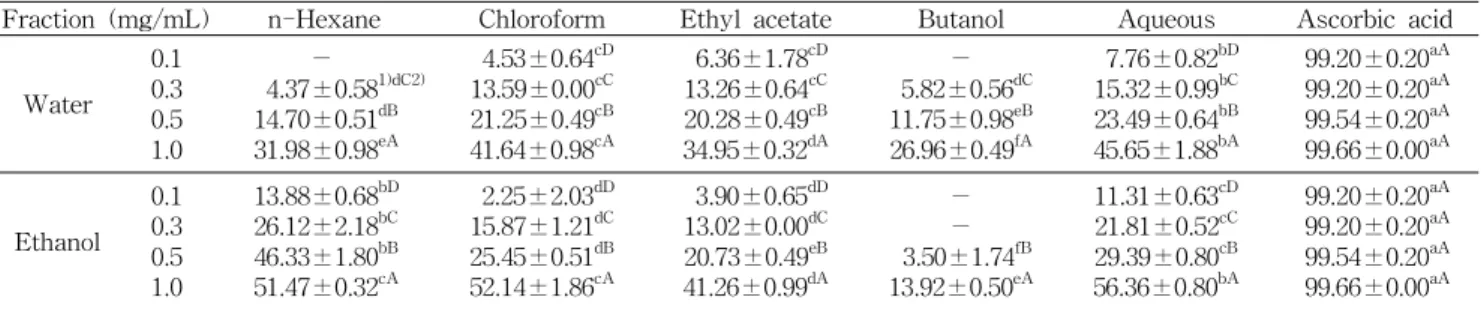
공여능을 측정한 결과는 Table 2와 같이 에탄올 추출물 후 분획된 EH(n-hexane fraction of ethanol extract)와 EE가 1.0 mg/mL에서 95% 이상으로 가장 우수한 전자공여효과를 보였다. WA(aqueous of fraction of water extract)와 EH는 0.1 mg/mL에서 93% 이상의 활성을 나타내었다. WA와 EA(aqueous of ethanol extract)는 0.5 mg/mL의 농도에서 가장 높은 활성을 나타내었으며, 농도가 증가함에 따라 점차 전자공여능이 감소하였으나 WA는 유의적 차이는 없었다.
Park(21)은 머루종실의 ethyl acetate 층 94.5%, butanol 층 93.9%의 활성도와 Kim 등(24)의 뜰보리수 과육의 용매 분획 물인 hexane 62.92%, ethyl acetate 47.13%라고 하여 전자공 여능은 분획물간의 차이는 있으나 머루종실과는 유사한 활 성을 보였으며, 뜰보리수 분획물보다는 높은 전자공여효과 를 나타내었다. 또한 대조군인 ascorbic acid의 활성 (97.02%)과 유사한 수준의 높은 항산화 활성을 나타내어 천 연 항산화제로 이용가능성이 높을 것으로 사료된다.
SOD 유사활성능
남천 열매 분획물의 SOD 유사활성능은 산화효소인 pyrogallol을 농도에 따라 반응시킨 결과 에탄올 추출 후 순 차 분획된 수층 EA의 1.0 mg/mL의 농도에서 56.36%로 가 장 높았으며, EH와 EC(chloroform fraction of ethanol extract)에서도 50% 이상의 활성을 나타내었다(Table 3). 특 히 EH는 0.5 mg/mL에서 46.33%로 1.0 mg/mL의 WA
(45.65%)와 유사한 활성을 보였다. SOD 유사활성율은 물보 다 에탄올 추출 분획물에서 더 높은 효과를 나타내었으나, butanol 층은 WB가 EB보다 약 2배 높은 활성을 나타내었다.
Choi 등(23)은 머루과피 분획물 SOD 유사활성이 ethyl acetate 층에서 32%였으며, 이외의 분획물은 25% 미만의 활성을 나타낸다고 하였으며, Chung 등(25)은 60여종의 약 용작물에서 평균 34%라는 보고와 비교하면 남천 열매의 butanol 층인 WB와 EB 그리고 WH를 이외의 모든 분획은 머루과피와 약용작물의 평균 활성도보다 우수하였다.
아질산염 소거능
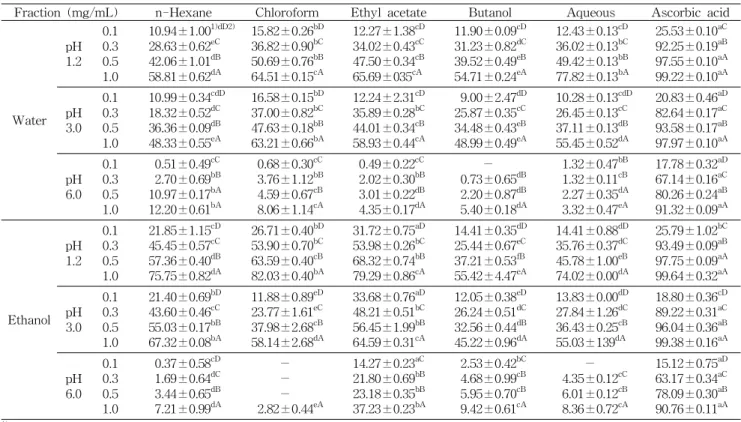
남천 열매 분획물을 상이한 pH와 농도 조건하에서 아질 산염 소거능을 측정한 결과 pH 1.2의 1.0 mg/mL의 농도에 서 54.71∼82.03%로 에탄올 추출 후 chloroform 층인 EC에 서 가장 높았으며, 모든 추출물에서 50% 이상의 소거율을 보였다. pH 3.0에서는 45.22∼67.32%로 EH가 가장 우수한 아질산염 소거활성을 나타내었으며, 물 추출 후 분획된 WC(chloroform fraction of water extract)와 에탄올 추출 후 분획된 EE에서도 60% 이상의 아질산염 소거율을 나타내 었다. pH 6.0에서는 EE가 37.23%로 가장 높은 소거능을 보 였으며, 이외의 분획물은 10% 미만으로 pH가 증가할수록 아질산염 소거능이 점차 낮아졌다. pH 1.2와 3.0의 0.1 mg/
mL에서 EE는 30% 이상으로 대조군인 ascorbic acid보다
높은 활성을 보였으며, pH 6.0에서도 유사한 소거율로 다른
Table 4. Nitrite scavenging ability of various solvent fractions from water and ethanol extracts of N. domestica fruits (%) Fraction (mg/mL) n-Hexane Chloroform Ethyl acetate Butanol Aqueous Ascorbic acid
Water pH 1.2
0.1 0.3 0.5 1.0
10.94±1.00
1)dD2)28.63±0.62
eC42.06±1.01
dB58.81±0.62
dA15.82±0.26
bD36.82±0.90
bC50.69±0.76
bB64.51±0.15
cA12.27±1.38
cD34.02±0.43
cC47.50±0.34
cB65.69±035
cA11.90±0.09
cD31.23±0.82
dC39.52±0.49
eB54.71±0.24
eA12.43±0.13
cD36.02±0.13
bC49.42±0.13
bB77.82±0.13
bA25.53±0.10
aC92.25±0.19
aB97.55±0.10
aA99.22±0.10
aApH 3.0
0.1 0.3 0.5 1.0
10.99±0.34
cdD18.32±0.52
dC36.36±0.09
dB48.33±0.55
eA16.58±0.15
bD37.00±0.82
bC47.63±0.18
bB63.21±0.66
bA12.24±2.31
cD35.89±0.28
bC44.01±0.34
cB58.93±0.44
cA9.00±2.47
dD25.87±0.35
cC34.48±0.43
eB48.99±0.49
eA10.28±0.13
cdD26.45±0.13
cC37.11±0.13
dB55.45±0.52
dA20.83±0.46
aD82.64±0.17
aC93.58±0.17
aB97.97±0.10
aApH 6.0
0.1 0.3 0.5 1.0
0.51±0.49
cC2.70±0.69
bB10.97±0.17
bA12.20±0.61
bA0.68±0.30
cC3.76±1.12
bB4.59±0.67
cB8.06±1.14
cA0.49±0.22
cC2.02±0.30
bB3.01±0.22
dB4.35±0.17
dA0.73±0.65 -
dB2.20±0.87
dB5.40±0.18
dA1.32±0.47
bB1.32±0.11
cB2.27±0.35
dA3.32±0.47
eA17.78±0.32
aD67.14±0.16
aC80.26±0.24
aB91.32±0.09
aAEthanol pH 1.2
0.1 0.3 0.5 1.0
21.85±1.15
cD45.45±0.57
cC57.36±0.40
dB75.75±0.82
dA26.71±0.40
bD53.90±0.70
bC63.59±0.40
cB82.03±0.40
bA31.72±0.75
aD53.98±0.26
bC68.32±0.74
bB79.29±0.86
cA14.41±0.35
dD25.44±0.67
eC37.21±0.53
fB55.42±4.47
eA14.41±0.88
dD35.76±0.37
dC45.78±1.00
eB74.02±0.00
dA25.79±1.02
bC93.49±0.09
aB97.75±0.09
aA99.64±0.32
aApH
3.0 0.1 0.3 0.5 1.0
21.40±0.69
bD43.60±0.46
cC55.03±0.17
bB67.32±0.08
bA11.88±0.89
eD23.77±1.61
eC37.98±2.68
cB58.14±2.68
dA33.68±0.76
aD48.21±0.51
bC56.45±1.99
bB64.59±0.31
cA12.05±0.38
eD26.24±0.51
dC32.56±0.44
dB45.22±0.96
dA13.83±0.00
dD27.84±1.26
dC36.43±0.25
cB55.03±139
dA18.80±0.36
cD89.22±0.31
aC96.04±0.36
aB99.38±0.16
aApH 6.0
0.1 0.3 0.5 1.0
0.37±0.58
cD1.69±0.64
dC3.44±0.65
dB7.21±0.99
dA- - 2.82±0.44 -
eA14.27±0.23
aC21.80±0.69
bB23.18±0.35
bB37.23±0.23
bA2.53±0.42
bC4.68±0.99
cB5.95±0.70
cB9.42±0.61
cA4.35±0.12 -
cC6.01±0.12
cB8.36±0.72
cA15.12±0.75
aD63.17±0.34
aC78.09±0.30
aB90.76±0.11
aA1)
All values are mean±SD of triplicate determinations.
2)
Values with different small and capital letters in superscripts within the same row and column are significantly different at p<0.05 by Duncan's multiple range test.
Table 5. Xanthine oxidase inhibition of various solvent fractions from water and ethanol extracts of N. domestica fruits (%) Fraction (mg/mL) n-Hexane Chloroform Ethyl acetate Butanol Aqueous Ascorbic acid
Water 0.1 0.3 0.5 1.0
12.21±2.77
1)cD2)83.03±3.78
cC92.72±0.00
bB98.79±1.05
aA82.05±1.11
aB86.53±3.84
bcB96.79±2.93
aA98.71±1.11
aA57.31±4.05
bD84.21±3.03
cC88.30±2.02
cB97.66±2.68
aA82.69±4.44
aC93.59±1.11
aA94.23±1.92
aA94.87±4.44
aA59.57±3.65
bB92.19±2.46
aA95.03±3.25
aA96.45±2.46
aA85.00±2.89
aC88.33±0.00
bBC90.56±0.96
bcB97.22±2.55
aAEthanol
0.1 0.3 0.5 1.0
75.30±4.27
cB94.44±1.85
aA96.29±3.70
abA96.29±1.85
abA50.26±1.83
eC83.59±2.42
cB91.53±1.83
bA92.59±3.99
bA83.09±1.67
bC89.37±2.21
bB95.65±2.89
aA97.58±0.83
aA48.55±1.25
eD75.36±3.32
dC92.02±3.32
bB98.55±1.25
aA63.94±5.13
dC88.43±4.24
bB91.15±4.71
bA93.87±0.00
cA89.10±1.03
aC89.88±1.03
bC92.86±0.00
bB98.99±0.00
aA1)
All values are mean±SD of triplicate determinations.
2)
Values with different small and capital letters in superscripts within the same row and column are significantly different at p<0.05 by Duncan's multiple range test.
분획물보다 pH 조건에 안정적인 것으로 나타내었다(Table 4).
본 실험결과는 pH 1.2의 조건에서 머루 종실 분획물이 39.5∼76.9%이며(21), 머루 과피 분획물은 31.8∼90.5%로 ethyl acetate 층에서 가장 높은 아질산염 소거효과를 나타 낸다는 결과(23)와 비교하면 분획물간에 차이는 있으나 머 루 종실보다는 높고 머루 과피보다는 낮았다. 약용 및 식용 으로 많이 사용되는 산수유(35%), 황기(49%), 감초(15%) 등 의 소거효과(26)와 비교하면 남천 분획물은 높은 아질산염 소거효과를 나타낸 것으로 생각되며, 일상에서 노출될 수 있는 발암성 nitrosamine의 생성 억제에도 효과를 나타낼 수 있을 것으로 판단된다.
Xanthine oxidase 저해 활성
남천 열매의 용매 분획물에 대한 xanthine oxidase 저해
효과는 0.5 mg/mL의 농도에서 WE를 제외한 모든 분획물에
서 90% 이상의 저해율을 나타내었으며, WB, WA 그리고
EH는 0.3 mg/mL에서도 90% 이상의 저해효과를 나타내어
대조군인 ascorbic acid보다 높은 xanthine oxidase 저해활
성을 나타내었다(Table 5). 그리고 WB, WA 그리고 EH는
0.3 mg/mL 이상에서 농도에 따른 xanthine oxidase 저해율
에 유의적인 차이가 없었다. Park과 Chang(27)은 복분자 추
출물의 xanthine oxidase 저해율이 43.26%이며, 꾸지뽕나무
열매 추출물은 57.94%라는 결과(28)와 비교하면 남천 열매
의 xanthine oxidase 저해효과가 매우 높았다. Xanthine
Table 6. Tyrosinase inhibition of various solvent fractions from water and ethanol extracts of N. domestica fruits (%) Fraction (mg/mL) n-Hexane Chloroform Ethyl acetate Butanol Aqueous Ascorbic acid
Water 0.1 0.3 0.5 1.0
7.98±3.06 -
1)dB2)9.06±3.83
eB13.36±1.59
eA5.69±0.28
dC13.65±1.29
cB20.48±0.97
cA21.62±0.56
dA7.40±2.99
cdD25.81±4.18
bC40.62±1.83
bB46.75±2.60
bA5.23±1.90
cC4.60±0.99
eC8.41±0.72
eB11.90±1.71
eA10.66±0.33
bBC11.81±1.19
cB13.52±1.74
dB30.09±1.43
cA96.90±0.34
aA97.29±0.34
aA98.06±0.34
aA99.42±0.00
aAEthanol
0.1 0.3 0.5 1.0
4.57±0.83
cC10.62±1.26
cB13.37±0.63
dA15.93±2.19
dA2.26±0.56
dD6.30±0.71
dC11.20±2.53
deB18.73±1.17
dA19.47±1.51
bD27.72±0.00
bC31.02±0.57
bB36.63±0.99
bA2.41±1.59
cdC6.62±1.20
cB8.23±2.43
eAB11.24±2.43
eA2.77±1.91
cdD6.34±0.90
dC16.07±5.86
cB29.96±2.40
cA96.90±0.34
aA97.29±0.34
aA98.06±0.34
aA99.42±0.00
aA1)
All values are mean±SD of triplicate determinations.
2)
Values with different small and capital letters in superscripts within the same row and column are significantly different at p<0.05 by Duncan's multiple range test.
oxidase는 산소를 수소 수용체로 이용하여 xanthine을 요산 형으로 산화하는 반응을 촉매하는 효소로써 저해율이 높을 수록 자유라디칼의 생성을 억제하므로 항산화, 노화 및 항암 등 생물학적으로 중요한 의의를 가지므로(29) 남천 열매 분 획물은 천연 항산화제로써 효과적으로 이용할 수 있을 것으 로 기대된다.
Tyrosinase 저해 활성
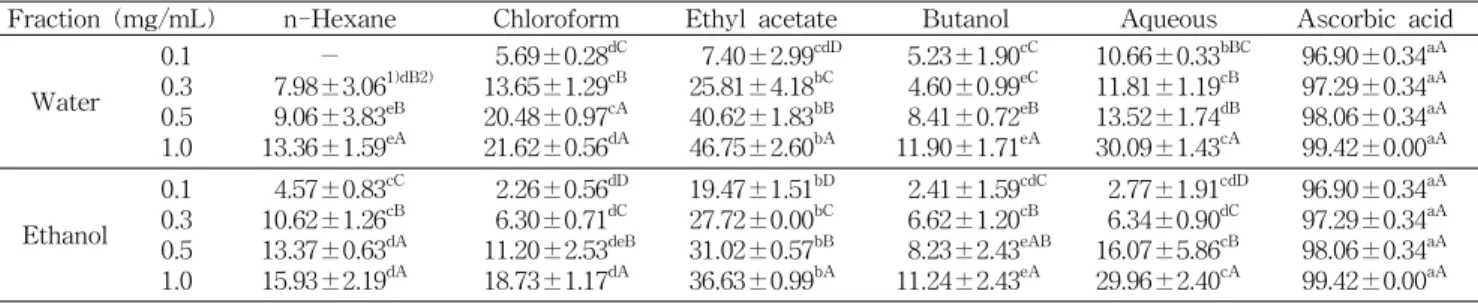
식품을 비롯한 생물의 갈변화 현상에 관련된 tyrosinase 저해를 남천 열매 추출물의 극성이 상이한 유기용매 분획물 에 대해 측정한 결과 WE(46.75%)>EE(36.63%)>WA(30.09
%)>EA(29.96%)의 순으로 ethyl acetate 층이 가장 우수하 였으며(Table 6), 분획물의 농도가 증가함에 따라 tyrosinase 저해율도 증가되는 것으로 분석되었다(p<0.05).
Kang 등(28)은 꾸지뽕나무 열매에서 37.23%의 저해율을 나타낸다고 하였으며, 일부 열매류 약용식물인 복분자 63%, 산사자 43% 그리고 오미자 21%의 tyrosinase 저해율을 보 고한 Jung 등(30)의 결과와 비교하면, 복분자보다는 낮았으 나 꾸지뽕나무 열매나 오미자보다는 유사하거나 높은 저해 율을 나타내어 남천 열매 추출물은 melanine 생성 및 식물의 갈변화를 저해하는데 이용 가능한 식물자원으로 판단된다.
요 약
남천(
Nandina domestica) 열매를 물과 에탄올 추출 후 극성이 상이한 유기용매를 순차적으로 분획하여 각 추출물 의 생리활성을 측정하였다. 폴리페놀은 EE(ethyl acetate fraction of ethanol extract)에서 922.22 mg/g이었으며, 플라 보노이드는 EB(butanol fraction of ethanol extract)에서 282.49 mg/g을 함유하였다. WA(aqueous of water extract) 와 EH(n-hexane fraction of ethanol extract)는 0.1 mg/mL 에서 93% 이상의 전자공여활성을 나타내었으며, 분획물의 농도 증가에 따른 전자공여능의 유의적 차이는 없었다. SOD 유사활성은 1.0 mg/mL의 EA(aqueous of ethanol extract) 에서 56.36%로 가장 우수하였으며, EH와 EC(chloroform fraction of ethanol extract)에서도 50% 이상의 활성을 나타
내었다. 아질산염 소거는 pH 1.2의 EC에서 82.03%로 가장 높았다. Xanthine oxidase 저해율은 0.5 mg/mL에서 WE를 제외한 모든 분획물에서 90% 이상의 저해율을 나타내었으 나, WE는 46.75%로 가장 우수한 tyrosinase 저해효과를 나 타내었다. 이상의 결과 남천 열매 분획물은 다량의 폴리페놀 과 플라보노이드를 함유하고 생리활성 효과가 우수하여 천 연 항산화 제재 및 이를 이용한 의약품 개발 가능성을 지닌 약용 식물자원인 것으로 판단된다.
감사의 글
본 연구는 2010년 대구한의대학교 기린연구비 지원에 의 한 것임.
문 헌