• 검색 결과가 없습니다.

Anatomical and Functional Recovery of Intracapsular Fractures of the Mandibular Condyle: Analysis of 124 Cases after Closed Treatment

N/A
N/A
Protected

Academic year: 2021

Share "Anatomical and Functional Recovery of Intracapsular Fractures of the Mandibular Condyle: Analysis of 124 Cases after Closed Treatment"

Copied!
7
0
0

로드 중.... (전체 텍스트 보기)

전체 글

(1)

ISSN 2288-8101(Print) ISSN 2288-8586(Online)

Original Article

RECEIVED September 13, 2014, ACCEPTED November 6, 2014 Correspondence to Jun-Young Paeng

Department of Oral and Maxillofacial Surgery, School of Dentistry, Kyungpook National University 2175 Dalgubeoldae-ro, Jung-gu, Daegu 700-705, Korea

Tel: 82-53-600-7551, Fax: 82-53-426-5365, E-mail: [email protected]

Copyright © 2014 by The Korean Association of Maxillofacial Plastic and Reconstructive Surgeons. All rights reserved.

CC

This is an open access article distributed under the terms of the Creative Commons Attribution Non-Commercial License (http://creativecommons.org/licenses/

by-nc/3.0) which permits unrestricted non-commercial use, distribution, and reproduction in any medium, provided the original work is properly cited.

Anatomical and Functional Recovery of Intracapsular Fractures of the Mandibular Condyle: Analysis of 124

Cases after Closed Treatment

Jong-Sung Lee, Eun-Gyu Jeon, Guk-Jin Seol, So-Young Choi, Jin-Wook Kim, Tae-Geon Kwon, Jun-Young Paeng

Department of Oral and Maxillofacial Surgery, School of Dentistry, Kyungpook National University

Abstract

Purpose: The purpose of this study is to evaluate the influence of intracapsular fracture lines of the mandibular condyle on the anatomical and functional recovery after non-surgical closed treatment.

Methods: Clinical and radiological follow-up of 124 patients with intracapsular fractures of the mandibular condyle was performed after closed treatment between 2005 and 2012. The intracapsular fractures were classified into three categories:

type A (medial condylar pole fracture), type B (lateral condylar pole fracture with loss of vertical height) and type M (multiple fragments or comminuted fracture).

Results: By radiological finding, fracture types B and M lost up to 24% vertical height of the mandibular condyle compared to the height on the opposite side. In Type M, moderate to severe dysfunction was observed in 33% of the cases. Bilateral fractures were significantly associated with the risk of temporomandibular joint (TMJ) dysfunction in fracture types A and B. Bilateral fracture and TMJ dysfunction were not statistically significantly associated in type M fractures.

Conclusion: Most of the mandibular intracapsular condylar fractures recovered acceptably after conservative non-surgical treatment with functional rehabilitation, even with some anatomical shortening of the condylar height. The poor functional recovery encountered in type M fractures, especially in cases with additional fracture sites and bilateral fractures, points up the limitation of closed treatment in such cases.

Key words: Temporomandibular joint disorders, Mandibular fracture, Mandibular condyle

Introduction

Among facial bone fractures, mandible and nasal bone fractures are most common, and condylar fractures are one of the most common fractures in the mandible[1]. Condylar fractures account for 29% to 40% of facial bone fractures

and 9% to 62% of all mandible fractures[2-8]. Intracapsular condylar fractures, however, are relatively rare[9].

The ideal approach for diagnosis and treatment of man-

dibular condylar fractures is an open question. Many stud-

ies have investigated treatment methods and physical ther-

apy based on condylar fracture classification[10-12]. The

(2)

Fig. 1. Type of intracapsular fracture in coronal view. (A) Medial condylar pole fracture. (B) Lateral condylar pole fracture with loss of vertical height. (C) Multiple fragments or comminuted fracture.

indications for closed versus open treatment are also a matter of debate[13-16], with various methods of con- servative treatment reported[17]. The typical closed treat- ment is intermaxillary fixation for one or two weeks to correct occlusion and stretch the jaw to prevent anky- losis[18]. Conservative treatments are preferred to avoid facial nerve injury, scar formation during surgery, and the difficulty of reducing small fragments[19]. However, several studies observed unpredictable results after conservative treatment, including deviation of the mandible[17], growth disturbance of the jaw, and ankylosis[19-21].

The purpose of this retrospective study is to evaluate the influence of intracapsular fracture lines of the man- dibular condyle on the anatomical and functional recovery after non-surgical closed treatment.

Materials and Methods

1. Patients

In the period from 2005 to 2012, 180 patients with intra- capsular fractures of the mandibular condyle were treated at our institution. In the current study, 124 of these patients (90 male and 34 female patients; average age, 35.4 years;

range, five to 71 years) were examined two to 90 months after treatment (mean, 31.2 months). The condylar frac- tures were caused by slips (n=58), traffic accidents (n=30), falls (n=24), motorcycle accidents (n=20), syncope (n=6), bicycle accidents (n=11), drunkenness (n=9), work acci- dents (n=6), sports (n=3), and assaults (n=1). The fractures

were classified based on radiographs including a pan- oramic and a postero-anterior radiogram, coronal com- puted tomography.

The current study adopted Hlawitschka classification sys- tem[22,23], which groups intracapsular fractures into three categories: type A (medial condylar pole fracture), type B (lateral condylar pole fracture with loss of vertical height) and type M (multiple fragments or comminuted fracture) (Fig. 1). Based upon Hlawitschka classification, 29 type A intracapsular fractures, 56 type B intracapsular fractures and 39 type M intracapsular fractures were diagnosed in the pres- ent study. Concomitant fractures at other sites of the mandible were treated by osteosynthesis, allowing the initiation of mouth-opening exercises as soon as possible. Closed treat- ment included one week of intermaxillary fixation and func- tional observation for four to eight weeks. This study was approved by the institutional review board of Kyungpook National University Hospital (IRB No. 2014-01-002-003).

2. Post-treatment examinations

The clinical findings are summarized using the dysfunc-

tion index provided by Helkimo[24], composed of five cri-

teria: mandibular mobility, temporomandibular joint (TMJ)

function, pain in masticatory muscle, TMJ pain, and pain

during movement (Table 1). The radiologic examination

included orthopantomograph. The distances measured are

shown in Fig. 2. Reductions in the height of the ramus

and condyle on panoramic radiographs after unilateral con-

dyle fracture were determined by comparison with the

height on the non-fractured contralateral side.

(3)

Table 1. TMJ clinical dysfunction index (Di) by Helkimo categories[24]

Symptom Criteria (point)

Impaired range of movement/mobility index

Impaired TMJ function

Muscle pain

TMJ pain

Pain on movement of the mandible

Normal range of movement (0) Slightly impaired mobility (1) Severely impaired mobility (5)

Smooth movement without TMJ sounds and/or deviation of ≤2 mm on opening or closing (0) TMJ sounds in one or both joints and/or deviation of ≥2 mm on opening or closing (1) Locking and/or luxation of the TMJ (5)

No tenderness on palpation of the masticatory muscles (0) Tenderness on palpation of 1∼3 palpation sites (1) Tenderness on palpation of 4 or more palpation sites (5) No tenderness on palpation (0)

Tenderness on palpation laterally (1) Tenderness on palpation posteriorly (5) No pain on movement (0)

Pain on 1 type of movement (1)

Pain on 2 or more types of movements (5)

Dysfunction score: sum of 5 symptoms (0∼25 points), Di0: clinically symptom free (0 point), DiI: mild dysfunction (1∼4 points), DiII: moderate dysfunction (5∼9 points), DiIII: severe dysfunction (10∼25 points).

TMJ, temporomandibular joint.

Fig. 2. Distances in the panoramic radiogram according to Hlawitschka and Eckelt[23]. ①: horizontal line of mandibular angle, ②: tangents line of mandibular angle, ③: horizontal line of subcondylar notch in non-fractured side, ④: horizontal line of condyle in non-fractured side, ⑤: ramus height in non-fractured side (mm), ⑥: condyle height in non-fractured side (mm), ⑦:

horizontal line of subcondylar notch in fractured side, ⑧:

horizontal line of condyle in fractured side, ⑨: condyle height in fractured side (mm), ⑩: ramus height in fractured side (mm).

Table 2. Distribution of loss in ramus and condyle height by fracture type

Type No. of patients

Loss in vertical ramus height (%)

Loss in condylar height (%) Type A

Type B Type M

19 41 19

2.7±2.5 9.3±4.5 7.7±5.0

8.3±7.0 23.7±13.5 24.0±7.7 Values are presented as number or mean±standard deviation.

Type A, medial condylar pole fracture; Type B, lateral condylar pole fracture with loss of vertical height; Type M, multiple fragments or comminuted fracture.

3. Statistical analysis

The average values and standard deviations were de- termined using the program Microsoft Excel 2010 (Microsoft, Redmond, WA, USA). Fisher exact test and Cochran-Mantel-Haenszel test were used to determine the significance of differences between types of intracapsular fracture and the presence of additional mandibular fractures. Null hypotheses of no difference were rejected if P -values were less than 0.05, or equivalently, if the 95%

confidence intervals of risk point estimates excluded 1.

Results

1. Radiological findings

Radiological evaluation showed a reduction of 24% in the condylar height for intracapsular fracture types B and M and a reduction of 8% for type A fractures, in comparison with the heights on the non-fractured contralateral side. The mandibular ramus height was reduced by an average of 9% for type B, 8% for type M, and 3% for type A (Table 2).

2. Clinical findings

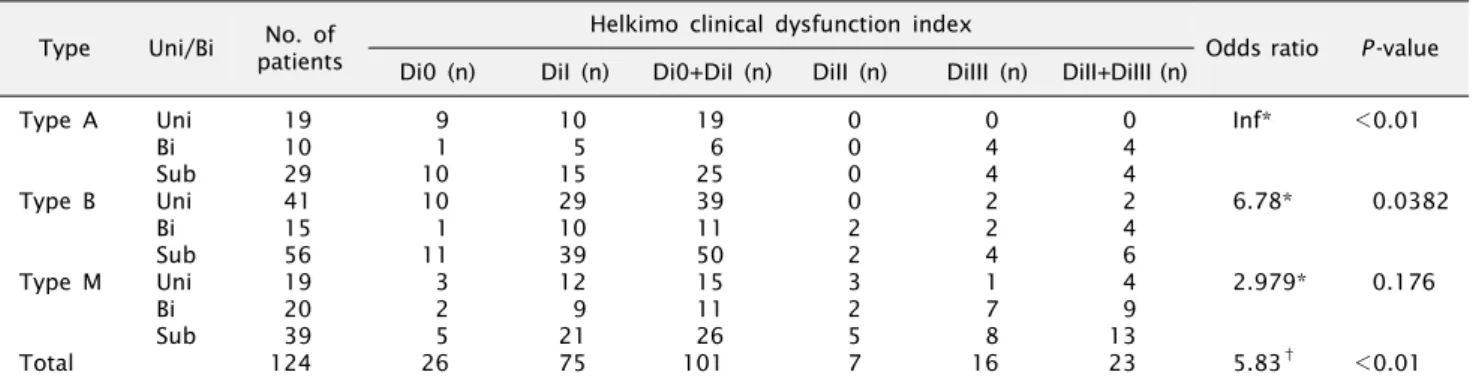
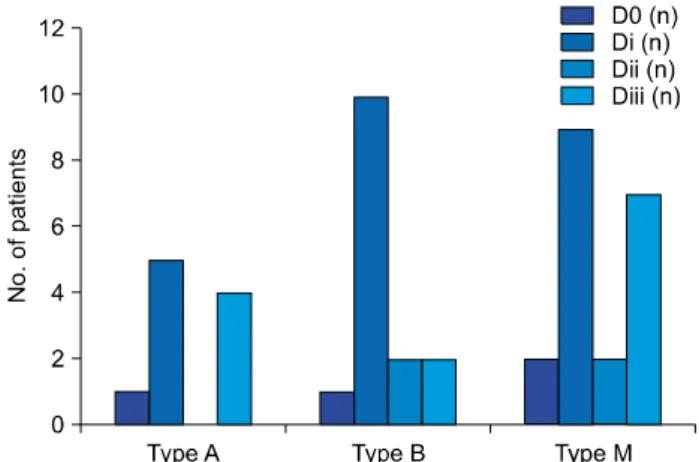
Moderate-to-severe dysfunction was observed in 13 out of 39 type M cases (33.3%), four out of 29 type A cases (13.8%), and six out of 56 type B cases (10.7%). The differ- ences in the risk of moderate-to-severe dysfunction among the three groups were statistically significant (Table 3, Fig.

3; Fisher exact test, P =0.019). Bilateral fractures were sig-

nificantly associated with the risk of TMJ dysfunction in

types A and B fractures. No statistically significant differ-

(4)

Table 3. Distribution of clinical dysfunction by fracture type Type Uni/Bi No. of

patients

Helkimo clinical dysfunction index

Odds ratio P -value Di0 (n) DiI (n) Di0+DiI (n) DiII (n) DiIII (n) DiII+DiIII (n)

Type A

Type B

Type M

Total

Uni Bi Sub Uni Bi Sub Uni Bi Sub

19 10 29 41 15 56 19 20 39 124

9 1 10 10 1 11 3 2 5 26

10 5 15 29 10 39 12 9 21 75

19 6 25 39 11 50 15 11 26 101

0 0 0 0 2 2 3 2 5 7

0 4 4 2 2 4 1 7 8 16

0 4 4 2 4 6 4 9 13 23

Inf*

6.78*

2.979*

5.83

<0.01

0.0382

0.176

<0.01 Dysfunction score: sum of 5 symptoms (0∼25 points), Di0: clinically symptom free (0 point), DiI: mild dysfunction (1∼4 points), DiII: moderate dysfunction (5∼9 points), DiIII: severe dysfunction (10∼25 points).

Type A, medial condylar pole fracture; Type B, lateral condylar pole fracture with loss of vertical height; Type M, multiple fragments or comminuted fracture; Uni, unilateral fracture; Bi, bilateral fracture; Sub, subtotal; Inf, infinity.

*Fisher’s exact test.

Cochran-Mantel-Haenszel test.

Fig. 3. Distribution of clinical dysfunction by fracture type.

Dysfunction score: sum of 5 symptoms (0∼25 points), Di0:

clinically symptom free (0 point), DiI: mild dysfunction (1∼4 points), DiII: moderate dysfunction (5∼9 points), DiIII: severe dysfunction (10∼25 points). Type A, medial condylar pole fracture; Type B, lateral condylar pole fracture with loss of vertical height; Type M, multiple fragments or comminuted fracture.

Fig. 4. Distribution of clinical dysfunction by fracture type in unilateral fracture. Dysfunction score: sum of 5 symptoms (0∼25 points), Di0: clinically symptom free (0 point), DiI: mild dysfunction (1∼4 points), DiII: moderate dysfunction (5∼9 points), DiIII: severe dysfunction (10∼25 points). Type A, medial condylar pole fracture; Type B, lateral condylar pole fracture with loss of vertical height; Type M, multiple fragments or comminuted fracture.

Table 4. Distribution of clinical dysfunction by unilateral/bilateral fracture

Type No. of patients Helkimo dysfunction index

Symptom-free: Di0 (n) Mild: DiI (n) Moderate: DiII (n) Severe: DiIII (n) Unilateral

Bilateral Total

79 45 124

22 4 26

51 24 77

3 4 7

3 13 16

ence was observed in the association between bilateral fractures and TMJ dysfunction in type M cases (Table 3).

Moderate-to-severe dysfunction was observed in 17 out of 45 bilateral fracture cases (37.8%), and in six out of 79 unilateral fracture cases (7.6%). The difference in the number of cases of moderate-to-severe dysfunction be-

tween the groups was statistically significant (Table 4, Fig.

3, 4; Fisher exact test, P <0.0001). Moderate-to-severe dys-

function was observed in 20 out of 75 cases with additional

fractures (26.7%), and in three out of 49 cases without

additional fractures (6.1%). The difference between groups

was statistically significant (Table 5; Fisher exact test,

(5)

Fig. 6. Radiologic findings of patient with bilateral and additional fracture who had severe dysfunction. (A) First visit. (B) Four years later.

Table 5. Distribution of clinical dysfunction by additional fracture sites

Fracture site No. of patients Helkimo dysfunction index

Symptom-free: Di0 (n) Mild: DiI (n) Moderate: DiII (n) Severe: DiIII (n) Additional fracture site

Symphysis Body or angle Subcondylar neck Total

None

60 19 6 75 49

13 6 2 17 9

31 8 3 38 37

6 1 1 7 0

10 4 0 13 3

Fig. 5. Distribution of clinical dysfunction by fracture type in bilateral fracture. Dysfunction score: sum of 5 symptoms (0∼25 points), Di0: clinically symptom free (0 point), DiI: mild dysfunction (1∼4 points), DiII: moderate dysfunction (5∼9 points), DiIII: severe dysfunction (10∼25 points). Type A, medial condylar pole fracture; Type B, lateral condylar pole fracture with loss of vertical height; Type M, multiple fragments or comminuted fracture.

P =0.0028). No statistically significant difference was found among the three additional fracture site groups (Fig. 5).

Discussion

The most common causes of condyle fractures cited in the literature are traffic accidents, followed by falls and assaults[25]. Condylar fractures can be caused by indirect forces delivered to the condyle from the direct trauma site[26]. In the present study, the most common cause of an intracapsular condyle fracture was a slip. Condylar frac- tures may lead to severe problems such as malocclusion, facial growth disturbance, or disorders of the TMJ[27].

Zachariades et al .[26] reported that choice of treatment for condylar fractures depends on factors such as co-mor- bidity with other facial fractures, the location of condylar fractures, the level of displacement, the state of dentition and dental occlusion, and general condition.

Treatment for condyle fractures is includes closed treat- ment and surgical intervention. Closed treatment includes intermaxillary mobilization and functional therapy. Surgical intervention is used to reposition and stabilize the frag-

ments[8].

Closed treatment is indicated in almost all condylar frac-

tures occurring in childhood[28], because it achieves early

mobilization and adequate functional stimulation of con-

(6)

dylar growth[8,28]. Conversely, surgical intervention is in- dicated when the condylar head is severely displaced or dislocated, especially in adults[26,28].

In childhood, remodeling of the mandibular condyle can often recover normal to near-normal morphology and func- tion, since the remodeling center is the mandibular condyle and it responds to changes in the relationship of surround- ing structures during growth[29-31].

Conservative treatment may be regarded as the first choice of treatment for fractures of mandibular condyle to avoid nerve injury and scar formation[19]. Nevertheless, contraindications for closed treatment for condylar fractures should be considered carefully. Ellis et al .[32] reported that more severe problems can occur, for example malocclusion and open bite, or deviation on mouth opening, when con- dylar fractures are treated by closed treatment. Dahlström et al .[29] reported that mild clinical dysfunction can occur after moderate displacement of the condylar head, and moderate clinical dysfunction may occur after condylar head dislocation. Silvennoinen et al .[27] reported that in- juries were more often severe after bilateral condylar frac- tures, compared with unilateral condylar fracture cases.

In this study, type M cases involving bilateral fractures and additional fractures often developed moder- ate-to-severe dysfunction and deranged condylar morphol- ogy (Fig. 6). Bilateral fractures developed more severe functional disturbance than unilateral fractures (odds ra- tio=5.83, P <0.01; Table 3), although the frequency of dys- function did not differ between bilateral and unilateral frac- tures in type M cases. This means that a type M presentation leads to significantly more dysfunction. Type M cases fre- quently developed severe functional problems even in uni- lateral cases.

Conclusion

Most mandibular intracapsular condylar fractures showed clinically acceptable recovery with conservative non-surgical treatment and functional rehabilitation even with some anatomical shortening of the condylar height.

The poor functional recovery encountered in type M frac- tures, especially in cases with additional fracture sites and bilateral fractures, point up the limitations of closed treat- ment for such cases.

References

1. Turvey TA. Midfacial fractures: a retrospective analysis of 593 cases. J Oral Surg 1977;35:887-91.

2. Schuchardt K, Metz HJ. Injuries of the facial skeleton. Mod Trends Plast Surg 1966;2:62-107.

3. Tasanen A, Lamberg MA. Transosseous wiring in the treat- ment of condylar fractures of the mandible. J Maxillofac Surg 1976;4:200-6.

4. Olson RA, Fonseca RJ, Zeitler DL, Osbon DB. Fractures of the mandible: a review of 580 cases. J Oral Maxillofac Surg 1982;40:23-8.

5. Fridrich KL, Pena-Velasco G, Olson RA. Changing trends with mandibular fractures: a review of 1,067 cases. J Oral Maxillofac Surg 1992;50:586-9.

6. Buchbinder D. Treatment of fractures of the edentulous mandible, 1943 to 1993: a review of the literature. J Oral Maxillofac Surg 1993;51:1174-80.

7. Schön R, Roveda SI, Carter B. Mandibular fractures in Townsville, Australia: incidence, aetiology and treatment us- ing the 2.0 AO/ASIF miniplate system. Br J Oral Maxillofac Surg 2001;39:145-8.

8. Valiati R, Ibrahim D, Abreu ME, et al . The treatment of condylar fractures: to open or not to open? A critical review of this controversy. Int J Med Sci 2008;5:313-8.

9. Rowe NL, Killey HC, editors. Fractures of the facial skeleton.

2nd ed. Edinburgh: E & S Livingstone; 1970. p.2-144.

10. Spiessl B. Rigid internal fixation of fractures of the lower jaw. Reconstr Surg Traumatol 1972;13:124-40.

11. Yamaoka M, Furusawa K, Iguchi K, Tanaka M, Okuda D.

The assessment of fracture of the mandibular condyle by use of computerized tomography. Incidence of sagittal split fracture. Br J Oral Maxillofac Surg 1994;32:77-9.

12. Choi BH. Magnetic resonance imaging of the tempor- omandibular joint after functional treatment of bilateral con- dylar fractures in adults. Int J Oral Maxillofac Surg 1997;26:

344-7.

13. Zide MF, Kent JN. Indications for open reduction of man- dibular condyle fractures. J Oral Maxillofac Surg 1983;41:

89-98.

14. Ellis E 3rd, Dean J. Rigid fixation of mandibular condyle fractures. Oral Surg Oral Med Oral Pathol 1993;76:6-15.

15. Walker RV. Condylar fractures: nonsurgical management. J Oral Maxillofac Surg 1994;52:1185-8.

16. Hall MB. Condylar fractures: surgical management. J Oral Maxillofac Surg 1994;52:1189-92.

17. Nørholt SE, Krishnan V, Sindet-Pedersen S, Jensen I.

Pediatric condylar fractures: a long-term follow-up study of 55 patients. J Oral Maxillofac Surg 1993;51:1302-10.

18. Kruger GO, editor. Textbook of oral surgery. 4th ed. Saint Louis: Mosby; 1974. p.2-360.

19. Hovinga J, Boering G, Stegenga B. Long-term results of nonsurgical management of condylar fractures in children.

Int J Oral Maxillofac Surg 1999;28:429-40.

20. Cascone P, Sassano P, Spallaccia F, Rivaroli A, Di Paolo C.

Condylar fractures during growth: follow-up of 16 patients. J Craniofac Surg 1999;10:87-92.

21. Strobl H, Emshoff R, Röthler G. Conservative treatment of

unilateral condylar fractures in children: a long-term clinical

(7)

and radiologic follow-up of 55 patients. Int J Oral Maxillofac Surg 1999;28:95-8.

22. Neff A, Kolk A, Deppe H, Horch HH. New aspects for in- dications of surgical management of intra-articular and high temporomandibular dislocation fractures. Mund Kiefer Gesichtschir 1999;3:24-9.

23. Hlawitschka M, Eckelt U. Assessment of patients treated for intracapsular fractures of the mandibular condyle by closed techniques. J Oral Maxillofac Surg 2002;60:784-91; discussion 792.

24. Helkimo M. Studies on function and dysfunction of the masticatory system. II. Index for anamnestic and clinical dysfunction and occlusal state. Sven Tandlak Tidskr 1974;67:

101-21.

25. Adi M, Ogden GR, Chisholm DM. An analysis of mandibular fractures in Dundee, Scotland (1977 to 1985). Br J Oral Maxillofac Surg 1990;28:194-9.

26. Zachariades N, Mezitis M, Mourouzis C, Papadakis D, Spanou A. Fractures of the mandibular condyle: a review of

466 cases. Literature review, reflections on treatment and proposals. J Craniomaxillofac Surg 2006;34:421-32.

27. Silvennoinen U, Lindqvist C, Oikarinen K. Dental injuries in association with mandibular condyle fractures. Endod Dent Traumatol 1993;9:254-9.

28. De Riu G, Gamba U, Anghinoni M, Sesenna E. A compar- ison of open and closed treatment of condylar fractures: a change in philosophy. Int J Oral Maxillofac Surg 2001;30:

384-9.

29. Dahlström L, Kahnberg KE, Lindahl L. 15 years follow-up on condylar fractures. Int J Oral Maxillofac Surg 1989;18:18-23.

30. Lindahl L. Condylar fractures of the mandible. IV. Function of the masticatory system. Int J Oral Surg 1977;6:195-203.

31. Ingervall B, Lindahl L. Masticatory muscle function in pa- tients treated for condylar fractures of the mandible. Int J Oral Surg 1980;9:359-66.

32. Ellis E 3rd, Simon P, Throckmorton GS. Occlusal results af-

ter open or closed treatment of fractures of the mandibular

condylar process. J Oral Maxillofac Surg 2000;58:260-8.

수치

Fig. 1. Type of intracapsular fracture in coronal view. (A) Medial condylar pole fracture
Fig. 2. Distances in the panoramic radiogram according to  Hlawitschka and Eckelt[23]
Table 3. Distribution of clinical dysfunction by fracture type Type Uni/Bi No. of
Fig. 6. Radiologic findings of patient with bilateral and additional fracture who had severe dysfunction

참조

관련 문서

이것은 이용허락규약 (Legal Code) 을 이해하기 쉽게 요약한 것입니다. 귀하는 원저작자를 표시하여야 합니다.. Operative treatment for nonunion of humerus shaft fracture ---

3.7 Fracture interface after tensile shear test with plunge depth 43 Table.. 3.13 Fracture interface after tensile shear test with dwell time

An evaluation of marginal fit of three-unit fixed dental prostheses fabricated by direct metal laser sintering system.. Marginal accuracy and fracture strength

Through this result, it was confirmed that brittle fracture did not occur in high Mn steel and ductile fracture occurred in spite of cryogenic

Purpose: Calcaneal fracture is a rare fracture, which accounts for about 2% of all fractures, but is one of the most common fractures in the ankle bone.. There is

The clinical outcome and complication for treating proximal femoral shaft fracture were compared and analyzed through the group treated with closed

This study investigated the loading rate effect on the fracture resistance under cyclic loading conditions to clearly understand the fracture behavior of

Figure 8.1 A propane tank truck explosion due to fracture from initial cracks in