ISSN 2288-1069 (Online)
http://dx.doi.org/10.12925/jkocs.2016.33.3.474
복분자 열매(
Rubus coreanus
Miquel)의 항산화 활성 및 생리활성물질진동혁․성종환․이영근․김동섭․정헌식․김한수
✝부산대학교 식품공학과
(2016년 7월 18일 접수; 2016년 8월 23일 수정; 2016년 9월 20일 채택)
Antioxidant Activity and Effective Compounds of Black Raspberry ( Rubus coreanus Miquel) Extracted by Different Solvents
Dong-Hyeok Jin․Jong-Hwan Seong․Young-Geun Lee․Dong-Seob Kim Hun-Sik Chung․Han-Soo Kim✝
Department of Food Science and Technology, Pusan National University, Miryang 50463, Korea (Received July 18, 2016; Revised August 23, 2016; Accepted September 20, 2016)
Abstract : The black raspberry (
Rubus coreanus
Miquel)
contains anthocyanin, tannins, gallotannin, gallic acid, ferulic acid and phenolics. It brightens the eyes and protects the liver and kidneys. It was effective for anti-aging. Thus, the purpose of this study was to inform the excellence of black raspberry and to screen antioxidant activity to ensure the possibility as a functional material. In this study, bioactive compounds in black raspberry were determined.Additionally, black raspberry was extracted by CM (chloroform:methanol, 2:1, v/v), 70% methanol and 70% ethanol, and were investigated and compared
in vitro
methods. Total phenol and flavonoid contents were measured to compare each different solvents. In addition, DPPH radical scavenging activity and ABTS radical scavenging activity, ferric reducing antioxidant power, reducing power were determined to measure the antioxidant activity. The results were the highest in 70% ethanol extracts, and the higher the concentration showed a significantly higher antioxidant capacity. When observed the relationship between the study, antioxidant activity of black raspberry was supposed to affect by the anthocyanin, phenol and flavonoid contents.Keywords : black raspberry (Rubus coreanus Miquel), Bokbunja, antioxidant activity, anthocyanin, total phenol, flavonoid
✝
Corresponding author
(E-mail: [email protected])
1. 서 론
최근 reactive oxygen species (ROS)과 같은 산화 대사산물이 노화의 원인으로 보고됨에 따라 ROS 및 free radical을 제거할 수 있는 천연 항 산화 물질의 수요는 증가하고 있다[1]. 식물체의 경우 이차 대사산물의 방어체계, 효소와 같은 보 호 기작이 발달되어 있어서 식물체에서 항산화 물질을 탐색, 연구하는 것은 중요한 의미를 지닌 다고 한다[2]. 이러한 식물체 중에서도 베리류는 polyphenols, phenolic acids, flavonoids 및 carotenoids 함량이 높을 뿐만 아니라 vitamin B 복합물과 vitamin C, anthocynin 등 여러 생리활 성물질을 함유하고 있어 이러한 천연화합물들은 체내에서 단백질의 변성이나 지질 과산화, DNA 손상 등을 일으키는 ROS 및 free radical을 제거 할 수 있는 능력과 이에 대한 상호 작용을 통해 생활습관병을 예방하는 것으로 알려져 있다[3].
그 중 복분자(
Rubus coreanus
Miquel)는 장미과 (Rosaceae
)에 속하는 낙엽 활엽성 관목으로 우리 나라에서는 제주도 및 남부지방, 중부지방과 일 본, 미국, 유럽 등의 해발 50~1,000 m 지역의 산기슭 양지에 자생하며 5~6월에 연한 홍색의 꽃이 피고, 7~8월에 열매가 성숙되며, 핵과(核 果)는 둥글고 붉은색으로 익은 후 검붉은 색으로 완숙되어 단맛과 신맛, 독특한 향을 가지고 있어 초여름에 열매를 수확하여 식용하고 있다[4]. 원 산지로 알려진 중국에서는 일반적으로Rubus
속 식물 약 20여종의 미성숙 과실을 증기로 쪄서 햇 볕에 말린 것을 복분자라고 정의하여 강장제 등 과 같은 약용으로 쓰이고 있고 우리나라는 약용 과 술에 사용하고 있다[5]. 유럽과 미국에서도Rubus
속 식물의 열매를 나무딸기류(raspberry) 로 통칭하며 이 속에 속하는 식물은 400여종 이 상이 있다고 한다[6]. 약을 보하고 속을 덮게 하 며 눈을 밝게 하고 간과 신장을 보호하며 안색을 좋게 하고 빈또 한방에서는 기를 더하고 몸을 가 볍게 하며 백발을 억제하고 오장을 편하게 하며 해산 후 허뇨를 줄이며 피부를 윤택하게 하고 불 임증 치료 등 많은 효능을 가지는 것으로 보고되 어 있다[7]. 이러한 복분자의 영양성분으로는 무 기질인 인과 철, 칼륨이 풍부하며 특히 citric acid 및 astraglin과 같은 유기산과 비타민 C가 많이 포함되어 있고 tannins, gallotannin, gallic acid, ferulic acid, protocatechuic acid, epicatechin, ellagic acid 그리고 anthocyanin이함유되어 있다고 보고되어 있으며[8], 복분자에서 분리한 탄닌의 항산화 활성[9], 페놀화합물에 의 한 효소적 지질과산화 억제활성[10], 진통 항염작 용[11], 위염과 류마티즘 관절염에 대한 항염증효 과[12], 복분자 추출물에 의한 내피세포 유래 NO 합성효소의 활성과 발현증가[13] 등이 보고 되어 있다. 반면에 복분자를 용매별로 추출한 후 생리활성물질의 성분 함량과 항산화 활성을 측정 하여 비교한 연구는 아직 충분하지 않은 실정이 다.
이에 따라 본 연구에서는 복분자의 chloroform:
methanol (CM, 2:1, v/v), 70% methanol, 70%
ethanol의 용매별로 추출하여 anthocyanin, total phenol, flavonoid 함량을 측정하고, 항산화 능력 (DPPH radical scavenging activity, ABTS radical scavenging activity) 및 환원력(ferric reducing antioxidant power, reducing power)을 측정하여 복분자의 추출 용매에 따른 항산화능력 을 비교하여 생활습관병 예방과 건강기능 식품 개발의 목적으로 이들의 소비 효율성을 높이고 이에 대한 기초자료를 제시함으로써 천연 항산화 제의 이용 가능성을 검토하고자 하였다.
2. 재료 및 방법
2.1. 실험 재료
본 실험에 사용된 시료는 2015년 9월 전북 부 안에서 채취한 복분자(
Rubus coreanus
Miquel) 열매를 동결건조시켜 분쇄한 것을 시중에 구입하 여 deep freezer (DF-8514, Il-Shin BioBase Co., Daegu, Korea)에서 –80℃로 보관하며 사용 하였다.2.2. 시료의 추출
시료의 추출은 동결 저장된 복분자 분말 100 g을 취해 chloroform:methanol (CM, 2:1, v/v), 70% methanol, 70% ethanol 용매를 각 10배 가 하여(1:10, w/v) 24시간씩 2회 추출한 뒤 여과 (filter paper, Advantec, No.2, Tokyo, Japan)하 였다. 추출물들은 rotary evaporator (Hei-VAP Advantage, Heidolph, Germany)를 이용하여 4 0℃에서 감압 농축하여 용매를 제거한 후, 실험 에 사용하였다. 시료의 수율은 추출 전 시료 중 량에 대한 추출 후 건조 중량 백분율(%)로 나타 내었다.
2.3. Anthocyanin 함량 측정
복분자의 anthocyanin 함량은 pH-differential 방법을 변형하여 측정하였다[14]. 즉, 건조된 복 분자 분말 0.5 g에 methanol-1 M HCl (85:15, v/v) 15 mL를 가하여 30분 동안 혼합한 뒤 여과하여 분석 시료로 사용하였다. 시료 1.0 mL에 0.025 M potassium chloride buffer (pH 1.0) 3.0 mL를 가하고 또 다른 시험관에 시료 1.0 mL에 0.4 M sodium acetate buffer (pH 4.5) 3.0 mL를 가한 후 암실에 20분간 방치하여 UV/Vis spectrophotometer (SP-200, Analytik Jena Co., Jena, Germany)를 사용하여 510 nm 및 700 nm에서 흡광도를 측정 하였다. 복분자의 anthocyanin 함량은 cyanidin-3-glucoside의 몰 흡광계수(ℇ=26,900 M-1cm-1)를 이용하여 계산 하였다[15].
2.4. Total phenol 함량 측정
Total phenol 함량은 Folin-Denis` 방법을 변 형하여 실험하였다[16]. 시료 추출액 0.5 mL에 증류수 4.0 mL을 넣고, Folin-Denis reagent 0.5 mL를 가한 후, 잘 섞어 3분간 실온에 방치한 뒤 10% Na2CO3 solution 0.5 mL을 첨가하여 실온 에 1시간 방치한 후 700 nm에서 흡광도를 측정 하였다. 표준물질로는 caffeic acid를 사용하여 시 료 1 g당 mg CAE (mg of caffeic acid equivalents)로 나타내었다.
2.5. Flavonoid 함량 측정
Total flavonoid 함량은 시료 추출액 0.5 mL에 10% aluminium nitrate 0.5 mL와 1 M potassium acetate 0.5 mL를 넣은 뒤, 80%
ethanol 2.0 mL를 첨가하여 잘 혼합한 후 40분 간 실온에 방치하여 반응시킨 후 415 nm에서 흡 광도 값을 측정하였다[17]. 이 때 표준물질인 quercetin을 사용해 검량선을 작성하여 시료 1 g 당 mg QE (mg of quercetin equivalents)로 계 산하였다.
2.6. DPPH radical scavenging activity 측정 DPPH (1,1'-diphenyl-2-picrylhydrazyl) radical scavenging activity는 각 용매 별 시료 추출물 0.2 mL와 0.1 mM DPPH 2.8 mL를 혼합하고 암실에서 30분간 반응시킨 후 517 nm에서 흡광 도를 측정하여 나타내었다. 각 시료 추출물의 free radical scavenging activity는 시료를 첨가하
지 않은 blank의 흡광도가 50% 감소하는데 필요 한 시료의 농도인 IC50 (50% inhibitory concentration)으로 결과를 표시하였다[18-19].
이 때 활성 비교를 위하여 control로 ascorbic acid를 사용하여 같은 방법으로 흡광도를 측정하 였다.
2.7. ABTS radical scavenging activity 측정 ABTS cation decolorization assay에 의한 방 법[20]을 변형하여 ABTS (2,2-Azino-bis-3- ethylbenzothiazoline-6-sulfonic acid) radical을 이용한 항산화력 측정을 시행하였다. 7 mM ABTS와 2.45 mM potassium persulfate를 1:1 (v/v)의 비율로 섞어 16시간 동안 암소에 방치하 여 ABTS radical을 형성시킨 후, ethanol로 희석 하여 735 nm에서 흡광도 값이 0.70(±0.02)이 되도록 하였다. 희석된 용액 3.9 mL에 시료 추출 액 0.1 mL를 넣은 후 10분 뒤 734 nm에서 흡 광도를 측정하였다. Control은 ascorbic acid를 사용하였고 ABTS radical scavenging activity는 백분율로 환산하여 표시하였다.
2.8. Ferric reducing antioxidant power (FRAP) 측정
FRAP 측정은 환원력을 이용하여 항산화능을 측정하는 방법[21-22]으로 0.3 M sodium acetate buffer (pH 3.6)과 10 mM 2,4,6- tripyridyl-S-triazine (TPTZ) solution, 20 mM ferric chloride를 10:1:1 (v/v/v)로 혼합하여 실 험 직전에 조제하여 사용하였다. 시료 추출액 0.2 mL에 FRAP reagent 3.0 mL를 가하여 30분간 water bath에 방치한 뒤 593 nm에서 흡광도를 측정하였으며 ferrous sulfate를 이용하여 검량선 을 작성한 후 환원력을 표시하였다. Control은 ascorbic acid를 사용하였다.
2.9. Reducing power 측정
복분자의 용매별 추출물에 따른 reducing power의 측정은 각 시료 추출 용액 1.0 mL 에 0.2 M sodium phosphate buffer (pH 6.6) 1.5 mL와 1% potassium ferrycyanide 1.0 mL를 넣 고 50℃의 water bath에서 20분간 반응 시켰다.
반응시킨 혼합액에 10% trichloroacetic acid 1.5 mL를 가하여 섞은 후 3,000 rpm에 10분간 원심 분리하여 분리된 상등액 1.0 mL를 증류수 3.0 mL 그리고 0.1% ferric chloride solution 0.2
Assays Black raspberry powder Anthocyanin content (mg/100 g DW2)) 156.52±0.79
CM1) 70% methanol 70% ethanol
Extraction yields (%) 32.56 66.60 72.52
Total phenol content (mg CAE3)/g) 23.43±0.81a6) 40.47±0.83b 42.93±0.82c Total flavonoid content (mg QE4)/g) 20.87±0.47a 32.82±0.14b 34.73±0.31c DPPH5) (IC50, mg/mL) 2.674±0.312c 0.518±0.002b 0.478±0.006a ABTS (IC50, mg/mL) 0.446±0.010c 0.175±0.002b 0.126±0.004a FRAP (IC50, mg/mL) 2.419±0.145c 0.658±0.001b 0.577±0.008a
1) CM: chloroform:methanol mixture (2:1, v/v). 2) DW: dry weight 3) CAE: caffeic acid equivalents.
4) QE: quercetin equivalents. 5) DPPH radical scavenging activity (DPPH), ABTS radical scavenging activity (ABTS), ferric reducing antioxidant power (FRAP). 6) The values are means±SD (n=3). Values with the different letters in the same row are significantly different (
p
<0.05) by Duncan`s multiple range tests.Table 1. Contents of anthocyanin, total phenol, flavonoid and IC50 values in the antioxidant activity evaluation assays of black raspberry (
Rubus coreanus
Miquel)mL와 잘 혼합시켜 10분 후 700 nm에서 흡광도 를 측정하였다[23].
2.10. 통계 처리
실험 데이터는 3회 반복 측정하였으며, mean±SD (n=3)으로 표현하였다. 또한 실험 군 간의 유의적인 차이는 one-way ANOVA (analysis of variance)로 분석 한 뒤
p
<0.05 수준 에서 Duncan`s multiple range test에 의하여 각 농도 간의 유의성을 검증하였다. 통계처리에 대한 프로그램은 IBM SPSS statistic ver. 22를 사용하 였다.3. 결과 및 고찰
3.1. 수 율
복분자(
Rubus coreanus
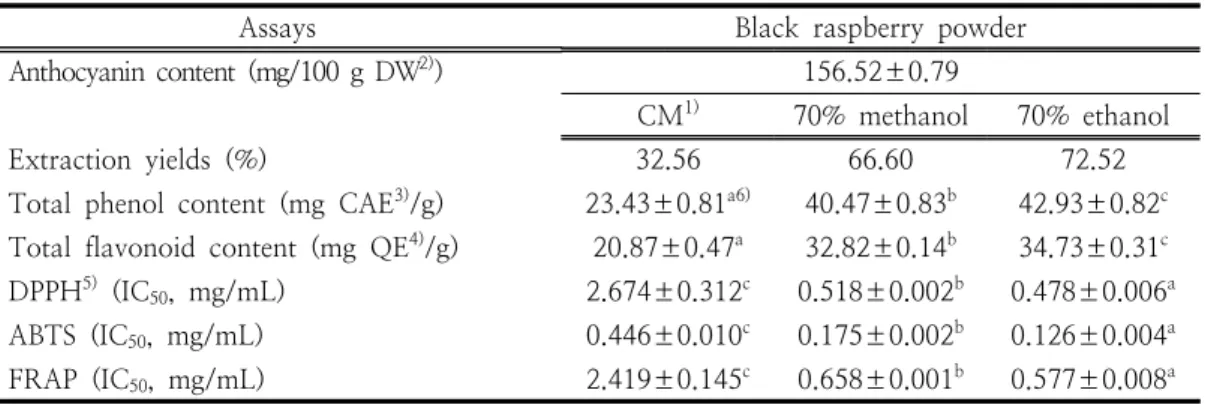
Miquel)의 chloroform:methanol (CM, 2:1, v/v)과 70% methanol 및 70% ethanol의 추출 수율은 Table 1에 나타내었 다. 각 용매별 추출 수율은 70% ethanol에서 72.52%로 가장 높게 나타났고, 70% methanol에 서 66.60%, CM에서 32.56% 순으로 나타났다.
3.2. Anthocyanin 함량
복분자 분말의 anthocyanin 함량은 Table 1과 같이 156.52±0.79 mg/100 g DW (dry weight) 로 나타났다. Anthocyanin은 적색과 자색 등의 색을 나타내는 식물체의 수용성 천연 색소로 시 력개선, 노화방지, 항암, 항염 등의 효과가 있는 것으로 알려져 있다[24]. 검은콩 1.12±0.02 mg/g[25], 블루베리 종인
Vaccinium corymbosum
L. (Northern Highbush) 129.2±3.2 mg/100 g[26], 오미자 340.4 mg/kg 로 보고되어 있다[27]. 따라서, 본 실험에서 복분 자 분말의 anthocyanin 함량은 이보다 높은 것으 로 확인되었다.3.3. Total phenol 함량
복분자의 용매별 추출물에서의 total phenol 함 량은 Table 1에 나타내었으며 70% ethanol 추출 물에서 42.93±0.82 mg CAE/g으로 가장 높게 나왔고, 70% methanol에서 40.47±0.83 mg CAE/g, CM에서 23.43±0.15 mg CAE/g 순으 로 CM에서 가장 낮은 값으로 관찰되었다. 건도 라지 acetone/methylene chloride 추출물과 methanol 분획물에서 각각 4.53±0.13, 27.22±0.83 TAE mg/100 g[28], 대추의 메탄올 추출물 326.46±1.97 mg%[29]로 복분자의 total
phenol 함량이 더 높은 것으로 나타났으며, Cho 등[30]의 복분자 60% 에탄올 추출물의 total phenol 함량이 41.3 mg/g으로 보고된 것으로 보 아 본 실험과 매우 유사한 것으로 나타났다.
3.4. Flavonoid 함량
복분자의 각 용매 추출물에서 flavonoid 함량 은 Table 1에 나타내었으며, 70% ethanol 추출 물에서 34.73±0.31 mg QE/g, 70% methanol 추출물이 32.82±0.14 mg QE/g, CM 추출물 20.87±0.47 mg QE/g으로 total phenol 함량의 결과와 비슷한 양상으로 측정 되었다. Kim 등 [31]의 생약 methanol 추출물 중 울금(
Curcuma longa
L.) 14.31±0.00 mg/g, 범부채 (Belamcanda chinensis
(L.) DC.) 12.02±1.44 mg/g, 삼백초(Saururus chinensis
(Lour.) Baill) 23.90±0.36 mg/g, 익모초(Leonurus japonicus
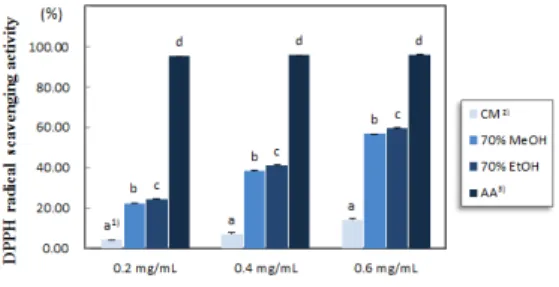
Houtt.) 20.35±0.36 mg/g 등으로 보고된 것과 비교했을 때 복분자의 flavonoid 함량은 매우 높 은 수준인 것으로 나타났다.3.5. DPPH radical scavenging activity 복분자의 각 용매별 추출물과 control인 ascorbic acid의 DPPH radical 소거능을 각 농도 별로 비교한 결과를 Fig. 1에 나타내었고, IC50값 을 구하여 Table 1에 나타내었다. 각 용매별 추 출물을 0.2, 0.4, 0.6 mg/mL의 농도로 맞추어 측 정한 결과 농도에 따라 점차 유의적으로 (
p
<0.05) radical 소거능이 증가하는 경향을 보였 다. 70% ethanol 추출물에서 농도별로 각각 24.58±0.15%, 41.02±0.29%, 59.55±0.50%로 추출물 중에 가장 높은 소거능을 보였으며, 70%methanol 추출물이 22.51±0.24%, 38.38±0.44%, 56.85±0.06%으로 나타났으며, CM 추출물이 4.26±0.15%, 7.19±0.60%, 14.28±0.56%로 각 용매 추출물 중 가장 낮은 소거능을 보였다. IC50은 70% ethanol 추출물과 70% methanol 추출물에서 각각 0.478±0.006, 0.518±0.002 mg/mL로 높은 free radical 소거능 을 나타내었고, CM 추출물의 경우 2.674±0.312 mg/mL로 70% ethanol 추출물에 비해 약 5.6배 낮은 free radical 소거능을 가지고 있는 것으로 나타났다. 이 결과 같은 시료라도 사용된 추출용 매의 극성에 의해 생리활성물질이 용해되는 정도 가 달라 항산화능의 차이가 나타난다는 보고와도 유사한 것으로 나타났다[32].
Fig. 1. DPPH radical scavenging activity of various extracts from black raspberry (
Rubus coreanus
Miquel).1) The values are means±SD (n=3).
Bars with the different letters are significantly different (
p
<0.05) by Duncan`s multiple range tests. 2) CM:chloroform:methanol mixture (2:1, v/v) extract. 3) AA: ascorbic acid.
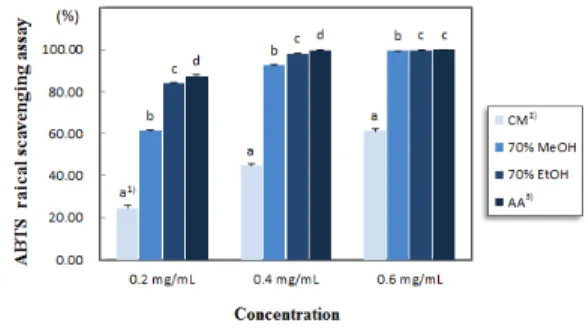
3.6. ABTS radical scavenging activity 복분자의 용매 농도별 추출물의 ABTS radical 소거능은 Fig. 2에 나타내었으며, 그 결과에 의한 IC50값은 Table 1에 표시하였다. ABTS radical 소거능은 각 농도가 높아짐에 따라 유의적으로 증가하였다(
p
<0.05). 그중 70% ethanol 추출물에 서 농도별 84.02±0.21%, 98.15±0.21%, 99.77±0.08%, 70% methanol 추출물에서 61.34±0.60%, 92.52±0.50%, 99.31±0.00%로 0.2 mg/mL의 농도에서는 70% ethanol 추출물의 소거능이 더 강한 활성을 나타냈으나 다른 농도 에서는 큰 차이 없이 강한 radical 소거능을 보였 다. 또한 control인 ascorbic acid와 비슷한 radical 소거능을 나타내었다(87.44±0.56%, 99.68±0.08%, 99.91±0.08%), CM 추출물은 농 도별로 24.67±1.06%, 44.76±0.94%, 61.34±0.91%로 다른 추출물 중 낮은 소거능을 보였다. 또한 IC50 값은 70% ethanol 추출물이 0.126±0.004 mg/mL로 높은 소거능을 보였고, 70% methanol 추출물이 0.175±0.002 mg/mL, CM 추출물 0.446±0.010 mg/mL의 순으로 나 타났다. 본 실험 결과는 DPPH 소거능 측정과 ABTS 소거능 측정은 활성도의 차이는 있지만 이 둘의 상관관계는 비슷한 결과가 나온다는 보고 [33]와 유사한 것으로 나타났다.Fig. 2. ABTS radical scavenging activity of various extracts from black raspberry (
Rubus
coreanus
Miquel).1) The values are means±SD (n=3).
Bars with the different letters are significantly different (
p
<0.05) by Duncan`s multiple range tests. 2) CM:chloroform:methanol mixture (2:1, v/v) extract. 3) AA: ascorbic acid.
3.7. Ferric reducing antioxidant power (FRAP)
복분자의 각 추출물에 따른 FRAP 결과는 Fig.
3에 나타내었고, IC50값은 Table 1에 나타내었다.
모든 추출물에서 측정한 흡광도는 농도별로 유의 적인 차이가 있었고(
p
<0.05) 표준물질로 ferrous sulfate를 사용하여 측정한 흡광도를 검량선을 작 성하여 환산한 결과 70% ethanol 추출물에서 각 농도별로 0.274±0.006, 0.515±0.008, 0.727±0.006 mM Fe2+로 유의적으로(p
<0.05) 높 게 나타났으며, 70% methanol 추출물에서 0.240±0.001, 0.449±0.010, 0.671±0.005 mM Fe2+, CM 추출물은 0.073±0.001, 0.155±0.004, 0.237±0.007 mM Fe2+로 낮은 것으로 나타났 고, IC50은 70% ethanol 추출물에서 0.577±0.008 mg/mL, 70% methanol 추출물에 서 0.658±0.001 mg/mL, CM 추출물에서 2.302±0.145 mg/mL 순으로 관찰되었다.2,4,6-tripyridyl-S-triazine (TPTZ)은 Fe3+와 결 합하여 황갈색의 Fe3+-TPTZ complex를 형성하 여 낮은 pH 환경에서 전자공여능이 있는 물질과 만날 경우 Fe2+-TPTZ로 환원되어 청색으로 변 색, 그 정도는 물질의 전자공여능과 비례하게 되 어 항산화능 측정에 자주 사용된다[34]. 적하수오
[35] 498.0±2.0 μM Fe2+/g, 딸기[22] 642.20 μM Fe2+/g으로 FRAP 측정된 보고와 비교하였 을 때 복분자의 항산화력은 우수한 것으로 사료 된다.
Fig. 3. Ferric reducing antioxidant power of various extracts from black raspberry (
Rubus
coreanus
Miquel).1) The values are means±SD (n=3).
Bars with the different letters are significantly different (
p
<0.05) by Duncan`s multiple range tests. 2) CM:chloroform:methanol mixture (2:1, v/v) extract. 3) AA: ascorbic acid.
3.8. Reducing power
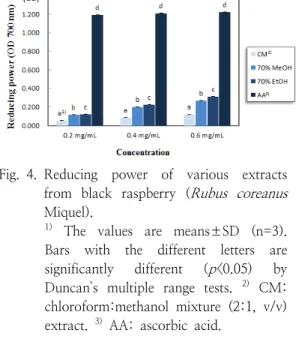
Reducing power는 각 용매별 추출물과 ascorbic acid의 농도가 증가함에 따라 유의적으 로(
p
<0.05) 흡광도가 증가하는 것을 보였고, 70%ethanol 추출물에서 각 농도별로 0.120, 0.222, 0.309로 높게 나타났으며, 70% methanol 추출물 에서 0.114, 0.199, 0.264로 높은 활성을 보였다.
CM 추출물은 0.051, 0.083, 0.117로 항산화 활 성 결과들과 마찬가지로 비교적 낮은 흡광도의 경향을 보였다. 이에 따라 total phenol, flavonoid 함량이 높아짐에 따라 항산화 활성 증 가하며, 또한 환원력 또한 높아짐을 확인하였다.
그 결과 total phenol 및 flavonoid와 항산화능 간의 상관관계가 있음 알 수 있었으며, 이는 total phenol과 flavonoid 함량이 많을수록 높은 항산화 활성을 보인다는 보고와 유사한 것으로 나타났다[36-37].
Fig. 4. Reducing power of various extracts from black raspberry (
Rubus coreanus
Miquel).1) The values are means±SD (n=3).
Bars with the different letters are significantly different (
p
<0.05) by Duncan`s multiple range tests. 2) CM:chloroform:methanol mixture (2:1, v/v) extract. 3) AA: ascorbic acid.
4. 결 론
복분자의 chloroform:methanol (CM, 2:1, v/v), 70% methanol, 70% ethanol 용매 추출물 에서 생리활성물질 및 항산화 활성을 알아보고 복분자의 바이오 기능성 소재 및 자원으로서의 가치를 검토하기 위하여 본 실험을 수행한 결과, 동결건조 복분자 분말에서 anthocynin 성분은 156.52±0.79 mg/100 g DW (dry weight)로 높 은 함량을 가지고 있었고, 각 용매별 추출물에 대하여 total phenol, flavonoid 함량, DPPH radical 소거능, ABTS radical 소거능, ferric reducing antioxidant power 및 reducing power 를 측정한 결과 70% ethanol > 70% methanol
> CM 추출물 순으로 70% ethanol 추출물과 70% methanol 추출물에서 높은 항산화능이 나 타났다. 특히 ABTS 소거능에서 70% ethanol 추 출물 0.6 mg/mL는 control인 ascorbic acid와 유 의적인 차이가 없이 높은 항산화 활성도를 보였 다. anthocyanin, phenolic compound, flavonoids 등 생리활성물질은 그 함량에 따라 항 산화활성이 유의적으로 증가되는 것으로 관찰되 었다. 따라서 본 연구 결과 복분자의 70%
ethanol과 70% methanol 추출물에서 높은 생리 활성과 항산화 활성을 가지고 있었으며 천연항산
화 및 기능성 소재로서 유용한 재료로 활용할 수 있을 것으로 사료된다.
References
1. R. C. Cristina and J. Rudolf, Free radical scavenging (antioxidant activity) of natural dissolved organic matter,
Marine Chem.
, 177, 668 (2015).2. K. W. Lin, B. W. Wang, C. M. Wu, M.
H. Yen, B. L. Wei, C. F. Hung and C.
N. Lin, Antioxidant prenylated phenols of
Artocarpus
plants attenuate ultraviolet radiation-induced damage on human keratinocytes and fibroblasts,Phytochem.
Letters
, 14, 190 (2015).3. H. K. Ju, E. J. Cho, M. H. Jang, Y. Y.
Lee, S. S. Hong, J. H. Park and S. W.
Kwon, Characterization of increased phenolic compounds from fermented Bokbunja (
Rubus coreanus
Miq.) and related antioxidant activity,J. Pharm.
Biomed. Anal.
, 49, 820 (2009).4. K. H. Kwon, W. S. Cha, D. C. Kim and H. J. Shin, A research and application of active ingredients in Bokbunja (
Rubus coreanus
Miquel),Korean J. Biotechnol.
Bioeng
., 21, 405 (2006).5. M. K. Lee, H. S. Lee, G. P. Choi, D. H.
Oh, J. D. Kim, C. Y. Yu and H. Y. Lee, Screening of biological activities of the extractsfrom
Rubus coreanus
Miq,Korean J. Medicinal Crop Sci.
, 11, 5 (2003).6. S. J. Kim, H. J. Lee, K. H. Park, C. O.
Rhee, I. J. Lim, H. J. Chung and J. H.
Moon, Isolation and identificaion of low molecular phenolic antioxidants from ethtylacetate layer of Korean black raspberry (
Rubus coreanus
Miquel) wine,Korean J. Food Sci. Technol
., 40, 129 (2008).7. S. J. Kim, J. Y. Kim and S. H. Baek, Effect of composts fermented with Korean medicinal herb wastes on physiological activity of
Rubus coreanus
Miquel(Bokbunja),
Korean J. Plant Res.
, 4, 243 (2011).8. M. W. Lee, Phenolic compounds from the leaves of
Rubus coreanum
,Korean J.
Pharmacogn.,
39, 200 (1995).9. K. H. Kim, Y. A. Lee, J. S. Kim, D. I.
Lee, Y. W. Choi, H. H. Kim and M. W.
Lee, Antioxidative activity of tannins from
Rubus coreanum, Yakhak Hoeji
, 44, 354 (2000).10. I. Yoon, J. Y. Cho, J. H. Kuk, J. H. Wee.
M. Y. Jang, T. H. Ahn and K. H. Park, Identification and activity of antioxidative compounds from
Rubus coreanum
fruit, Korean J. Food Sci. Technol., 34, 898 (2002).11. J. W. Choi, K. T. Lee, J. H. Ha, S. Y.
Yun, C. D. Ko, H. J. Jung and H. J.
Park, Antinociceptive and antiinflammatory effects of niga-ichigoside F1 and 23-hydroxytormentic acid obtained from
Rubus coreanus, Biol. Pharm. Bull
, 26, 1436 (2003).12. J. H. Nam, H. J. Jung, J. W. Choi, K. T.
Lee and H. J. Park, The anti-gastropathic and anti-rheumatic effect of niga- ichigoside F1 and 2,3-hydroxytormentic acid isolated from the unripe fruits
Rubus coreanus
in a rat model,Biol.
Pharm. Bull.
, 29, 967 (2006).13. H. J. Yoon, S. Y. Park, S. T. Oh, K. Y.
Lee and S. Y. Yang, Extract of
Rubus coreanus
fruits increases expression and activity of endothelial nitric oxide synthase in the human umbilical vein endothelial cells,J. Life Sci
., 21, 44 (2011).14. H. S. Kim, Y. Duan, M. A. Kim and S.
H. Jang, Contents of antioxidative components from pulpy and seed in wild haw (
Crataegus pinnatifida
Bunge),J.
Environ. Sci. Int.
, 23, 1791 (2014).15. Y. Wang, J. Zhu, X. Meng, S. Liu, J. Mu, C. Ning, Comparison of polyphenol, anthocyanin and antioxidant capacity in four varieties of
Lonicera caerulea
berry extracts,Food Chem.
, 197, 522 (2016).16. J. G. Kim, H. L. Kim, S. J. Kim and K.
S. Park, Fruit quality, anthocyanin and total phenolic contents, and antioxidant activities of 45 blueberry cultivars grown in Suwon, Korea,
J. Zhejiang University- Science B (Biomed. Biotechnol.),
14, 793 (2013).17. E. L. Jing, T. F. Song, H. Q. Zeng, L.
Chang and P. N. Shao, Total flavonoids content, antioxidant and antimicrobial activities of extracts from
Mosla chinensis
Maxim. cv. Jiangxiangru,LWT-Food Sci.
Technol.
, 64, 1022 (2015).18. Y. Duan, M. A. Kim, H. S. Kim, J. H.
Seong, Y. G. Lee, D. S. Kim and H. S.
Chung, Effects of feral haw (
Crataegus pinnatifida
Bunge) seed extracts on the antioxidant activities,J. Life Sci.
, 24, 386 (2014).19. M. S. Blois, Antioxidant determinations by the use of a stable free radical,
Nature
, 181, 1199 (1958).20. A. Floegel, D. O. Kim, S. J. Chung, S. I.
Koo and O. K. Chun, Comparison of ABTS/DPPH assays to measure antioxidant capacity in popular antioxidant-rich US foods,
J. Food Compos. Anal.
, 24, 1043 (2011).21. J. Ortuño, R. Serrano, M. J. Jordán and S. Bañón, Relationship between antioxidant status and oxidative stability in lamb meat reinforced with dietary rosemary diterpenes,
Food Chem.
, 190, 1056 (2016).22. R. Raudonis, L. Raudone, V. Jakstas and V. Janulis, comparative evaluation of post-column free radical scavenging and ferric reducing antioxidant power assays for screening of antioxidants in strawberries,
J. Chromatogr. A
, 1233, 8 (2012).23. M. Singhal, A. Paul and H. P. Singh, Synthesis and reducing power assay of methyl semicarbazone derivatives,
J. Saudi Chem. Soc.
, 18, 121 (2014).24. N. Chorfa, S. Savard and K. Belkacemi, An efficient method for high-purity
anthocyanin isomers isolation from wild blueberries and their radical scavenging activity,
Food Chem.
, 197, 1226 (2016).25. Y. M. Ji, M. Y. Kim, S. H. Lee, G. Y.
Jang, M. Li, N. Yoon, K. M. Kim, J. Lee and H. S. Jeong, Effects of acidic treatments for anthocyanin and proanthocyanidin extraction on black bean (Glycine max Merrill.),
J. Korean Soc.
Food Sci. Nutr.
, 44, 1594 (2015).26. R. L. Prior, G. Cao, A. Martin, E. Sofic, J. McEwen, C. O`Brien, N. Lischner, M.
Ehlenfeldt, W. Kalt, G. Krewer and C. M.
Mainland, Antioxidant capacity as influenced by total phenolic and anthocyanin content, maturity, and variety of
Vaccinium
species,J. Agric. Food Chem.
, 46, 2686 (1998).27. Y. J. Seo, J. S. Kim, J. C. Kim, Y. K.
Kim, Y. S. Ahn and S. W. Cha, Effects of fertilization and co-application of compost tea on fruit growth and accumulation of anthocyanin in Omija (
Schisandra chinensis
Baillon),Korean J. Soil Sci. Fert.
, 47, 547 (2014).28. S. Y. Hwang, H. M. Choi and S. Y. Lim, Total phenolics of dried
Platycodon grandiflorum
and its effect on growth of human cancer cell lines,Korean J. Food Sci. Technol.
, 45, 84 (2013).29. H. K. Kim and K. J. Joo, Antioxidative capacity and total phenolic compounds of methanol extract from
Zizyphus jujuba
,J.
Korean Soc. Food Sci. Nutr.
, 34, 750 (2005).30. Y. J. Cho, S. S. Chun, H. J. Kwon, J. H.
Kim, S. J. Yoon and K. H. Lee, Comparison of phsiological activities between hot-water and ethanol extracts of Bokbunja (
Rubus coreanum
F.),J. Korean Soc. Food Sci. Nutr.
, 34, 790 (2005).31. E. J. Kim, J. Y. Choi, M. Yu, M. Y. Kim, S. Lee and B. H. Lee, Total polyphenols, total flavonoid contents, and antioxidant activity of Korean natural and medicinal plants,
Korean J. Food Sci. Technol.
, 44,337 (2012).
32. V. Vaithiyanathan and S. Mirunalini, Assessment of anticancer activity: A comparison of dose-response effect of ethyl acetate and methanolic extracts of
Pergularia daemia
(Forsk),Oral Sci. Int.
, 13, 24 (2016).33. P. C. Wootton, A. Moran and L. Ryan, Stability of the total antioxidant capacity and total polyphenol content of 23 commercially available vegetable juices before and after in vitro digestion measured by FRAP, DPPH, ABTS and Folin-Ciocalteu methods,
Food Res. Int.
, 44, 217 (2011).34. K. I. Berker, K. Guclu, I. Tor and R.
Apak, Comparative evaluation of Fe(III) reducing power-based antioxidant capacity assays in the presence of phenanthroline, batho-phenanthroline, tripyridyltriazine (FRAP), and ferricyanide reagents,
Talanta
, 72, 1157 (2007).35. C. C. Wong, H. B. Li, K. W. Cheng and F. Chen, A systematic survey of antioxidant activity of 30 Chinese medicinal plants using the ferric reducing antioxidant power assay,
Food Chem
, 97, 705 (2006).36. D. D. Quy, E. A. Artik, L. T. N. Phuong, H. H. Lien, E. S. Felycia, I. Suryadi and Y. H. Ju, Effect of extraction solvent on total phenol content, total flavonoid content, and antioxidant activity of
Limnophila aromatica
,J. Food Drug Anal.
, 22, 296 (2014).37. C. A. Rice-Evans, N. J. Miller and G.
Paganga, Structure-antioxidant activity relationships of flavonoids and phenolic acids,