http://dx.doi.org/10.7841/ksbbj.2015.30.1.27 ISSN 1225-7117 / eISSN 2288-8268
Aspergillus oryzae 심부배양에 의한 다시마의 항산화능, 총페놀 및 플라 보노이드 함량의 증대
S. M. Rafiquzzaman
1, 공인수
1, 김진만
2*
Enhancement of Antioxidant Activity, Total Phenolic and Flavonoid Content of Saccharina japonica by Submerged Fermentation with Aspergillus oryzae
S. M. Rafiquzzaman
1, In-Soo Kong
1, and Jin-Man Kim
2*
Received: 7 January 2015 / Accepted: 25 February 2015
© 2015 The Korean Society for Biotechnology and Bioengineering
Abstract: The current investigation was carried out to explore the possibility of submerged fermentation of Saccharina jap- onica as sole substrate using Aspergillus oryzae. In this study we used 2% S. japonica powder as fermentation media for A.
oryzae. Fermentation period was optimized by monitoring the fermented sample at regular intervals for a period of 7 days.
Results found that a fermentation period of 5 days was effec- tive with maximum desirable characteristics such as total sug- ar, total phenolic and flavonoid contents. Under optimum fer- mentation period, fermented extracts showed enhanced anti- oxidant activity as determined by different assays such DPPH radical scavenging, ABTS scavenging and phosphomolyde- num assay. This study provides the information for the enhan- cement of bioactive molecules in an eco-friendly manner and also paves way towards the development of wide range of seaweed-based functional foods.
Keywords: Saccharina japonica, Aspergillus oryzae, Phe- nolic, Flavonoid, Antioxidant activity
1. INTRODUCTION
Filamentous fungi are considered as one of the most important group of microorganisms for fermentation which has been used since long time. Its hyphal mode of growth allows the penetrate into the substrates easily, and utilize the nutrients for growth and produce metabolite [1]. Fermentation is one the important processing techniques that are traditionally used to preserve and enhance the nutritional quality [2]. Two types of fermenta- tion techniques viz solid state fermentation (SSF) and submer- ged fermentation (SmF) have been commonly used for impro- ved production of novel as well as existing food products and ingredients [3]. In recent developments, the organisms are used in SSF to produce high yields of pure enzyme which are much more efficiently produced than in SmF [4]. Despite the advan- tages of SSF, availability of water and heat removal is one of the major problems in large-scale SSF [5]. To overcome this problem, SmF of fungi is an important option where water is abundantly present and gradients in temperature, oxygen con- centration [5].
Among several factors, substrate also plays an important role in the economical production of metabolites by microorganism via fermentation [6]. Macroalgae could be potential substrate for the fermentation as it is rich in carbohydrates such as algi- nate, fucoidan, laminarin, cellulose and mannitol [7]. More- over, seaweeds can be an appropriate substrate for microbial
1부경대학교 생물공학과
1Dept. of Biotechnology, Pukyong National University, Busan 608- 737, Korea
2전남대학교 생명산업공학과
2Department of Biotechnology, CNU Brewing Science and Technol- ogy Institute, Chonnam National University, Yeosu 550-749, Korea Tel: +82-61-659-7304, Fax: +82-
e-mail: [email protected]
연구논문
conversion processes since they offers several advantages, such as being easy to grow, generating more dry biomass per square meter per year, as compared with fast growing terrestrial crops, and they contain 15-20% carbohydrates of the total wet weight [8]. In addition, seaweeds contain around 27% of minerals (so- dium, potassium, calcium, magnesium, iron, zinc, copper, etc.), and amino acids (aspartate, glutamate, alanine, proline, etc.) [7]. Among the seaweeds, the Saccharina (Laminaria) spp. are reported as one the most important prospects in biotechnology industries [9] and are considered as one of the main potential feedstocks for production of methane and ethanol.
Fermented foods have been used by human since ancient times to preserve foods or improve their quality. It plays a vital role in human diets in most Asian countries, including China, Japan and Korea [10]. Recently, fungal fermentation of nume- rous food materials has been reported to improve their antioxi- dant benefits [11-12]. Fungal-mediated secondary metabolite modification of soybean have been well reported, which have a high potential for antimicrobial and antioxidant activities [13].
Previously, several studies have been reported that new phyto- chemicals are synthesized during fungal fermentation of food materials, particularly soybeans [14]. Among fungal popula- tions, Aspergillus oryzae is one of the major fungi that produce beneficiary compounds in food materials [15-16].
With respect to utilization of seaweeds, research is mainly focused on identifying the potential production of methane, methanol, butanol and ethanol [17]. Fermentation of Irish brown seaweeds with Lactobacillus plantarum has also been reported for a possibility to develop a range of functional foods [18].
Considering the advantages of fermentation, interest in fermen- tation of seaweed as a source of more functional food is increa- sing, particularly because of the advantages to the consumer beyond strictly nutritional benefits.
Thus, the present study was carried out to improve the anti- oxidant properties of fermented extract of Saccharina japonica by SmF. In this study, fungi-mediated fermentation of S. japo- nica was performed using A. oryzae, then the water soluble su- gar, phenolics and flavonoid compounds were identified during the fermentation period, and the impact of fermentation on antioxidant potential was determined.
2. MATERIALS AND METHODS
2.1. Microorganism, maintainenace, and inoculum prep- aration
Aspergillus Oryzae (ATCC 14895) used for this study was col- lected from Korean Cell Cultures of Microorganism (KCCM) and stored at optimum conditions. In order to prepare inoculum
for flask culture experiments, a loopful of A. oryzae was inocu- lated on Malt extract slants and incubated for 5 days at 25
oC.
After incubation, 10 mL of sterilized distilled water containing tween 80 (0.2% v/v) was added to the agar slop cultures. The conidia were aseptically sampled by scrapping the top of the mycelium with an inoculating loop. The resulting suspension was used for this study
2.2. Fermentation conditions
Fermentation experiments were carried out in 100 mL conical flask containing 50 mL of fermentation medium. The fermenta- tion medium was prepared by suspending of 2% S. japonica powder in distilled water and autoclave at 121
oC for 15 min.
Then 1 mL of spore suspension was inoculated within fermen- tation medium and incubated at 25
oC for 7 days. During incu- bation, flask were withdrawn at each day interval and quanti- fied the total water soluble sugar, phenolics, flavonoids using different analytical methods.
2.3. Total sugar
The total water soluble sugar of fermented water extract was estimated spectro-photometrically by phenol-sulfuric method [19].
2.4. Total phenolic assay
The level of total phenols in the fermented extracts were det- ermined by using Folin-Ciocalteu reagent and external calib- ration with gallic acid. Briefly, 0.5 mL of extract solution and 0.1 mL of Folin-Ciocalteu reagent were added and the contents mixed thoroughly [20]. After 15 min, 2.5 mL of saturated Na
2CO
3(75 g/L) was added, and then the mixture was allowed to stand for 30 min at room temperature (RT). The absorbance was measured at 760 nm using spectrophotometer. The concen- tration of the total phenolics was calculated as mg of gallic acid equivalent by using an equation obtained from gallic acid calibration curve.
2.5. Total flavonoid assay
Total flavonoid contents of fermented extracts were determined by using the aluminium chloride colorimetric method as des- cribed by Marinova et al., 2005, with some modifications [21].
Different crude extracts (1.0 mL), methanol (1 mL), 10% alu- minium chloride (0.5 mL), 1 M potassium acetate (0.5 mL) were mixed. After incubation at room temperature for 30 min, the absorbance was measured at 415 nm using spectrophotometer.
The concentration of the total flavonoids was calculated as mg
of quercetin equivalent by using an equation obtained from cali-
bration curve.
2.6. Evaluation of antioxidant capacity by phosphomolyb- denum method
The total antioxidant capacity of fermented extracts were eva- luated by the method of Prieto et al. (1999) [22]. An aliquot mixture of 0.1 mL of extract at different concentrations was mixed with 900 µL of mixture reagent solution (0.6 M sulphuric acid, 28 mM sodium phosphate and 4 mM ammonium molyb- date). The sample tubes were sealed and incubated in a boiling water bath for 90 min. After incubation the reactant samples had cooled to room temperature, the absorbance of each aque- ous solution was measured at 695 nm against blank. A typical blank sample contained 1 mL of reagent solution and the appro- priate volume of the same solvent used for the sample and it was incubated under same conditions as the rest of the samples.
For samples of unknown composition, water soluble antioxi- dant activity was expressed as equivalents of ascorbic acid.
2.7. Di (phenyl)-(2,4,6-trinitrophenyl)iminoazanium (DPPH) radical scavenging assay
Antioxidants activities of different fermented extracts were analyzed by investigating their ability to scavenge the DPPH free radical and it was carried out according to the method of Blois [23]. Briefly, a solution of 0.15 mM DPPH in ethanol was prepared and mixed with 100 mL of DW. To evaluate DPPH activity, the DPPH solution was mixed with crude extracts at various concentrations. The reaction mixture was kept in the dark at RT for 30 min. Ascorbic acid was used as a positive reference. The ability to scavenge DPPH radicals was calculated by the following equation:
DPPH radical scavenging activity (%) = [(Abscontrol Abssample)] / (Abscontrol)] × 100
where Abscontrol is the absorbance of DPPH radicals + me- thanol and Abssample is the absorbance of DPPH radicals + sample extract/standard.
2.8. 2,2-Azino-bis(3-ethylbenzothiazoline-6-sulphonic acid)(ABTS) radical scavenging assay
Antioxidant activities of different fermented extracts were analyzed by measuring the ability to scavenge the ABTS+. This assay is based on decolorization that occurs when the radical cation of ABTS (ABTS+) is reduced to ABTS [25]. The radical was generated by the reaction of a 7 mM solution of ABTS in water with 2.45 mM potassium persulfate (1:1). The mixture was held in darkness at RT for 16 h, as this is the time needed to obtain stable absorbance values at 734 nm. The assay was performed with 950 µL of ABTS and 50 µL of sample at vari- ous concentrations.
3. RESULTS
3.1. Extraction and total sugar determination
After incubation, sampling was done at each day interval and extraction was performed from the fermented broth sample.
Initially fermented broth was filtered by using whatman filter paper and extract was freeze dried for further analysis. During the fermentation, total sugar content was increased and reached to its maximum at 3 days (Fig. 1). There was slight variation in total sugar content between 3 and 5 days of fermentation. After 7 days of fermentation, total sugar content was decreased which was similar to the control.
3.2. Total phenolic and flavonoid content
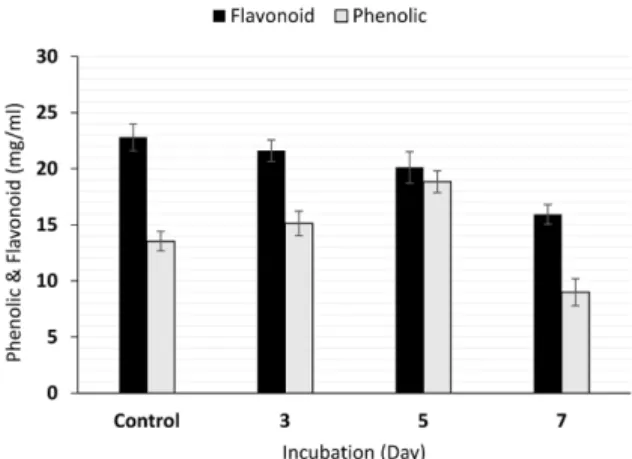
TPC of fermented extract was assayed using folin ciocalteu’s colorimetric method. Fig. 2 shows the total phenolic content of fermented extracts and the highest amount (18.84 mg of GA/g) of phenolic content was recorded after 5 days of fermentation.
Fig. 1. Total sugar during fermentation of S. japonica using A.
oryzae.
Fig. 2. Total phenolic and flavonoid content during fermentation of S. japonica using A. oryzae.
Whereas the flavonoid content of fermented extract was dec- reased (Fig. 2). Slight decrease in flavonoid content was obser- ved after 3 days of fermentation. Thus, the study reveals that an incubation period of 5 days was optimum for fermentation of S. japonica by A. oryzae.
3.3. Antioxidant activity
Antioxidant activity as assayed by three different assays showed an enhanced activity on fermentation as compared with con- trol. DPPH, ABTS and phosphomolybdenum assay was used to determine the antioxidant potential of fermented extracts.
Based on the present investigation, DPPH scavenging activity of fermented and normal extract was 90.45% and 80%, res- pectively (Fig. 3). Maximum ABTS scavenging activity was observed after 5 days of incubation and the value was 95.52%.
Whereas control sample before fermentation exhibited 70.15%
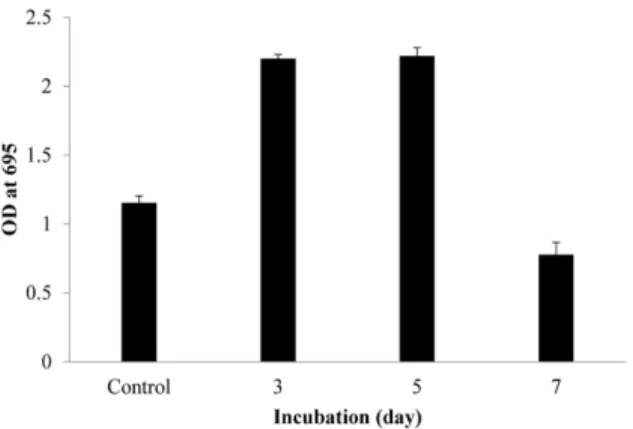
ABTS scavenging activity (Fig. 3). Regarding the total antioxi- dant determination by using phopsphomolybdenum assay, it has been found that highest antioxidant activity was accorded for the fermented extract compared with non-fermented sam- ple. Higher optical density indicated the higher antioxidant activity. In the present study, 5 days fermented extract showed 2.2 OD at 695nm whereas non-fermented extract showed 1.154 (Fig. 4). Thus, this study reveals that all the antioxidant assays was correlated with increase in polyphenolic content.
4. DISCUSSION
Fermentation is a process of where complex macromolecules are broken down to simpler compounds by the action of micro- organisms. This process has been used since ancient time to preserve food and improve the biofunctional activities. Recently, fermentation of seaweed has been attracting much more inte-
rest as seaweed contains lots of polysaccharides. Previously, it has been reported that fermentation of seaweed by different lactic acid bacteria enhances the bioactive compound as well as biofunctional activity [27-30]. However, submerged fermenta- tion of S. japonica by A. oryzae has been merely reported.
Owing to this, this present study was accomplished to enhance the antioxidant activity, total phenolic and flavonoid content of S. japonica by fermentation with A. oryzae.
Fermentation consists of modifying food by microorganism that grow, reproduce and consume part of the substrate while enriching it with the products of their metabolism. The fermen- tation of S. japonica was suspected to result in various compo- sitional and functional changes by different kind of microorga- nisms. In this study, we observed the compositional changes (total sugar, phenolics and falvonoids) and functional changes (antioxidant acitivity) at each day interval of fermentation.
Result found that with the start of the fermentation, an increase in the content of total sugar was observed, reaching to its maximum at 3 days and then showed decreasing pattern (Fig.
1). The decreasing pattern of total sugar indicated that leached out sugar in seaweed broth was utilized by A. oryzae. Similar observation was made by General et al. (2014) [31] who found that total sugar content was increased and reached to its maxi- mum after 9 days of fermentation. The total phenolic content of fermented extract was enhanced compared to the control (Fig. 2) and the highest phenolic content was found after 5 days of fermentation. These results are consistent with the previous data showing that Lactobacillus fermentation of a Hizikia fusi- forme [32] and yeast fermentation of Eisenia bicycilis [30] en- hanced the phenolic content. The enhancement of phenolic con- tent might be due to the fact that enzymes released from A.
oryzae breakdown the cell wall of seaweed which helps to release out more phenolic compounds in the water. It has been well known that A. oryzae contains high amounts of catalytic
Fig. 3. ABTS and DPPH scavenging activity during fermentationof S. japonica using A. oryzae.
Fig. 4. Phosphomolybdenum assay during fermentation of S.
japonica using A. oryzae.
enzymes, including alpha-amylase (starch to simple sugar con- verter), proteolytic enzymes, including protease's. Oppositely, flavonoid compound was decreased following fermentation (Fig.
2). Similar observation was reported by Kim et al. (2013) [33].
Further antioxidant potential of fermented S. japonica was evaluated by different assay systems including DPPH, ABTS, and phosphomolybdenum assay. Antioxidant activity of differ- ent extract of S. japonica has extensively studied and showed potent antioxidant activity (Figs. 3 & 4). Previous studies have also demonstrated that fermentation process enhances the anti- oxidant activity [29-30]. Considering this, fermentation techni- que was applied to improve the antioxidant activity. According to the results obtained, fermented extracts showed higher anti- oxidant activity compared to the control. The elevated level of activity correlated with the increased phenol content indicating the role of polyphenols in scavenging free radicals. Fermenta- tion may cause disruption of seaweed cell wall resulting in inc- reased polyphenol content in the fermented sample [27]. Poly- phenols are known to be effective antioxidant compounds bec- ause of their hydroxyl group that aid in scavenging free radi- cals [34]. Increase in total phenolic content can be used to judge the antioxidant property of the sample, and these phenolic compounds are found to be more effective as compared with a- tocopherol and synthetic antioxidants [34]. Similar to the pre- sent observation, Eom et al. (2011) also reported the enhance- ment of polyphenol content and antioxidant activity of brown algae by fermentation [30].
In conclusion, considering the results obtained from this study, it has been found that A. oryzae (ATCC 14895) is a good candidate for the fermentation of S. japonica. Based on the present investigation, total phenolic content, DPPH radical scavenging, ABTS scavenging and phosphomolybdenum assay indicate that optimum level of fermentation by A. oryzae was obtained after 5 days of fermentation. The increased activity of fermented extract was associated with many factors such as the metabolic changes due to fungal degradation of S. japonica.
This result suggested that fungal fermentation is an attractive strategy for developing value-added food ingredients.
ACKNOWLEDGEMENTS
This research was supported from 2014 RIS (Traditional) prog- ram funded by the Ministry of Trade, Industry & Energy of Korea (A007300037).
REFERENCES
1. Pandey, A. (2003) Solid-state fermentation. Biochem. Eng. J. 13:
81-84.
2. Juan, M. Y. and C. C. Chou (2010) Enhancement of antioxidant activity, total phenolic and flavonoid content of black soybeans by solid state fermentation with Bacillus substilis BCRC 14715. Food Microbiol. 27: 918-923.
3. Pandey, A., C. R. Soccol, and D. A. Mitchell (2000) New develop- ments in solid state fermentation: I-Bioprocess and products. Pro- cess Biochem. 35: 1135-1169.
4. Pandey, A., P. Selvakumar, C. R. Soccol, and P. Nigam (1999) Solid state fermentation for the production of industrial enzymes.
Curr. Sci. 77: 149-162.
5. Biesebeke, R. T., G. Rujiter, S. P. Yovita, Rahardjo, M. J. Hoog- schagen, M. Herrikhusen, A. Levin, G. V. Kenneth, V. Driel, A. I.
Maarten, Schutyser, Dijksterhuis, Y. Zhu, F. J. Weber, , M. Willem, De Vos, A. M. J. J. Kees, V. D. Hondel, A. Rinzema., and P. J.
Punt (2002) Aspergillus oryzae in solid state and submerged fer- mentations progress report on multi-disciplinary project. FEMS Yeast Res. 2: 245-248.
6. Babitha, S., C. R. Soccol, and A. Pandey (2006) Jackfruit seed-a novel substrate for the production of Monascus pigments through solid state fermentation. Food Technol. Biotechnol. 44: 465-471.
7. Holdt, S. L. and S. Krran (2011) Bioactive compounds in sea- weed: Functional food applications and legislations. J. Appl. Phy- col. 23: 543-597.
8. Gao, K. and K. R. McKinley (1994) Use of macroalgae for marine biomass production and CO2 remediation: a review. J. Appl. Phy- col. 6: 45-60.
9. Bartsch, I., C. Wiencke, K. Bischof,, C.M. Buchholz, H. Buck, A.
Eggert, P. Feuerpfeil, D. Hanelt, S. Jacobsen, R. Karez, U. Karsten, M. Molis, M.Y. Roleda, H. Schubert, R. Schumann, K. Valentin, F.
Weinberger, and J. Wiese (2008) The genus Laminaria sensulato:
recent insights and developments. Eur. J. Phycol. 43: 1-86.
10. Kim, M. J., K. M. Maria John, J. N. Choi, S. Lee, A. J. Kim, Y. M.
Kim, and C. H. Lee (2013) Changes in secondary metabolites of green tea during fermentation by Aspergillus oryzae and its effect on antioxidant potential. Food Res. Int. 53: 670-677.
11. Baek, J. G., S. M. Shim, D. Y. Kwon, H. K. Choi, C. H. Lee, and Y. S. Kim (2010) Metabolite profiling of Cheonggukjang, a ferm- ented soybean paste, inoculated with various Bacillus strains dur- ing fermentation. Biosci. Biotechnol. Biochem. 74: 1860-1868.
12. Jeng, K. C., C. S. Chen, Y. P. Fang, R. C. W. Hou, and Y. S. Chen (2007) Effect of microbial fermentation on content of statin, GABA, and polyphenols in Pu-Erh tea. J. Agric. Food Chem. 55: 8787- 8792.
13. Kim, J., J. N. Choi, D. Kang, G. H. Son, Y. S. Kim, and H. K. Choi (2011) Correlation between antioxidative activities and metabolite changes during Cheonggukjang fermentation. Biosci. Biotechnol.
Biochem. 75: 732-739.
14. Shyur, L. F. and N. S. Yang (2008) Metabolomics for phytomedi- cine research and drug development. Curr. Opin. Chem. Biol. 12:
66-71.
15. Chirtchai, P., C. Chaiyavat, C. Sunee, T. Somsak, V. Wonnop, and P. Suchart (2011) 8-Hydroxygenistein formation of soybean fer- mented with Aspergillus oryzae BCC 3088. Afr. J. Agric. Res. 6:
785-789.
16. Hong, K. J., C. H. Lee, and S. W. Kim (2004) Aspergillus oryzae GB-107 fermentation improves nutritional quality of food soy- beans and feed soybean meals. J. Med. Food 7: 430-435.
17. Jung, K. A., S. R. Lim, Y., Kim, and J. M. Park (2013) Potential macroalgae as feed stocks for biorefinery. Bioresour. Technol. 135:
182-190.
18. Gupta, S., N. Abu-Ghannam, and A. G. M. Scannell (2011) Growth and kinetics of Lactobacillus plantarum in the fermentation of edi- ble Irish brown seaweeds. Food Bioprod. Process. 89: 346-355.
19. Nielsen, S. S. (2003) Phenol-sulfuric acid method for total carbo- hydrates. Food analysis laboratory manual. pp. 39-44. Indiana.
Kluwer Academic/Plenum Publisher.
20. Singleton, V. L., R. Orthofer, and R. M. Lamuela-Raventos (1999) Analysis of total phenols and other oxidation substrates and anti- oxidants by means of Folin-Ciocalteu reagent. Methods Enzymol.
299: 152-178.
21. Marinova, D., F. Ribarova, and M. Atanassova (2005) Total phe- nolics and total flavonoids in Bulgarian fruits and vegetables. J.
Univ. Chem. Technol. Metallurgy 40: 255-260.
22. Prieto, P., M. Pineda, and M. Aguilar (1999) Spectrophotometric quantitation of antioxidant capacity through the formation of a Phosphomolybdenum Complex: Specific application to the deter- mination of vitamin E. Anal. Biochem. 269: 337-341.
23. Blois, M. S. (1958) Antioxidant determinations by the use of a sta- ble free radical. Nature 181: 1199-1200.
24. Re, R., N. Pellegrini, A. Proteggente, A. Pannala, M. Yang, and C.
Rice Evans (1999) Antioxidant activity applying an improved ABTS radical cation decolorization assay. Free Radic. Biol. Med.
26: 1231-1237.
25. Oyaizu, M. (1986) Antioxidative activities of products of brown- ing reaction prepared from glucosamine. Jpn. J. Nutr. 44: 307-315.
26. Rafiquzzaman, S. M., E. Y. Kim , Y. R. Kim, T. J. Nam, and I. S.
Kong (2013) Antioxidant activity of glycoprotein purified from Undaria pinnatifida measured by an in vitro digestion model. Int.
J. Biol. Macromol. 62: 265-272.
27. Shobharani, P., P. M. Halami, and N. M. Sachindra (2013) Poten- tial of marine lactic acid bacteria to ferment Sargassum sp. for en- hanced anticoagulant and antioxidant properties. J. Appl. Micro- biol. 114: 96-107.
28. Kang Y. M., B. J. Lee, J. I. Kim, B. H. Nam, J. Y. Cha, Y. M. Kim, C. B. Ahn, J. S. Choi, I. S. Choi, and J. Y. Je (2012) Antioxidant effects of fermented sea tangle (Laminaria japonica) by Lactoba- cillus brevis BJ20 in individuals with high level of
γ-GT: A ran-
domized, double-blind, and placebo-controlled clinical study. Food Chem. Toxicol. 50: 1166-1169.29. Gupta, S., N. Abu-Ghannam, and G. Rajauria (2012) Effect of heating and probiotic fermentation on the phytochemical content and antioxidant potential of edible Irish brown seaweeds. Bot. Ma- rina 55: 527-537.
30. Eom, S. H., Y. M. Kang, J. H. Park, D. U. Yu, E. U. Jeong, M. S.
Lee, and Y. M. Kim (2011) Enhancement of polyphenol content and antioxidant activity of brown alga Eisenia bicyclis extract by microbial fermentation. Fish Aquat. Sci. 14: 192-197.
31. General, T., B. Prasha, H. J. Kim, N. Vadakedath, and M. G. Cho (2014) Sachharina japonica, a potential feedstock for pigment production using submerged fermentation. Biotechnol. Bioprocess Eng. 19: 711-719.
32. Song, H. S., S. H. Eom, Y. M. Kang, J. D. Choi, and Y. M. Kim (2011) Enhancement of the antioxidant and anti-inflammatory activity of Hizikia fusiforme water extract by lactic acid bacteria fermentation. Korean J. Fish Aquat. Sci. 44: 111-117.
33. Jimenez-Escrig, A., I. J. Jimenez, R. Pulido, and F. S. Calixto (2001) Antioxidant activity of fresh and processed edible sea- weeds. J. Sci. Food Agric. 81: 530-534.
34. Vijayabaskar P. and V. Shiyamala (2012) Antioxidant properties of seaweed polyphenol from Turbinaria ornate (Turner) J. Agardh, 1848. Asian Pac. J. Trop. Biomed. 2: S95-S98.