http://dx.doi.org/10.9724/kfcs.2014.30.2.212
피조개의 항산화 활성과 Acetylcholinesterase 저해 활성
김정빈․김재민․이영민․백인석․이승철† 경남대학교 식품생명학과
Antioxidant Activity and Acetylcholinesterase Inhibitory Activity of Ark shell (Scapharca broughtonii)
Jeong-Been Kim․Jae-Min Kim․Young-Min Lee․In-Seok Baek․Seung-Cheol Lee† Department of Food Science and Biotechnology, Kyungnam University, Changwon 631-701, Korea
Abstract
Ark shell (Scapharca broughtonii; Korean name, pijogae) is one of the most widely cultivated and consumed shellfishes in Korea.
The purpose of this study was to evaluate the antioxidant activity and acetylcholinesterase inhibitory activity of ark shell. After preparing the methanol extract of ark shell powder, the extract was subsequently fractionated by hexane, diethyl ether, ethyl acetate and water. The antioxidant activity evaluated by DPPH radical scavenging activity, ABTS radical scavenging activity and reducing power was relatively higher in the water fraction; however, the activity was spread out in all fractions. Acetylcholinesterase inhibitory activity was the highest in the diethyl ether fraction. Taken together with the results of both antioxidant and acetylcholinesterase inhibitory activities, it can be suggested that different kinds of physiological compounds were contained in the ark shell.
Key words: ark shell, fractions, antioxidant activity, acetylcholinesterase inhibitory activity
†Corresponding author: Seung-Cheol Lee, Dept. of Food Science and Biotechnology, Kyungnam University, Masan-happogu Changwon 631-701, Korea
Tel: 82-55-249-2684 Fax: 82-55-249-2995
E-mail: [email protected]
Ⅰ.
서 론피조개(Scapharca broughtonii)는 연체동물, 이매패강, 돌조개목, 꼬막조개과에 속하며 수심 50 m 정도에서 식 물성 플랑크톤과 유기물을 먹이로 하여 살아간다. 한국, 일본, 중국 연안에 주로 서식하는데 우리나라에서는 남해 안과 서해안, 그리고 제주도에서 채집된다. 2012년도에 우리나라에서는 2,432 M/T가 생산되어 약 250억원의 생 산금액을 기록하였으며, 특히 일본으로의 수출 비율이 높 아 2012년도에 1,491 M/T(약 1,865만 달러)가 수출되었다 (Fisheries Information Service 2014). 피조개는 주로 생식 으로서 회, 초밥요리, 식초요리, 샐러드요리 등의 소재로 이용되고 있다(Shimizu M 등 1989, Nose Y 등 1989). 피 조개 가공에 관련하여 분말 수프의 제조(Kim HY 1988) 에 대한 보고가 있지만 아직 활발하지 않다.
근래 여러 수산 식품 소재에 대한 생리적 활성이 주목을
받고 있다. 피조개에 함유된 주요 성분을 보면, 먼저 28종 의 유리 아미노산이 1,966 mg/100 g 함유되어 있으며, 특 히 타우린(628 mg/ 100 g)과 글루탐산(205 mg/ 100 g)이 높은 비율로 함유되어 있어 응용 가치가 매우 높다(Park CK 2002). 피조개의 붉은 피는 혈색소로서 헤모글로빈을 함유하고 있으며, 이로 인해 철분(7.4 mg%)이 다른 식품에 비해 비교적 높다(Food Composition Table 2006). 또한 아 연(1.5 mg%)과 마그네슘(55 mg%)의 함량이 높아 인체의 생리활성 유지에 매우 도움이 된다(Food Composition Table 2006). 한편 피조개에는 전체 지방산 중 다가 불포화 지방산이 35.7%를 차지하며, 그중에서 DHA와 EPA가 각 각 13.5%와 14.3%를 차지하고 있다(National Fisheries Research Development Institute 2013). 그리고 간기능 보호 와 시력회복 기능이 있으며 동맥경화와 고혈압예방 기능 이 있다고 알려진 베타인류의 일종인 글리신 베타인과 호 마린이 각각 824.4 mg/100 g, 22.8 mg/100 g 함유되어 있 다(National Fisheries Research Development Institute 2013).
그러나 생리적 기능성의 경우에는 피조개의 아가미에 서 SOD(superoxide dismutase), CAT(catalase)의 활성이 발 표된 바 있으나(An MI 등 2009, An MI와 Choi CY 2010), 그 이외에는 자료가 거의 없는 실정이다. 본 논문
에서는 피조개의 생리적 기능성에 대한 기초 연구로서 피조개의 메탄올 추출물로부터 분획물을 제조하여 항산 화능과 acetylcholinesterase 저해능을 분석하였다. 항산화 능은 일반적으로 활성산소종을 제거하는 능력을 의미하 며, 활성산소종은 체내에서 단백질, 핵산, 효소 및 면역계 를 손상하여 각종 질환을 유발하는 원인물질로 알려져 있다. 한편, acetylcholine는 시냅스와 시냅스 사이의 신경 전달에 관련하는 신경전달물질로서 여러 가지 생리작용 을 나타내는데, acetylcholinesterase(AChE)는 acetylcholine 을 acetate와 choline으로 가수분해 하는 효소로 이 효소 의 활성을 저해하는 것은 Alzheimer 질병과 같은 신경질 환의 예방에 효과적이다(McGleenon BM 등 1999).
Ⅱ.
재료 및 방법1. 시약
분석에 이용한 1,1-diphenyl-2-picrylhydrazyl(DPPH), 2,2'- azino-bis(3-ethylbenzthiazoline-6-sulfonic acid)(ABTS) tablets, potassium ferricyanide, trichloroacetic acid, ferric chloride, dimethyl sulfoxide(DMSO), peroxidase(EC 1.11.1.7), acetyl- cholinesterase(AChE), acetylthiocholine iodide, 5,5'-dithiobis (2-nitrobenzoic acid)(DTNB), dimethyl sulfoxide(DMSO), L-ascorbic acid 등은 Sigma-Aldrich(St. Louis, MO, USA)에서 구입하였다. Potassium phosphate monobasic, potassium phosphate dibasic은 Daejung Chemical Co.(Siheung, Korea)에 서 구입하였으며, 사용된 용매는 모두 1급 이상의 등급을 사용하였다.
2. 피조개 분획 추출물 제조
본 실험에 사용된 피조개(Scapharca broughtonii)는 피 조개양식수협(Changwon, Korea)에서 껍질을 제거한 형태 로 제공받았으며, 이를 깨끗이 씻어 이물질을 제거한 후 동결건조하였다. 건조한 피조개를 분쇄하여 25 mesh 체 로 걸러 분말 형태로 질소 충전하여 초저온냉동고(-78℃) 에 보관하였다. 피조개 분말 20 g에 20배(w/v)의 메탄올 을 가하여 25℃의 진탕기(HB-201, Hanbaek Co., Seoul, Korea)에서 24시간 동안 추출하였다. 추출용액은 여과지 (Whatman No. 1, GE Healthcare Co., Kent, UK)로 여과한 후, 회전농축기(Eyela N-1000, Tokyo Rikakikai Co., Tokyo, Japan)를 이용하여 50℃에서 농축하였다. 메탄올 농축물은 20배(w/v)의 증류수에 용해시킨 다음 분별깔때 기에 의한 용매별 분획으로 같은 부피의 hexane, diethyl ether, ethyl acetate 및 증류수로 용매별로 3회씩 연속 추 출한 후 각각의 분획물을 회전농축기로 농축하였다. 각 분획 농축물들은 25 mg/mL의 농도로 DMSO에 녹여 4℃
로 냉장보관하고 적당한 농도로 희석하여 실험에 사용하
였다.
3. DPPH 라디칼 소거 활성 측정
DPPH 라디칼 소거능은 Jeong SM 등(2004)의 방법을 이 용하였다. 각 분획물을 농도별(1, 5, 10, 25 mg/mL)로 제조한 시료 0.1 mL에 0.041 mM DPPH 용액 0.9 mL를 가한 후 상온에서 30분간 반응시켜 UV/Vis spectrophotometer (Optizen POP, Mecasys Co., Daejeon, Korea)를 이용하여 517 nm에서 흡광도를 측정하였다. 무처리구와 처리구의 값을 비교하여 DPPH 라디칼 소거활성을 결정하였으며, 아래의 식으로 계산하여 백분율로 나타내었다. 일반적으로 알려진 항산화제인 L-ascorbic acid를 대조구로 사용하여 비교하였 다. 무처리구의 경우에는 시료 대신 DMSO를 사용하였다.
DPPH 라디칼 소거능(%) = 시료 첨가구의 흡광도무처리 구의 흡광도
×
4. ABTS 라디칼 소거활성 측정
ABTS 라디칼 소거능은 Pellegrini N 등(1999)의 방법 에 따라 측정하였다. 각 분획물을 농도별(1, 5, 10, 25 mg/mL)로 희석한 시료 100 μL에 0.1 M phosphate buffer (pH 5.0) 100 μL와 10 mM hydrogen peroxide 20 μL를 가 하고 37℃에서 5분간 예비반응을 시켰다. 반응물에 1.25 mM의 ABTS와 peroxidase(1 U/mL)를 각각 30 μL씩 넣은 후 다시 37℃에서 10분간 반응을 시켰다. 반응물을 405 nm의 Multiplate Reader(Sunrise RC/TS/TS Color-TC/TW/
BC/6Filter, Tecan Austria GmbH, Grödig, Austria)를 이용 하여 흡광도를 측정하여 아래의 식에 의해 소거능을 계 산하였다. 무처리구의 경우에는 시료 대신 DMSO를 사용 하였다.
라디칼 소거능(%) = 시료 첨가구의 흡광도무처리 구의 흡광도
×
5. 환원력 측정
환원력은 Fe3+가 Fe2+로 환원되는 능력을 측정하는 Oyaizu M(1996)의 방법에 따라 측정하였다. 각각 다른 농 도(1, 5, 10, 25 mg/mL)의 분획물 1 mL에 200 mM sodium phosphate buffer(pH 6.6) 1 mL와 1%(w/v) potassium ferricyanide 1 mL를 혼합시켰다. 그리고 혼합물을 50℃에 서 20분 동안 반응 시킨 후 10%(w/v) tricholoroacetic acid 용액을 첨가했다. 이 후 혼합물을 12,000×g에서 5분간 원 심분리하여 얻은 상징액 1 mL와 증류수 1 mL를 넣고 0.1% ferric chloride 0.1 mL를 첨가시켰다. UV/Vis spectrophotometer를 사용하여 700 nm에서 흡광도를 측정 하였다.
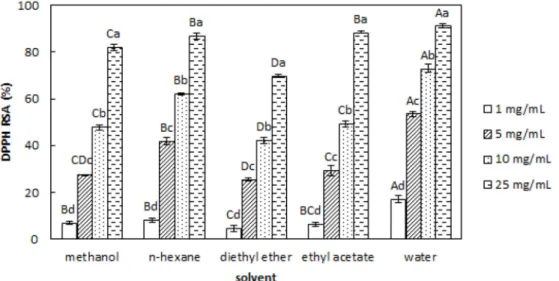
Fig. 1. DPPH radical scavenging activity (RSA) of methanol extract and its fractions from ark shell. Values with different letters (a-d) within same extraction solvent and (A-D) within same concentration indicate significant difference (p<0.05), n=3.
6. Acetylcholinesterase(AChE) 저해 활성 측정 AChE 저해 활성은 acetylcholine iodide를 기질로 사용하 여 측정하였다(Prashanth D 등 2007). 농도별(1, 5, 10, 25 mg/mL)로 희석한 시료 30 μL에 100 mM phosphate buffer(pH 8.0) 2.8 mL, AChE(0.25 U/mL) 30 μL, DTNB (39.6 mg of DTNB and 15 mg of sodium bicarbonate dissolved in 10 mL phosphate buffer pH 8.0) 100 μL를 혼합 한 후, 25℃에서 5분간 반응시켰다. 반응물에 기질(108.35 mg of acetylthiocholine iodide in 5 mL of H2O) 30 μL를 가하여 25℃에서 30분 간 반응시켜 UV/Vis spectrophotometer (Mecasys)를 이용하여 412 nm에서 흡광도를 측정하였다.
AChE 저해 활성 (%) = (1-시료첨가구의 흡광도무첨가구의 흡광도 )×100
7. 통계처리
모든 분석은 3회 반복으로 이루어졌으며 SPSS 프로그램 (ver. 14, SPSS Academy, Seoul, Korea)을 사용하여 통계 처 리하였다. 각 항목에 따라 평균치±표준오차로 나타내었고, 각 군의 평균 차이에 대한 유의성 검정을 위해 one-way 분 산분석(ANOVA)을 시행하였고, 사후 검증은 Duncan의 다 중 검정법을 이용하였다. 각 실험 항목에 대해 상관관계를 분석하였으며 통계적 유의성은 95%(p<0.05)수준에서 평가 하였다.
Ⅲ.
결과 및 고찰1. DPPH 라디칼 소거능
DPPH 라디칼 소거능은 안정한 형태의 DPPH 라디칼 이 항산화물질에서 전자를 받아 흡광도가 변하는 정도를
측정하여 구한다. 항산화 물질과 반응하게 되면 본래의 보라색의 안정된 자유 라디칼인 DPPH가 무색에 가깝게 변하게 된다. 피조개의 메탄올 추출물 및 그로부터 유래 한 4가지 분획 추출물의 농도에 따른 DPPH 라디칼 소거 능을 Fig. 1에 나타내었다. 모든 추출물에서 농도가 증가 함에 따라 DPPH 라디칼 소거능이 상승하였다. 농도가 가 장 높은 25 mg/mL에서 모든 추출물들은 80% 이상의 높 은 DPPH 라디칼 소거능을 보였지만, 1-10 mg/mL 농도에 서는 물 분획물이 유의적으로(p<0.05) 가장 높은 소거능 을 나타내며, 그 뒤를 이어 hexane, ethyl acetate, diethyl ether 분획물 순으로 유의적인(p<0.05) DPPH 라디칼 소거 능을 보였다. 기존에 잘 알려진 항산화제인 L-ascorbic acid의 경우에는 100 μg/mL 농도에서 86.39%의 DPPH 라디칼 소거능을 나타내었다.
한편, DPPH 라디칼 소거능이 특정한 분획 용매에 주로 모이는 현상은 발견되지 않았으므로 극성이 다른 여러 물질 이 혼합하여 DPPH 라디칼 소거능을 발휘하는 것으로 추정 된다. 극성이 낮은 용매에서의 항산화 활성에는 다가 불포 화 지방산의 기여 가능성이 높다. 피조개에는 전체 지방산의 3분의 1 이상이 다가 불포화 지방산이며(National Fisheries Research Development Institute 2013), 다가 불포화 지방산 은 항산화력을 보유하고 있다(Richard D 등 2008). 극성이 높은 용매를 이용한 분획물에서는 수용성 물질이 라디칼 소거능에 기여할 것으로 여겨지는데, 가식부 100 g 당 3 mg 함유된 비타민 C(Food Table Composition 2006)를 비롯한 여러 물질들이 관여하였을 것으로 보인다. 그러나 아직 피 조개의 성분이나 항산화능에 대한 자세한 연구가 되지 않아 항산화 물질에 대한 명확한 설명은 어렵다. 국내에 주로 서 식하는 조개류의 항산화능 연구 보고는 거의 없었으며, 다 만 Kim HL 등(2006)이 전복의 육질과 내장으로부터 80%
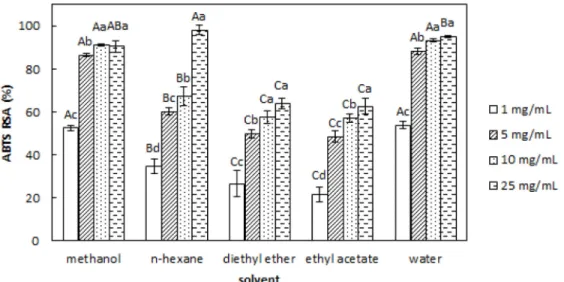
Fig. 2. ABTS radical scavenging activity (RSA) of methanol extract and its fractions from ark shell. Values with different letters (a-d) within same extraction solvent and (A-D) within same concentration indicate significant difference (p<0.05), n=3.
에탄올과 물 추출물을 제조하여 DPPH 라디칼 소거능을 분 석하여 보고하였으나 본 연구와는 추출 방법이 달라 절대치 를 비교하기가 어려웠다. 미더덕의 경우에는 물 추출물이 10 mg/mL 농도에서 채취시기에 따라 육질 부위는 29.40-53.02%, 껍질 부위는 9.21-25.67%의 DPPH 라디칼 소 거능을 나타내었다(Lee DW 등 2010). 본 연구에서의 피조 개의 물 분획물의 같은 농도에서 DPPH 라디칼 소거능 (72.99%)과 비교해 보면 피조개가 미더덕보다는 높은 것을 알 수 있다.
2. ABTS 라디칼 소거능
ABTS 라디칼 소거능은 유리기들과 반응하여 만들어진 활성 양이온 ABTS+가 항산화물질에 의해 환원되어 얼마 나 소거되는지를 흡광도를 이용하여 측정한다. 분획 용매 와 농도를 다르게 한 피조개 분획물의 ABTS 라디칼 소 거 활성을 측정한 결과를 Fig. 2에 나타내었다. 모든 시료 군에서 농도가 증가할수록 ABTS 라디칼 소거능이 증가 하였다. 전체적으로 DPPH 라디칼 소거 활성보다 높은 ABTS 라디칼 소거능을 나타내었는데, 이는 DPPH는 안 정한 유리 라디칼이며 ABTS는 양이온 라디칼이라는 라 디칼의 차이와, DPPH는 주로 소수성 물질의 항산화능을 측정하는데 비해 ABTS는 친수성과 소수성 물질의 항산 화능을 다 측정할 수 있다는 차이 등에 기인하기 때문이 다(Yu L 등 2002, Floegel A 등 2011). 물 분획물은 메탄 올 추출물과 비슷한 ABTS 라디칼 소거 활성을 나타내었 지만, 다른 분획물들은 메탄올 추출물보다 낮은 활성을 보였다. 1-10 mg/mL 농도에서 물 분획물이 유의적으로 (p<0.05) 가장 높은 ABTS 라디칼 소거능을 나타내었으 며, 그 다음에는 hexane 분획물이었으며, ethyl acetate 분
획물과 diethyl ether 분획물은 유의적인(p<0.05) 차이를 보이지 않았다. 미더덕의 물 추출물은 10 mg/mL 농도에 서 시기에 따라 육질 부위는 22.80-61.10%, 껍질 부위는 18.80-43.10%의 ABTS 라디칼 소거능을 나타내었으며 (Lee DW 등 2010), 같은 농도에서 피조개의 물 분획물은 93.38%의 ABTS 라디칼 소거능을 보였다. 양성 대조군으 로 사용된 L-ascorbic acid는 30 μg/mL 농도에서 99.29%
의 ABTS 라디칼 소거능을 보였다.
3. 환원력
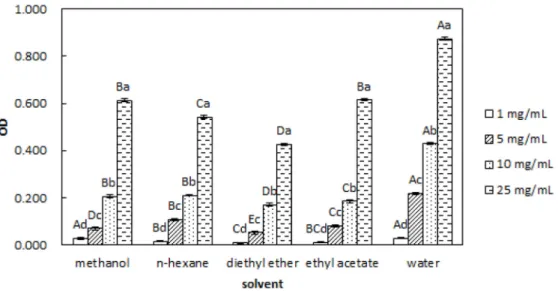
항산화물질은 활성 산소종 및 유리기에 전자를 공여하 는 환원력을 가지고 있다. Fe+3이온에서 Fe2+이온으로의 환원력을 측정하여 항산화 활성을 검정하는 수단으로 이 용할 수 있다. 용매와 농도에 따른 피조개 분획물의 환원 력을 Fig. 3에 나타내었다. 피조개 분획물은 농도 의존적 으로 흡광도(optical density, OD)가 증가하였으며, 물 분 획물이 모든 농도에서 유의적으로(p<0.05) 가장 높은 환 원력을 보였으며 25 mg/mL 농도에서 0.874의 흡광도를 나타내었다. 같은 농도에서 ethyl acetate, hexane, diethyl ether 분획물 순으로 유의적인(p<0.05) 차이를 보였다. 본 연구에서 분석 방법에 따라 분획물들의 항산화능 순서가 약간 차이가 있었는데, 이는 항산화 물질의 작용이 연쇄 반응 개시의 방해, 전이 금속 물질의 결합, 과산화물의 분해, 라디칼 소거 등의 여러 기작과 연관이 있기 때문이 다(Diplock AT 1997). 양성 대조구로 사용된 L-ascorbic acid는 200 μg/mL 농도에서 0.944의 수치를 나타냈다.
4. Acetylcholinesterase(AChE) 저해 활성
피조개 분획물의 AChE 저해 활성을 Fig. 4에 나타내었
Fig. 3. Reducing power of methanol extract and its fractions from ark shell. Reducing power was expressed as optical density (OD). Values with different letters (a-d) within same extraction solvent and (A-D) within same concentration indicate significant difference (p<0.05), n=3.
Fig. 4. Acetylcholinesterase (AChE) inhibitory activity of methanol extract and its fractions from ark shell. Values with different letters (a-d) within same extraction solvent and (A-D) within same concentration indicate significant difference (p<0.05), n=3.
다. 메탄올 추출물과 hexane 분획물은 농도에 따른 활성의 차이를 보이지 않았으며, 물, diethyl ether, ethyl acetate의 분획물은 농도 의존적으로 활성이 증가하였다. 특히, diethyl ether 분획물이 유의적으로(p<0.05) 가장 높은 활성 을 나타내었는데, 이는 DPPH와 ABTS 라디칼 소거 활성, 환원력 등의 항산화능 실험 결과와는 다른 양상을 보였다.
이는 항산화능과 AChE 저해 활성을 나타내는 물질에 차 이가 있음을 의미한다. AChE 저해제로서는 galactamine, donepezil, rivastigmine, tacrine 등이 FDA에 허용되어 있으 며(Lahiri DK 등 2002), coumarine 계의 페놀 물질이 galactamine과 유사한 방식으로 AChE에 결합하여 저해하
는 것이 보고되었다(Rollinger JM 등 2004). 따라서 다양한 식물 유래의 AChE 저해제가 다양하게 연구되고 있으나 (Pulok KM 등 2007, Jang CH 등 2003, Ijaz A 등 2003, Tang XC와 Han YF 1999, Song JE와 Lee JS 2008) 어패류 에서는 잘 알려지고 있지 않아 향후 보다 자세한 연구가 기대된다. 한편, 양성 대조군으로 사용된 eserine은 0.1 mg/mL에서 42.05%의 AChE 저해활성을 보였다.
Ⅳ.
요약국내 연안에서 널리 양식되고 있는 피조개의 생리적 기능
성을 발굴하기 위하여 항산화능과 acetylcholinesterase 저해 능을 측정하였다. 피조개 분말로부터 메탄올 추출물을 제조 하고, 이로부터 극성에 따라 hexane, diethyl ether, ethyl acetate, 그리고 물 분획물을 얻었다. DPPH 라디칼 소거능, ABTS 라디칼 소거능, 환원력으로 항산화능을 분석한 결과, 각 활성은 한 분획물에 치중되지 않았지만 물 분획물에서 비교적 높았다. 그러나 acetylcholinesterase 저해능은 diethyl ether 분획물에서 높게 측정되었다. 이로서 항산화능과 acetylcholinesterase 저해능에 관여하는 다양한 물질들이 피 조개에 함유되어 있음을 확인하였다.
감사의 글
본 연구는 2013년도 경남대학교 연구비 지원으로 이루 어졌습니다.
References
An MI, An KW, Choi CY. 2009. Changes in antioxidant enzyme activity and physiological responses to cadmium and tributyltin exposure in the ark shell, Scapharca broughtonii.
Mol Cell Toxicol 5(4):273-282
An MI, Choi CY. 2010. Activity of antioxidant enzymes and physiological responses in ark shell, Scapharca broughtonii, exposed to thermal and osmotic stress: Effects on hemolymph and biochemical parameters. Comp Biochem Phys B 155(1):34-42
Diplock AT. 1997. Will the good fairies please prove to us that vitamin E lessens human degenerative disease? Free Rad 27(5):511-532
Fisheries Information Service. www.fips.go.kr. Accessed February 3, 2014
Floegel A, Kim DO, Chung SJ, Koo SI, Chun OK. 2011.
Comparison of ABTS/DPPH assays to measure antioxidant capacity in popular antioxidant-rich US foods. J Food Compos Anal 24(7):1043-1048
Food Composition Table. Rural Resources Development Institute.
2006
Ijaz A, Itrat A, Abdul M, Sarfraz AN, Muhammad IC. 2003.
Cholinesterase inhibitory constituents from Onosma hispida.
Chem Pharm Bull 51(4):412-414
Jang CH, Eun JS, Park HW, Seo SM, Yang JH, Leem KH, Oh SH.
Oh CH, Baek NI, Kim DK. 2003. An acetylcholinesterase inhibitor from the leaves of Securinega suffruticosa. Korean J Pharmacogn 34(1):14-17
Jeong SM, Kim SY, Park HR, Lee SC. 2004. Effect of far-infrared radiation on the activity of extracts from Citrus unshiu peels. J Korean Soc Food Sci Nutr 33(9):1580-1583 Kim HL, Kang SG, Kim IC, Kim SJ, Kim DW, Ma SJ, Gao T,
Li H, Kim MJ, Lee TH, Ham KS. 2006. In vitro
anti-hypertensive, antioxidant and anticoagulant activities of extracts from Haliotis hannai. J Korean Soc Food Sci Nutr 35(7):835-840
Kim HY. 1988. Studies on the utilization of arkshell 1. Preparation and quality stability during storage of powdered dried ark shell for instant soup. Korean J Food Hygiene 3(4):217-223 Lahiri DK, Farlow MR, Greig NH, Sambamurti K. 2002. Current
drug targets for Alzheimer's disease treatment. Drug Devel Res 56(3):267-281
Lee DW, You DH, Yang EK, Jang IC, Bae MS, Jeon YJ, Kim SJ, Lee SC. 2010. Antioxidant and ACE inhibitory activities of Styela clava according to harvesting time. J Korean Soc Food Sci Nutr 39(3):331-336
McGleenon BM, Dynan KB, Passmore AP. 1999. Acetylcholinesterase inhibitors in Alzheimer’s disease. Br J Clin Pharmacol 48(4):471-480
National Fisheries Research Development Institute. Nutrient Database for Ark shell Available from: http://portal.nfrdi.re.kr/
page?id=aq_seafood_2_7&type=tot&from=totList&fim_col_i d=2009-MF0004224-6-D01. Accessed February 3, 2014 Nose Y, Hanyu I, Iwai T, Shimizu M. 1989. Encyclopedia of
Fishes. Tokyodoo Syuksubanbu, Tokyo, Japan. p 9
Oyaizu M. 1996. Studies on product of browning reaction.
Antioxidative activities of products of browning reaction prepared from glucosamine. Jap J Nurt 44(6):307-315 Park CK. 2002. Comparison of extractive nitrogenous constituents
in the three species of raw bloody clams, Scaphrca broughtonii, S. subcrenata, and Tegellarca granosa extracts.
Korean J Food Sci Technol 34(6):954-961
Pellegrini N, Re R, Yang M, Rice-Evans C. 1999. Screening of dietary carotenoids and carotenoid-rich fruit extracts for antioxidant activities applying 2,2’-azinobis(3-ethylenebenzothiazoline- 6-sulfonic acid) radical cation decolorization assay. Vol 299.
pp 379-389. In: Methods in Enzymololy. Packer L (ed).
Academic Press. New York, NY. USA
Prashanth D, Vinutha B, Salma KM, Sreeja SL, Pratiti D, Padmaja R, Radhika S, Amit A, Venkateshwarlu K, Deepak M. 2007. Screening of selected Indian medicinal plants for acetylcholinesterase inhibitory activity. J Ethnopharmacol 109(2):359-363
Pulok KM, Venkatesan K, Mainak M, Peter JH. 2007.
Acetylcholinesterase inhibitors from plants. Phytomedicine 14(4):289-300
Richard D, Kefi K, Barbe U, Bausero P, Visioli F. 2008.
Polyunsaturated fatty acids as antioxidants. Pharmacol Res 57(6):451–455
Rollinger JM, Hornick A, Langer T, Stuppner H, Prast H. 2004.
Acetylcholinesterase inhibitory activity of scopolin and scopoletin discovered by virtual screening of natural products. J Med Chem 47(25):6248-6254
Shimizu M, Yamaguchi K, Takiguchi M. 1989. Fish Guide Book.
Jookoeiyodaikaku Syuksubanbu, Tokyo, Japan. p 102 Song JE, Lee JS. 2008. Physicochemical characteristics of antidementia
acetylcholinesterase inhibitor-containing methanol extract from Sorghum bicolor and industrial application. J Natural Sci Pai Chai Univ 19(1):45-55
Tang XC, Han YF. 1999. Pharmacological profile of huperzine A, a novel acetylcholinesterase inhibitor from chinese herb.
CNS Drug Reviews 5(3):281-300
Yu L, Haley S, Perret J, Harris M, Wilson J, Qian M. 2002. Free radical scavenging properties of wheat extracts. J Agric Food Chem 50(6):1619-1624
Received on Feb.3, 2014/ Revised on Apr.4, 2014/ Accepted on Apr. 9, 2014