J Korean Soc Occup Environ Hyg, 2011: 21(4): 193-200
퇴직한 납 근로자들의 납 노출지표 및 혈장 호모시스테인과 혈압과의 관련성
Association between the lead exposure index and plasma homocysteine, and blood
pressure in retired lead workers
김남수 정경식 이병국*
Nam-Soo Kim Kyung-Sick Jung Byung-Kook Lee*
순천향대학교 환경산업의학연구소
Institute of Environmental and Occupational Medicine, Soonchunhyang University
ABSTRACT ABSTRACT Objectives
Objectives: Blood lead and hyperhomocysteinemia have been found to be associated with cardiovascular disease. The objective of the present study was to assess the relationship of lead biomarkers on plasma homocysteine and blood pressure.
Methods
Methods: To evaluate the effect of lead biomarkers including blood lead on plasma homocysteine and blood pressure in retired lead workers, 66 retired lead workers without any occupational exposure to organic solvent, mercury and arsenic were agreed to participate this study. For the control subjects 42 controls were recruited from same area of retired lead workers with consideration of demographic characteristics.
Results:
Results: The mean levels of blood lead and ZPP of retired lead workers were significantly higher than control group.
There were positive significant correlations between blood lead and plasma homocysteine, also systolic and diastolic blood pressure. The multiple linear regression analysis also reveled that plasma homocysteine was significantly associated with blood lead after adjusting for age, gender, body mass index, lead exposure, smoking and drinking.
Diastolic blood pressure was significantly associated with blood lead, plasma homocysteine, and total cholesterol;
whereas, systolic blood pressure was significantly associated with plasma homocysteine only.
Conclusions
Conclusions: Blood lead showed significant association with plasma homocysteine and blood pressure even after more than mean 10 years from their retirements.
Key words
Key words : plasma homocysteine, blood pressure, retired lead worker
. 서 론
심혈관계 질환은 사망률에 있어서 전 세계적으로 수 위를 차지하고 있으며 질환 부담에 일차적인 기여를 하고 있다(Lopez 등, 2006). 납이나 기타 중금속들의 노출은 인구집단에서 심혈관계 질환의 변동을 설명하여 주기도 하며(Weinhold 등, 2004; Bhatnagar 등, 2006), 납 노출이 심혈관계 질환의 결과와 연결되어 있다는 것을 암시한 보고는 100년이 넘었다(Navas-Acien, 2007).
동물 실험에서 납이 혈압을 증가시킨다고 보고되고
*Corresponding author: Byung-Kook Lee 충남 아산시 신창면 읍내리 646 순천향대학교 환경산업의학연구소 Tel: 041-530-1760, Fax: 041-530-1778 E-mail: [email protected]
Received: 2011. 9. 2., Revised: 2011. 10. 28.
Accepted: 2011. 11. 7.
이 논문은 2010년 정부(교육과학기술부)의 재원으로 한국 연구재단의 지원을 받아 수행된 연구임(2010-0004961)
있는데 이는 말초혈관 저항, 심박수, 심박출량을 조절하는 신경체액성 조절의 변이를 초래하는 등의 다양한 기전을 통한다고 한다(ATSDR, 2007). 이렇게 동물 모델에서 강 력한 증거를 제공하고 있어 인간에서도 납이 혈압을 상 승시킬 것이라는 논리가 설득력이 있다. 비록 동물실험 에서 납이 다양한 심혈관계에 영향을 준다고 알려졌지 만(Vaziri and Sica, 2004), 궁극적인 관심사는 인간에서 납 노출이 심혈관계에 주는 영향이 될 것이다. 역학연구를 통하여 인간에게 납 노출이 심혈관계 질환과 어떠한 연 관성이 있는 지를 보고한 연구결과들은 아직까지 일치 하지 않고 있다. 다만 일반인구집단에서 30개 이상의 연 구와 6만 명 이상의 자료를 혼합한 몇 개의 문헌고찰 및 메타분석에서 혈중 납과 혈압 혹은 고혈압간의 관련성이 조사되고 혈중 납 수준과 혈압 간에는 양의 연관성이 있 다고 보고되고 있다(Sharp 등, 1987; Hertz-Picciotto와 Croft, 1993; Staessen 등, 1994; Schwartz, 1995; Nawrot 등, 2002; U.S. EPA, 2006).
한편 고 호모시스테인은 심혈관계 질환과 혈전증의 새로운 위험인자로 최근 주목 받고 있다. 호모시스테인은
메티오닌의 탈메틸화에 의하여 생산되는 아미노산으로 축적시는 혈관내피세포를 자극하여 혈관질환을 일으킨다.
이렇게 생산된 호모시스테인은 비타민 B6 의존성 황전 환작용 과정이나 주로 엽산과 비타민 B12 의존성 재 메틸 화 과정을 통하여 각각 시스테인이나 메티오닌으로 대 사된다. 따라서 이 과정에 관여하는 효소, 비타민 및 엽 산 등의 부족이나 음주, 흡연 및 일부 약물(아산화질소, 항 경련제, methotrexate, sulfasalazine)등에 의하여 대사과정 에 영향을 받으면 혈중내 호모시스테인이 증가한다. 다 만 혈중납량과 호모시스테인과의 관련성에 관한 연구결 과는 아직까지 이견이 있는 실정이다. 심혈관계 질환을 유 발하는 소인은 다양하여 납 노출과의 인과관계를 입증 하기는 쉽지 않아 학자들에 따라 논란이 계속되고 있으 며, 연구방법간의 차이와 심혈관계 질환에 관여하는 다 양한 교란변수의 통제정도에 기인된다고 주장하고 있어 이에 대한 연구는 더 진행되어야 할 것으로 생각된다. 또한 대부분의 연구는 현직근로자를 대상으로 하거나 환경 납 노출로 인한 혈장 호모시스테인과 심혈관계 질환 간에 관련성에 대한 평가로(Chia 등, 2007; Schafer 등, 2005;
Yakub와 Iqbal, 2010) 납 취급 근로자들에서 납 노출이 중 단된 시점인 퇴직 후에도 납으로 인하여 혈장 호모시스 테인과 혈압 등 심혈관계 질환에 영향을 주고 있는지에 대한 연구는 없다. 특히 우리나라와 같이 비교적 납 노출이 많았던 납 근로자들의 경우 일정기간이 지나도 체내의 납 부담이 높은 상태로 퇴직 후 체내 납 수준이 일반인들과 비교하여 혈장 호모시스테인과 혈압 등 심혈관계 질환에 영향을 주는지에 대한 연구는 향후 납 취급 근로자들의 보건관리에도 의미 있는 자료가 될 것으로 판단된다.
그러므로 본 연구에서는 납 취급 근로자들의 퇴직 후 납 노출 수준 및 혈장 호모시스테인 농도를 알아보았다. 또한 납 노출지표와 혈장 호모시스테인, 혈압과의 관련성을 살 펴보아 납 노출이 미치는 영향을 확인하고자 하였다.
II. 연구대상 및 방법
1. 연구대상
본 연구는 2010년 6월부터 2011년 2월 사이에 이루어 졌다. 납 사업장에서 퇴직한 근로자중 납을 취급한 경력이 최소 1년 이상인 퇴직근로자 66명과 납 퇴직근로자와 성, 연령 및 주거환경이 비슷한 납을 취급하지 않은 대조군 42명 총 108명을 대상으로 하였다. 대조군 참여자들은 심혈관계 질환의 질병력이 이전에 없으며 납 이외에도 심혈관계 질환에 영향을 줄 수 있는 유기용제, 수은, 비소 등에 노출된 적이 없는 대상자를 본 연구에 참여하기로 동의한 경우만 연구대상자로 선정하였다.
2. 연구방법
연구대상자들의 혈장내 호모시스테인은 Direct chemilumi- nescent를 이용한 competitive immunoassay (ADVIA Centaur;
Siemens, USA)로 측정하였으며, 납 노출지표는 혈중납량, 혈중 zinc protophorphyrin (ZPP) 농도, 요중 δ-ALA (-amino- levulinic acid) 배설량, 혈색소량, 혈구용적치를 측정하였다.
또한 표준화된 설문지를 통하여 연구대상자들의 성, 연령, 직력, 질병력, 비만도, 음주 및 흡연 등에 대해 조사하였다.
시료채취는 대상자들로부터 약 8mL의 혈액을 채취하여 2mL는 전혈로서 납 흡수 및 중독 지표로 혈중납량, 혈중 ZPP 농도, 혈색소량, 혈구용적치를 조사하였다. 6mL의 혈액은 각각 혈장과 혈청으로 원심분리한 후 호모시스 테인 및 생화학 검사에 이용하였다. 또한 요중 δ-ALA 배 설량 검사를 위하여 대상자들의 소변을 5mL채취하여 -75 의 초저온 냉동고에 보관한 후 전체 시료에 대한 분 석을 동시에 진행하였다.
1) 혈액 및 요의 검사 (1) 혈중납량의 분석
혈중납의 정량분석은 전혈 0.5mL를 2.5mL의 1% Triton X-100으로 희석하여 polarized zeeman 바탕보정장치가 장착되어 있는 비불꽃 원자흡수분광광도계(automic absor- ption spectrophotometer, Z-8100, Hitachi, Japan)를 사용하 였으며, 자동시료 주입장치(autosampler, SSC-200, Hitachi, Japan)가 부착된 기기를 사용하였다(Fernandez, 1975).
(2) 혈중 ZPP의 분석
혈중 ZPP는 채혈 즉시 근로자들의 정맥혈 한 방울을 cover glass에 떨어뜨린 후 이를 휴대용 hematoflurometer (model: Aviv-206)를 이용하여 형광 스펙트럼 423nm에서 측정하였다(Blumberg 등, 1977).
(3) 혈색소 및 혈구용적치의 분석
자동혈구계산기(coulter counter A.T series, USA)를 사 용하여 혈액의 혈색소(hemoglobin), 혈구용적치(hemato- crit)를 측정하였다.
(4) 혈장 호모시스테인 및 혈청시료의 분석
혈장 호모시스테인 분석은 Direct chemiluminescent를 이용한 competitive immunoassay (ADVIA Centaur; Siemens, USA)로 측정하였으며, 총 콜레스테롤, 중성지방, HDL 콜레스테롤, 혈당, 혈청 크레아티닌은 자동분석기(Hita- chi 7080, Japan)를 사용하였다.
(5) 요중 δ-ALA의 분석
일시뇨를 냉동 보관하였다가 분석시 상온에서 해동하여 HPLC법에 의하여 δ-ALA를 분석한 후 요중 배설량을 요 비중 1.024로 보정하였다.
2) 혈압측정
Digital Blood Pressure Monitor (HEM-907, Omron Health- care, USA)를 이용하였다. Cuff를 대상자에게 맨 후 5분
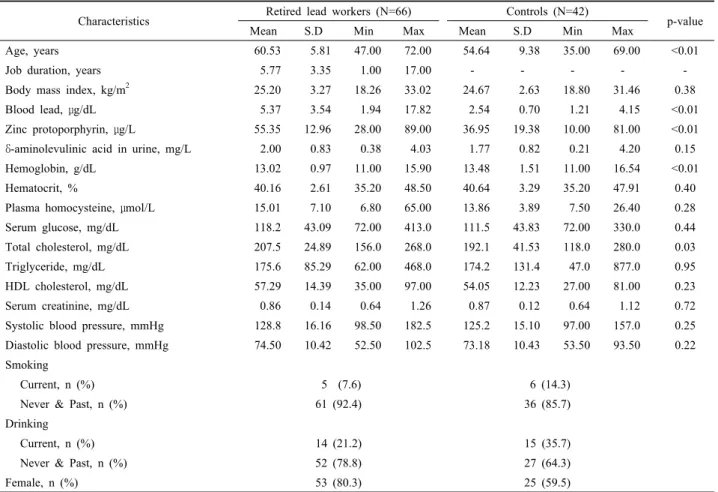
Table 1. Characteristics of study subjects
Characteristics Retired lead workers (N=66) Controls (N=42)
p-value
Mean S.D Min Max Mean S.D Min Max
Age, years 60.53 5.81 47.00 72.00 54.64 9.38 35.00 69.00 <0.01
Job duration, years 5.77 3.35 1.00 17.00 - - - - -
Body mass index, kg/m2 25.20 3.27 18.26 33.02 24.67 2.63 18.80 31.46 0.38
Blood lead, μg/dL 5.37 3.54 1.94 17.82 2.54 0.70 1.21 4.15 <0.01
Zinc protoporphyrin, μg/L 55.35 12.96 28.00 89.00 36.95 19.38 10.00 81.00 <0.01
δ-aminolevulinic acid in urine, mg/L 2.00 0.83 0.38 4.03 1.77 0.82 0.21 4.20 0.15
Hemoglobin, g/dL 13.02 0.97 11.00 15.90 13.48 1.51 11.00 16.54 <0.01
Hematocrit, % 40.16 2.61 35.20 48.50 40.64 3.29 35.20 47.91 0.40
Plasma homocysteine, μmol/L 15.01 7.10 6.80 65.00 13.86 3.89 7.50 26.40 0.28
Serum glucose, mg/dL 118.2 43.09 72.00 413.0 111.5 43.83 72.00 330.0 0.44
Total cholesterol, mg/dL 207.5 24.89 156.0 268.0 192.1 41.53 118.0 280.0 0.03
Triglyceride, mg/dL 175.6 85.29 62.00 468.0 174.2 131.4 47.0 877.0 0.95
HDL cholesterol, mg/dL 57.29 14.39 35.00 97.00 54.05 12.23 27.00 81.00 0.23
Serum creatinine, mg/dL 0.86 0.14 0.64 1.26 0.87 0.12 0.64 1.12 0.72
Systolic blood pressure, mmHg 128.8 16.16 98.50 182.5 125.2 15.10 97.00 157.0 0.25
Diastolic blood pressure, mmHg 74.50 10.42 52.50 102.5 73.18 10.43 53.50 93.50 0.22
Smoking
Current, n (%) 5 (7.6) 6 (14.3)
Never & Past, n (%) 61 (92.4) 36 (85.7)
Drinking
Current, n (%) 14 (21.2) 15 (35.7)
Never & Past, n (%) 52 (78.8) 27 (64.3)
Female, n (%) 53 (80.3) 25 (59.5)
안정 후 혈압기가 자동으로 작동되게 하여 충분히 휴식을 취하지 못하였을 때의 혈압의 변동을 최소로 하였다. 혈 압은 2번 연속으로 측정되게 하고 각 혈압측정 간의 안 정시간을 30초로 설정하였다. 최종 혈압은 2회 측정한 혈압치의 평균으로 하였다.
3) 자료분석
자료에 대한 통계분석은 SAS version 9.2 (SAS Institute Inc., Cary, NC, USA)를 이용하여 과거 직업적으로 납에 노출된 군과 대조군간의 납 노출지표 및 혈장 호모시스 테인, 혈압 등에 대한 차이를 t-검정하였다. 또한 납 노출 지표 및 혈장 호모시스테인, 혈압 등의 검사성적 간에 관 련성을 보기 위하여 단순상관분석을 시행하였다. 그 후 혈장 호모시스테인, 수축기 및 이완기 혈압을 각각 모델의 종속변수로 정하고 독립변수로 혈중납량, 혈중 ZPP 농도, 요중 δ-ALA 배설량, 혈색소, 혈구용적치, 혈청 크레아티닌, 총 콜레스테롤 등의 영향에 대한 다중회귀분석을 실시 하였다.
III. 연구 결과
총 연구대상자 108명의 주요 연구변수들의 평균과 표 준편차(범위), 음주 및 흡연상태는 Table 1과 같다. 퇴직 납 작업자들의 납 흡수 및 중독지표로서 평균 혈중납량, 혈중 ZPP 농도, 요중 δ-ALA 배설량, 혈색소량, 혈구용적치는
각각 5.37μg/dL, 55.35μg/dL, 2.0mg/L, 13.02g/dL, 40.16%
이었으며, 혈장 호모시스테인은 15.01μmol/L이었다. 대조군의 평균 혈중납량, 혈중 ZPP 농도, 요중 δ-ALA 배설량, 혈색 소량, 혈구용적치는 각각 2.54μg/dL, 36.95μg/dL, 1.77mg/L, 13.48g/dL, 40.64%이었으며, 혈장 호모시스테인은 13.86 μmol/L이었다. 납 노출지표와 혈장 호모시스테인 중 혈 중납량과 혈중 ZPP 농도, 혈색소량에서 두 그룹 간에 유 의한 차이가 있었다(각각 p<0.01, p<0.01, p<0.01).
연구변수들의 상호관련성을 보기 위하여 주요변수들의 단순상관을 구한 바는 Table 2와 같다. 납 노출지표 중 혈 중납량은 혈색소량, 혈장 호모시스테인, 수축기 및 이완기 혈압과 유의한 상관관계를 보였다(각각 p<0.01, p<0.01, p<0.05, p<0.01). 또한 혈장 호모시스테인의 경우 혈중납량, 혈색소량, 수축기 및 이완기 혈압과 유의한 상관관계를 나타냈다(각각 p<0.01, p<0.05, p<0.01, p<0.01). 수축기 혈압의 경우 혈중납량, 혈색소량, 혈장 호모시스테인과 유의한 상관관계를 보였으며(각각 p<0.05, p<0.05, p<0.01), 이완기 혈압은 혈중납량, 혈중 ZPP 농도, 혈색소량, 혈장 호모시스테인과 유의한 상관관계를 나타내었다(각각 p<0.01, p<0.05, p<0.01, p<0.01, p<0.01).
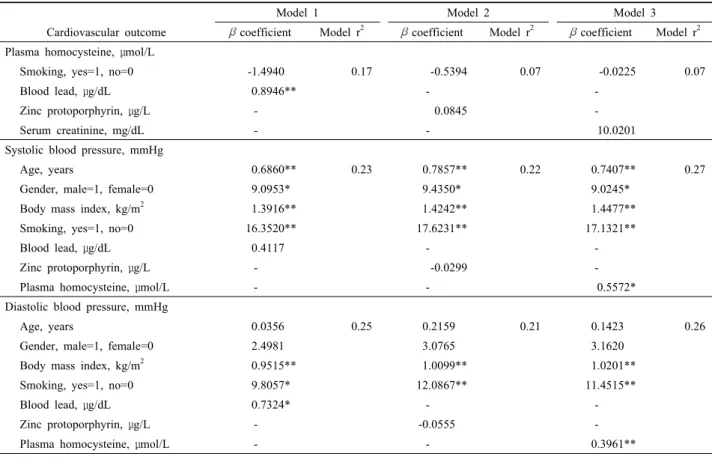
연구대상자 전원을 대상으로 혈장 호모시스테인, 수 축기 및 이완기 혈압을 각각 모델의 종속변수로 정하고 독립변수로 혈중납량, 혈중 ZPP 농도, 요중 δ-ALA 배설량, 혈색소, 혈구용적치, 혈청 크레아티닌, 총 콜레스테롤 등의 영향을 본 바는 Table 3의 내용과 같다. 혈장 호모시스테
Table 2. Spearman correlation coefficients for age, lead exposure indices, plasma homocysteine, and blood pressure in 108 retired lead workers and controls
Blood lead ZPP Hemoglobin Plasma
homocysteine Systolic BP Diastolic BP
Age, years 0.090 0.628** -0.419** -0.057** 0.036** -0.177**
Blood lead, μg/dL 0.184** 0.378** 0.389** 0.246** 0.310**
Zinc protoporphyrin, μg/L -0.465** 0.088** -0.058** -0.202**
Hemoglobin, g/dL 0.201** 0.235** 0.267**
Plasma homocysteine, μmol/L 0.250** 0.268**
Systolic blood pressure, mmHg 0.768**
*; p < 0.05, **; p < 0.01
Table 3. Multiple regression modeling for the affecting factors of plasma homocysteine and blood pressure in 108 study subjects
Model 1 Model 2 Model 3
Cardiovascular outcome β coefficient Model r2 β coefficient Model r2 β coefficient Model r2 Plasma homocysteine, μmol/L
Smoking, yes=1, no=0 -1.4940** 0.17 -0.5394 0.07 -0.0225 0.07
Blood lead, μg/dL 0.8946** - -
Zinc protoporphyrin, μg/L - 0.0845 -
Serum creatinine, mg/dL - - 10.0201
Systolic blood pressure, mmHg
Age, years 0.6860** 0.23 0.7857** 0.22 0.7407** 0.27
Gender, male=1, female=0 9.0953** 9.4350** 9.0245**
Body mass index, kg/m2 1.3916** 1.4242** 1.4477**
Smoking, yes=1, no=0 16.3520** 17.6231** 17.1321**
Blood lead, μg/dL 0.4117** - -
Zinc protoporphyrin, μg/L - -0.0299 -
Plasma homocysteine, μmol/L - - 0.5572*
Diastolic blood pressure, mmHg
Age, years 0.0356** 0.25 0.2159** 0.21 0.1423** 0.26
Gender, male=1, female=0 2.4981** 3.0765** 3.1620**
Body mass index, kg/m2 0.9515** 1.0099** 1.0201**
Smoking, yes=1, no=0 9.8057** 12.0867** 11.4515**
Blood lead, μg/dL 0.7324** - -
Zinc protoporphyrin, μg/L - -0.0555** -
Plasma homocysteine, μmol/L - - 0.3961**
*; p < 0.05, **; p < 0.01
인을 종속변수로 한 모형에서 납 노출지표 중 모형 1의 혈중납량은 혈장 호모시스테인에 유의한 영향변수로 확 인되었다. 수축기 혈압을 종속변수로 한 모형에서 모형 3의 혈장 호모시스테인은 수축기 혈압에 유의한 영향변 수로 확인되었다. 반면 이완기 혈압을 종속변수로 한 모형 1에서는 혈중납량이 이완기 혈압에 유의한 영향변수로 확인되었고, 모형 3의 경우 혈장 호모시스테인이 이완기 혈압의 유의한 영향변수로 확인되었으며, 총 콜레스테 롤도 유의한 영향변수로 확인하였다(모형 생략).
IV. 고 찰
평균 작업 기간이 남자 8.4년, 여자 10.1년인 국내 퇴직 근로자 235명을 대상으로 한 혈중납량 수준은 남녀 각각
11.5μg/dL와 8.9μg/dL이었으며(김남수 등, 2006), 평균 작 업 기간이 9.26년인 95명을 대상으로 한 연구에서는 10.4 μg/dL로 본 연구의 평균 작업기간이 5.77년인 퇴직근로 자의 5.37μg/dL 보다 높은 수준이며(김남수 등, 2010), 이 외의 납 노출지표의 수준도 본 연구결과보다 높은 수준 으로 이는 퇴직근로자의 평균 작업 기간의 차이에 따른 것으로 판단된다.
민혜선(2001)의 연구에서 한국 성인(남녀 20-69세)의 혈장 호모시스테인 수준은 남녀 각각 13.95μmol/L, 11.83 μmol/L로 성별에 따라 차이를 보였으며, 60이상의 그룹 에서는 남녀 각각 14.30μmol/L, 11.22μmol/L로 본 연구의 퇴직근로자(전체, 15.01μmol/L; 남성, 17.85μmol/L; 여성, 14.32μmol/L) 및 대조군(전체, 13.86μmol/L; 남성, 14.22μ mol/L; 여성, 13.61μmol/L)과 비교하여 다소 차이를 보였다.
다만, 본 연구결과에서 퇴직근로자 및 대조군 모두 각각 성별에 따라 혈장 호모시스테인의 차이는 없었다.
호모시스테인은 아미노산이 분해되면서 생성되는 유 해물질로 신경관 결손증, 심혈관계 질환, Alzheimer's dementia, 염증성 장질환 등의 위험성을 증가시킨다고 알 려져 왔다(D'Angelo and Selhub, 1997). 또한 혈중 호모시 스테인 증가의 원인은 과거 메티오닌 대사에 관여하는 효소인 cysthathionine beta synthase의 활성 결핍이 주된 원인으로 알려져 왔으며, 1990년대에 들어서면서 많은 논란이 있으나 methyltetrahydrofolate reductase (MTHFR)와 thymidylate synthase enhancer region (TSER)의 유전적 변 이가 한 원인으로 보고되었다(Jacque 등, 1996; Franken 등, 1996). 이러한 유전적 이상 이외에 호모시스테인의 혈중 농도를 증가시키는 요인으로 영양학적 문제로 비타민 B12와 엽산의 존재가 부적절한 경우 호모시스테인의 전 환은 방해받게 되고 호모시스테인의 혈중농도 증가가 나타나게 된다(Selhub and Miller, 1992). 한 연구에서는 호모시스테인이 뼈를 약화시켜 골다공성 골절을 유발한 다는 사실이 밝혀지기도 하였다(Eichinger 등, 1998).
한편, 납 독성은 호모시스테인이 메티오닌으로 바뀌 는데 주위에 있는 비타민 B12, 엽산-의존 효소, 메치오닌 합성의 활성도를 점진적으로 억제한다(Richard 등, 2008). 또한 메티오닌 합성 활성도는 산화적 스트레스에 매우 민감하며(Ludwig 등, 1997), 중금속은 효소의 활성 도를 떨어뜨리고 호모시스테인 대사의 불균형을 악화시 킨다고 보고하였다(이미경, 2010).
이미경(2010)의 연구에서 혈중납량이 높은 군일수록 혈장 호모시스테인이 높았으며, 나이, 성별, 인종, 소득, BMI, 흡연, 음주, 신체활동, 비타민 B6, B12, 혈청 엽산 등 다른 변수들을 차례로 보정한 이후에도 혈중납량분위에 따른 혈장 호모시스테인 증가의 폭은 낮아졌지만 결과는 유지된 것으로 보고하였다. Chia 등(2005)의 연구에서는 혈중납량이 1μg/dL 증가하면 혈장 호모시스테인은 0.05 μmol/L 증가하는 것으로 보고하였으며, Yakub와 Iqbal (2010)의 일반인구집단을 대상으로 한 연구에서도 혈중 납량과 고호모시스테인혈증간에 관련성이 있었다. 본 연구에서도 혈중납량과 혈장 호모시스테인 간에 유의한 상관관계를 보였다. 또한 성별, 연령, 체질량지수, 음주 및 흡연여부 등을 통제한 후에도 혈중납량이 혈장 호모시 스테인에 유의한 영향변수로 확인하였다. 한편 호모시 스테인에 영향을 미치는 인자로는 연령, 흡연, 수축기 혈압, 혈당, 혈청 크레아티닌 등이 보고되고 있다(Nygard 등, 1995; 1998; Jacques 등, 2001; van Asselt 등, 1998; Ramon 등, 2003; Gomez-Ambrosi 등, 2007; Huang 등, 2007; Perier 등, 2007). 연령이 증가할수록 cysthathionine beta synthase의 활성이 감소와 장의 흡수능력 감소에 따른 비타민 B12의 혈중 농도가 감소하는 것도 원인으로 보고되었다(van Asselt 등; 1998). 흡연과의 연관성에 대한 정확한 기전은 알려져 있지 않으며, 다만 흡연자에서 호모시스테인이 높은 것으로 보고되었는데(Nygard 등, 1995; 1998; Jacques
등 2001), 본 연구에서는 혈장 호모시스테인을 종속변수로 하고 흡연유무를 독립변수로 한 다중회귀분석에서 모두 유의한 관련이 없었다. 이는 전체 대상자중 여성의 빈도가 높고, 일반 인구집단과 비교하여 흡연율 등에 차이가 있어 흡연으로 인한 영향이 일부 반영이 되지 않은 것으로 판 단된다. 한편 혈관내피 세포의 기능부전으로 인한 혈관의 경직도 상승 및 확장능의 감소로 인하여 수축기 혈압과도 유의한 상관이 있는 것으로 보고되었는데(Rodgers and Conn, 1990), 본 연구에서는 수축기 및 이완기 혈압 모두 유의한 상관관계를 나타내었다.
한편 납 노출이 심혈관계 질환을 유발할 수 있다는 것은 이미 1900년도 초에 호주를 비롯한 영국의 의사들에 의해 주장되기 시작하였고(Henderson, 1958), 동물을 이용한 연구에서부터 납 노출 근로자들에 대한 역학적 연구까지 다양하게 수행되고 있다(Bernard and Becker, 1988;
Cramer 등, 1974; Grandjean 등, 1989; Verchoor 등, 1987).
Nomiyama 등(2002)은 납이 지단백 대사과정을 바꾸어 혈압을 증가시킬 수 있다는 것을 보고하였는데 그 기전은 지질과산화, 혈관내피 세포층의 변이, 혈중 콜레스테롤 에의 영향, 혈관벽의 지질 합성 증가로 동맥압을 높일 수 있다고 추정하였다. 또한 직업적으로 납에 노출되는 근 로자들에서의 납에 의한 고혈압 유발의 인과관계뿐만 아니라 환경오염으로 인한 체내의 납 농도의 증가가 고 혈압의 중요한 변수라는 주장이 제기되어 이에 대한 활 발한 역학연구가 이루어진바 있다(Antonio 등, 1994;
Apostoli 등, 1992; William 등, 1988; Kirkby 등, 1985). 다만, 고혈압을 유발하는 소인은 다양하여 납 노출과 고혈압 간의 인과관계를 입증하기는 쉽지 않아 학자들에 따라 논란이 계속되고 있으며 연구방법간의 차이와 고혈압에 관여하는 다양한 교란변수의 통제정도에 기인된다고 주 장하고 있으나 아직 연구가 계속되어야 하고 검증되어야 할 것으로 생각된다. 일부 연구들은 양자간의 관련성이 존재하더라도 그 정도가 미미하다고 주장하는 반면, 일부 연구들은 일반 인구집단에서 체내 납 농도와 혈압간에 유의한 관련이 있다고 하였다(Neri 등, 1988; Parkinson 등, 1987; Pocock 등, 1988). 본 연구에서도 혈중납량과 수축기 및 이완기 혈압간의 유의한 상관관계를 나타내었다. 다만, 이러한 결과는 추가 연구에서 다양한 영향요인을 고려 해야 할 것으로 사료된다.
이상에서 고찰한 바와 같이 개별연구에서 혈중납량과 호모시스테인의 증가는 각각 심혈관계 질환과 관련이 있는 것으로 보고되었으며(Schafer 등, 2005; Chia 등, 2007), 일반 인구집단을 대상으로 한 연구 및 메타분석에 서도 납과 혈압과의 관련성은 보고되고 있다(Poreba 등, 2011; Nawrot 등, 2002; Den Hond 등, 2002; Schwartz, 1995; Staessen 등, 1994). 또한 이러한 결과들은 하나의 독립적인 영향이라기보다는 유전적인 요인이나, 성별, 연령, 인종 등 다양한 요인과 함께 복합적으로 작용하는 것으로 판단된다. 따라서 인구학적 특성과 함께 엽산과 비타민 B6, B12 등 다양한 영향요인을 통제한 후 체내 납
량의 증가가 혈장 호모시스테인, 혈압의 증가에 미치는 영향의 정도를 보다 구체적으로 규명하는 것이 필요하다.
다만, 본 연구는 퇴직 납 근로자의 경우 한정된 코호트로 인해 남녀의 성별에 차이가 있고 연령층이 평균 60세 이 상으로 일반인구집단의 결과와 비교하는데 한계가 있다.
또한 호모시스테인의 대사에 필요한 인자 중에서 엽산과 비타민 B6, B12에 대해 조사하지 않았다. 일부 다른 의견이 있기는 하나 엽산, 비타민 B6, B12 수준과 혈장 호모시스 테인 수준 사이에는 유의한 음의 상관관계가 있는 것으로 보고되고 있다(van Wersch 등, 2002; Suzanne 등, 1996;
Johan 등, 1993). 이번 연구의 결과를 뒷받침하기 위해서는 납 누적지표에 대한 연구와 함께 혈장 호모시스테인 대사에 영향을 주는 인자를 함께 다루는 연구가 이루어져야 한다.
V. 결 론
본 연구는 납 사업장에서 퇴직한 근로자중 납을 취급한 경력이 최소 1년 이상인 퇴직근로자들을 대상으로 과거 직업적 납 노출로 인한 퇴직 후 납 노출 수준 및 혈장 호 모시스테인 농도를 알아보았다. 또한 납 노출지표와 혈장 호모시스테인, 혈압과의 관련성을 살펴보아 퇴직이후에도 납 노출이 근로자에 미치는 영향을 확인하고자 하였다.
전체 연구대상 중 퇴직 납 근로자들이 대조군보다 혈 중납량, 혈중 ZPP 농도, 혈색소량에서 유의한 차이를 보 였으며, 혈장 호모시스테인이 높은 것으로 나타났으나 혈장 호모시스테인의 경우 통계적으로는 유의한 차이를 보이지 않았다. 납 노출지표와 혈장 호모시스테인, 혈압 과의 단순상관분석에서는 혈중납량과 혈압, 혈장 호모 시스테인 간에 유의한 상관관계를 보였다. 혈장 호모시 스테인을 종속변수로 한 다중회귀분석에서는 혈중납량, 수축기 혈압을 종속변수로 한 다중회귀분석에서는 혈장 호모시스테인, 그리고 이완기 혈압을 종속변수로 한 다 중회귀분석에서는 혈중납량과 혈장 호모시스테인, 총 콜레스테롤이 영향변수로 확인되었다.
이상의 결과에서 퇴직이후에도 5μg/dL 이상의 혈중납 량은 각각 혈장 호모시스테인과 이완기혈압의 증가와 관련이 있는 것으로 판단된다. 다만, 퇴직근로자의 경우 골중납량 등의 납 누적지표가 혈장 호모시스테인과 혈압 증가에 기여했는지, 엽산, 비타민 B6, B12 수준이 혈장 호 모시스테인 대사에 영향을 주었는지에 대한 추가 연구가 필요하다.
VI. REFERENCES
김남수, 김진호, 이병국. 퇴직한 납 근로자들의 체내 납 부 담 노출지표가 신경행동학적 기능에 미치는 영향.
한국산업위생학회지 2010; 20(3): 156-167.
김남수, 김진호, 김화성, 김희선, 이성수, Andrew C. Todd, 이병국. 퇴직한 납 취급 근로자들에서 골밀도 저하 와 경골납량이 혈중납량에 미치는 영향. 한국산업 위생학회지 2006; 16(4): 324-333.
민혜선. 한국 성인 남녀의 엽산 영양상태와 혈장 호모시 스테인 농도. 한국영양학회지 2001; 34 (4): 393-400.
이미경. 혈중 homocysteine과 체내 lead, cadmium과의 관 계. 경북대학교 대학원 의학과 예방의학 전공 박사 학위논문. 2010.
Antonio CDS, Sergio C, Creuza MR, Neife AG. Occupa- tional exposure to lead, kidney function tests, and blood pressure. Am J Ind Med 1994; 26: 635- 643.
Apostoli P, Maranelli G, Micciolo R. Is hypertension a confounding factor in the assessment of blood lead reference values?. Sci Total Environ 1992; 120 (1/2):
127-134.
ATSDR. Toxicological profile for lead. U.S. Department of Health & Human Services Public Health Service.
Agency for Toxic Substances and Disease Registry.
2007.
Bernard BP, Becker CE. Environmental lead exposure and the kidney. J Toxicol Cloin Toxicol 1988; 6 (1-2): 1-34.
Bhatnagar A. Environmental cardiology: studying mechanistic links between pollution and heart disease. Circ Res 2006; 99: 692-705.
Blumberg WE, Eisinger J, Lamola AA, Zuckermann DM.
Zinc protoporphyrin level in blood determination by a portable hematofluorometer; A screening device for lead poisoning. J Lab Clin Med 1977; 89: 712-723.
Chia SE, Ali SM, Lee BL, Lim GH, Jin S et al. Asso- ciation of blood lead and homocysteine levels among lead exposed subjects in Vietnam and Singapore.
Occup Environ Med 2007; 64 (10): 688-93.
Cramer K, Goyer RA, Jagenburg R, Wilson MH. Renal ultrastructure renal function, and parameters of lead toxicity in workers with different period of lead exposure. Brit J Ind Med 1974; 31: 113-127.
D'Angelo A, Selhub J. Homocysteine and thrombotic disease. Blood 1997; 90: 1-11.
Den Hond E, Nawrot T and Staessen JA. The rela- tionship between blood pressure and blood lead in NHANES III. J Hum Hypertens 2002; 16: 563-568.
Eichinger S, Strumpflen A, Hirschl M, Bialonczyk C and Herkner K et al: Hyperhomocysteinemia is a risk factor of recurrent venous thromboembolism. Thromb Haemost, 1998; 80 (4): 566-569.
EPA. 2006. Air quality criteria for lead. Available:
http://cfpub.epa.gov/ncea/cfm/recorddisplay.cfm?
deid=158823.
Fernandez FJ. Micromethod for lead determination in whole blood by atomic absorption with use of graphite furnace. Clin Chem 1975; 21: 555-561.
Franken DG, Boers GH, Blom HJ, Cruysberg JR, Trijbels, FJ et al. Prevalence of familial mild hyperhomocy- steinemia. Atherosclerosis 1996; 125: 71-80.
Gomez-Ambrosi J Pastor, C Salvador J, Silva C, Rotellar, F et al. Influence of waist circumference on the metabolic risk associated with impaired fasting glucose: effect of weight loss after gastric bypass. Obes Surg 2007;
17: 585-591.
Grandjean P, Hollnagel H, Hedegaard L, Christensen JM, Larsen, S. Blood lead-blood pressure relationship;
Alcohol intake and hemoglobin as confounders. Am J of Epidemiol 1989; 129 (4): 732-739.
Huang CW, Chen TH, Lin HS, Tseng YL, Lai SL. et al.
The relation between plasma homocysteine level and cardiovascular risk factors in cerebral ischemia. Acta Neurol Taiwan 2007; 16: 81-85.
Jacques PF, Williams RR, Ellison RC, Eckfeldt JH, Rosenberg, IH. et al. Relation between folate status, a common in methyltetrahydrofolate reductase, and plasma homocysteine concentrations. Circulation 1996; 93: 7-9.
Jacques PF, Bostem AG, Wilson PW, Rich S, Rsenberg IH. et al. Determinants of plasma total homocysteine concentration in the Framinghan offspring cohort. Am J Clin Nutr 2001; 73: 613-21.
Johan BU, Hayward V, Annatjie van der M, Piet JB.
Vitamin B-12, vitamin B-6 and folate nutritional status in men with hyperhomocysteinemia. Am J Clin Nutr 1993; 57: 47-53.
Henderson DA. The etiology of chronic nephritis in Queensland. Med J Aust 1958; 1: 377-386.
Hertz-picciotto I, Croft J. review of the relation between blood lead and blood pressure. Epidemiol Rev 1993;
15: 352-373.
Loperz AD, Mathers CD, Ezzati M, Jamison DT, Murray CJ. Global and regional burden of disease and risk factors, 2001:systemic analysis of population health data. Lancet 2006; 367: 1747-1757.
Kirkby H, Gyntelberg F. Blood pressure and other cardio- vascular risk factors of long-term exposure to lead.
Scand J Work Environ Health 1985; 11: 15-19.
Ludwig ML, Matthews RG. Structure-based perspectives on B12-dependent enzymes. Annu Rev Biochem 1997;
66: 269-313.
Navas-Acien A, Guallar E, Silbergeld EK, Rothenberg SJ.
Lead exposure and cardiovascular disease-a systemic review. Environ Health Perspect 2007; 115: 472-482.
Nawrot TS, Thijs L, Den Hond EM, Roels HA, Staessen JA. An epidemiological re-appraisal of the associa- tion between blood pressure and blood lead: a meta- analysis J of Human Hypertension 2002; 16: 123-131.
Neri LC, Hewitt D, Orser B. Blood lead and blood pressure; Analysis of cross-sectional and longitudinal data from Canada. Environmental Health Perspectives 1988;78: 123-126.
Nomiyama K, Nomiyama H, Liu SJ, Tao YX, Nomiyama, T et al. Lead induced increase of blood pressure in female lead workers. Occup Environ Med 2002; 59:
734-739.
Nygard O, Refsum H, Vollset SE, Stensvold I, Tverdal A et al. Total plasma homocysteine and cardiorisk profile.
The Hordland Homocystein Study. JAMA 1995; 274:
1526-1533.
Nygard O, Refsum H, Ueland PM, Vollset SE. Major lifestyle determinants of plasma total homocysteine distribution: the Hardland Homocysteine Study. Am J Clin Nutr 1998; 67:263-270.
Perier MA, Gineyts E, Munoz F, Sornay-Rendu E, Delmas PD. Homocysteine and fracture risk in postmenopau- sal women: the OFELY study. Osteoporos Int 2007; 18:
1329-1336.
Ramon R, Walter P, Julia A, Myrian O, Gonzalo R. Homo- cysteine and essential hypertension. J Clin Pharmacol 2003; 43: 1299-1306.
Parkinson DK, Hodgson MJ, Bormet EJ, Dew MA, Connell MM. Occupational lead exposure and blood pressure. Brit J of Industr Med 1987; 44: 744-748.
Pocock SJ, Sharper AG, Ashby D, Delves HT, Clayton, BE. The relationship between blood lead, blood pressure, stroke and heart attacks in middle-aged british men. Environmental Health Perspectives 1988;
78: 23-30.
Poreba R, Gac P, Poreba M, Andrzejak R. Environmental and occupational exposure to lead as a potential risk factor for cardiovascular disease. Environ Toxicol Pharmacol 2011; 31(2): 267-277.
Richard D, Christina M, Jorge B, Verna A, Mostafa W.
How environmental and genetic factors combine to cause autism : A redox/methylation hypothesis. Neuro Toxicology 2008; 29: 190-201.
Rodgers GM, Conn MT. Homocysteine, an atherogenic stimulus, reduecs protein C activat-ivation by arterial and venous endothelial cells. Blood 1990; 75: 895-901.
Schafer JH, Glass TA, Bressler J, Todd AC, Schwartz BS.
Blood lead is a predictor of homocysteine levels in a population-based study of older adults. Environ Health Persp 2005; 113: 31-35.
Schwartz J. Lead, blood pressure, and cardiovascular disease in men. Arch Environ Health 1995; 50: 31-37.
Selhub J, Miller JW. The pathogenesis of homocystei- nemia: interruption of the coordinate regulation by Sadenosylmethionine of the remethylation and trassul- furation of homocysteine. Am J Clin Nutr 1992; 55:
131-8.
Sharp DS, Becker CE, Smith AH. chronic low-level lead exposure. Its role in the pathogenesis of hyperten- sion. Med Toxicol 1987; 2: 210-232.
Staessen JA, Bulpitt CJ, Fagard R, Lauwerys RR, Roels H et al. Hypertension caused by low-level lead exposure:
myth or fact? J Cardiovasc Risk 1994; 1 (1): 87-97.
Suzanne LC, Marianne X, Alain P, Jacob S, Jean D et al. Plasma total homocysteine in health subject:
sex-specific relation with biological traits. Am J Clin Nutr 1996; 64: 587-93.
William RH. The relationship of blood lead levels to blood pressure in the U.S. population. Environmental Health Perspectives 1988; 78: 9-13.
van Asselt DZ, de Groot LC, van Staveren WA, Blom HJ, Wevers RA et al. Role of cobalamin intake and atrophic gastritis in mild cobalamin deficiency in older Dutch subjects. Am J Clin Nutr 1998; 68:
328-334.
van Wersch JWJ, Janssens Y, Zandvoort JA. Folic acid, Vitamin B12, and homocysteine in smoking and non- smoking pregnant women. European Journal of Obestetrics & Gynecology and Reproductive Biology 2002; 103: 18-21.
Vaziri ND, Sica DA. Lead-induced hypertension: role of oxidative stress. Curr Hypertens Rep 2004; 6 (4):
314-320.
Verschoor M, Wibowo A, Herber R, Hemmen J, Zielhuis R. Influence of occupational low-level lead exposure on renal parameters. Am J of Ind Med 1987; 12:
341-351.
Weinhold B. Environmental cardiology: getting to the heart of matter. Environ Health Perspect 2004; 112: 880-887.
Wells EM, Navas-Acien A, Herbstman JB, Apelberg BJ, Silbergeld EK et al. Low-level lead exposure and elevations in blood pressure during pregnancy.
Environ Health Perspect 2011; 119 (5): 664-669 Yakub M, Iqbal MP. Association of blood lead (Pb) and
plasam homocysteine: A cross sectional survey in Karachi, Pakistan. PloS One 2010; 5 (7): 1-6.