자폐스펙트럼장애의 치료에 대한 한의 임상 가이드라인 개발을 위한 기초연구 -기존에 개발된 자폐스펙트럼장애 가이드라인을 중심으로-
김상민․이진용․이선행․장규태
경희대학교 대학원 소아과학교실
Received: January 20, 2017 ∙ Revised: February 9, 2017 ∙ Accepted: February 13, 2017 Corresponding Author 1: Chang Gyu Tae
Department of Pediatrics of Korean Medicine, Kyung Hee University Hospital at Gang-dong, 892 Dongnam-ro, Gangdong-gu, Seoul 05278, Republic of Korea.
Tel: +82-2-440-7126 / Fax: +82-2-440-7143 / E-mail: [email protected] Corresponding Author 2: Lee Jin Yong
Pediatrics of Clinical Korean Medicine, College of Korean Medicine, Kyung Hee University, 23, Kyungheedae-ro, Dongdaemun-gu, Seoul, 130-872, Republic of Korea.
Tel: +82-2-958-9172 / Fax: +82-2-958-9171 / E-mail: [email protected]
ⓒ The Association of Pediatrics of Korean Medicine. All rights reserved. This is an open-access article distributed under the tenus of the Creative Commons Attribution Non-Commercial License (http://creativecommons.org/licenses/by-nc/3.0/), which permits unrestricted non-commercial use, distribution, and reproduction in any medium, provided the original work is properly cited.
Abstract
A Basic Study for Development of Clinical Practice Guidelines of Korean Medicine in Autism Spectrum Disorder
-Based on Pre-existing Clinical Practice Guidelines of Autism Specturm Disorder-
Kim Sang Min․Lee Jin Yong․Lee Sun Haeng․Chang Gyu Tae Department of Korean Pediatrics, Graduate School, Kyung Hee University Objectives
The purpose of this study is to review pre-existing clinical practice guidelines for autism spectrum disorders, and refer those in developing a new practice guideline.
Methods
A total of 9 existing clinical practice guidelines for autism spectrum disorder developed from 2010 to 2016 were searched by Google scholar and Pubmed, and were reviewed those literatures in three parts: general, diagnosis &
evaluation, and intervention.
Results
There were no consistency in the recommendation methods of 9 clinical care guidelines (such as the method of rating and recommendation intensity for diagnosis, evaluation, and treatment). However, in the diagnosis and evaluation section, frequently used evaluation and diagnostic tools are mentioned in most clinical practice guidelines, and the types of pharmacologic and non-pharmacological treatments that are mainly recommended in treatment are equally mentioned in most clinical practice guidelines could confirm.
Conclusions
1. Some guideline recommendations are graded according to each criterion. Recommendations presented in various databases were based on systematic reviews or other literatures. The most utilized database were PsycINFO, CINAHL, Cochrane.
2. DSM-5 and ICD-10 were the most common used diagnostic criteria, and DSM-IV was used as a diagnostic standard in the guideline published before 2013. The tools used for diagnosis and evaluation were also varied.
However, most recommended ones were ADI-R, ADOS-G, and DISCO.
3. Treatment was largely divided into pharmacological intervention and non-pharmacological intervention. In some guideline, the interventions were divided into pediatric and adult. Most of the pharmacological interventions were not recommended due to lack of evidence, but in cases in which specific symptoms were aimed, they recommended to seek professional help.
4. In addition to interventions, each guideline referred to supportive interventions that may be helpful in the daily life of patients with ASD, which may need to be addressed in future clinical guidelines.
Key words: Autism spectrum disorder, Autism, Clinical practice guideline, Diagnosis, Assessment, Intervention, TCM
ISSN 1226-8038(Print), 2287-9463(Online), https://doi.org/10.7778/jpkm.2017.31.1.052
Ⅰ. Introduction
자폐스펙트럼장애 (Autism Spectrum Disorder, ASD) 는 아동기에서 나타나는 신경 발달 장애로서 미국정신 의학회의 진단체계인 Diagnostic and Statistical Manual of Mental Disorders, 5th edition (DSM-5)에 의하면 의사소 통 및 사회적 상호작용에 있어 손상을 보이며, 행동 및 감정 통제 등에 어려움의 양상을 보이는 질병이다
1). 최 근의 시행된 계통적 연구에 따르면, 세계적인 ASD의 유 병률은 1000 명 당 7.6 명으로 나타났으며, 남아에게서 나타날 확률이 여아의 4 배 정도인 것으로 나타났다
2-4).
ASD는 포괄적인 치료적 접근이 필요한 질환인데 이 는 질환이 만성적이고 개개인의 사회적・행동적인 기 능의 제약이 다양하기 때문이다. 이로 인해서 치료는 아동의 나이와 특별한 필요에 따라서 개별적인 맞춤화 가 된 상태로 환아의 약점을 강화하기 위한 목적을 가 지고 진행된다
5). 시행되고 있는 치료 유형으로는 ASD 의 핵심 증상 개선을 목표로 하는 행동 및 교육적 치료, 동반되는 합병증이나 이상 증상을 경감시키기 위한 정 신약리학적 치료, 보완 및 대체 치료 등이 있다
6).
ASD는 한의학적 측면에서 꼭 일치하는 증후를 찾을 수는 없으나, 그 증상의 표현 상 비교될 수 있는 것으로
‘呆’, ‘健忘’, ‘五遲’ 중 ‘語遲’와 ‘行遲’ 등의 증상과 일치 하며 뇌의 발달상의 지연 혹은 장애 (腦未滿)로 인식하 고 치료의 측면으로 ‘神’, ‘心’, ‘腦’, ‘腎’, ‘精’의 균형적인 발달을 목표로 접근하고 있다
7).
많은 ASD 환자의 부모들은 보완 및 대체 치료를 추 구하고 있으며 이러한 경향은 사회・경제적인 지위가 높을수록 두드러지는 것으로 나타났다
8-9). 보완・대체 치료의 범위는 매우 다양한데 이는 생물학적으로 기반 을 둔 치료법 (Vitamin 또는 무기질 및 특수 식이)부터 고압 산소 요법 (Hyperbaric oxygen treatment, HBOT), 킬레이트화 (Chelation), 주사요법 등을 포함한다. 하지 만 이러한 치료방법에 대한 연구는 매우 제한적으로
진행되어 있다
10). 보완・대체 치료의 한 분야를 차지하 고 있는 한의학적 치료에 대한 연구 역시 매우 제한적 으로 진행되어 있으며, ASD의 한의학적 진료에 있어서 변증과 치법이 통일되지 않았다는 특징 때문에 많은 수요에도 불구하고 제도적 뒷받침에 있어서 걸림돌이 되고 있는 것이 현실이다. 따라서 ASD의 한의 진료에 있어서 체계화된 임상 진료 지침의 필요성이 대두되고 있다.
이에 본 저자는 문헌조사를 통하여 기존에 제시된 몇몇 guideline에서 수록한 내용을 개요・진단 및 평 가・치료의 세 항목으로 나누어 고찰하고, 이를 바탕 으로 앞으로 개발되는 한의 임상 진료 지침이 추구해 야 할 방향을 제시하고자 한다.
Ⅱ. Materials and methods
1. 문헌검색
국내외 ASD와 관련된 임상진료가이드라인의 각 항 목을 분석하기 위하여 2016년까지 발표된 ASD의 임상 가이드라인을 검색 및 분류하였다. 구체적인 방법으로 는 해외의 다양한 임상 진료 지침의 정보를 얻을 수 있는 Google portal과 Pubmed에서 'Autism guideline', 'Autism spectrum disorder guideline', 'Autism clinical guideline' 이라는 검색식을 사용하여 검색하였다. 그 중에서 요약된 Guideline의 원본이나 직접 검색이 가능 한 Guideline 중에서 2010년도 이후 발간되거나 개정 된 Guideline을 대상으로 하여 총 9편의 Guideline
11-9)을 선정하고 이 중에서 NICE에서 출간한 3편의 guide-
line
12-4), MAGI에서 출간한 2편의 guideline
17-8)을 하나
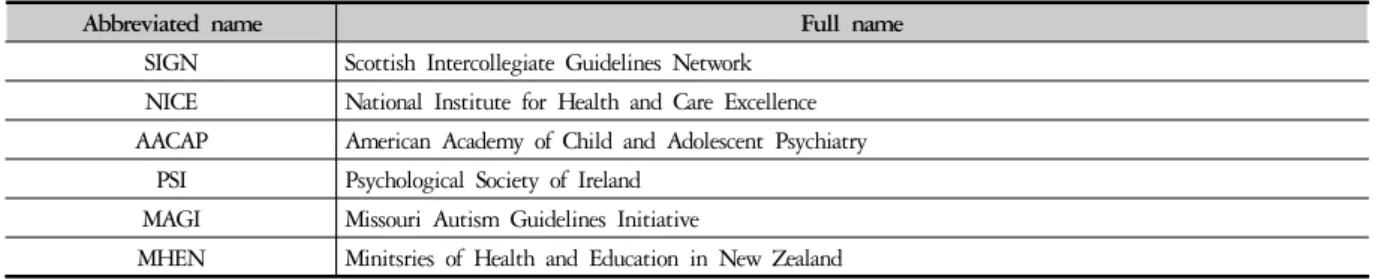
의 Category로 묶어서 총 6 항목에 대하여 문헌 고찰을 실시하였다. 본 연구에서는 편의상 발행 기관의 명칭 으로 guideline을 지칭하였으며 각각의 발행 기관의 정 보는 추가적으로 정리하였다 (Table 1).
Table 1. Publishing Organization of Guideline
Abbreviated name Full name
SIGN Scottish Intercollegiate Guidelines Network NICE National Institute for Health and Care Excellence AACAP American Academy of Child and Adolescent Psychiatry
PSI Psychological Society of Ireland MAGI Missouri Autism Guidelines Initiative
MHEN Minitsries of Health and Education in New Zealand
2. 주제 선정 방법
임상진료지침의 구성에 있어서 가장 중요한 부분을 차지하는 내용에 대해서 연구진이 회의를 거쳐 크게 진단 및 평가, 치료의 2가지 주제를 선정하였으며, 각 각의 Guideline에서 나타나는 특이한 항목들에 대해서 언급하고자 개괄이라는 주제를 추가하여 개괄, 진단 및 평가, 치료의 총 3가지의 항목으로 구분하여 주제를 선정하였다.
Ⅲ. Results
1. 개괄 (Table 2)
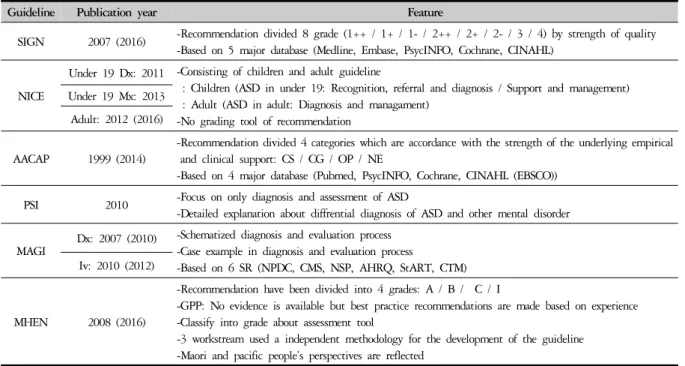
대부분의 guideline에서는 권고에 대하여 그 근거의 신뢰성에 따라서 권고 등급을 나누어서 권고를 등급화 하고 있는데, SIGN의 경우 큰 등급을 1~4등급으로 나 눈 뒤에 1등급과 2등급은 다시 ++, +, - 의 세부 등급으 로 나누어 권고의 수준을 더 세밀하게 평가할 수 있도 록 하였다. 또한 AACAP의 경우에는 임상적인 신뢰성 을 기준으로 하여 CS (Clinical standard), CG (Clincial guideline), OP (Clinical option) 및 NE (Not endorsed)의 4 등급으로 나누어 각각의 권고마다 등급을 붙여 놓았
는데, 이러한 등급화는 MHEN에서도 비슷하게 나타난 다 (A, B, C, I).
각 guideline에서는 권고의 근거가 되는 자료들에 대 한 검색 방법이나 검색 database에 대해서 언급해 놓았 는데, 그 중에서도 Systematic review에 근거한 권고가 가장 많이 나타났으며, 많이 사용된 database로는 PsycINFO, CINAHL, Cochrane 등이 있었다. MHEN의 경우 8개의 part로 이루어진 guideline의 구성을 3개의 workstream으로 나누어 각각 독립적인 검색 및 구성방 법을 사용하여 guideline을 제시하였다.
2. 진단 및 평가 (Table 3)
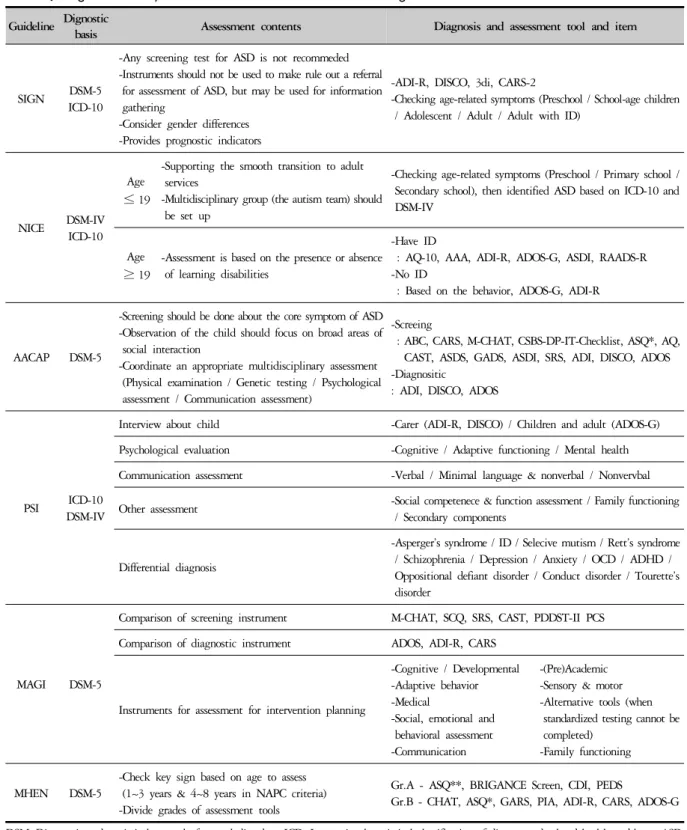
2010년도 이후에 출간된 guideline을 대상으로 하였 기에, 2013년 DSM-IV에서 DSM-5로의 변화를 따라 대 부분의 guideline에서 DSM-5의 진단기준을 참고할 것 을 권장하였다. 몇몇 guideline에서는 ICD-10의 분류도 함께 참고하여 진단 및 평가에 응용하도록 제시하고 있으며, DSM-IV를 진단기준으로 참고한 guideline 중 에서도 DSM-5로의 개정에 대해서 언급하며 그 변화에 대해서 추가적인 개정이 필요함을 제시하고 있다. 각 guideline의 진단 근거가 되는 기준 및 평가 특징, 평가 도구에 대한 내용을 정리하였다.
Table 2. Summary about Characteristic of ASD Guideline
Guideline Publication year Feature
SIGN 2007 (2016) -Recommendation divided 8 grade (1++ / 1+ / 1- / 2++ / 2+ / 2- / 3 / 4) by strength of quality -Based on 5 major database (Medline, Embase, PsycINFO, Cochrane, CINAHL)
NICE
Under 19 Dx: 2011 -Consisting of children and adult guideline
: Children (ASD in under 19: Recognition, referral and diagnosis / Support and management) : Adult (ASD in adult: Diagnosis and managament)
-No grading tool of recommendation Under 19 Mx: 2013
Adult: 2012 (2016)
AACAP 1999 (2014)
-Recommendation divided 4 categories which are accordance with the strength of the underlying empirical and clinical support: CS / CG / OP / NE
-Based on 4 major database (Pubmed, PsycINFO, Cochrane, CINAHL (EBSCO)) PSI 2010 -Focus on only diagnosis and assessment of ASD
-Detailed explanation about diffrential diagnosis of ASD and other mental disorder
MAGI
Dx: 2007 (2010) -Schematized diagnosis and evaluation process -Case example in diagnosis and evaluation process
-Based on 6 SR (NPDC, CMS, NSP, AHRQ, StART, CTM) Iv: 2010 (2012)
MHEN 2008 (2016)
-Recommendation have been divided into 4 grades: A / B / C / I
-GPP: No evidence is available but best practice recommendations are made based on experience -Classify into grade about assessment tool
-3 workstream used a independent methodology for the development of the guideline -Maori and pacific people’s perspectives are reflected
CS: Clinical standard, CG: Clinical guideline, OP: Clinical option, NE: Not endorsed, CINAHL: Cumulative index to nursing and allied health
literature, Dx: Diagnosis, Mx: Management, Iv: Intervention, SR: Systematic review, NPDC: National professional development center, CMS: Centers
for medicare and medicaid services, NSP: National standards project, AHRQ: Agengy for healthcare research and quality, StART: Stanford autism
research team, CTM: Comprehensive treatment models, GPP: Good practice point
Table 3. Diagnostic Basis, Assessment Contents and Tool According to Guideline Guideline Dignostic
basis Assessment contents Diagnosis and assessment tool and item
SIGN DSM-5
ICD-10
-Any screening test for ASD is not recommeded -Instruments should not be used to make rule out a referral
for assessment of ASD, but may be used for information gathering
-Consider gender differences -Provides prognostic indicators
-ADI-R, DISCO, 3di, CARS-2
-Checking age-related symptoms (Preschool / School-age children / Adolescent / Adult / Adult with ID)
NICE DSM-IV ICD-10
Age
≤ 19
-Supporting the smooth transition to adult services
-Multidisciplinary group (the autism team) should be set up
-Checking age-related symptoms (Preschool / Primary school / Secondary school), then identified ASD based on ICD-10 and DSM-IV
Age
≥ 19
-Assessment is based on the presence or absence of learning disabilities
-Have ID
: AQ-10, AAA, ADI-R, ADOS-G, ASDI, RAADS-R -No ID
: Based on the behavior, ADOS-G, ADI-R
AACAP DSM-5
-Screening should be done about the core symptom of ASD -Observation of the child should focus on broad areas of
social interaction
-Coordinate an appropriate multidisciplinary assessment (Physical examination / Genetic testing / Psychological assessment / Communication assessment)
-Screeing
: ABC, CARS, M-CHAT, CSBS-DP-IT-Checklist, ASQ*, AQ, CAST, ASDS, GADS, ASDI, SRS, ADI, DISCO, ADOS -Diagnositic
: ADI, DISCO, ADOS
PSI ICD-10
DSM-IV
Interview about child -Carer (ADI-R, DISCO) / Children and adult (ADOS-G) Psychological evaluation -Cognitive / Adaptive functioning / Mental health Communication assessment -Verbal / Minimal language & nonverbal / Nonvervbal Other assessment -Social competenece & function assessment / Family functioning
/ Secondary components
Differential diagnosis
-Asperger’s syndrome / ID / Selecive mutism / Rett’s syndrome / Schizophrenia / Depression / Anxiety / OCD / ADHD / Oppositional defiant disorder / Conduct disorder / Tourette’s disorder
MAGI DSM-5
Comparison of screening instrument M-CHAT, SCQ, SRS, CAST, PDDST-II PCS Comparison of diagnostic instrument ADOS, ADI-R, CARS
Instruments for assessment for intervention planning
-Cognitive / Developmental -Adaptive behavior -Medical
-Social, emotional and behavioral assessment -Communication
-(Pre)Academic -Sensory & motor -Alternative tools (when
standardized testing cannot be completed)
-Family functioning
MHEN DSM-5
-Check key sign based on age to assess (1~3 years & 4~8 years in NAPC criteria) -Divide grades of assessment tools
Gr.A - ASQ**, BRIGANCE Screen, CDI, PEDS
Gr.B - CHAT, ASQ*, GARS, PIA, ADI-R, CARS, ADOS-G DSM: Diagnostic and statistical manual of mental disorders, ICD: International statistical classification of diseases and related health problems, ASD:
Autism spectrum disorder, ADI-R: Autism diagnostic interview-revised, DISCO: Diagnostic interview for social and communication disorders, 3di:
Developmental·dimensional·diagnostic interview, CARS: Childhood autism rating scale, ID: Intellectual disabilities, AQ-10: Autism-spectrum quotient-10 items, AAA: Adult-asperger assessment, ADOS-G: Autism diagnostic bbservation schedule-generic, ASDI: Asperger syndrome (and high-functioning autism) diagnostic interview, RAADS-R: Ritvo autism asperger diagnostic scale-revised, ABC: Autism behavior checklist, M-CHAT:
Checklist for autism in toddlers, CSBS-DP-IT-Checklist: Communication and symbolic behavior scales developmental profile infant-toddler checklist, ASQ*: Autism screening questionnaire, AQ: Autism quotient, CAST: Childhood autism screening test, ASDS: Asperger syndrome diagnostic scale, GADS: Gilliam asperger's disorder scale, SRS: Social responsiveness scales, OCD: Obsessive-compulsive disorder, ADHD: Attention deficit hyperactivity disease, SCQ: Social communication questionnaire, PDDST-II PCS: Pervasive developmental disorders screening test-II primary care screener, CDI:
Child development inventories, PEDS: Parents evaluations of developmental status, NAPC: National autism plan for children, ASQ**: Ages and
stages questionnaire, GARS: Gilliam autism rating scale, PIA: Parent interview for autism
ASD의 진단과 평가에 있어서 ASD가 가지는 독특한 질병 특성으로 인하여 대부분의 guideline에서 ASD의 이른 진단의 필요성을 언급 하면서 SIGN, NICE, MHEN에서는 진단에 앞서서 ASD를 의심할 수 있는 증상을 아동의 발달 시기에 따라 나누어 구분하였다.
구분의 기준이 되는 시점에 대한 명칭은 각각 다르지 만, 대부분 학교 활동을 시작하는 시점을 기준으로 크 게 ‘Preschool’, ‘School-age’, ‘Adolescent’의 세 단계로 크 게 나누고 있으며 세부적인 분류는 약간씩 차이를 보 이고 있다.
진단과 평가에서 사용되는 대다수의 Screening test 나 Assessment tool의 특이성과 민감성에 대해서는 신 뢰성이 높지 않다고 언급했다. 하지만 Guideline에서 제시하는 각각의 Screening 혹은 Assessment tool이 배제 진단의 정확성을 높여주거나, ASD 환자를 평가하는데 있어서 중요한 정보를 확보하는데 큰 도움이 될 수 있 어서 각각의 상황들에 맞게 사용하는 것을 권장하고 있다. 그중에서도 가장 많이 언급되고 있는 진단 및 평 가 tool로 ADI (R) 이 있으며, 그 외에도 ADOS-G, DISCO 등이 많은 guideline에서 이용하도록 권고되었 다. MHEN의 경우는 Assessment에 사용하는 tool에 권 고등급을 지정하였는데, 가장 많이 언급된 ADI-R의 경 우는 B grade에 속한 반면 아동의 전반적인 발달과정에 대한 검사들 (ASQ, Brigance Screen 등)에 대해서 A grade를 부여하여 ASD의 진단과 평가에 있어서 정상적 발달과정에 대한 확인이 중요하다는 점을 제시하였다.
한편 몇몇 평가도구들은 ASD환자의 지적 장애의 유무 에 따라서 권고되는 경우가 다르게 나타나기도 하였다.
평가에 있어서 대부분의 guideline에서 중요하게 다 룬 요소로 다각적인 평가 (Multidisciplinary assessment) 가 이루어져야 한다는 내용이 제시되었다. 다각적인 평가에 포함되는 내용은 Physical examination, Genetic testing, Psychological assessment와 같은 환자에 대한 평가 뿐만이 아니라 환자의 주변에 있는 구성원과의 관계에 대 한 평가에 해당하는 Family functioning, Communication assessment 및 Social competence & Function assessment 에 해당하는 내용까지 시행하도록 권고하고 있다. 이 는 한 의료인이 모두 실행할 수 없기에, NICE에서는 나아가 Multidisciplinary group이라 하는 ASD에 대한 전문 Team을 구성하여 평가와 함께 치료에 대한 계획 을 세울 것을 권고하고 있다.
추가적으로 다른 정신과적 질환에 대한 감별진단 역시 철저하게 할 것을 제시하고 있는데 특히 진단과
평가만을 다루고 있는 MAGI에서는 각각의 정신과적 질환들과 구별하는 방법에 대해서 상세하게 제시하고 있다.
3. 치료 (Table 4)
ASD의 치료에 대하여 대부분의 guideline에서는 큰 분류로 약물적 치료 (Pharmacological Intervention, PI) 와 비약물적 치료 (Non-pharmacological Intervention, NPI)의 2개의 치료 방법으로 구분하여 치료법을 권고 하였다. 각각의 guideline에서 세부적인 치료 항목으로 구분한 내용은 약간씩 차이가 있는데, NICE와 AACAP 의 경우 그 세부적인 분류는 Communication, Behavioral, Psychological symptom과 같이 ASD환자가 나타낼 수 있는 개개의 증상에 초점을 맞추어 구성되어 있다.
MAGI의 경우는 치료의 유효성을 기준으로 구성을 나 누었는데, 행동치료에 있어서 효과적이라고 구분해 놓 았던 Methylphenidate (MPH)가 제한·반복적 행동 혹은 자극과민성을 치료하는데 효과적이지 않다는 것을 제 시하였다. 또한 guideline에서 해로운 치료법이라고 할 만한 충분한 근거를 찾지 못하였으나 충분히 유해한 치료방법이 나타날 수 있기 때문에 환자에게 모든 치 료 방법에 대한 사전 동의를 구할 것을 권고하고 있다.
NICE에서는 또한 사용해서는 안 될 치료방법에 대해 서도 소개하고 있는데, 특히 대체 보완치료로 언급되 고 있는 킬레이트화나 HBOT도 사용하지 말 것을 권고 하였다. 그 외에도 MHEN에서 소개된 두 치료법인 Omega-3을 수면장애에 사용하지 않는 것과 Auditory Integration traning (AIT)를 Neurofeedback과 함께 언어 및 발화의 문제에 적용하지 않도록 권고하는 것을 확 인 할 수 있다.
NICE에서는 ASD에서 나타날 수 있는 핵심 증상과 더불어 부가적으로 나타나는 증상들과 동반되는 합병 증에 대한 언급 및 ASD 환자의 일상적인 생활까지 지 원할 수 있는 포괄적인 치료 권고안을 제시하고 있었 다. 이는 MHEN에서도 CAMHS나 NASC과 같은 사회 혹은 국가가 보장하는 제도의 권고까지 치료의 영역으 로 보고 제시하고 있음을 확인할 수 있다.
ASD에 대한 약물 치료의 권고안은 다양하게 나타나
고 있지만 대체적으로 신중하게 사용할 것을 권고하고
있는데 MHEN의 경우에서는 ASD의 몇몇 증상을 제외
하고는 효과적이라고 밝혀진 약물은 없다고 권고하고
있으며, 향정신성 약물의 사용에 대해서 반드시 전문
가와 상담하여 처방할 것을 권고하고 있다. 그 중에서 도 가장 많이 언급된 약물적 치료의 종류로는 세로토 닌 재흡수 저해제 (Serotonin Reuptake Inhibitor, SRI)와 향정신약물 (Antipsychotics), MPH가 있으며 나머지 약 물들은 각각의 추가적인 증상에 맞게 사용할 것을 권 고하고 있다.
비약물적 치료로는 대부분 ASD환자가 가진 발달 지 연과 관련된 증상에 맞추어 재활 치료, 인지 행동 기반 치료, 지역사회 기반 치료 Program등을 소개하고 있으 며 그와 더불어 영양학적 치료, 대체의학적 치료 등을 언급하였다.
Guideline Classification treatment
method Contents
SIGN
Non-pharmacological Intervention
-Parent-mediated intervention / Communication intervention / Behavioral or psychological intervention / Nutritional intervention / Other intervention
Pharmacological Intervention
Children -Antipsychotics / Stimulant (especially MPH) / NRI / Antidepressants / Naltrexone / Hormonal intervention / Melatonin
Adult -Children’s medicine + Anxilolytics / Anticonvulsant
NICE
Intervention for the core feature -Psycosocial: Specific social-communication intervention
-Pharmacological and dietary: Do not use Antipsychotic / Antidepressants / Anticonvulsants / Exclusion diet Intervention for behavior that
challenges
-Assessment and initial intervention
-Psycosocial: Treat physical disorder or environmental problesm as a first-line -Pharmacological: Careful medication about autism (Dose / Period / Side effect) Intervention for life skills -Offer community service, public transport, employment
Intervention for coexisting problems
-Referred other guideline in ADHD / Conduct disorder / Constipation / Depression / Epilepsy / OCD / PTSD -CBT in anxiety
-Sleep problem: Do not use phamacological intervention if possible Interventions should not be
used
-Neurofeedback, AIT in speech and language problem / Omega-3 fatty acid in sleep problem / Secretin, Chelation, HBOT
AACAP
Behavioral -ABA (Effective to academic tasks / Adaptive living skills / Communication / Social skills / Vocational skills) Communication -Alternative communication modalities (Sign language / Communication boards / Visual supports /
Picture exchange / Other augmentative communiciation)
Educational -Early start denvor model / Treatment and education of autism and related communication handicapped children program have shown efficacy
Other intervention -Lack of evidence (Sensory oriented intervention / Developmental, social-pragmatic model of intervention) Pharmacotherapy -
-agonist
-SRI
-Antipsychotics -Stimulants
-NRI -Miscellaneous
MAGI
Effective ASD intervention
-Comprehensive behavioral intervention -Focused behavioral intervention
-Medication (Aripiprazole / MPH / Risperidone) Ineffective ASD intervention -Stimulant (MPH) / Naltrexone / Secretin
Harmful ASD intervention -None Other ASD intervention -None
MHEN
Problem minimisation and
avoidance -Learn about ASD / Develop routines & communication within home and society Psychological approach -Behavioral intervention / CBT
Pharmacologic al intervention
Recommendation (Children &
adult)
-Except some target symptom of ASD, no medication has been identified as a cure for ASD -Evidence for psychotropic medications is limited and consultation with specialist is recommended -Drugs used in ASD (permission from CAMHSNET) and only guided
: Atypical antipsychotics : Typical antipsychotics : SSRI
: Stimulants
: Other drugs (Clonidine, Benztropine, Trimeprazine, Promethazine, Melatonin)
Table 4. Classification and Contents of Intervention According to GuidelineIV. Discussion
ASD라는 개념은 1943년 Kanner에 의해서 처음 고 안된 것으로, “Autistic disturbance of affective contact”
20)라는 논문에서 대인관계에 있어서 관계형성의 어려움 과 극심한 고립, 언어와 의사소통의 문제 그리고 동일 성의 유지 및 반복적 특이한 행동을 보인다는 것을 주 장하며 조기 유아 자폐증 (Early infantile autism)이라는 개념을 시작으로 ASD에 대한 진단적 분류와 개념적 이해에 획기적 진전을 마련하게 되었다. 이러한 ASD의 원인에 대하여 과거에는 환경, 특히 어머니의 비정상 적인 양육 방법, 애정 결핍 등이 원인론으로 고려되었 고, 최근에는 기질적, 생물학적 요인으로 보는 견해가 지배적이지만 아직까지 정확한 기전에 대해서는 논란 이 있다
21). 이러한 논란에 대해서 이
22)의 논문에서는 한의학적 관점을 도입하여 ASD 환자가 나타내는 증상 을 토대로 오장육부의 기능을 조절하는 방법을 기본으 로 하여 腎虛, 肝氣鬱結, 痰濕蒙蔽心竅, 陰陽不和而心 身惽塞, 心腎不足, 心血虛 등을 자폐의 원인으로 보고 치료를 시도해야 한다고 주장했다.
2013년 전까지 사용되던 정신의학적 진단 기준인 DSM-IV-TR (Text revised)이 2013년에 DSM-5로 개정 되면서 ASD의 편재나 진단 기준에도 많은 변화가 일 어났는데, 대표적인 변화로는 ASD의 아형으로 각각 구 분되던 Asperer’s disorder, pervasive developmental dis-
order not otherwise specified (PDD-NOS) 와 같은 진단 이 사라지고 오로지 ASD의 단일 진단으로만 나타나게 된 것, 진단에 필요한 증상의 영역과 진단에 필요한 증 상의 숫자 기준이 감소한 점, 그리고 사회적 상호작용 과 소통의 문제를 가지고 있지만 반복적이고 제한적인 행동이나 흥미를 보이지 않는 경우를 하나의 새로운 진단 영역인 ‘Social communication disorder (SCD)’로 구 분하였다는 점
23)등이 있다.
이러한 진단적 변화에 대해서 National Autistic Society of United Kingdom (NASUK)
24)에서는 더 유용 하고 단순하며 ASD의 심각도를 측정하는 측면에서 굉 장히 효과적이라고 설명하고 있는 반면에 Fred R
25)의 논문에서는 DSM-5의 진단하에서 ASD의 개념이 더 제 한적이고 범위가 좁아져 진단 도구나 방법에 대해서 의사들이 더 광범위한 교육을 받아야 한다는 필요성을 제시하고 있다. 제한적인 진단으로 인해서 이전에 ASD 로 진단되던 아이들이 DSM-5의 진단 기준을 만족시키 지 않게 된다. 이는 추가적으로 이루어 질 ASD에 관한 역학적 혹은 종단 연구에서 대상자로 선정할 수 있는 기준과 숫자에 영향을 미칠 수 있게 되므로, 앞으로의 연구에서 보다 명확한 진단 기준을 정하고 그에 따른 연구를 진행할 수 있도록 권고하고 있다. 이는 단지 DSM 기준에만 적용되는 것이 아닌데, 현재 사용되고 있는 국제 질병 분류인 ICD-10에서 ICD-11로의 변화 가 2018년에 완성될 것으로 예상되는 가운데 ASD가
Guideline Classification treatment
method Contents