147
Polymerase Chain Reaction-Sequence Specific Primer를 이용한 HLA-B 유전자의 DNA 다형성 조사
진주보건대학 임상병리과
장 순 모
Genotyping of HLA-B by Polymerase Chain Reaction-Sequence Specific Primer
Soon-Mo Jang
Department of Clinical pathology, Jinju Health College, Jinju 660-757, Korea
Most expressed HLA (human leukocyte antigen) loci exhibit a remarkable degree of allelic polymorphism, which derives from sequence differences predominantly localized to discrete hypervariable regions of the amino terminal domain of the molecule. In this study, the HLA-B genotypes were determined in twenty students unrelated koreans using the PCR-SSP (polymerase chain reaction-sequence specific primer) technique.
Several specific primer pairs in assigning the HLA-B gene were used (B*4001/4007, B*4901/5001/4501, B*3701, B*5801). The results of PCR-SSP, the HLA-B3701 primer was detected one (5%), the HLA-B*5801 were detected four (20%), the HLA-B*4001/4007 were detected nineteen (95%) and the HLA-B*4901/5001/
4501 were detected twenty. This study shows that the PCR-SSP technique is relatively simple, fast and a practical tool for the determination of the HLA-B genotypes. Moreover, these results genotype frequency of the HLA-B gene could be useful for database study before being applied to individual identification and transplantation immunity.
Key Words : HLA, HLA-B*4001/4007, HLA-B*3701, HLA-B*4901/5001/4501, HLA-B*5801, PCR-SSP
I. 서 론
1)HLA-B는 HLA(human leukocyte antigen) Class I 부 위에서의 가장 다형성을 나타내는 유전자좌로 존재한다.
HLA Class I 다형성은 일반적으로 alloantisera나 혹은 단 클론 항체를 이용하여 검출해 왔다(Bodmer 등, 1979). 혈 청학적 검사는 HLA Class I의 검출에 간편하면서도 비교
교신저자 : 장순모, (우) 660-757 경남 진주시 상봉서동 1142 진주 보건대학 임상병리과
Tel : 055-740-1849, 016-9507-1056 E-mail : [email protected]
적 빠른 방법이긴 하지만, 혈청학적 교차반응이나, typing 을 위한 유용한 시약의 제한이 있다는 문제점이 있다. 혈 청학적 typing 검사는 점점 PCR 기법을 이용한 유전학적 인 typing 방법으로 대체 되고 있는 추세이며, HLA 유전 자의 다형성의 규명에 많이 이용되고 있다(Randall 등, 1989; Thonnard 등, 1995). HLA-B를 포함한 HLA Class I의 검출을 위한 DNA typing 방법은 모든 대립유전자들 이 다른 대립유전자들과의 염기서열 부위의 공유나, 다른 Class I 유전자좌 뿐만 아니라, 같은 유전자들에서의 공유 에 의한 복잡한 핵산의 치환에 의해서 상당히 어려웠었
대한임상검사학회지 : 39권 제3호, 147-150, 2007 ISSN 1738-3544
대한임상검사학회지 39(3):147-150, 2007
148
Primer Primer sequence PCR product (bp)
HLA-B*4001/4007 HLA-B*3701
HLA-B*4901/5001/4501 HLA-B*5801
5'-CCACTCCATGAGGTATTTCC-3' 3'-TACCAGCGCGCTCCAGCT-5' 5'-GCCGCGAGTCCGAGGAC-3' 3'-CCTCCAGGTAGGCTCTGTC-5' 5'-CCACTCCATGAGGTATTTCC-3' 3'-ATCCTTGCCGTCGTAGGCT-5' 5'-GAACATGAAGGCCTCCGCG-3' 3'-GCCATACATCCTCTGGATGA-5'
784 606 600 345 Table 1. The sequence of HLA-B specific primer
다(Schwartz, 1985). 최근 Class I 대립인자들의 typing 방 법을 위한 DNA 염기서열의 발견으로 이런 문제를 해결 하였다(Fernandez 등, 1992; Yoshida 등, 1992).
HLA-B의 분자유전학적 typing을 위한 방법으로 PCR- SSOP(sequence specific oligonucleotide probe)이나, PCR- SSP(sequence specific primer)등이 자주 사용된다(Flei- schhauer 등, 1995; Gustincich 등, 1991; Guttridge 등, 1994; Sadler 등, 1994; Bunce 등, 1995).
본 연구는 무작위로 선출된 20명의 학생으로부터 HLA-B 유전자의 다형성을 PCR-SSP 법을 이용하여 조사해 보고, HLA-B 유전자형 검사에 PCR-SSP 방법이 유용한지를 알 아보고자 한다.
II. 대상 및 방법
1. 대 상
20명의 무작위로 선출된 건강한 한국 대학생을 대상으 로 조사하였다. 20명의 학생으로부터 EDTA가 처리된 CBC bottle에 전혈 5 mL을 채혈하였다.
2. 핵산 분리
채혈한 혈액을 각각 200 μL 사용하여, Bioneer사의 Genomic DNA Extraction Kit(Cat. No. K-3032)를 이용하 여 Bioneer사의 방법으로 전혈로부터 genomic DNA를 분 리하였다.
3. Sequence Specific PCR을 위한 Primer의 합성
이 실험에 사용된 primer들은 Marsh와 Bodmer에 의해 밝혀진 HLA-B 유전자의 exon 2에서 특이적으로 잘 보존 된 DNA 염기서열을 이용하여 제작하였다(Table 1).
4. PCR을 이용한 HLA-B 유전자의 증폭
PCR-SSP을 위한 PCR 혼합액 dNTP(각 2.5 mM), 10×
PCR buffer 2 μL, primer(10 pmol) 각 1 μL씩 넣었고, genomic DNA(25 μg) 1 μL, Taq DNA polymerase (2 unit) 1 μL, 최종 반응액은 증류수로 20 μL 되게 실시하였다.
DNA thermal cycler(Perkin Elmer)에서 94℃에서 1분, 52~66℃(HLA-B*4901/5001/4501은 52℃, HLA-B* 3701, HLA-B*5801은 60℃ 그리고 HLA-B*4001/4007은 62℃) 에서 1분, 72℃에서 1분의 순서로 35회를 시행한 후 7 2℃에서 10분간 처리하였다.
5. PCR 산물의 확인
PCR 증폭산물을 1.5% agarose gel에 1× TAE buffer에 서 70 volt, 100 mA로 3시간 동안 전기영동을 실시한 다 음, agarose gel을 ethidium bromide(0.5 μg/mL) 수용액에 서 20분간 염색하고 증류수에 10분간 탈색하여 UV transilluminator로 관찰하고, polaroid camera로 사진을 촬 영하였다.
Korean Soc. Clin. Lab. Sci. 39(3):147-150, 2007
149
M 1 2 3 4 5 6 7 8 9 10 11 12 13 14 15 16 17 18 19 20 M 1 2 3 4 5 6 7 8 9 10 11 12 13 14 15 16 17 18 19 20
M 1 2 3 4 5 6 7 8 9 10 11 12 13 14 15 16 17 18 19 20 M 1 2 3 4 5 6 7 8 9 10 11 12 13 14 15 16 17 18 19 20 M 1 2 3 4 5 6 7 8 9 10 11 12 13 14 15 16 17 18 19 20 M 1 2 3 4 5 6 7 8 9 10 11 12 13 14 15 16 17 18 19 20
M 1 2 3 4 5 6 7 8 9 10 11 12 13 14 15 16 17 18 19 20 M 1 2 3 4 5 6 7 8 9 10 11 12 13 14 15 16 17 18 19 20
606bp-
345bp-
784bp-
600bp- (A)
(B)
(C)
(D)
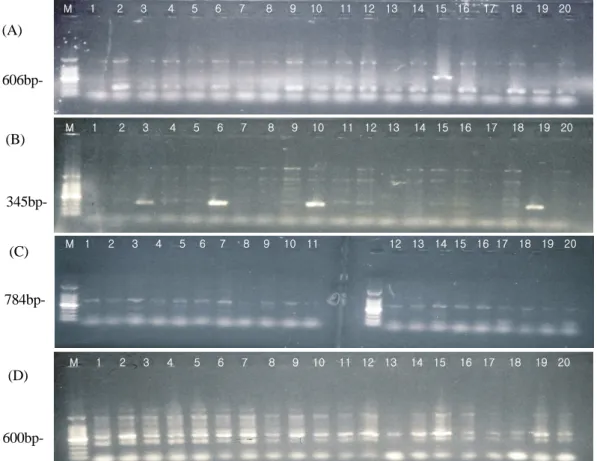
Fig. 1. PCR-SSP patterns of HLA-B.
A : HLA-B*3701 primer, lane 15 was detected.
B : HLA-B*5801 primer, lanes 3, 6, 10 and 19 were detected.
C : HLA-B*4001/4007 primer, all lanes detected except lane 8.
D : HLA-B*4901/5001/4501 primer, all lanes detected.
Lane M, 100-bp molecular size marker
III. 결 과
PCR-SSP 결과 HLA-B*3701은 20명 중 1명(5%)에서 검출이 되었고, HLA-B*5801은 20명 중 4명(20%)이 검출 되었다. 그러나 HLA-B*4001/4007에서는 20명 중 19명 (95%), HLA-B*4901/5001/4501에서는 20명 중 20명(100%) 모두 검출이 되었다. 이 실험군의 결과에서는 HLA-B*
4001/4007와 HLA-B*4901/5001/4501이 HLA-B*3701, HLA-B*5801군보다 높게 검출되었고, HLA-B*4001/
4007, HLA-B*4901/5001/4501은 거의 모든 실험군에서 검출되는 것으로 보아 이 유전자가 가장 일반적으로 존 재하는 유전자임을 알 수 있었다(Fig. 1).
IV. 고 찰
최근 몇 년 전 까지 HLA Class I 대립유전자의 다형 성은 혈청학적 방법이나 세포학적 방법으로 동정을 하였 다. 그러나 DNA typing 방법은 혈청학적 typing의 대체방 법으로 점점 더 널리 알려졌다. HLA Class I의 발현된 단 백질이 유전자 다형성에 의해 변이가 심하기 때문에 장 기이식 수술에서의 공여자와 수여자 사이에서의 HLA Class I 유전자들의 대립유전자의 차이는 가끔 심각한 합 병증의 초래를 야기시키기도 한다. 따라서 HLA Class I 유전자에 간단하면서도 정확한 유전자형 검사가 임상에 서 중요한 역할을 한다. PCR-SSP의 방법으로 대립유전자 의 분석에서 HLA-B*3701은 5%로 검출이 되었고,
대한임상검사학회지 39(3):147-150, 2007
150 HLA-B*5801은 20%, HLA-B*4001/4007은 95% 그리고 HLA-B*4901/5001/4501은 100% 검출이 되었으며, HLA-B*
4001/4007과 HLA-B*4901/5001/4501이 HLA-B*3701과 HLA-B*5801 군보다 더 높게 검출되었고, HLA-B*4001/
4007과 HLA-B*4901/5001/4501은 거의 모든 실험군에서 검출되는 것으로 보아 이 유전자가 가장 일반적으로 존 재하는 유전자임을 알 수 있었다. 앞으로 더 많은 실험군 을 선택해서 실험을 실시하여, 한국 사람에서의 일반적인 대립유전자의 분포를 더욱 자세히 밝히려고 한다.
본 연구에서의 HLA Class I의 DNA typing 방법에 PCR-SSP법으로의 접근은 매우 간단하면서도 아주 강력 한 방법이라고 생각되며, 더욱이 이 연구결과는 장기이식 수술에 있어서 조직적합여부검사의 기초자료로 제공이 가능할 것으로 사료된다.
감사의 글
본 연구는 2007년도 진주보건대학 학술연구비조성비 에 의하여 이루어진 것임
참 고 문 헌
1. Bodmer WF, Bodmer JG. Cytofluorochromasia for HLA-A, -B and DR typing. In Ray JG (ed.), NIAID manual of tissue typing techniques, p46-51, NIH, Bethesda Mamyland, 1979.
2. Bunce M, Fanning GC, Welsh KI. Comprehensive, serologically equivalent DNA typing for HLA-B by PCR using sequence-specific primer. Tissue Antigen 45:81-90, 1995.
3. Fernandez-Vina M, Falco M, Sun Y, Stastny P. DNA typing for HLA class I alleles. Hum Immunol 33:
163-173, 1992.
4. Fleischhauer K, Zino E, Bordignon C, Benazzi E.
Complete genetic and extensive fine-specificity typing of the HLA-B locus by the PCR-SSOP. Tissue Antigens 46:281-292, 1995.
5. Gustincich S, Manfioleti G, Del-Sal SG, Schneider C, Carninci. A fast method for high quality genomic DNA extractions from whole human blood. Bio- techniques 11:298-302, 1991.
6. Guttridge MG, Burr C, Klouda PT. Identification of HLA-B35, B53, B18, B5, B78 and B17 alleles by the polymerase chain reaction using sequence-specific primers. Tissue Antigens 44:43-46, 1994.
7. Randall KS, Sean W, Corey HL, Henry AE. Genetic analysis of amplified DNA with immobilized sequence-specific oligonucleotide probes. Proc Natl Acad Sci 86:6230-6234, 1989.
8. Sadler AM, Petrozelli F, Krausa P, Mash SGE, Guttridge MG, Browning MJ, Bodmer JG. Low DNA typing for HLA-B using sequence-specific primers in allele- or group-specific ARMS/PCR. Tissue Antigens 33:148-154, 1994
9. Schwartz RZ. T-lymphocyte recognition of antigen in association with gene products of the major histocom- patibility complex. Ann Rev Immunol 3:237-250, 1985.
10. Thonnard J. Deldime F, Heusterspreute M, Delepaut B, Hanon F, Bruyere M, Philippe M. HLA class II Genotyping : Two Assay Systems Compared. Clin Chem 41:553-556, 1995.
11. Yoshida M, Kimura A, Numano F, Sazazuki T.
Polymerase-chaim-reaction-based. based analysis of polymorphism in the HLA-B gene. Hum Immunol 34:257-266, 1992.