Myung W Chang1, Caron Berg2, Jamie Thurman3, Youn-Young Heo4, Eung-Hwan Kim5, Randall Toothaker6
Harvard School of Dental Medicine, University of Nebraska Medical Center School of Dental Medicine
1Director of Pre-doctoral Prosthodontics, Harvard School of Dental Medicine, Boston, MA
2,3Former dental students, University of Nebraska School of Dental Medicine, Lincoln,NE
4Former research assistant, University of Nebraska School of Dental Medicine, Lincoln, NE
5Assistant professor and Director of Pre-doctoral Implantology, University of Nebraska School of Dental Medicine, Lincoln, NE
6Associate professor of Adult Restorative Dentistry, University of Nebraska School of Dental Medicine, Lincoln, NE
국문초록
네브라스카 치과대학은 재학생들이 임플란트 보철의 진단, 치료계획과 임상시술과정에 대한 이해를 높이기 위한 교육을 시행 하여 왔다. 2003년 부터 3학년과정에 임상전단계 과정을 설치하고 모든 학생들이 졸업이전에 적어도 하나이상의 임플란트 보 철 증례를 이수하도록 하였다. 임플란트의 저변확대와 치과대학의 적절한 수가로 인하여 학생들의 교육에 충분한 증례를 공급 할 수 있었다.
본 연구는 네브라스카 치과대학의 학부과정에서 수행된 임플란트 증례를 추적조사한 것이다. 2003년부터 2005년 사이에 수 행되었던 모든 증례에 대한 진료기록들이 검토되었다.
고정성 임플란트 보철물에 대해서는 임플란트의 크기와 외과적 문제점, 지대주와 최종보철물의 종류, 보철적 문제점들에 대한 정보가 수집되었다. 가철성 임플란트 보철물에서는 임플란트의 크기와, 외과적 문제점, 하악무치악의 잔존치조제의 양과 보철 적 문제점들이 분석되었다.
조사기간동안 시술된 증례중 98%의 임플란트과 골유착에 성공하였다. 고정성 보철물 중 8%의 증례에서 가철성 보철물의 17.8%의 증례에서 보철물의 문제가 발생하였다.
The Predoctoral Clinical Implant Dentistry at
University of Nebraska Medical Center College of
Dentistry: A Three-Year Clinical Report
Implant dentistry has evolved from a concept prac- ticed by a few, and criticized by many, to an increas- ingly popular and respected part of standard dentistry.
The prevalence of implants has increased worldwide at an unprecedented pace due to the success and pre- dictability of implants in dentistry.
The National Institute of Dental Research sponsored a consensus conference on dental implants in 1988 which demonstrated the increased interest in and acceptance of implant in the dental field.1 Implant education is undergoing a transition from short, often superficial, continuing education to extensive, hand- on experiences, based on clinical case studies. The topic of predoctoral implant dentistry and its didactic and clinical education is one of that is challenging dental educators throughout the world.
The results from the 1989 survey by Bavitz2showed that the predoctoral curriculum should contain instruction in implant dentistry. The school that did not have a predoctoral implant dentistry program in 1993 claimed a lack of curriculum time and financial resources as well as little need for a predoctoral pro- gram as the primary reasons for their decision. A study reported by Arbree and Chapman3 showed that 65% of responding dental schools taught predoctoral implant dentistry. Although it represents an interme- diate point between 1974 and 1993 in the increasing number of schools teaching implant dentistry to pre- doctoral students, the 65% value of Arbree and
reported. Petropoulos et al reported that 97% of den- tal schools have didactic instruction, and 86% have clinical implant experience at the predoctoral level.
However, only 13 % of the school that provide clinical experience have a predoctoral clinical competency requirement in implant prosthodontic procedures.
University of Nebraska Medical Center School of Dentistry has implemented a program to instruct den- tal students become proficient in diagnosis, treatment planning, and clinical restoration of implant prosthe- ses. Because few schools offer a clinical implant cur- riculum as a requirement, there is little data regarding the success rate of fixed or removable implant pros- theses restored in the predoctoral educational envi- ronment.
The purpose of this retrospective study was to deter- mine the clinical outcome of implants placed and restored for three years at the University of Nebraska Medical Center College of Dentistry since the imple- mentation of the undergraduate clinical implant pro- gram in April 2003.
The comprehensive chart review for the patients, who had undergone implant treatment in the pre-doc- toral clinical implant program at University of Nebraska Medical Center College of Dentistry since its
Ⅱ
case report
inception in April 2003, was performed. Data The data was compiled from 138 patients for fixed and remov- able implant prostheses. The information gathered for fixed prostheses included the size of implant, surgical complications, type of abutment and restoration (screw versus cement), and prosthetic complications. The data assembled for removable implant-retained overdenture prostheses included the size of the implant, surgical complications, dimension of the edentulous mandible, and prosthetic complications. Measurements of the edentulous mandible were made based upon the panoramic radiographs at the area previously occupied by the mandibular first molars. The data was then analyzed and success was based upon the existence of complications including the screw loosening, screw fracture, soft tissue problems, esthetics, and surgical success.
The data was gathered from 138 patients from April 2003 through December 2005. Of the cases, 73.2% (101 cases) were single implants, 20.3% (28 cases) were implant-retained overdentures, and 6.5% (9 cases) were fixed partial denture implants. (Figure 1)
Analysis of the three year data in the Undergraduate Implant Clinic at University of Nebraska Medical Center College of Dentistry revealed 98% (5 fail- ures/167 fixtures) surgical success of implants.
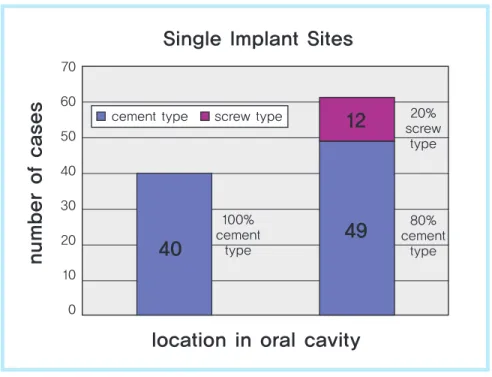
The fixed implant restorations were further analyzed for anterior or posterior location and type of restora- tion (screw versus cement type). Anterior cases accounted for 39% (40 cases), and posterior cases
Ⅲ
Figure 1. Types of Implant Cases in Predoctoral Implant Clinic (Total 138 Cases)
Myung W Chang et al: The Predoctoral Clinical Implant Dentistry at University of Nebraska Medical Center College of Dentistry: A Three-Year Clinical Report. Implantology 2009
Figure 3. Complication of Implant Fixed Prostheses
Myung W Chang et al: The Predoctoral Clinical Implant Dentistry at University of Nebraska Medical Center College of Dentistry: A Three-Year Clinical Report. Implantology 2009
case report
accounted for 61% (61 cases). All of the anterior fixed implants were cement-type restorations whereas 80%
of the posterior fixed implants were cement-type and 20% screw-type. (Figure 2)
Complications encountered with the fixed implant restorations included screw loosening (4 posterior cases), esthetics (2 cases), failed cementation (1 case), porcelain fracture (2 posterior cases), failure at seating (1 case), and ceramic abutment fracture (2 cases).
These complications occurred in 8% of the total cases.
(Figure 3)
The mandibular implant-retained overdenture cases were grouped based upon the American College of Prosthodontists Classification of Edentulism. For the Class I patients with greater than 21 mm of residual
bone; 18 cases are included in this category-two of them with complications. The patients with residual bone of 16~21 mm are classified as Class II; four cases are included in this classification-one of them with a complication. Class III patients have 11~15 mm of residual bone; four cases are included in this classifi- cation as well-one of them with a complication. The final classification, Class IV patients, has residual bone less than 10 mm; two cases fell into this category-one patient encountered complications. (Figure 4)
Five cases of screw loosening occurred with the mandibular implant-retained overdentures restored at the College of Dentistry. These minor complications were the only mechanical problems encountered with the removable implant prostheses and make up 17.8%
Figure 4. Complications of Implant-retained Overdenture
Myung W Chang et al: The Predoctoral Clinical Implant Dentistry at University of Nebraska Medical Center College of Dentistry: A Three-Year Clinical Report. Implantology 2009
University of Nebraska Medical Center College of Dentistry has implemented a program to instruct den- tal students become proficient in diagnosis, treatment planning, and clinical restoration of implant prosthe- ses since 2003. Because not many dental schools offer a clinical implant curriculum as a requirement, there is little data regarding the success rate of fixed or removable implant prostheses restored in the predoc- toral educational environment. The reality is that it requires many hours of didactic and technical experi- ence to acquire the expertise to perform the restora- tive aspects of implant dentistry. The strength of den- tal school education format is that it integrates didactic information, clinical demonstrations, and hands-on patient care with faculties’supervision. The students can hear, observe, and experience all the steps associ- ated with implant patient care.
The aim of this retrospective study was to determine the clinical outcome of implants placed and restored for three years at the University of Nebraska Medical Center College of Dentistry since the implementation of the undergraduate clinical implant program in April 2003.
Of the total of 138 patients from April 2003 through December 2005, the 73.2% (101 cases) of single implant
rable to the pre-doctoral implant programs in other schools allowed to do mostly implant-retained mandibular overdenture due to case complexity of fixed-type implant prostheses. The anterior implant prostheses accounted for 39% of the fixed-type implant cases with all of these restorations being cement type. Of the remaining 61% that were done to replace posterior teeth, 20% were screw type, and 80%
were cemented.
Complications occurred in 8% of the total fixed-type implant cases. These complications included the screw loosening, esthetics, failed cementation, porcelain fracture, failure at seating, and ceramic abutment fracture. These are similar complications to those reported by Goodacre et al.5,6
One of the significant complications in anterior implants was esthetics. Screw loosening, one of the most common complications in fixed implant prosthe- ses, was not seen in the anterior implant restorations.
Careful treatment planning is, however, necessary to achieve esthetic results especially in anterior cases.
Evaluation for bone and soft tissue grafts is an essen- tial aspect of treatment planning with the support of the postgraduate periodontics program. In addition, prosthetic treatment plan with the careful selection of abutments would help to provide more predictable esthetic clinical outcome.
Of the fixed posterior implant restorations, most of the complications were mechanical in nature. They included screw loosening, porcelain fracture, ceramic
Ⅳ
case report
abutment fracture, and failure at seating of the restoration. Though these complications were seen in fewer than 8% of the restorations, it suggested to be aware of the possibility that the implant abutments may need to be accessed and supports use of the screw-type restorations for the pre-doctoral implant clinic.
To further divide the implant-retained mandibular overdenture cases, the American College of Prosthodontists Classification of Edentulism was used through the measurements of mandibular height on the panoramic radiograph. A Class I edentulous arch has the greatest amount of residual bone and class IV has the least. Due to the amount of instability of den- tures when little residual bone remains, it would be expected that more screw loosening in cases with very little bone support. Although most of cases had greater than 21 mm of residual bone, it was found that a high- er percentage of failures in cases with less residual bone (Class IV arch). Even though the number of cases in the categories with less residual bone is few, it should be aware of the increased likelihood of screw loosening in these cases.
Additionally, most complications with removable prostheses were seen within the first 3 months of function. This data supports the importance of periodic recalls on a frequent basis for all patients with implant-retained overdenture prostheses. As dental implants are quickly becoming the treatment of choice to restore edentulous areas in many patients, it is crit- ical that dental students enter the profession of den-
tistry with an understanding and appreciation of the treatment planning and restoration of dental implants.
Because of the cost-effectiveness of having treat- ment at pre-doctoral implant clinic at University of Nebraska Medical Center College of Dentistry with an excellent background in implant dentistry, patients are able to be well-served to seek implant treatment that is done under the careful supervision of the expert faculty.
Analysis of the three year data in the Undergraduate Implant Clinic at University of Nebraska Medical Center College of Dentistry revealed 98% (5 fail- ures/167 fixtures) surgical success of implants. There were incidences of mechanical complications in 8% (12 failures/110 cases) of fixed implant prostheses and in 17.8% (5 failures/28 cases) of implant-retained mandibular overdenture prostheses. Compared to Goodacre’s study5, the fixed implants restored at UNMC showed slightly higher success whereas screw loosening in mandibular overdentures occurred more frequently.
This study showed that the implant patients at the pre-doctoral implant clinic are receiving care that meets or exceeds the success of implants restored out- side dental schools or private practitioners.
Ⅴ
1. National Institute of Health Consensus Development Conference Statement on Dental Implants: J Dent Edu 1988; 52:824-27.
2. Bavitz JG. Dental implantology in US dental schools. J Dent Edu 1990;
54: 24-32.
Workshop’s Survey of dean. J Dent Edu 2006; 70: 580-88.
5. Goodacre CJ. Clinical complications with implant and implant prosthe- ses. J Prosthet Dent 2003; 90:120-32.
6. Porter JA. Success or failure of dental implants? A literature review with treatment considerations. General Dentistry 2005; 53:433-32.
Abstract
University of Nebraska Medical Center College of Dentistry has implemented a program to help dental students become proficient in diagnosis, treatment planning, and clinical restoration of implant prostheses. As of 2003, all students were required to complete a didactic implant pre-clinical course in their third year along with restoration of at least one implant prostheses during their clinical education in dental school. The popularity of dental implants along with the cost effective- ness of having them restored at the College of Dentistry is affording students the opportunity to be involved in as much implant work as desired, thus, providing students with valuable experience in implant dentistry.
The aim of this study was to investigate the success of implants placed and restored at the pre-doctoral implant clinic in University of Nebraska Medical Center College of Dentistry. The systemic chart review of all patients who had undergone implant treatment in 2003-2005 was performed.
Data gathered for implant fixed prostheses included sizes of implants, surgical complications, types of abutments and restorations, and prosthetic complications. For removable implant prostheses, the analyzed data included sizes of the implants, surgical complications, amount of ridge resorption of the edentulous mandible, and prosthetic complications.
The result showed that the surgical success rate was 98 % in implants placed in 2003-2005 at the University of Nebraska Medical Center College of Dentistry. There were incidences of mechanical complications in 8% of fixed implant prostheses and in 17.8% of implant-retained mandibular overdenture prostheses.
Key words: Implant, Pre-doctoral education, Implant surgery, Implant prostheses, Success rate, Complications
Correspondence: Dr. Myung W. Chang, Harvard School of Dental Medicine, 188 Longwood Ave., Boston, MA, 02115, USA E-mail: [email protected]