• 검색 결과가 없습니다.

A Case of the Pneumopericardium Following Blunt Chest Trauma

N/A
N/A
Protected

Academic year: 2021

Share "A Case of the Pneumopericardium Following Blunt Chest Trauma"

Copied!
3
0
0

로드 중.... (전체 텍스트 보기)

전체 글

(1)

흉부둔상에 의한 심막기종: 치험 1예

A Case of the Pneumopericardium Following Blunt Chest Trauma

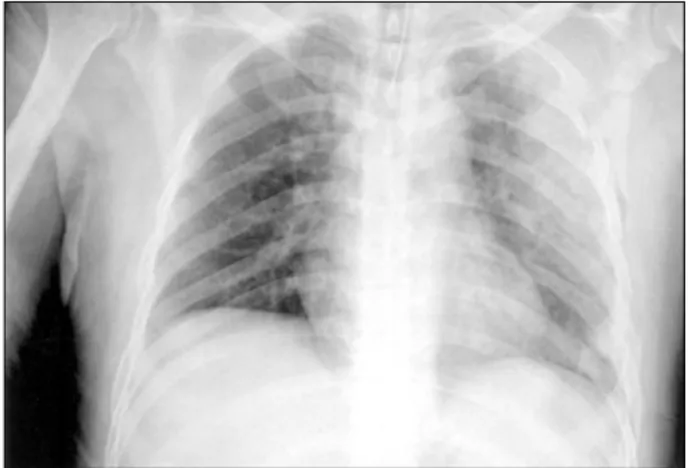
The pneumopericardium following blunt chest trauma is exceedingly unusual. A patient was admitted to the emergency room after a motorcycle accident. Pneumopericardium and left pneumothorax were not detected on initial chest AP, but they were detected on chest computed tomograpy and resolved completely after chest tube insertion into the left pleural space.

(Korean J Thorac Cardiovasc Surg 2003;36:627-629) Key words: 1. Blunt trauma

2. Chest trauma 3. Pneumomediastinum

(2)

Fig. 1. Initail chest AP demonstrates left multiple ribs fractures, increased hazziness of left lung field. Pneumopericardium was not seen in this initial simple X-ray.

Fig. 2. Axial CT at mid-thoracic level confirmed pneumoperi- cardium. A left minimal pneumothorax and contusion are also present.

Fig. 3. ECG shows ST elevation in V2-V5.

(3)

=국문 초록=

중심 단어

수치

Fig. 2. Axial CT at mid-thoracic level confirmed pneumoperi- pneumoperi-cardium. A left minimal pneumothorax and contusion are also  present.

참조

관련 문서

When determining the occlusion zone during the REBOA procedure, factors such tortuosity of the aorta, co-occurring minor chest injuries, and the severity of shock must

Despite the frequent use of CT for the evaluation of chest injury after blunt trauma, di- agnosis of tracheobronchial rupture by CT scan has rarely been reported: to our knowledge,

We reported a middle aged man who developed an acute transmural inferior wall myocardial in- farction associated with coronary artery fistula secondary to blunt chest trauma in

We report a case of retroperitoneal hematoma caused by rupture of left ovarian artery occurred after abdominal blunt trauma including brief review of the literatures.. Keywords:

Hence application of PCPS is thought to be good option to stabilize the patient until all medical resources are prepared, when cardiac arrest or collapse

7 Moreover, initial Doppler ultrasonography showed only a partial steal, which would be consistent with an embolism from a thrombus in the left sub- clavian artery that