Journal of Trauma and Injury Vol. 27, No. 4, December, 2014
� Address for Correspondence : Seong Pyo Mun, M.D.
Department of surgery, School of Medicine, Chosun University, Korea 365 Philmundaero, Donggu, Gwangju 501-717, Korea
Tel : 82-62-220-3062, Fax : 82-62-228-3441, E-mail : [email protected]
Submitted : November 10, 2014 Revised : November 25, 2014 Accepted : December 2, 2014
복부 둔상 후에 발생한 광범위한 하대정맥 손상: 증례보고
조선대학교 의과대학 외과학교실 유영선, 문성표
- Abstract -
Extensive Inferior Vena Cava Injury Following Blunt Abdominal Trauma: A Case Report
Young Sun Yoo, M.D., Seong Pyo Mun, M.D.
Department of Surgery, Chosun University, School of Medicine, Korea
Traumatic injuries of the inferior vena cava (IVC) are the most challenging lesions in abdominal vascular injuries and are associated with a high mortality rate. Although endovascular treatment has been addressed in the management of vascular trauma, surgery is the mainstay in the treatment for IVC injury as an endovascular technique for the venous sys- tem has not been developed. We report a case of successful surgical repair of an extensive IVC laceration following a fall.
[ J Trauma Inj 2014; 27: 219-23 ]
Key Words: Inferior vena cava, Blunt trauma, Surgical repair
I. Introduction
Traumatic injuries of inferior vena cava (IVC) account for approximately 25~40% of abdominal vascular injuries and are the most challenging and lethal lesions sustained by trauma patients.(1-3) Although its overall incidence is rare, it is reported that up to 1% of patients with blunt trauma sustain injuries to the IVC.(3) Blunt trauma is responsible
for about 10% of IVC injuries.
Despite the progress in the surgical and interven- tional techniques, mortality rate remains high between 40~60% with little improvement.(4-6) Due to high mortality in the field, the data on IVC are probably under-reported in the literature and the results are not well updated.
Although endovascular treatment has been addressed in the management of vascular trauma,
surgery is the mainstay in the treatment for IVC injury as endovascular technique for venous system has not developed widely.(7) We report a case of successful surgical repair of extensive IVC lacera- tion following falling-down.
II. Case
A 31-year-old woman was brought in our emer- gency department (ED) following falling down injury from a height of seventh floor 30 minutes ago. On physical examination, there were multiple contu- sions on abdomen and extremities. Initial blood pressure in ED was 60/40 mmHg with pulse rate 120/min, for which she was resuscitated and simple x-ray and computed tomography (CT) was checked after being stable state. Initial trauma radiographs
revealed multiple fractures on extremity and pelvic.
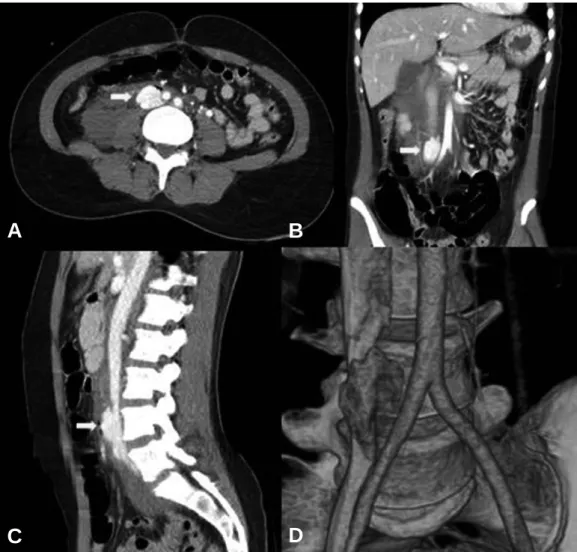
CT scan showed no signs of hollow viscus organ injury but huge retroperitoneal hematoma and active bleeding around the infrarenal IVC was seen (Fig. 1). Her initial hemoglobin (Hb) level was 12.5 g/dl and dropped to 9.1 g/dl after an hour. Suddenly her blood pressure dropped to 80/60 mmHg with stuporous mentation. The patient was immediately taken to the operating theatre for exploration.
Access was gained into the peritoneal cavity through midline incision. At laparotomy, there was no hollow viscus perforation and solid organ injury.
However, a large expanding hematoma behind the right colon was observed. For proximal and distal vascular control, a medial visceral rotation from the right side was carried out for exposure of IVC and both iliac veins .Rommel tourniquets were applied at
Fig. 1. Computed tomography showed laceration of infrarenal IVC with active bleeding (arrow).
(A) Axial view (B) Coronal view (C) Sagittal view (D) Reconstrucked angiogram
A B
C D
suprarenal IVC and both common iliac vein. When hematoma around IVC was carefully unroofed, active bleeding from injured IVC took place. Temporary control of active bleeding was gained by digitally compressing the IVC against the spine above and below the injury. Even though proximal and distal vessels were controlled, hemorrhage from lumbar
veins were not controlled well and continued. A lac- eration of anterior wall in length of 4 cm from infrarenal IVC to iliac bifurcation was identified.
Although we attempted to control bleeding applying a side-biting Satinsky clamp, it was difficult to clamp the entire circumference of the laceration due to the large area of laceration. Using several sponge sticks and suctions, laceration was visualized and closed with a continuous 5-0 Prolene suture from the lower edge to the upper edge of the laceration (Fig.
2). A total of 16 packs of RBCs and 18 packs of FFP were transfused during the operation.
The patient was recovered uneventfully and sev- eral elective operations were performed to treat the multiple fractures. Although CT scan after one month showed focal stenosis of IVC, the lumen was patent and there was no flow-limiting lesion (Fig.
3). Low molecular weight heparin was administered after IVC repair, but no oral anticoagulant was pre- scribed. The patient was discharged without compli- cation such as deep vein thrombosis or leg edema, and was still well without complications at the fol- low-up visit 8 months after the operation.
III. Discussion
The injury of inferior vena cava continues to chal- lenge trauma surgeons. Although improvements in prehospital medical services and rapid transporta- tion to emergency room enable more patients to
Fig. 3. In follow-up CT scan 1 month after operation, focal stenosis without flow-limitation was identified and there was no deep vein thrombosis of venous system. (A) Axial view (B) Sagittal view
Fig. 2. Intraoperative photography showing repaired laceration of IVC in length of 4 cm with prolene 5-0 (black arrow).
A B
reach the hospital alive, 10~20% patient die before surgical operation or completion of repair.(8)
Several clinical factors have been previously known to be predictive of survival, particularly anatomic location of injury, initial severity of shock and associated vascular injury.(8,9) Because the infrarenal IVC is surgically accessible, which simpli- fies exposure and facilitates vascular control of hemorrhage and repair of the injury, survival is highest in patients with infrarenal IVC injury, and mortality is highest in patients with retrohepatic injuries.
However, there are no definitive indications of surgical repair in case of IVC injury. It is difficult to decide whether to repair the injury of IVC or to observe, due to a real risk of making things much worse by unroofing the injury and releasing the tamponade. A stable, small hematoma may be treat- ed without further exploration or repaired in care- fully selected patients. However, sudden fatal hem- orrhage in an uncontrolled situation resulting in exsanguination is possible.
A number of techniques were introduced to the trauma surgeons to control hemorrhage.(10) Direct pressure with finger or sponge stick is effective until exposure is complete. The larger Satinsky clamp placed under the smaller one to contain the entire laceration is also effective. However, blind application of vascular clamp should be avoided to prevent further laceration and avulsion of lumbar veins or IVC itself. Instead of vascular clamp, Rommel tourniquets are useful to achieve proximal and distal vascular control.
Extensive disruption of IVC like in our case is the most difficult to repair, requiring significant mobi- lization and extended surgical exposure. Primary repair remains the procedure of choice in hemody- namic stable patients with noncomplex injuries.(11) Anterior perforation of IVC should be repaired in a transverse fashion as far as possible to prevent nar- rowing of IVC. When significant longitudinal perfo- ration is present, surgical repair can be performed in a longitudinal fashion just like our case.
However, because the narrowing may lead to post- operative stenosis or occlusion of IVC, autogenous vein patch, PTFE patch and interposition graft
should be considered depending on the patient’s hemodynamic status. In case of our patient, there were no complications such as IVC occlusion or deep vein thrombosis in clinical follow-up.
Ligation of IVC may be life-saving procedure in otherwise exsanguinating injuries and should be considered early in the management of complex injuries.(6,12) However, because ligation of IVC as a bailout solution remains associated with high mor- tality, certain precautions such as bilateral four- compartment fasciotomies and continuous elastic compression and leg elevation is generally required.
The exact incidence of venous thromboembolism (VTE) after IVC injury is poorly defined. Recently, in a large statewide database, the overall incidence of VTE was reported as 2.3% (5/308).(13) Although the use of VTE prophylaxis was undefined, it was surprisingly low rate of VTE after operative management, which was similar for patient undergoing ligation and repair (4.2% versus 1.7%, p>0.99). Accordingly, the question remains whether the VTE prophylaxis and use of screening modality is necessary.
In summary, we report a case of extensive IVC injury in the setting of blunt trauma, which was treated by surgical repair. In case of extensive IVC injury, surgical repair is technically demanding pro- cedure and careful surgical strategy should be planned.
IV. Acknowledgement
This study was supported by research fund from Chosun University Hospital, 2014
REFERENCES
01) Jackson MR, Olson DW, Beckett WC, Jr., Olsen SB, Robertson FM. Abdominal vascular trauma: a review of 106 injuries. Am Surg 1992; 58: 622-6.
02) Ombrellaro MP, Freeman MB, Stevens SL, Diamond DL, Goldman MH. Predictors of survival after inferior vena cava injuries. Am Surg 1997; 63: 178-83.
03) Buckman RF, Pathak AS, Badellino MM, Bradley KM.
Injuries of the inferior vena cava. Surg Clin North Am 2001;
81: 1431-47.
04) Porter JM, Ivatury RR, Islam SZ, Vinzons A, Stahl WM.
Inferior vena cava injuries: noninvasive follow-up of venor- rhaphy. J Trauma 1997; 42: 913-7.
05) Tyburski JG, Wilson RF, Dente C, Steffes C, Carlin AM.
Factors affecting mortality rates in patients with abdominal vascular injuries. J Trauma 2001; 50: 1020-6.
06) Sullivan PS, Dente CJ, Patel S, Carmichael M, Srinivasan JK, Wyrzykowski AD, et al. Outcome of ligation of the inferior vena cava in the modern era. Am J Surg 2010; 199: 500-6.
07) Gabriele Piffaretti GC, Filippo Piacentino, Patrizio Castelli.
Traumatic IVC Injury Repair: The Endovascular Alternative.
Endovascular today 2013; 11: 39-44.
08) Kuehne J, Frankhouse J, Modrall G, Golshani S, Aziz I, Demetriades D, et al. Determinants of survival after inferior vena cava trauma. Am Surg 1999; 65: 976-81.
09) Rosengart MR, Smith DR, Melton SM, May AK, Rue LW,
3rd. Prognostic factors in patients with inferior vena cava injuries. Am Surg 1999; 65: 849-55.
10) Lenworth Jacobs SL. Advanced trauma operative manage- ment. 2nd ed: American college of surgeons; 2010.
11) Carr JA, Kralovich KA, Patton JH, Horst HM. Primary venor- rhaphy for traumatic inferior vena cava injuries. Am Surg 2001; 67: 207-13.
12) Adhikary S, Shakya VC, Dhungel K, Rajbanshi S, Shakya V, Khaniya S, et al. Inferior vena cava injury repair, a successful outcome. Nepal Medical College journal 2012; 14: 68-70.
13) Singer MB, Hadjibashi AA, Bukur M, Ley EJ, Mirocha J, Malinoski DJ, et al. Incidence of venous thromboembolism after inferior vena cava injury. J Surg Res 2012; 177: 306-9.