435 https://doi.org/10.9713/kcer.2018.56.4.435
PISSN 0304-128X, EISSN 2233-9558
Optimization of Transesterification Process of Biodiesel from Nyamplung ( Calophyllum inophyllum Linn) using Microwave with CaO Catalyst
Heri Septya Kusuma†, Ansori Ansori, Sasmitha Wibowo, Donny Satria Bhuana and Mahfud Mahfud† Department of Chemical Engineering, Faculty of Industrial Technology, Institut Teknologi Sepuluh Nopember,
Surabaya, 60111, Indonesia
(Received 10 June 2017; Received in revised form 7 June 2018; accepted 22 June 2018)
Abstract − Nyamplung (Calophyllum inophyllum Linn) is one of the most widely grown plants in Indonesia. In addi- tion, nyamplung oil has a future competitive advantage in that it can be processed into biodiesel. However, conventional methods for transesterification of nyamplung oil have been less effective. Therefore, in this study biodiesel was pro- duced using microwaves as one of the alternative methods that can improve the shortcomings of conventional methods.
In addition, optimization of parameters such as microwave power, catalyst concentration and transesterification time was done using Box-Behnken design. The combination of microwave with CaO catalyst and treated with Box-Behnken design are considered as a new and modern method for production of biodiesel from nyamplung oil and optimizing the factors that affected the transesterification process. The results showed that factors such as microwave power of 449.29 W, concentration of catalyst of 4.86% and transesterification time of 10.07 min can produce optimal yield of biodiesel of 92.73% with reliability of 93.22%.
Key words: Biodiesel, Calophyllum inophyllum Linn, CaO, Nyamplung oil, Transesterification
1. Introduction
Population growth and increasing economic development are two factors that cause higher energy demand [1]. Most of the energy used today comes from petroleum, natural gas and coal. Increased energy consumption can lead to depletion of the fuel reserves, which are non-renewable natural resources. Many countries have oil fuel short- ages for their own countries. Therefore, it is necessary to look for alternative fuels, especially from renewable materials. One alterna- tive is biodiesel, to replace diesel [2].
Biodiesel is a mono alkyl ester from long chain fatty acids contain- ing 12 to 24 carbon atoms made from renewable lipid sources, such as vegetable oils and animal fats through transesterification [3].
When compared to fossil fuels, biodiesel has advantages, such as raw materials can be renewable, does not have sulfur content so as not to contribute to the occurrence of acid rain, has a very good lubri- cant properties that can extend the life of the machine, has high flash point so it is safer from fire hazards, can reduce toxic air emissions, and is biodegradable [4].
Nyamplung (Calophyllum inophyllum Linn) is one of the most widely grown plants in Indonesia [5]. Some studies on biodiesel development have been done, among others: biodiesel made from palm oil and biodiesel made from raw material of jatropha oil. In addition to oil palm and jatropha oil, the raw material of biodiesel
that has great potential to be developed is nyamplung seed oil.
Compared with fossil fuels, biodiesel has advantages, such as the nature of renewable raw materials, more energy efficiency, can replace diesel fuel, can reduce toxic air emissions, and is also biode- gradable [6]. Some of the superiority of biodiesel produced from nyamplung is the yield of nyamplung oil is high compared to other types of plants, jatropha oil 40~60%, palm oil 46~54%, and nyam- plung oil 40~73%, and nyamplung seed oil has twice as long com- pared to kerosene. In addition, nyamplung oil has a future competitive advantage such as biodiesel from nyamplung can be used as a solar mixer with certain composition, even can be used 100% with proper processing technology, better emission quality than diesel, can be used as biokerosen to replace kerosene.
In addition, in this study, innovations were made in the production of biodiesel from nyamplung oil using microwave power. This is because from some previous studies indicating that the use of micro- waves in biodiesel production has several advantages, such as enhanc- ing the reaction rate, improving the separation process and can minimize the time of transesterification [7]. While in this research the used catalyst is CaO. The reason for choosing CaO as a catalyst for the production of biodiesel from nyamplung oil using micro- wave power is that CaO is a heterogeneous catalyst which has prop- erties that are easy to separate with the formed product, requiring no special preparation [8] and has been used by many researchers [9,10].
Therefore, in this study biodiesel from nyamplung oil was produced using microwaves with CaO catalyst, and optimization was done for some parameters such as microwave power, concentration of catalyst and transesterification time using response surface meth- odology.
†To whom correspondence should be addressed.
E-mail: [email protected], [email protected] This is an Open-Access article distributed under the terms of the Creative Com- mons Attribution Non-Commercial License (http://creativecommons.org/licenses/by- nc/3.0) which permits unrestricted non-commercial use, distribution, and reproduc- tion in any medium, provided the original work is properly cited.
2-1. Material and process of biodiesel production using microwave The main raw material used in this study is nyamplung oil and CaO as catalyst. The system consists of domestic microwave oven (EMM2308X, Electrolux, maximum delivered power of 800 W) with wave frequency of 2450 MHz, which is considered as a source of heat for the transesterification process (Fig. 1). On top of that, the system is connected to the reflux condenser used to condense. Holes contained in the microwave serve to connect between the system with condenser which is still open then closed using PTFE. This needs to be done with the aim that the radiation from microwave does not go out into the environment. Finally, the products in the form of biodiesel, which is still mixed with impurities such as glycerol and the remaining catalyst, is separated by separating funnel and washed with warm aquadest (Fig. 2).
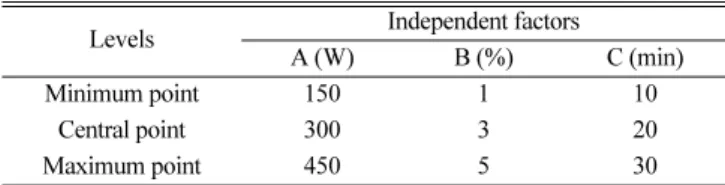
2-2. Experimental design with Box-Behnken design Response surface methodology (RSM) was chosen to optimize the effect factors of transesterification of nyamplung oil on the effect of the microwave power (A), concentration of calayst (B), and trans- esterification time (C) to maximize biodiesel yield. Box-Behnken design (BBD) offers the experiment matrix designs, and the response variable is yield of biodiesel obtained (Y), which are displayed in Table 1. The experiment matrix designs were conducted by parame- ter A set in range of 150-450 W, B set in range of 1~5%, and C set in range of 10-30 min. For the statistical dissect, Design-Expert® soft- ware version 9.0.4.1 (Stat-Ease Inc., Minneapolis) was practiced to assume the experimental design and to model the data.
3. Results and Discussion
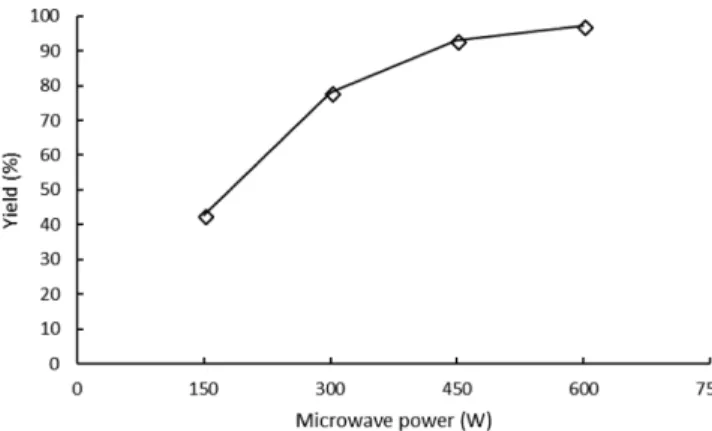
3-1. The effect of microwave power to yield of biodiesel Microwave power is one of the parameters that needs to be consid- ered, because microwave power affects mass transfer rates. To study the effect of microwave power to yield of biodiesel, then in this research we used some microwave power (150, 300, 450 and 600 W).
The effect of microwave power to yield of biodiesel can be seen in Fig. 3.
Based on Fig. 3, higher microwave power can lead to higher yield of obtained biodiesel. This can occur due to the higher temperatures that are in line or proportional to the higher microwave power. The existence of these phenomena has an impact on the increasing effi- ciency of transesterification process and rate of conversion [11]. In addition, according to Fig. 3 there is also a slight increase in yield between microwave power of 400 to 600 W. So if in this transesteri- fication process using microwave power higher than 600 W it is Fig. 1. Schematic representation for transesterification of nyamplung
oil using microwave power with CaO catalyst.
Fig. 2. Experimental procedure for transesterification of nyamplung oil using microwave power with CaO catalyst.
Levels Independent factors
A (W) B (%) C (min)
Minimum point 150 1 10
Central point 300 3 20
Maximum point 450 5 30
feared that yield of obtained biodiesel will become smaller. This is possible because based on previous research too high microwave power can cause the rate of saponification reaction or soap forma- tion from triglycerides become increasing [12].
3-2. The effect of consentration of catalyst to yield of biodiesel In the transesterification process, the determination of catalyst concentration needs to be considered. In the production of bio- diesel through the transesterification process it is necessary to add catalyst with a certain concentration. Too high concentration of cat- alyst can cause the formation of soap, which is the result of a reac- tion between triglycerides with catalyst. To study the effect of consentration of catalyst to yield of biodiesel, then in this research we used some consentration of catalyst (0.5, 1.0, 3.0 and 5.0%).
The effect of consentration of catalyst to yield of biodiesel can be seen in Fig. 4.
Based on Fig. 4, the higher consentration of catalyst can lead to higher yield of obtained biodiesel. This is in accordance with research by Encinar et al. (2012) [13] who reported that a higher consentra- tion of catalyst can lead to higher yield of obtained biodiesel.
3-3. The effect of transesterification time to yield of biodiesel In addition to microwave power and concentration of catalyst, transesterification time is a parameter that also needs to be consid-
ered. To study the effect of transesterification time to yield of bio- diesel, we used some transesterification time (5, 10, 20 and 30 min).
The effect of transesterification time to yield of biodiesel can be seen in Fig. 5.
Based on Fig. 5, the yield of obtained biodiesel between transes- terification time of 5 to 30 min is likely to be constant. This indi- cates that production of biodiesel is almost reaching equilibrium at transesterification time of 5 to 30 min, and if transesterification is done with longer time it is possible to cause soap formation or saponification reaction. Meanwhile, if transesterification is done with a shorter time, it is possible that the production of mono- glycerides and diglycerides will increase and the production of esters will decrease [14].
3-4. Analysis of Box-Behnken design
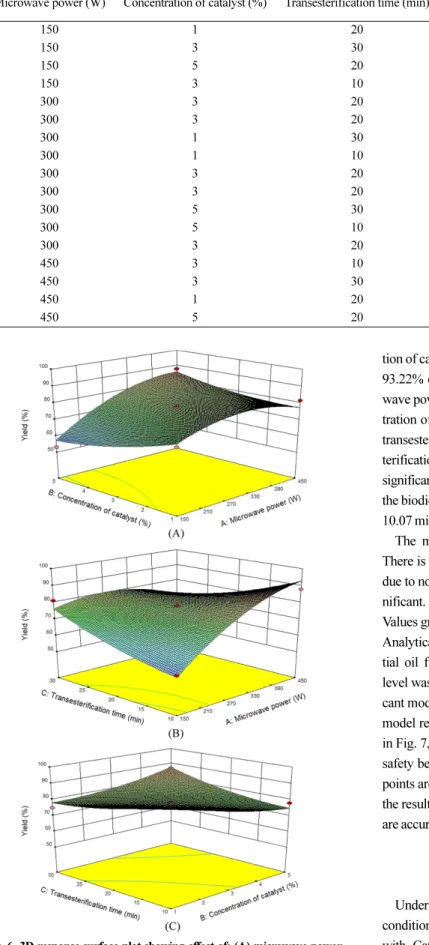
A total of 17 experiments were carried out to estimate the response surface the biodiesel yield. The response variable is that the bio- diesel yield (Y) depends on the independent variables realize through the experiments is indicated in Table 2. The results showed that there is a contact between factors biodiesel yield. To determine which of the effects in the model are statistically significant, the p-value of regression was significant with a commonly used α-level of 5% [15-19]. The quadratic model is described by the following as in Eq. (1):
Yield = 48.74 + 0.32*A - 17.54*B + 0.13*C + 0.02*A*B – 0.01*A*C + 0.33*B*C – 3.10-4*A2 + 0.62*B2 + 0.03*C2 (1) The equation in terms of actual factors can be used to make predic- tions about the response for given levels of each factor. By default, the high levels of the factors are coded as +1 and the low levels are coded as -1. The coded equation is useful for identifying the relative impact of the factors by comparing the factor coefficients. Fig. 6 shows a 3D model of the relationship between the attained biodiesel yield and three independent factors: microwave power (A), concen- tration of catalyst (B), and transesterification time (C). The result of variance analysis for yield of biodiesel showed R2 value was 93.22%.
This indicates that fixed variables (microwave power (A), concentra- Fig. 3. The effect of microwave power to yield of biodiesel (concentra-
tion of catalyst of 5% and transesterification time of 10 min).
Fig. 4. The effect of consentration of catalyst to yield of biodiesel (micro- wave power of 300 W and transesterification time of 30 min).
Fig. 5. The effect of transesterification time to yield of biodiesel (micro- wave power of 300 W and consentration of catalyst of 5%).
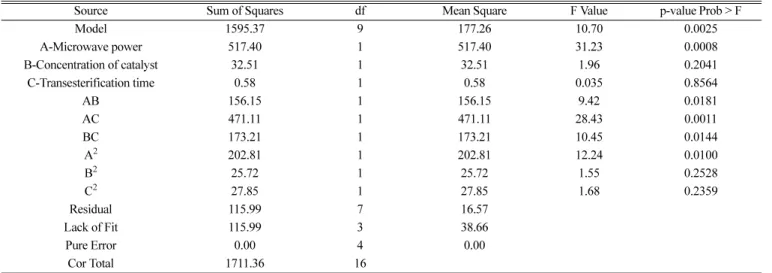
tion of catalyst (B), and transesterification time (C)) have an effect of 93.22% on the model. Based on Table 3 it can be seen that micro- wave power (A), interaction between microwave power and concen- tration of catalyst (AB), interaction between microwave power and transesterification time (AC), concentration of catalyst and transes- terification time (BC) and quadratic of microwave power (A2) are significant model terms (p<0.05). Optimization results are given with the biodiesel yield of 92.73% with A = 449.29 W, B = 4.86% and C = 10.07 min for desirability of 100%.
The model F-value of 10.70 implies the model is significant.
There is only a 0.25% chance that an F-value this large could occur due to noise. P-values less than 0.0500 indicate model terms are sig- nificant. In this case A, AB, AC, BC, A2 are significant model terms.
Values greater than 0.10 indicate the model terms are not significant.
Analytical results showed that the factors interacted with the essen- tial oil function with significance level R2= 0.93 and confidence level was 95% as can be seen in Table 3. If there are many insignifi- cant model terms (not counting those required to support hierarchy), model reduction may improve your model. In addition, as observed in Fig. 7, the high correlation coefficient represents a high degree of safety between the actual and predicted values, because most of the points are closely aligned with the straight line. This has proven that the results of the investigations during the transesterification process are accurate and the optimization is highly effective.
4. Conclusion
Under the optimization performed by Box-Behnken design, the conditions for transesterification of nyamplung oil using microwave with CaO catalyst have been suggested as follows: microwave power of 449.29 W, concentration of catalyst of 4.86% and transes- terification time of 10.07 min with yield of 92.73%. Box-Behnken Microwave power (W) Concentration of catalyst (%) Transesterification time (min) Yield (%)
Residual (%)
Experimental Model
150 1 20 72.09 73.85 -1.76
150 3 30 81.25 76.27 4.97
150 5 20 53.06 57.33 -4.27
150 3 10 56.16 55.11 1.05
300 3 20 78.10 78.10 0.00
300 3 20 78.10 78.10 0.00
300 1 30 75.10 78.31 -3.21
300 1 10 92.72 92.01 0.71
300 3 20 78.10 78.10 0.00
300 3 20 78.10 78.10 0.00
300 5 30 86.73 87.44 -0.71
300 5 10 78.03 74.82 3.21
300 3 20 78.10 78.10 0.00
450 3 10 87.92 92.90 -4.97
450 3 30 69.60 70.65 -1.05
450 1 20 81.71 77.44 4.27
450 5 20 87.67 85.91 1.76
Fig. 6. 3D response surface plot showing effect of: (A) microwave power and concentration of catalyst, (B) microwave power and trans- esterification time and (C) concentration of catalyst and trans- esterification time.
design and transesterification of nyamplung oil using microwave with CaO catalyst showed not only the convenience of the experi- ments, but also the optimization of the three parameters in detail, which made the yield of biodiesel obtained more efficiently both quantity and quality.
References
1. Moreau, V. and Vuille, F., “Decoupling Energy Use and Eco- nomic Growth: Counter Evidence from Structural Effects and Embodied Energy in Trade,” Appl. Energy, 215, 54-62(2018).
2. Hassan, M. H. and Kalam, M. A., “An Overview of Biofuel as a Renewable Energy Source: Development and Challenges,” Procedia Eng., 56, 39-53(2013).
3. Demirbas, A., “Biodiesel Production from Vegetable Oils by Super- critical Methanol,” J. Sci. Ind. Res. (India), 64, 858-865(2005).
4. Huang, D., Zhou, H. and Lin, L., “Biodiesel: An Alternative to Conventional Fuel,” Energy Procedia, 16, 1874-1885(2011).
5. Fadhlullah, M., Widiyanto, S. N. B., Restiawaty, E., “The Potential of Nyamplung (Calophyllum inophyllum L.) Seed Oil as Bio- diesel Feedstock: Effect of Seed Moisture Content and Particle Size on Oil Yield,” Energy Procedia, 68, 177-185(2015).
6. Ajala, O. E., Aberuagba, F., Odetoye, T. E. and Ajala, A. M.,
“Biodiesel: Sustainable Energy Replacement to Petroleum-based Diesel Fuel - A Review,” ChemBioEng Rev., 2, 145-156(2015).
7. El Sherbiny, S. A., Refaat, A. A. and El Sheltawy, S. T., “Produc- tion of Biodiesel Using the Microwave Technique,” J. Adv. Res., 1, 309-314(2010).
8. Boey, P. L., Maniam, G. P. and Hamid, S. A., “Performance of Calcium Oxide as a Heterogeneous Catalyst in Biodiesel Produc- tion: A Review,” Chem. Eng. J., 168, 15-22(2011).
9. Marinković, D. M., Stanković, M. V., Veličković, A. V., Avramović, J. M., Miladinović, M. R., Stamenković, O. O., Veljković, V. B.
and Jovanović, D. M., “Calcium Oxide as a Promising Hetero- geneous Catalyst for Biodiesel Production: Current State and Perspectives,” Renew. Sustain. Energy Rev., 56, 1387-1408(2016).
10. Colombo, K., Ender, L. and Barros, A. A. C., “The Study of Bio- diesel Production Using CaO as a Heterogeneous Catalytic Reac- tion,” Egypt. J. Pet., 26, 341-349(2017).
11. Hsiao, M.-C., Lin, C.-C. and Chang, Y.-H., Microwave Irradia- tion-assisted Transesterification of Soybean Oil to Biodiesel Cata- lyzed by Nanopowder Calcium Oxide,” Fuel, 90, 1963-1967(2011).
12. Mathiyazhagan, M. and Ganapathi, A., “Factors Affecting Bio- diesel Production,” Res. Plant Biol., 1, 1-5(2011).
13. Encinar, J. M., González, J. F., Martínez, G., Sánchez, N. and Pardal, Table 3. ANOVA for quadratic model
Source Sum of Squares df Mean Square F Value p-value Prob > F
Model 1595.37 9 177.26 10.70 0.0025
A-Microwave power 517.40 1 517.40 31.23 0.0008
B-Concentration of catalyst 32.51 1 32.51 1.96 0.2041
C-Transesterification time 0.58 1 0.58 0.035 0.8564
AB 156.15 1 156.15 9.42 0.0181
AC 471.11 1 471.11 28.43 0.0011
BC 173.21 1 173.21 10.45 0.0144
A2 202.81 1 202.81 12.24 0.0100
B2 25.72 1 25.72 1.55 0.2528
C2 27.85 1 27.85 1.68 0.2359
Residual 115.99 7 16.57
Lack of Fit 115.99 3 38.66
Pure Error 0.00 4 0.00
Cor Total 1711.36 16
R2 = 0.93; Adj R-Squared = 0.85; Std. Dev. = 4.07; Mean = 77.21; C.V. (%) = 5.27
Fig. 7. (a) predicted and experimental yield of biodiesel for 17 experi- mental conditions and (b) normal residual plot according to the regression model reported in Table 3.
Flow System,” Fuel, 95, 386-393(2012).
14. Zhang, S., Zu, Y. G., Fu, Y. J., Luo, M., Zhang, D. Y. and Efferth, T., “Rapid Microwave-assisted Transesterification of Yellow Horn Oil to Biodiesel Using a Heteropolyacid Solid Catalyst,”
Bioresour. Technol., 101, 931-936(2010).
15. Kusuma, H. S. and Mahfud, M., “Response Surface Methodology for Optimization Studies of Microwave-Assisted Extraction of Sandalwood Oil,” J. Mater. Environ. Sci., 7, 1958-1971(2016).
16. Kusuma, H. S. and Mahfud, M., “Box-Behnken Design for Inves- tigation of Microwave-assisted Extraction of Patchouli Oil,” In:
AIP Conference Proceedings (2015).
17. Ahmad, A., Alkharfy, K. M., Wani, T. A., Raish, M., “Applica-
of Polysaccharides from Paeonia Emodi,” Int. J. Biol. Macromol., 72, 990-997(2015).
18. Chen, F., Jia, J., Zhang, Q., Yang, L. and Gu, H., “Isolation of Essential Oil from the Leaves of Polygonum Viscosum Buch-ham.
Using Microwave-assisted Enzyme Pretreatment Followed by Microwave Hydrodistillation Concatenated with Liquid-liquid Extraction,” Ind. Crops Prod., 112, 327-341 (2018).
19. Jahirul, M. I., Koh, W., Brown, R. J., Senadeera, W., O’Hara, I.
and Moghaddam, L., “Biodiesel Production from Non-edible Beauty Leaf (Calophyllum inophyllum) oil: Process Optimization Using Response Surface Methodology (RSM),” Energies, 7, 5317-5331 (2014).