pISSN: 2287-4208 / eISSN: 2287-4690
World J Mens Health 2013 August 31(2): 176-178
http://dx.doi.org/10.5534/wjmh.2013.31.2.176
Case Report
Received: Apr 25, 2013; Revised: (1st) Jun 7, 2013, (2nd) Jun 25, 2013; Accepted: Jul 1, 2013 Correspondence to: Yun Seob Song
Department of Urology, Soonchunhyang University School of Medicine, 59 Daesagwan-ro, Yongsan-gu, Seoul 140-743, Korea.
Tel: +82-2-709-9375, Fax: +82-2-709-9378, E-mail: [email protected] Copyright © 2013 Korean Society for Sexual Medicine and Andrology
This is an Open Access article distributed under the terms of the Creative Commons Attribution Non-Commercial License (http://creativecommons.
org/licenses/by-nc/3.0) which permits unrestricted non-commercial use, distribution, and reproduction in any medium, provided the original work is properly cited.
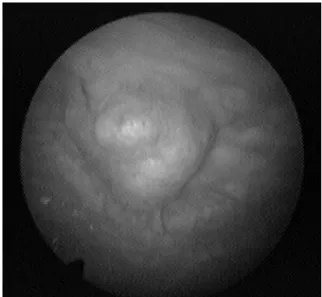
Fig. 1. Cystoscopy results revealed a smooth sessile mass at the bladder dome.
Ectopic Prostate Tissue at the Bladder Dome Presenting as a Bladder Tumor
Jae Heon Kim1, Yoon Mi Jeen2, Yun Seob Song1
1Departments of Urology, 2Pathology, Soonchunhyang University Seoul Hospital, Soonchunhyang University School of Medicine, Seoul, Korea
The presence of ectopic prostate tissue in the bladder is common, but the involvement of the bladder dome has rarely been reported. This case report describes a 72-year-old man who presented with gross painless hematuria. Cystoscopy revealed a smooth sessile mass at the dome region of the bladder. A complete transurethral resection of the mass was performed.
Histopathological examination of the mass revealed the presence of benign ectopic prostatic tissue.
Key Words: Urinary bladder; Choristoma; Prostate
Ectopic prostatic tissue is relatively uncommon and has been underreported.1 It is most commonly encountered in the lower male genitourinary tract, but is also found in per- icolic fat and the female genitourinary tract, anal canal, retroperitoneum, and spleen.2 Ectopic prostate tissue in the bladder usually involves the midline in the form of the vestigial remains of embryonic prostatic elements.2 Only 4 cases of this lesion have been reported previously in the English medical literature.2-4 This report presents an un- usual case of ectopic prostate tissue at the bladder dome confirmed with cystoscopy, and this report also reviews the relevant literature.
CASE REPORT
A 72-year-old man presented to our urology department with a history of gross painless hematuria and dysuria.
Initial laboratory signs were within normal levels, except
Jae Heon Kim, et al: Ectopic Prostate in Bladder Dome 177
Fig. 2. (A) Prostate glands in the subepithelial layer of the urinary bladder. The bladder mucosa seems to be intact (arrows) (H&E, ×40).
(B) The prostate glands are composed of a distinct luminal epithelial cell layer and a basal cell layer (H&E, ×200).
Fig. 3. (A) Prostate glands showing irregular dilated lumens with flattened epithelial cells (H&E, ×200). (B) Immunopositive staining of most prostate glands for prostate-specific antigen (H&E, ×200).
hematuria in routine urine analysis. Abdominal computed tomography revealed a sessile bladder mass (dimensions, 1.0 cm×1.5 cm) at the bladder dome, but no perivesical infiltration or regional lymphadenopathy was observed.
Cystoscopy results also showed a smooth sessile mass (dimensions, 1.0 cm×1.5 cm) at the bladder dome (Fig.
1). The patient underwent transurethral resection for treat- ment of the bladder mass. Histological analysis of the tis- sue submitted showed several fragments of bladder muco- sa and subepithelial tissue. Microscopic examination
showed several benign prostate glands with 2 distinct cell layers (the basal cell and luminal epithelial cell layers) em- bedded in the subepithelial stroma (Fig. 2). Some of the glands were cystically dilated (Fig. 3), and some contained corpora amylacea. There was no direct continuation with the bladder mucosa, and although some of the bladder mucosa was denuded, no severe inflammation was evi- dent in the surrounding tissue. Immunohistochemical analysis results showed that most prostatic glands were strongly positive for prostate-specific antigen (PSA). The
178 World J Mens Health Vol. 31, No. 2, August 2013
postoperative course was uneventful. The postoperative 6-month follow-up indicated that the patient was well and had not experienced a recurrence.
DISCUSSION
Most ectopic prostatic tissue that arises in the bladder in- volves the trigone and ureteral orifices.2 This is because of the characteristics of the embryonic prostatic elements.
Although the origins of ectopic prostate tissue are not en- tirely clear, the frequent involvement of the tissue of the bladder trigone supports the theory of migration.5,6 Different theories have been proposed to explain this phenomenon, including the migration and misplacement of normal tissue, the persistence of embryonic remnants, and metaplastic change caused by chronic inflam- mation.5,6 In relation to ectopic prostatic tissue, the most likely explanation seems to be that the embryonic pro- static tissue migrated and became isolated.7 Ectopic pro- static tissue is histologically and immunohistochemically indistinguishable from normal prostatic tissue and most probably indicates the persistence of embryonic struc- tures.2 Our case supports the migration theory because there was no histological evidence of inflammation or metaplastic processes in the subepithelial lesion.
The key complaints associated with this disease are mi- croscopic or gross hematuria. The main point of differ- ential diagnosis is bladder cancer relating to transitional cell carcinoma. One notable report demonstrated that ec- topic prostate tissue is a potential site of hyperplastic and malignant changes by describing a case of prostatic ad- enocarcinoma arising in the ectopic prostate tissue at the bladder dome.3 To date, 4 cases of ectopic prostate tissue at the bladder dome have been published. It is important to recognize that different tissues may coexist with ectopic prostatic tissue, including prostatic adenocarcinoma and urachal remnants.3
When ectopic prostatic tissue is encountered, PSA and prostate-specific acid phosphatase are usually the first 2 immunohistochemical stains to be used. CD10 is consid- ered a marker for tissues of mesonephric origin and is re- ported to be positive in the epithelial and basal cells of nor- mal and hyperplastic prostatic acini.8 When prostatic ad- enocarcinoma is suspected to arise in the ectopic prostate
tissue, immunohistochemical staining for p63 or 34βE12 is used for the detection of basal cells. Overexpression of α-methylacyl-CoA-racemase can also be effective in the diagnosis of adenocarcinoma.2
The prognosis of ectopic prostatic tissue is excellent be- cause it is benign and the lesion will not recur if the tissue is completely removed.2
In conclusion, we have described an extremely un- common type of tumor at the bladder dome, which was confirmed to be ectopic prostatic tissue. Ectopic prostatic tissue is histologically and immunohistochemically indis- tinguishable from normal prostatic tissue, and most likely indicates the persistence of embryonic structures.
However, other characteristics of the tissue must also be considered to confirm the diagnosis of ectopic prostatic tissue at the bladder dome.
ACKNOWLEDGEMENTS
This work was supported by Soonchunyang University Fund.
REFERENCES
1. Bellezza G, Sidoni A, Cavaliere A. Ectopic prostatic tissue in the bladder. Int J Urol 2005;12:1066-8
2. Halat S, Eble JN, Grignon DJ, Lacy S, Montironi R, MacLennan GT, et al. Ectopic prostatic tissue: histogenesis and histopathological characteristics. Histopathology 2011;
58:750-8
3. Gardner JM, Khurana H, Leach FS, Ayala AG, Zhai J, Ro JY.
Adenocarcinoma in ectopic prostatic tissue at dome of blad- der: a case report of a patient with urothelial carcinoma of the bladder and adenocarcinoma of the prostate. Arch Pathol Lab Med 2010;134:1271-5
4. Richter S, Saghi N, Nissenkorn I. Supratrigonal ectopic pros- tate: case report and review of the literature. Urol Int 1991;46:96-8
5. Wallace C, Creager AJ, Cappellari JO, Bergman S. Ectopic prostatic tissue in the uterine cerrix. Am J Surg Pathol 2001;25:1215-6
6. Roy C, Guth S, Gasser B, Le Bras Y, Tuchmann C, Saussine C, et al. Benign hyperplasia in ectopic prostatic tissue: a rare cause of pelvic mass. Eur Radiol 1997;7:35-7
7. Yasukawa S, Aoshi H, Takamatsu M. Ectopic prostatic ad- enoma in retrovesical space. J Urol 1987;137:998-9
8. Tawfic S, Niehans GA, Manivel JC. The pattern of CD10 ex- pression in selected pathologic entities of the prostate gland.
Hum Pathol 2003;34:450-6