pISSN 2288-6575 • eISSN 2288-6796 https://doi.org/10.4174/astr.2020.98.5.224 Annals of Surgical Treatment and Research
Enhanced recovery after surgery strategy for cirrhosis patients undergoing hepatectomy: experience in a single research center
Yiling Zheng*, Liming Wang*, Fan Wu, Weiqi Rong, Yunhe Liu, Kai Zhang, Jianxiong Wu
Department of Hepatobiliary Surgery, National Cancer Center/National Clinical Research Center for Cancer/Cancer Hospital, Chinese Academy of Medical Sciences and Peking Union Medical College, Beijng, China
INTRODUCTION
For patients with hepatocellular carcinoma (HCC), hepatic resection is the main curative treatment [1]; however, hepatic resection is associated with a high postoperative complication rate (approximately 30%) [2]. Complications include haemorrhage, coagulopathy, and renal failure, in addition to the inherent complications of hepatic resection, such as biliary
fistula and postoperative liver failure [3]. Liver cirrhosis is an independent risk factor for perioperative liver failure and death in HCC patients with positive HBsAg [4]. For cirrhotic hepatitis patients, the mortality rate is increased because of decreased reticuloendothelial system function and impaired regeneration [5]. Fibrotic parenchyma, irregular vascular structure, elevated portal pressure, and impaired coagulation in cirrhosis patients would cause excessive bleeding, and a more severe impact on
Received October 23, 2019, Revised January 6, 2020, Accepted February 13, 2020
Corresponding Author: Jianxiong Wu
Department of Hepatobiliary Surgery, National Cancer Center/National Clinical Research Center for Cancer/Cancer Hospital, Chinese Academy of Medical Sciences and Peking Union Medical College, Beijng 100021, China Tel: +86-13161361180, Fax: +86-01087787100
E-mail: [email protected]
ORCID: http://orcid.org/0000-0003-2129-9032
*Yiling Zheng and Liming Wang contributed equally to this study as co- first authors.
Copyright ⓒ 2020, the Korean Surgical Society
cc Annals of Surgical Treatment and Research is an Open Access Journal. All articles are distributed under the terms of the Creative Commons Attribution Non- Commercial License (http://creativecommons.org/licenses/by-nc/4.0/) which permits unrestricted non-commercial use, distribution, and reproduction in any medium, provided the original work is properly cited.
Purpose: To evaluate the safety and effectiveness of an enhanced recovery after surgery (ERAS) programme after curative liver resection in cirrhotic hepatocellular carcinoma (HCC) patients.
Methods: One hundred sixty-two patients were enrolled in the study; 80 patients whose data were collected prospectively were assigned to the ERAS group, and 82 patients whose data were collected retrospectively were assigned to the control group. Preoperative clinicopathologic factors, surgical factors, and postoperative outcomes of the 2 groups were compared. Logistic regression was applied to explore potential predictors of hospital stay and morbidity.
Results: The postoperative hospital stay, postoperative complication rate, and recovery of liver function on postoperative day 5 seemed to be better in the ERAS group. The composition of complications was different in the 2 groups; pleural effusion and postoperative ascites were more common in the control group, and indocyanine green retention at 15 minutes, operation time, preoperative alanine aminotransferase, and number of liver segmentectomies were associated with postoperative complications rather than ERAS intervention.
Conclusion: The ERAS programme is safe and effective for HCC patients with chronic liver disease undergoing hepatectomy, but it seems that surgical factors, such as operation type, have a greater impact on morbidity than other factors. Operative characteristics such as the method of blood loss control and the volume of liver resection should be augmented into ERAS protocol of hepatectomy.
[Ann Surg Treat Res 2020;98(5):224-234]
Key Words: Enhanced recovery after surgery, Hepatectomy, Hepatitis, Hepatocellular carcinoma, Liver cirrhosis
recovery of liver function postoperatively, or liver and renal failure. However, with the development of technology, the results of liver resection for HCC in patients with cirrhosis has improved over time [6]. A study [7] showed that for elderly cirrhosis patients, major hepatectomy was as safe as for noncirrhosis patients. In brief, hepatectomy is still the most important option for HCC cirrhosis patients, even with higher risk of postoperative complication. Some surgeons prefer the Glissonean approach rather than the Pringle maneuver in cirrhosis patients [8] for preservation of liver function; some studies strictly controlled central venous pressure (CVP) and intravenous fluid in cirrhosis patients. Therefore, perioperative management of hepatic resection requires additional attention in cirrhosis patients.
Enhanced recovery after surgery (ERAS), also called fast-track surgery, is a multistep strategy in the perioperative period used to improve recovery and reduce complications [9]. The essence of ERAS is to maintain homeostasis, reduce unnecessary operative stress and increase the speed of recovery in patients [10]. In recent years, many studies have demonstrated that ERAS is safe and effective for colorectal [11], orthopedic, and gynecological surgery patients, and ERAS is coincident with clinical practice. ERAS has also been proven effective for hepatectomy patients in some analyses [12]. Currently, the ERAS strategy for hepatectomy patients is similar to that for colorectal surgery patients and includes no preoperative fasting for more than 6 hours, no need for oral bowel preparation, a reduction in the use of opioids, early intake, and mobilization [13]. However, most surgical centers have not applied ERAS to cirrhosis patients, so whether the colorectal ERAS strategy is safe for cirrhosis patients undergoing hepatectomy is unknown.
In our center, most hepatectomies are performed on cirrhosis patients; therefore, we have attempted to apply an ERAS strategy similar to that for colorectal surgery patients in our clinical practice to confirm its safety and effectiveness.
The primary aim of this study was to evaluate the safety and effectiveness of ERAS for cirrhotic liver resection patients in a single, high-volume liver unit. The second aim was to investigate the factors that influence postoperative hospital stay and complications.
METHODS
This study was approved by the Independent Ethics Committee of the National GCP Center for Anticancer Drugs, Cancer Hospital, Chinese Academy of Medical Sciences (IRB No. NCC2017-YL-002). This is a prospective and historical case- control study.
Patients
All enrolled patients were managed by the same single-
surgeon team. All patients in the ERAS group and the control group were screened for the following inclusion criteria: (1) the patient was diagnosed with HCC, (2) the patient had current hepatitis or previous hepatitis, (3) the patient had cirrhosis confirmed by imaging or an operation record with a pathological evaluation with a Scheuer S score ≥ 1 (an S score <
3 was recognized as mild fibrosis and ≥3 was considered severe fibrosis or cirrhosis), (4) the patient had a class A Child-Pugh score and an indocyanine green retention at 15 minutes (ICG15) rate <15%, and (5) the patient’s comorbidities were controlled well. The exclusion criteria were as follows: (1) the patient could not be informed of the study due to mental or physical factors, (2) the patient had other organ cancers, (3) the patient had other severe diseases, and (4) the patient had a Scheuer S score = 0 in the pathological report. Patients were then divided into 2 groups. This was a historical case-control study that compared a prospective cohort (ERAS group: October 2017 to November 2018) with a historical standardized care pathway cohort (control group: January 2017 to August 2017). Written and verbal informed consent was obtained from each patient before inclusion in the study. Based on an expected hospital stay of 6 days in the ERAS group and 7 days in the conventional treatment group (the standard deviation of the hospital stay was 2 days), we performed a sample size calculation with an α of 0.05 and power of 0.8 and determined that 60 patients were needed in each group to detect a difference in-hospital stay and postoperative morbidity using the PASS software (ver. 11, NCSS, LLC, Kaysville, UT, USA).
ERAS group
The ERAS group consisted of 80 patients whose data were collected prospectively and who were undergoing the ERAS strategy perioperatively for hepatectomy from October 2017 to November 2018.
Control group
The historical control group consisted of 82 consecutive patients who underwent hepatectomy with routine (non- ERAS) perioperative management from January 2017 to August 2017, before the implementation of the ERAS strategy. Control group patients also served as a control group in another prospective clinical trial studying the perioperative application of corn peptide in HCC patients with chronic liver disease (2016YFD0400604-03) in our center. Data from the control group were collected retrospectively from the medical records.
Intervention
The ERAS protocol was based on experience in colorectal surgery and review of the current literature on liver surgery.
The key factors for ERAS were minimization of the time interval with no oral intake, absence of a gastric tube and
bowel preparation; control of intraoperative CVP, minimization of intraoperative and postoperative intravenous fluids, minimization of total opioids by multimodal analgesia, early mobilization, and standardized postoperative care.
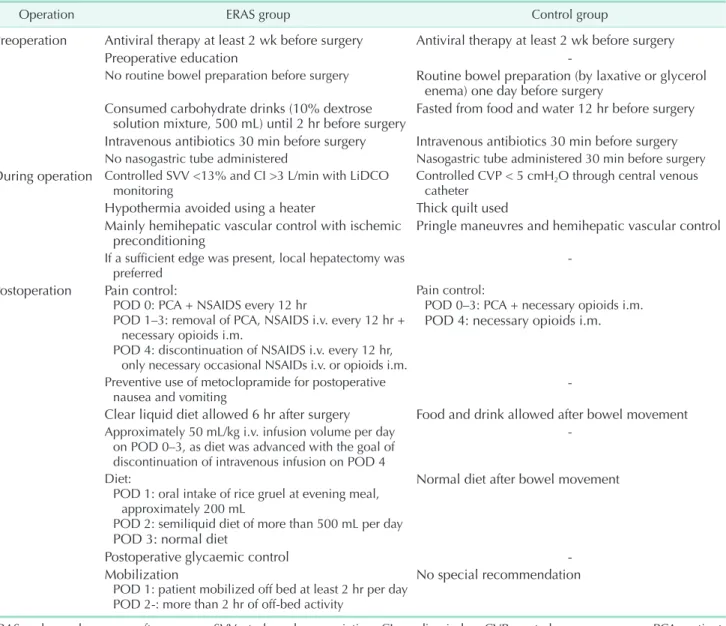
The basic protocols of the ERAS and control groups are summarized below (Table 1). The attending surgeons, resident physicians, midlevel providers, and nurses were educated on the new protocol.
Evaluated factors
The controlling nutritional status (CONUT) score is an objective tool that is considered an established assessment model for evaluating nutritional aspects in surgically treated patients, and it reflects liver functional reserve especially well [14,15]; therefore, the CONUT score as well as body mass index
(BMI) were used to evaluate the perioperative nutrition state in this study.
Postoperative opioids were converted to morphine equivalent units (MEU). The visual analogue score (VAS) was used to evaluate pain. The liver fibrosis-cirrhosis degree was evaluated by pathologists and surgeons with the Scheuer S score. The Scheuer score classifies fibrosis into 4 stages: minimal, mild, moderate, or severe/cirrhosis [16].
Liver resection was defined as a resection in which the lesion(s) was/were anatomically removed on the basis of Couinaud classification, including single segmentectomy, 2 combined segmentectomies, and major hepatectomy. Major hepatectomy was defined as 3 combined segmentectomies, hemihepatectomy, and caudate lobe hepatectomy. Morbidities such as liver failure were classified according to the Clavien-
Table 1. Summary of the ERAS protocol and comparison with the control group
Operation ERAS group Control group
Preoperation Antiviral therapy at least 2 wk before surgery Antiviral therapy at least 2 wk before surgery
Preoperative education -
No routine bowel preparation before surgery Routine bowel preparation (by laxative or glycerol enema) one day before surgery
Consumed carbohydrate drinks (10% dextrose
solution mixture, 500 mL) until 2 hr before surgery Fasted from food and water 12 hr before surgery Intravenous antibiotics 30 min before surgery Intravenous antibiotics 30 min before surgery No nasogastric tube administered Nasogastric tube administered 30 min before surgery During operation Controlled SVV <13% and CI >3 L/min with LiDCO
monitoring Controlled CVP < 5 cmH2O through central venous
catheter Hypothermia avoided using a heater Thick quilt used Mainly hemihepatic vascular control with ischemic
preconditioning Pringle maneuvres and hemihepatic vascular control
If a sufficient edge was present, local hepatectomy was
preferred -
Postoperation Pain control:
POD 0: PCA + NSAIDS every 12 hr
POD 1–3: removal of PCA, NSAIDS i.v. every 12 hr + necessary opioids i.m.
POD 4: discontinuation of NSAIDS i.v. every 12 hr, only necessary occasional NSAIDs i.v. or opioids i.m.
Pain control:
POD 0–3: PCA + necessary opioids i.m.
POD 4: necessary opioids i.m.
Preventive use of metoclopramide for postoperative
nausea and vomiting -
Clear liquid diet allowed 6 hr after surgery Food and drink allowed after bowel movement Approximately 50 mL/kg i.v. infusion volume per day
on POD 0–3, as diet was advanced with the goal of discontinuation of intravenous infusion on POD 4
-
Diet:
POD 1: oral intake of rice gruel at evening meal, approximately 200 mL
POD 2: semiliquid diet of more than 500 mL per day POD 3: normal diet
Normal diet after bowel movement
Postoperative glycaemic control -
Mobilization
POD 1: patient mobilized off bed at least 2 hr per day POD 2-: more than 2 hr of off-bed activity
No special recommendation
ERAS, enhanced recovery after surgery; SVV, stroke volume variation; CI, cardiac index; CVP, central venous pressure; PCA, patient- controlled analgesia; NSAIDS, non-steroidal anti-inflammatory drugs; POD, postoperative day; i.v., intravenously; i.m., intramuscularly.
Dindo definition as grade I to V [17]. All morbidities were assessed by 2 experienced surgeons (FW and LW) who were masked to the group assignments. Postoperative hospital stay was defined as the day when the patient was medically fit for discharge.
Patients were deemed stable for discharge once they could tolerate half-stream food, have bowel movements, and had no serious complications. The discharge criteria were based on the Chinese hepatectomy guideline as follows: white blood cell count < 1.2 times the normal value, albumin (ALB) > 30 g/L, ALT/AST < 3 times the normal value, serum total bilirubin (TBIL) < 2 times the normal value, and prothrombin activity (PTa) > 60%.
The preoperative factors (age, sex, ICG15 value, Scheuer S score, BMI, preoperative laboratory indexes), operative factors (blood loss, operation time, operation type, hepatectomy type, blood transfusion) and postoperative factors (postoperative hospital stay, bowel movement time, drain removal time, postoperative complication [Clavien-Dindo grade] rate, total morphine usage after surgery, postoperative day [POD] 1/3/5 CONUT score, and postoperative laboratory indexes) for all patients were recorded. All factors were analyzed to identify risk factors for delayed recovery after surgery.
The primary endpoint was the day when the patients could
be discharged. Secondary endpoints included morbidity and recovery of liver function on POD 5.
Statistical analyses
Data on patient characteristics, intraoperative parameters, and postoperative courses were collected. Continuous data with a normal distribution were statistically tested for group differences using a 2-sample Student t-test. Data without a normal distribution were analyzed using the Mann-Whitney U-test. Complication and mortality rates were analyzed using the chi-square test or Fisher exact test. The median postoperative hospital stay was compared across the same factors using Mann-Whitney or Kruskal-Wallis tests for categorical factors and Spearman correlation for continuous factors. Logistic regression multivariate analysis was performed to determine the association between risk factors and complications. A P-value of <0.05 was considered to be statistically significant. Statistical analyses were performed with IBM SPSS Statistics ver. 24.0 (IBM Co., Armonk, NY, USA).
RESULTS
During the study period, 85 patients who met the inclusion criteria were included in the ERAS group, and 5 patients whose
Table 2. Perioperative characteristics of HCC patients in the ERAS and control groups
Variable ERAS Control P-value
Age (yr) 55 (42–69) 59 (45–70) 0.339
Sex, female:male 16:64 23:59 0.491
ICG15 (%) 4.00 (1.70–10.42) 5.05 (2.20–10.73) 0.281
Preoperative PLT (×109 L) 177.50 (104.10–253.50) 153.00 (87.90–272.40) 0.125
Preoperative PTa (%) 88.10 (74.00–103.10) 82.50 (67.60–99.43) 0.533
Preoperative TBIL (µmol/L) 13.30 (8.61–21.78) 11.80 (7.16–20.22) 0.054
Preoperative ALT (U/L) 22.50 (13.00–49.50) 24.50 (13.30–61.50) 0.090
Preoperative AST (U/L) 23.00 (17.00–43.00) 23.50 (15.30–43.00) 0.418
Preoperative ALB (g/L) 45.20 (40.14–49.90) 43.90 (38.99–48.59) 0.080
Preoperative CONUT score 2.00 (0.00–3.40) 2.00 (0.10–4.00) 0.290
Preoperative BMI (m2/kg) 23.43 (20.18–28.26) 24.64 (20.92–29.13) 0.062
Tumor size (cm2) 11.52 (3.04–38.08) 12.00 (3.00–45.43) 0.993
Scheuer S score 0.651
<3 27 (33.75) 24 (29.27)
≥3 53 (66.25) 58 (70.73)
Type of procedure 0.500
Laparoscopic surgery 21 (26.25) 14 (17.07)
Open surgery 59 (73.75) 68 (82.93)
Type of hepatectomy 0.728
Single segmentectomy 25 (31.25) 28 (34.14)
Two combined segmentectomies 25 (31.25) 33 (40.24)
Major hepatectomy 30 (37.50) 21 (25.62)
Values are presented as median (IQR)a) or number (%)b).
IQR, interquartile range; HCC, hepatocellular carcinoma; ERAS, enhanced recovery after surgery; ICG15, indocyanine green retention at 15 minutes; PLT, platelet; PTa, prothrombin activity; TBIL, total bilirubin; ALB, albumin; CONUT, controlling nutritional status; BMI, body mass index.
P-value: a)Mann-Whitney test. b)Chi-square test.
Scheuer S scores were 0 were excluded in the end; 82 patients were included in the control group.
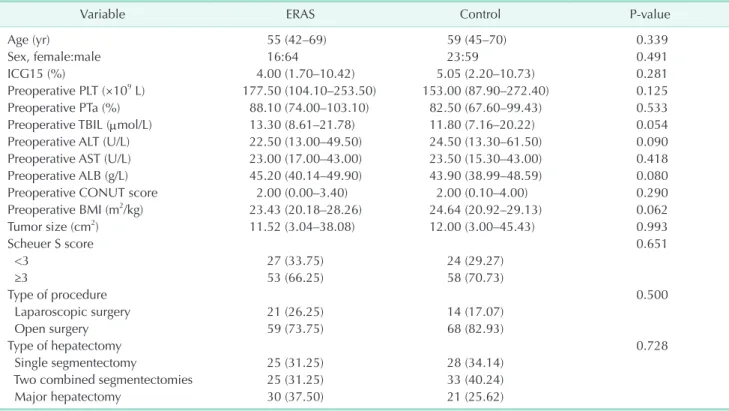
The baseline characteristics and perioperative results of the patients are displayed in Table 2. There were no significant differences between the 2 groups for sex, age, preoperative liver function (ICG15 rate, serum ALB level, TBIL level, ALT level, and platelet count), CRP level, preoperative CONUT score/
BMI, tumor size, Scheuer S score, type of procedure and type of hepatectomy.
Clinical short-term outcomes after surgery are summarized in Table 3.
The median postoperative hospital stay was 5 days in the ERAS group and 7 days in the control group (P < 0.001).
Patients in the ERAS group had a shorter postoperative hospital stay than those in the control group. The control group was comparable to the ERAS group regarding the use of different types of postoperative pain management, which is shown in Table 1. The MEU value was significantly lower in the ERAS group, resulting in a higher POD 1/2 pain score; the pain score was 2 in the ERAS group and 1 in the control group. The median time to return of bowel function was earlier in the ERAS group, and abdominal drains were removed 3 days postoperatively in
Table 4. Univariate and multivariate logistic regression analysis of the risk factors for prolonged hospital stay
Variable Univariate analysis Multivariate analysis
Odds ratio 95% CI P-value Odds ratio 95% CI P-value
Control group 2.093 0.757–5.792 0.155 - - -
Age 1.051 0.991–1.115 0.100 1.037 0.990–1.087 0.128
ICG15 1.009 0.854–1.192 0.919 - - -
Operation time 1.014 1.004–1.024 0.008* 1.010 1.003–1.017 0.006*
Tumor size 0.996 0.965–1.029 0.826 - - -
Intraoperative blood loss 0.998 0.996–1.001 0.226 - - -
Preoperative ALB 1.045 0.905–1.208 0.547 - - -
Preoperative ALT 1.063 1.008–1.120 0.023* 1.026 1.000–1.053 0.051
Preoperative AST 0.972 0.922–1.025 0.289 - - -
Open surgery 1.551 0.372–6.475 0.547 - - -
Single segmentectomy 0.368 0.094–1.436 0.150 0.300 0.094–0.958 0.042*
Combined 2 segmentectomies 0.319 0.085–1.200 0.091 0.512 0.173–1.511 0.225
Major hepatectomy - - 0.190 - - 0.127
Postoperative complication 0.148 0.041–0.538 0.004* 0.067 0.024–0.185 <0.001*
Results from the logistic regression model, with prolonged hospital stay as the dependent variable.
CI, confidence interval; ICG15, indocyanine green retention at 15 minutes; ALB, albumin.
*P < 0.05, statistically significant differences.
Table 3. Comparison of short-term outcomes between the ERAS and control groups
Variable ERAS Control P-value
Intraoperative blood loss (mL) 200 (100–500) 300 (175–400) 0.064
Total blood transfusion (mL) 0 (0–400) 0 (0–400) 0.89
Postoperative hospital stay (mL) 5 (4–6) 7 (6–8) <0.001*
Abdominal drainage tubes removed day (day) 3 (3–4) 4 (3–5) 0.005*
Bowel movement time (day) 2 (2–3) 3 (3–3) <0.001*
Morphine equivalents units (MEU) 83.33 (48.75–92.50) 250 (167.50–280.00) <0.001*
POD 1 VAS score 2 (1–2) 1 (1–2) 0.002*
POD 2 VAS score 2 (1–2) 1 (1–2) 0.001*
POD 1 CONUT score 7 (5.75–8) 7 (6–8) 0.689
POD 3 CONUT score 7 (5–8) 7 (5.5–8) 0.927
POD 5 CONUT score 5 (4–6) 7 (4–8) 0.113
Values are presented as median (interquartile range).
Data are the mean/medians with ranges in parentheses for continuous variables, with P-values from Mann-Whitney test or 2-sample Student t-test.
ERAS, enhanced recovery after surgery; POD, postoperative day; VAS, visual analogue scale; CONUT, controlling nutritional status.
*P < 0.05, statistically significant differences.
the ERAS group, which was significantly sooner than that in the control group under the same standard of drain removal.
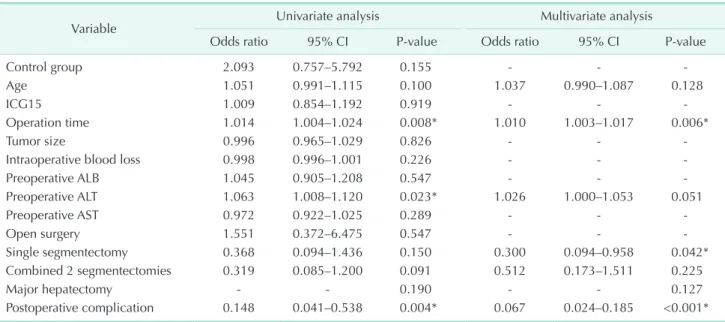
Based on the median hospital stay of 6 days in all patients, we dichotomized hospital stay into 2 groups (prolonged hospital stay > 6 days). Logistic regression analysis was applied to identify risk factors of prolonged hospital stay (Table 4).
Patients with single segmentectomy had shorter hospital
stay, meanwhile longer operation time and postoperative complication were associated with prolonged hospital stay.
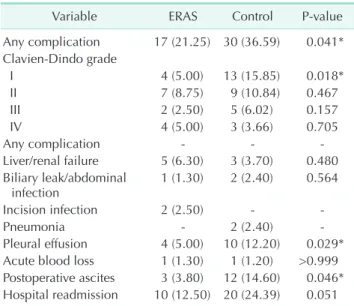
Sixteen patients (20.00%) in the ERAS group and 30 patients (36.59%) in the control group had at least one complication (P <
0.05) (Table 5); most complications were classified as grade 1–2, accounting for 68.75% of the total complications in the ERAS group and 70.65% in the control group. Grade I complications were significantly different in the 2 groups (patients in the ERAS group had fewer grade I complications), while complications of other grades were similar. The differences in the rates of pleural effusion and postoperative ascites (referring to ascites needing intervention, such as diuretics or paracentesis) were significant;
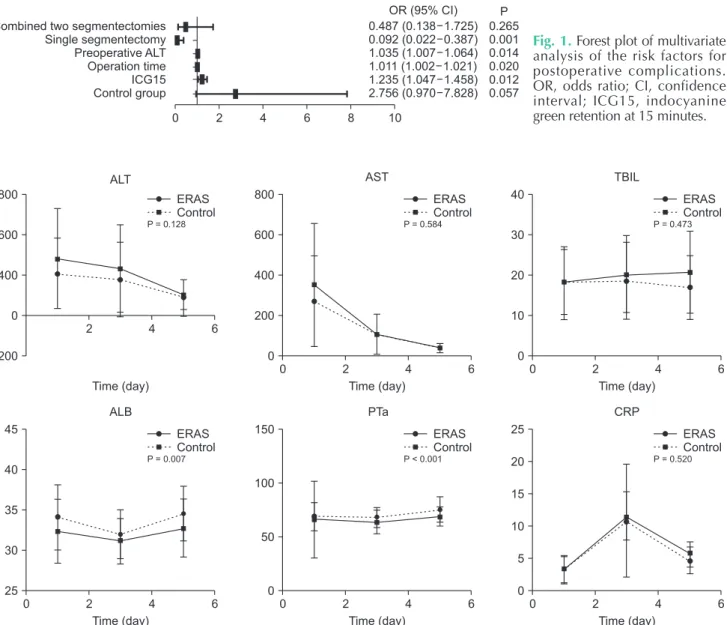
the control group rates were approximately 3 times higher than those in the ERAS group. Risk factors for complications are shown in Table 6 (logistic regression analysis). ICG15, operation time, preoperative ALT, and number of liver segmentectomies were associated with postoperative complications (Fig. 1).
Recovery of liver function was evaluated by the Child-Pugh score, and postoperative biochemical parameters including liver enzymes are shown in Fig. 2. The median hospital stay was 5 days in the ERAS group; therefore, recovery of liver function on POD 5 was compared between the 2 groups (Table 7). The Child-Pugh score on POD 5 was lower in the ERAS group (6 vs. 7) (P < 0.001), while the ALT, AST, and TBIL levels did not show significant differences between the 2 groups. In repeated measurement analysis of variance, the postoperative PTa (P
< 0.001) and ALB (P = 0.007) levels were higher in the ERAS group than in the control group.
The CRP concentration in the ERAS group was lower than that in the control group, and the POD 5 CRP level was Table 5. Comparison of morbidity after surgery between the
ERAS and control groups
Variable ERAS Control P-value
Any complication 17 (21.25) 30 (36.59) 0.041*
Clavien-Dindo grade
I 4 (5.00) 13 (15.85) 0.018*
II 7 (8.75) 9 (10.84) 0.467
III 2 (2.50) 5 (6.02) 0.157
IV 4 (5.00) 3 (3.66) 0.705
Any complication - - -
Liver/renal failure 5 (6.30) 3 (3.70) 0.480 Biliary leak/abdominal
infection 1 (1.30) 2 (2.40) 0.564
Incision infection 2 (2.50) - -
Pneumonia - 2 (2.40) -
Pleural effusion 4 (5.00) 10 (12.20) 0.029*
Acute blood loss 1 (1.30) 1 (1.20) >0.999 Postoperative ascites 3 (3.80) 12 (14.60) 0.046*
Hospital readmission 10 (12.50) 20 (24.39) 0.051 Values are presented as number (%).
ERAS, enhanced recovery after surgery.
*P < 0.05, statistically significant differences. P-values from chi- square test.
Table 6. Univariate and multivariate logistic regression analysis of the risk factors for postoperative complications
Variable Univariate analysis Multivariate analysis
Odds ratio 95% CI P-value Odds ratio 95% CI P-value
Control group 2.496 1.247–4.996 0.010* 2.756 0.970–7.828 0.057
Age 1.017 0.982–1.053 0.338 - - -
ICG15 1.194 1.059–1.346 0.004* 1.235 1.047–1.458 0.012*
Operation time 1.010 1.005–1.015 <0.001* 1.011 1.002–1.021 0.020*
Tumor size 1.011 0.996–1.027 0.150 - - -
Intraoperative blood loss 1.003 1.001–1.004 <0.001* 1.002 1.000–1.004 0.051
Preoperative ALB 0.872 0.798–0.953 0.003* 1.011 0.885–1.154 0.873
Preoperative ALT 1.019 1.000–1.038 0.045* 1.035 1.007–1.064 0.014*
Preoperative AST 1.001 0.993–1.009 0.877 - - -
Laparoscopic surgery 0.390 0.151–1.011 0.053 0.500 0.099–2.529 0.402
Single segmentectomy 0.426 0.187–0.973 0.043 0.092 0.022–0.387 0.001*
Combined 2 segmentectomies 0.504 0.214–1.191 0.118 0.487 0.138–1.725 0.265
Major hepatectomy - - 0.110 - - 0.004*
Results from the logistic regression model, with prolonged hospital stay as the dependent variable.
CI, confidence interval; ICG15, indocyanine green retention at 15 minutes; ALB, albumin.
*P < 0.05, statistically significant differences.
Fig. 1. Forest plot of multivariate analysis of the risk factors for postoperative complications.
OR, odds ratio; CI, confidence interval; ICG15, indocyanine green retention at 15 minutes.
Combined two segmentectomies Single segmentectomy Preoperative ALT Operation time ICG15 Control group
0.487 (0.138 1.725) 0.092 (0.022 0.387) 1.035 (1.007 1.064) 1.011 (1.002 1.021) 1.235 (1.047 1.458) 2.756 (0.970 7.828)
0.265 0.001 0.014 0.020 0.012 0.057 OR (95% CI) P
0 2 4 6 8 10
Table 7. Comparison of POD5 liver/renal function between the ERAS and control groups
Variable ERAS Control P-value
Child-Pugh score 6 (5–6) 7 (6–7) <0.001*
ALT (U/L) 110.3881 ± 106.02100 133.3077 ± 94.57991 0.171
AST (U/L) 35.9254 ± 17.79369 37.6026 ± 20.02229 0.597
TBIL (µmol/L) 18.8866 ± 11.09306 20.2423 ± 11.25989 0.468
DBIL (µmol/L) 9.7955 ± 5.74821 11.0385 ± 6.17238 0.214
PLT (×109 L) 149.8824 ± 58.36108 140.7949 ± 52.94652 0.326
CRE (µmol/L) 71.9552 ± 34.13273 66.0649 ± 12.21985 0.159
K (mmol/L) 3.8999 ± 0.38684 3.8247 ± 0.40474 0.258
Values are presented as mean ± standard deviation.
POD, postoperative day; ERAS, enhanced recovery after surgery; PLT, platelet; TBIL, total bilirubin; DBIL, direct bilirubin; CRE, creatinine.
*P < 0.05, statistically significant differences. P-values from t-tests.
0 2 4 6
ERAS Control 800
600
400
200
0
Time (day) AST
P = 0.584
0 2 4 6
ERAS Control 40
30
20
10
0
Time (day) TBIL
P = 0.473
2 4 6
ERAS Control 800
600
400
-200 0
Time (day) P = 0.128 ALT
0 2 4 6
ERAS Control 45
40
35
30
25
Time (day) ALB
P = 0.007
0 2 4 6
ERAS Control 150
100
50
0
Time (day) PTa
P < 0.001
0 2 4 6
ERAS Control 25
20 15 10 5 0
Time (day) CRP
P = 0.520
Fig. 2. Postoperative biochemical parameters of the 2 groups. Mean ± standard deviation of ALT/AST/TBIL/ALB/PTa/CRP in the ERAS and control groups on POD 1/3/5. Squares represent the control group and circles represent the ERAS group.
P-values from repeated measurement analysis of variance. TBIL, total bilirubin; ALB, albumin; PTa, prothrombin activity; ERAS, enhanced recovery after surgery; POD, postoperative day. *P < 0.05, statistically significant differences.
significantly different between the groups (4.62 ± 0.296 vs. 5.60
± 0.314, P = 0.027).
DISCUSSION
This study showed that using an evidence-based multimodal enhanced program similar to that for colorectal surgery patients was safe for hepatectomy patients, including those with cirrhosis undergoing major hepatectomy. Patients in the ERAS group had a shorter postoperative hospital stay and fewer complications than those in the control group, indicating that the ERAS strategy was effective in cirrhotic hepatitis patients.
Unlike in colorectal surgery, ERAS protocol in liver resection took more consideration regarding remnant liver metabolism, especially in cirrhosis patients. In view of impaired coagulation and possible epidural hematoma, epidural anesthesia was not performed in our ERAS protocol; instead, the way of blood loss control, the volume of liver resection, more specific fluid therapy, and protection of postoperative liver and renal function were augmented.
Quality of life seemed to be better in the ERAS group than in the control group based on 3 aspects. First, the MEU value was significantly reduced in the ERAS group, while the postoperative VAS pain score was not clinically different (VAS scores of 1 and 2 both represent minimal pain); therefore, the side effects of morphine, such as gastrointestinal motility disturbance, were reduced in the ERAS group. Second, reduced morphine use may have accelerated bowel movements in the ERAS group, and the normal oral intake time was earlier, which is an important factor in the General Comfort Questionnaire for the Kolcaba score [18] to evaluate quality of life. Additionally, under the same standard of drain tube removal (drainage < 50 mL, no blood present), the drain removal time was significantly reduced in the ERAS group, which could potentially be explained by the policy of early drain removal in ERAS patients [19]. This result coincides with a study [20] that used the validated MD Anderson Symptom Inventory to show that ERAS group patients seemed to have a better quality of life.
A study in 2010 [5], which explored risk factors for complications associated with hepatectomy, concluded that the independent relative risk for morbidity was influenced by operation time and blood loss. Another study concluded that improvements in surgical technology and techniques and perioperative management resulted in marked reductions in mortality and morbidity over time [3]. As for the type of surgery procedure, laparoscopic liver resection for HCC is feasible and safe but not inferior to open liver resection in regard to operative outcome [21]. In our center, in order to prevent bias, we did not deliberately perform more laparoscopic surgery in the ERAS group. Coincidentally, ERAS showed an advantage in reducing morbidity in our study, though in the multivariate
analysis, it was not an outstanding factor. Preoperative liver function, such as ICG15 rate and ALT levels, and operative characteristics, such as operation time and number of liver segmentectomies, were associated with postoperative complications in the multivariate analysis rather than the intervention. Improvements of the factors in operation, such as hemihepatic vascular control and local hepatectomy, do have positive impacts on recovering after surgery. Our team’s previous study [22] showed that intraoperative factors, such as hemihepatic vascular control, could result in better postoperative outcomes. In this study, patients in ERAS group had lower POD5 Child-Pugh score and lesser postoperative hospital stay. Based on earlier studies regarding hepatobiliary surgery in our center [23,24], hemihepatic vascular control and local hepatectomy combined with necessary radiotherapy showed no difference in survival of HCC. In colorectal surgery, surgical procedure is relatively constant compared with irregular hepatectomy, and operative characteristics have not changed much between the surgeries. Different HCC patients require specific liver resection, with different liver metabolism status, and it might be the reason why preoperative liver function and operative characteristics have greater impact in multivariate analysis of morbidity. Regardless, for some specific postoperative complications, such as pleural effusion and ascites, ERAS had a significant preponderance. This may be due to perioperative goal-directed fluid therapy changes. In the ERAS group, the anaesthesiologists controlled the intravenous fluid by stroke volume variation and cardiac index rather than CVP during the operation. This is unique in the liver surgery ERAS strategy, particularly regarding anesthesia, because goal- directed fluid therapy can effectively reduce operative bleeding and postoperative pleural effusion. After the operation, strict control of postoperative fluid through the veins was applied, and further oral intake was encouraged.
Liver function recovery was not different according to the trends of ALT and AST levels, while postoperative PTa and ALB levels were notably higher and the POD5 Child-Pugh score was lower in the ERAS group than in the control group.
These results may indicate that liver function recovery was faster in the ERAS group than in the control group. In the ERAS group, surgeons paid more attention to avoiding Pringle maneuvres and preserving as much of the remnant liver as possible. Although hemihepatic vascular control was performed more often in the ERAS group, there was no difference in intraoperative blood loss and total blood transfusion, which indicates that hemihepatic vascular control is safe and effective in cirrhotic patients.
Malnutrition is a common complication after hepatectomy in cirrhosis patients. Although some research found that nutritional support is less related to postoperative morbidity, most research reports that nutrition support is beneficial
to cirrhosis patients undergoing liver surgery [25], and early enteral feeding is advantageous in reducing the complication rate after major hepatic resection [26]. In particular, early enteral nutrition on POD 1 was verified to be beneficial in shortening the recovery period of intestine and liver functions in patients with HCC, even in a situation of liver cirrhosis [27]. There are a few methods, such as the subjective global assessment, nutritional risk index, and CONUT score, that can be used to evaluate the nutritional state of postoperative patients [28]. Considering that weight is not a reliable indicator of malnutrition because of the presence of ascites and edema, and that early postoperative CONUT scores are associated with complications after hepatectomy in HCC patients [29], it seems reasonable to use the CONUT score to assess the nutritional state of a patient. However, in our study, the postoperative nutritional state in the 2 groups was not different according to the CONUT scores. It seems that the ERAS strategy cannot improve nutrition state recovery. However, the ERAS group may have experienced less stress because the POD 5 CRP levels and POD 3 neutrophil to lymphocyte ratios were lower in the ERAS group than in the control group. One study noted that the ERAS protocol seemed to modulate perioperative insulin sensitivity, reducing operative stress and accelerating the return of baseline function [30]. More detailed laboratory studies are needed to validate this theory.
One limitation of this study was that it was not conducted as a randomized blind trial because in the trial test, the ERAS protocol showed sufficient safety and efficacy, and the trial could not be performed in a double-blind manner. Data from patients in the ERAS group were collected prospectively, and the principal aim was to assess the impact of implementing ERAS in routine clinical practice. Another limitation was that our ERAS protocol was very basic compared to that used in other studies involving the administration of branched-chain amino acids, and data of perioperative intravenous fluid were not analyzed in our study, for the anesthetists in our group have done a deeper study about goal-fluid therapy and metabolism.
In conclusion, this study has demonstrated that ERAS is a safe and effective intervention for cirrhosis patients undergoing complex liver resection surgery. ERAS, with a high level of compliance with the different elements, can result in a significant reduction in postoperative hospital stay and fewer postoperative medical complications, together with improved quality of life in the hospital. Patients undergoing cirrhotic hepatectomy with an ERAS protocol might have better recovery of liver function after surgery. In ERAS protocol for hepatectomy, operative characteristics such as the method of blood loss control and the volume of liver resection should be brought into consideration.
ACKNOWLEDGEMENTS
We are grateful to all our colleagues and authors at the Chinese Academy of Medical Sciences Cancer Hospital for their technical assistance, especially the anaesthetists Chao Liu and Liang Zhou.
Clinical Trial Registration
Enhanced Recovery After Surgery in Hepatectomy of Cirrhosis Hepatocellular Carcinoma (chictr.org identifier:
ChiCTR1900022361).
Fund/Grant Support
This study was supported by the National Key Research and Development Program of China (No. 2016YFD0400604), by the Beijing Hope Run Special Fund of Cancer Foundation of China (LC2017L05).
Conflict of Interest
No potential conflict of interest relevant to this article was reported.
ORCID iD
Yiling Zheng: https://orcid.org/0000-0002-9668-4982 Liming Wang: https://orcid.org/0000-0002-0418-405X Fan Wu: https://orcid.org/0000-0003-2566-3663 Weiqi Rong: https://orcid.org/0000-0003-2194-023X Yunhe Liu: https://orcid.org/0000-0002-8663-8819 Kai Zhang: https://orcid.org/0000-0001-6125-3157 Jianxiong Wu: https://orcid.org/0000-0003-2129-9032
Author Contribution
Conceptualization: LW Formal Analysis: YZ Investigation: KZ, YL Methodology: JW
Project Administration: JW, FW, WR Writing – Original Draft: YZ Writing – Review & Editing: LW, JXW
REFERENCES
1. Heimbach JK, Kulik LM, Finn RS, Sirlin CB, Abecassis MM, Roberts LR, et al.
AASLD guidelines for the treatment of hepatocellular carcinoma. Hepatology 2018;67:358-80.
2. Takamoto T, Hashimoto T, Inoue K, Nagashima D, Maruyama Y, Mitsuka Y, et al. Applicability of enhanced recovery program for advanced liver surgery. World J Surg 2014;38:2676-82.
3. Page AJ, Kooby DA. Perioperative management of hepatic resection. J Gastrointest Oncol 2012;3:19-27.
4. Sasaki K, Shindoh J, Margonis GA, Nishioka Y, Andreatos N, Sekine A, et al. Effect of background liver cirrhosis on outcomes of hepatectomy for hepatocellular carcinoma. JAMA Surg 2017;152:e165059.
5. Kamiyama T, Nakanishi K, Yokoo H, Kamachi H, Tahara M, Yamashita K, et al. Perioperative management of hepatic resection toward zero mortality and morbidity: analysis of 793 consecutive cases in a single institution. J Am Coll Surg 2010;211:443-9.
6. Wu CC, Cheng SB, Ho WM, Chen JT, Liu TJ, P’eng FK. Liver resection for hepatocellular carcinoma in patients with cirrhosis. Br J Surg 2005;92:348-55.
7. Sahara K, Paredes AZ, Tsilimigras DI, Hyer JM, Merath K, Wu L, et al. Impact of liver cirrhosis on perioperative outcomes among elderly patients undergoing hepatectomy: the effect of minimally invasive surgery. J Gastrointest Surg 2019;
23:2346-53.
8. Yoon YI, Kim KH, Kang SH, Kim WJ, Shin MH, Lee SK, et al. Pure laparoscopic versus open right hepatectomy for hepatocellular carcinoma in patients with cirrhosis: a propensity score matched analysis. Ann Surg 2017;265:856-63.
9. Wilmore DW, Kehlet H. Management of patients in fast track surgery. BMJ 2001;322:473-6.
10. Wilmore DW. From Cuthbertson to fast- track surgery: 70 years of progress in
reducing stress in surgical patients. Ann Surg 2002;236:643-8.
11. van Zelm R, Janssen I, Vanhaecht K, de Buck van Overstraeten A, Panella M, Sermeus W, et al. Development of a model care pathway for adults undergoing colorectal cancer surgery: evidence-based key interventions and indicators. J Eval Clin Pract 2018;24:232-9.
12. Rossi G, Vaccarezza H, Vaccaro CA, Mentz RE, Im V, Alvarez A, et al. Two-day hospital stay after laparoscopic colorectal surgery under an enhanced recovery after surgery (ERAS) pathway. World J Surg 2013;37:2483-9.
13. Ni TG, Yang HT, Zhang H, Meng HP, Li B.
Enhanced recovery after surgery programs in patients undergoing hepatectomy:
a meta-analysis. World J Gastroenterol 2015;21:9209-16.
14. Nishikawa H, Yoh K, Enomoto H, Ishii N, Iwata Y, Takata R, et al. The relationship between controlling nutritional (CONUT) score and clinical markers among adults with hepatitis C virus related liver cirrhosis. Nutrients 2018;10:1185.
15. Harimoto N, Yoshizumi T, Inokuchi S, Itoh S, Adachi E, Ikeda Y, et al. Prognostic significance of preoperative controlling nutritional status (CONUT) score in patients undergoing hepatic resection for hepatocellular carcinoma: a multi- institutional study. Ann Surg Oncol 2018;25:3316-23.
16. Mannan R, Misra V, Misra SP, Singh PA, Dwivedi M. A comparative evaluation of scoring systems for assessing necro- inflammatory activity and fibrosis in liver biopsies of patients with chronic viral hepatitis. J Clin Diagn Res 2014;8:FC08-12.
17. Clavien PA, Barkun J, de Oliveira ML, Vauthey JN, Dindo D, Schulick RD, et al. The Clavien-Dindo classification of surgical complications: five-year experience. Ann Surg 2009;250:187-96.
18. de Araujo Lamino D, Turrini RN, Kolcaba K. Cancer patients caregivers comfort. Rev Esc Enferm USP 2014;48:278-84.
19. Fuster J, Llovet JM, Garcia-Valdecasas JC, Grande L, Fondevila C, Vilana R, et al.
Abdominal drainage after liver resection for hepatocellular carcinoma in cirrhotic patients: a randomized controlled study.
Hepatogastroenterology 2004;51:536-40.
20. Day RW, Cleeland CS, Wang XS, Fielder S, Calhoun J, Conrad C, et al. Patient- reported outcomes accurately measure the value of an enhanced recovery program in liver surgery. J Am Coll Surg 2015;221:1023-30.e1-2.
21. Kim SJ, Jung HK, Lee DS, Yun SS, Kim HJ.
The comparison of oncologic and clinical outcomes of laparoscopic liver resection for hepatocellular carcinoma. Ann Surg Treat Res 2014;86:61-7.
22. Wang L, Feng L, Rong W, Liu M, Wu F, Yu W, et al. Regional ischemic preconditioning has clinical value in cirrhotic HCC through MAPK pathways. J Gastrointest Surg 2019;23:1767-77.
23. Wu JX, Wang LM, Liu LG, Zhong YX, Rong WQ, Wu F, et al. Application of selective and timely regional hepatic vascular occlusion for resection of large centrally located liver tumors: report of 133 cases.
Zhonghua Zhong Liu Za Zhi 2012;34:850- 4.
24. Yu W, Wang W, Rong W, Wang L, Xu Q, Wu F, et al. Adjuvant radiotherapy in centrally located hepatocellular carcinomas after hepatectomy with narrow margin (<1 cm): a prospective randomized study. J Am Coll Surg 2014;218:381-92.
25. Koretz RL, Avenell A, Lipman TO.
Nutritional support for liver disease.
Cochrane Database Syst Rev 2012;2012:CD 008344.
26. Masuda T, Shirabe K, Yoshiya S, Matono R, Morita K, Hashimoto N, et al. Nutrition support and infections associated with hepatic resection and liver transplantation in patients with chronic liver disease.
JPEN J Parenter Enteral Nutr 2013;37:318- 26.
27. Fearon KC, Luff R. The nutritional management of surgical patients:
enhanced recovery after surgery. Proc Nutr Soc 2003;62:807-11.
28. Lu X, Li Y, Yang H, Sang X, Zhao H, Xu H, et al. Improvement of nutritional support strategies after surgery for benign liver tumor through nutritional risk screening:
a prospective, randomized, controlled,
single-blind clinical study. Hepatobiliary Surg Nutr 2013;2:14-21.
29. Li L, Liu C, Yang J, Wu H, Wen T, Wang W, et al. Early postoperative controlling nutritional status (CONUT) score is associated with complication III-V after hepatectomy in hepatocellular carcinoma:
a retrospective cohort study of 1,334 patients. Sci Rep 2018;8:13406.
30. Carli F. Physiologic considerations of enhanced recovery after surgery (ERAS) programs: implications of the stress response. Can J Anaesth 2015;62:110-9.