식물추출물의 Human-ACAT 저해활성 검색
이대영*·정태숙**·류하나*·방면호*·홍윤희*·이윤형***·백남인*†
*경희대학교 식물대사 연구센터 및 생명자원과학연구원, **한국생명공학연구원 지질대사 연구센터,
***경희대학교 원예학과
Screening for Human ACAT-1 and ACAT-2 Inhibitory Activity of Edible Plant Extracts
Dae Young Lee
*, Tae Sook Jeong
**, Ha Na Lyu
*, Myun Ho Bang
*, Yoon Hee Hong
*, Youn Hyung Lee
***, and Nam In Baek
*†*Plant Metabolism Research Center and Institute of Life Science & Resources, KyungHee University, Suwon 446-701, Korea.
**National Research Laboratory of Lipid Metabolism & Atherosclerosis, Korea Research Institute of Bioscience and Biotechnology, Daejeon 305-333, Korea.
***Department of Horticultural Biotechnology, KyungHee University, Suwon 446-701, Korea.
ABSTRACT : Cholesterol acyltransferase (ACAT) catalyzes the acylation of cholesterol to cholesteryl ester with long chain fatty acids and ACAT inhibition is a useful strategy for treating hypercholesterolemia or atherosclerosis. Inhibitory effects on ACAT of the MeOH extracts prepared from 163 edible plants were evaluated. 15 species out of 163 species exhibited higher than 50% of inhibition on the hACAT-1 and 9 species exhibited higher than 50% of inhibition on the hACAT-2 activ- ity at their concentration of 100 ㎍ /mL.
Key Words : Edible Plant, Acyl-CoA: Cholesterol Acyltransferase (ACAT), Hypercholesterolemia, Atherosclerosis
INTRODUCTION
Inhibition of Acyl-CoA: cholesterol acyltransferase (ACAT, E.C.2.3.1.26), which catalyzes the acylation of cholesterol to cholesteryl esters with long chain fatty acids, is a very attractive target for the treatment of hypercholesterolemia and atherosclerosis (Brown et al ., 1975). It was found to be present as two isoforms in mammals (Anderson et al ., 1998; Coses et al ., 1998), ACAT-1 and ACAT-2, with different tissue distribution and membrane topology (Joyce et al ., 2000). However, most ACAT inhibitors, which were screened by rat liver microsomal ACAT, have problems associated with low oral bioavailability and adrenal and/or hepatic toxicity in clinical trials (Dominick et al ., 1993;
Matsuo et al ., 1996). ACAT-1 plays a critical role in foam cell formation in macrophages, whereas ACAT-2 is in charge of the cholesterol absorption process in intestinal
mucosal cells (Rudel et al ., 2001). These findings were consistent with the following results that atherosclerosis lesions were reduced at ACAT-1 mice, whereas ACAT-2 mice have limited cholesterol absorption in the intestine, and decreased cholesterol ester content in the liver and plasma lipoproteins (Accad et al ., 2000). Therefore, ACAT- 1 or ACAT-2 may be effective for the development of a useful hypercholesterolemic or anti-atherogenic agent (Sliskovic et al ., 2002).
Recently, many researchers have studied ACAT-1 and ACAT-2 inhibitory activity for plant extracts or plant- derived compounds. Im et al . investigated lupane-type triterpenoids isolated from I. macropoda , lupeol and betulin, to exert an inhibitory effect against ACAT activity (Im et al ., 2006). And Kim et al . reported triterpenoids from the flower of Campsis grandiflora showed inhibitory effects on hACAT-1 and hACAT-2 (Kim et al ., 2005).
†
Corresponding author: (Phone) +82-31-201-2661 (E-mail) [email protected]
Received August 14, 2008 / Revised September 24, 2008 / Accepted October 8, 2008
As a part of our screening studies to search new hypercholesterolemia and atherosclerosis materials, 163 edible plant extracts were evaluated for Inhibitory effects on the human ACAT-1 (hACAT-1) and human ACAT-2 (hACAT-2) expressed and characterized from Hi5 cells by recombinant baculoviruses (Cho et al ., 2003).
MATERIALS AND METHODS
1. Plant materials and cell line
The 163 edible plants, which were permitted as food materials by Korea Food & Drug Administration, were purchased at an agricultural and fishery products market located in Suwon, Korea. The plants were taxonomically identified with respect to morphology by Prof. Dae-Keun Kim, College of Pharmacy, Woosuk University, Jeonju, Korea. Voucher specimens (KHU0501001~163) are reserved at the Laboratory of Natural Products Chemistry, KyungHee University, Suwon, Korea. Hi5 cells were obtained from Gibco-BRL (Grand Islands, NY).
2. Preparation of plant extracts
Each of the dried plants (50 g) were powdered and extracted with 80% MeOH (0.5 L × 2) for 24 hr at room temperature. The fresh materials (500 g) were cut or sliced and extracted with 100% MeOH (1 L × 2) for 24 hr at room temperature. The extract solution was evaporated under reduced pressure at 45 ℃ and then completely dried by vacuum centrifugal evaporator. The completely dried MeOH extracts were used as samples for activity screening tests.
3. ACAT activity assay
The microsomal fractions of Hi5 cells containing baculovirally expressed hACAT-1 and hACAT-2 were used as sources of the enzyme. The activities of the hACAT-1 and hACAT-2 were measured according to the method of Brecher and Chan (Brecher & Chan, 1980), with slight modification (Jeong et al ., 1995). The reaction mixture, containing 4 µ L of microsomes (8 ㎎ /mL protein), 20 ìL of 0.5 M potassium phosphate buffer (pH 7.4) with 10 mM dithiothreitol, 15 µ L of bovine serum albumin (fatty
20 min at 37 ℃ with brief vortexing and sonication. The reaction was initiated by the addition of 8 µ L of [1-
14C]
oleoyl-CoA solution (0.05 µ Ci, final conc. 10 µ M). After 25 min of incubation at 37 ℃ , the reaction was stopped by the addition of 1 mL of isopropanol : heptane (4 : 1; v/v).
A mixture of 0.6 mL of heptane and 0.4 mL of 0.1 M potassium phosphate buffer (pH 7.4) with 2 mM dithiothreitol was then added to the terminated reaction mixture. The above solution was mixed and allowed to phase separation under gravity for 2 min. Cholesterol oleate was recovered in the upper heptane phase (total volume 0.9-1.0 mL). The radioactivity in 100 µ L of the upper phase was measured in a liquid scintillation viral with 3 mL of scintillation cocktail using a liquid scintillation counter. Background values were obtained by preparing heat inactivated microsomes or normal insect cell lysate microsomes, usually background value was 200-250 cpm, while 8000 cpm of ACAT reaction. The hACAT activity was expressed as a defined unit, cholesteryl oleate pmol/
min/ ㎎ protein.
RESULTS AND DISCUSSION
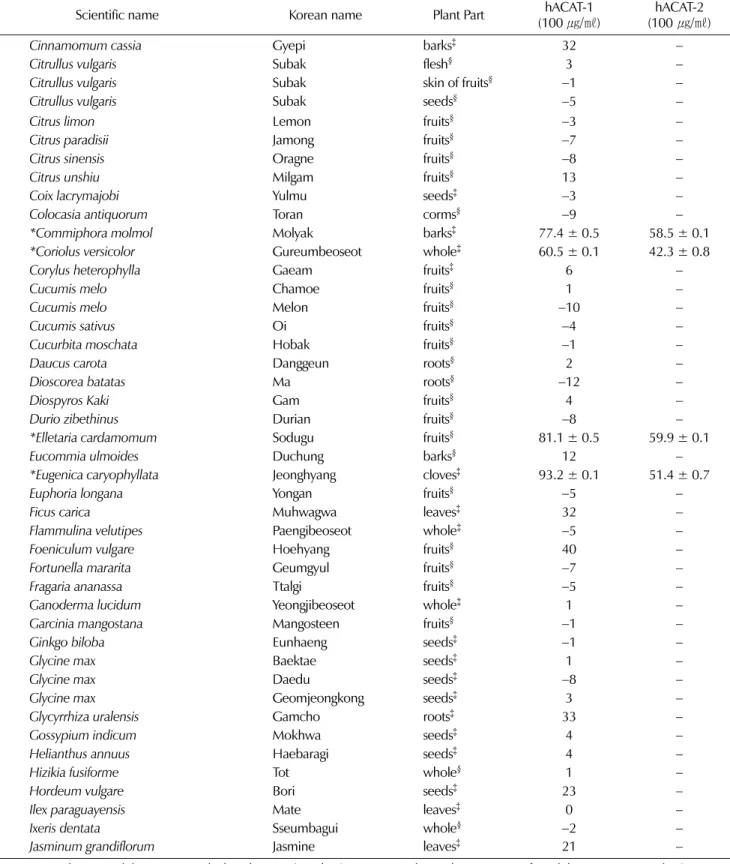
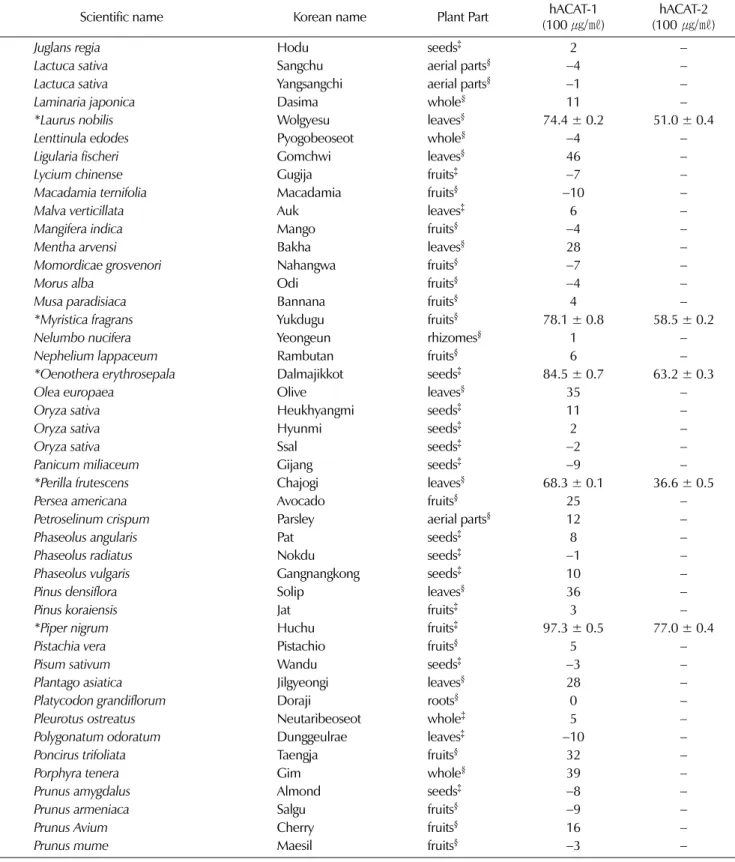
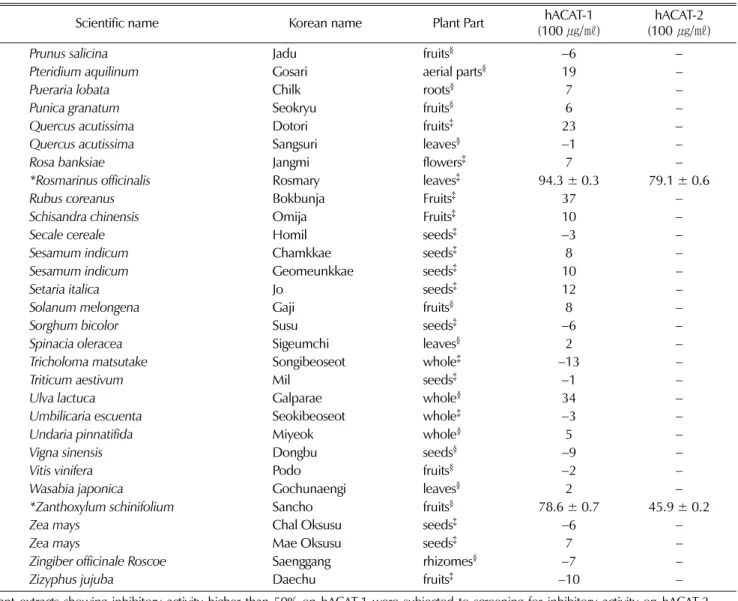
For the development of a useful hypercholesterolemic or anti-atherogenic agent, 163 kinds of edible plant extracts were examined for hACAT-1 inhibitory activity (Table 1).
As the result of this experiment, 15 species exhibited higher than 50% of inhibition on the hACAT-1 at their concentration of 100 ㎍ /mL. Eleven plant extracts- Angelica gigas, Chlorella vulgaris, Cinnamomum cassia, Coriolus versicolor, Commiphora molmol , Eugenica caryophyllata Laurus nobilis, Myristica fragrans, Oenothera erythrosepala, Perilla frutescent, and Zanthoxylum schinifolium - showed inhibitory activity on the hACAT-1 higher than 50%
inhibition at the concentration of 100 ㎍ /mL. And four
plant extracts- Capsella bursa-pastoris (92.1 ± 0.6%) , Piper
nigrum (97.3 ± 0.5%), Rosmarinus officinalis (94.3 ± 0.3%),
and Elletaria cardamomum (93.2 ± 0.1%)- showed strong
inhibition on the hACAT-1 at the same concentration. The
previously described 15 plant extracts showing hACAT-1
inhibition effect were also evaluated for hACAT-2
inhibition effect (Table 1). The 9 extracts showed higher
Table 1.
Inhibitory activities (%) of MeOH extracts from edible plants on hACAT-1 and hACAT-2
†.
Scientific name Korean name Plant Part hACAT-1
(100
㎍/
㎖) hACAT-2 (100
㎍/
㎖)
Acanthopanax sessiliflorus Ogapi roots
‡38
−Acanthopanax sessiliflorus Ogapi stems
‡21
−Actinidia arguta Darae Fruits
§ −3
−Adenophora triphylla Jandae roots
‡4
−Agaricur bisporus Yangsongibeoseot whole
‡ −15
−Allium cepa Yangpa bulbs
§ −8
−Allium chinense Lakgyo bulbs
§0
−Allium fistulosum Pa whole
§ −4
−Allium sativum Maneul bulbs
§ −3
−Allium schoenoprasmum Golpa whole
§9
−Ananas comosus Pineapple fruits
§ −7
−Angelica gigas Danggwi roots
‡29
−*Angelica gigas Danggwi leaves
§65.3 ± 0.3 31.1 ± 0.6
Angelica keiskei Sinseoncho leaves
§36
−Apium graveolens Celery leaves
§ −3
−Arachis hypogaea Tang-kong seeds
‡1
−Aralia elata Dureup aerial parts
§ −4
−Artemisia princeps Ssug aerial parts
§37
−Asparagus officinalis Asparagus stems
§17
−Aster scaber Chwi leaves
§18
−Auricularia auricula-judae Mogibeoseot whole
‡9
−Brassica campestris Yuchae seeds
‡2
−Brassica juncea Gat aerial parts
§0
−Brassica cernua Gyeoja aerial parts
§21
−Brassica oleracea Kale aerial parts
§45
−Brassica oleracea Yangbaechu aerial parts
§ −3
−Brassica campestris ssp rapa Sunmu roots
§3
−Brassica rapa Baechu aerial parts
§ −6
−Camellia sinensis Nokcha leaves
‡38
−*Capsella bursa-pastoris Naengi aerial parts
§92.1 ± 0.6 61.6 ± 0.1
Capsicum annuum Gochu fruits
‡7
−Capsicum annuum Paprica fruits
§3
−Capsicum annuum Pimang fruits
§ −3
−Capsosiphon fulvescens Maesaengi whole
§ −4
−Carica papaya Papaya fruits
§ −2
−Carthamus tinctorius Honghwa seeds
‡26
−Carya illinoensis Pecan fruits
‡6
−Cassia obtusifolia Gyeolmyeongja seeds
‡3
−Castanea crenata Bam fruits
§ −5
−Chaenomelis sinensis Mogwa fruits
§ −1
−*Chlorella vulgaris Chlorella whole
‡66.2 ± 0.7 45.5 ± 0.4
Cichorium endivia Endive aerial parts
§6
−Cichorium intybus Chicory leaves
§ −12
−*Cinnamomum cassia Gyeji twigs
‡57.0 ± 0.3 40.7 ± 0.3
†
Plant extracts showing inhibitory activity higher than 50% on hACAT-1 were subjected to screening for inhibitory activity on hACAT-2.
‡
The dried plants (50 g) were powdered and extracted with 80% MeOH .
§
The fresh plants (500 g) were cut or sliced and extracted with 100% MeOH.
*The data are presented as the mean ± standard deviation of three replications.
Table 1.
continued.
Scientific name Korean name Plant Part hACAT-1
(100
㎍/
㎖) hACAT-2 (100
㎍/
㎖)
Cinnamomum cassia Gyepi barks
‡32
−Citrullus vulgaris Subak flesh
§3
−Citrullus vulgaris Subak skin of fruits
§ −1
−Citrullus vulgaris Subak seeds
§ −5
−Citrus limon Lemon fruits
§ −3
−Citrus paradisii Jamong fruits
§ −7
−Citrus sinensis Oragne fruits
§ −8
−Citrus unshiu Milgam fruits
§13
−Coix lacrymajobi Yulmu seeds
‡ −3
−Colocasia antiquorum Toran corms
§ −9
−*Commiphora molmol Molyak barks
‡77.4 ± 0.5 58.5 ± 0.1
*Coriolus versicolor Gureumbeoseot whole
‡60.5 ± 0.1 42.3 ± 0.8
Corylus heterophylla Gaeam fruits
‡6
−Cucumis melo Chamoe fruits
§1
−Cucumis melo Melon fruits
§ −10
−Cucumis sativus Oi fruits
§ −4
−Cucurbita moschata Hobak fruits
§ −1
−Daucus carota Danggeun roots
§2
−Dioscorea batatas Ma roots
§ −12
−Diospyros Kaki Gam fruits
§4
−Durio zibethinus Durian fruits
§ −8
−*Elletaria cardamomum Sodugu fruits
§81.1 ± 0.5 59.9 ± 0.1
Eucommia ulmoides Duchung barks
§12
−*Eugenica caryophyllata Jeonghyang cloves
‡93.2 ± 0.1 51.4 ± 0.7
Euphoria longana Yongan fruits
§ −5
−Ficus carica Muhwagwa leaves
‡32
−Flammulina velutipes Paengibeoseot whole
‡ −5
−Foeniculum vulgare Hoehyang fruits
§40
−Fortunella mararita Geumgyul fruits
§ −7
−Fragaria ananassa Ttalgi fruits
§ −5
−Ganoderma lucidum Yeongjibeoseot whole
‡1
−Garcinia mangostana Mangosteen fruits
§ −1
−Ginkgo biloba Eunhaeng seeds
‡ −1
−Glycine max Baektae seeds
‡1
−Glycine max Daedu seeds
‡ −8
−Glycine max Geomjeongkong seeds
‡3
−Glycyrrhiza uralensis Gamcho roots
‡33
−Gossypium indicum Mokhwa seeds
‡4
−Helianthus annuus Haebaragi seeds
‡4
−Hizikia fusiforme Tot whole
§1
−Hordeum vulgare Bori seeds
‡23
−Ilex paraguayensis Mate leaves
‡0
−Ixeris dentata Sseumbagui whole
§ −2
−Jasminum grandiflorum Jasmine leaves
‡21
−Table 1.
continued.
Scientific name Korean name Plant Part hACAT-1
(100
㎍/
㎖) hACAT-2 (100
㎍/
㎖)
Juglans regia Hodu seeds
‡2
−Lactuca sativa Sangchu aerial parts
§ −4
−Lactuca sativa Yangsangchi aerial parts
§ −1
−Laminaria japonica Dasima whole
§11
−*Laurus nobilis Wolgyesu leaves
§74.4 ± 0.2 51.0 ± 0.4
Lenttinula edodes Pyogobeoseot whole
§ −4
−Ligularia fischeri Gomchwi leaves
§46
−Lycium chinense Gugija fruits
‡ −7
−Macadamia ternifolia Macadamia fruits
§ −10
−Malva verticillata Auk leaves
‡6
−Mangifera indica Mango fruits
§ −4
−Mentha arvensi Bakha leaves
§28
−Momordicae grosvenori Nahangwa fruits
§ −7
−Morus alba Odi fruits
§ −4
−Musa paradisiaca Bannana fruits
§4
−*Myristica fragrans Yukdugu fruits
§78.1 ± 0.8 58.5 ± 0.2
Nelumbo nucifera Yeongeun rhizomes
§1
−Nephelium lappaceum Rambutan fruits
§6
−*Oenothera erythrosepala Dalmajikkot seeds
‡84.5 ± 0.7 63.2 ± 0.3
Olea europaea Olive leaves
§35
−Oryza sativa Heukhyangmi seeds
‡11
−Oryza sativa Hyunmi seeds
‡2
−Oryza sativa Ssal seeds
‡ −2
−Panicum miliaceum Gijang seeds
‡ −9
−*Perilla frutescens Chajogi leaves
§68.3 ± 0.1 36.6 ± 0.5
Persea americana Avocado fruits
§25
−Petroselinum crispum Parsley aerial parts
§12
−Phaseolus angularis Pat seeds
‡8
−Phaseolus radiatus Nokdu seeds
‡ −1
−Phaseolus vulgaris Gangnangkong seeds
‡10
−Pinus densiflora Solip leaves
§36
−Pinus koraiensis Jat fruits
‡3
−*Piper nigrum Huchu fruits
‡97.3 ± 0.5 77.0 ± 0.4
Pistachia vera Pistachio fruits
§5
−Pisum sativum Wandu seeds
‡ −3
−Plantago asiatica Jilgyeongi leaves
§28
−Platycodon grandiflorum Doraji roots
§0
−Pleurotus ostreatus Neutaribeoseot whole
‡5
−Polygonatum odoratum Dunggeulrae leaves
‡ −10
−Poncirus trifoliata Taengja fruits
§32
−Porphyra tenera Gim whole
§39
−Prunus amygdalus Almond seeds
‡ −8
−Prunus armeniaca Salgu fruits
§ −9
−Prunus Avium Cherry fruits
§16
−Prunus mume Maesil fruits
§ −3
−†
Plant extracts showing inhibitory activity higher than 50% on hACAT-1 were subjected to screening for inhibitory activity on hACAT-2.
‡
The dried plants (50 g) were powdered and extracted with 80% MeOH .
§
The fresh plants (500 g) were cut or sliced and extracted with 100% MeOH.
*The data are presented as the mean ± standard deviation of three replications.
nobilis, M. fragrans, O. erythrosepala, P. nigrum, and R.
officinalis exhibited hACAT-2 inhibition effect with 61.6, 58.5, 59.9, 51.4, 51.0, 58.5, 63.2, 77.0 and 79.1% at the concentraton, respectively. P. nigrum and R. officinalis showed very high inhibition activity on both of human ACAT-1 and ACAT-2.
The plant extracts significant exhibiting hACAT inhibitory activities (more than 75.0% inhibition) were examined for the activity reported in the literature. C. bursa-pastoris
it reported to have cytotoxic and anti-inflammatory effects on human gingival fibroblasts cells (Tipton et al ., 2003).
E. cardamomum has been found effective for a treatment of postoperative nausea and vomiting (De Pradier, 2006).
Numerous papers have been published on E. caryophyllata , which are widely cultivated globally and their potential health effects including hypertension, hyperlipidemia, arteriosclerosis (Zhang, 2007), antioxidant activity (Lee et al ., 2002) and anticoagulation and anticancer activities
Table 1.
continued.
Scientific name Korean name Plant Part hACAT-1
(100
㎍/
㎖) hACAT-2 (100
㎍/
㎖)
Prunus salicina Jadu fruits
§ −6
−Pteridium aquilinum Gosari aerial parts
§19
−Pueraria lobata Chilk roots
§7
−Punica granatum Seokryu fruits
§6
−Quercus acutissima Dotori fruits
‡23
−Quercus acutissima Sangsuri leaves
§ −1
−Rosa banksiae Jangmi flowers
‡7
−*Rosmarinus officinalis Rosmary leaves
‡94.3 ± 0.3 79.1 ± 0.6
Rubus coreanus Bokbunja Fruits
‡37
−Schisandra chinensis Omija Fruits
‡10
−Secale cereale Homil seeds
‡ −3
−Sesamum indicum Chamkkae seeds
‡8
−Sesamum indicum Geomeunkkae seeds
‡10
−Setaria italica Jo seeds
‡12
−Solanum melongena Gaji fruits
§8
−Sorghum bicolor Susu seeds
‡ −6
−Spinacia oleracea Sigeumchi leaves
§2
−Tricholoma matsutake Songibeoseot whole
‡ −13
−Triticum aestivum Mil seeds
‡ −1
−Ulva lactuca Galparae whole
§34
−Umbilicaria escuenta Seokibeoseot whole
‡ −3
−Undaria pinnatifida Miyeok whole
§5
−Vigna sinensis Dongbu seeds
§ −9
−Vitis vinifera Podo fruits
§ −2
−Wasabia japonica Gochunaengi leaves
§2
−*Zanthoxylum schinifolium Sancho fruits
§78.6 ± 0.7 45.9 ± 0.2
Zea mays Chal Oksusu seeds
‡ −6
−Zea mays Mae Oksusu seeds
‡7
−Zingiber officinale Roscoe Saenggang rhizomes
§ −7
−Zizyphus jujuba Daechu fruits
‡ −10
−†
Plant extracts showing inhibitory activity higher than 50% on hACAT-1 were subjected to screening for inhibitory activity on hACAT-2.
‡
The dried plants (50 g) were powdered and extracted with 80% MeOH .
§