J. Appl. Biol. Chem.50(4), 301-303 (2007)
Short Communication
Inhibitory Effect of Plant Extracts on VHR Dual Specificity
Protein Phosphatase
Jae-Hoon Kim
1,2,3,* and Jeong-Hun Yun
11Faculty of Biotechnology, College of Applied Life Science, Cheju National University
Jeju 690-756, Korea
2Gene & Material Bank for Citrus Breeding, Cheju National University, Jeju 690-756, Korea
3Research Institute for Subtropical Agriculture and Biotechnology, Cheju National University,
Jeju 690-756, Korea
Received november 16, 2007; Accepted December 5, 2007
Key words: VHR, Dual specificity protein phosphatase, plant extracts, inhibition
Vaccinia H1-related phosphase (VHR) is a member of the Dual specificity protein phosphatases (DSPs) that dephosphorylate both phospho-tyrosyl and phospho- seryl/threonyl residues and is involved in the mitogen- activated protein kinase (MAPK) signaling cascade in mammalian cells [Denu et al., 1995; Alonso et al., 2001].
When subjected to the various stimulations such as epidermal growth factor (EGF) and stress, the extracellular- signal-regulated kinase 1 (ERK1) or ERK2 is activated within 5 min, and then inactivated within 20 min by the administration of VHR in COS-1 cells [Todd et al., 1999].
The activated ERKs phosphorylate several important cytoplasmic substrates and also translocate to the nucleus, where they phosphorylate some transcription factors that cause changes in the gene expression [Marshall, 1995].
VHR can suppress T cell antigen receptor signaling and inhibits T cell activation [Alonso et al., 2003]. Loss of the VHR causes the hyperactivation of JNK and ERK, resulting in cell-cycle arrest and senescence [Rahmouni et al., 2006]. Specific inhibitors of VHR are valuable
candidates for the treatment of several human diseases and are expected to be useful for revealing the physiological functions of VHR [Usui et al., 2001; Bae et al., 2004; Shi et al., 2007]. In this present paper we report on the investigation of 20 plant extracts collected from Jeju Island for their inhibitory effects on VHR. Freshly picked plants were dried at 55oC using a convection dry oven for 1 day and shredded. The samples were extracted with 80% (V/V) methanol, concentrated under reduced pressure, and freeze-dried.
The full-length VHR gene was amplified by PCR using the human cDNA (Clontech, Mountain View, CA). The amplified PCR product was subcloned into the NdeI - BamHI site of the pET28a(+) vector (Novagen, Darmstad, Germany), resulting in the N-terminal His-tagged protein.
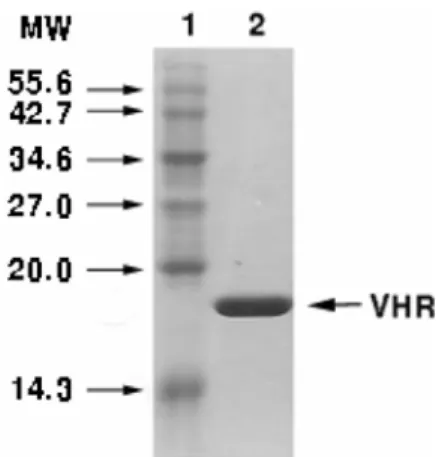
BL21(DE3) E.coli cells harboring the VHR gene were grown at 18oC, and the protein expression was induced with 0.1 mM IPTG for 16 h. The cell lysate was prepared by sonication with a buffer containing 50 mM Tris-HCl, pH 7.5, 200 mM NaCl, 0.5 mM PMSF, 0.04% (v/v) 2- mercaptoethanol. The His-tagged VHR protein was purified by nickel-affinity chromatography. The His-tag was removed from the protein by thrombin digestion, and the protein was further purified by CM-Sepharose ion exchange chromatography (Fig. 1)
The inhibitory effects of the 20 plant extracts on the VHR activity were measured using the para-nitrophenyl- phosphate (pNPP) as a substrate [Denu et al., 1995b]. The reaction mixture (total volume 100µL) contained 40 mM Tris-Cl (pH 6), 150 mM NaCl, 2 mM EDTA, and 0.1 mM pNPP with or without the plant extracts. The reactions were performed at 30oC for 10 min and were stopped by
*Corresponding author Phone: +82-64-754-3358 E-mail: [email protected]
Abbreviations: PCR, polymerase chain reaction; E.coli, Escher- ichia coli;PMSF, phenyl methyl sulfonyl fluoride; IPTG, isopro- pyl-β-D-thiogalactopyranoside; CM-Sepharose, carboxymethyl- Sepharose
Fig. 1. Expression and purification of VHR. VHR was expressed in BL21 (DE3) E.coli and purified by chroma- tography. The purified protein (2µg) was analyzed by SDS-PAGE. Positions of the molecular mass markers (kDa) are shown on the left.
302 Jae-Hoon Kim and Jeong-Hun Yun
Table 1. Inhibitory effects of Jeju plant extracts on VHR
Voucher
Specime No. Sample name Part used Inhibition (%)
K- 1 Zanthoxylum planispinum S. et Z. Leaves 54 ± 5.1
K- 2 Crinum asiaticum var. japonicum Baker Leaves 01 ± 4.6
K- 4 Viscum album var. coloratum (Kom.) Ohwi Aerial Part 70 ± 9.2
K-16 Viburnum awabuki K. KOCH Stem 41 ± 3.4
K-20 Leonurus sibiricus L. Root 34 ± 7.2
K-24 Portulaca oleracea L Aerial Part 43 ± 5.5
K-25 Viola Mandshurica W.Becker Aerial Part 27 ± 2.9
K-27 Ligularia fischeri (Ledeb.) Turcz. Aerial Part 61 ± 9.8
K-28 Empetrum nigrum L. var. japonicum K. Koch Aerial Part 92 ± 7.5
K-30 Geranium nepalense subsp.thunbergii Aerial Part 89 ± 9.1
K-31 Torilis japonica (Houttuyn) DC Root 01 ± 7.7
K-40 Halorrhagis micrantha R. Br. Aerial Part 94 ± 3.6
K-51 Caesalpinia japonica Siebold. et Zuccarini. Stem 48 ± 7.5
K-52 Calystegia soldanella Roem. et Schult. Aerial Part 37 ± 3.2
K-56 Platycarya strobilacea Siebold et Zuccarini Stem 95 ± 4.1
K-58 Acorus calamus Linne var. angustataus Root 35 ± 8.7
K-63 Oenothera biennis L. Aerial Part 95 ± 3.8
K-72 Zingiber Mioga (Thunb.) Roscoe Root 76 ± 8.7
K-74 Angelica japonica A. Gray Aerial Part 46 ± 8.6
K-81 Glehnia littoralis Fr. Schm Root 38 ± 4.5
Fig. 2. Effects of plant extracts on ERK. Serum-starved 293T cells were incubated with 0.02 mg/mL plant extracts for 1 h at 37oC and stimulated with EGF for the indicated times (min). Me: Methanol. (a) Cell lysates were analyzed with anti- bodies against the phospho-p42/p44 ERK and p42/p44 ERK. (b) Level of phospho-p42/p44 ERK remaining at the indi- cated times was densitometrically quantitated (ImageJ software).
adding 100µL of 2 N NaOH. The inhibition of VHR activity was calculated as a decrease in the absorbance at 405 nm of the product para-nitrophenolate, compared to
that of the control not containing the plant extract. At a concentration of 200µg/mL, marked inhibitory effects (>70%) were observed from the methanol extracts of the
Plant Extracts for VHR Inhibition 303
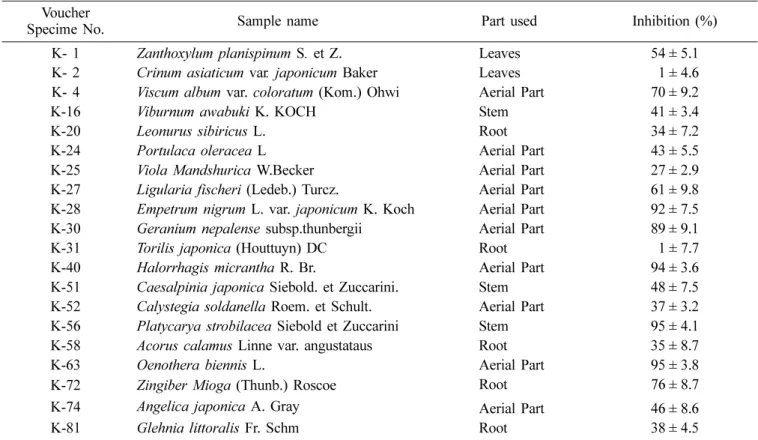
aerial parts of Viscum album var. coloratum (Kom.) Ohwi (K-4), Empetrum nigrum L. var. japonicum K. Koch (K- 28), Geranium nepalense subsp.thunbergii (K-30), Halorrhagis micrantha R. Br. (K-40), Oenothera biennis L. (K-63), as well as from the stems of Platycarya strobilacea Siebold et Zuccarini (K-56), and the roots of Zingiber Mioga (Thunb.) Roscoe (K-72). The extracts of Crinum asiaticum var. japonicum Baker (K-2) and Torilis japonica (Houttuyn) DC (K-31) had no inhibitory effects on the VHR activity, whereas the other remaining plant extracts showed moderate inhibitions on the VHR activity (Table 1).
Because ERK has been identified as a substrate for VHR, we tested whether the plant extracts have inhibitory effects on the VHR activity toward the dephosphorylation of ERK in 293T cells. The serum-starved 293T cells were incubated with the plant extracts (0.02 mg/mL) such as K-28, K-30, K-40, K50, and K60 for 1 h and treated wi the epidermal growth factor (EGF). The cell lyastes were prepared, and the levels of phosphorylated ERKs were determined by Western blotting using antibodies against phospho-p42/p44 ERK and p42/p44 ERK (Fig. 2a).
Densitometric analysis was employed to quantitate the level of phospho-p42/p44 ERK (Fig. 2b). EGF induced the phosphorylation of p42/p44 ERK within 5 min in 293T cells (Fig. 2), followed by the dephosphorylation of p42/p44 ERK. After 1 h, only the weak band of phospho- p42/p44 ERK could be detected (Fig. 2a, lanes 1-4). K-40 showed little increase in the phosphorylation of ERK in 293T cells, whereas K-28, K-30, K-56, and K-63 enhanced the phosphorylation of ERKs at 5 min (Fig. 2a and 2b).
Among the extracts tested, K-63 showed the strongest accumulation of the phosphorylated ERKs at 5 min, and a strong band of the phospho-p42/p44 ERK was detected after 1 h, compared to those of the control and the other extracts (Fig. 2). Although the extract of Platycarya strobilacea Siebold et Zuccarini (K-56) has been used for various medicinal purposes [Choi et al., 2003], the inhibitory effect on phosphatase has not yet been reported.
Our results demonstrate that K-56 is a potent candidate for the development of a VHR inhibitor.
Acknowledgment. This work was supported by the Education program for environment favorable agriculture
& subtropical bio-industry.
References
Alonso A, Saxena S, Williams S, and Mustelin T (2001) Inhibitory role for dual specificity phosphatase VHR in T cell antigen receptor and CD28-induced Erk and Jnk activation. J Biol Chem.276, 4766-4771.
Alonso A, Rahmouni S, Williams S, van Stipdonk M, Jaroszewski L, Godzik A, Abraham RT, Schoenberger SP, Mustelin T (2003) Tyrosine phosphorylation of VHR phosphatase by ZAP-70. Nat Immunol. 4, 44-48.
Bae EY, Oh H, Oh WK, Kim MS, Kim BS, Kim BY, Sohn CB, Osada H, and Ahn JS (2004) A new VHR dual- specificity protein tyrosine phosphatase inhibitor from Dendrobium moniliforme. Planta Med70, 869-870.
Choi YH, Chae SG, Kim JH, Kan SJ, Baek NI, and Han JT (2003) Isolation of an Antifungal Compound from Aerial Parts of Platycarya strobilacea. J Korean Soc Agric Chem Biotechnol46, 268-270.
Denu JM, and Dixon JE (1995) A catalytic mechanism for the dual-specific phosphatases. Proc Natl Acad Sci USA
92, 5910-5914.
Denu JM, Zhou G, Wu L, Zhao R, Yuvaniyama J, Saper MA, and Dixon JE (1995) The purification and charac- terization of a human dual-specific protein tyrosine phos- phatase. J Biol Chem270, 3796-3803.
Rahmouni S, Cerignoli F, Alonso A, Tsutji T, Henkens R, Zhu C, Louis-dit-Sully C, Moutschen M, Jiang W, and Mustelin T (2006) Loss of the VHR dual-specific phos- phatase causes cell-cycle arrest and senescence. Nat Cell Biol8, 524-531.
Marshall CJ (1995) Specificity of receptor tyrosine kinase signaling: transient versus sustained extracellular signal- regulated kinase activation. Cell80, (2):179-185.
Shi Z, Tabassum S, Jiang W, Zhang J, Mathur S, Wu J, and Shi Y (2007) Identification of a Potent Inhibitor of Human Dual-Specific Phosphatase, VHR, from Com- puter-Aided and NMR-Based Screening to Cellular Effects. Chembiochem8, 2092-2099.
Todd JL, Tanner KG, and Denu JM (1999) Extracellular reg- ulated kinases (ERK) 1 and ERK2 are authentic sub- strates for the dual-specificity protein-tyrosine phosphatase VHR. A novel role in down-regulating the ERK path- way. J Biol Chem274, 13271-80.
Usui T, Kojima S, Kidokoro S, Ueda K, Osada H, and Sodeoka M (2001) Design and synthesis of a dimeric derivative of RK-682 with increased inhibitory activity against VHR, a dual-specificity ERK phosphatase: impli- cations for the molecular mechanism of the inhibition. Chem Biol12, 1209-1220.