DOI : 10.3947/ic.2009.41.5.279 ORIGINALARTICLE
혈액에서 분리된 Extended-Spectrum Cephalosporin 내성 Enterobacter cloacae에서 Plasmid-Mediated
Quinolone Resistance 유전자의 분포 및 Fluoroquinolone 감수성 양상
한양대학교병원 감염내과1, 서울대학교병원 소아과2
김연재1ㆍ서미란1ㆍ김지은1ㆍ최은화2ㆍ이환종2ㆍ배현주1
Pr e v a l e n c ea n dCh a r a c t e r i z a t i o no fPl a s mi d - Me d i c a t e dQu i n o l o n eRe s i s t a n c eGe n e sa mo n g Cl i n i c a lI s o l a t e so fEx t e n d e d - Sp e c t r u m Ce p h a l o s p or i nRe s i s t a n tEnt e r o b a c t e rc l o a c a e
Yeon-Jae Kim, M.D.1, Mi-Ran Seo1, Jieun Kim M.D.1, Eun-Hwa Choi M.D.2, Hoan-Jong Lee, M.D.2, and Hyunjoo Pai, M.D.1 Division of Infectious Diseases1, Hanyang University College of Medicine,
Department of Pediatrics2, Seoul National University college of Medicine, Seoul, Korea
Background : Extended-spectrum cephalosporins (ESCs)-resistant Enterobacter cloacae is one of the pathogens of nosocomial infection the incidence of which is on the rise. Moreover, plasmid-mediated quinolone resistance genes (PMQR genes) that reduce quinolone sensitivity have been shown to be widely distributed among clinical isolates of Enterobacteriaceae. This study was carried out to observe the distribution of PMQR genes in clinical isolates of E. cloacae resistant to ESCs.
Materials and Methods : Fourty-three ESCs-resistant E. cloacae strains from the blood collected during the span of 7 years, from 1994 to 2001, at Seoul National University Children’s Hospital (SNUCH) were included in this study.
Isoelectric focusing and enzyme specific PCR were performed to characterize β-lactamase. The presence of qnrA, qnrB, qnrC, qnrS, qepA, and aac(6’)-Ib-cr was determined by PCR, restriction enzyme analyses of PCR products, and DNA sequencing. Minimal inhibitory concentration (MIC) of several quinolones was measured by agar dilution method.
Results : The PMQR genes were detected in 9 (21%) of 43 ESCs-resistant E. cloacae isolates. Among them, five isolates were positive for qnrB2, and each two isolates harbored qnrB4 or qnrB5, respectively. qnrA, qnrC, qnrS or qepA was not identified. aac(6’)-Ib was detected in 27 isolates, but aac(6’)-Ib-cr was not found. Among the 9 qnrB-positive isolates, 5 produced SHV-12, 3 were derepressed mutants, and 1 produced pI 7.5 β-lactamase.
MIC ranges and percent resistances of nalidixic acid, ofloxacin, levofloxacin, and moxifloxacin for the PMQR genes-positive isolates were higher than PMQR genes-negative isolates.
Conclusions : In this study, ESCs-resistant E. cloacae showed a high prevalence of PMQR genes, and qnrB was the only PMQR gene identified.
Key Words :Enterobacter cloacae, qnr, Extended-spectrum cephalosporin resistance
1)
Submitted : 10 August, 2009, Accepted : 16 October, 2009 Correspondence author : Hyunjoo Pai M.D.
Division of Infectious Diseases, College of Medicine, Hanyang University, 17 Heangdang-dong, Sungdong-gu, Seoul, 133-791, Korea
Tel : +82-2-2290-8356, Fax : +82-2-2298-9183 E-mail : [email protected]
서 론
Enterobacter cloacae는 중요한 병원 감염균으로서 extended-spectrum cephalosporins (ESCs) 내성이 큰 문제이다. 장내세균에서 ESCs 내성이 증가하는 것은 항생제 의 광범위한 사용과 내성균 또는 내성 플라스미드의 환자 및 균간 전파가 원인이다(1, 2). Enterobacter 균주에서 ESCs
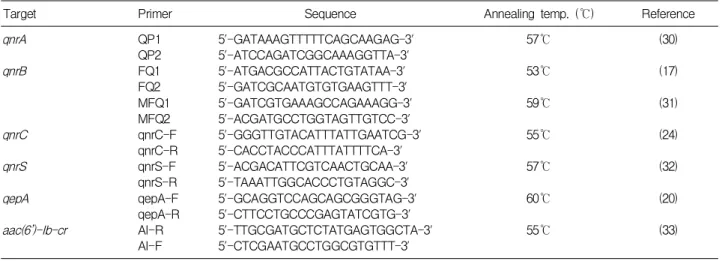
Table1.PrimersusedforPCR Amplification
Target Primer Sequence Annealingtemp.(℃) Reference
qnrA qnrB
qnrC qnrS qepA aac(6’)-Ib-cr
QP1 QP2 FQ1 FQ2 MFQ1 MFQ2 qnrC-F qnrC-R qnrS-F qnrS-R qepA-F qepA-R AI-R AI-F
5'-GATAAAGTTTTTCAGCAAGAG-3' 5'-ATCCAGATCGGCAAAGGTTA-3' 5'-ATGACGCCATTACTGTATAA-3' 5'-GATCGCAATGTGTGAAGTTT-3' 5'-GATCGTGAAAGCCAGAAAGG-3' 5'-ACGATGCCTGGTAGTTGTCC-3' 5'-GGGTTGTACATTTATTGAATCG-3' 5'-CACCTACCCATTTATTTTCA-3' 5'-ACGACATTCGTCAACTGCAA-3' 5'-TAAATTGGCACCCTGTAGGC-3' 5'-GCAGGTCCAGCAGCGGGTAG-3' 5'-CTTCCTGCCCGAGTATCGTG-3' 5'-TTGCGATGCTCTATGAGTGGCTA-3' 5'-CTCGAATGCCTGGCGTGTTT-3'
57℃
53℃
59℃
55℃
57℃
60℃
55℃
(30)
(17)
(31)
(24)
(32)
(20)
(33) 내성은 주로 염색체내 AmpC β-lactamase 발현 조절 유전
자의 derepressed mutation 혹은 플라스미드 매개 ex- tended-spectrum β-lactamase (ESBL) 생성에 의하여 발생한다(2).
한편 ESC를 사용하면 쉽게 염색체 변이로 인한 내성이 발 생하는 Enterobacter 균주 감염에서 퀴놀론은 중요한 치료 제이다. 일반적으로 퀴놀론 내성은 염색체내 DNA gyrase와 topoisomelase IV 변성의 축적이나 유출 펌프의 발현 조절 에 의해 발생하지만(3), 최근 퀴놀론의 감수성을 감소시키는 플라스미드 매개 퀴놀론 내성(plasmid-mediated qui- nolone resistance; PMQR) 유전자가 있음을 알게 되었다.
1987년 Shigella dysenteriae type1에서 플라스미드 매개 퀴놀론 내성이 처음 보고 된 이래(4) qnr, aac(6’)-Ib-cr, qepA 등 여러 PMQR 유전자가 존재하는 것이 밝혀졌다. Qnr 결정자는 여러 퀴놀론의 최소억제농도(minimal inhibitory concentration, MIC)를 4-8배 가량 증가시키고 aac(6’)- b-cr은 ciprofloxacin의 MIC를 4배 올린다. PMQR 유전자 는 세계적으로 다양한 장내세균에 널리 퍼져 있고(3) 장내세 균에서 ESCs 내성과 퀴놀론 내성이 서로 연관 되어 있음이 보고되었다. 이는 다양한 항생제 사용에 의한 선택압력과 PMQR 유전자가 ESCs 내성 플라스미드에 존재하기 때문으 로 생각되고 있다(5).
국내에서도 다양한 균주에 대한 PMQR 유전자의 연구가 이루어지고 있으나 E. cloacae에서의 PMQR 유전자 분포에 대한 보고는 아직 부족하다. 이에 저자들은 ESCs 내성 E.
cloacae 균주에서 PMQR 유전자의 빈도 및 종류를 분석하고 ESCs 내성기전과의 연관성 및 PMQR 유전자가 실제 퀴놀론 의 내성에 미치는 영향에 대해 알아보고자 하였다.
재료 및 방법
1. 대상균주
1994년에서 2001년까지 8년 동안 서울대학교 어린이 병 원의 균혈증 환자에게서 분리된 434주의 그람 음성 균주 중 74주의 E. cloacae를 동정하였고 이 중 ESCs에 내성인 46 균주에서 재연 가능한 43 균주를 대상으로 하였다. 이들의 ESCs 내성 기전은 이전 연구에서 확인하였다(6).
2. PMQR 중합효소 연쇄 반응과 염기서열 분석
qnrA, qnrB, qnrC, qnrS, qepA와 aac(6’)-Ib-cr의 PCR 시행을 위한 primer는 Table 1에 정리하였다. PCR 성 분조건은 qnrA, qnrC, qepA와 qnrS에서 2.5mM dNTP Mix, 1.5mM MgSO4, Taq polymerase (Bio Basic Inc., Markham, Canada)이었으며 qnrB 에서는 2.5mM dNTP Mix, 2.5mM MgSO4, Taq polymerase (Bio Basic Inc.)이 었다. 염기서열 분석은 qnrB 양성인 9균주의 PCR 증폭산물 을 QIGEX gel extraction kit (Qiagen, Chatsworth, USA) 로 정제하여 염기서열을 분석하였다.
3. 제한효소 분석을 이용한 아형분류
aac(6’)-Ib와 aac(6’)-Ib-cr의 분류는 AI-R, AI-F를 primer로 이용하여 시행한 PCR 증폭산물을 BccI (Pro- mega, Madison, USA)으로 절단하여 분류하였다. BccI은 aac(6’)-Ib를 233bp, 209bp, 40bp의 DNA 조각으로 절단 하고 aac(6’)-Ib-cr은 절단하지 못한다(7). qnrB2와 qnrB5의 아형분류를 위해 MFQ1과 MFQ2 primer를 이용하 여 증폭된 산물을 ApaI (Promega) 혹은 HindIII (Pro-
Table2.DistributionofPMQR genesinExtended-spectrum cephalosporins-resistantE.cloacae
β-lactamase Numberofisolates qnrA qnrB
qnrC qnrS aac(6’)-Ib-cr qepA qnrB2 qnrB4 qnrB5
PD* PD+SHV-12 D†
D+7.5 D+>8.2 D+TEM-52 D+SHV-12 D+SHA-2a SHV-12 TEM-52 CTX-M-14
9 1 11
3 1 5 6 2 3 1 1
1 1
1
2
1
1
1
1
Total 43 5 2 2
*PD,partialderepressedmutant;†D,derepressedmutant mega)로 절단하였다. ApaI은 qnrB2의 증폭산물을 467bp와 95bp의 DNA 조각으로 절단하고 HindIII는qnrB5 증폭 산물 을 333bp와 229bp로 절단한다(8).
4. 최소억제농도 또는 MIC
ESCs에 내성인 E. cloacae 43주 중에서 PMQR 유전자가 포함된 균주를 선별하여 nalidixic acid, ciprofloxacin, levofloxacin, ofloxacin, moxifloxacin에 대해 한천희석법 으로 MIC를 측정하였으며 NCCLS 가이드라인에 따른 breakpoint로 percent resistance를 측정하였다(9).
결 과
1. β-lactamase 분석
ESCs에 내성인 E. cloacae 43주를 대상으로 isoelectric focusing (IEF), 효소억제검사와 효소 특이 중합효소 연쇄 반응을 통해 분석한 결과, ESCs 내성 기전으로서 염색체 변 이로 인한 derepressed mutant가 28주(65%, 28/43), partial derepressed mutant가 1주(2%, 1/43)이고 SHV- 12가 10주(23%, 10/43), TEM-52가 6주(14%, 6/43), SHA-2a가 2주(5%, 2/43), CTX-M-14가 1주(2%, 1/43)였다(6).
2. PMQR 유전자의 분포
ESCs 내성인 E. cloacae 43주 중 9주에서 PMQR이 존재 하였다(21%, 9/43). PMQR 양성으로 나타난 균주의 분포와 ESCs 내성 기전과의 상관관계는 Table 2에 정리하였다.
PMQR 유전자 양성인 9주는 모두 qnrB를 가지고 있었으며
그 외 qnrA, qnrC, qnrS 혹은 qepA는 발견되지 않았다.
qnrB의 아형을 분석한 결과 qnrB2가 5주(56%, 5/9), qnrB4가 2주(22%, 2/9), qnrB5가 2균주(22%, 2/9)로 나 타났다. 아미노글리코사이드에 내성을 보이는 aac(6’)-Ib 는 27균주(63%, 27/43)에서 발견되었으나 aac(6’)-Ib- cr 변이 유전자는 발견되지 않았다. PMQR 유전자 양성인 9 균주 중 5균주(56%, 5/9)가 SHV-12 ESBL을 생산하였고 3균주는(33%, 3/9)는 derepressed mutant였으며 한 균주 (11%, 1/9)는 pI 7.5 β-lactamase를 생산하였다(Table 2).
3. 퀴놀론에 대한 MIC 측정 및 내성비율(%)
퀴놀론에 대한 MIC 측정값 및 percent resistance는 Table 3에 정리하였다. MIC range는ciprofloxacin, levo- floxacin, ofloxacin, nalidixic acid, moxifloxacin에서 PMQR 유전자 양성인 균주가 각각 <0.5-1 µg/dL, 1-4 µg/
dL, 1-8 µg/dL, 32-128 µg/dL, 2-8 µg/dL로 나타났고 PMQR 유전자 음성인 균주에서는 <0.5 µg/dL, <0.06-1 µg/dL, <0.06-4 µg/dL, <4->1024 µg/dL, <0.06-1 µg/
dL로 PMQR 유전자 양성인 균주에서 전반적으로 높게 분포 하였다. Breakpoint에 따른 내성 균주의 비율은 cipro- floxacin, levofloxacin, ofloxacin, nalidixic acid, moxi- floxacin에서 PMQR 양성인 균주가 각각 0%, 0%, 11%, 100%, 56%로 0%, 0%, 0%, 26%, 0%인 PMQR 음성 균주 에 비해 현저히 높았다.
Table 3. MICs of Quinolones for Extended-spectrum cephalosporins-resistantE.cloacaewhich contains (Plasmid- MediatedQuinoloneResistance)PMQR Genes
No.of isolates
Ciprofloxacin Levofloxacin Ofloxacin Nalidixicacid Moxifloxacin MIC range %R MIC range %R MIC range %R MIC range %R MIC range %R qnr(+)isolates
qnrB2 qnrB4 qnrB5
Subtotal
qnr(-)isolates
Total
5
2
2
9
34
43
<0.5-1
1
<0.5
<0.5-1
<0.5
<0.5-1 0 (0/5)
0 (0/2)
0 (0/2)
0 (0/9)
0 (0/34)
0 (0/43)
1-2
2-4
1
1-4
<0.06-1
<0.06-4 0 (0/5)
0 (0/2)
0 (0/2)
0 (0/9)
0 (0/34)
0 (0/43)
1-8
4
1-2
1-8
<0.06-4
<0.06-8 20 (1/5)
0 (0/2)
0 (0/2)
11 (1/9)
0 (0/34)
2 (1/43)
32-128
32-64
32
32-128
<4->1024
<4->1024 100 (5/5) 100 (2/2) 100 (2/2) 100 (9/9)
26 (9/34)
42 (18/43)
2-4
4-8
2
2-8
<0.06-1
<0.06-8 60 (3/5) 100 (2/2)
0 (0/2)
56 (5/9)
0 (0/34)
12 (5/43)
*MIC,minimalinhibitoryconcentration(µg/dL)
†%R,% resistance(resistantisolates/totalisolates)
고 찰
장내세균에서 다제내성균주는 점차 증가하는 추세이다 (3, 10, 11). 특히 퀴놀론 내성에 대해서는 2003년 미국의 중환자실에서 검출된 장내세균의 10%이상이 ciprofloxacin 에 내성을 보였고(12) 2006년 홍콩에서는 E. coli에서 퀴놀 론 내성이 40%까지 보고되었으며(13), 1999년 바르셀로나 에서는 일반인의 장내 균집락 중 25%에서 퀴놀론 내성 E.
coli가 검출되기도 하였다(14). 퀴놀론에 대한 내성은 과거 염색체의 돌연변이에 의해서 발생하는 것으로 알려졌으나 최 근에 퀴놀론 내성을 전달하는 다양한 플라스미드 매개 유전 자들이 발견되었다. 이들을 플라스미드 매개 퀴놀론 내성 (PMQR) 유전자라 하며, 현재 qnr, aac(6’)-Ib-cr, qepA 등이 밝혀졌다. 이 중 qnr 유전자의 아형에는 qnrA, qnrB, qnrC, qnrS와 최근 qnrD가 보고되었으며(15-19), 내성기 전은 fluoroquinolone으로부터 DNA gyrase를 보호함으로 써 작용하고 접합을 통해 내성 플라스미드를 전달하였을 때 fluoroquinolone의 MIC를 4-8배 증가시킨다(15). 또 다른 PMQR 유전자인 aac(6’)-Ib-cr 유전자는 aminoglyco- side acetyltrasferase 유전자인 aac(6’)-Ib의 변이 유전자 로서 iprofloxacin의 piperazinyl substituent의 acety- lation을 유발하여 ciprofloxacin MIC를 4배정도 증가시킨 다(3). Norfloxacin도 유사한 영향을 받으나 piperazynyl nitrogen이 없는 levofloxacin, moxifloxacin은 영향을 받 지 않는다(20). qepA는 fluoroquinolone이나 norfloxacin
을 세포질에서 세균벽 밖으로 내보내는 방류 펌프(efflux pump)의 상향조절(upregulation)로 fluoroquinolone MIC 를 2배정도 증가시킨다(21).
PMQR 유전자의 발현빈도는 세계적으로 점차 증가하는 추세로(3) 최근에는 병원 내 퀴놀론 내성 및 PMQR 유전자 를 가진 장내세균이 집단 발병하는 사례가 보고되고 있다 (22-24). 국내에서도 PMQR 유전자의 발현 빈도는 증가하 는 추세이다. 최근 9년간 국내병원의 혈액에서 동정된 Escherichia coli, Klebsiella pneumoniae, E. cloacae에서 PMQR 유전자의 빈도 및 ciprofloxacin의 내성 발현 비율을 조사한 결과 PMQR 유전자의 빈도 및 ciprofloxacin 내성 발 현비율 모두 유의하게 증가하였으며 본 연구 결과와 유사하 게 PQMR 유전자의 아형은 대부분 qnrB였다(25). 또한 국 내에서 K. pneumoniae와 E. coli를 을 대상으로 시행된 다른 연구결과도 qnr 양성 균주 중 qnrB가 각각 91%, 75%로 높 은 비율을 차지했다(8). 장내세균 368균주를 대상으로 한 연 구에서도 qnrB가 36.7%로 높은 비율을 차지하였으나 7주의 qnr양성 E. cloacae 중에서는 qnrA1이 4균주, qnrB2와 qnrB4가 각각 1균주, 2균주였다(26). 이 중 qnrA1 양성인 균주는 CTX-M-9과 SHV-12를 생산하였고 qnrB 양성 균 주는 DHA-1이나 DHA-1과 SHV-12를 생산하였다. 한 편, 국내에서 186주의 ESBL 생성 E. cloacae를 대상으로 시 행한 연구에서는 qnrA1의 비율이 36.1%로 가장 높은 것으 로 확인되었다(27). 그러나 이 논문에서 qnrA1 양성인 균주 의 62.5%가 CTX-M-9을 생산하였고 SHV 아형 생산과 qnrB의 연관성은 64.6%로 높았다(qnrB4 38.5%, qnrB2
26.1%). 이러한 자료를 종합하면 qnr의 아형은 균종보다는 균주가 생산하는 베타락탐분해효소, 즉 내성 플라스미드에 따라 결정되는 것으로 추측되지만 qnr의 분포가 균 종 차이를 보이는지에 관해서는 자료가 충분하지 않아서 좀 더 많은 수 를 대상으로 한 연구가 필요할 것이다. 본 연구에서 qnrA1 균 주가 없는 것은 43균주 중 SHV-12 생성 균주가 10주인데 반해 CTX-M 생성 균주는 1주 밖에 없는 것에 기인하는 것 으로 설명할 수 있겠다.
본 연구의 PMQR 유전자의 빈도는 21%로 높게 나타났으 며, 그 아형은 모두 qnrB였으나 qnrA, qnrC, qnrS, qepA, aac(6’)-Ib-cr은 검출되지 않았다. 본 연구의 대상 균주 중 1995, 1996, 1998년에 각각 1균주, 1999년에 2균주 및 2000년에 4균주가 qnr 유전자 양성이어서 qnr 유전자는 1995년에도 이미 존재하고 있었다는 것을 알 수 있다. 이를 연도별 qnr 양성균주/총 균주의 비율로 계산해 보면 1995년, 1996년, 1998년, 1999년 및 2000년에 각각 16% (1/6), 20% (1/5), 16% (1/6), 40% (2/5), 67%(4/6)이었다. 비 록 연구에 포함된 균주의 수가 적으나 매년 혈액에서 분리된 전 균주를 수집한 것을 고려한다면 qnr 양성이 증가하고 있음 을 제시한다.
ESCs 내성균주에서 퀴놀론 내성이 높은 이유는 여러 약 제에 의한 내성균의 선택의 영향이외에도 같은 내성 플라스 미드내에 베타락탐분해효소 유전자와 PMQR 유전자가 같이 존재하기 때문이다(5). 한 연구에서는 blaVEB-1 를 가진 23균 주 중 11주(48%)에서 qnrA가 확인되었으나 그렇지 않은 22균주에서는 qnr이 확인되지 않았으며(28), blaDHA-1을 포 함하는 K. pneumoniae의 내성 플라스미드 pTN60013내 qnrB4가 존재하였다(29). 하지만 본 연구에서는 PMQR이 나 ESBL의 유전자 위치에 대하여는 분석을 시도하지 않았 다.
본 연구에서 qnrB 양성 균주 중에서 가장 흔한 ESBL은 SHV-12 임을 알 수 있었다. qnrB와 SHV-12와의 연관성 은 이전 연구를 통해 알려져 있으며(18) 국내에서 시행된 한 연구에서 SHV type의 ESBL은 qnrB2나 qnrB4와 연관이 있는 것으로 나타났다(27). 또한 qnrB와 SHV-12에 의한 내성의 발생은 앞으로 늘어날 것으로 생각되어 주의가 필요 하다(8).
일반적으로 PMQR 유전자는 퀴놀론의 MIC를 증가시키지 만 다른 내성기전 없이 PMQR 보유만으로는 균은 여전히 퀴 놀론 감수성이다. 그러나 PMQR이 있는 균주는 gyrase나 topoisomerase의 유전자 변이를 보다 용이하게 하여서 쉽 게 퀴놀론 고도내성을 일으킬 수 있는 것으로 알려져 있다 (11). 본 연구에서는 PMQR 유전자의 전이에 의한 퀴놀론
MIC 변화를 관찰하지 않았으나 야생균주만으로도 levo- floxacin, ofloxacin, nalidixic acid와 moxifloxacin에서 MIC가 2배에서 4배 증가하였고 내성비율도 ofloxacin과 nalidixic acid 그리고 moxifloxacin에서 증가하는 것을 관 찰할 수 있었다. 이는 아마도 균주들이 플루오로퀴놀론을 거 의 사용하지 않는 소아에서 분리되었으므로 퀴놀론 내성을 유발하는 염색체성 유전자 변이가 비교적 적기 때문에 PMQR 유전자의 영향을 보다 뚜렷하게 보여주기 때문으로 생각되었다 이상의 결과를 통해 혈액에서 분리된 ESCs 내성 E. cloacae에서 PMQR 유전자는 21%로 모두 qnrB 유전형 이었으며, PMQR이 발견된 균주에서 가장 흔한 β-lac- tamase는 SHV-12이었다(56%). E. cloacae의 감염 발생 빈도는 다른 장내세균에 비해 낮으나 cephalosporin을 포함 한 다제항생제와 퀴놀론에도 내성이 증가하고 있고 PMQR 유전자의 빈도도 증가하고 있어 향후 E. cloacae에서의 PMQR 유전자의 아형 분류 및 빈도, ESBL이나 AmpC β- lactamase와의 연관성 및 내성발현에 관한 추가적인 연구가 필요할 것으로 생각된다.
References
1) Graffunder EM, Preston KE, Evans AM, Venezia RA.
Risk factors associated with extended‐spectrum beta‐
lactamase‐producing organisms at a tertiary care hospital. J Antimicrob Chemother 56:139-45, 2005 2) Paterson DL. Resistance in gram-negative bacteria:
Enterobacteriaceae. Am J Infect Control 34 Suppl 1:S20-8, 2006
3) Robicsek A, Jacoby GA, Hooper DC. The worldwide emergence of plasmid-mediated quinolone resis- tance. Lancet Infect Dis 6:629-40, 2006
4) Munshi MH, Sack DA, Haider K, Ahmed ZU, Rahaman MM, Morshed MG. Plasmid-mediated resistance to nalidixic acid in Shigella dysenteriae type 1. Lancet 2:419-21, 1987
5) Nordmann P, Poirel L. Emergence of plasmid-me- diated resistance to quinolones in Enterobacteri- aceae. J Antimicrob Chemother 56:463-9, 2005 6) Pai H, Hong JY, Byeon JH, Kim YK, Lee HJ. High
prevalence of extended-spectrum beta-lactamase- producing strains among blood isolates of Entero- bacter spp. collected in a tertiary hospital during an 8-year period and their antimicrobial susceptibility patterns. Antimicrob Agents Chemother 48:3159- 61, 2004
7) Seo MR, Park YS, Pai H. Characteristics of plasmid- mediated quinolone resistance genes in extended- spectrum cephalosporin-resistant isolates of Kleb-
siella pneumonia and Escherichia coli in Korea.
Chemotherapy (in press)
8) Pai H, Seo MR, Choi TY. Association of QnrB de- terminants and production of extended-spectrum beta-lactamases or plasmid-mediated AmpC beta- lactamases in clinical isolates of Klebsiella pneu- moniae. Antimicrob Agents Chemother 51:366-8, 2007
9) Clinical and Laboratory Standards Institute (CLSI;
formerly National committee for Clinical Laboratory Standard). Methods for Dilution Antimicrobial Sus- ceptibility Tests for Bacteria that Grow Aerobically- 6th ed:. Approved Standard M7-A6, Wayne, PA, USA, NCCLS, 2003
10) Lautenbach E, Strom BL, Bilker WB, Patel JB, Edelstein PH, Fishman NO. Epidemiological inves- tigation of fluoroquinolone resistance in infections due to extended-spectrum beta-lactamase-pro- ducing Escherichia coli and Klebsiella pneumoniae. Clin Infect Dis 33:1288-94, 2001
11) Hooper DC. Emerging mechanism of fluoroquinolone resistance. Emerg Infect Dis 7:337-41, 2001 12) Neuhauser MM, Weinstein RA, Rydman R, Danziger
LH, Karam G, Quinn JP. Antibiotic resistance among gram-negative bacilli in US intensive care units:
implications for fluoroquinolone use. JAMA 289:
885-8, 2003
13) Ling TK, Xiong J, Yu Y, Lee CC, Ye H, Hawkey PM.
Multicenter antimicrobial susceptibility survey of gram-negative bacteria isolated from patients with community-acquired infections in the People's Republic of China. Antimicrob Agents Chemother 50:374-8, 2006
14) Garau J, Xercavins M, Rodríguez-Carballeira M, Gómez-Vera JR, Coll I, Vidal D, Llovet T, Ruíz- Bremón A. Emergence and dissemination of qui- nolone-resistant Escherichia coli in the community.
Antimicrob Agents Chemother 43:2736-41, 1999 15) Martínez-Martínez L, Pascual A, Jacoby GA. Qui-
nolone resistance from a transferable plasmid. Lancet 351:797-9, 1998
16) Cavaco LM, Hasman H, Xia S, Aarestrup FM. qnrD, a novel gene conferring transferable quinolone re- sistance in Salmonella enterica serovar Kentucky and Bovismorbificans strains of human origin. Antimicrob Agents Chemother 53:603-8, 2009
17) Hata M, Suzuki M, Matsumoto M, Takahashi M, Sato K, Ibe S, Sakae K. Cloning of a novel gene for quinolone resistance from a transferable plasmid in Shigella flexneri 2b. Antimicrob Agents Chemother 49:801-3, 2005
18) Jacoby GA, Walsh KE, Mills DM, Walker VJ, Oh H, Robicsek A, Hooper DC. qnrB, another plasmid-
mediated gene for quinolone resistance. Antimicrob Agents Chemother 50:1178-82, 2006
19) Wang M, Guo Q, Xu X, Wang X, Ye X, Wu S, Hooper DC, Wang M. New plasmid-mediated quinolone resistance gene, qnrC, found in a clinical isolate of Proteus mirabilis. Antimicrob Agents Chemother 53:1892-7, 2009
20) Robicsek A, Strahilevitz J, Jacoby GA, Macielag M, Abbanat D, Park CH, Bush K, Hooper DC. Fluoro- quinolone-modifying enzyme: a new adaptation of a common aminoglycoside acetyltransferase. Nat Med 12:83-8, 2006
21) Yamane K, Wachino J, Suzuki S, Kimura K, Shibata N, Kato H, Shibayama K, Konda T, Arakawa Y. New plasmid-mediated fluoroquinolone efflux pump, QepA, found in an Escherichia coli clinical isolate.
Antimicrob Agents Chemother 51:3354-60, 2007 22) Potron A, Poirel L, Bernabeu S, Monnet X, Richard C,
Nordmann P. Nosocomial spread of ESBL-positive Enterobacter cloacae co-expressing plasmid-me- diated quinolone resistance Qnr determinants in one hospital in France. J Antimicrob Chemother 64:543- 4, 2009
23) Poirel L, Nordmann P, De Champs C, Eloy C.
Nosocomial spread of QnrA-mediated quinolone resistance in Enterobacter sakazakii. Int J Antimicrob Agents 29:223-4, 2007
24) Naqvi SM, Jenkins C, McHugh TD, Balakrishnan I.
Identification of the qnr family in Enterobacteriaceae in clinical practice. J Antimicrob Chemother 63:
830-2, 2009
25) Kim HB, Park CH, Kim CJ, Kim EC, Jacoby GA, Hooper DC. Prevalence of plasmid-mediated qui- nolone resistance determinants over a 9-year period.
Antimicrob Agents Chemother 53:639-45, 2009 26) Tamang MD, Seol SY, Oh JY, Kang HY, Lee JC, Lee
YC, Cho DT, Kim J. Plasmid-mediated quinolone resistance determinants qnrA, qnrB, and qnrS among clinical isolates of Enterobacteriaceae in a Korean hospital. Antimicrob Agents Chemother 52:4159- 62, 2008
27) Park YJ, Yu JK, Lee S, Oh EJ, Woo GJ. Prevalence and diversity of qnr alleles in AmpC-producing Entero- bacter cloacae, Enterobacter aerogenes, Citrobacter freundii and Serratia marcescens: a multicentre study from Korea. J Antimicrob Chemother 60:868-71, 2007
28) Poirel L, Van De Loo M, Mammeri H, Nordmann P.
Association of plasmid-mediated quinolone resis- tance with extended-spectrum beta-lactamase VEB-1. Antimicrob Agents Chemother 49:3091-4, 2005
29) Verdet C, Benzerara Y, Gautier V, Adam O, Ould-
Hocine Z, Arlet G. Emergence of DHA-1-producing Klebsiella spp. in the Parisian region: genetic organization of the ampC and ampR genes originating from Morganella morganii. Antimicrob Agents Che- mother 50:607-17, 2006
30) Jacoby GA, Chow N, Waites KB. Prevalence of plasmid-mediated quinolone resistance. Antimicrob Agents Chemother 47:559-62, 2003
31) Robicsek A, Strahilevitz J, Sahm DF, Jacoby GA, Hooper DC. qnr prevalence in ceftazidime-resistant Enterobacteriaceae isolates from the United States.
Antimicrob Agents Chemother 50:2872-4, 2006 32) Wang A, Yang Y, Lu Q, Wang Y, Chen Y, Deng L, Ding
H, Deng Q, Zhang H, Wang C, Liu L, Xu X, Wang L, Shen X. Presence of qnr gene in Escherichia coli and Klebsiella pneumoniae resistance to ciprofloxacin isolated from pediatric patients in China. BMC Infect Dis 8:68, 2008
33) Park CH, Robicsek A, Jacoby GA, Sahm D, Hooper DC.
Prevalence in the United States of aac(6')-Ib-cr encoding a ciprofloxacin-modifying enzyme. Anti- microb Agents Chemother 50:3953-5, 2006