This is an Open Access article distributed under the terms of the Creative Commons Attribution Non-Commercial License (http://creativecommons.org/licenses/by-nc/3.0/) which permits unrestricted non-commercial use, distribution, and reproduction in any medium, provided the original work is properly cited.
© 2015 The Korean Society of Clinical Nutrition Clin Nutr Res 2015;4:267-271
http://dx.doi.org/10.7762/cnr.2015.4.4.267 pISSN 2287-3732 ∙ eISSN 2287-3740
Introduction
Thyroid cancer is the most common type of cancer in Korea [1], with differentiated thyroid cancer (DTC, includes papillary and follicular thyroid cancer) accounting for the vast majority of cases [2]. The standard treatment for DTC is thyroidectomy followed by 131I (radioactive iodine, RAI) therapy and thyroxine suppression to decrease serum thyroid stimulating hormone (TSH). RAI therapy eliminates microscopic residual tissues after thyroidectomy which decreases the likelihood of thyroid can- cer recurrence [2,3].
Prior to RAI therapy, the patient is advised to maintain a low-iodine diet (LID) to facilitate 131I uptake, maximizing the efficiency of RAI therapy [4,5]. Appropriate levels of dietary iodine intake or duration of the LID are not yet standardized
*Corresponding author YoonJu Song
Address Major of Food and Nutrition, School of Human Ecology, The Catholic University of Korea, 43 Jibong-ro, Wonmi-gu, Bucheon 14662, Korea
Tel +82-2-2164-4681 Fax +82-2-2164-6583 E-mail [email protected]
Received August 10, 2015 Revised September 6, 2015 Accepted September 25, 2015
The Impact of Low Adherence to the Low-iodine Diet on the Efficacy of the Radioactive Iodine Ablation Therapy
Dal Lae Ju
1,2, Young Joo Park
3, Hee-Young Paik
2, YoonJu Song
4*
1Department of Food Service and Nutrition Care, Seoul National University Hospital, Seoul 03080, Korea
2Department of Food and Nutrition, Seoul National University, Seoul 08826, Korea
3Department of Internal Medicine, Seoul National University College of Medicine, Seoul 03080, Korea
4Major of Food and Nutrition, School of Human Ecology, The Catholic University of Korea, Bucheon 14662, Korea
To improve the efficacy of radioactive iodine (RAI) therapy for differentiated thyroid cancer patients, a low-iodine diet (LID) prior to the therapy is recommended. In iodine-rich areas such as Korea, however, a strict LID is very difficult to maintain. We experienced the cases of three patients showing low adherence to the LID before initial RAI therapy, and analyzed the main food source supplying iodine during the LID, and examined the influence of the poorly maintained LID on the efficacy of RAI therapy. The dietary intake during the LID periods were assessed using three-day dietary records and remnant thyroid activ- ity after the second RAI administration was also evaluated. All patients’ mean daily iodine intake during two-week LID periods exceeded the 100 µg guideline set by the Korean Thyroid Association (median 110.9 µg, ranges 100.4-117.0 µg). Although the typical food sources of iodine intake are seaweeds in Korea, salted vegetables were the main contributor to the patients’ iodine intake during the LID periods. Remnant thyroid activity was shown on a follow-up scan in all of 3 patients suggesting low ef- ficacy of RAI therapy. In summary, the patients with low adherence to the LID guideline showed unsuccessful remnant ablation, and the main food source of iodine was salted vegetables. Further studies are necessary to examine the relationship between adherence of the LID and RAI efficacy according to dietary iodine intake levels, as well as food sources that cause low adher- ence to the LID. These data can then be used to develop more practical LID guidelines.
Key Words: Thyroid cancer, Iodine, Radioactive isotopes, Dietary management, Patient adherence
over regions or countries. The American Thyroid Association recommends the LID with less than 50 µg/day of dietary iodine for 1-2 weeks prior to RAI therapy [2], but the Korean Thyroid Association recommends a low-iodine diet with less than 100 μg/day and provide a dietary guideline for the LID where al- lowed or restricted food items are listed during the LID [6].
In iodine-rich areas such as Korea, the recommended level of iodine intake during the LID is important to facilitate main- taining the LID, because a strict guideline may negatively impact the LID compliance [7]. A few studies were reported results of less strict diet [8,9] or short periods of the LID [10], however, the general consensus among clinical dietitians in Korea regarding appropriate degree or duration of the LID have not yet elucidated. According to Moon et al. [11], clinical dietitians should develop a practical dietary strategy in order to improve and facilitate the LID compliance.
To improve the compliance of the LID, dietary iodine levels should be evaluated comprehensively. Most previous studies used urinary iodine measurements due to the lack of an iodine database and the difficulties in dietary survey. Urinary iodine excretion is a good measure for dietary iodine intake [12], but evaluating the dietary iodine intake using multiple days of dietary records would provide a more comprehensive measure of dietary iodine intake in order to develop a practical dietary strategy for the LID.
Therefore, this study aims to assess dietary iodine level us- ing three-day of dietary records and to search food sources
that cause low adherence to the LID. In addition, we attempted to evaluate the ablation rate of remnant thyroid by compliance of the LID.
Case
We experienced three patients showing the diet composing iodine levels over 100 μg/day despite their efforts for the LID before initial RAI therapy. The protocol of case report was ap- proved by the institutional review board of College of Medicine at Seoul National University (H-1308-066-513), and all the pa- tients provided their written informed consent to participate.
The clinical characteristics of the patients are shown in Table 1. The patients had stage II or III papillary thyroid cancer, clas- sified based on the cancer staging manual in the 7th edition of the American Joint Committee on Cancer (AJCC) [13].
All three patients were educated on the preparation and management of the LID prior to RAI therapy in a two-and- a-half-hour intensive education session. During the session, a clinical dietitian explained patients of the importance and methodology of maintaining the LID in a half-hour. Then the patients maintained the LID for two weeks prior to 131I admin- istration (1.1 GBq) and a Whole Body Scan (WBS), which was done three days after the 131I administration. To elevate their TSH levels, recombinant human TSH (rhTSH; ThyrogenTM, Gen- zyme, Cambridge, MA, USA) was injected two days times: at two and one day before 131I administration.
Table 1. Clinical characteristics of the patients
Patient 1 Patient 2 Patient 3
Sex Female Female Female
Age, yr 53 48 59
BMI, kg/m2 22.7 24.6 17.7
Histology Papillary Papillary Papillary
Tumor size (H x W x D), cm 2.5 x 2.0 x 1.5
0.6 x 0.5 x 0.4 1.1 x 0.8 x 0.6
2.4 x 1.9 x 1.4 1.9 x 1.1 x 1.0 0.5 x 0.4 x 0.3 0.7 x 0.5 x 0.5
BRAF mutation None NA None
Tumor multiplicity + - +
Bilaterality One lobe One lobe Both lobe
Extrathyroid extension None Gross Microscopic
TNM pT2N0M0 pT1bN1aMO pT3N0M0
Stages* Stage II Stage III Stage III
*Classified according to the American Joint Committee on Cancer (AJCC) cancer staging manual [13].
BRAF: gene for the B-type Raf kinase, TNM: Tumor size, lymph Node status, distant Metastasis.
Dietary intakes for patients were assessed using three-day dietary records during usual diet period and the LID period respectively. Patients were taught how to record their diet and asked to record three-day dietary records at two weekdays and one weekend day.
Energy and nutrient intakes, except for iodine, were calcu- lated using a Diet Evaluation System (DES) [14]. Iodine intake was estimated using the database recently established by Han et al. [15] and modified for this study. Blood test results were collected from electronic medical records.
The efficacy of RAI therapy was evaluated by successful thyroid ablation. Successful remnant ablation is defined as an absence of visible RAI uptake on a subsequent diagnostic RAI scan or an undetectable stimulated serum thyroglobulin (off- Tg) level [2].
Figure 1 presents the dietary iodine intake in both the usual diet and LID periods. Although the patients tried to maintain their LID according to the guideline of less than 100 μg/day their mean daily iodine intakes during two-week LID period were more than 100 µg. For Patient 1, the mean iodine intake level for usual diet and the LID were 317.2 and 117.0 µg/day re- spectively. Patient 2’s levels were 125.2 and 110.9 µg/day and Patient 3’s levels were 217.7 and 100.4 µg/day.
We also performed urinary iodine measurements. The values in all three patients were reduced after a two-week LID period, but the iodine/creatinine ratio in spot urine exceeded 66.2 µg/
g (iodide/creatinine), that was the cutoff value for a poorly maintained LID set by Kim et al. [16].
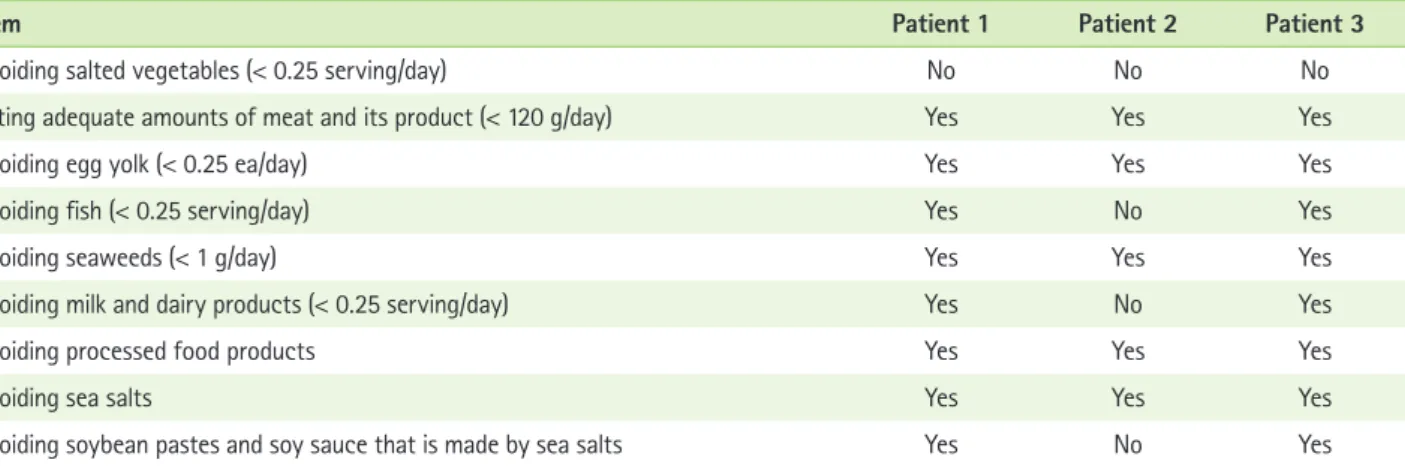
Table 2 presents the adherence of the LID guideline by each food item. All three patients followed five items out of nine food items in the LID guidelines that were using refined salts instead of sea salts and avoiding seaweeds, egg yolk, pro-
cessed food, and consumed adequate amount of meat and its product, which was less than 120 g/day. Patient 1 and Patient 3 also followed three more items that were avoiding fish, milk and dairy products consumption, soybean pastes and soy sauce made with sea salts. Patient 2, however, did not fol- low three items and consumed fish, milk and dairy products, condiments including sea salts. The food item in the guideline that all three patients did not follow was avoiding salted veg- etables, mainly kimchi during the LID. Patient 2 showed the lowest adherence to the LID and the mean iodine intake level during the LID periods was not much different from Patient 2’s usual intake level.
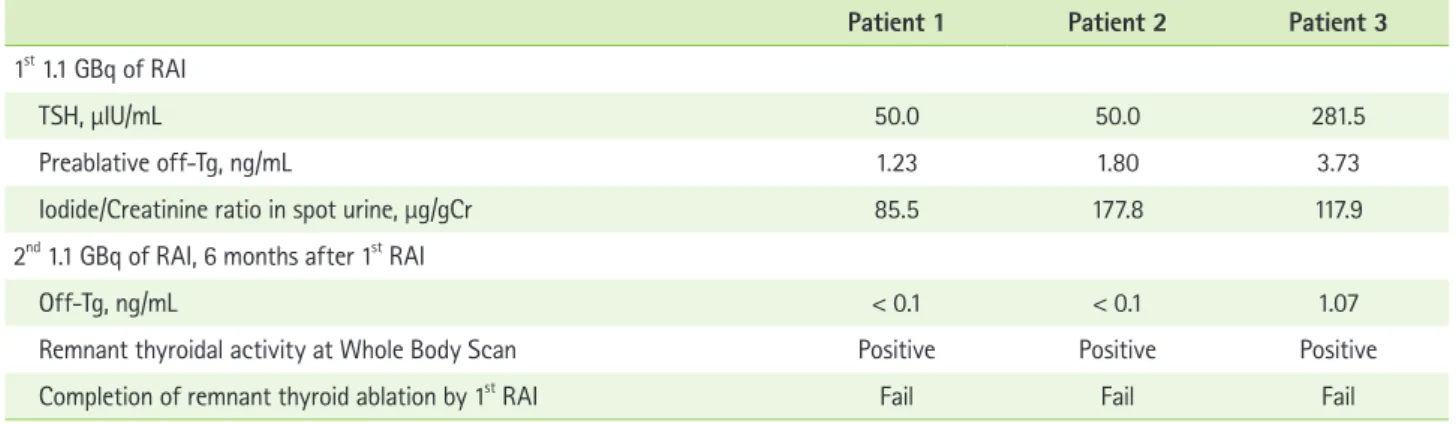
Table 3 presents the clinical outcomes of thyroid remnant ablation therapy. Remnant ablation was unsuccessful in all three patients. Though serum off-Tg levels became undetect- able (< 1.0 ng/mL) for Patients 1 and 2, Patient 3’s off-Tg level was 1.07 ng/mL and all three patients showed visible RAI up- take.
Table 2. Adherence to the low-iodine diet guidelines
Item Patient 1 Patient 2 Patient 3
Avoiding salted vegetables (< 0.25 serving/day) No No No
Eating adequate amounts of meat and its product (< 120 g/day) Yes Yes Yes
Avoiding egg yolk (< 0.25 ea/day) Yes Yes Yes
Avoiding fish (< 0.25 serving/day) Yes No Yes
Avoiding seaweeds (< 1 g/day) Yes Yes Yes
Avoiding milk and dairy products (< 0.25 serving/day) Yes No Yes
Avoiding processed food products Yes Yes Yes
Avoiding sea salts Yes Yes Yes
Avoiding soybean pastes and soy sauce that is made by sea salts Yes No Yes
Figure 1. The iodine intake during usual and the low-iodine diet (LID) periods.
317.2
117.0 125.2 110.9
217.7 100.4 350
300 250 200 150 100 50
0 Patient 1 (µg/day)
Patient 2 Patient 3 Usual LID
Discussion
We evaluated dietary iodine during LID and successful abla- tion of the RAI therapy for three differentiated thyroid cancer patients. All three patients showed low adherence to the LID guideline, in particular for salted vegetable and exhibited rem- nant thyroid activity in the second post-RAI therapy scan.
Dietary assessment of iodine intake is challenging because the large day-to-day variation makes it difficult to quantify the “usual” iodine intake. However, the dietary iodine intakes are comparable with the previous findings where dietary iodine intake was reported 478 μg/day for Korean healthy adults using food frequency questionnaire [17] and 312 µg/day in men and 413 µg/day in women for Japanese using 7-day dietary records [18]. In besides, we measured urinary iodide excretion in both usual diet and the LID periods along with dietary iodine and both two values showed the same trend of being markedly reduced.
Although our patients were intensively educated on main- taining the LID, all of their dietary iodine intake levels exceeded the less than 100 µg guideline set by the KTA. Patient 2 did not follow the LID guidelines such as avoiding dairy, fish and kimchi. Patients 1 and 3 followed KTA guidelines except for the restriction on kimchi.
Maintaining the LID is challenging for Korean patients, whose regular diet consists of foods with very high iodine content, such as seaweeds, seafoods, soy sauce, soy bean pastes, and salted vegetables such as kimchi. According to Moon et al. [11], thyroid cancer patients had considerable knowledge of high iodine content foods but they had a dif- ficulty to prepare low iodine dishes not using sea salts.
Though seaweed has the highest iodine content and is by
far the biggest contributor to dietary iodine consumption, the patients’ main source of iodine was kimchi during the LID peri- od. Kimchi is a main side dish in our Korean diet and is usually made of large amounts of sea salts, garlic, red pepper, salted fish and other spices.
According to analytical values determined by the Korean Food and Drug Administration (KFDA), the iodine content per 100 g of radish kimchi, napa cabbage kimchi, and young radish kimchi are 198.4, 143.4, and 107.4 µg [19] respectively.
Therefore, avoiding foods with a high sea salts content, such as kimchi, is very important for successful RAI therapy.
Although clinical dietitian put enough emphasis on avoid- ing sea salts or replacing sea salts with refined salts, it is very challenging for patients to distinguish the dishes made by re- fined salts from all dishes or to prepare their own dishes with refined salts in daily life. To increase the adherence of the LID, more practical dietary strategy for avoiding sea salts or for replacing sea salts in our Korean dishes should be considered.
In conclusion, low adherence to the LID guideline with more than 100 µg/d of dietary iodine intake level negatively influ- enced the efficacy of RAI therapy. Future studies are required to explore the influence of various dietary iodine intake levels on the efficacy of RAI therapy and to develop more practical guidelines to facilitate the LID maintenance.
Acknowledgment
This study was supported by the 2015 Research Fund of The Catholic University of Korea.
Table 3. Clinical outcomes of thyroid ablation
Patient 1 Patient 2 Patient 3
1st 1.1 GBq of RAI
TSH, μIU/mL 50.0 50.0 281.5
Preablative off-Tg, ng/mL 1.23 1.80 3.73
Iodide/Creatinine ratio in spot urine, µg/gCr 85.5 177.8 117.9
2nd 1.1 GBq of RAI, 6 months after 1st RAI
Off-Tg, ng/mL < 0.1 < 0.1 1.07
Remnant thyroidal activity at Whole Body Scan Positive Positive Positive
Completion of remnant thyroid ablation by 1st RAI Fail Fail Fail
Off-Tg: stimulated TSH thyroglobulin, RAI: radioactive iodine, TSH: thyroid stimulating hormone.
Conflict of Interest
We declare that we have no conflict of interest.
ORCID
Dal Lae Ju http://orcid.org/0000-0002-3251-0932 Young Joo Park http://orcid.org/0000-0002-3671-6364 Hee-Young Paik http://orcid.org/0000-0002-4026-0881 YoonJu Song http://orcid.org/0000-0002-4764-5864
References
1. Jung KW, Won YJ, Kong HJ, Oh CM, Cho H, Lee DH, Lee KH. Cancer sta- tistics in Korea: incidence, mortality, survival, and prevalence in 2012.
Cancer Res Treat 2015;47:127-41.
2. American Thyroid Association (ATA) Guidelines Taskforce on Thyroid Nodules and Differentiated Thyroid Cancer, Cooper DS, Doherty GM, Haugen BR, Kloos RT, Lee SL, Mandel SJ, Mazzaferri EL, McIver B, Pacini F, Schlumberger M, Sherman SI, Steward DL, Tuttle RM. Revised American Thyroid Association management guidelines for patients with thyroid nodules and differentiated thyroid cancer. Thyroid 2009;19:1167-214.
3. Kim TY, Kim WG, Kim WB, Shong YK. Current status and future per- spectives in differentiated thyroid cancer. Endocrinol Metab (Seoul) 2014;29:217-25.
4. Lee SL. Radioactive iodine therapy. Curr Opin Endocrinol Diabetes Obes 2012;19:420-8.
5. Sawka AM, Ibrahim-Zada I, Galacgac P, Tsang RW, Brierley JD, Ezzat S, Goldstein DP. Dietary iodine restriction in preparation for radioactive iodine treatment or scanning in well-differentiated thyroid cancer: a systematic review. Thyroid 2010;20:1129-38.
6. Kim WB, Seok JW, Kim MH, Kim BI, Park YJ, Lee KE, Lee SM, Lee YS, Jung KH, Jo YS, Cheon GJ, Chung JH, Kang SJ. Korean Thyroid Associa- tion guidelines for patients undergoing radioiodine therapy for dif- ferentiated thyroid cancers (First Edition, 2012). J Korean Thyroid Assoc 2013;6:12-25.
7. Chung JH. Low iodine diet for preparation for radioactive iodine therapy in differentiated thyroid carcinoma in Korea. Endocrinol Metab (Seoul) 2013;28:157-63.
8. Yoo ID, Kim SH, Seo YY, Oh JK, O JH, Chung SK. The success rate of
initial 131i ablation in differentiated thyroid cancer: comparison between less strict and very strict low iodine diets. Nucl Med Mol Imaging 2012;46:34-40.
9. Lim CY, Kim JY, Yoon MJ, Chang HS, Park CS, Chung WY. Effect of a low iodine diet vs. restricted iodine diet on postsurgical preparation for radioiodine ablation therapy in thyroid carcinoma patients. Yonsei Med J 2015;56:1021-7.
10. Lee M, Lee YK, Jeon TJ, Chang HS, Kim BW, Lee YS, Park CS, Ryu YH.
Low iodine diet for one week is sufficient for adequate preparation of high dose radioactive iodine ablation therapy of differentiated thyroid cancer patients in iodine-rich areas. Thyroid 2014;24:1289-96.
11. Moon JA, Yoo CH, Kim MH, Lee SM, Oh YJ, Ryu YH, Lee YS, Chang HS, Park CS, Lee KE. Knowledge, self-efficacy, and perceived barriers on the low-iodine diet among thyroid cancer patients preparing for radioac- tive iodine therapy. Clin Nutr Res 2012;1:13-22.
12. Rohner F, Zimmermann M, Jooste P, Pandav C, Caldwell K, Raghavan R, Raiten DJ. Biomarkers of nutrition for development--iodine review. J Nutr 2014;144:1322S-1342S.
13. Edge SB; American Joint Committee on Cancer. AJCC cancer staging handbook: from the AJCC cancer staging manual. 7th ed. New York (NY):
Springer; 2010.
14. Jung HJ, Lee SE, Kim D, Noh H, Song S, Kang M, Song Y, Paik HY. Devel- opment and feasibility of a web-based program ‘Diet Evaluation Sys- tetm (DES)’ in urban and community nutrition survey in Korea. Korean J Health Promot 2013;13:107-15.
15. Han MR, Ju DL, Park YJ, Paik HY, Song Y. An iodine database for com- mon Korean foods and the association between iodine intake and thy- roid disease in Korean adult. Int J Thyroidol. Forthcoming 2015.
16. Kim HK, Lee SY, Lee JI, Jang HW, Kim SK, Chung HS, Tan AH, Hur KY, Kim JH, Chung JH, Kim SW. Usefulness of iodine/creatinine ratio from spot-urine samples to evaluate the effectiveness of low-iodine diet preparation for radioiodine therapy. Clin Endocrinol (Oxf) 2010;73:114- 8.
17. Kim JY, Moon SJ, Kim KR, Sohn CY, Oh JJ. Dietary iodine intake and urinary iodine excretion in normal Korean adults. Yonsei Med J 1998;39:355-62.
18. Imaeda N, Kuriki K, Fujiwara N, Goto C, Tokudome Y, Tokudome S. Usual dietary intakes of selected trace elements (Zn, Cu, Mn, I, Se, Cr, and Mo) and biotin revealed by a survey of four-season 7-consecutive day weighed dietary records in middle-aged Japanese dietitians. J Nutr Sci Vitaminol (Tokyo) 2013;59:281-8.
19. Kang TS, Lee JH, Leem D, Seo IW, Lee YJ, Yoon TH, Lee JH, Lee YJ, Kim YJ, Kim SG. Monitoring of iodine in foods for estimation of dietary intake.
Cheongwon: National Institute of Food and Drug Safety Evaluation;
2012.